

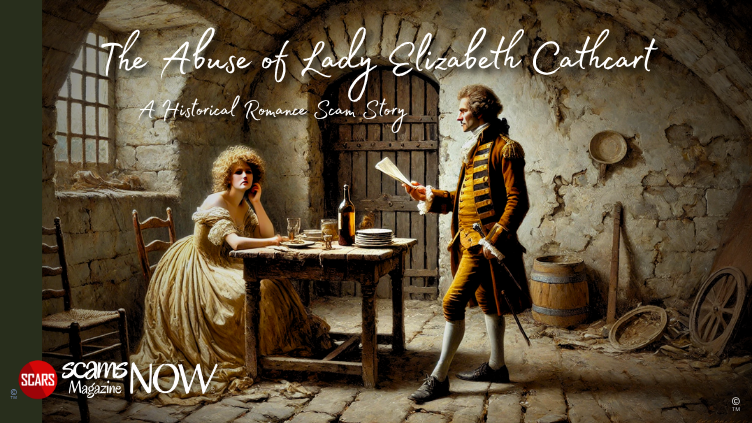
The Abuse of Lady Elizabeth Cathcart
A Historical True Romance Scam Story by Tim McGuinness, Ph.D.
A True Story
More Stories »
Image & Text Copyright © 2026 – All Rights Reserved Worldwide
The Abuse of Lady Elizabeth Cathcart
A Historical True Romance Scam Story by Tim McGuinness, Ph.D.
In 1745, Lady Elizabeth Cathcart stood at the threshold of her fourth marriage, a woman of 56 whose life had been shaped by wealth, loss, and ambition. Born Elizabeth Malyn in 1691, the daughter of a London brewer, she had navigated the world with a beauty that captivated admirers and a resolve that secured her fortune. Her first marriage to James Fleet, son of a Lord Mayor, was a nod to parental duty, ending with his death in 1733 and leaving her Tewin Water, a grand Hertfordshire estate. Her second, to Colonel William Sabine, brought wealth until his passing in 1738. The third, to Lord Charles Cathcart, a military commander, granted her a title but ended swiftly with his death at sea in 1741.
Each union had served a purpose—duty, security, status—but this fourth was different. Then, in the city of Bath, she met Colonel Hugh Maguire, a 35-year-old Irish officer whose charm promised love. On May 18, 1745, she wed him, her heart alight with hope. To mark the occasion, she wore a ring engraved with a defiant jest: “If I survive, I will have five.” But love, like a candle in a storm, flickered and betrayed her, casting her into a darkness that would test her for over two decades.
The honeymoon glow faded swiftly at Tewin Water. Hugh, a descendant of the Maguires of Tempo, County Fermanagh, revealed a hunger not for Elizabeth but for her fortune. He seized her accessible funds, then demanded her jewels and the deeds to her estate. Elizabeth, seasoned by life’s trials, refused. She hid her valuables—diamonds woven into her wig, gems quilted into her petticoats—and concealed the deeds behind a secret panel in her favorite room. Hugh’s charm turned to menace. One September morning, under the pretense of a carriage ride, he announced they were bound for Holyhead, not home. A lookalike, some whispered, rode in her place to quell suspicion. Elizabeth, betrayed, was spirited across the Irish Sea, her world shrinking to the confines of an attic prison.
Her captivity began at Tempo House, or possibly Carra near the Fermanagh-Monaghan border, before she was moved to Castle Nugent in County Longford. The attic was sparse—a single window, a prayer book, an old newspaper, and bare walls. Denied pen or paper, Elizabeth pricked her thoughts into the wallpaper with a pin, memorizing conversations to preserve her sanity. Hugh, her jailer, brought meals with a pistol at her side, repeating his demand: “Reveal the deeds and jewels, and you’ll be free.” She held firm, her will a fortress against his threats. Early in her ordeal, she entrusted her jewels to a local woman, Mrs. Johnson, dropping them from her window with a whispered plea for safekeeping. The world beyond her prison moved on. In England, Tewin Water was let by Hugh’s agent, and her absence was dismissed as a widow’s retreat abroad.
Years stretched into decades, each day a battle to endure. Elizabeth, once vibrant, grew frail, her red wig a stark contrast to her worn frame. Hugh’s tactics grew desperate. He bribed highwaymen to rob messengers, staged cruel hoaxes, and even fought a duel in a plowed field, mocking an opponent’s wooden leg. Yet Elizabeth’s silence held. She recorded her defiance in pinpricks, her mind sharp despite her body’s decline. In 1766, at 75, she relented, revealing the deeds’ hiding place at Tewin Water, perhaps sensing her time was short. Hugh, fevered with greed, raced to Hertfordshire. In a locked compartment, he found the deeds but fumbled with a rusty lock. His knife slipped, gashing his hand. Blood poisoning set in, and lockjaw claimed him by April, his ambition undone by a moment’s carelessness.
News of Hugh’s death reached Elizabeth, but she hesitated, fearing another ruse. Her attorney, dispatched to Ireland, found her in a state that shocked observers. As Maria Edgeworth, who chronicled her tale in Castle Rackrent, recorded, she had “scarcely clothes sufficient to cover her; she wore a red wig, looked scared, and her understanding seemed stupefied.” At 75, after 21 years of captivity, she was free, but the world beyond the attic was alien. She barely recognized human faces, her senses dulled by isolation. Yet, like a tree battered by storms, her roots held firm. With her attorney’s aid, she returned to Tewin Water, her spirit stirring beneath the weight of trauma.
Elizabeth’s recovery was a testament to her unyielding will. She sought out Mrs. Johnson, the woman who had safeguarded her jewels and rewarded her generously, a gesture of gratitude that echoed her restored humanity. Tewin Water, once a stage for betrayal, became her sanctuary. Legal battles followed as she reclaimed her estate from Hugh’s agent, who had sold her possessions and rented her home. Her resilience shone through, not in vengeance but in renewal. At 80, she danced a minuet, her steps defying the years of confinement. The ring’s inscription—“If I survive, I will have five”—remained unfulfilled; she never took a fifth husband, choosing instead to live for herself. Her charity and good works marked her final years, a quiet rebuke to the greed that had sought to break her.
On August 3, 1789, Elizabeth died at 98, her life a saga of love, betrayal, and triumph. At her request, she was buried beside James Fleet, her first husband, in Tewin’s churchyard, a nod to the innocence of her youth. Her obituary in the Gentleman’s Magazine chronicled her ordeal, preserving her story for posterity. Elizabeth Cathcart, once a prisoner in an attic, emerged as a symbol of endurance, her spirit dancing long after the chains fell away. Her tale, woven into Edgeworth’s fiction and whispered in Hertfordshire’s halls, reminds us that even in the darkest confinement, the will to survive can light the way to freedom.
A true story.
Thanks to Dr. Jordan B. Peterson for the suggestion.
Why Tell Stories?
We tell stories because that is what humans do. We are storytellers. And our stories matter.
These stories about survivors do work that clinical writing cannot. A survivor in the early months reads an article about trauma and meets their own shame on every page; but when they read a story about someone else, in some other world, and sees themself at a distance, they can process without triggering (or at least less). Allegory slips past the defenses that shame builds. That is its value: the reader absorbs the truth before recognizing it as their own, and no part of them has to admit anything to take it in.
Each of our stories carries some load-bearing truth of healing or recovery inside its fiction: that identity is rebuilt in community, that healing cannot be borrowed or hurried but only grown at each person’s own pace, that the mind strengthens whatever is rehearsed, whether shame or rage or life itself, and that beginning badly is still beginning. These are the same truths the clinical literature teaches, delivered where a wounded reader can actually receive them.
However, not all stories will carry hope. Some, by necessity, have to tell cautionary tales for what can or has gone very wrong. The truth is not all survivor stories are about survival, and every survivor needs to understand that. Some tales end very badly. But knowing that helps each survivor avoid those outcomes.
Survivors read them because the stories never blame, never lecture, and never look away, and because each one ends with a door either open or closed, but a lesson learned. They matter because somewhere a reader who cannot yet say what happened to her or him will recognize the shape of it, know they are not alone, and begin and continue.
So goes the theory.
This is the way.
Tim McGuinness, Ph.D.
September 2026