




Scam Victim Recovery Insights
From the SCARS Institute
Honesty and Intentionality – A Few Thoughts
A SCARS Institute Scam Victimization Insight
After returning from Europe with a particularly nasty variant of COVID-19, I was thinking about how scammers engage their victims, especially about the application of urgency in scams, so I wrote an article about Urgency and Pressure in Scam Victimization.
But two words seemed to jump off my page while I was writing that: Honesty and Intentionality. Two seemingly unrelated concepts. But as is often the case in the complex world of scams and victimization, two disparate concepts can triangulate with surprising correlation, revealing something new about the dark geometry of deceit.
At first glance, the connection seems tenuous, almost paradoxical. Honesty is a virtue, a moral anchor, a commitment to objective truth and sincerity. Intentionality is a psychological state, the invisible “why” that propels human action, the conscious purpose, the motive, the will behind a deed. Scams, by their very definition, are built on a foundation of lies. So where does honesty fit in? The answer is both simple and profound: scammers do not use honesty; they weaponize its perception. They don’t practice it; they perform it. They create a sophisticated, high-stakes counterfeit of honesty to mask their malicious intentionality, and it is in this substitution that the entire tragic drama unfolds.
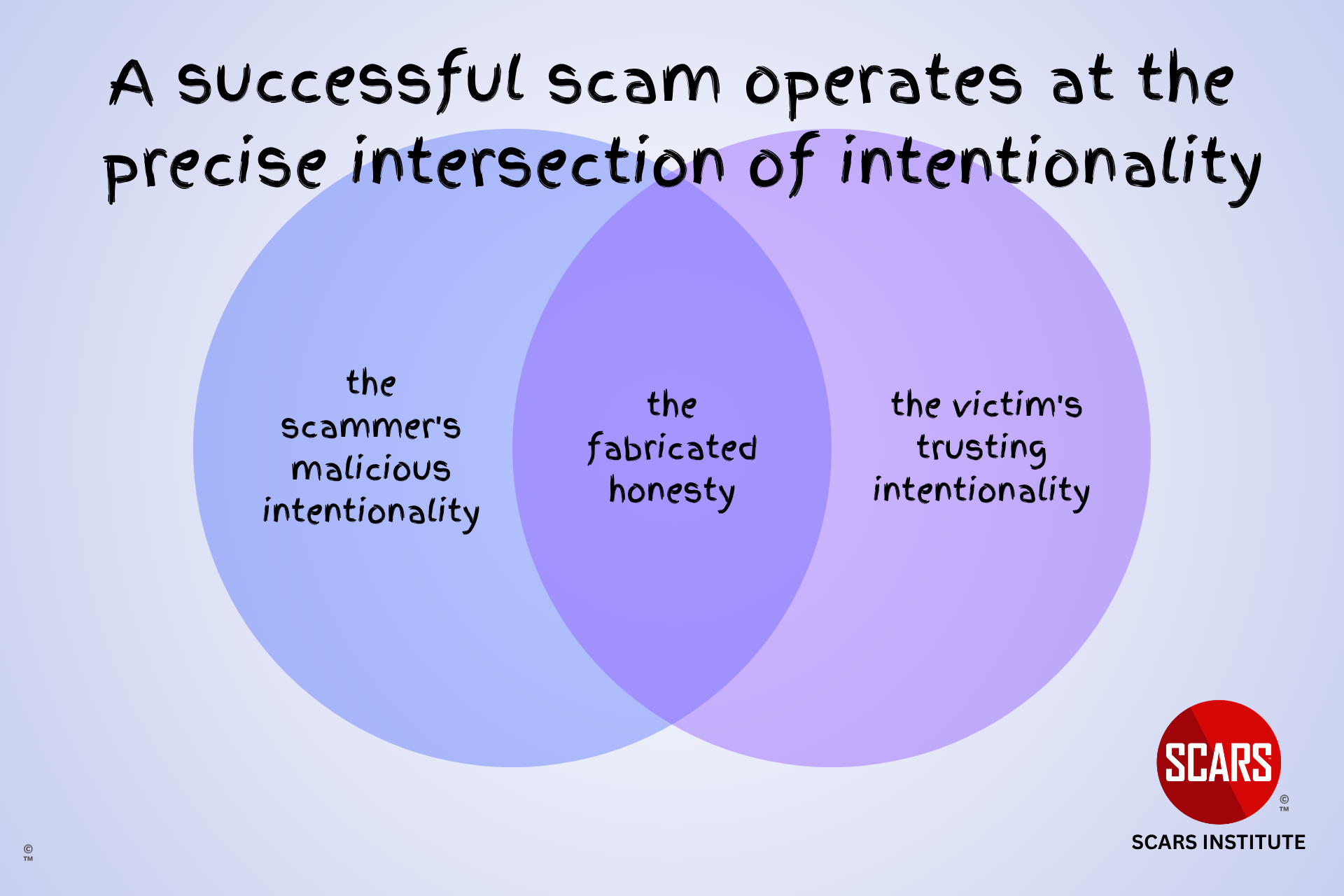
This is where the triangulation becomes starkly clear. A successful scam operates at the precise intersection of three points: the scammer’s malicious intentionality, the victim’s trusting intentionality, and the fabricated honesty that serves as the deceptive bridge between them. The entire enterprise is a study in the manipulation of these forces.
The Scammer’s Malicious Intentionality: The Prime Mover
This is the true north of every scam, the unseen engine driving the entire process. It is the single-minded, purposeful, and unwavering drive to deceive, manipulate, and ultimately defraud. This is not a casual or incidental dishonesty; it is a campaign. Every element of the scam is engineered with the precision of a military operation. The choice of words, the construction of the narrative, and the timing of the contact are all filtered through the lens of this core intentionality.
The application of urgency is perhaps the most potent tool in the scammer’s arsenal and a direct expression of their malicious intent. Phrases like “you must act in the next hour,” “this offer expires at midnight,” or “your account will be seized if you don’t act now” are not arbitrary. They are psychological triggers, carefully designed to achieve a specific outcome: the suspension of the victim’s critical thinking. Urgency creates a cognitive tunnel vision. It floods the brain with adrenaline and cortisol, hormones associated with the fight-or-flight response, which effectively sidelines the prefrontal cortex, the seat of logic, reason, and long-term planning. In this state, the victim is neurologically disinclined to ask questions, seek outside advice, or perform due diligence. The scammer’s intentionality is to force the victim out of a state of reflection and into a state of reaction.
This intentionality is also evident in the meticulous research scammers perform. They harvest data from social media to understand a victim’s hopes, fears, and life circumstances. They know who is lonely, who is worried about retirement, and who has a grandchild they would do anything for. This isn’t random; it’s targeted. The scammer’s intention is to find the perfect psychological key to unlock the victim’s defenses, and they will invest significant time and energy to find it. Their goal is not just to lie, but to tell a lie so perfectly tailored to the victim that it feels more real than reality itself.
The Fabricated Honesty: The Counterfeit Reality
To achieve their goal, scammers must build a convincing stage play of honesty. This is their art, their craft. They don’t just tell a simple lie; they construct an entire immersive reality that feels authentic, legitimate, and trustworthy. This fabricated honesty is the bait, the lure, the surface upon which the victim is invited to place their trust.
The methods for creating this counterfeit are manifold and increasingly sophisticated. They use official-sounding jargon and legalistic language borrowed from legitimate domains like banking, law enforcement, or tech support. They forge documents that look indistinguishable from the real thing, bank statements, court orders, and investment prospectuses. They create professional-looking websites and social media profiles, complete with fake testimonials and doctored photos. They adopt personas that are carefully calibrated to inspire trust: a caring government agent, a savvy investment advisor, a desperate romantic partner, a celebrity, or a beloved grandchild in trouble.
This performance of honesty is designed to resonate with the victim’s own understanding of how the world works. It triggers our innate trust in institutions, in authority figures, and in the fundamental goodwill of others. The urgency is a critical prop in this play, serving to enhance the authenticity of the “honest” narrative. A real emergency, after all, is urgent. A legitimate limited-time investment opportunity would have a deadline. By embedding urgency into the script, the scammer makes the fabricated honesty feel more dynamic, more real, and more compelling. The lie isn’t just a static falsehood; it’s a living, breathing, time-sensitive scenario that demands to be engaged with.
The Victim’s Trusting Intentionality: The Unwitting Co-Star
This is the third point of the triangle, and the one that is most profoundly and tragically misunderstood by society at large. The victim enters the scenario not with naiveté, but with their own positive and rational intentionality. They are not intending to be scammed; they are intending to act decisively and wisely based on the information they have been given.
Their actions are driven by the very best human impulses: trust, hope, compassion, prudence, and love. The person who wires money to a “grandson” in jail is acting with the intention of providing care and protection. The retiree who transfers their life savings to a “high-yield investment” is acting with the intention of securing their future and ensuring their comfort. The lonely individual who sends money to an online love interest is acting with the intention of building a genuine connection and finding happiness. Their intentionality is a mirror image of what they have been led to believe the scammer’s to be. They believe they are collaborating with an honest person to achieve a shared, positive goal.
This is a crucial distinction: the victim is not failing to be honest themselves; they are failing to detect the other’s dishonesty. They are applying their own honest intentions to a situation they perceive as equally honest. In this dynamic, the victim’s intelligence is not the primary factor at play. Their emotional state, their inherent trust, and their desire to believe are far more influential. Scammers are not looking for stupid people; they are looking for trusting people. They are hunting for individuals whose intentionality is aligned with virtues like compassion and optimism, as these are the very qualities that can be most easily exploited and manipulated.
The Correlation and the Collapse: When the Triangle Implodes
The devastating correlation occurs at the moment of transaction, when the victim’s trusting intentionality collides with the scammer’s malicious intentionality, with the fabricated honesty acting as the catalyst. The urgency has done its work, ensuring the collision happens at high speed, without the victim having a chance to pump the brakes. The money is sent, the personal information is divulged, the password is shared. The trap is sprung.
The aftermath is the violent and painful uncoupling of these concepts. The “honesty” that formed the foundation of the victim’s reality evaporates overnight, revealing itself to have been a complete and utter fiction. The phone number is disconnected. The website vanishes. The loving partner disappears. The victim is left standing in the wreckage of a world that never existed.
But the deeper trauma comes from being forced to confront the horrifying truth of the scammer’s real intentionality. The person they believed was a partner, an advisor, or a helper was, in fact, a predator. Every conversation, every expression of concern, every shared hope was a calculated move in a game designed to hurt them. This revelation is a profound violation, a psychic wound that goes far deeper than the financial loss.
Most painfully, however, the victim is left to grapple with their own trusting intentionality. In the cold light of hindsight, their good intentions are recast as gullibility. Their trust feels like a fatal flaw. Their compassion feels like foolishness. This is the source of the intense shame and self-blame that plagues almost all scam victims. They replay the events over and over, not understanding how their own fundamentally decent motivations could have led to such a devastating outcome. The very qualities that make us human, trust, compassion, the willingness to believe in another’s honesty, were the ones that were ruthlessly exploited and turned against them.
Understanding this triangulation is not just an academic exercise; it is a crucial reframing of the entire narrative of victimization. It shifts the focus from the judgmental question of “how could the victim be so stupid?” to the more compassionate and accurate inquiry of “how was the victim’s fundamental humanity so expertly exploited?” It reveals the scam for what it truly is: a premeditated act of psychological violence. In this dark geometry, a counterfeit of honesty is used to bridge the gap between a predator’s malicious intent and a victim’s trusting heart, with the relentless ticking clock of urgency serving as the tempo for a tragedy that was, from the very beginning, intentionally composed.
Prof. Tim McGuinness, Ph.D.
March 2026
2 Comments
Leave A Comment
This is but one component, one piece of the puzzle …
Understanding how the human mind is manipulated and controlled involves recognizing that the tactics employed by deceivers are multifaceted and complex. This information is just one aspect of a broader spectrum of vulnerabilities, tendencies, and techniques that permit us to be influenced and deceived. To grasp the full extent of how our minds can be influenced, it is essential to examine all the various processes and functions of our brains and minds, methods and strategies used the criminals, and our psychological tendencies (such as cognitive biases) that enable deception. Each part contributes to a larger puzzle, revealing how our perceptions and decisions can be subtly swayed. By appreciating the diverse ways in which manipulation occurs, we gain a more comprehensive understanding of the challenges we face in avoiding deception in its many forms.
“Thufir Hawat: Now, remember, the first step in avoiding a *trap* – is knowing of its existence.” — DUNE
“If you can fully understand your own mind, you can avoid any deception!” — Tim McGuinness, Ph.D.
“The essence of bravery is being without self-deception.” — Pema Chödrön



Great article …
About the implosion: When I finally came around it was as if I was popping out of a trance and was being released.
very true exactly the way I felt in nov and December you explained it were you ever a victim Dr Tim of a scam