



Scam Victim Recovery Insights
From the SCARS Institute
Living with Hopelessness
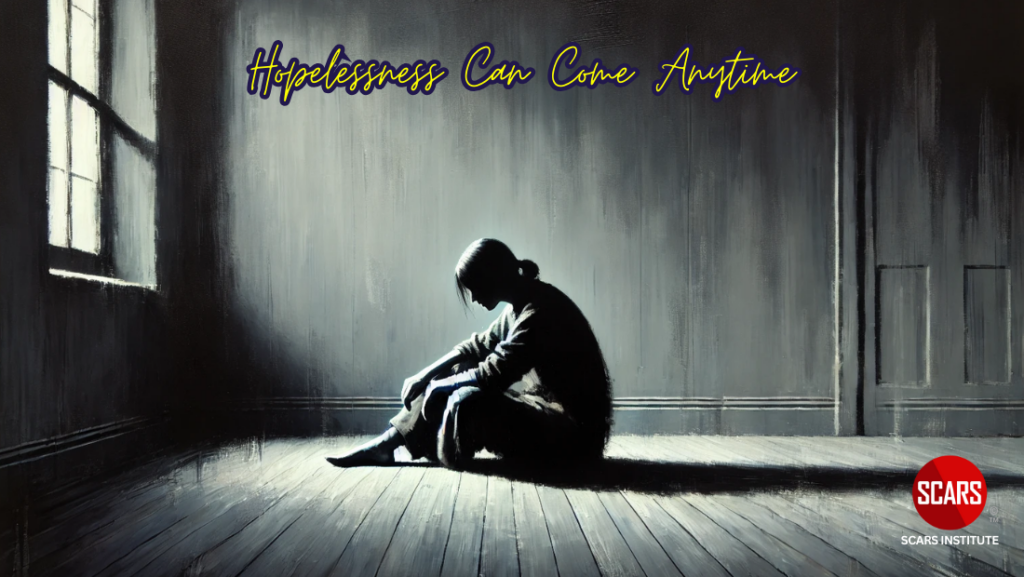
To truly live without hope is to inhabit a world drained of its color, where every day is a shade of the same monotonous gray. It is not the acute despair of a sudden tragedy, which carries its own violent energy, but a quiet, pervasive stillness that settles into the marrow of your bones. Hope is the engine of human endeavor, the belief that tomorrow can be different, that effort can yield results, that the future holds a possibility for joy or relief.
To live without it is to be a car with a dead battery, forever parked in a landscape of endless, unchanging roads. The future does not beckon with promise or even dread; it simply does not exist. There is only the oppressive, suffocating weight of the perpetual now.
In this state, the very mechanics of life become a burden. Waking up is not a beginning but a continuation of a sentence you never agreed to. The motivations that drive others, ambition, love, curiosity, even simple hunger, feel like distant echoes from a life you once observed but no longer live. Why strive for a promotion if the ladder leads nowhere? Why connect with another soul if the bond is just a prelude to inevitable separation or pain? Why create, build, or explore if the universe is indifferent and your efforts are ultimately meaningless? These questions are not debated philosophically; they are felt as a crushing, self-evident truth. The world continues to move around you, people laugh, plan vacations, fall in love, but it is like watching a film in a language you do not understand. You see the motion and hear the sound, but the narrative, the emotional core, is completely lost on you.
For the scam victim, this hopelessness is uniquely profound. It is not just a general malaise but a specific poison that contaminates every aspect of their being. The trauma is a deep, personal violation that shatters trust in others and, more devastatingly, in one’s own judgment, purpose, and identity. The survivor is left adrift in a sea of shame, self-blame, and the agonizing replay of their own perceived naivety. The world does not feel like a den of predators with constant dangers; instead, their own mind feels like a faulty instrument that led them into the vast nothingness of the void. This specific betrayal makes the future seem not just bleak, but totally empty, and the idea of recovery feels like an impossible, cruel joke. They are not just a ship without a sail; they are a ship run aground with no chance of progress.
This profound hopelessness, however, is not an impenetrable fortress. Its transformation begins not with a sudden, blinding light, but with a single, deliberate act: the commitment to recovery. Hope does not just manifest; it is decided. This is the decision to stop drifting and to start moving, even if the shore is not yet in sight. It is the conscious choice to believe that the story does not end with the scam. This commitment offers the first flicker of hope, a tiny, defiant spark against an overwhelming darkness. It is a guide star that can permit charting a new course.
Regaining hope involves seeking therapy, setting boundaries, and doing the grueling internal work of facing the pain, naming it, and processing it. It is a slow, arduous process of repairing the shattered life, one moment at a time, often while still feeling how flimsy this new hope really is.
You must make a decision to rekindle hope. You must commit to a destination, even if you cannot see it yet. This is what we mean by starting the long walk along the ‘Yellow Brick Road’.
The most powerful catalyst for this transformation, this rediscovery of hope, is the joining of a real survivors’ community such as that provided by the SCARS Institute www.SCARScommunity.org/register.
In the beginning, the thought of engaging with others and sharing your story can be terrifying. But when you finally speak your truth and hear the words, “I understand, that happened to me too,” the isolation begins to crack. In a community, you are no longer a freak or a fool; you are one of many, you are ‘legion’ as the saying goes. You see others at different stages of their journey, some just starting out, others further down the path, and they provide living proof that healing and hope are possible.
This shared experience becomes a new kind of hope, one not based on blind optimism but on the tangible evidence of resilience being rebuilt. The community becomes the shore you were paddling toward, a safe harbor where your story is validated, your strength is recognized, and together, you learn that from the wreckage of the lie, you can build a new, more authentic life.
Prof. Tim McGuinness, Ph.D.
December 2025
This is but one component, one piece of the puzzle …
Understanding how the human mind is manipulated and controlled involves recognizing that the tactics employed by deceivers are multifaceted and complex. This information is just one aspect of a broader spectrum of vulnerabilities, tendencies, and techniques that permit us to be influenced and deceived. To grasp the full extent of how our minds can be influenced, it is essential to examine all the various processes and functions of our brains and minds, methods and strategies used the criminals, and our psychological tendencies (such as cognitive biases) that enable deception. Each part contributes to a larger puzzle, revealing how our perceptions and decisions can be subtly swayed. By appreciating the diverse ways in which manipulation occurs, we gain a more comprehensive understanding of the challenges we face in avoiding deception in its many forms.
“Thufir Hawat: Now, remember, the first step in avoiding a *trap* – is knowing of its existence.” — DUNE
“If you can fully understand your own mind, you can avoid any deception!” — Tim McGuinness, Ph.D.
“The essence of bravery is being without self-deception.” — Pema Chödrön