

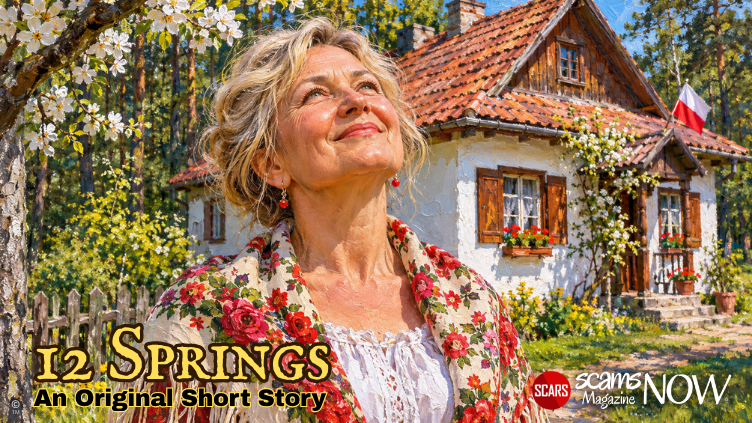
12 Springs
An Original Short Story by Tim McGuinness, Ph.D.
This is a Work of Fiction
More Stories »
Image & Text Copyright © 2026 – All Rights Reserved Worldwide
12 Springs
A Short Story by Professor Emeritus Tim McGuinness, Ph.D. DFin.
November 16, 2026, Anno Domini
Copyright © 2026
Dedicated to my friends, Janina Morcinek and Vianey Gonzalez
It begins …
Emilia Kowalczyk was forty-nine years old the spring she fell in love, and she would tell you, if you asked her then, that she had never been happier in her life.
She lived alone at the end of a gravel road, five kilometers outside a small village in the forests west of Gdańsk, in the house her great-great-grandparents had built almost a hundred years before. It was a plain house of brick and dark timber with a steep roof for the snow, a kitchen that faced east into the morning, and a porch where many generations of her family had sat in the evenings and listened to the pines. Emilia kept it the way her grandmother had kept it. The floors were swept every morning, the windows were washed every spring, and the linen smelled of lavender from the bags she sewed herself. When her husband Andrzej died six years before, her children had worried that the house would be too quiet for her. It was not. She loved the quiet. She loved that the nearest neighbor was a couple of kilometers away and that at night the only sounds were the wind and the owls.
But quiet is not the same as company, and in the long evenings of that winter she had begun to feel the difference.
His name was Mark. He wrote to her first on a site for people over forty, a short and courteous message about a photograph she had posted of the sea at Sopot. He said the light in it reminded him of the coast of Scotland, where he had grown up. He was an engineer on a drilling platform in the North Sea, a widower with one grown son, and he wrote English slowly and carefully, the way she did, so that their messages felt like letters from another time. Within a month they were writing every morning and every night. He asked about her children, about the house, about Andrzej. He remembered everything she told him. When she mentioned that her adult daughter Zofia had a cold, he asked three days later whether Zofia was feeling better.
No one had paid that kind of attention to her in years.
By April he was calling her “my Emilia,” and by May he was making plans. His contract on the platform would end in June. He would fly to Gdańsk, and they would walk on the beach at Sopot where her photograph had been taken, and then he would see the house in the forest he had heard so much about. She cleaned the guest room twice. She bought new curtains for it, pale blue, because he had said blue was his favorite color.
In June his contract was extended by the company, three more weeks, nothing he could do. In July a storm damaged the platform and no one could leave. In August his son was in an accident in Aberdeen, and Mark flew there instead, and the hospital needed payment before the surgery, and his own accounts were frozen because of a dispute with the oil company over his final wages. He was so ashamed to ask. He said he had never asked a woman for money in his life. He said he would repay every złoty the day he arrived, with interest, with a ring. Of course he meant Euros, but somehow she liked that he said that.
She sent the first payment in August. She sent the last one in January.
In between there were customs fees on the gold he was bringing out of a deposit box, a lawyer to release his wages, a tax on the inheritance from his late wife, and each time a new date for his arrival that slid away like the others. Each time she was disappointed, and each time he was more sorry than she was, and somehow it was she who ended up comforting him. When her son Tomasz asked who she was writing to all the time, she told him it was a friend. When Zofia asked why she did not come for coffee anymore, she said she was busy. Mark had told her that her children would not understand. He said they would think he was after her money, and that it was better to tell them everything once he arrived and they could see for themselves how happy he made her. So she pulled away from them a little, and then a little more.
By January she had sent him everything. Her savings, the money from Andrzej’s life insurance, the small account her mother had left her. One hundred and eighty-four thousand Euros.
Then, in the second week of February, his messages stopped.
She waited three days, then a week. She wrote to him every morning and every night, the way they always had. The messages went unread. On the tenth day, his profile was gone from the site, and his phone number no longer rang. On the twelfth day she went to the bank in the village to ask whether the last transfer had gone through, and the young woman at the counter, who had known her since she was a child, looked at the account and then at Emilia and asked her very gently to sit down.
The word the bank used was fraud. The word the police used was scam. There was no Mark. There was no platform, no son in Aberdeen, no gold, no ring. There were only bank accounts in three countries, opened and emptied, and a man or a group of men somewhere who had done this before and would do it again tomorrow to someone else.
She drove home and sat in her kitchen in her coat until it was dark.
* * *
The first two weeks after that were the worst weeks of her life, worse than the weeks after Andrzej died, because when Andrzej died she had been allowed to grieve. No one tells you how to grieve for a man who never existed.
Her children came. Zofia came first, the day after the bank, with a pot of żurek and her husband Piotr, and stood in the kitchen trying not to look at the guest room with its new blue curtains. Tomasz drove up from Gdańsk that weekend with his wife. Maria, her youngest, called every evening from Warsaw, where she was finishing her studies, and cried on the phone more than Emilia did. They were kind, all of them, but they did not understand, and Emilia could not bring herself to explain. They knew there had been a man on the internet and that the money was gone. They did not know about the morning messages, or the plans for Sopot, or the way he had asked after Zofia’s cold. They did not know that what she had lost was not only the money.
They asked whether she had reported it. She had. They asked whether the bank could get it back. It could not. They asked why she had not told them. She could not answer that one at all.
Tomasz was angry, though he tried not to show it, and his anger made her feel like a child. Zofia was frightened, and her fear made Emilia feel like a burden. Every visit ended with both of them watching her the way you watch someone standing too close to the edge of a platform, and every visit left her more exhausted than the one before. After the first week she began to tell them she was fine. After the second week she stopped answering the door.
She could not eat. She could not sleep more than an hour at a time. When she did sleep, she woke reaching for her phone to see whether he had written, and then she remembered. She read their messages over and over, hundreds of them, looking for the place where she should have known. Sometimes she found it. Sometimes she found nothing at all, and that was worse. The shame sat on her chest like a stone. She was forty-nine years old. She had raised three children and buried a husband and kept a hundred-year-old house standing through a dozen hard winters, and a man who did not exist had taken everything she had, and she had thanked him for it.
* * *
On the last night of February, she could not stay in the house any longer.
She put on Andrzej’s old coat and went out onto the porch. The cold was clean and sharp. The forest was black and still, and above the tops of the pines the sky was full of stars, more than anyone in the city ever sees. One of them was brighter than the others, low in the east over the trees. Her grandmother used to call it the traveler’s star and said that if you wished on it with your whole heart, it would carry the wish wherever it needed to go.
Emilia did not believe in wishes. She had not believed in them since she was a girl. But she was so tired.
She did not wish to die. She did not even wish for the money back, or for Mark to have been real. She only wished, with her whole heart, to be over it. Not to forget, but to be on the other side of it. To wake up one morning and find that the worst of this was behind her, that the stone was off her chest, that she could breathe again.
“Please,” she said to the star. “I just want to be over this.”
Then she went inside, climbed the stairs, lay down in her clothes on top of the bed, and slept.
* * *
She woke to sunlight.
For a long moment she lay still and did not know what was different. Then she understood that it was herself. Her chest did not hurt. The stone was not there. She could feel the scam, the way you can feel a scar with your fingertips. She could feel the loss of the money, the grief for the man who never was, the shame of having believed him. All of it was still there. But it did not crush her. It was something she carried now, not something that carried her.
She sat up and looked around the bedroom, and the first thing she noticed was the dust.
It lay over everything. A gray film covered the dresser and the mirror and the little table by the window. The windowsill was furred with it. There were cobwebs in the corners of the ceiling and a long strand of one drifting from the light fixture. She ran a finger along the headboard and it came away gray. She frowned. She had been in a bad way these last weeks, she knew that, but she had never in her life let the house get like this. Her grandmother would have been ashamed of her.
In the bathroom, she turned the tap and nothing came out. Not a drop. She tried the light switch and nothing happened. She stood in the dim room and thought, I forgot to pay the bills. Of course she had. She had forgotten everything these last weeks. She would go to the village and pay them today.
It was a bright, warm day outside the window, warmer than it had any right to be in February. She went to the wardrobe to change out of the clothes she had slept in, and the smell that came out when she opened the door made her step back. Her clothes smelled of damp and age, like the trunks in her house’s attic. She chose a sweater and a pair of trousers and shook them out and put them on anyway. Later, she thought, she would open every window in the house and air it all out.
The kitchen was worse. The cupboards were empty. Not low, as they would be after weeks of not shopping, but empty, wiped clean, as if someone had cleared them. There was no bread, no coffee, no tea, no sugar, no flour. The refrigerator stood open a few centimeters, dark and clean and empty except for a single bottle of water on the top shelf. The only other thing in the whole kitchen was a tin on the highest shelf, a round blue tin of gingerbread from Toruń, the kind Andrzej used to bring her at Christmas. The seal around the lid was still taped.
She took it down and opened it. The pierniki inside were whole, dark and glazed, and when she bit into one it was dry and a little hard, but the spice in it was warm and good, and she ate three of them standing at the counter. Then she drank the bottle of water. It was the best water she had ever tasted. She drank it all and felt it go into her like rain into dry ground.
She stood in her empty kitchen with the sun coming through the dusty east window and thought, Something is wrong here. But she did not feel afraid. For the first time in weeks, she did not feel afraid of anything.
* * *
Outside, it was spring.
Not the thin, hesitant spring of early March, but full spring, the kind that comes in May. The birches along the edge of the clearing were in new leaf. The grass in front of the porch was long and green and full of dandelions, and the lilac by the gate, which Andrzej had planted the year Zofia was born, was heavy with purple blossoms. The air was soft and warm and smelled of pine and earth. Somewhere in the forest a cuckoo was calling.
She stood on the porch and breathed it in. Then she went to the side of the house for her car.
The car was not there.
The place where she always parked it was grown over with grass and young saplings, some of them as tall as her shoulder. Her bicycle, which she kept chained under the eaves, was gone too, and so was the chain. She walked all the way around the house twice, as if the car might have moved itself. Then she stood with her hands on her hips in the long grass and said out loud, to no one, “What the hell?”
No one answered. The cuckoo called again.
Well. It was five kilometers to the village, where Zofia lived. She had walked it many times when she was younger. She would walk it now.
She set off down the gravel road. The pines stood tall on either side, their tops moving and whispering in the breeze, and the light came down through them in long golden slants. The road was worse than she remembered, rutted and patched with grass down the middle, but the walking felt good. Her legs were strong. Her lungs were full. After the weeks of storm inside her head, the calm of the forest was like cool water.
As she walked, she began to worry, but even the worrying felt different. It was the ordinary worry of a person with problems to solve, not the drowning of the last weeks. She would have to tell her children everything now, the whole story, the morning messages and the blue curtains and all of it. She would have to see the bank about whether she still owed anything for the last transfer. She would have to go back to the police, and they would look at her the way they looked at her before, as a foolish middle-aged woman who sent her money to a stranger. She would have to live on her small pension and whatever work she could find. She did not know how she would do any of it. But she knew, somehow, that she would.
At the place where the gravel road met the paved road to the village, there was a sign: a blue sign with a white arrow and the name of the village. She stopped in front of it.
It was rusted. The blue was faded almost to gray, the white letters were chipped, and orange rust had bled down from the bolts in long streaks. The post leaned a little, and a bramble had grown up around its base.
But that sign was new. She remembered the morning the road crew put it up, the autumn before, three men in orange vests and a little truck with a yellow light. She had stopped her car to let them work, and one of them had waved. It had been bright blue then, and shining.
She stood and looked at it for a long time. Then she kept walking, a little faster.
At the edge of the village there was a house she had never seen before. It was a new house, or newish, two stories with a red tile roof and a trampoline in the yard, standing on what had been an empty field where the Wiśniewskis grazed their goats. Past it there was another new house, and another, a whole short street of them where there had been nothing. She told herself the village had been growing, that she had simply not noticed. But she had driven this road every week of her life.
The little shop at the crossroads, where she had bought her bread and her newspaper for twenty years, was still there, but it had a new sign in green and white with a name she did not recognize. In the window was a poster for a telephone she had never heard of. A young man came out with a bag of groceries and glanced at her without interest, the way you glance at someone you do not know.
The center of the village was the same and not the same. The church was the same, and the war memorial, and the bakery on the corner. But the pharmacy was now a café with tables on the sidewalk. Three of the old houses on the square had been painted, one yellow, one green, one a pale peach that her mother would have called a disgrace. And above the roofs to the north, where there had only ever been sky, stood a tall building of glass and gray panels, six or seven stories high, with balconies and satellite dishes. She had never seen it in her life.
She stopped in the middle of the square and pressed her hands to her face. Had she lost her mind? Was this what the last weeks had done to her? Was she walking through her own village and not knowing it?
She took her hands away. The sun was warm. The bakery smelled of bread. She was not afraid. She only needed to get to Zofia.
* * *
Zofia’s house stood on a narrow street behind the church, a tidy brick house that opened straight onto the sidewalk with no yard in front, only a step and a door. Emilia saw the brass plaque beside the door, KOWALCZYK-NOWAK in the letters Piotr had chosen when they married, and she felt her whole body loosen with relief. It was the same. It was here. She had not imagined her life.
But the curtains in the front window were different. Zofia had always had white lace curtains, the ones Emilia had given her when she moved in. These were a heavy green. Emilia frowned at them. When had Zofia changed her curtains, and why had she not said? They talked about everything. Before the scam, Emilia had come for coffee every two or three days, and they talked about curtains, and the price of butter, and whether Tomasz’s wife was expecting yet.
Before the scam. She felt the old shame stir. During the months with Mark she had stopped coming. He had said her children would not approve, and she had believed him, and she had pulled away. And after the scam she had been in such shock, so ashamed, that she had hidden in her house and stopped answering the door. Of course, Zofia had changed her curtains without telling her. Emilia had not been there to tell.
But she was here now. And she felt better. She knocked.
For a long time nothing happened. She knocked again, and then a third time. At last, she heard slow footsteps inside, and the click of a lock, and the door opened a few centimeters, no more, the way a door opens for someone who is afraid of what is outside.
A woman looked out through the gap. For a moment Emilia did not know her. Then the woman’s eyes went wide, and she made a sound like something tearing, and the door slammed shut.
“Zofia!” Emilia put both hands flat on the door. “Zosia, it’s Mama. Open the door. Please.”
Silence. Then, very slowly, the lock clicked again, and the door opened all the way.
Her daughter stood in the doorway. Zofia was twenty-six years old. This woman was older, close to forty, and she looked older than that. She was thin, much too thin, and her hair, which had always been thick and dark like Andrzej’s, was dull and streaked with gray and pulled back carelessly. There were deep lines around her mouth and dark hollows under her eyes. She looked like someone who had been very ill for a very long time, like someone who had lived in a hospital and only just come home.
They looked at each other.
“Mama,” Zofia whispered.
Then her eyes rolled up and her knees went, and she crumpled to the floor of the entryway.
Emilia caught her before her head struck the tile. She knelt there with her daughter in her arms, calling her name, and then she got her own arms under Zofia’s shoulders and half carried, half dragged her into the sitting room, onto the old brown sofa that had been in this room for fifteen years. Zofia’s eyes opened. She looked up at her mother’s face above her, and her lips moved, and she fainted again.
Emilia put a cushion under her head and a blanket over her legs. Then, because she did not know what else to do, and because it was what her own mother had always done, she went into the kitchen to make tea.
The kitchen was nearly the same. The same yellow tiles, the same table, the same window over the sink with the same pot of basil, or one like it. But the kettle was new, a shiny electric kettle instead of the old enamel one that whistled. She filled it and found the button and stood watching it heat and noticed other things as she waited. A calendar on the wall with a year printed at the top that made no sense to her. A row of pill bottles on the windowsill with Zofia’s name on them. A photograph on the refrigerator of Tomasz standing beside a boy of nine or ten who looked exactly like Tomasz had at that age.
She made two cups of tea with lemon and too much sugar, the way Zofia liked it and carried them back to the sitting room.
Zofia was sitting up. She had the blanket around her shoulders, and she was staring at the doorway, and when Emilia came through it with the tea she pressed herself back against the sofa as if she wanted to disappear into it.
“Are you a ghost?” she asked.
“Of course not.” Emilia set the cups on the table and sat down on the edge of the armchair facing her. “Zosia, what’s the matter with you? Look at me. It’s only me.”
“You’ve been gone so long.”
“Gone?” Emilia shook her head. “I know I haven’t come. I know I stopped answering the door. These last weeks have been so terrible, Zofia, I can’t tell you. I couldn’t face anyone. Last night was the worst of all. I went to bed in such despair, I thought I couldn’t go on another day like that. But this morning I woke up and everything was different. I felt better. I felt like I could breathe again. And I wanted to see you. I’m sorry I stayed away.”
Zofia stared at her.
“Mama,” she said. “You disappeared twelve years ago.”
* * *
Emilia did not understand her. She heard the words, but they did not mean anything. She said, “What?” and Zofia said it again, and then she began to talk, and once she began, she could not stop.
She told her about the morning twelve years before when she had come up the gravel road with a pot of soup and found the door unlocked and the house empty. Her mother’s bed had been slept in, but she was gone. Her coat was gone, Andrzej’s old coat. Her car was in the yard, and her purse was on the kitchen table. Zofia had called for her through the forest until her voice gave out. Then she had called Piotr, and Piotr had called the police.
The police searched for weeks. They brought dogs and men from the next three villages and walked the forest in long lines. They dragged the pond behind the old mill. They found nothing, not a footprint, not a thread. A detective from Gdańsk came and sat in Zofia’s kitchen and asked questions. He found the bank transfers and the messages on her mother’s computer, and he told them about the scam, about the man who did not exist and the money in three countries. He thought for a while that the scammers might have lured her somewhere, that she had gone to meet someone. In the end, he believed that a stranger had come to the house in the night, killed her, and carried her away into the forest. He was kind about it. He said they would probably never know. After a year, they stopped searching. After seven years, a court declared her legally dead.
“We had a funeral,” Zofia said. “There’s a stone in the churchyard with your name on it, next to Papa. There’s nothing under it.”
They had kept the house. Tomasz wanted to sell it, but Zofia would not let him, and Maria took her side. They paid the taxes on it every year and shut off the water and the electricity, and once a year, when she was well enough, Zofia went up and cleaned out the kitchen and left something sealed and a bottle of water in the refrigerator, in case. She did not know why she did that. She knew it was foolish. They sold the car the second year. The bicycle went to the church charity.
“And you,” Emilia said softly. “Zosia. What happened to you?”
Zofia looked down at her hands.
“I didn’t do well,” she said. “After. I kept thinking I should have come sooner. I should have stayed with you that night. I should have known how bad it was. I thought it was my fault.” She was quiet for a moment. “I was in the hospital in Gdańsk for a long time. Years, all together, in and out. For the depression. Piotr stayed with me through all of it. I don’t know why. I’m better now. Mostly better. I’ve been home for almost two years.”
Emilia reached across and took her daughter’s hand. It was cold and thin, and she held it in both of hers.
“I’m so sorry,” she said. “Zofia, I’m so sorry.”
“How?” Zofia said. “How are you here? Where have you been? You look well, Mama. You look healthy. But you look—” She stopped.
“What?”
Zofia did not answer. She only looked at her mother’s face, and Emilia saw something there she did not understand, and suddenly she felt sick. She stood up.
“Excuse me,” she said, and went into the little bathroom off the hallway and closed the door.
There was a mirror over the sink. She had not looked in a mirror since she woke up; the one in her bedroom was so thick with dust she had not seen anything in it. Now she looked.
A woman of nearly sixty looked back at her. Her hair, which had been brown with a little gray at the temples, was nearly white. There were lines at the corners of her eyes and across her forehead that had not been there, and the skin of her neck and her hands had softened and loosened the way her mother’s had. It was her face. She knew it. But it was her face twelve years older.
She held on to the edge of the sink until the room stopped tilting. Then she turned on the tap, which worked, and splashed cold water on her face, and dried it on Zofia’s towel, and looked again. The woman in the mirror looked back at her, steady. She did not look frightened. She looked tired, and older, and surprisingly calm.
When she came back to the sitting room, Zofia was on the telephone, speaking fast and low. She hung up when Emilia came in.
“That was Piotr,” she said. “He’s coming home from work. He called Tomasz, and Tomasz is driving up from Gdańsk, and he’s bringing Agnieszka and the boy. And Maria is coming from Warsaw on the next train.” She stood up, holding the blanket around her, and her voice shook. “You can’t leave. Mama, promise me you won’t leave. Promise me you won’t go anywhere.”
“I won’t,” Emilia said. “I promise. I’m not going anywhere.”
* * *
Piotr came first, still in his work clothes, and stopped dead in the doorway of the sitting room as Zofia had and then crossed the room in three steps and held his mother-in-law so tightly she could not breathe. He had always been a quiet man. He did not say anything for a long time. When he finally let her go, his face was wet, and he went into the kitchen and began making sandwiches for everyone because he did not know what else to do with his hands.
Tomasz arrived in the late afternoon. He was forty-one now, heavier, with gray in his beard, and when he saw her, he stood very still and his face did several things at once. The boy from the photograph stood behind him holding his mother’s hand, a boy of ten named Andrzej after his grandfather, whom Emilia had never met and who had never met her. Tomasz had been angry with her, twelve years ago. She saw now that he had carried that anger a long time, and that it had turned into something else, and that he did not know what to do with it now that she was standing in front of him. So, she went to him first, and put her arms around him, and said, “I’m sorry, Tomek. I’m so sorry for all of it.” And her son, who had not cried at his father’s funeral, cried like a child.
Maria came last, after dark, straight from the train. She was thirty-four, a doctor at a hospital in Warsaw, with a husband she had married in a church with no mother of the bride. She stood in the doorway with her bag still on her shoulder and said, “Mama?” very quietly, as if the word might break something. Then she dropped the bag.
They sat together in Zofia’s small sitting room late into the night, all of them, crowded onto the sofa and the chairs and the floor, and Emilia told them her story. The whole story this time. Mark’s first message about the photograph from Sopot. The morning and evening letters. The blue curtains in the guest room. The storm, and the accident in Aberdeen, and the gold, and the ring. The money, every payment, all one hundred and eighty-four thousand Euros. The day at the bank. The two weeks after, when she could not face them. She told them things she had never been able to say, about how happy he had made her and how stupid she felt for it, and about the stone on her chest, and about the shame that made her stop answering the door. Nobody interrupted. Nobody said she should have known.
Then she told them about the last night of February, and Andrzej’s coat, and the traveler’s star over the pines. She told them what she had wished for. She told them she had gone to bed, and slept, and woken up this morning in a dusty house with no water and no electricity and a tin of gingerbread and a bottle of water in the kitchen, and walked to the village, and found it changed.
“That’s all,” she said. “I don’t know how. I don’t know where I was. I don’t remember anything. It was one night. I closed my eyes and I opened them and it was today.”
No one spoke. Tomasz rubbed his face with both hands. Little Andrzej had fallen asleep against his mother. Piotr got up quietly to make more tea.
Then Maria stood up and went to the bookshelf in the corner.
It was the old bookshelf from the house in the forest. Zofia had taken it, and the books on it, the year after the funeral. Maria ran her finger along the spines until she found the one she wanted, a thick old book with a cracked red cover and gold letters worn almost away, and she brought it back and sat down on the floor at her mother’s feet and opened it on her knees.
“Do you remember this?” she said.
Emilia did. It was the book of old tales her own grandmother had read to her, and that she had read to her children at bedtime when they were small, all three of them piled into the big bed in the forest house while the wind moved in the pines. The pages were soft and brown at the edges. Maria turned them carefully until she found the one she was looking for and turned the book around so they could all see. There was an old engraving of a woman asleep in a bed in a house in the forest, with ivy growing over the windows.
“Pani VonWinkle,” Maria said. “You read this one to us more than any other. Zofia always asked for it.”
Zofia leaned forward. “The woman in the forest,” she said slowly. “The village said she was a witch.”
“Because she lived alone,” Maria said, “and they didn’t understand her. They said terrible things about her, and she was so ashamed and so sad that she went into her house and lay down and wished she could sleep until it was all over. And she slept for a hundred years.” She looked up at her mother. “And when she woke up, everyone who had said those things was gone. The village had forgotten the whole story. And she walked into town and nobody knew her, and she started her life again.”
“You always cried at the end,” Tomasz said to Emilia. His voice was rough. “Every time. We used to make fun of you for it.”
Emilia looked down at the engraving of the woman asleep in the forest. She remembered reading the words aloud, in the lamplight, with Maria’s head on her shoulder. She remembered the ending, and she remembered why it had always made her cry. It was not because the woman had lost a hundred years. It was because she had woken up.
“A hundred years,” she said. “I only slept twelve.”
“Twelve was long enough,” said Zofia.
* * *
It was very late before anyone thought of going to bed, and later still before anyone slept.
The shock did not wear off all at once. It went in waves through the night and through the days that followed. Zofia would wake in the dark and go to the guest room door to make sure her mother was still there. Tomasz called every morning and every evening. There were questions that had no answers, and there were papers to sort out with the court and the police and the bank, and a stone in the churchyard that would have to come down. There were twelve years that no one could give back. Zofia’s years in the hospital. Maria’s wedding. Little Andrzej’s whole life so far. Emilia grieved for those years, and she knew she would go on grieving for them, the way she still grieved for Andrzej.
But underneath the shock, and the grief, and the questions, something else rose up through all of them over those first days, slowly, like water rising in a well. It was happiness.
The scam was still a part of Emilia’s life. She would always know that it had happened, and that she had believed, and what it had cost. But the weight of it was gone. The pain and the shame and the trauma that had pressed her down into her bed that last night of February had lifted, and they had not come back. She could talk about Mark now without the stone returning to her chest. She could look at the blue curtains in the guest room of the forest house, when she went back to air it out and sweep the dust from the floors, and they were only curtains.
And the family that had come apart in the dark of those twelve years came back together around her, the way a family does when it is given a second chance it never expected. Zofia began to put on weight, and the color came back into her face. Tomasz brought the boy up every weekend, and Emilia taught him the names of the birds in the forest. Maria came home for Easter and stayed for two weeks. They opened every window in the old house, and Piotr fixed the pump, and the water ran again, and the lights came on, and the house at the end of the gravel road smelled of lavender and fresh bread and coffee once more.
They had lost twelve years, and they would never get them back. But they were together now, all of them, and the lilac by the gate bloomed every spring.
And they lived happily ever after.
* * *
Postscript
You will not sleep for twelve years. There is no traveler’s star that will carry you over the worst of it while you sleep, and no morning when you will simply wake up on the other side. Emilia’s story is a fairy tale, and fairy tales tell the truth by telling it slant.
Here is the truth inside it. The years pass whether you work through the pain or not. If you lie down in the dark and wait to be over it, the time will go by anyway, and the people who love you will spend it worrying and searching and blaming themselves, and you will wake up older to find that the world went on without you. Emilia’s wish came true, but look at what it cost: twelve springs, a daughter’s health, a grandson’s whole childhood, and a stone in the churchyard with her name on it. No one gets to skip the hard part for free.
But there is another truth in it too, and it is the one that made Emilia cry when she read the old story to her children. The point was never the sleeping. The point was the waking. The scam will always be part of your story, but it does not have to be the stone on your chest forever. The weight can lift. You can walk into town again, and knock on the door, and tell the people who love you everything, the whole story this time. They are waiting for you. Some of them have been waiting for a long time.
Do not wait twelve years to wake up. Wake up a little today, and a little more tomorrow, and keep doing the work until the morning comes when you notice that you can breathe again. It will come. This is the way.
– – 30 – –
TAXONOMY
Categories: About Survivors / Fairy Tale / Fiction / Short Story / Tim McGuinness PhD
Topics: Short Story
Why Tell Stories?
We tell stories because that is what humans do. We are storytellers. And our stories matter.
These stories about survivors do work that clinical writing cannot. A survivor in the early months reads an article about trauma and meets their own shame on every page; but when they read a story about someone else, in some other world, and sees themself at a distance, they can process without triggering (or at least less). Allegory slips past the defenses that shame builds. That is its value: the reader absorbs the truth before recognizing it as their own, and no part of them has to admit anything to take it in.
Each of our stories carries some load-bearing truth of healing or recovery inside its fiction: that identity is rebuilt in community, that healing cannot be borrowed or hurried but only grown at each person’s own pace, that the mind strengthens whatever is rehearsed, whether shame or rage or life itself, and that beginning badly is still beginning. These are the same truths the clinical literature teaches, delivered where a wounded reader can actually receive them.
However, not all stories will carry hope. Some, by necessity, have to tell cautionary tales for what can or has gone very wrong. The truth is not all survivor stories are about survival, and every survivor needs to understand that. Some tales end very badly. But knowing that helps each survivor avoid those outcomes.
Survivors read them because the stories never blame, never lecture, and never look away, and because each one ends with a door either open or closed, but a lesson learned. They matter because somewhere a reader who cannot yet say what happened to her or him will recognize the shape of it, know they are not alone, and begin and continue.
So goes the theory.
This is the way.
Tim McGuinness, Ph.D.
September 2026