

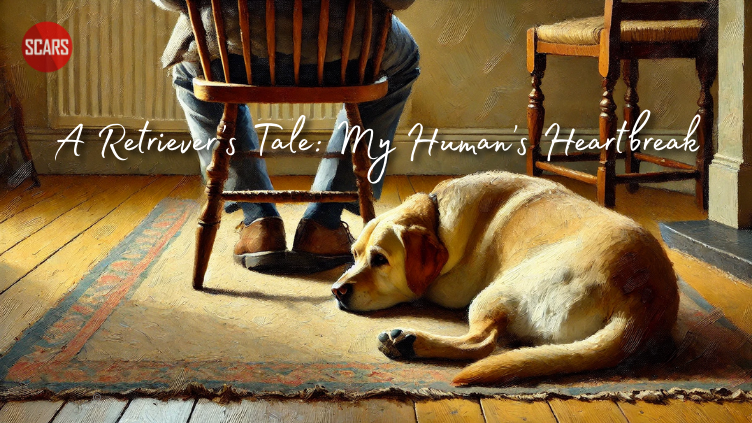
A Retriever’s Tale: My Human’s Heartbreak
A Romance Scam Story
An Original Short Story by Tim McGuinness, Ph.D.
I am Max, a Retriever with a shiny golden coat. Until recently, I lived a happy life with my human, Tom, in a small house with a big yard where I chase squirrels on sunny mornings. Tom is the best human, always scratching my ears just right and sneaking me bits of his bacon when he thinks I’m not looking. But he’s been lonely for a long time, ever since his last human friend left two summers ago, taking her laughter with her. I try to cheer him up, bringing him my squeaky toy or resting my head on his lap, but I can see the sadness in his eyes, the way he stares out the window like he’s waiting for someone who never comes. When it began, I was lying on the rug in our living room, my tail thumping softly against the floor, watching Tom at his computer. His face is lit up with a smile I haven’t seen in ages, and I can’t help but wag harder, happy to see him happy, even if I don’t understand why a screen makes him feel this way.
Tom has been talking to a woman named Lila for weeks now, typing messages late into the night, his laughter filling the house like it used to when his friends came over for barbecue. He tells me about her while he fills my water bowl, his voice soft and dreamy, the kind of voice he uses when he talks about the good old days. She’s perfect, he says, a beautiful woman with long blonde hair and sad blue eyes, someone who needs saving. He shows me her pictures on his phone, holding the screen close so I can see, and I tilt my head, sniffing at it, but all I smell is plastic, not the flowers or cookies I like. Lila told him she’s stuck in a faraway place, working a tough job, and she needs help to get free so they can be together. Tom believes her, his eyes shining with hope, and I believe him because he’s my human, and he’s always right. He starts sending her money, first a little to help with her rent, then more for plane tickets to come to him, then even more for some emergency he doesn’t explain to me. I watch him at the computer, his fingers tapping faster each day, his smile fading into worry as the requests keep coming, like a squirrel that won’t stop running just out of reach.
Tom starts selling things, things I thought he loved. He sells the old car he used to fix up on weekends, the one he’d let me ride in with my head out the window, my ears flapping in the wind. He sells the fancy watch his dad gave him, the one he’d wear when he dressed up nice, and even the TV we used to watch together, the one where we’d see dogs like me running in fields. He sends Lila everything he has, every last bit of his money, until there’s nothing left but what he calls his Social Security, which I guess isn’t much because he stops buying my favorite treats, the ones that taste like peanut butter. I don’t mind too much, I still have my kibble, but I miss the way Tom used to smile when he gave me those treats, calling me a good boy.
Weeks pass, and Tom’s worry grows, his steps heavier as he paces the house, muttering words I don’t understand. I follow him, my tail wagging slower now, trying to nudge his hand with my nose, but he’s too busy to notice me. One evening, while I’m chewing on my favorite bone, I hear Tom gasp, his voice sharp with something I don’t recognize. He’s sitting at the computer, his eyes wide as he stares at the screen. He tells me he had a funny feeling about Lila, so he decided to search for her photos online, using a website called www.ScammerPhotos.com that he found after reading about scams on a forum. I don’t know what that means, but I see his face change as he clicks through the site, his mouth falling open. He says the pictures Lila sent him, the ones he looked at with such love, are there on the website, listed as belonging to someone else, a woman who makes adult movies. The site says her photos are often stolen by scammers to trick people, and Tom’s voice shakes as he reads the warnings about romance scams, his hands trembling so much he knocks over his coffee mug, the brown liquid spilling across the desk. I whimper, nudging his leg with my nose, trying to tell him I’m here, but he doesn’t pet me. He’s angry, growling words I don’t understand, saying he should have known, that it was too good to be true, his voice sharp like the edge of a bone I can’t chew.
I thought finding out the truth would make Tom stop, but it doesn’t. He keeps messaging Lila, demanding answers, begging her to tell him it’s a mistake. I hear him late at night, his voice cracking as he pleads with her, saying he loves her, that he can forgive her if she just tells the truth. I don’t understand why he keeps talking to someone who makes him so sad, but I curl up at his feet, my head on his knee, hoping my warmth will help. He pushes me away, his anger spilling over like a spilled water bowl, and I slink back, my tail low. He smashes a lamp against the wall, shouting that he’ll find her, that she can’t do this to him, and I hide under the table, my ears flat, scared of the human I love. I miss the Tom who played fetch with me, who laughed when I rolled in the grass, but that Tom feels far away now, lost in a storm I can’t bark away.
The next week, Tom’s grown-up pups, Sarah and Jake, come to visit, their car crunching gravel in the driveway. I wag my tail hard, happy to see them, my tongue lolling out as I bound to the door, but their faces are serious, not smiling like they usually do when they bring me treats. They sit Tom down in the kitchen, and I sit by the door, my ears perked, listening as they talk in low voices, the kind humans use when they’re worried. They say they heard about the scam, that they saw the same pictures Tom found when they looked her up, and they tell him Lila isn’t real, that she’s a scam, that he needs to stop. They say he’s lost so much already, that they’re worried he’ll have nothing left, their voices soft but firm, like when they tell me not to chase the neighbor’s cat. Tom’s face turns red, and he yells at them, his voice louder than I’ve ever heard, louder than when I chewed his favorite shoe. He says they don’t understand, that Lila loves him, that she’ll come back if he just waits, his words sharp and fast like a squirrel darting across the yard. Sarah starts crying, her hands covering her face, and Jake shakes his head, his mouth a tight line, but Tom won’t listen. He tells them to leave, his voice hard, and they do, their shoulders slumped as they walk back to their car, leaving me alone with Tom again.
After that, Tom changes even more, and I feel the house grow colder, even on sunny days. He stops answering the phone when his friends call on the old phone on the wall, their voices leaving messages I can hear through the old answering machine, asking him to come to the park or to bowling night. He doesn’t go anymore, and I miss the park, the way I’d run through the grass, sniffing for new smells while Tom laughed with his buddies. He doesn’t invite his bowling friends over on Fridays, and the house feels emptier than ever, just me and Tom and the quiet. I try to cheer him up, bringing him my rope toy, but he ignores me, his eyes fixed on the computer screen as he sends more messages to Lila, even though she never replies. I hear him talking to himself, saying he’ll prove everyone wrong, that she’s real, that they’ll be together, his voice a mix of anger and hope that confuses me, like when I can’t find my favorite bone.
Now Tom just sits in his chair all day, staring out the window, his face hard and angry, like he’s waiting for a squirrel that never comes. He doesn’t play with me anymore, doesn’t scratch my ears, doesn’t even look at me when I bring him my ball, my tail wagging hopefully. I try to cheer him up, dropping my squeaky toy at his feet, but he kicks it away, growling at me to stop bothering him, his voice sharp enough to make me flinch. I don’t understand why he’s so mad, why he won’t let me help, but I feel his hurt like it’s my own, a heavy weight that makes my tail hang low. The house feels cold, even on sunny days, and I miss the sound of his laughter, the smell of bacon in the morning, the way things used to be before Lila came into his life and took everything from him.
I curl up in my bed at night, watching Tom as he sits in the dark, his hands clenched into fists, his eyes red from staring at the broken lamp he never fixed. He whispers Lila’s name sometimes, like he’s waiting for her to come back, but she never does. I wish I could tell him she’s not coming, that he needs to let her go, that I’m still here, ready to chase squirrels with him again. But I’m just a dog, and all I can do is stay by his side, my head resting on the floor, hoping one day he’ll see me again, the way he used to, before the perfect woman who needed saving took everything from him and left him with nothing but anger, a broken heart, and a lonely Labrador who still loves him more than anything in the world.
Postscript
This is a work of fiction, but often in fiction we can see the deeper truth.
Why Tell Stories?
We tell stories because that is what humans do. We are storytellers. And our stories matter.
These stories about survivors do work that clinical writing cannot. A survivor in the early months reads an article about trauma and meets their own shame on every page; but when they read a story about someone else, in some other world, and sees themself at a distance, they can process without triggering (or at least less). Allegory slips past the defenses that shame builds. That is its value: the reader absorbs the truth before recognizing it as their own, and no part of them has to admit anything to take it in.
Each of our stories carries some load-bearing truth of healing or recovery inside its fiction: that identity is rebuilt in community, that healing cannot be borrowed or hurried but only grown at each person’s own pace, that the mind strengthens whatever is rehearsed, whether shame or rage or life itself, and that beginning badly is still beginning. These are the same truths the clinical literature teaches, delivered where a wounded reader can actually receive them.
However, not all stories will carry hope. Some, by necessity, have to tell cautionary tales for what can or has gone very wrong. The truth is not all survivor stories are about survival, and every survivor needs to understand that. Some tales end very badly. But knowing that helps each survivor avoid those outcomes.
Survivors read them because the stories never blame, never lecture, and never look away, and because each one ends with a door either open or closed, but a lesson learned. They matter because somewhere a reader who cannot yet say what happened to her or him will recognize the shape of it, know they are not alone, and begin and continue.
So goes the theory.
This is the way.
Tim McGuinness, Ph.D.
September 2026


This is the sad truth told in the most beautiful way.
I hope those who read this, realise in how much pain they are, how anger eats away their peace. Most of all I hope they reach out to SCARS to help them heal, so they can first smile, then laugh and then see the sun and light of life again.