

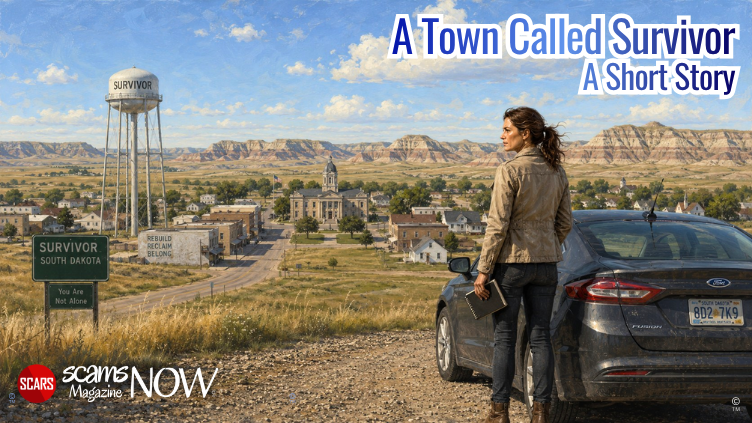
A Town Called Survivor
An Original Short Story by Tim McGuinness, Ph.D.
This is a work of fiction
More Stories »
Image & Text Copyright © 2026 – All Rights Reserved Worldwide
The town did not appear on the state’s tourist maps, though it sat plainly enough where the grassland gave out, and the Badlands showed their old striped bones. Survivor, South Dakota, population uncertain and climbing, occupied a shallow fold of ground between the last wheat and the first clay, and the wind came through it all day and most of the night with a sound like someone breathing in a next room. Nothing about the place announced itself. There was a water tower with the name painted plain, a grid of streets that gave out into gravel, a church that had changed denominations twice and now held no service anyone could name, and along the two blocks of Main a row of low buildings that the town had somehow kept from dying the way such towns usually die.
What a traveler noticed first, if a traveler came, was what the town lacked. No franchise had ever taken root in Survivor. No arch of yellow rose over the highway exit, no chain pharmacy, no big lot with a big store, none of the bright familiar signs that make one American town the reassuring twin of every other. A man had tried, years back, to put a convenience franchise at the edge of town, and the paperwork had gone strange, and the land had turned out to sit on a seam of water that no engineer would insure, and the man had gone away. People in Survivor bought their bread from Dorthea, who baked it, and their vegetables from whoever had the garden that year, and their coffee at the coffee shop that had no name but the Kettle, and if they wanted a thing the town did not make, they learned, slowly and without complaint, to want it less.
The town was mostly women, and the women were mostly old. This was the second thing a traveler noticed, and it was harder to hold in the mind, because it did not arrange itself into any story a traveler already carried. They were widows, some of them, but not most. They had come from Ohio and Florida and California and the long grey suburbs of cities that had never learned their names. They had arrived by bus, by worn car, once or twice on foot from the county road, and they had stayed, and more came, and no agency had planned it, and no church had summoned it, and no one, when you asked, could tell you the reason plainly. They had lost everything. That was the one thing they all had in common, and they said it about themselves the way other people say where they were born.
They had been taken. Each of them had given her savings, her house, her trust, her certainty about her own good sense, to a voice on a telephone or a face on a screen that had loved her precisely and expensively and had never existed at all. The particulars varied, and the shape did not. A man who needed a little help to come home from the oil rig, from the peacekeeping mission, from the customs office in a country whose flag they could not have drawn. An investment that a kind stranger had let them in on because they, alone, had seemed worthy of it. A grandchild’s voice, cracking, in trouble, begging them not to tell the family. The money went, and then the shame came, which was worse than the money, and the shame was a private thing that each of them had carried alone into some room and set down, expecting to die beside it.
And then, by a route none of them could retrace, they had come to Survivor.
Daily life in the town had the texture of ordinary life anywhere, which was itself the strangest thing about it, because these were women who had privately concluded that ordinary life was over for them. They kept gardens against the wind, staking the tomatoes low and building little walls of stone to hold the heat. They quilted, and the quilts were not sold to tourists because there were no tourists, so the quilts went from house to house as gifts and as debts of kindness, and a stranger tracing them would have mapped the whole town’s affections. They took in work. Marjorie did everyone’s taxes and asked nothing but a jar of what you had put up. Ruth cut hair in her kitchen. Pearl, who had been an accountant before a man on a dating site had emptied her into a wire transfer, kept the town’s small books and would not touch her own.
Many of them lived together, three and four to a house, and they called it saving money, and it was that, and it was also the plain animal comfort of not being alone in the dark with the thing they had set down. A house on Cedar held four of them, and they had worked out the rooms and the chores and the long evenings with the patience of women who had nothing left to protect from one another. When one of them woke crying at two in the morning, which happened, another would be at the stove already, and the kettle would be on, and nobody would say much, because there was not much that words could do and they had all learned exactly how much that was.
On Wednesdays, at six in the evening, they gathered in the town square.
No bell called them. No notice went up. The habit had simply established itself the way water establishes a channel, and now it was the deepest groove in the town’s week. They came out of the houses on Cedar and Ash and the two Elm streets, and they came from the shared kitchens still smelling of supper, and they came in cardigans against the wind that never fully quit even in July, and they filled the square in front of the courthouse that no longer held a court. There were hundreds of them now. A person seeing it for the first time from the edge would have felt the hair lift on her arms, because there was no stage, no leader, no order given, and yet at six exactly, as though the light itself had spoken, they began.
“I am a survivor.”
They said it together, and they said it plainly, without the lift of a chant or the swell of a hymn, in the flat declaring voice a person uses to state a fact she has grown tired of doubting. There was no one at the front leading the count. There was no swaying, no clasped hands, none of the warm choreography that outsiders would later, wanting to explain it, try to insist upon. They simply stood in the failing light with the striped land going purple beyond the roofs, and for one hour they said the four words, together and apart, a woman falling silent to breathe and the sound never thinning because a hundred others carried it, until the phrase stopped being speech at all and became a kind of weather the town stood inside of.
And at seven, without a signal, it ended. The saying wound down the way a wind winds down, and they stood a moment in the enormous quiet, and then they drifted. Some went home. Many went to the Kettle, where the lights were on and the urns were full, and they sat at the little tables and talked, not about the men who had ruined them, which they almost never did, but about what a life was for once you had been stripped of the life you thought you were living. They talked about that as easily as other people talk about weather, and a stranger listening would have understood perhaps one sentence in five, because the women had built, without meaning to, a grammar of their own.
Cynthia Reyes came in on the Tuesday bus, the day before a Wednesday, which some of them would later say was the town being kind to her, and others would say was only the bus schedule, and there was no way to tell the two apart, which was the town all over.
She was fifty-eight and looked older, and she carried one bag that did not need both hands, and she stood on the gravel apron where the bus left her as though she had been set down on the surface of the moon. Two years she had loved a man named, he had said, Anthony, an engineer on a platform in the North Sea, a widower with a daughter at school in Geneva, a man of such tender specific attention that she had reorganized her entire interior life around the gravity of him. There had been no Anthony. There had been a room somewhere with a bank of phones, and photographs stolen from a real man who sold boats in Perth, and a spreadsheet with her name on a line among many names, and at the bottom of it all the simple fact of one hundred and forty thousand dollars that had been her retirement and her late husband’s insurance and her mother’s small inheritance, gone through eleven transfers she had made herself, with her own hands, believing. She had learned the truth six weeks ago. She had not spoken more than a hundred words since.
Ruth found her on the gravel, or was there when she needed finding, and did not ask her name or her business. Ruth said, “You’ll want tea, and you’ll want to sit where nobody looks at you, and we have both,” and she took the bag that did not need two hands, and Cynthia followed her because there was nothing left in her that could refuse. By evening a bed had been found in the house on Cedar, the fourth room that had been standing ready as though the town kept a room always ready, which it did. No one asked Cynthia what had happened. This was the mercy she had not known to hope for and could not have borne if offered wrong. They already knew what had happened. It had happened to all of them. The only variable was the amount and the name of the man who had never lived, and those did not matter here, and so for the first time in six weeks Cynthia Reyes lay down in the dark and did not have to explain herself to anyone, and somewhere in the house another woman was awake, and the kettle was on, and she slept.
Helen VOSS arrived four days later, and the town knew her for what she was before she had turned off her engine.
She came in a rented sedan with out-of-state plates and a phone charger and a folder of printouts on the passenger seat, and she came because a database had told her something a database is not supposed to be able to feel, which was that something was wrong here in an interesting way. Helen was thirty-four and wrote features for the New York Meridian, a mid-sized newspaper, and she was good, better than her paper deserved in the opinion of everyone including Helen, and she had grown up in Troy, New York on the wrong side of the river with a mother who answered every phone call as though it might finally be good news and was ruined, twice, small amounts, by con artists who found that hope and priced it. So Helen had a nose for this, and a wound behind the nose that she called objectivity. She had noticed the migration first as a demographic freak, a county whose population of women over sixty had quadrupled in a decade with no facility, no program, no reason. Then she had noticed the money, or the absence of it, the way the place bought nothing and sold nothing and did not appear to run on anything an economy would recognize. Then she had found, in three separate obituaries and one police report, the same four words, and she had booked the flight.
She checked into the Survivor Motel, eight rooms along a single strip, run by a woman named Verna who wrote the registration by hand in a ledger and looked at Helen’s license a beat too long.
“Just the one night?” Verna asked.
“Let’s say a week,” Helen said, and smiled the smile that opened people, and watched it fail to open Verna at all. “I’m a writer. I’m interested in the town.”
“People usually are,” Verna said, “for a little while,” and she gave Helen the key to number six, and something in the way she said it made Helen write in her notebook, that night, a single line she could not afterward account for: They are not afraid of me. They are afraid for me.
The first day, nothing happened, and Helen worked the way she always worked, which was to walk and to listen and to be harmless and curious until people forgot to guard themselves. She had lunch at the diner, the Meadowlark, where the pie was made that morning, and the coffee was refilled without asking, and the waitress, whose name was Alva and who had been a schoolteacher in Sacramento, talked easily about the wind and the winters and the price of nothing, because nothing had a price here. Helen asked her questions sideways, the way she had learned, and Alva answered every one of them fully and told her nothing at all. The women of Survivor, Helen wrote that night, are the most open closed people I have ever met. They will tell you anything except the thing.
The town knew her intent the way a body knows a splinter, and the town began, without deciding to, to expel her.
It began small enough that Helen filed it under the ordinary friction of a place that did not want its picture taken. Her phone, which had full signal on the highway, could not hold a bar inside the town limits, and the one time she drove the six miles to the county road to send her notes, they sent, and the reply from her editor never came. The printouts in her folder went damp overnight in a dry room, and the ink ran until the names were clouds. She told herself weather. She told herself old wiring. She was a woman who told herself things, and she was good at it, and the town was patient.
On the second day it stopped being small.
She had driven out to the western edge of town, past the last house, to photograph the place where the grassland broke into the clay, because the light was extraordinary there and because a good feature needs a landscape. She had the window down, and the engine idling, and she was framing the shot when the light changed, not the sun but the ground, a shadow crossing it that was not a cloud. The bison came over the low rise the way water comes over a lip, not running at first, simply present where a moment before there had been empty land, a hundred of them and then it seemed like more, the great dark heads low, the ground beginning to speak through the floor of the car. Helen had time to think, with the strange clarity that comes in these moments, that bison did not do this, that there was no ranch out here, that the herd on the federal land ran miles to the south and had never once in her research come near the town. Then the thinking stopped, and there was only the roaring brown weight of them pouring around the car, striking it, the metal booming, the window she had never rolled up filling with a wet black eye and a horn that scored the door like a can opener and was gone. She was screaming and she could not hear herself over the ground. The car rocked up onto two wheels and hung there, deciding, and came down, and the herd was past, and the dust stood in the still air, and out beyond the settling dust the land was empty again as though nothing had crossed it in a thousand years. She sat with both hands on the wheel for a long time. When she finally drove back into town, shaking, the women she passed on the street looked at her with faces full of a sorrow she could not stand, and not one of them looked surprised.
That night there was a sound in her room like dry leaves, though there were no trees. She turned on the light, and the floor between the bed and the door was moving. Three of them, then she saw the fourth, prairie rattlers thick as her wrist, coiled and singing that dry papery song, between her and the only way out, and there was no reason for them, no gap under the door that a snake could take, the window latched, the walls sound. She went out through that window with a strength she did not own, tearing the screen, dropping into the gravel in her bare feet, and she stood in the parking lot in the enormous prairie dark and understood, in a place below her objectivity, that she had not been attacked. She had been warned. The distinction arrived in her whole and terrible. A thing that wanted her dead would have let the snakes come while she slept. A thing that wanted her gone had turned on the light in her mind and shown her the floor.
Verna came out in a robe and did not scream at the sight of the snakes when Helen made her look through the window, and did not call anyone, and said only, in a voice gone gentle and old, “You should think about going home, honey. This isn’t a town that likes to be looked at. It isn’t anybody doing it. That’s the part you won’t be able to write.”
Helen did not go home. She was from Troy, and she had a wound she called objectivity, and she had never once left a story because the story frightened her, and some furious part of her had decided that the fear was itself the proof of the thing worth printing. She moved to number two, on the other end of the strip. The next day her rented car would not start, and when the man came from the county to look at it he found the wiring in the engine chewed to bright copper threads by teeth too small to name, and he crossed himself, which Helen had not seen a man do in years, and he would not take her money. She walked everywhere after that, and the wind that had merely blown now leaned on her, and the loose dogs of the town, which had never so much as lifted a head, stood in the road with their hackles up and their eyes following her and made no sound, which was worse than snarling. A gutter fell as she passed beneath it and opened her scalp, and Ruth herself dressed the wound with hands so tender that Helen wept, and Ruth wept too, and said nothing, and the not-saying was the whole town speaking at once.
On the fifth morning Helen sat in the Meadowlark with a bandage over her eye, and her notebook closed on the table, because there was nothing left in it she trusted, and a woman she had not interviewed sat down across from her uninvited. She was perhaps seventy, small and square and steady, with reading glasses on a chain and flour worked permanently into the lines of her hands. Her name, she said, was Debra. She had run a fabric store in Boise for thirty years before a man she had met in a widowers’ group had convinced her, over fourteen tender months, to mortgage it for a gold mine in Ghana that was a photograph and a lie. She said all of this quickly and flatly, the way you show a stranger a scar to make her trust you, and then she put her flour-worked hand flat on the table beside Helen’s closed notebook and did not touch it.
“I’m going to tell you a thing,” Debra said, “and then I’m going to get up and pay for my pie, and I am not going to have said it. Do you understand me? I’ll deny it kindly, but I’ll deny it.”
“I understand you,” Helen said, though she did not.
“You think you’re in danger from us,” Debra said. “You’re not. There isn’t a woman in this town would harm a hair on you. Half of them are praying for you right now, this minute, praying you’ll be smart. That’s God’s truth.” She leaned in, and her voice dropped under the sound of the urn and the wind. “The danger isn’t from us. It’s from the town. And I don’t mean the buildings, and I don’t mean the ground, though it’s in the ground too. We came here broken and we made something here, out of all of us together, out of the saying and the years and the sheer weight of what was done to us, and it keeps us. Do you hear what I’m telling you. It keeps us. And it does not want to be seen, because being seen is how they got us the first time, every one of us, being seen and being wanted and being told a story about ourselves that somebody else had written. It will not let that happen to us again. It cannot tell the difference between a woman with a notebook and a man with a wire transfer. To it, you are the thing that comes to look at us and take something away. And it will stop you the way a body stops a fever, without hating you, without meaning anything by it, until you leave or until you can’t.”
Helen’s mouth was dry. “You’re saying the town is,” and she could not make herself finish, because every ending to the sentence belonged to a story she was too good a reporter to print.
“I’m saying you’re in mortal danger,” Debra said, and the old-fashioned word landed with a weight no other word could have carried. “Not just your neck. Your soul, if you’ve got one, and I think you do, which is your trouble. Because there’s another way this goes, and it’s the way it went for some who came to look and stayed. You could start to belong to it. You could sit in that square one Wednesday and open your mouth and find the words already in it, and mean them, and never leave, and be safe forever and never write another story line as long as you live. And I can’t tell you which of those two would be worse for a woman like you, and neither can you, and that not-knowing is the danger I’m talking about.” She stood, and smoothed her apron, and her face rearranged itself into the mild, closed pleasantness the whole town wore. “Go home, honey,” she said, at a normal volume, for the room. “There’s nothing here to write about. We’re just a bunch of old women who got touched by evil and made the best of it.” And she paid for her pie, and left, and the little bell over the door rang once in the wind, and out in the square, though it was only Monday and not yet noon, one voice somewhere had begun, very quietly, to say the four words, and then another took them up, and Helen sat alone with her closed notebook and understood that she would have to decide, and soon, and that the town already knew what she would decide, and was only waiting, with its terrible patience, to find out whether it would have to save her or lose her.
The next morning Helen was on the bus out of town, and she did not look back, because she understood by then that looking back was itself a kind of taking, and she had decided, somewhere in the long prairie dark of that last night, that she was done taking from those who had been taken enough. She left the rental car where it sat with its bright, chewed wiring for the company to come and collect, and she left the key with Verna, who took it without a word and held Helen’s hand a moment longer than the exchange required, the way you hold the hand of someone who has just gotten well. This was a story the town of Survivor did not want told, and Helen, who had never in her life honored such a request, honored this one. She thought about it the whole way east, the land flattening and greening and filling again with the yellow signs and the familiar twins of every other place, and she could not have said whether she was leaving something monstrous or something holy, and she came to understand that the not-knowing was the truest thing she had learned there, and the only thing she would be allowed to keep.
When she got back to the paper her editor asked her what she had, and Helen looked at him across the desk and heard, faintly, under the traffic and the phones and the whole restless hungry noise of the seen world, four flat words she would hear for the rest of her life, and she said there was no story. She said it was a demographic quirk and a sad one, a lot of elderly washing up in the same cheap county the way driftwood finds the same cove, nothing more, nothing that would hold a reader past the second paragraph. She said, and she smiled the smile that opened people, and said in a soft voice, “that there was no there there.” Her editor believed her, and he moved on to the next thing, and Helen went back to her desk and sat with her notebook closed in front of her, and did not open it, then or ever, and was, in the only way the town would have permitted, saved. Then she said something softly, mostly under her breath: “I am a survivor.”
Postscript
Somewhere on the edge of civilization there is a town called Survivor, a place that offers haven to those in need. If you are someone who has been beaten down, who has been taken and left with nothing but the shame of it, there is a community for you too. You do not have to keep carrying it alone. Only look, and you will find it, and you will find that there is a place where you belong.
– – 30 – –
“A Town Called Survivor”
By Dr. Tim McGuinness
Lyrics & Music Copyright © 2026
Lyrics
– – – – – – – – – – – – – – –
Where the wheat gives way to the Badlands bones,
Past the county road where the wild wind moans,
There’s a water tower and a two-block street,
And the prairie dust blows around your feet.
No bright signs shining, no promises sold,
Just a kettle singing when the nights turn cold,
And a name on the tower against the sky,
For the ones who came when their old lives died.
They came with a suitcase,
They came with a scar,
They came from the places
Where broken hearts are.
I am a survivor.
I am still here.
I walked through the darkness,
I carried the fear.
What was taken is taken,
What is gone can be gone,
But I am a survivor,
And I’m learning to go on.
Some lost their savings, some lost their homes,
Some loved a voice on a telephone,
A face on a screen with a tender lie,
A promise of forever from a man who’d never been alive.
Then the money was gone and the shame moved in,
And the cruelest voice was the one within,
Till somebody whispered, “You can sleep tonight.
There’s a room on Cedar and the kettle’s light.”
No one asked questions,
No one needed proof,
They knew every road
That had led to that roof.
I am a survivor.
I am still here.
I walked through the darkness,
I carried the fear.
What was taken is taken,
What is gone can be gone,
But I am a survivor,
And I’m learning to go on.
Every Wednesday evening when the sun sinks low,
From the little wood houses the women all go,
No preacher before them, no bell, no command,
Just hundreds together in the failing light they stand.
And four simple words rise into the air,
Not a prayer for mercy, not a cry of despair,
Just a fact they have learned and no longer deny,
Till the words become the wind and the wind fills the sky.
I am a survivor.
I am a survivor.
I am a survivor.
I am still here.
Then a woman came east with a notebook in hand,
Looking for the reason beneath the land,
She came for a story, she came to explain,
Why the broken kept gathering out on the plain.
Then the buffalo thundered around her car,
And the rattlers sang where the shadows are,
And the wind leaned hard and the old dogs stared,
And nobody threatened her, but everyone cared.
“This town doesn’t hate you.
This town knows the cost.
We built something living
From everything lost.
We came here broken,
One woman at a time,
Till grief learned a heartbeat
And sorrow learned a spine.
It remembers the taking.
It remembers the lies.
And it will not stand silent
When another stranger arrives.”
So she sat with her notebook closed on the table,
Still trying to name what no language was able,
Was the town something holy? Was the town something wild?
Was it vengeance grown old, or protection grown mild?
There are things you can witness you don’t have to own,
There are truths that are wounded by being made known,
And sometimes the kindest thing anyone can do
Is leave someone’s story belonging to you.
I am a survivor.
I am still here.
I walked through the darkness,
I carried the fear.
You can take all my money,
You can bury my plans,
But you cannot take from me
Who I still am.
I am a survivor.
Let the whole prairie know.
There are things we must carry,
There are things we let go.
And when one voice grows tired,
Another carries the song.
I am a survivor.
I am learning to go on.
She rode east in the morning,
Never looking behind,
Left the town and its mystery
Where the prairie meets the sky.
Back among the traffic,
The telephones and noise,
She could still hear Survivor
In a hundred distant voices.
Her editor asked her,
“What story did you find?”
She closed her empty notebook
And left the town behind.
Then beneath all the noise
Where no one else could hear,
She whispered four words
She would carry for years.
I am a survivor.
I am a survivor.
I am a survivor.
I am a survivor.
And somewhere there’s a town
For the ones who need to come home.
Why Tell Stories?
We tell stories because that is what humans do. We are storytellers. And our stories matter.
These stories about survivors do work that clinical writing cannot. A survivor in the early months reads an article about trauma and meets their own shame on every page; but when they read a story about someone else, in some other world, and sees themself at a distance, they can process without triggering (or at least less). Allegory slips past the defenses that shame builds. That is its value: the reader absorbs the truth before recognizing it as their own, and no part of them has to admit anything to take it in.
Each of our stories carries some load-bearing truth of healing or recovery inside its fiction: that identity is rebuilt in community, that healing cannot be borrowed or hurried but only grown at each person’s own pace, that the mind strengthens whatever is rehearsed, whether shame or rage or life itself, and that beginning badly is still beginning. These are the same truths the clinical literature teaches, delivered where a wounded reader can actually receive them.
However, not all stories will carry hope. Some, by necessity, have to tell cautionary tales for what can or has gone very wrong. The truth is not all survivor stories are about survival, and every survivor needs to understand that. Some tales end very badly. But knowing that helps each survivor avoid those outcomes.
Survivors read them because the stories never blame, never lecture, and never look away, and because each one ends with a door either open or closed, but a lesson learned. They matter because somewhere a reader who cannot yet say what happened to her or him will recognize the shape of it, know they are not alone, and begin and continue.
So goes the theory.
This is the way.
Tim McGuinness, Ph.D.
September 2026