

“Just Ask”
An Original Short Story by Tim McGuinness, Ph.D.
This is a Work of Fiction
More Stories »
Image & Text Copyright © 2026 – All Rights Reserved Worldwide
Just Ask
An Original Short Story by Tim McGuinness, Ph.D.
The “Devil’s Throat Diner” sits on the old road of Route 66 on the west edge of Vega, Texas, where the road still runs straight past the grain elevator and the water tower with the star painted on it, and then gives up and joins the interstate. It has been there longer than anyone in Vega has been alive, and it took its name from the dry wash behind it, which the ranchers called the Devil’s Throat a hundred years before anyone thought to sell coffee there. Nobody in Vega knows that there is a cave by the same name in the mountains where a river goes into the rock and does not come out for a long way, and that the old story says a man went down through it once to bring somebody back.
The road is older than the diner and older than the town. Before it was Route 66 it was the Ozark Trail, marked out for the first automobiles with painted posts, and before that the Rock Island laid its rails along the same line and Vega grew up beside them in 1903, and before the rails it was the wagon road that Josiah Gregg blazed to Santa Fe and Captain Marcy mapped, and before the wagons it was a hunting path that people had walked for longer than anyone has a number for, because it is the line across the high plains that finds the water. Everything that has ever crossed this country has crossed it here, going the same way, wanting something on the far side.
And once, in 1541, an army crossed it going the wrong way. Coronado came up onto the Llano with his horses and his priests because a guide the Spaniards called the Turk had told them there was a city to the northeast where the plates were gold and the bells were gold and the river was two leagues wide, and they believed him because they wanted to, and they walked for weeks across a sea of grass with nothing in it but the buffalo they called cows. There was no city. There was a village of grass houses, and a river, and a guide who had lied to lead them away from the people he was protecting, and they stranded him for it, and then they came back across this ground, this exact ground, forty miles from anywhere, knowing what they were. That is the oldest story anybody wrote down about the place where the Devil’s Throat now stands: a great many people, led a long way by a lie, walking home.
They were not the last. The wagons that came after carried families who had been told about California by men selling land they had never seen. The railroad brought speculators and then bypassed the towns the speculators had laid out. In the thirties the road filled up with people out of Oklahoma and the eastern panhandle who had lost everything to the dust and the banks and were driving west on a rumor of work, with mattresses tied to the roofs of cars that would not make it to Tucumcari, and a good many of them stopped at a diner on the edge of Vega because it was the last light before miles and miles of nothing. Then the interstate came through in the sixties, a mile to the south, and the traffic went with it, and the neon went half dark, and the diner stayed where it was, because it had never been about the traffic.
The counterman has been at that crossing, one way or another, for as long as anyone has been walking home across it. So has the other one.
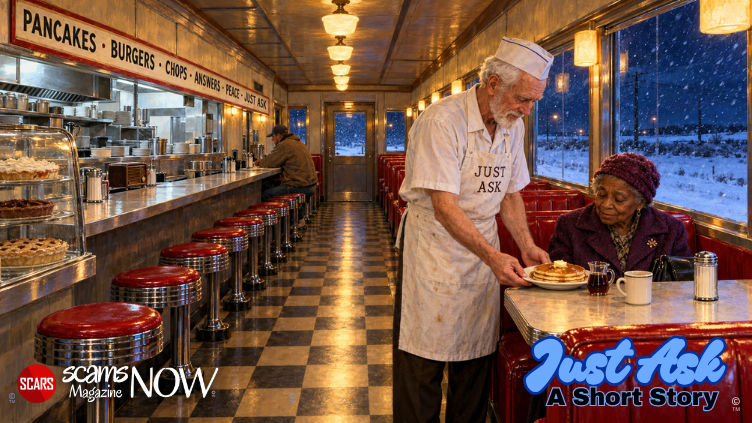
The sign out front is three words in red neon, and on most nights the DINER is out, so that from the road it reads as a warning, or as a joke, depending on who is driving. It has two doors, one at each end of the long room. The one on the left, if you are standing at the counter, faces the wash, and opens onto nothing but a strip of gravel and the dark; nobody uses it, and most people who eat there never notice it is a door. The one on the right faces the road and the lot and the lights of Vega, such as they are. Inside there are six booths along the windows between the two doors, a counter with eight stools, a pie case, a radio behind the counter that is always on and never loud, and a menu board that runs the full length of the wall above the pass-through. It says, in the plastic letters that slide into grooves:
PANCAKES · BURGERS · CHOPS · ANSWERS · PEACE · JUST ASK
Nobody who has eaten there can remember whether the fourth and fifth words were always up there or whether they noticed them only later. The pancakes have a name on the paper menus, in the same red as the neon: El Dorado Pancakes, $6.95, no explanation.
On the night this story is about, it was snowing the way it snows on the panhandle maybe twice a winter, sideways, out of a sky the color of the road, and the interstate was closed from Adrian to Amarillo. The Devil’s Throat was open. The counterman was alone. He was a lean old man with white hair and a white beard cut close, and if you had seen him in a red suit you would have known who he was supposed to be, but he was not in a red suit. He was in kitchen whites, with a paper hat, and an apron that said, in letters somebody had stitched by hand, Just Ask. On his shirt, above the pocket, was a plastic name tag of the kind you buy at a hardware store, and the name on it was ORPHEUS.
Nobody in Vega had ever called him that. Nobody in Vega had ever called him anything.
1.
The first one to come into the diner was a woman of about sixty, in a good wool coat with snow on the shoulders and no hat. She came in by the left door, the one nobody uses, and she stood inside it for a moment the way people do when they have come out of weather, and then she looked around the empty room as if she expected to be told where to sit, and when nobody told her she went to the second booth and sat down facing the door.
She did not know how she had gotten there. She would think about it later and not be able to say. She had been driving, she was fairly sure. Her car was in the lot with snow on it, on the other side of the building from the door she had come in by, which she did not think about. But the last thing she remembered clearly was a kitchen table in Amarillo with a laptop open on it, and a screen that had stopped answering.
The counterman came out from behind the counter with a mug in one hand and a coffee pot in the other. He set the mug down in front of her and filled it before she could say whether she wanted it.
She looked at the apron. “Ask what?”
“Anything you’d like,” he said. “The pork chops are good tonight. Or the El Dorado pancakes. A lot of people go with the pancakes.”
“I’m not hungry.”
“You don’t have to be.” He set the pot down on the table, which was a strange thing for a counterman to do, and he did not go away. “You want to talk about it?”
She did not know what it was, or she did, and she did not know how he did. She reached for the sugar because her hands needed something. The sugar was in one of those glass jars with the steel pour-top, the kind that has been on diner tables since before she was born, and somebody had put a strip of label tape on it, the old kind with white letters punched into black plastic. It said IT WAS NOT YOUR FAULT.
She read it twice. Then she said, “I know how this is going to sound,” and the counterman said, “It doesn’t sound like anything yet,” and she told him.
His name had been Daniel. He had been a civil engineer on a contract in Kuala Lumpur, a widower, with a daughter at Baylor, and he had found her on a Scrabble app of all places, and for eleven months he had been the first thing she looked at in the morning and the last thing at night. She had known better. She said that three times in the first minute. She had known better and she had done it anyway, first for his daughter’s tuition when the contract payment was delayed, then for the customs bond on his equipment, then for the hospital in Bangkok. By the time she told anyone, it was her son, and she told him only because there was nothing left to tell him about, except the house. That she was going to lose it.
The screen had stopped answering four days ago. She had kept it open on the table anyway. She had driven, she thought, to get away from the table.
“What did he call you?” the counterman asked.
She had not expected that. “Sweetheart,” she said. “My love. He called me my love.” And then, because he waited, “Nobody had called me anything in a long time.”
“When did you last say his name out loud?”
She had to think. “Not since I found out.”
“You just did,” he said. “Twice. It’s still just a name.” He picked up the pot. “Pancakes?”
She said all right. He brought them in a few minutes, a short stack with the butter already going soft and a little pitcher of syrup, and she ate them, all of them, and she would say afterward that they were the best thing she had ever put in her mouth, and she would not be able to say why, because they were just pancakes. But they were heavenly.
2.
The second one in was a man in his forties in a puffer jacket and dress shoes wrong for the snow, and he came in by the left door with his phone in his hand and kept it there, on the table, face up, the way you keep a phone when you are still expecting it to do something. He took the booth at the end. When the counterman came with the mug and the pot, he said, “Ask what?” like the woman had, and got the same answer, and the pork chops and the pancakes, and looked at the coffee he had not asked for and drank some of it.
He reached for the sugar and read the label and put the jar down carefully, as if it might break.
“You want to talk about it?”
“Not really.”
“All right.” The counterman did not move.
The man looked at the phone for a long couple of minutes. “It started with a wrong number,” he said. “You know how that goes. Somebody texts you, sorry, wrong person, you say no problem, they say you seem nice. That’s it. That’s how it starts.” Her name had been Sophie, or that was the name, she had lived in Vancouver, and she had an uncle who did something with cryptocurrency that had made her a lot of money, and she had never once asked him for anything. That was what he wanted the counterman to understand. She had never asked. She had shown him, the app and the balance and the withdrawals that worked, and he had put in two thousand to see, and taken out twenty-five hundred, and then it had been forty thousand, and then it had been his retirement account and a loan against the truck, and when he tried to withdraw the big one there had been a tax, and then a compliance fee, and then a security verification, and then the app was gone from the store and the website was a blank page and Sophie’s number was a recording.
“It was two hundred and sixty thousand,” he said. He said the number to the table. “My wife doesn’t know yet. She thinks it’s in the account. I’ve been driving around since Tuesday trying to figure out how to say it.”
“Who have you told?”
“You.”
“That’s one.”
“That’s nobody. You’re a guy in a diner.”
“Still one,” the counterman said. “You can’t get to two without it.” He picked up the pot. “The pancakes are good.”
The man laughed, not kindly, and then he said all right, and when they came he ate them with his free hand while the other stayed near the phone, and halfway through the plate he moved the phone to the seat beside him, face down, and did not look at it again that night.
3.
The third was a young woman, early thirties, Asian, in a thin jacket that was not made for this weather, carrying a laptop bag she held against her chest like something she had rescued from a fire. She came in by the left door too and stood with her back against it before she moved. She sat in the booth nearest the counter and did not take the bag off her shoulder. When the counterman came, she said “Ask what?” so quietly that he had to lean in, and when he said anything you’d like she said she was fine, and he poured the coffee anyway, and she wrapped both hands around it.
She read the sugar and looked away from it.
“You want to talk about it?”
She shook her head. Then she said, “It was a job.”
It had been a real company, or a real company’s name. Remote data analyst, good salary, an interview over a chat window with a woman named Ms. Reyes who had been warm and quick and had said she was impressed. There had been onboarding. There had been a check, a real-looking check for four thousand dollars, to buy the equipment from the company’s approved vendor, and she had deposited it and sent the vendor the money and the check had bounced nine days later, after the money was gone, and the bank wanted the four thousand back, and Ms. Reyes’s chat window had gone gray. She had also, on the second day, sent them a scan of her driver’s license and her Social Security card for the I-9, because that is what you do when you get a job.
“My parents think I’m working,” she said. “They tell people I’m working. My father tells his brother in Houston that I’m working.”
“What are you afraid they’ll say?”
“That I was stupid. That I let them down. That I am a failure.”
“Would you say that? If it was your sister?”
“I don’t have a sister.”
“If you did.”
She was quiet a long time. “No,” she said. “I’d say it wasn’t her fault.” And then she looked at the sugar jar, and then at him, and said, “That’s cheap,” and he said, “It’s true, though,” and went to make the pancakes.
She took the bag off her shoulder to eat them. She put it on the seat. When she finished she did not pick it back up.
4.
The fourth one was the angry one.
He came in the way weather comes in, with a blast, through the left door like the rest of them, a big man in his fifties in a canvas coat, stamping the snow off, and he looked at the empty booths and the empty stools and the old man in the apron and said, “Interstate’s closed,” as if the counterman had closed it. He sat at the counter, not in a booth, on the stool nearest the door, and when the mug came down in front of him he said, “I didn’t order that.”
“No,” the counterman agreed, and filled it.
The man read the apron. “Ask what.”
“Anything you’d like. Chops are good tonight. Pancakes.”
“I’d like to know what kind of place this is.”
“A diner.”
The man looked at the menu board over the pass-through, and read it, and got to the fourth word and the fifth, and said, “Answers. Peace. You serve answers and peace.” He said it with contempt. “What do those go for?”
“It’s on the house,” the counterman said. “You want to talk about it?”
“About what?”
“Whatever it is.”
The man reached for the sugar, read it, and pushed it away so hard it slid the length of the counter and the counterman caught it without looking. “Don’t,” the man said. “Don’t you do that.”
“All right.”
“You don’t know a thing about it.”
“No.”
It came out anyway, the way it comes out of angry men, sideways and in the wrong order. It had been a call from the Social Security Administration. There had been a case number. There had been a badge number, and a supervisor, and a second call from what the caller ID said was the county sheriff. His number had been used in a crime in El Paso, there was a warrant being prepared, his accounts were about to be frozen as evidence, and the only way to protect his money while the matter was cleared was to move it to a secure federal holding account, which he had done, in three transfers over two days, from the bank where he had done business for thirty years, and the teller had asked him if he was sure, and he had told her to mind her own business.
“I told her,” he said. “I told that girl to mind her own business.”
“Who are you angry at?”
“Them.”
“Who else?”
“The bank. The government. Whoever sits on a phone in a room somewhere. My brother, who keeps saying it could have happened to anybody. It could not have happened to anybody. It happened to me.”
“Who else?”
The man did not answer that, and the counterman let it sit, and then said, “The pancakes are good,” and the man said, “I heard you the first time,” and then, after a while, “Fine.”
He ate them. He ate them the way he did everything, fast and with his shoulders up, and then he slowed down, and then he stopped and looked at the plate.
“El Dorado,” he said. “That’s what you call these. The city of gold.”
“That’s right.”
“There wasn’t one.”
“No. Everybody came looking anyway. Right through here, some of them.” The counterman nodded at the window, at the road under the snow. “These are what was actually out here. Flour and eggs and a hot griddle. Nobody thought that was worth walking to.”
The man looked at the plate again. “What’s the word?” he said. “On the sign out there. Under the pancake thing. Axios. What is that, Greek?”
“Greek.”
“What’s it mean?”
“You are worthy,” the counterman said. “They say it in church, in the old churches, when they’re making a man a priest. The whole congregation says it. Three times. He is worthy.”
“Of what?”
“Of what he’s about to be given.”
The man looked at him a long time. “You’re a strange old bird,” he said.
“So they tell me.”
5.
The fifth came in last, and quietest. She was a small Black woman in her seventies in a church coat and a knitted hat, and she had a purse she held with both hands, and she came in by the left door and stood inside it longer than any of them, looking at the four strangers in the room, and something in her face said she had not expected to find anyone here and had not expected to find anyone anywhere. She took the booth nearest the door, across from the big man at the counter, and she sat down slowly, and she said thank you when the coffee came, which none of the others had.
“Ask what?” she said, reading the apron, and smiled a little, because it was a kind of joke and she could see that.
“Anything you’d like.”
“I couldn’t eat, honey.”
“Then just the coffee. You want to talk about it?”
She looked at the sugar jar and read the label, and she did not push it away and she did not look away from it. She put her hand on it.
“It was my computer,” she said.
She said it to the counterman, but the room was small and the radio was low and the storm had made everything quiet, and the woman in the wool coat heard it, and the man with the phone, and the young woman with the laptop bag, and the big man at the counter, who had turned on his stool. She did not seem to mind. She told it like a woman who has told it in church already and has decided the shame is not going to get any smaller by keeping it.
There had been a warning on the screen, with a siren sound, and a number to call, and a nice young man named Kevin from Microsoft who had been so patient with her, and who had found the problem, and who had needed her to let him in so he could fix it, and she had let him in, and he had fixed it, and then there had been a refund for the service, and the refund had been too much, a typing error, and she was such an honest woman, he said, that he knew she would send the difference back, and she had. And then the bank had called to say the account was empty, and it was, and Kevin’s number was a recording, and it had been her husband’s pension and forty years of what they had put by.
“He passed in March,” she said. “I keep thinking he would have caught it. He’d have said, Lorraine, hang up that phone. And I didn’t have anybody to say it.”
“What did you do with your hands,” the counterman asked, “after?”
She looked at him, and then at her hands on the purse. “I don’t know what you mean.”
“After the bank called. What did you do.”
“I sat down,” she said. “I sat down at the kitchen table and I folded them, like this, and I sat there. I don’t know how long.” She thought. “Then I got up and I got my coat. I don’t know why I got my coat.”
“You got in the car.”
“I suppose I did.”
“You came here.”
“I suppose I did.” She looked around the room again, at the four of them looking back at her. “I don’t know where here is.”
“Vega,” the counterman said. “Texas. About forty miles from anywhere.” He picked up the pot. “Let me bring you some pancakes. You don’t have to eat them.”
She ate them. So did the rest of them, a second plate, without anyone asking, because he brought them, and the room ate together without anybody moving from where they sat, and the big man at the counter turned all the way around on his stool to face the booths, and at some point the woman in the wool coat said to the young woman with the laptop bag, “Was yours a job? Mine was a man,” and the young woman said, “A job,” and the man with the phone said, “Money. Fake money,” and the big man said, “Government,” and the old woman said, “A boy named Kevin,” and that was all any of them said about it to each other, and it was enough.
The storm blew itself out a little after two a.m. The wind went first and then the snow, and the sky over the water tower cleared to a black with stars in it, and one of them, low in the west, was brighter than the others, which is the only reason the town is called what it is called.
The woman in the wool coat asked for the check first. The counterman said there wasn’t one.
“I can pay.”
“I know. It’s on the house.” He wiped the table, though it was clean. “How are you feeling?”
She did not answer right away, because she was checking, the way you check a tooth with your tongue. “Lighter,” she said finally. “I don’t understand it. Nothing’s changed. He’s still gone and the money’s still gone and I still have to tell my son the rest of it. But I feel like I put something down.” She looked at the empty plate. “It couldn’t be the pancakes.”
“The pancakes are just pancakes, right?”
“Then what was it?”
“You said his name out loud,” the counterman said, “to somebody who didn’t flinch. That’s all it ever is.” He walked her to the door, and it was the other door, the one on the right, that faces the road, and she went to it as if it were the only one. Through the glass the snow in the lot was clean and blue under the light and there were five cars in it, and she had not heard any of them arrive. She put her hand on the door. “Thank you,” she said. “For asking.”
“That’s the job,” he said. And then, as she went out, quietly, so that only she heard it: “Don’t look back.”
She didn’t. She walked to her car through the new snow with her head up, and she was smiling a little, and she did not know why.
The man with the phone went next. He left it on the seat until he was standing, and then he picked it up and put it in his pocket without looking at it, and he said the same things she had said, that nothing had changed and yet he felt lighter anyway, that he was going to drive home now and wake his wife up and tell her, and he did not know if the pancakes had done it, and the counterman said the pancakes were just pancakes, and walked him to the right-hand door, and there said, “Don’t look back,” and the man said, “I don’t intend to,” and went.
The young woman put the bag on her shoulder and then, thinking about it, took it off and carried it in her hand like a bag. She said she was going to call her father in the morning. She said it as a question and then again as a statement. At the right-hand door she said, “Axios,” trying it out, and the counterman said, “That’s right,” and then, “Don’t look back,” and she went out and did not.
The big man stood at the counter a while with his coat on. He looked at the menu board again, the fourth word and the fifth, and did not say anything about them this time. He put a twenty on the counter and the counterman pushed it back, and the man left it there anyway, and the counterman let him.
“Who else,” the man said. “You asked me who else I was angry at.”
“I did.”
“Me. I’m angry at me.”
“I know.”
“You going to tell me it wasn’t my fault? It’s on the sugar. I read it.”
“No,” the counterman said. “You’ll tell yourself. Not tonight. But you’ll get there, and you’ll believe it about a day before you’re ready to, and then you’ll have to catch up.” He came around the counter and walked him to the door on the right. “Go on home. Go see your brother. Let him say it could have happened to anybody. He’s not wrong, he’s just early.” At the door: “Don’t look back.”
The man grunted, which was as close as he came to anything, and went out into the snow with his shoulders down for the first time all night.
The old woman was last. She let him help her with her coat, which was already on. She held the purse with both hands. At the right-hand door she stopped and looked at him, at the beard and the hat and the name tag, and she read the name tag, and she said, “Orpheus. That’s a strange name for a cook.”
“It’s an old one.”
“Wasn’t he the one who went down to get his wife back? And lost her?”
“He looked back,” the counterman said. “That was the whole of it. He was almost out, and he looked back to see if she was still there, and that was the one thing he was told not to do.”
“I know that story.” She looked past him at the sign, backwards through the glass, the red letters and the dark ones. “Where did he go down? In the story.”
“A cave,” the counterman said. “In the mountains, a long way from here. The river goes into it and doesn’t come out for miles. They have a name for it.”
She looked at the sign a while longer and did not ask what the name was. Then she looked down the length of the room at the other door, the one she had come in by, which was only a dark rectangle now with the snow blown against the glass. “So this is the way out,” she said, and put her hand on the door in front of her.
“This is the way out.” He opened it for her. The cold came in clean. “You’re almost out, Lorraine. Don’t look back.”
She patted his arm, and she went, small in the church coat across the blue snow, and she was humming something, and it might have been the thing on the radio.
The Devil’s Throat was empty except for the counterman and one customer.
He had been there all night. He had come in before the first of them and taken the stool at the far end of the counter, under the pie case, and he had not ordered anything and had not been offered anything, and the five had not seemed to see him, though he had been in plain sight the whole time in a barn coat and a baseball cap pulled low. He had listened to every word. Now, in the quiet, with the radio playing something nobody could name, he took the cap off and set it on the counter, and there they were, two of them, small and dark and curved back along the skull like a goat’s, exactly where you would expect them to be.
“Damn you,” he said, “for helping them.”
He said it tiredly. It was not the first time.
“You picked the place,” the counterman said. “Of all the diners on this road.”
“I never named anything. They named it. They name everything after me they’re afraid of, and then they come and eat in it.” He turned the cap over in his hands. “I was here when the Spaniard came through. I told his guide what to say. Gold to the northeast, as much as they could carry. You should have seen their faces on the way back.” He almost smiled. “I thought this would be a comfort. Sitting in my own house.”
“It’s not your house.”
“No,” the customer said. “I noticed.”
The counterman set the coffee pot down. He straightened, and he kept straightening, as if there had been a great deal more of him folded up inside the whites than the whites had room for, and the apron and the paper hat and the name tag were still there but they were on something else now, something that had wings, wide and unhurried, opening across the whole width of the counter and the pie case and the menu board, and around all of it a light with no source, gold, the color the sugar turns when it is just starting to burn.
“Sorry,” he said. “That was never mine to carry. It was theirs, and they put it down.”
“They’ll pick it back up.”
“Some of it. Not all. Not tonight.” The wings settled. “You had every one of them alone at a kitchen table. That was your whole play. Silence and a table. And then they got in the car.”
“You don’t know why they got in the car,” said the Devil.
“No,” the counterman said, and picked the pot back up, and the light went with him behind the counter like something he had never put down. “Nobody does. That’s the part that isn’t yours either.”
The customer put the cap on. He looked at the menu board a long time, at the fourth word and the fifth, and then he went out, not by the door the others had used but by the one on the left, the one that faces the wash, and eventually the cave, and he went out into the dark the way he had come, and unlike the others, before the dark took him, he looked back.
There was nothing behind him but a diner with his own name on it, in red, and the last word dark, and no cars at all on that side.
Postscript
If you are reading this, you know which booth you would have taken.
You know what the sugar says and you know you would have pushed it away too at first. You know the name you have not said out loud, or the number, or the word for what it was. And you know the table, the one at home, the one you are probably sitting at now, where the screen stopped answering and you folded your hands and did not know how long.
Here is what the counterman knew and did not say, because it is not the kind of thing that helps to be told.
Nothing in the Devil’s Throat fixed anything. The money was gone when they walked in and gone when they walked out. No one was rescued. What happened was smaller than that and worth more: five people said the thing out loud to someone who did not flinch, and found out there were others, and ate something warm, and walked out into the weather with the thing put down instead of carried. That is all a first night is. The road from Vega to anywhere is miles and miles of dark, and every one of them still had to drive it, and the morning after, and the morning after that.
But you cannot drive it looking behind you. That is the only rule there is. Not because what is back there is not real. Because you are almost out.
Just ask. Then don’t look back.
– – 30 – –
“Just Ask and Don’t Look Back”
By Dr. Tim McGuinness
Lyrics & Music Copyright © 2026
Lyrics
– – – – – – – – – – – – – – –
Before the rails, before the cars,
They followed water, chased the stars.
Across the plains where lost winds blow,
They walked for something made of gold.
An army followed one man’s lie,
Then crossed again beneath that sky.
And every road through dust and black
Has carried someone walking back.
At Devil’s Throat, the red lights burned,
For everyone deceived who turned.
Six empty booths, eight stools in line,
A coffee pot, a weathered sign.
The snow came down, the highway closed,
While one old counterman still rose.
His apron held two words intact:
“Just Ask,” it said. “Don’t hold it back.”
Just ask, and let the silence break,
Set down the weight you should not take.
Speak the name, the loss, the fact,
Then face the road and don’t look back.
No gold was waiting down that track,
No dream survives a heartless act.
But you are here, and that is fact.
Just ask, then don’t look back.
She came inside without a hat,
With snow upon her woolen black.
A silent screen, an empty home,
Eleven months of love by phone.
He called her “sweetheart,” called her “mine,”
Then took her house one lie at a time.
She knew the words that blame repeats,
She knew the shame of empty seats.
“What did he call you?” Orpheus said.
She spoke the name she thought was dead.
It crossed her lips and lost its claim,
A fraud was still a fraud by name.
He set warm pancakes by her side,
She ate, then breathed, then softly cried.
The sugar jar gave truth, not tact:
“It was not your fault.” Just fact.
Just ask, and let the silence break,
Set down the weight you should not take.
Speak the name, the loss, the fact,
Then face the road and don’t look back.
No gold was waiting down that track,
No dream survives a heartless act.
But you are here, and that is fact.
Just ask, then don’t look back.
A wrong-number message found a man,
Then Sophie showed a golden plan.
Two thousand grew, withdrawals came,
A glowing balance fed the flame.
The tax, the fee, the final call,
Then blank white screens erased it all.
Two hundred sixty thousand gone,
His wife still thought the money strong.
A young woman entered holding tight
The bag she carried through the night.
A job, a check, a vendor’s name,
An interview that looked the same.
Her papers sent, the false check cleared,
Then bounced exactly as she feared.
“My father thinks I found my place.”
She held the coffee near her face.
“If this had happened to your kin,
Would you condemn the trap they’re in?”
She shook her head and answered low,
“I’d say it wasn’t theirs to know.”
She set the guarded laptop down,
And looked beyond the guilt she’d found.
The man turned his dead phone face down.
Two lives came back without a sound.
Just ask, and let the silence break,
Set down the weight you should not take.
Speak the name, the loss, the fact,
Then face the road and don’t look back.
No gold was waiting down that track,
No dream survives a heartless act.
But you are here, and that is fact.
Just ask, then don’t look back.
The fourth came through like winter wind,
With rage outside and rage within.
A badge, a warrant, county law,
A caller told him what he saw.
Three transfers to a “federal” place,
A teller questioned him face to face.
He told the girl to step aside,
Then found the government voice had lied.
“Who are you angry with?” he heard.
“The thieves, the bank, my brother’s words.
He says this happens every day,
But I’m the fool who gave it away.”
The pancakes cooled, his shoulders fell,
He knew the final name too well.
“Who else?” the counterman asked him then.
He could not say, “Myself,” not yet.
“El Dorado,” the big man read,
“A city made of gold,” he said.
“There was no city.” “No,” came back,
“But hungry people walked that track.
What waited here was flour and heat,
A place to rest, a thing to eat.
The gold was never what they lacked.
It was the strength to journey back.”
Axios, Axios, you are worthy,
Not because your hands are clean.
Not because you saw the ending,
Not because you guessed the scheme.
You are worthy of returning,
Worthy of the help you need.
Worthy when your voice is shaking,
Worthy when you cannot see.
Then Lorraine entered, small and slow,
With folded hands and widow’s clothes.
A warning screamed across her screen,
Then Kevin spoke so calm and clean.
He fixed the threat, returned too much,
And praised her honesty and trust.
She sent it back, then learned the cost:
Her husband’s pension, savings lost.
“He would have told me, ‘Hang up, dear.’
But since he passed, there’s no one here.”
“What did your hands do after that?”
“I folded them. Alone, I sat.
Then took my coat and found my car.
I don’t know why I drove this far.”
“You came,” he said. “That’s what you did.”
And brought the plate she had forbidden.
Five broken stories filled the room,
Not one required a grand excuse.
Now go home and don’t look back.
This is the way
Then took my coat and found my car.
I don’t know why I drove this far.”
“You came,” he said. “That’s what you did.”
And brought the plate she had forbidden.
Five broken stories filled the room,
Not one required a grand excuse.
“A man,” said one. “A job,” said two.
“Fake money.” “Law.” “A boy I knew.”
No one repaired what had been done,
No stolen dollar was returned.
They spoke, were heard, and shared the night,
And silence lost its ancient right.
Just ask, and let the silence break,
Set down the weight you should not take.
Speak the name, the loss, the fact,
Then face the road and don’t look back.
No gold was waiting down that track,
No dream survives a heartless act.
But you are here, and that is fact.
Just ask, then don’t look back.
The storm grew quiet after two,
The snow beneath the starlight blue.
Five cars appeared beyond the glass,
Five people rose to face the past.
“The money’s gone. He’s gone,” she said,
“But something heavy left instead.”
“You spoke his name to one who stayed,
Who did not flinch or turn away.”
The man went home to wake his wife.
The young woman called at morning light.
The angry brother faced his blame,
But walked out straighter all the same.
Lorraine stood by the proper door
And knew what Orpheus had done before.
“This is the way out,” Lorraine said.
The open road stood just ahead.
The diner emptied, one remained,
A tired man who knew each name.
He raised his cap, two dark horns showed.
He’d watched them enter from the road.
“Damn you,” he said, “for helping them.”
“You had them silent. Not again.
You found each one alone at home,
But something made them rise and roam.”
The counterman grew straight and tall,
Gold light climbed the diner walls.
Wide wings opened, slow and bright,
Like sugar burning into light.
“That weight was never mine to bear.
They laid it down because I cared.”
The Devil vanished into black,
And he alone still looked back.
[Final Chorus]
Just ask, and let the silence break,
Set down the weight you should not take.
Speak the name, the loss, the fact,
Then face the road and don’t look back.
The road is long, the night is black,
The heart still bears the cruel attack.
But you are here, and that is fact.
Just ask, then don’t look back.
The pancakes were just flour and heat,
A little gold that they could eat.
The losses stayed, the night stayed black,
But five souls left and did not look back.
No one was rescued. Nothing erased.
They spoke the truth and found a place.
The road still waited, mile on mile.
Just ask.
Then drive.
Why Tell Stories?
We tell stories because that is what humans do. We are storytellers. And our stories matter.
These stories about survivors do work that clinical writing cannot. A survivor in the early months reads an article about trauma and meets their own shame on every page; but when they read a story about someone else, in some other world, and sees themself at a distance, they can process without triggering (or at least less). Allegory slips past the defenses that shame builds. That is its value: the reader absorbs the truth before recognizing it as their own, and no part of them has to admit anything to take it in.
Each of our stories carries some load-bearing truth of healing or recovery inside its fiction: that identity is rebuilt in community, that healing cannot be borrowed or hurried but only grown at each person’s own pace, that the mind strengthens whatever is rehearsed, whether shame or rage or life itself, and that beginning badly is still beginning. These are the same truths the clinical literature teaches, delivered where a wounded reader can actually receive them.
However, not all stories will carry hope. Some, by necessity, have to tell cautionary tales for what can or has gone very wrong. The truth is not all survivor stories are about survival, and every survivor needs to understand that. Some tales end very badly. But knowing that helps each survivor avoid those outcomes.
Survivors read them because the stories never blame, never lecture, and never look away, and because each one ends with a door either open or closed, but a lesson learned. They matter because somewhere a reader who cannot yet say what happened to her or him will recognize the shape of it, know they are not alone, and begin and continue.
So goes the theory.
This is the way.
Tim McGuinness, Ph.D.
September 2026