

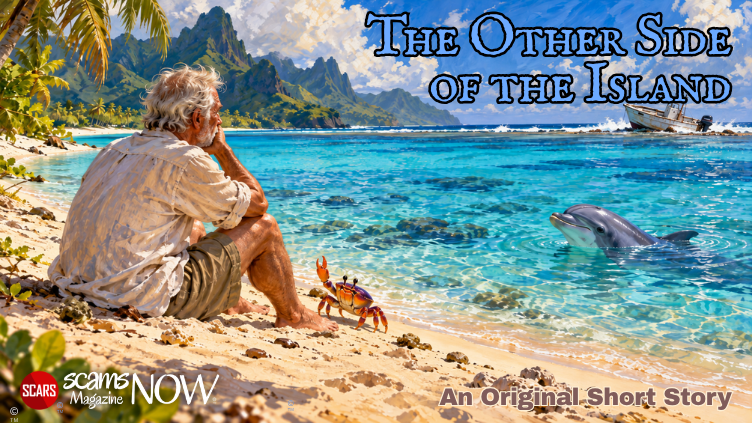
The Other Side of the Island
An Original Short Story by Tim McGuinness, Ph.D.
This is a Work of Fiction
More Stories »
Image & Text Copyright © 2026 – All Rights Reserved Worldwide
The Other Side of the Island
An Original Short Story by Tim McGuinness, Ph.D.
Copyright © 2026
They all asked the same question, in the end.
They asked it in different voices, his brother over the phone, his daughter across a kitchen table, the men he had golfed with for twenty years in a parking lot after church, but it was the same question every time.
How could you let this happen?
Some of them asked the other question too, the one underneath. His brother asked it out loud. “Were you stupid, Martin? Were you just stupid?”
He had no answer that would survive the asking.
He had loved a woman named Alina for fourteen months. She had a laugh he could hear through the screen and a mother in a hospital in Odessa and a sadness in her eyes that matched his own. She sent him good morning every day at six, before he was even out of bed, and good night every night with a little moon and a heart. She remembered the name of his dog. She asked about his knees. She told him he was the first man in years who had listened to her as though her words mattered.
He had sent her the money for the hospital, and then the money for the lawyer, and then the money for the ticket that would finally bring her to him. Each time, there was a reason the money had not been enough, and each time the reason made sense. He had sent her everything. He had cashed in the savings bonds his late wife had set aside, and then he had borrowed against the house.
But Alina never came.
Then when the money rand out, Alina vanished.
Alina had never existed. The face belonged to a fitness instructor in another country who had never heard his name. The laugh had been typed. The mother in the hospital had been typed. The sadness in her eyes had been a photograph taken on a cloudy day.
He found out on a Tuesday, from a bank investigator with a calm voice and a file in front of her. She had seen it many times, she said. She was sorry. He drove home and sat in the driveway with the engine off until the windshield fogged, and he could not make his hands open the car door.
His daughter came that weekend. She sat across from him at the kitchen table where she had done her homework as a girl, and she looked at the bank statements, and then she looked at him. She did not say anything for a long time. Then she asked, very quietly, how he could have let this happen. It was not cruel, the way she said it. That was what made it impossible to bear. It was the voice she had once used to ask him why the dog had to be put to sleep.
So he did what a man does when every face he knows has become a mirror. He left.
He chose the South Pacific because it was the farthest place he could find on the map that still had an airport. He bought the ticket with a credit card he should not have used, and he told no one but his daughter, and even her he told only in a text message from the gate. He flew for nineteen hours across a darkness that felt like the inside of his own chest. He told himself it would be quiet there. He told himself the sea would wash it off.
But the island was not what he wanted. The people spoke English, a soft and musical English, and still he understood almost nothing of the life around him. The rhythm of the days was not his rhythm. Shops closed when he expected them to open. Families gathered on the beach in the evenings and sang in a language he did not know, and he walked past them with his hands in his pockets like a man who had come to the wrong party. The food was not his food. He could not sleep. He lay under the slow ceiling fan and listened to the geckos chirp on the walls, and at three in the morning his mind replayed every message Alina had ever sent him, looking for the moment he should have known.
Every evening the sun went down in a blaze of orange and violet that tourists photographed from the beach, and he sat on his balcony and felt nothing at all. It was like watching a fire through a window. He knew it was beautiful. He could not feel the heat.
The people were kind. That was the worst of it. The woman at the guesthouse brought him fruit in the mornings and asked how he had slept, and he heard pity in her voice. The boy who swept the walkway smiled at him, and he was certain the boy knew. The waiter at the little restaurant on the harbor asked him whether he was traveling alone, and Martin felt his face go hot, as if the man had asked him to empty his pockets. They all knew. Somehow, across all that water, the news of what he was and had done had arrived before him.
On the ninth day he rented a boat to go fishing. He wanted to be somewhere no one could look at him, and the open water seemed like the only place left. It was a small aluminum skiff with an outboard motor and a cooler bolted to the bench, and the man at the dock asked him twice whether he had handled a boat on open water before. Martin said he had. He had, once, on a lake in Ohio, thirty years ago, with his wife laughing in the bow. It did not seem like a lie worth correcting.
The man looked at the sky for a moment, then at Martin, and handed him the key. “Stay inside the point,” he said. “Weather comes up fast out here.”
For the first hour the sea was a sheet of blue glass. The island shrank behind him into a green smudge. He let a line out and sat with the sun on his neck and the hull rocking gently beneath him, and he felt something he had not felt in months, something close to peace. No one was asking him anything. No one was looking at him with pity or contempt. There was only the water and the light and the small, honest tug of the line.
Then the sky in the west turned the color of a bruise. The wind came up all at once, cold and wet, and the sea changed its mind. The swells grew from gentle hills into moving walls, gray and streaked with foam, and the little boat climbed each one and slammed down the other side so hard his teeth clicked together.
He tried to turn back. He pointed the bow toward where he thought the island was and opened the throttle, and the wind and the waves pushed him sideways and away, as if the ocean had made up its mind. The point the man had warned him about was gone in the rain. The island was gone. Everything was gone except the next wave and the one after that. He fought it until the motor coughed, sputtered, and went silent. Out of fuel. He pulled the cord until his arm burned, and nothing happened. Now he was not steering anything. He was cargo, and the sea was taking him wherever it pleased.
He remembered thinking, with a strange calm, that this was a fitting end. A fool, lost at sea because he had lied about knowing how to drive a boat. His brother would shake his head. His daughter would ask how he could have let this happen.
He never knew exactly when it happened. A wave lifted the stern high, the boat lurched sideways, and something hard met the side of his head. Then nothing.
When he woke, the world was quiet. That was the first thing he noticed, the quiet. The boat was not moving. It was broken nearly in two, wedged on a coral reef, and he was sitting in water up to his knees. His head throbbed, and when he touched it his fingers came away sticky. The sky was clear and enormous, washed clean, and the sea beyond the reef lay flat and innocent again, as if nothing had happened at all.
He was still in the Pacific, he supposed. It was too big for him to be anywhere else.
About a hundred yards away, across a lagoon so clear he could see the ripples in the sand beneath it, there was a beach. White sand. Palm trees leaning toward the water as if they were listening for something. He gathered what he could carry: his fishing knife with its serrated back edge, a coil of line, a water bottle with a little left in it. Then he slid over the side into the lagoon and swam, slowly, his head pounding with every stroke, until his knees scraped sand.
He walked the beach end to end that first afternoon, looking for anything at all: a footprint, a bottle, a rope, a roof, a strip of plastic, any sign that another human being had ever stood where he was standing. There was nothing. Only white sand and green palms and the long hush of the surf, unchanged, it seemed, since the day the world was made.
He made a shelter before dark. The serrated edge of the knife sawed through the stems of the palm fronds, and he leaned them against a low branch until he had something like a roof. He cracked a coconut on a rock, the way he had seen it done on television a lifetime ago, and drank the water inside, remembering from somewhere that it would keep him from drying out. It tasted faintly sweet and faintly of the earth. Then he lay down under the fronds and listened to the sea until he slept.
In the morning he was hungry, the deep and honest hunger of a body that has been through something. He watched the beach and saw crabs scuttling between the rocks, quick and sideways and wary. He watched the lagoon and saw fish moving in the shallows, flashes of silver and blue inside the ring of the reef. So he swam back out to the broken boat and brought back everything he could use: the rod, the tackle box, a bucket, a tarp, a plastic bottle of lighter fluid, and a lighter that still worked after it dried in the sun. He made four trips. On the last one he stood in the wreck for a while, knee deep in the warm water, and looked out past the reef toward nothing.
He fished. He hunted crabs. He split coconuts. Between the three, he lived.
The first weeks were the hardest. Not the work, though the work was hard, but the silence. He had not realized how much noise he carried inside him until there was no other noise to cover it. In the day he kept busy. At night, lying under the fronds, he heard his brother’s voice, and his daughter’s, and the calm voice of the bank investigator, and underneath them all, the endless replay of Alina’s messages. Good morning, my love. I am so sorry to ask again. You are the only one who understands me.
He began talking to himself, out loud, just to hear a voice that was not one of those. He narrated his chores. He argued with himself about the best way to split a coconut. Once he caught himself telling the fire, in great detail, how the investigator had looked at him across her desk, and he stopped mid-sentence and laughed, and the laugh frightened him more than the silence had.
The weeks became months. Storms came through now and then and tore his shelter apart, scattering the fronds down the beach, and each time he rebuilt it. After the third storm, he decided to build something that would last. He felled young coconut palms with the saw edge of the knife, a slow labor of days that left his palms blistered and then hard. He notched the trunks, the way he remembered from a book about log cabins he had read to his daughter when she was small, and stacked them into walls. He thatched a roof from layers of fronds, overlapping them the way he imagined roofs had been made for ten thousand years. In time he had a little cabin, square and solid, with a door that faced the lagoon and a shelf for his tackle and a sleeping platform raised off the sand.
He was proud of it. He had not been proud of anything in a long time.
His days took on a shape. He woke with the light, before the heat, and walked the tide line to see what the night had brought: driftwood for the fire, a tangle of fishing net from some far-off boat, once a green glass float as big as his head, which he set on the shelf in the cabin like a trophy. In the cool of the morning he fished the lagoon or hunted crabs along the rocks. In the heat of the day he mended things, the roof, the net, the spear, because on the island something always needed mending. In the late afternoon he swam, slow laps along the inside of the reef, and in the evening he cooked whatever he had caught over the coals and ate it watching the sky.
He learned the island’s moods. He learned which clouds meant rain and which only meant shade, which tides brought the fish in close and which left the lagoon empty and still. He learned that the crabs went quiet before a storm, and that the birds flew low. He learned to sleep through the rain on the thatch and to wake at the smallest change in the sound of the surf. His body changed too. He grew lean and brown and hard, and his hands, which had once held drafting pencils and coffee cups, became something he barely recognized, scarred and calloused and sure.
The storms were the worst of it. One night, in what he guessed was his second year, a storm came in off the sea with a wind that made the whole cabin groan. Rain drove sideways through the gaps in the logs. He sat on his sleeping platform with his knees pulled up and listened to the roof strain against the dark, and for the first time in many months he thought about his daughter.
He thought about her as a little girl, afraid of thunder, climbing into his bed in the middle of the night. He used to tell her that storms were only the sky rearranging its furniture, and she would laugh and fall asleep against his arm. He wondered whether she thought he was dead. He wondered whether she had held a service, and who had come, and what they had said about him. He was a good man, but. He was sure there was a but. There was always a but now.
By morning the storm had passed, and the roof had held. He went outside into the washed, bright air and fed the fire, which he had kept alive all night under a lean-to of fronds, and he did not think about his daughter again for a very long time. He had become good at not thinking about things. It was the most useful skill the island had taught him.
On the beach in front of his cabin he kept the fire burning, day and night. He fed it driftwood and dry husks and never let it die, so that a passing ship or plane might see the smoke and come for him.
Once, in those first months, he heard the far drone of an airplane, very high, and he stood in the clearing by the fire and watched the silver speck cross the sky. He did not wave. He did not throw green fronds on the fire to make the smoke go dark and thick. He only watched it until it was gone, and then he went back to mending his net, and he did not ask himself why.
He told himself the fire was a signal. He told himself that was what it was for.
After who knows how long, a year perhaps, a dolphin came into the lagoon.
He had stopped counting days by then. He had tried, at first, cutting notches into a palm trunk beside the cabin, but somewhere in the second rainy season he had missed a week and then another, and the notches had become a thing he walked past without seeing. Time on the island was measured in tides and storms and the slow turning of the stars.
The dolphin came through a gap in the reef on the rising tide and circled twice in the clear water, then lifted its head and looked straight at him.
“Hey,” it said. “What’s happening? Are you okay?”
He did not think it strange that it spoke English. By then very little seemed strange to him. He walked down to the water’s edge and sat in the wet sand and said that no, he did not think he was okay, not really.
“Well,” said the dolphin, “that’s honest. Most people say they’re fine.”
The dolphin came back the next afternoon, and the one after that. Every day it arrived in the lagoon when the heat began to fade, and they talked until the sun went down.
At first he talked about small things: the fishing, the storms, the trick he had found for splitting coconuts along the seam. But the dolphin had a way of waiting, of turning slowly in the water and saying nothing, that made the bigger things come out. So one evening he told the dolphin about Alina. He told it about the good mornings at six and the moon at night. He told it about the hospital that did not exist and the mother who did not exist and the ticket that was never bought. He told it about his brother’s question, and his daughter’s face across the kitchen table.
The dolphin listened, sliding through the water, and never once asked how he could have been so stupid.
“They were good at it, weren’t they,” the dolphin said finally. It was not a question.
“I should have seen it.”
“Maybe. Or maybe they were very good at making sure you wouldn’t. Those aren’t the same things.”
They talked about other things too, on the long evenings that followed. About philosophy, and whether a man is the sum of his choices or something more, something that stays the same underneath all the choices he has ever made. About the way bridges hold their weight, which Martin had once known a great deal about, in the years when he had been an engineer and people had trusted his numbers with their lives. He drew load diagrams in the wet sand with a stick, and the dolphin watched the tide erase them and said that was a kind of engineering too.
They talked about history, about the long voyages of the people who first crossed this ocean in open canoes, reading the swells and the clouds and the flight of birds, carrying their families toward islands they could not yet see. The dolphin said those voyagers had not been fearless. They had simply decided that the island over the horizon was worth the fear.
They talked about stories, the old ones, where a man goes down into the dark and comes back changed. Martin said he had always liked those stories, and the dolphin asked him which part he liked best, the going down or the coming back. He had to think about it for a long time. He realized he did not know.
For the first time since he had left home, the evenings went by without his noticing them go. He laughed sometimes. Once he even sang, badly, an old song his wife had loved, and the dolphin made a sound that might have been applause.
One evening, as the last light went copper on the water, the dolphin asked him why he did not leave.
“Why do you stay here, alone?”
Martin laughed, not kindly. “What choice do I have? I’m on a deserted island. There’s no one here but me. Where could I go?”
The dolphin looked at him for a long moment.
“Of course that’s true,” it said. “As long as you believe it.”
Then it turned, slipped through the gap in the reef, and was gone. It did not come back the next day, or the day after. He waited at the water’s edge every afternoon for weeks, until the waiting itself became one more thing he did not let himself notice.
He was alone again.
A few days, weeks later, he was lying on the beach in the late morning. He had a deep tan by then, the color of the palm logs of his cabin, and a beard that reached his chest, streaked with gray and salt. A crab walked past him, close enough to touch. He thought about the spear he had made from a straight branch and the knife, and about crab for lunch.
The crab stopped and turned one stalked eye toward him.
“Don’t even think about it,” said the crab. “Unless you’d like to lose a few fingers and toes.”
Martin looked at the crab for a while. “Okay,” he said finally. “Then just leave me alone.”
And the crab walked off the way crabs do, sideways, as though it had somewhere better to be.
That night, in the cabin, he heard a scraping at the door. The crab came in backward, dragging a fish nearly as long as itself across the floor.
“You didn’t go fishing today,” it said. “Are you hungry? I brought you a fish.”
He thanked the crab. He cleaned the fish and cooked it over the coals outside, and ate it in silence while the crab sat on the doorstep and watched the stars. It was the first time anyone had brought him anything since the fruit at the guesthouse, and he did not know what to do with the feeling, so he did nothing with it at all.
After a while he asked the crab what it was like, being a crab.
“Pretty easy,” said the crab. “Food is everywhere. You just have to watch out for the monster who lives in the log house and hunts crabs on the days he doesn’t fish.”
Martin was quiet. Then he laughed, for the first time in a very long time, a real laugh that surprised him and went on longer than he expected.
“I’m sorry,” he said, when he could. “About the hunting.”
“Everybody has to eat,” said the crab. “I’m not here about the hunting.”
The crab came back the next night, and the next. It did not talk the way the dolphin had talked. It had no interest in philosophy or bridges or the long voyages of ancient sailors. It talked about the tides, and which rocks had the best shade, and a moray eel on the far end of the reef that it described with deep and personal contempt. Martin found that he liked it. He liked having something that came to the door at night. He began leaving the door open.
One night the crab sat on the doorstep for a long time without saying anything. Then it asked the question.
“Why are you still here?”
“Where would I go?” said Martin. “I’m trapped on this island. I have no boat, and there’s no way past the reef even if I had one.”
“That’s not true,” said the crab. “Go to the other side of the island. Other humans come here all the time. There’s a dock where the boats tie up.”
Martin stared at it. “There’s no other side. I’ve been here more than a year.”
“You’ve been on this side more than a year,” said the crab. “That’s not the same thing.”
And it walked out into the dark, sideways, the way crabs do.
He did not sleep much that night. The crab’s words sat in his chest like a stone he had swallowed. In the morning, before he could talk himself out of it, he walked to the other side of the island.
It took less than an hour. The path through the palms was easy, the ground soft and level, shaded and cool, and with every step one question grew louder in his head. Why had he never done this before? In all those months, years, all those days of fishing and building and tending the fire, he had never once walked to the other side. He had walked the beach in front of his cabin a thousand times, end to end, until he knew every rock and every tide pool. He had never wanted to know what lay beyond the trees. Some part of him, he understood now, had not wanted to know.
The trees thinned, and there it was: a wooden dock reaching out over turquoise water, gray and weathered, with iron cleats where the boats tied up. A trash can, half full, with an empty soda bottle on top. A path worn smooth by many feet, leading from the dock to a little clearing with two picnic tables under a thatched roof. Someone had carved initials and a heart into one of the tables.
There was no boat.
He stood there a long time, in the bright, ordinary sunlight, looking at the soda bottle. It was the first human thing he had seen in more than a year, and it seemed to him the strangest object in the world. Then he walked back to his cabin and fed the fire.
That night the crab came to the doorstep, as it always did. It did not ask him anything. It only sat there, watching the stars, and after a while it went away again.
A few days later, or maybe it was weeks, he went back. He told himself he was only going to look. This time, as he came through the trees, he heard an engine. A white boat with a blue canopy was gliding up to the dock, and a young couple stepped off onto the sand, laughing, carrying a cooler and a bright yellow umbrella. A man in a cap stayed at the wheel of the boat, his feet up, reading a paperback book.
Martin stopped at the tree line and stood very still in the shade, watching them.
They spread a blanket. They swam in the shallows. They ate sandwiches and took pictures of each other against the sea, and once the young woman laughed so hard at something her companion said that she had to sit down in the sand. Martin watched every minute of it. He watched the way the young man brushed sand off her shoulder. He watched them share a bottle of water. He stood in the shade of the palms with his beard and his salt-stiff ragged clothes and his heart beating so hard he could feel it in his throat, and he did not move.
In the afternoon they packed up their things and climbed back aboard. The man in the cap started the engine, and the boat pulled away from the dock, and grew smaller and smaller on the bright water, until it was gone.
He went back the next week. He told himself he was only curious. He went back the week after that, and then it became a thing he did, the way he checked the tide line in the mornings. Every few days he walked through the palms to the other side and stood in the shade at the edge of the trees, where the light was dim and no one would look, and he watched.
The boats came most mornings. He learned their schedule the way he had learned the tides. The white boat with the blue canopy came often, and a smaller red one with a loud motor, and sometimes a wide, slow catamaran that carried a three or four people at a time. The man in the cap brought most of them. He always put his feet up and read his book while his passengers swam, and he always waved at the sea birds on the dock posts as if they were old friends.
The people were all different, and Martin watched them all. A family came with three children who shrieked at the cold of the water and then would not get out of it. An older woman came alone and sat at the picnic table for an hour with a book she never opened, looking out at the reef. A group of young men came and played a loud game with a ball in the shallows until one of them cut his foot on the coral, and the others carried him back to the boat, laughing and swearing. Once a man about his own age came with a grown daughter, and the two of them walked the length of the beach together, talking quietly, and at the end of it she put her arm through his. Martin had to look away from that one.
He began to know them, in a way. He gave some of them names. He knew which ones would swim and which ones would only sit in the shade. He knew the woman with the book came a couple of times. He felt a strange, aching fondness for them, these strangers who did not know he existed, the way a man might feel fondness for the characters in a television show he watched alone every night.
And every time, when they packed up their things and walked back down the dock, he felt something pull at him, like a line hooked somewhere behind his ribs. Every time, he stood very still until the boat was gone. Then he walked back through the trees to his cabin and fed the fire and told himself it did not matter.
Once, one of the children, a girl of about seven, looked straight at the tree line while her parents were folding the blanket. She looked right at the place where he stood. He held his breath. She tilted her head, the way children do when they are deciding whether something is real, and then her mother called her name, and she turned and ran down the dock. He stood there trembling long after the boat had gone, and he did not know whether what he felt was relief or grief.
Why hadn’t he walked out to them? Why hadn’t he raised his hand, said hello, told them who he was, asked for a ride back to the world? The boat had been right there, close enough to call to. It had been there, he understood now, the whole time. Every week, maybe every day, while he fished and built and fed his fire on the other side of the trees.
But they would judge me, he thought. They would look at me and know. They would know about my shame. They would know about the scam, and that it was my fault, and that I am just a fool.
The thought was so old and so familiar that it did not even feel like a thought anymore. It felt like the ground.
He walked back to his cabin, and on the way he decided he would not visit the other side of the island again.
He had what he needed. He had his little cabin made of coconut palm logs, with its thatched roof and its shelf for his tackle and its door that faced the lagoon. He had food. He had a fire that never went out. He had a crab to talk to, most nights. What more did he need?
That evening he sat by the fire and watched the sun go down in its blaze of orange and violet, and he felt nothing at all. It was like watching a fire through a window.
He was comfortable with his shame, his guilt, and his self-blame.
He needed no one else.
Postscript
If you have been where Martin was, you know this island. You may be living on it now.
Shame builds it for us, log by log. It tells us the questions the people we love ask are verdicts. It tells us that strangers can see what happened to us, that every kind face is hiding judgment, and that the only safe place is the one where no one can look at us at all. And then, slowly, we make it comfortable. We learn to fish. We build a roof against the storms. We keep a fire burning and tell ourselves it is a signal, when in really it is only warmth for one.
But the island has another side. It always has. There are people who come and go there every day: other survivors, therapists and counselors, support groups, family members who were frightened and spoke badly and would give anything to have you back. The dock is real. The boats come in. But they also leave if you do not come out.
The dolphin was right. You are trapped only as long as you believe it. The crab was right too. Sometimes the way out is not across the reef at all. It is a short walk through the trees, to a place you were afraid to look.
What happened to you was a crime, and it was not your fault. You do not have to carry the shame for the people who chose to deceive you.
Walk to the other side. Let someone see you. Get on the boat.
This is the way.
– – 30 – –
“The Other Side of the Island”
By Dr. Tim McGuinness
Lyrics & Music Copyright © 2026
Lyrics
– – – – – – – – – – – – – – –
He sailed away on a borrowed boat,
Nineteen hours through the black and the blue,
Told himself that the sea would save him and not gloat,
That the waves would wash what he never knew.
He found an island, white and green,
Far as a man could run and hide,
But the ghost of a woman he’d never seen
Was waiting there at the water’s side.
Oh, the other side, the other side,
Where the boats come in and the people ride,
You can build your walls and tend your fire,
But the island’s only half your home,
And the other side is calling you to come,
The other side, the other side,
The dock is real, the tide is wide,
So walk the trees and let them see,
The other side will set you free.
He built a roof from the palm and the rain,
He learned the tide, he learned the pain,
He talked to a dolphin in the fading light,
Said, “I should have known,” and the dolphin said,
“They were good at it, that isn’t the same,
The shame you carry isn’t your name.”
He fed a fire both day and night,
And told himself that it was a light.
Oh, the other side, the other side,
Where the boats come in and the people ride,
You can build your walls and tend your fire,
But the island’s only half your home,
And the other side is calling you to come,
The other side, the other side,
The dock is real, the tide is wide,
So walk the trees and let them see,
The other side will set you free.
A crab came sideways through the door,
Said, “You’ve been on this side before,
But that’s not all the island is,
You carved a life, but you missed the biz.”
He walked the palms, he found the dock,
A soda bottle, a weathered cleat,
He watched the strangers laugh and talk,
And he stood in the shade with his quiet heart.
Why do you stay here, all alone?
Why do you watch and never call?
You are trapped only while you believe it,
The walk is short, the trees are small.
The dock is real, the boats come in,
They also leave if you don’t come out,
So step into the ordinary sun,
And let them see what you’re about.
Oh, the other side, the other side,
Where the boats come in and the people ride,
You built your walls, you kept your fire,
But the island’s only half your home,
And the other side is calling you to come,
The other side, the other side,
The dock is real, the tide is wide,
So walk the trees and let them see,
The other side will set you free.
Walk to the other side.
Let someone see your face.
Get on the boat.
This is the way.
This is the way.
Why Tell Stories?
We tell stories because that is what humans do. We are storytellers. And our stories matter.
These stories about survivors do work that clinical writing cannot. A survivor in the early months reads an article about trauma and meets their own shame on every page; but when they read a story about someone else, in some other world, and sees themself at a distance, they can process without triggering (or at least less). Allegory slips past the defenses that shame builds. That is its value: the reader absorbs the truth before recognizing it as their own, and no part of them has to admit anything to take it in.
Each of our stories carries some load-bearing truth of healing or recovery inside its fiction: that identity is rebuilt in community, that healing cannot be borrowed or hurried but only grown at each person’s own pace, that the mind strengthens whatever is rehearsed, whether shame or rage or life itself, and that beginning badly is still beginning. These are the same truths the clinical literature teaches, delivered where a wounded reader can actually receive them.
However, not all stories will carry hope. Some, by necessity, have to tell cautionary tales for what can or has gone very wrong. The truth is not all survivor stories are about survival, and every survivor needs to understand that. Some tales end very badly. But knowing that helps each survivor avoid those outcomes.
Survivors read them because the stories never blame, never lecture, and never look away, and because each one ends with a door either open or closed, but a lesson learned. They matter because somewhere a reader who cannot yet say what happened to her or him will recognize the shape of it, know they are not alone, and begin and continue.
So goes the theory.
This is the way.
Tim McGuinness, Ph.D.
September 2026