




ScamsNOW!
The SCARS Institute Magazine about Scam Victims-Survivors, Scams, Fraud & Cybercrime



The Four Character Model by Dr. Jill Bolte Taylor
Dr. Jill Bolte Taylor’s Four Characters Model and How This Affects Scam Victim Recovery
An Analysis of the Four Character Model and Its Application to Scam Victims
Primary Category: Psychology / Neurology
Author:
• Tim McGuinness, Ph.D., DFin, MCPO, MAnth – Anthropologist, Scientist, Polymath, Director of the Society of Citizens Against Relationship Scams Inc.
Author Biographies Below
About This Article
The Four Characters model created by neuroscientist Dr. Jill Bolte Taylor provides a neurological explanation for how different brain systems influence vulnerability to manipulation and recovery after relationship scams. The model divides brain function into four distinct internal characters: a logical planner, a protective fear-based responder, an emotional connector, and a peaceful meaning-seeker. During a scam, emotional and threat-driven brain systems overpower logic and caution, allowing attachment and fantasy to override red flags. When the deception is discovered, trauma disrupts communication among these regions, leading to fear, confusion, shame, and loss of purpose. Recovery involves rebalancing these characters, restoring structure, reducing fear, rebuilding connection, and re-establishing inner peace. Understanding these brain dynamics helps reduce self-blame and supports healing.
Note: This article is intended for informational purposes and does not replace professional medical advice. If you are experiencing distress, please consult a qualified mental health professional.

Dr. Jill Bolte Taylor’s Four Character Model and How This Affects Scam Victim Recovery
An Analysis of the Four Character Model and Its Application to Scam Victims
Dr. Jill Bolte Taylor, a neuroanatomist known for her work on the brain’s hemispheres and her personal experience with a stroke, developed a conceptual model describing four “characters” or brains within every human brain. These characters reflect how different brain regions create distinct styles of thinking, reacting, and relating to the world. Her model is based largely on the separation of the brain’s left and right hemispheres, and the differences between their emotional and logical networks.
Here are Her Four Characters:
Character 1
This character comes from the left-brain thinking (logical) region. It is task-oriented, organized, structured, and focused on details. It values routine, planning, rules, and order. Character 1 is the part of a person that handles schedules, responsibilities, deadlines, and everyday functional life. It is the manager or the “CEO” inside the brain who keeps everything on track.
Character 2
This character emerges from the left-brain emotional region. It is protective, cautious, and sometimes fearful. Its job is to keep a person safe by scanning for potential threats, remembering past pain, and anticipating danger. Character 2 relates to the stress response, self-criticism, defensiveness, and avoidance. It stores trauma and creates worry or resentment when a person feels unsafe or hurt.
Character 3
This character comes from the right-brain emotional region. It is experiential, creative, playful, and intuitive. Character 3 is the part of a person that loves novelty, movement, sensory experiences, and human connection. It lives fully in the present moment, trusting feelings and relationships. It expresses spontaneity, empathy, and joy.
Character 4
This character originates in the right-brain thinking region, which contributes to a person’s sense of peace, connectedness, and higher meaning. It is calm, compassionate, and expansive. Character 4 creates a sense of spiritual connection beyond the self, a feeling of unity with others and the world. It is the deeply mindful, philosophical, or transcendent part of the brain.
Summary of Their Roles
- Characters 1 and 2 represent the left brain: structure and self-protection
- Characters 3 and 4 represent the right brain: creativity and connection
- One side is focused on separation and survival
- The other side is focused on belonging and well-being
Taylor’s model explains why people may feel pulled in different directions inside themselves. For example, a person might be responsible and organized (Character 1), while another part of them fears embarrassment or failure (Character 2), while a joyful part longs for play and connection (Character 3), and a peaceful part seeks meaning and compassion (Character 4).
The goal is not to silence or eliminate any character but to understand when each one is speaking, appreciate its purpose, and choose consciously which part of the brain a person wants leading in a given moment.
Understanding How the Four Brain Characters Influence Vulnerability to Relationship Scams
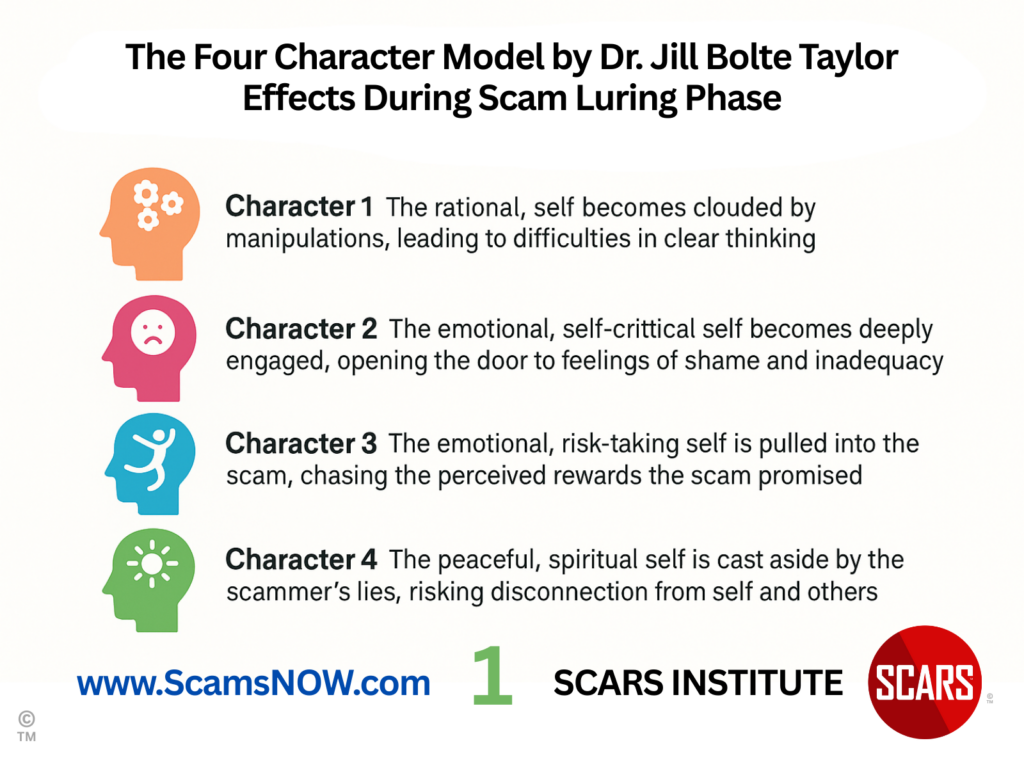
Individuals targeted in relationship scams often wonder why they ignored red flags or trusted someone who turned out to be an impostor. Dr. Jill Bolte Taylor’s Four Characters framework provides a helpful way to understand how different brain systems can shape thinking, decision-making, and emotional responses during a manipulative relationship.
Each of the four characters can play a role in the scam process:
Character 1
Left-Brain Thinking Self: This character loves order, logic, facts, and routines. When functioning well, Character 1 looks for proof, checks details, and evaluates risks. During the early stages of a scam, scammers often bypass this part of the brain by creating emotional intimacy, urgency, or secrecy. When the brain is overwhelmed by hope or fear, Character 1 may be silenced, causing a person to stop double-checking stories or questioning inconsistencies.
Character 2
Left-Brain Emotional Self: This character is responsible for protection and fear. It watches for danger and tries to prevent harm. In a scam environment, Character 2 can become highly triggered. If the scammer alternates affection with threats, guilt, or emotional withdrawal, it can push this protector into panic. The fear of losing love, future dreams, or emotional safety can keep a person trapped in the scam even when reality begins to show cracks.
Character 3
Right-Brain Emotional Self: This character is creative, spontaneous, empathetic, and highly relational. It seeks deep emotional connection and lives fully in the present moment. Scammers manipulate this character the most. They mirror affection, share false vulnerabilities, and promise love and belonging. Character 3 becomes emotionally bonded to the fantasy of the relationship. That bond often overrides logic, making it feel dangerous to question the scammer or step away.
Character 4
Right-Brain Thinking Self: This character feels connected to humanity and inner peace. It focuses on meaning, purpose, and being part of something larger. Scammers exploit this part by aligning themselves with a person’s dreams, values, and spiritual hopes. They may claim that fate brought them together or that the victim is their “soulmate.” This creates an elevated emotional experience that feels too profound to doubt.
How the Four Characters Shift During Trauma
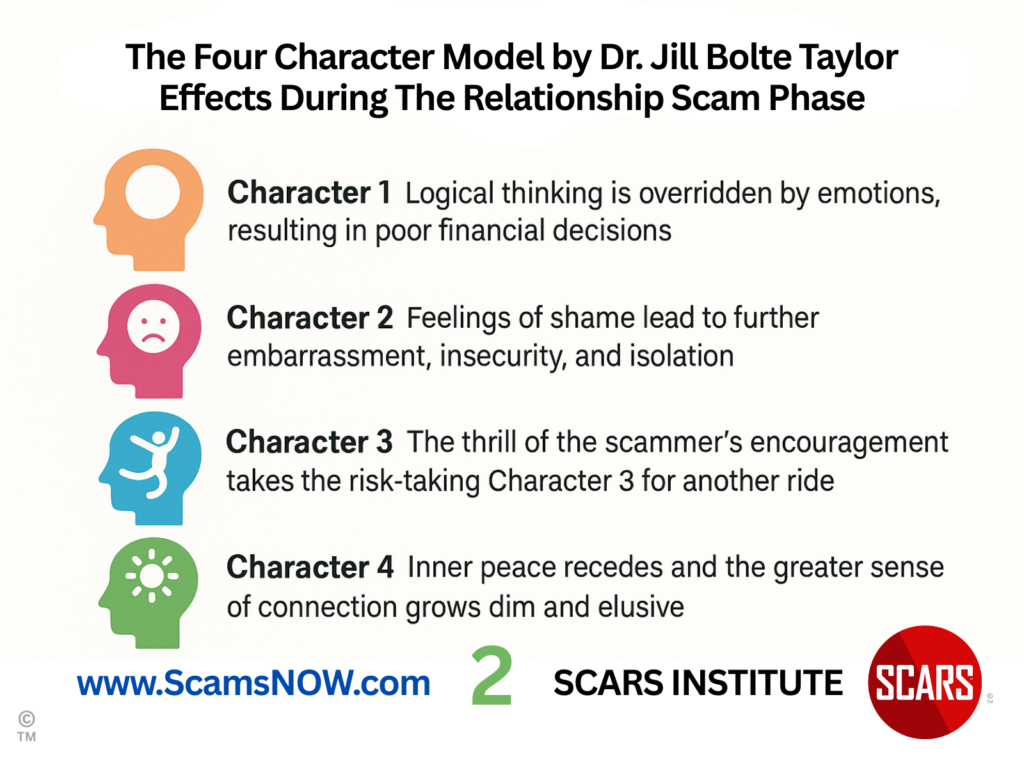
As the scam deepens and red flags appear, survivors often enter a trauma state. The brainstem and amygdala begin driving decisions instead of the prefrontal cortex. When this happens:
- Character 3 clings to emotional attachment
- Character 2 escalates fear and anxiety
- Character 1 loses authority and logic weakens
- Character 4 withdraws into fantasy or denial
This internal imbalance keeps victims psychologically trapped.
When the Scam is Discovered
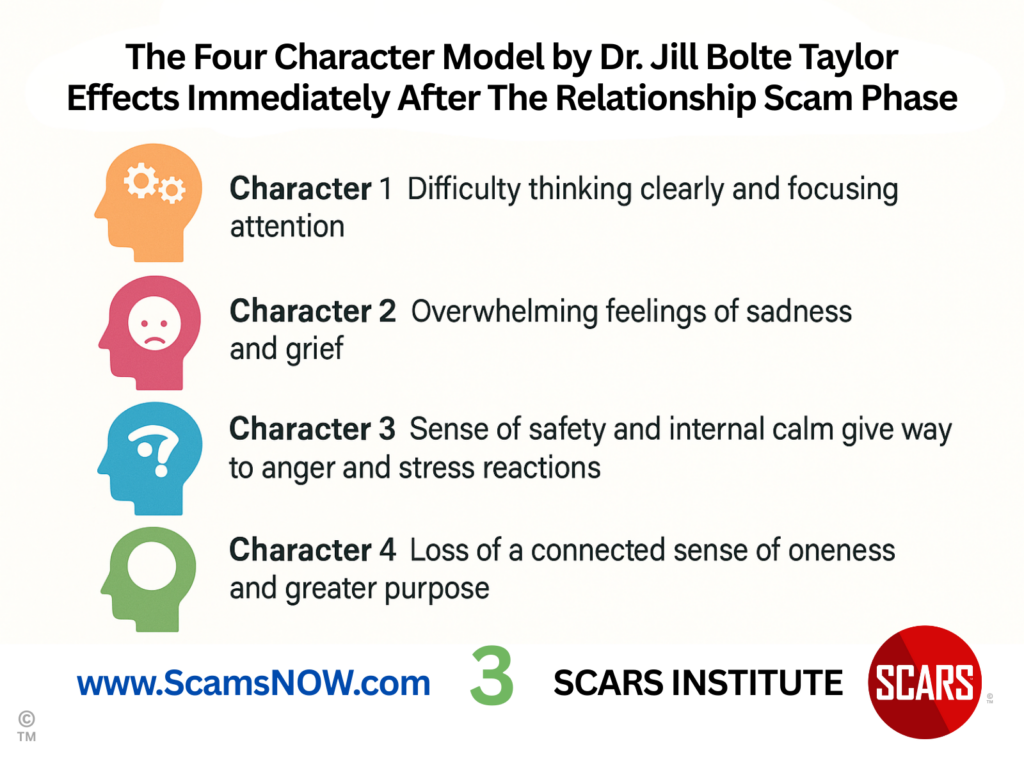
The moment the deception is revealed, the brain splits into a psychological crisis. Character 2 takes over with terror, shame, and panic. Character 3 experiences grief and heartbreak. Character 1 may attack with self-blame or confusion about how this could have happened. Character 4 may feel spiritually broken or disconnected from identity and purpose.
Healing Involves Reintegrating the Four Characters
Recovery means helping each “character” regain a healthy voice:
- Character 1 needs facts, clarity, and structure for safety
- Character 2 needs reassurance and trauma support
- Character 3 needs healthy relationships and emotional expression
- Character 4 needs connection to meaning beyond the scam
In therapy and structured support programs, survivors learn to regulate fear, rebuild logical thinking, and restore emotional and spiritual well-being.
Why This Matters
Understanding that different parts of the brain were overwhelmed or hijacked helps survivors replace self-blame with self-compassion. Choices made during the scam were influenced by a very natural and very human internal brain process. They were not based on stupidity or weakness, but on the manipulation of fundamental neurological systems that all people share.
Key Takeaway
Every scam victim has a brain that was working to love, protect, and connect. Scammers weaponized those strengths. Integrating the Four Characters again is one path toward healing and reclaiming one’s sense of self.
How the Four Brain Characters Support Scam-Victim Recovery
Trauma from a relationship scam deeply disrupts how each part of the brain communicates. Betrayal, loss, and shock create overwhelming emotional reactions that feel confusing and unpredictable. Understanding these “characters” inside your brain helps you make sense of those reactions and regain choice, strength, and direction.
Each character has an important purpose. None of them are wrong or bad. They all exist to protect you, guide you, and help you heal.
Character 1
This part of your brain helps you rebuild structure and regain control. It handles essentials such as organizing paperwork, remembering appointments, tracking finances, and communicating with law enforcement or support professionals. After a scam, Character 1 gives you the ability to take action again when everything feels chaotic. It supports your independence, stability, and the return to normal life.
Character 2
This character holds pain, fear, mistrust, and memories of danger. It is trying to protect you from being hurt again. It remembers what happened and wants to prevent any repeat harm. It becomes activated through triggers, anxiety, shame, self-blame, and avoidance of relationships or risk. Character 2’s intentions are protective, but when it leads your life for too long, you may feel stuck in fear and unable to move forward. Healing involves listening to this character’s warnings and acknowledging its pain, while not allowing it to control your future.
Character 3
This is the part of you that still longs for joy, creativity, connection, and lightness. It helps you rediscover laughter, hobbies, people you trust, and meaningful experiences. After trauma, Character 3 may feel buried or silenced, but it remains alive inside you. It offers hope and the ability to build healthy relationships again. When engaged, it brings healing through play, curiosity, social support, and safe emotional connection.
Character 4
This character offers inner peace, grounding, and a sense of meaning. It connects you with purpose, spirituality, and compassion. Character 4 reminds you that you have worth and dignity beyond what happened to you. It helps you recognize that your healing is possible and that your story is not defined by the scam. In recovery, this part supports forgiveness of self, acceptance of the past, and courage to heal.
How They Interact After the Scam
Early in trauma, Character 2 takes the lead because your brain believes you are still in danger. It pushes you to isolate, doubt yourself, and fear any new contact with others. Character 1 can feel overwhelmed because the situation is unfamiliar, and you may be dealing with losses, investigations, or financial disruption.
You might miss Characters 3 and 4 because the scam may have erased much of your joy and sense of wholeness. But those parts are not gone. They simply went quiet while your brain shielded you from further harm.
Recovery happens when you gently bring all four characters back into balance. Each one supports a different part of your healing:
- Character 1 rebuilds daily life
- Character 2 protects and warns
- Character 3 restores connection and joy
- Character 4 brings peace and meaning
When they work together, you feel stronger, safer, and more able to move forward without losing who you are.
A Simple Daily Practice for Balance
You may try this short reflection exercise once a day:
- Sit quietly for one minute and breathe gently.
- Ask yourself: “Who is speaking inside me right now?”
- Identify whether it is Character 1, 2, 3, or 4.
- Say: “Thank you for trying to help me.”
- Then choose which character you want leading the next decision or moment.
This gives you back a sense of control that trauma temporarily took from you.
What This Means for Your Recovery
- You are not broken.
- You are reorganizing.
Your brain is trying to protect you using the tools it has. When you understand the characters inside you, you can respond with wisdom instead of confusion, compassion instead of shame, and choice instead of fear.
- You deserve to feel safe again.
- You deserve to feel joy again.
And those parts of your brain needed for healing are already inside you, waiting to be invited back into your life.
How to Recognize Which of the Four Brain Characters is Leading
Every person switches between the four distinct internal “characters” throughout the day. These shifts are normal. They become especially important after a relationship scam, when trauma can create sudden changes in emotions, behavior, and thinking.
This will help you identify which character is dominant in any given moment so you can respond with more understanding and control.
You can ask yourself the question: “Which part of my brain is talking right now?”
Then look for signals like these:
Character 1
Left-Brain Thinking:
- Who is speaking inside: the logical manager
- How it feels: task-focused, practical, organized
Typical signs:
- Thinking in steps and lists
- Planning, problem solving, handling responsibilities
- Focus on documents, finances, schedules, tasks
- Prefers facts over emotions
Helpful reminder: When Character 1 is leading, structure and clarity are returning.
Character 2
Left-Brain Emotional:
- Who is speaking inside: the fearful protector
- How it feels: anxious, ashamed, angry, hyper-alert
Typical signs:
- Self-blame, rumination, “How could I be so stupid?”
- Avoiding people or social contact
- Feeling danger everywhere, even where none exists
- Reliving the trauma or deeply mistrusting others
Helpful reminder: Character 2 is trying to keep you safe because you were hurt.
Character 3
Right-Brain Emotional:
- Who is speaking inside: the playful connector
- How it feels: expressive, sensitive, relational
Typical signs:
- Seeking comfort, friendship, or creativity
- Feeling emotions intensely in the moment
- Craving closeness or needing reassurance
- Laughter, crying, spontaneous actions
Helpful reminder: Character 3 is returning joy and human connection to life.
Character 4
Right-Brain Thinking:
- Who is speaking inside: the calm observer
- How it feels: peaceful, reflective, spiritually grounded
Typical signs:
- Feeling connected to the world or nature
- Gaining perspective beyond the trauma
- Acceptance, forgiveness, compassion for self
- Thinking about purpose, meaning, and growth
Helpful reminder: Character 4 reminds you that trauma is not the whole story.
A Quick Check-In Practice
You can pause at any moment and ask:
- What am I feeling right now?
- What am I trying to accomplish or avoid?
- Which needs seem most important in this moment:
- Structure?
- Safety?
- Connection?
- Peace?
Your answer usually reveals which character is leading.
When Red Flags Show Up
After a scam, certain patterns can appear:
- If Character 2 dominates too long;
You may feel trapped in trauma, fear, and avoidance. - If Character 1 takes over completely;
You may overwork yourself and push emotions away. - If Character 3 becomes overwhelming;
You may rush into new relationships before you feel safe. - If Character 4 stays in control;
You may detach from day-to-day needs or ignore necessary boundaries.
Balance comes from letting each have a turn.
How To Gently Shift Leadership
Small actions help invite a more helpful character forward:
- If Character 2 is leading → Breathe, find safety cues, grounding
- If Character 1 is leading → Pause, soften expectations, allow emotion
- If Character 3 is leading → Choose safe people and activities
- If Character 4 is leading → Bring meaning into daily routine
You are not fighting these characters. You are coordinating them.
Why This Matters For Scam Recovery
Your brain protected you during the scam using the best tools it had. Now it is learning a new balance.
By noticing which character is speaking, you give yourself:
- Choice instead of panic
- Compassion instead of self-criticism
- Healing instead of blame
This helps you rebuild who you are without losing the parts of you that were loving, trusting, and hopeful.
How to Actively Switch Between the Four Brain Characters
After a relationship scam, the brain often becomes stuck in fear and self-protection. You may feel as if one character, especially Character 2, has taken over your life. The good news is that you can intentionally activate a different character when you need it. This is not about suppressing feelings. It is about giving yourself options and regaining control of your internal state.
Each character responds to different neurological inputs. By choosing the right tools, you can shift which character leads your thinking and behavior in the moment.
Switching into Character 1
When you need structure, clarity, or grounding
- Brain Target: Left thinking hemisphere, prefrontal cortex
Useful cues and techniques:
- Make a short written list: “What is the next right step?”
- Look at calendars, documents, or numbers
- Organize one small area or task
- Speak out loud in short, clear sentences
- Engage in logical games such as puzzles or sorting
- Goal: Restore order when everything feels chaotic or overwhelming
Switching out of Character 2
When fear, shame, or panic is controlling your choices
- Brain Target: Calm the amygdala and stress system
Useful cues and techniques:
- Deep breathing with a longer exhale to signal safety
- Grounding through physical sensations, such as feet on the floor
- Slow self-touch, such as hand over heart or gentle arm pressure
- Name the emotion: “This is fear trying to protect me.”
- Step into a safe environment or connect with a trusted person
- Goal: Reduce threat signals so other characters can participate
Switching into Character 3
When you need social connection, joy, or creativity
- Brain Target: Right emotional hemisphere
Useful cues and techniques:
- Music, dance, art, movement, or rhythm
Warm social contact, even a short conversation
Playful activities with no pressure to perform
Mindfulness of the present moment, such as noticing colors or sounds
Laughter, smiles, or a comforting touch from a safe person
Goal: Re-activate positive emotion and reconnection with others
Switching into Character 4
When you need peace, perspective, or meaning
- Brain Target: Right thinking hemisphere and default mode network
Useful cues and techniques:
- Meditation, prayer, nature, or slow breathing
Reflective writing about purpose or values
Looking up and out at the horizon or sky
Compassion practices: “May I feel safe, may I heal.”
Silence and stillness to notice the connection beyond the trauma
Goal: Restore a sense of calm identity and spiritual wholeness
A Simple “Switching Formula” Anyone Can Use
Step 1: Notice
Ask: “Which character is leading right now?”
Step 2: Name
Say to yourself: “That is Character 2 protecting me” or “Character 1 is taking charge.”
Step 3: Choose
Ask: “Which character do I want leading this next moment?”
Step 4: Activate
Use the matching sensory or cognitive tool above to invite that character forward
This four-step practice helps move you from automatic trauma responses to intentional healing decisions.
Why This Works Neurologically
The brain changes state based on three key signals:
- Sensory input
- Perceived safety
- Cognitive focus
By adjusting even one of these factors, neural activation shifts from one hemisphere or network to another. This reduces the power of fear-based responses and strengthens the parts of the brain that support logic, joy, connection, and peace.
You are not helpless inside your trauma. You have internal systems already built to help you recover. Learning how to invite a different character forward gives you control that the scam temporarily took away.
Conclusion
Recovery after a relationship scam is a process of rediscovering who you are. The trauma disrupted how your brain communicates, leaving you feeling confused, afraid, or disconnected from your own thoughts and emotions. Dr. Jill Bolte Taylor’s Four Characters model helps explain this experience by showing that different parts of your brain have been trying in their own ways to protect you, soothe you, or hold onto what once felt real.
Note that this is a different model from the “Parts“ model. Parts is more psychological, and this is more neurological.
Each character has strengths that supported you before the scam. Those same strengths were manipulated during the deception. None of them failed. None of them was wrong. They simply became overwhelmed by an artificial crisis created by a criminal who targeted your humanity.
Healing means giving each of these characters space to breathe again. It means allowing Character 1 to restore structure, Character 2 to release its fear, Character 3 to rediscover connection, and Character 4 to find peace and purpose after betrayal. As balance returns, you regain the ability to make choices based on who you want to be now, not on what happened to you.
The most important truth is that you are still whole. The scam did not erase your capacity to thrive, love, trust, or find joy again. Your brain already holds everything needed for recovery. When the four characters work together, you move from surviving the trauma to rebuilding a life that reflects your values, your strengths, and your future.
- You deserve safety.
- You deserve clarity.
- You deserve connection.
- You deserve inner peace.
Those are not lost. They are waiting to be welcomed back.


Glossary
- Amygdala — The amygdala is a small, deep brain structure that detects potential threat and helps generate fear, alarm, and survival reactions. In a relationship scam, the amygdala can stay highly activated, keeping a survivor stuck in constant worry, startle, or panic. This overactivation can make calm thinking and trust very difficult.
- Betrayal trauma — Betrayal trauma occurs when a person is deeply harmed by someone they trusted emotionally, such as a scammer posing as a loving partner. The shock comes not only from the loss of money, but from the shattering of safety, belief, and attachment. This kind of trauma can strongly activate Character 2 and silence the more peaceful and logical characters.
- Brain hemispheres — The brain hemispheres are the left and right halves of the brain that coordinate different kinds of thinking and feeling. The left hemisphere focuses more on logic, language, and structure, while the right hemisphere focuses more on emotion, connection, and big-picture experience. In the Four Character Model, each hemisphere is described as having its own emotional and thinking “character.”
- Brainstem — The brainstem is the most primitive part of the brain that controls automatic survival functions such as heart rate, breathing, and basic alertness. It also participates in the fight, flight, or freeze response when a person feels under threat. During a scam or its aftermath, the brainstem can keep the body in a high-alert state even when the danger has passed.
- Character 1 — Character 1 is the left-brain thinking self that values order, routine, and practical problem-solving. It manages tasks such as paperwork, finances, schedules, and communication with authorities. In recovery, Character 1 helps a survivor rebuild daily structure after chaos.
- Character 2 — Character 2 is the left-brain emotional self that focuses on protection, threat detection, and remembering pain. It carries fear, anger, shame, and mistrust, and often drives self-blame after a scam. When Character 2 becomes dominant for too long, a person may feel stuck in trauma and unable to move forward.
- Character 3 — Character 3 is the right-brain emotional self that seeks connection, creativity, and shared experiences. It responds strongly to affection, shared stories, and a sense of being special to someone. Scammers often target Character 3 by building intense emotional bonds that can override logical concerns.
- Character 4 — Character 4 is the right-brain thinking self that holds a sense of peace, meaning, and connection to something larger than the individual. It supports compassion, spirituality, and philosophical understanding of life. In recovery, Character 4 helps a survivor find purpose, acceptance, and self-worth beyond the scam.
- Cognitive focus — Cognitive focus describes where a person’s thinking attention is directed at any moment. It might be centered on danger, problem-solving, memories, or future goals. Shifting cognitive focus intentionally can help a survivor move from panic or rumination toward planning, connection, or reflection.
- Emotional attachment — Emotional attachment refers to the deep bond a person feels toward someone who appears to care, protect, or love them. In relationship scams, this attachment is built through repeated contact, shared “dreams,” and counterfeit intimacy. Once formed, emotional attachment can make it very hard to see red flags or walk away.
- Emotional regulation — Emotional regulation is the ability to notice, manage, and calm emotional states without becoming overwhelmed. It involves both body-based tools, such as breathing, and mental tools, such as reframing thoughts. Scam survivors often need to rebuild emotional regulation skills to balance Characters 2 and 3.
- Fear response — The fear response is the body and brain’s reaction to perceived danger, which can include a racing heart, tense muscles, and urgent thoughts. In a scam, this response may be repeatedly triggered by threats, crises, or pressure from the scammer. Afterward, the fear response can become hypersensitive and activate even during safe situations.
- Grounding — Grounding is a set of techniques that help a person return attention to the present moment using the senses or simple actions. Examples include feeling feet on the floor, naming objects in the room, or focusing on slow breathing. Grounding helps calm Character 2 and allows other characters to re-engage.
- Hypervigilance — Hypervigilance is a state of constant scanning for danger, even when circumstances are relatively safe. It often develops after trauma and can make ordinary life feel exhausting and unsafe. In the Four Character framework, hypervigilance shows Character 2 working overtime to prevent further harm.
- Inner critic — The inner critic is an internal voice that attacks a person with harsh judgments, such as calling them foolish or unworthy. After a scam, this critic often grows louder and blames the person for being deceived. The inner critic is frequently driven by Character 2 and can be softened by the compassion of Character 4 and the facts gathered by Character 1.
- Inner peace — Inner peace is a felt sense of calm, safety, and acceptance within oneself, even when life has been difficult. It does not erase pain, but helps a person hold that pain without being consumed by it. Inner peace is largely supported by Character 4 and often grows through reflection, support, and healing practices.
- Left-brain emotional system — The left-brain emotional system is the network that includes Character 2 and focuses on self-protection, fear, and critical evaluation of danger. It uses past pain to predict future risk and pushes a person to avoid anything that feels unsafe. This system can be very helpful in warning about real threats, but it can also overreact after trauma.
- Left-brain thinking system — The left-brain thinking system is the network that includes Character 1 and handles logic, structure, and language-based analysis. It excels at organizing information, checking facts, and following steps. When re-engaged after a scam, this system helps a survivor rebuild control and navigate practical tasks.
- Neurological model — A neurological model is a way of explaining behavior, emotion, and thought based on how brain structures and networks function. Dr. Jill Bolte Taylor’s Four Character Model offers a neurological map of four different styles within one brain. This type of model helps scam survivors understand that their reactions come from brain systems, not personal failure.
- Neuroplasticity — Neuroplasticity is the brain’s ability to change its connections and patterns in response to experiences, learning, and practice. It means that trauma-related pathways can gradually be reshaped through new habits and safe experiences. Neuroplasticity makes recovery and rebalancing of the four characters possible over time.
- Perceived safety — Perceived safety is how safe or unsafe a person feels, regardless of the actual level of risk. The brain often reacts to perceived danger just as strongly as to real danger. After a scam, perceived safety is often low, and rebuilding it is essential for calming Character 2 and allowing Characters 1, 3, and 4 to participate fully.
- Prefrontal cortex — The prefrontal cortex is the front part of the brain that supports planning, decision-making, impulse control, and perspective-taking. During intense fear or stress, its activity is reduced, which weakens logical reasoning. Re-activating the prefrontal cortex helps Character 1 lead with clear thinking instead of panic.
- Relationship scam — A relationship scam is a fraudulent relationship in which a scammer pretends to care, love, or commit in order to steal money or other resources. The scammer carefully builds emotional trust and then exploits that bond for financial gain. This kind of scam deeply affects the emotional, cognitive, and spiritual systems described in the Four Character Model.
- Right-brain emotional system — The right-brain emotional system is the network that includes Character 3 and focuses on present-moment feeling, empathy, and connection. It responds strongly to tone of voice, facial expression, and body language. Scammers target this system by creating intense emotional experiences that feel genuine.
- Right-brain thinking system — The right-brain thinking system is the network that includes Character 4 and supports holistic understanding, spiritual awareness, and a sense of unity. It looks for meaning and bigger patterns in life events. When engaged in recovery, it helps survivors understand the scam as an event in their story rather than the definition of their identity.
- Self-compassion — Self-compassion is the practice of responding to one’s own pain with kindness, understanding, and nonjudgment. It recognizes that being deceived in a scam comes from human vulnerability, not from worthlessness. Self-compassion strengthens Character 4 and quiets the harshness of Character 2.
- Sensory input — Sensory input includes all information that comes into the brain through sight, sound, touch, taste, and smell. Changing sensory input, such as moving to a quieter room or focusing on a calming sound, can shift which brain networks are active. Sensory tools are often used to help switch from a fear-driven state to a more grounded or peaceful one.
- Survivor — A survivor is a person who has lived through a harmful experience and continues to move forward, even if they feel fragile or overwhelmed. In the context of scams, a survivor is someone who was targeted and harmed, but is now working toward safety and healing. The term highlights strength rather than blame.
- Switching practice — Switching practice is a deliberate method for recognizing which character is leading and then inviting a different character to take the lead. It usually involves noticing, naming, choosing, and activating a new state through simple tools. Over time, this practice helps a survivor regain control over internal reactions.
- Trauma response — A trauma response is the pattern of thoughts, feelings, and body reactions that occur after a person experiences overwhelming threat or betrayal. It often includes flashbacks, avoidance, numbness, or intense fear. The Four Character Model helps explain how different characters express and hold these trauma responses.
- Trigger — A trigger is any cue, such as a word, image, or situation, that reminds the brain of past trauma and reactivates intense emotions. Triggers can quickly pull a person back into Character 2’s fear and Character 3’s grief. Learning to identify and manage triggers is a key step in scam-victim recovery.
- Vulnerability (psychological) — Psychological vulnerability refers to the aspects of a person’s history, needs, and emotional style that make certain kinds of manipulation more effective. Loneliness, financial stress, caregiving burden, or past trauma can all increase vulnerability to relationship scams. Recognizing vulnerability is not about blame, but about understanding risk and strengthening protection.
- Whole-brain integration — Whole-brain integration means that different brain systems, and in this model, the four characters, are communicating and cooperating instead of competing. In an integrated state, logic, emotion, creativity, and meaning all have a voice. For scam survivors, whole-brain integration supports balanced decisions and a stable sense of self after trauma.
Author Biographies
-/ 30 /-
What do you think about this?
Please share your thoughts in a comment below!
TABLE OF CONTENTS





CATEGORIES
ARTICLE META
Important Information for New Scam Victims
- Please visit www.ScamVictimsSupport.org – a SCARS Website for New Scam Victims & Sextortion Victims.
- SCARS Institute now offers its free, safe, and private Scam Survivor’s Support Community at www.SCARScommunity.org – this is not on a social media platform, it is our own safe & secure platform created by the SCARS Institute especially for scam victims & survivors.
- SCARS Institute now offers a free recovery learning program at www.SCARSeducation.org.
- Please visit www.ScamPsychology.org – to more fully understand the psychological concepts involved in scams and scam victim recovery.
If you are looking for local trauma counselors, please visit counseling.AgainstScams.org
If you need to speak with someone now, you can dial 988 or find phone numbers for crisis hotlines all around the world here: www.opencounseling.com/suicide-hotlines
Statement About Victim Blaming
Some of our articles discuss various aspects of victims. This is both about better understanding victims (the science of victimology) and their behaviors and psychology. This helps us to educate victims/survivors about why these crimes happened and not to blame themselves, better develop recovery programs, and help victims avoid scams in the future. At times, this may sound like blaming the victim, but it does not blame scam victims; we are simply explaining the hows and whys of the experience victims have.
These articles, about the Psychology of Scams or Victim Psychology – meaning that all humans have psychological or cognitive characteristics in common that can either be exploited or work against us – help us all to understand the unique challenges victims face before, during, and after scams, fraud, or cybercrimes. These sometimes talk about some of the vulnerabilities the scammers exploit. Victims rarely have control of them or are even aware of them, until something like a scam happens, and then they can learn how their mind works and how to overcome these mechanisms.
Articles like these help victims and others understand these processes and how to help prevent them from being exploited again or to help them recover more easily by understanding their post-scam behaviors. Learn more about the Psychology of Scams at www.ScamPsychology.org
SCARS INSTITUTE RESOURCES:
If You Have Been Victimized By A Scam Or Cybercrime
♦ If you are a victim of scams, go to www.ScamVictimsSupport.org for real knowledge and help
♦ SCARS Institute now offers its free, safe, and private Scam Survivor’s Support Community at www.SCARScommunity.org/register – this is not on a social media platform, it is our own safe & secure platform created by the SCARS Institute especially for scam victims & survivors.
♦ Enroll in SCARS Scam Survivor’s School now at www.SCARSeducation.org
♦ To report criminals, visit https://reporting.AgainstScams.org – we will NEVER give your data to money recovery companies like some do!
♦ Follow us and find our podcasts, webinars, and helpful videos on YouTube: https://www.youtube.com/@RomancescamsNowcom
♦ Learn about the Psychology of Scams at www.ScamPsychology.org
♦ Dig deeper into the reality of scams, fraud, and cybercrime at www.ScamsNOW.com and www.RomanceScamsNOW.com
♦ Scam Survivor’s Stories: www.ScamSurvivorStories.org
♦ For Scam Victim Advocates visit www.ScamVictimsAdvocates.org
♦ See more scammer photos on www.ScammerPhotos.com
You can also find the SCARS Institute’s knowledge and information on Facebook, Instagram, X, LinkedIn, and TruthSocial
Psychology Disclaimer:
All articles about psychology and the human brain on this website are for information & education only
The information provided in this and other SCARS articles are intended for educational and self-help purposes only and should not be construed as a substitute for professional therapy or counseling.
Note about Mindfulness: Mindfulness practices have the potential to create psychological distress for some individuals. Please consult a mental health professional or experienced meditation instructor for guidance should you encounter difficulties.
While any self-help techniques outlined herein may be beneficial for scam victims seeking to recover from their experience and move towards recovery, it is important to consult with a qualified mental health professional before initiating any course of action. Each individual’s experience and needs are unique, and what works for one person may not be suitable for another.
Additionally, any approach may not be appropriate for individuals with certain pre-existing mental health conditions or trauma histories. It is advisable to seek guidance from a licensed therapist or counselor who can provide personalized support, guidance, and treatment tailored to your specific needs.
If you are experiencing significant distress or emotional difficulties related to a scam or other traumatic event, please consult your doctor or mental health provider for appropriate care and support.
Also read our SCARS Institute Statement about Professional Care for Scam Victims – click here
If you are in crisis, feeling desperate, or in despair, please call 988 or your local crisis hotline – international numbers here.
More ScamsNOW.com Articles





A Question of Trust
At the SCARS Institute, we invite you to do your own research on the topics we speak about and publish. Our team investigates the subject being discussed, especially when it comes to understanding the scam victims-survivors’ experience. You can do Google searches, but in many cases, you will have to wade through scientific papers and studies. However, remember that biases and perspectives matter and influence the outcome. Regardless, we encourage you to explore these topics as thoroughly as you can for your own awareness.