




ScamsNOW!
The SCARS Institute Magazine about Scam Victims-Survivors, Scams, Fraud & Cybercrime



The Karpman Drama Triangle and Scam Victims
The Karpman Drama Triangle and Scam Victim Psychology: How Roles Shape Perception, Behavior, and Recovery
Primary Category: Scam Victim Psychology
Author:
• Tim McGuinness, Ph.D., DFin, MCPO, MAnth – Anthropologist, Scientist, Polymath, Director of the Society of Citizens Against Relationship Scams Inc.
Author Biographies Below
About This Article
The Karpman Drama Triangle explains how scam victims, scammers, and helpers can become locked into dysfunctional psychological roles shaped by trauma and manipulation. Victims may experience a collapse of perceived agency, scammers rotate between rescuing, persecuting, and victim postures to maintain control, and helpers can be misperceived as either rescuers or persecutors depending on the victim’s emotional state. These role dynamics sustain confusion, dependency, and conflict, even after the scam ends. Recovery improves when interactions move away from role-based survival responses toward agency, collaboration, and clear boundaries. Understanding this model helps victims interpret their reactions without self-blame, helps supporters avoid reinforcing helplessness, and supports healing by restoring choice, stability, and adult-to-adult engagement.
Note: This article is intended for informational purposes and does not replace professional medical advice. If you are experiencing distress, please consult a qualified mental health professional.

The Karpman Drama Triangle and Scam Victim Psychology: How Roles Shape Perception, Behavior, and Recovery
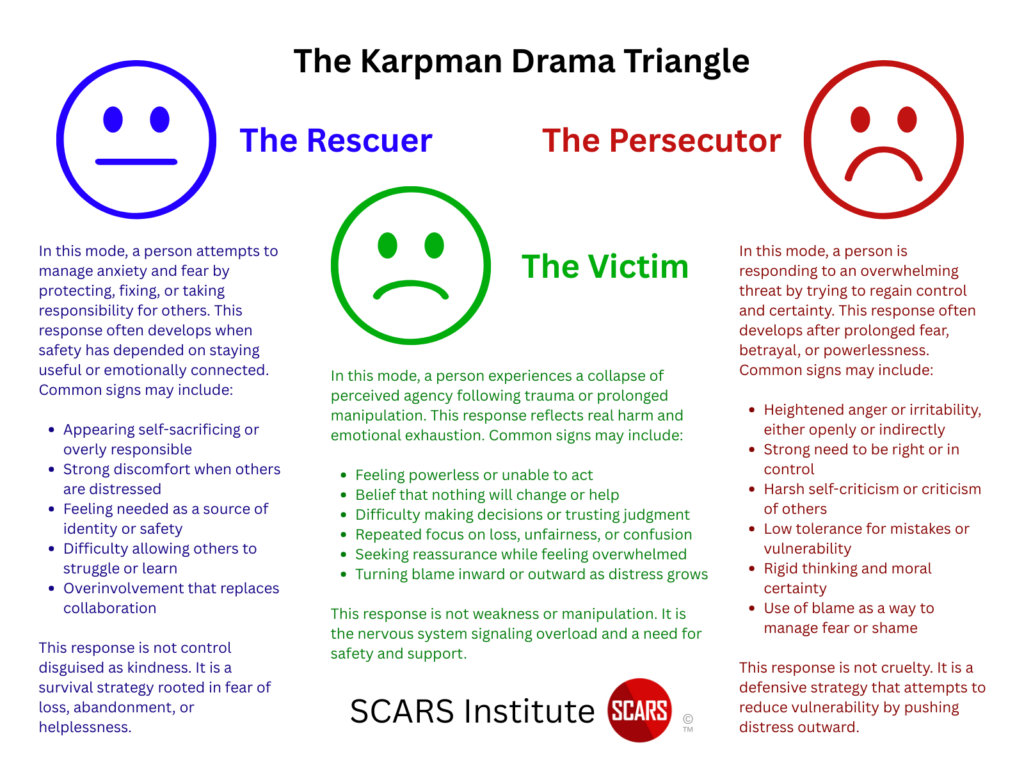
The Karpman Drama Triangle offers a useful framework for understanding how scam victims often perceive themselves, the scammers, and the people who attempt to help them. Originally developed to describe dysfunctional interpersonal dynamics, the model maps three recurring psychological roles: Victim, Rescuer, and Persecutor. In the context of scams, these roles do not describe moral character or intent. They describe how trauma, manipulation, and emotional shock distort perception and behavior during and after victimization.
Scams are relational crimes built on psychological positioning. The Drama Triangle helps explain why scam victims may feel trapped, misunderstood, or defensive, even when help is available, and why recovery can become complicated despite good intentions on all sides.
The Karpman Drama Triangle
The Karpman Drama Triangle describes a dysfunctional pattern of interaction in which people unconsciously rotate through three roles during conflict or emotional stress: Victim, Rescuer, and Persecutor. The model explains how interpersonal drama is created and maintained, especially in high-emotion or high-stress situations.
What the Drama Triangle Is
The Drama Triangle is not about intentional manipulation in most cases. It describes habitual roles people fall into when they lack healthy boundaries, emotional regulation, or direct communication. These roles feel psychologically compelling because each one temporarily reduces discomfort, even though the overall pattern increases conflict and dependency.
The Three Roles
Victim
The Victim role is characterized by feelings of helplessness, powerlessness, and injustice. The person perceives themselves as unable to solve the problem or protect themselves. Language often includes phrases such as “I can’t,” “It’s not fair,” or “There’s nothing I can do.” Importantly, the Victim role is about perceived lack of agency, not whether someone has actually been harmed. Real victims of crime can still be pulled into the Victim role psychologically after the event.
Rescuer
The Rescuer steps in to fix, save, or protect the Victim, often without being asked. While this may appear helpful, it reinforces the Victim’s belief that they are incapable. The Rescuer gains a sense of purpose, control, or moral superiority, but avoids addressing their own needs. Over time, rescuing creates dependency rather than recovery.
Persecutor (Villain)
The Persecutor criticizes, blames, controls, or punishes. This role provides a sense of power and certainty. The Persecutor may target the Victim or the Rescuer and often justifies behavior as “tough love,” “telling the truth,” or “holding someone accountable.”
Role Switching
A key feature of the Drama Triangle is that people switch roles. A Rescuer may become a Persecutor when unappreciated. A Victim may become a Persecutor when anger builds. A Persecutor may claim Victimhood when challenged. These shifts keep the drama active and prevent resolution.
Why It Matters for Scam Victims
The Drama Triangle is especially relevant to scam victim psychology. Scammers deliberately place victims in the Victim role, present themselves as Rescuers, and later become Persecutors through threats, guilt, or blame. After the scam, victims may remain stuck in the Victim role, while others unintentionally reinforce it by over-rescuing or blaming.
Moving Out of the Triangle
Healthy interaction requires stepping out of roles and into agency, responsibility, and boundaries. This involves replacing Victimhood with problem-solving, Rescuing with support that preserves autonomy, and Persecuting with clear, non-punitive limits.
The Drama Triangle explains why emotional situations feel stuck and exhausting. Recognizing it is often the first step toward breaking the cycle and restoring healthy, adult-to-adult interaction.
The Victim Role and Scam Victim Identity
In the Drama Triangle, the Victim role is defined by perceived powerlessness, helplessness, and lack of agency. This does not mean the person is not a real victim of harm. Scam victims are genuine victims of crime. The role refers to a psychological position in which the person feels unable to influence outcomes or protect themselves.
During a scam, manipulators deliberately push targets into this role. They create narratives of danger, urgency, dependence, or emotional need. The victim is taught, subtly or explicitly, that survival, love, safety, or success depends on the scammer’s guidance. Over time, the victim’s sense of agency erodes. Decision-making becomes externally anchored.
After discovery, many scam victims remain psychologically positioned in the Victim role even as the external threat has ended. Shock, shame, grief, and financial loss reinforce the feeling of helplessness. The mind may interpret the situation as proof of personal inadequacy rather than as evidence of skilled manipulation. This can lead to statements such as “I cannot trust myself,” “I will never recover,” or “No one can really help me.”
When stuck in this role, victims may unintentionally resist empowerment. Advice can feel overwhelming or invalidating. Requests for action can feel punitive. Even accurate information can feel threatening because it implies responsibility at a time when emotional capacity is limited.
How Scammers Occupy Multiple Roles
Scammers do not remain in a single position within the triangle. They rotate roles strategically to maintain control.
At the beginning of many scams, especially romance, investment, or recovery scams, the scammer presents as a Rescuer. They offer understanding, affection, guidance, or solutions. They appear uniquely capable of meeting the victim’s emotional or situational needs. This creates relief and attachment while reinforcing dependency.
When compliance falters, the scammer often shifts into the Persecutor role. Threats, guilt, accusations, withdrawal, or intimidation emerge. The victim is blamed for delays, doubts, or boundary setting. Fear replaces comfort, and the victim is pushed back into compliance to escape emotional pain.
Scammers may also portray themselves as Victims. They claim hardship, danger, illness, or persecution to extract sympathy and resources. This role reversal deepens emotional confusion and strengthens trauma bonds by positioning the victim as morally responsible for the scammer’s survival.
This constant role switching destabilizes the victim’s perception and exhausts emotional regulation, making escape and clarity more difficult.
How Helpers Are Perceived as Rescuers or Persecutors
After a scam is discovered, family members, friends, professionals, and support organizations often attempt to help. From a stable perspective, these efforts may be appropriate and compassionate. From within the Drama Triangle, however, they may be perceived very differently.
When helpers step in quickly to fix problems, take control, or make decisions on the victim’s behalf, they may unintentionally reinforce the Victim role. The victim may feel further disempowered, even if the help is effective. Over time, this can create dependency, resentment, or resistance.
When helpers challenge beliefs, set boundaries, or emphasize responsibility, they may be experienced as Persecutors. This is especially likely when the victim is still in shock or shame. Statements meant to protect can feel blaming. Questions meant to clarify can feel accusatory. The helper’s authority or certainty can trigger defensiveness and withdrawal.
As a result, scam victims may reject help not because it is wrong, but because their psychological position interprets it as unsafe.
How Victims May Shift Into Other Roles
Scam victims do not remain fixed in the Victim role. Under stress, they may shift into other positions within the triangle.
Some victims move into the Rescuer role toward other victims. They may feel compelled to save others, provide advice beyond their expertise, or immerse themselves in advocacy before stabilizing their own recovery. While altruistic, this can delay healing and reinforce avoidance of personal grief.
Others shift into the Persecutor role. Anger toward scammers, institutions, family members, or even other victims can become dominant. This anger may feel empowering after helplessness, but it often masks unresolved fear and shame. It can fracture support networks and prolong emotional distress.
Role switching keeps the drama active. Each position provides temporary emotional relief while preventing resolution.
The Triangle as a Barrier to Recovery
The Drama Triangle explains why recovery can feel stalled even when resources are available. As long as interactions are organized around Victim, Rescuer, and Persecutor roles, the focus remains on emotional survival rather than growth.
True recovery requires movement out of the triangle. This does not mean denying harm or rushing empowerment. It means gradually restoring agency, responsibility, and choice without blame.
For victims, this involves shifting from helplessness to problem-solving at a pace that matches capacity. It involves learning to accept support without surrendering autonomy.
For helpers, it requires offering assistance that respects the victim’s agency and emotional readiness. Support becomes collaborative rather than directive. Boundaries are clear but not punitive.
For institutions, it means avoiding language or processes that inadvertently shame or infantilize victims.
Moving Toward Healthy Roles
Several models describe healthier alternatives to the Drama Triangle. While labels vary, the underlying principles are consistent.
- Victimhood is replaced by agency and learning. The person remains acknowledged as harmed while being supported in regaining control.
- Rescuing is replaced by a supportive partnership. Help is offered without taking over or reinforcing dependency.
- Persecuting is replaced by accountability with compassion. Boundaries and truth are delivered without contempt or punishment.
In scam recovery, this shift often happens gradually. Education, trauma-informed support, clear decision frameworks, and emotional regulation skills all contribute.
Why This Understanding Matters
Scam victims are often judged for their reactions after discovery. They may be labeled as resistant, defensive, angry, or uncooperative. The Drama Triangle reframes these behaviors as understandable responses to trauma and manipulation rather than character flaws.
Understanding this model helps victims make sense of their own reactions. It helps helpers avoid unintentional harm. It helps organizations design support that restores agency instead of reinforcing helplessness.
Most importantly, it reminds everyone involved that recovery is not about winning an argument or assigning blame. It is about moving out of survival roles and back into grounded, adult, reality-based engagement.
Scams create drama by design. Recovery begins when the triangle dissolves, and real healing work can begin.
Conclusion
The Drama Triangle offers a clear framework for understanding how scam victimization reshapes perception, behavior, and relationships during and after the crime. Scam victims are real victims of harm, yet trauma and manipulation can pull them into psychological roles that limit agency and complicate recovery. Scammers intentionally induce and rotate these roles to maintain control, while well-meaning helpers may unintentionally reinforce them through over-rescuing or blame. As long as interactions remain organized around Victim, Rescuer, and Persecutor positions, emotional survival takes priority over growth, clarity, and healing.
Recovery depends on gradually stepping out of these roles and restoring agency, responsibility, and boundaries without shame. Victims benefit from support that acknowledges harm while encouraging problem-solving at a pace aligned with emotional capacity. Helpers are most effective when assistance preserves autonomy rather than replacing it. Institutions play a role by avoiding language and processes that reinforce helplessness. When the triangle dissolves, drama gives way to stability, and recovery becomes possible through grounded, adult, reality-based engagement.

Glossary
- Adaptive Support — Assistance that preserves choice and agency. It promotes recovery.
- Agency — The capacity to make choices and influence outcomes. In scam recovery, restoring agency helps victims move from helplessness toward problem-solving and self-trust.
- Attachment Bond — An emotional connection formed through perceived safety or care. Scammers exploit attachment bonds to deepen dependence and compliance.
- Authority Projection — The appearance of expertise or moral certainty used to gain influence. Scammers and helpers alike may be perceived through this lens under stress.
- Boundary Confusion — Difficulty recognizing or maintaining personal limits. Trauma and manipulation often blur boundaries, increasing vulnerability.
- Caretaking Compulsion — A drive to fix or protect others to manage anxiety. This response can pull victims into rescuer roles prematurely.
- Cognitive Anchoring — Reliance on an external figure for decisions or reassurance. Scams intentionally create this dependence to reduce autonomy.
- Cognitive Dissonance — Psychological discomfort caused by conflicting beliefs or actions. It can keep victims trapped in harmful dynamics despite evidence.
- Compliance Conditioning — Gradual training to obey requests without evaluation. Scammers reinforce compliance through rewards and punishments.
- Control Restoration Drive — A psychological push to regain power after helplessness. This can manifest as anger or rigid certainty.
- Dependency Loop — A cycle in which reliance on another person increases over time. Role switching within the triangle sustains this loop.
- Emotional Exhaustion — Depletion caused by prolonged stress and vigilance. It reduces capacity for reflection and boundary setting.
- Emotional Leverage — Use of feelings such as fear, guilt, or hope to influence behavior. Scammers rely heavily on this tactic.
- Emotional Safety — A state in which distress can be tolerated without threat perception. Recovery requires rebuilding emotional safety.
- Empowerment Resistance — Avoidance of responsibility due to fear of failure. This response often appears during early recovery.
- External Orientation — Habitual reliance on others for direction or validation. Trauma increases this orientation.
- Fear Conditioning — Learned association between cues and threat. Scams create strong fear conditioning through repeated stress.
- Guilt Induction — Manipulation that frames noncompliance as moral failure. It is commonly used to enforce control.
- Helplessness Schema — A belief that personal action is ineffective. This schema strengthens the victim role.
- Identity Disruption — Loss of coherent self-concept after betrayal. It complicates decision-making and trust.
- Information Threat Response — Emotional reaction that treats facts as dangerous. This response blocks learning during trauma.
- Interpersonal Role Locking — Being psychologically fixed in one triangle role. It prevents adaptive interaction.
- Isolation Reinforcement — Discouragement of outside contact. Scammers use isolation to maintain dominance.
- Moral Injury — Damage to core beliefs about self or fairness. Scam victimization often produces moral injury.
- Perceived Power Imbalance — Belief that another person holds all control. This belief sustains dependency.
- Problem-Solving Inhibition — Reduced ability to plan or act under stress. Trauma suppresses executive function.
- Projection — Attributing internal states to others. Victims may project threat or blame inaccurately.
- Psychological Positioning — How a person unconsciously places themselves relative to others. Scams rely on positioning rather than logic.
- Reassurance Loop — Repeated seeking of comfort without resolution. This loop maintains dependency.
- Recovery Avoidance — Delaying healing tasks due to emotional overload. It reflects capacity limits, not unwillingness.
- Role Enactment — Behavioral expression of victim, rescuer, or persecutor roles. These enactments feel automatic under stress.
- Role Rotation — Shifting between triangle roles. Rotation keeps drama active.
- Safety Substitution — Seeking relief through people instead of internal regulation. This increases vulnerability.
- Secondary Victimization — Harm caused by invalidating or blaming responses. It can occur after disclosure.
- Shame Activation — Sudden rise in self-condemnation. Shame narrows thinking and promotes withdrawal.
- Social Threat Sensitivity — Heightened fear of judgment or rejection. It affects help-seeking behavior.
- Support Misalignment — Help that does not match emotional readiness. It may reinforce helplessness.
- Threat-Based Compliance — Obedience driven by fear rather than consent. Scammers cultivate this state.
- Trauma Bond — Emotional attachment formed through cycles of distress and relief. It strengthens control.
- Trust Collapse — Loss of confidence in others and oneself. It generalizes after betrayal.
- Validation Dependence — Need for others to confirm reality. It weakens internal judgment.
- Victim Identity Fusion — Overidentification with harm experienced. It can stall recovery.
- Volitional Shutdown — Temporary loss of perceived ability to act. It reflects overload.
- Witnessing Role — Observing without rescuing or blaming. This stance supports autonomy.
Author Biographies
-/ 30 /-
What do you think about this?
Please share your thoughts in a comment below!
TABLE OF CONTENTS






CATEGORIES
ARTICLE META
Important Information for New Scam Victims
- Please visit www.ScamVictimsSupport.org – a SCARS Website for New Scam Victims & Sextortion Victims.
- SCARS Institute now offers its free, safe, and private Scam Survivor’s Support Community at www.SCARScommunity.org – this is not on a social media platform, it is our own safe & secure platform created by the SCARS Institute especially for scam victims & survivors.
- SCARS Institute now offers a free recovery learning program at www.SCARSeducation.org.
- Please visit www.ScamPsychology.org – to more fully understand the psychological concepts involved in scams and scam victim recovery.
If you are looking for local trauma counselors, please visit counseling.AgainstScams.org
If you need to speak with someone now, you can dial 988 or find phone numbers for crisis hotlines all around the world here: www.opencounseling.com/suicide-hotlines
Statement About Victim Blaming
Some of our articles discuss various aspects of victims. This is both about better understanding victims (the science of victimology) and their behaviors and psychology. This helps us to educate victims/survivors about why these crimes happened and not to blame themselves, better develop recovery programs, and help victims avoid scams in the future. At times, this may sound like blaming the victim, but it does not blame scam victims; we are simply explaining the hows and whys of the experience victims have.
These articles, about the Psychology of Scams or Victim Psychology – meaning that all humans have psychological or cognitive characteristics in common that can either be exploited or work against us – help us all to understand the unique challenges victims face before, during, and after scams, fraud, or cybercrimes. These sometimes talk about some of the vulnerabilities the scammers exploit. Victims rarely have control of them or are even aware of them, until something like a scam happens, and then they can learn how their mind works and how to overcome these mechanisms.
Articles like these help victims and others understand these processes and how to help prevent them from being exploited again or to help them recover more easily by understanding their post-scam behaviors. Learn more about the Psychology of Scams at www.ScamPsychology.org
SCARS INSTITUTE RESOURCES:
If You Have Been Victimized By A Scam Or Cybercrime
♦ If you are a victim of scams, go to www.ScamVictimsSupport.org for real knowledge and help
♦ SCARS Institute now offers its free, safe, and private Scam Survivor’s Support Community at www.SCARScommunity.org/register – this is not on a social media platform, it is our own safe & secure platform created by the SCARS Institute especially for scam victims & survivors.
♦ Enroll in SCARS Scam Survivor’s School now at www.SCARSeducation.org
♦ To report criminals, visit https://reporting.AgainstScams.org – we will NEVER give your data to money recovery companies like some do!
♦ Follow us and find our podcasts, webinars, and helpful videos on YouTube: https://www.youtube.com/@RomancescamsNowcom
♦ Learn about the Psychology of Scams at www.ScamPsychology.org
♦ Dig deeper into the reality of scams, fraud, and cybercrime at www.ScamsNOW.com and www.RomanceScamsNOW.com
♦ Scam Survivor’s Stories: www.ScamSurvivorStories.org
♦ For Scam Victim Advocates visit www.ScamVictimsAdvocates.org
♦ See more scammer photos on www.ScammerPhotos.com
You can also find the SCARS Institute’s knowledge and information on Facebook, Instagram, X, LinkedIn, and TruthSocial
Psychology Disclaimer:
All articles about psychology and the human brain on this website are for information & education only
The information provided in this and other SCARS articles are intended for educational and self-help purposes only and should not be construed as a substitute for professional therapy or counseling.
Note about Mindfulness: Mindfulness practices have the potential to create psychological distress for some individuals. Please consult a mental health professional or experienced meditation instructor for guidance should you encounter difficulties.
While any self-help techniques outlined herein may be beneficial for scam victims seeking to recover from their experience and move towards recovery, it is important to consult with a qualified mental health professional before initiating any course of action. Each individual’s experience and needs are unique, and what works for one person may not be suitable for another.
Additionally, any approach may not be appropriate for individuals with certain pre-existing mental health conditions or trauma histories. It is advisable to seek guidance from a licensed therapist or counselor who can provide personalized support, guidance, and treatment tailored to your specific needs.
If you are experiencing significant distress or emotional difficulties related to a scam or other traumatic event, please consult your doctor or mental health provider for appropriate care and support.
Also read our SCARS Institute Statement about Professional Care for Scam Victims – click here
If you are in crisis, feeling desperate, or in despair, please call 988 or your local crisis hotline – international numbers here.
More ScamsNOW.com Articles







A Question of Trust
At the SCARS Institute, we invite you to do your own research on the topics we speak about and publish. Our team investigates the subject being discussed, especially when it comes to understanding the scam victims-survivors’ experience. You can do Google searches, but in many cases, you will have to wade through scientific papers and studies. However, remember that biases and perspectives matter and influence the outcome. Regardless, we encourage you to explore these topics as thoroughly as you can for your own awareness.