



ScamsNOW!
The SCARS Institute Magazine about Scam Victims-Survivors, Scams, Fraud & Cybercrime



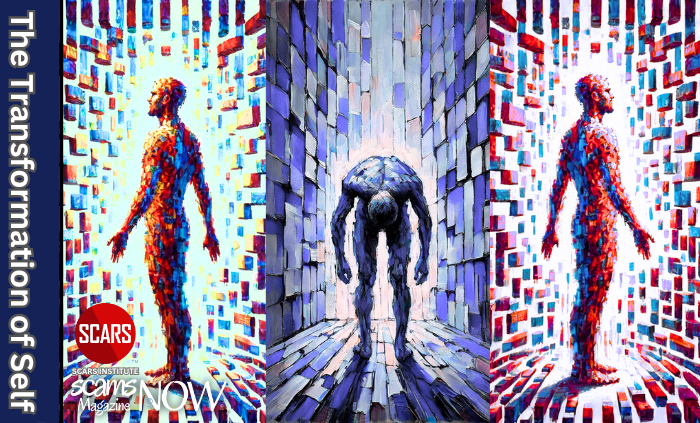
The Transformation of Self – Recovering from a Relationship Scam
The Fractured Self and the Work of Becoming Again Via Scam Victim Recovery
Primary Category: Essay / Scam Victim Recovery Philosophy
Authors:
• Tim McGuinness, Ph.D., DFin, MCPO, MAnth – Anthropologist, Scientist, Polymath, Director of the Society of Citizens Against Relationship Scams Inc.
Author Biographies Below
About This Article
The experience of relationship scam victimization produces a profound disruption in identity, perception, and trust, forcing individuals into a process of psychological and philosophical transformation. Initially grounded in a sense of stable selfhood, victims are drawn into a constructed reality that collapses, resulting in fragmentation, disorientation, and loss of narrative coherence. This rupture extends to internal trust, leading to self-doubt and alienation. Through reflection, individuals confront vulnerabilities and re-evaluate meaning, often entering a transitional state between former and emerging identities. Over time, recovery involves reconstructing a coherent sense of self, restoring measured trust, and developing practical awareness of deception. The process reflects broader philosophical themes of impermanence, becoming, and the evolving nature of identity shaped by lived experience.
Note: This article is intended for informational purposes and does not replace professional medical advice. If you are experiencing distress, please consult a qualified mental health professional.
The Fractured Self and the Work of Becoming Again Via Scam Victim Recovery
An Essay by Prof. Tim McGuinness,
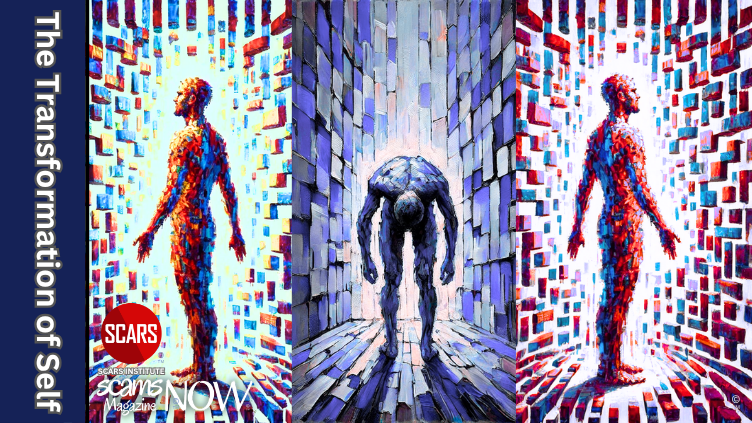
The Three Phases of a Scam Victim’s Self
The experience of being deceived in a relationship scam is not simply an event that happens to you. It becomes a rupture in your sense of reality, identity, and continuity. What follows is not just recovery in a practical sense, but a deep transformation that reaches into philosophy, psychology, and the nature of what it means to exist as a self. This transformation has been explored, in fragments, across centuries of philosophical thought, from Western existentialism to Eastern contemplative traditions. When placed together, these ideas begin to form a map of what you are going through and what it means.
This is not a simple return to who you were – you will never be who you were again – you will be different. However, it is a passage through disintegration and into reconstruction. It is a movement from coherence, through distortion, and toward a new form of clarity that carries the imprint of what has been endured.
The Illusion of the Stable Self
Before the scam, life often appears stable. Your identity feels continuous, your perceptions feel trustworthy, and your relationships seem grounded in shared reality. This sense of stability aligns with what many Western philosophers once assumed about the self, that it is a consistent, unified entity moving through time.
However, thinkers such as David Hume challenged this idea by suggesting that the self is not a fixed object, but a bundle of perceptions constantly changing. You do not notice this instability in ordinary life because your environment reinforces continuity. Your routines, relationships, and expectations all support the illusion of a stable identity. This is also consistent with the psychological model of the Internal Family System or “Parts Theory”.
A relationship scam disrupts that illusion with precision. It introduces a constructed reality that feels authentic enough to be trusted, yet is fundamentally false. When this false reality collapses, it does not simply remove a relationship. It destabilizes the very mechanism by which you determine what is real and what is not.
At this stage, you feel as though you have lost not just a person, but your ability to trust your own mind. This is where the philosophical question becomes unavoidable. If your perceptions can be manipulated so deeply, then what is the self that relies on those perceptions?
The Manufactured Reality and the Fragmented Mind
The grooming process used in scams functions as a form of controlled reality modification or construction. It gradually replaces external reference points with an internally consistent narrative that is guided by the scammers. This process aligns with ideas explored by phenomenologists such as Edmund Husserl, who examined how reality is constituted through perception and meaning, rather than objective reality.
In your experience, the scam becomes a lived world. It is not simply information. It is a relationship, a future, a structure of meaning, a changed story of yourself. When that structure is revealed to be false, the collapse is not partial. It is total within that constructed domain.
This collapse produces what can be understood as fragmentation. Your memories remain, but their meaning changes. Your emotional investments remain, but their object disappears. Your sense of time feels distorted, as past, present, and imagined future no longer align.
Philosophically, this resembles what Jean-Paul Sartre described as the confrontation with nothingness. The person who seemed present is revealed to be absent. Yet the absence is not empty. It is filled with the weight of what was believed to exist.
You find yourself asking questions that feel both simple and impossible. How could this be real and not real at the same time? How can something that shaped your life so deeply turn out to have no authentic existence?
These questions are not signs of confusion alone. They are signs that you are encountering the limits of how the mind constructs reality.
The Loss of Coherence and the Experience of the “Not Quite”
After the collapse, many victims describe a state that feels difficult to define. You are still yourself, but not in the same way. Your thoughts feel unfamiliar. Your emotional responses seem disproportionate or unpredictable. Your sense of connection to others feels weakened or strained.
This state can be described as the “not quite.” You are not who you were before, but you are not yet who you will become. This in-between condition has been explored in various philosophical traditions.
- In existential philosophy, this resembles a crisis of authenticity. The assumptions that once guided your life have been disrupted, forcing you to confront the responsibility of redefining meaning without relying on those assumptions.
- In Buddhist thought, this state aligns with the recognition of impermanence and non-self. The idea that the self is not fixed can become more than an abstract concept. It becomes an immediate experience. What you thought was stable has revealed itself to be contingent and subject to change.
- In Daoist philosophy, this in-between state reflects the concept of transformation as a natural process. The Dao is not static. It is a flow of change in which forms arise and dissolve. From this perspective, the feeling of being “not quite” is not a failure. It is a stage within a larger movement.
However, understanding these ideas intellectually does not remove the distress. The lived experience of fragmentation can feel disorienting and painful. It includes intrusive thoughts, emotional swings, difficulty concentrating, and a persistent sense of unreality.
This is where the philosophical and the psychological meet. The transformation is not just conceptual. It is embodied.
The Encounter With Betrayal and the Shattering of Trust
At the center of this transformation is betrayal. The harm is not limited to deception. It involves the violation of trust at a fundamental level. Trust is not only about other people. It is also about your relationship with your own judgment.
Philosophers such as Søren Kierkegaard explored the idea of trust as a leap, a movement beyond certainty. In ordinary life, you make these leaps constantly. You trust that others are who they say they are. You trust that your interpretations of their actions are valid.
A scam exploits this natural human tendency. It does not create trust from nothing. It amplifies and redirects it. When the deception is revealed, the collapse of trust extends inward. You begin to question your own capacity to judge, to interpret, and to decide.
This internalization of doubt can lead to a form of self-alienation – dissonance. You feel separated from your previous self, as though that version of you made decisions that you cannot understand or accept.
Philosophically, this reflects a rupture in narrative identity. The story you tell about yourself no longer fits together in a coherent way. There is a discontinuity between who you believed yourself to be and what has occurred.
This rupture can feel like a loss of dignity or worth, but it is much deeper. It is important to recognize that this perception arises from the disruption of narrative coherence (your schemas), not from an actual loss of value. The experience challenges your sense of self, but it does not define your essence because you still hold the power of transformation and recovery.
The Descent Into Reflection and the Search for Meaning
After the initial shock, many victims enter a period of intense reflection. You revisit conversations, analyze decisions, and attempt to identify the point at which things went wrong. This process can feel compulsive, but it also serves a purpose.
Ironically, the point where things went wrong is easy to identify. It was a singular mistake of talking to a stranger. We all make mistakes, so that mistake is easily forgivable. But the damage and the true blame came from the criminal intent of the scammers.
In philosophical terms, this stage resembles what Friedrich Nietzsche described as a descent into the depths of experience in order to re-evaluate values. When existing frameworks collapse, new ones must be constructed.
This process is, without any doubt, painful because it requires confronting uncomfortable truths. You must recognize vulnerabilities that were previously unnoticed. You must see patterns in your thinking or behavior that contributed to your susceptibility. This does not mean you attach blame to them, just recognize the truth of their existence.
At the same time, this reflection can open the possibility of growth. It allows you to move from a passive understanding of what happened to an active engagement with its meaning.
In Eastern traditions, particularly in Zen Buddhism, there is an emphasis on direct experience as a path to insight. The disruption of ordinary assumptions can create an opportunity to see reality more clearly, without the filters that previously shaped perception.
This does not mean that the experience is beneficial in itself. The harm remains real and significant. However, within that harm, there is the potential for a deeper understanding of yourself and the world.
The Work of Reconstitution and the Emergence of a New Self
Rebuilding the self after a scam is not about returning to a previous identity. It is about reconstituting your sense of self in a way that incorporates what has been learned.
This process involves several dimensions. You begin to reconstruct your narrative identity by integrating the experience into your life story. Instead of viewing it as an isolated event, you place it within a broader context of who you are and how you have changed, what you have learned, and how you have grown.
You also work to restore trust, both in others and in yourself. This does not mean returning to the same level of openness without discernment – far from it. It involves developing a more nuanced understanding of trust, one that balances openness with awareness, boundaries, and self-protection.
Philosophically, this stage aligns with the concept of becoming. Rather than seeing the self as a fixed entity, you begin to understand it as a process that evolves over time. It is a process of transformation.
In Daoist thought, this reflects the idea of harmony with change. Instead of resisting or avoiding the transformation, you learn to move with it, to adapt to it, and maybe even learn to love your new changes. The goal is not to eliminate uncertainty, not to eliminate trauma and grief, but to navigate it with greater clarity, with an appreciation that they can light the way for your new self.
In existential terms, this is an act of freedom and true agency. You are not defined solely by what has happened to you. What happened to you is a chapter in your new life story, and you participate in shaping what comes next.
This does not mean that the past loses its significance. The experience remains part of you. It informs your perceptions, your decisions, and your relationships. However, it no longer dominates your identity in the same way.
The Integration of Experience and the Development of Wisdom
As the process continues, there is a gradual integration of the experience – this is also known as reframing. The intensity of emotions decreases, and the sense of fragmentation begins to resolve. You find that you can think about what happened without the same level of distress – every day a bit easier, until one day, you don’t think about it at all. Then days go by, weeks, months, and the events are just part of the background of who you are.
This stage can be understood as the development of wisdom. Not in an abstract sense, but as a practical, embodied understanding of how deception works, how vulnerability operates, how your mind and nervous system respond, and how resilience can be cultivated.
Philosophers across traditions have emphasized that wisdom arises from difficulty and suffering. It is not simply the accumulation of knowledge, but the transformation of understanding through experience.
In Stoic philosophy, adversity is seen as an opportunity to develop inner strength and clarity. In Buddhist thought, suffering can lead to insight into the nature of attachment and impermanence. In existentialism, confronting difficult realities can lead to a more authentic engagement with life.
For you, this integration manifests as increased discernment, greater emotional awareness, and a more grounded sense of yourself. You can become more attentive to inconsistencies, more cautious in forming attachments, and more deliberate in your decisions.
At the same time, there is a risk of becoming overly guarded or distrustful. The challenge is to balance protection with openness. This balance is not fixed. It evolves as you continue to engage with the world.
This is what lies ahead for you in your recovery and transformation.
The Return to Life and the Meaning of Transformation
The final stage of this transformation is not a clear endpoint – after all, there really is no ending. It is a return to life with a changed perspective. You engage with your relationships, work, and daily activities in ways that reflect what you have learned and who you have become.
This return is not a restoration of what was lost. It is the emergence of something new and possibly much better. You carry the memory of the experience, but you are not defined or triggered by it in the same way.
Philosophically, this can be seen as a movement from unexamined existence and reactive life to a more reflective and intentional way of living. The disruption has forced you to confront questions that might otherwise have remained unknown and unaddressed.
In this sense, the transformation is not only about recovery. It is about the expansion of awareness. You come to see the complexities of your life and human behavior in general, the fragility of perception, and the importance of discernment, both for safety and for peace.
This does not make the experience desirable. The harm remains real. The losses remain significant. However, the process of working through that harm can lead to a form of growth that is both psychological and philosophical.
You move from a state of assumed stability, through a period of fragmentation and uncertainty, and into a renewed engagement with life that carries greater depth. Assuming you allow it to happen.
Conclusion
The transformation that follows a relationship scam is not a return to a former life, but a reinvention of the self through disruption, reflection, and deliberate change. What begins as a collapse of trust and meaning gradually becomes an opportunity to rebuild coherence on more grounded foundations. You move from an unexamined sense of stability into a direct integration with how perception, trust, and identity are formed and influenced. This process is painful, disorienting, and often prolonged, yet it is also where the essential work of recovery takes place.
As you continue forward, the goal is not to erase what happened or to restore a previous version of yourself, but to reframe your life in new terms. The goal is to integrate the experience in a way that strengthens awareness, sharpens discernment, and restores confidence in your ability to navigate reality and live a life with wisdom and peace. You learn to recognize manipulation, to set boundaries, and to balance openness with caution. Over time, the intensity of the disruption decreases and quiets, and a new sense of continuity begins to form.
This transformation reflects a deeper philosophical truth. The self is not fixed. It evolves through experience, especially through adversity. What was once assumed becomes examined. What was once fragile becomes more resilient. You do not return unchanged. You emerge with a clearer understanding of yourself, your vulnerabilities, and your capacity to rebuild with intention and purpose.

Glossary
- Absence — Absence refers to the psychological and philosophical experience in which something believed to exist is revealed to be missing, yet still feels emotionally present. It carries weight because the mind continues to respond to what was expected rather than what is real. For scam victims, absence often manifests as the lingering emotional presence of a person who never truly existed. This creates confusion and grief that must be processed over time.
- Authenticity Crisis — Authenticity crisis describes a disruption in a person’s sense of being true to themselves following deception. It occurs when previously held beliefs about identity, values, and choices no longer align with current understanding. Victims may question their past decisions and feel disconnected from their prior sense of self. Recovery involves rebuilding a more grounded and self-aware identity.
- Becoming — Becoming refers to the philosophical concept that identity is not fixed but continuously evolving through experience. It emphasizes that the self is shaped over time rather than defined by a single event. For scam victims, this concept helps reframe recovery as a process of growth rather than restoration. It supports the understanding that transformation is ongoing and meaningful.
- Betrayal Violation — Betrayal violation describes the deep emotional and psychological harm caused when trust is deliberately exploited. It extends beyond deception and affects a person’s ability to feel safe in relationships and within themselves. Victims often experience confusion, anger, and self-doubt as a result. Healing involves recognizing that the violation came from external wrongdoing, not personal failure.
- Cognitive Fragmentation — Cognitive fragmentation refers to the breakdown of coherent thinking and meaning-making after the collapse of a false reality. Thoughts may feel disorganized, conflicting, or difficult to integrate. Victims may struggle to align memories with new knowledge about the deception. Recovery focuses on gradually restoring mental coherence through reflection and understanding.
- Constructed Reality — Constructed reality is the artificially created narrative built by scammers to manipulate perception and belief. It feels real because it is internally consistent and emotionally reinforced over time. Victims engage with this reality as if it reflects truth, shaping decisions and expectations. Understanding this concept helps explain why the experience felt genuine despite being false.
- Continuity Illusion — Continuity illusion refers to the belief that identity and life experience follow a stable, uninterrupted path. It is maintained by routines, relationships, and consistent interpretations of events. A scam disrupts this illusion by introducing a false narrative that later collapses. Victims must reconstruct a sense of continuity during recovery.
- Daoist Transformation — Daoist transformation reflects the philosophical idea that change is a natural and continuous process within life. It emphasizes flow, adaptation, and the emergence of new forms from disruption. For scam victims, this perspective can help normalize the experience of transition and uncertainty. It encourages acceptance of change as part of personal development.
- Discernment Development — Discernment development refers to the gradual strengthening of a person’s ability to evaluate information, relationships, and intentions. It becomes especially important after deception, when trust has been compromised. Victims learn to recognize inconsistencies and warning signs more effectively. This process supports safer and more informed decision-making.
- Dissonance State — Dissonance state describes the internal conflict that arises when beliefs, memories, and new information do not align. Victims may feel tension between what they experienced and what they now know to be true. This creates emotional discomfort and confusion. Resolution occurs through integration and re-evaluation of meaning.
- Embodied Transformation — Embodied transformation refers to the way psychological and philosophical changes are experienced physically and emotionally. It includes shifts in stress response, emotional regulation, and perception. Victims may notice changes in how their body reacts to reminders or stressors. Recovery involves both mental and physical adjustment.
- Emotional Residue — Emotional residue describes the lingering feelings that remain after the recognition of deception. These emotions persist even when the false reality is intellectually understood. Victims may continue to feel attachment, grief, or confusion. Processing these emotions is an essential part of recovery.
- Existential Confrontation — Existential confrontation refers to the direct encounter with fundamental questions about meaning, identity, and reality following a disruptive event. It forces individuals to reconsider assumptions that were previously taken for granted. Victims may question the nature of trust, perception, and selfhood. This confrontation can lead to a deeper understanding over time.
- Experiential Collapse — Experiential collapse is the sudden breakdown of a constructed emotional and cognitive world. It occurs when the deception is revealed and the supporting narrative dissolves. Victims lose not only a relationship but also the meaning attached to it. Recovery requires rebuilding a new framework of understanding.
- Fragmented Identity — Fragmented identity refers to a disrupted sense of self in which different aspects of identity feel disconnected or inconsistent. Victims may struggle to reconcile their past actions with their current awareness. This fragmentation can feel disorienting and destabilizing. Integration is achieved through reflection and narrative reconstruction.
- Grooming Process — The grooming process describes the systematic method used by scammers to build trust and manipulate perception over time. It involves gradual emotional engagement, reinforcement, and control of information. Victims are guided into a false sense of security and connection. Recognizing this process helps reduce self-blame and clarify responsibility.
- Identity Reconstruction — Identity reconstruction is the process of rebuilding a coherent sense of self after disruption. It involves integrating the experience of deception into a broader life narrative. Victims develop a more informed and resilient identity. This process supports long-term recovery and stability.
- Impermanence Recognition — Impermanence recognition refers to the understanding that all aspects of life, including identity and relationships, are subject to change. This concept is central in many Eastern philosophies. For scam victims, it can help explain the instability they experienced. It also supports acceptance of transformation as part of recovery.
- Internal Trust Collapse — Internal trust collapse describes the loss of confidence in one’s own judgment and perception after deception. Victims may question their ability to make decisions or interpret reality accurately. This can lead to hesitation and self-doubt. Rebuilding internal trust is a critical part of healing.
- Liminal State — Liminal state refers to the transitional phase between a former identity and an emerging one. It is characterized by uncertainty, instability, and openness to change. Victims may feel disconnected from both past and future selves. This state is temporary but essential for transformation.
- Meaning Reconstruction — Meaning reconstruction involves redefining the significance of experiences after a major disruption. Victims reinterpret events to create a coherent understanding that aligns with current knowledge. This process helps restore a sense of purpose and direction. It is central to psychological recovery.
- Narrative Identity Rupture — Narrative identity rupture describes the breakdown of the personal story that gives life coherence and continuity. The scam disrupts the storyline, creating gaps and contradictions. Victims may feel that their life narrative no longer makes sense. Recovery involves rebuilding this narrative with new insights.
- Non-Self Realization — Non-self realization refers to the recognition that identity is not fixed or permanent. This concept is drawn from Buddhist philosophy. Victims may experience this realization through the disruption of their previous sense of self. It can lead to greater flexibility in how identity is understood.
- Perceptual Instability — Perceptual instability describes the difficulty in trusting one’s interpretation of reality after deception. Victims may question what is real and what is not. This can create ongoing uncertainty and anxiety. Stabilization occurs through the gradual rebuilding of confidence in perception.
- Phenomenological Reality — Phenomenological reality refers to the experience of reality as it is perceived and interpreted by the individual. It emphasizes that meaning is constructed through perception. In scams, this constructed experience becomes deeply convincing. Understanding this helps explain why the deception felt real.
- Psychological Disorientation — Psychological disorientation is the confusion and lack of clarity that follows the collapse of a false reality. Victims may struggle to organize their thoughts and emotions. This can affect decision-making and daily functioning. Recovery involves restoring clarity through structured reflection.
- Reflective Descent — Reflective descent describes the process of deeply examining one’s experiences, decisions, and beliefs after disruption. It involves revisiting events to understand their meaning. While difficult, this process supports growth and learning. It allows victims to move from confusion to insight.
- Reframing Process — Reframing process refers to the reinterpretation of experiences in a way that reduces distress and supports understanding. Victims shift from viewing themselves as at fault to recognizing external manipulation. This change in perspective promotes healing. It also strengthens resilience.
- Relational Trust Disruption — Relational trust disruption describes the difficulty in trusting others after experiencing deception. Victims may become cautious or withdrawn in relationships. This response is protective but can limit connection. Gradual rebuilding of trust supports recovery.
- Residual Attachment — Residual attachment refers to the continued emotional connection to a person or relationship that has been revealed as false. Victims may struggle to detach from feelings that were genuinely experienced. This attachment can persist even after understanding the deception. Processing it is necessary for closure.
- Schema Disruption — Schema disruption involves the breakdown of mental frameworks used to interpret experiences and organize knowledge. The scam challenges assumptions about relationships, trust, and reality. Victims may feel uncertain about how to understand new situations. Rebuilding schemas supports stability.
- Self-Alienation — Self-alienation describes the feeling of being disconnected from one’s own identity and past actions. Victims may perceive their previous self as unfamiliar or distant. This can create internal conflict and distress. Integration helps restore a sense of unity.
- Self-Continuity Reconstruction — Self-continuity reconstruction refers to rebuilding a sense of ongoing identity after disruption. It involves connecting past, present, and future into a coherent narrative. Victims work to restore a sense of stability over time. This process supports emotional grounding.
- Sense-Making Process — The sense-making process involves organizing experiences into a meaningful framework that can be understood and accepted. Victims interpret events to reduce confusion and distress. This process evolves as new insights emerge. It is essential for recovery and adaptation.
- Stability Assumption — Stability assumption refers to the belief that life and identity are consistent and predictable. This assumption is often challenged by the experience of deception. Victims must adjust to a more complex understanding of change. This shift supports greater awareness.
- Stoic Resilience — Stoic resilience reflects the philosophical approach of focusing on what can be controlled while accepting what cannot. It emphasizes emotional regulation and clarity of thought. Victims can apply this perspective to manage distress and rebuild stability. It supports long-term strength.
- Temporal Distortion — Temporal distortion describes the altered perception of time following the collapse of a constructed reality. Past, present, and imagined future may feel misaligned. Victims may struggle to place events in a coherent timeline. Reorganization of time perception aids recovery.
- Transformational Passage — Transformational passage refers to the process of moving through disruption toward a new form of identity. It includes stages of fragmentation, reflection, and reconstruction. This passage is not linear and varies for each individual. It represents the core of recovery.
- Trust Recalibration — Trust recalibration involves adjusting how trust is given and maintained after deception. Victims learn to balance openness with caution. This process reduces vulnerability to future manipulation. It supports healthier relationships.
- Value Re-Evaluation — Value re-evaluation refers to reassessing personal beliefs and priorities after a disruptive experience. Victims examine what matters and why. This process can lead to more intentional decision-making. It contributes to a stronger sense of purpose.
- Vulnerability Recognition — Vulnerability recognition involves identifying personal tendencies that may have been exploited during the scam. This is done without assigning blame. Understanding these factors supports prevention and growth. It empowers victims to make safer choices.
- Wisdom Integration — Wisdom integration is the process of applying insights gained from experience to future decisions and behavior. It reflects a deeper understanding of self and environment. Victims use this knowledge to navigate life more effectively. It marks a mature stage of recovery.
Author Biographies
-/ 30 /-
What do you think about this?
Please share your thoughts in a comment below!
TABLE OF CONTENTS







CATEGORIES
ARTICLE META
Important Information for New Scam Victims
- Please visit www.ScamVictimsSupport.org – a SCARS Website for New Scam Victims & Sextortion Victims.
- SCARS Institute now offers its free, safe, and private Scam Survivor’s Support Community at www.SCARScommunity.org – this is not on a social media platform, it is our own safe & secure platform created by the SCARS Institute especially for scam victims & survivors.
- SCARS Institute now offers a free recovery learning program at www.SCARSeducation.org.
- Please visit www.ScamPsychology.org – to more fully understand the psychological concepts involved in scams and scam victim recovery.
If you are looking for local trauma counselors, please visit counseling.AgainstScams.org
If you need to speak with someone now, you can dial 988 or find phone numbers for crisis hotlines all around the world here: www.opencounseling.com/suicide-hotlines
Statement About Victim Blaming
Some of our articles discuss various aspects of victims. This is both about better understanding victims (the science of victimology) and their behaviors and psychology. This helps us to educate victims/survivors about why these crimes happened and not to blame themselves, better develop recovery programs, and help victims avoid scams in the future. At times, this may sound like blaming the victim, but it does not blame scam victims; we are simply explaining the hows and whys of the experience victims have.
These articles, about the Psychology of Scams or Victim Psychology – meaning that all humans have psychological or cognitive characteristics in common that can either be exploited or work against us – help us all to understand the unique challenges victims face before, during, and after scams, fraud, or cybercrimes. These sometimes talk about some of the vulnerabilities the scammers exploit. Victims rarely have control of them or are even aware of them, until something like a scam happens, and then they can learn how their mind works and how to overcome these mechanisms.
Articles like these help victims and others understand these processes and how to help prevent them from being exploited again or to help them recover more easily by understanding their post-scam behaviors. Learn more about the Psychology of Scams at www.ScamPsychology.org
SCARS INSTITUTE RESOURCES:
If You Have Been Victimized By A Scam Or Cybercrime
♦ If you are a victim of scams, go to www.ScamVictimsSupport.org for real knowledge and help
♦ SCARS Institute now offers its free, safe, and private Scam Survivor’s Support Community at www.SCARScommunity.org/register – this is not on a social media platform, it is our own safe & secure platform created by the SCARS Institute especially for scam victims & survivors.
♦ Enroll in SCARS Scam Survivor’s School now at www.SCARSeducation.org
♦ To report criminals, visit https://reporting.AgainstScams.org – we will NEVER give your data to money recovery companies like some do!
♦ Follow us and find our podcasts, webinars, and helpful videos on YouTube: https://www.youtube.com/@RomancescamsNowcom
♦ Learn about the Psychology of Scams at www.ScamPsychology.org
♦ Dig deeper into the reality of scams, fraud, and cybercrime at www.ScamsNOW.com and www.RomanceScamsNOW.com
♦ Scam Survivor’s Stories: www.ScamSurvivorStories.org
♦ For Scam Victim Advocates visit www.ScamVictimsAdvocates.org
♦ See more scammer photos on www.ScammerPhotos.com
You can also find the SCARS Institute’s knowledge and information on Facebook, Instagram, X, LinkedIn, and TruthSocial
Psychology Disclaimer:
All articles about psychology and the human brain on this website are for information & education only
The information provided in this and other SCARS articles are intended for educational and self-help purposes only and should not be construed as a substitute for professional therapy or counseling.
Note about Mindfulness: Mindfulness practices have the potential to create psychological distress for some individuals. Please consult a mental health professional or experienced meditation instructor for guidance should you encounter difficulties.
While any self-help techniques outlined herein may be beneficial for scam victims seeking to recover from their experience and move towards recovery, it is important to consult with a qualified mental health professional before initiating any course of action. Each individual’s experience and needs are unique, and what works for one person may not be suitable for another.
Additionally, any approach may not be appropriate for individuals with certain pre-existing mental health conditions or trauma histories. It is advisable to seek guidance from a licensed therapist or counselor who can provide personalized support, guidance, and treatment tailored to your specific needs.
If you are experiencing significant distress or emotional difficulties related to a scam or other traumatic event, please consult your doctor or mental health provider for appropriate care and support.
Also read our SCARS Institute Statement about Professional Care for Scam Victims – click here
If you are in crisis, feeling desperate, or in despair, please call 988 or your local crisis hotline – international numbers here.
More ScamsNOW.com Articles






A Question of Trust
At the SCARS Institute, we invite you to do your own research on the topics we speak about and publish. Our team investigates the subject being discussed, especially when it comes to understanding the scam victims-survivors’ experience. You can do Google searches, but in many cases, you will have to wade through scientific papers and studies. However, remember that biases and perspectives matter and influence the outcome. Regardless, we encourage you to explore these topics as thoroughly as you can for your own awareness.