




ScamsNOW!
The SCARS Institute Magazine about Scam Victims-Survivors, Scams, Fraud & Cybercrime



Electronic Dance Music EDM and Scam Victims Recovery
High Beat-Rate Electronic Dance Music (EDM) has Profound Emotional and Psychological Effects on Listeners
Primary Category: Scam Victim Recovery Psychology
Author:
• Tim McGuinness, Ph.D., DFin, MCPO, MAnth – Anthropologist, Scientist, Polymath, Director of the Society of Citizens Against Relationship Scams Inc.
Author Biographies Below
About This Article
High-beat-rate electronic dance music influences emotional and psychological states through dopamine release, endorphins, neural entrainment, and social bonding mechanisms. Its repetitive rhythms and structured buildups can alter focus, perception of time, and emotional intensity, producing both energizing and regulating effects. Compared to classical music, EDM is more physiologically arousing and immersive, engaging reward and threat systems more directly. For individuals with psychological trauma, responses to EDM vary by recovery stage, sensory tolerance, and personal preference. In early trauma recovery, intense stimulation may increase hyperarousal and anxiety, while later stages may allow safe engagement that supports emotional expression and reconnection. Effective use depends on personalization, pacing, and respect for individual agency rather than universal application.
Note: This article is intended for informational purposes and does not replace professional medical advice. If you are experiencing distress, please consult a qualified mental health professional.

EDM Music “Scammers”
by Tim McGuinness, Ph.D.
Copyright © 2026 SCARS Institute
Classical Music “Classical Focus”
by Tim McGuinness, Ph.D.
Copyright © 2026 SCARS Institute
High Beat-Rate Electronic Dance Music (EDM) has Profound Emotional and Psychological Effects on Listeners
The EDM Effect
High beat-rate electronic dance music (EDM) has profound and multifaceted emotional and psychological effects on listeners, driven by its unique ability to engage the brain’s reward systems, modulate neurochemistry, and influence physiological states. The intense, rhythmic nature of EDM, characterized by pulsating beats, buildups of tension, and cathartic “drops,” creates a powerful sensory experience that can significantly alter mood, cognition, and even social perception.1
One of the primary mechanisms behind EDM’s emotional impact is its ability to trigger the release of neurochemicals associated with pleasure and reward. When listeners engage with EDM, particularly during moments of anticipation leading up to a drop, the brain releases a surge of dopamine, a neurotransmitter linked to feelings of euphoria and motivation. This dopamine release is not merely a passive response but is amplified by the brain’s prediction of pleasure, creating a cycle of anticipation and reward that heightens emotional intensity. This neurochemical cascade is often accompanied by the release of endorphins, which act as natural painkillers and mood elevators, contributing to the feelings of euphoria and reduced stress commonly reported by EDM listeners.
The psychological effects of EDM extend beyond temporary mood enhancement. Research indicates that the repetitive rhythms and structured patterns of EDM can induce a state of neural entrainment, where brainwaves synchronize to the music’s tempo. This synchronization can lead to altered states of consciousness, including heightened focus, increased energy, and a sense of time distortion. For many, this manifests as a feeling of being “in the zone” or fully immersed in the musical experience, which can be both psychologically invigorating and emotionally cathartic.
EDM also has significant implications for emotional regulation and stress reduction. Studies on music-based interventions have consistently shown that listening to music, including high-energy genres like EDM, can reduce symptoms of anxiety and depression by modulating activity in the brain’s limbic structures, such as the amygdala, which is central to emotional processing. The immersive quality of EDM can serve as a form of distraction from negative thoughts, allowing listeners to break cycles of rumination and experience temporary relief from psychological distress.
From a social perspective, EDM’s communal nature, often experienced in settings like festivals and dance clubs, creates a sense of connection and belonging. The shared experience of synchronized movement to a powerful beat can promote the release of oxytocin, a hormone associated with social bonding and trust. This collective euphoria can enhance feelings of unity and empathy, counteracting feelings of isolation and loneliness.
However, it is important to note that the effects of EDM can vary based on individual preferences and context. While many find its high energy and intensity uplifting, others may experience overstimulation or anxiety, particularly in environments with overwhelming sensory input. Personalization of music interventions is critical to maximizing therapeutic benefits, as individual responses to musical stimuli are highly variable. Everyone is encouraged to find music that works for them.
High beat-rate EDM exerts its emotional and psychological effects through a combination of neurochemical release, neural entrainment, and social synchronization, though even alone at home, the beat can still work its magic. Its ability to stimulate the brain’s reward systems, modulate emotional responses, and foster social connection makes it a powerful tool for mood enhancement, stress reduction, and even therapeutic intervention in certain contexts.
What is Entrainment?
begin to synchronize with one another through interaction. This phenomenon was first identified by the Dutch physicist Christiaan Huygens in the 17th century when he observed that pendulum clocks mounted on the same wall would eventually fall into perfect synchronized swing. In a biological context, entrainment describes how an external rhythm can influence and align an organism’s internal rhythms. The most common example is circadian entrainment, where the daily light-dark cycle synchronizes our internal body clocks. In the realm of neuroscience and psychology, neural entrainment refers to the process where brainwave activity, its electrical oscillations, synchronizes with the rhythmic patterns of external stimuli, such as sound or light. When you listen to music with a strong, consistent beat, your brain’s electrical patterns begin to align with that tempo, which can profoundly alter your state of consciousness, focus, and emotional experience. This synchronization is what allows rhythmic auditory stimulation to influence cognitive functions and is the mechanism behind the trance-like states or heightened focus that can be induced by music.
EDM Differs from Listening to Classical Music
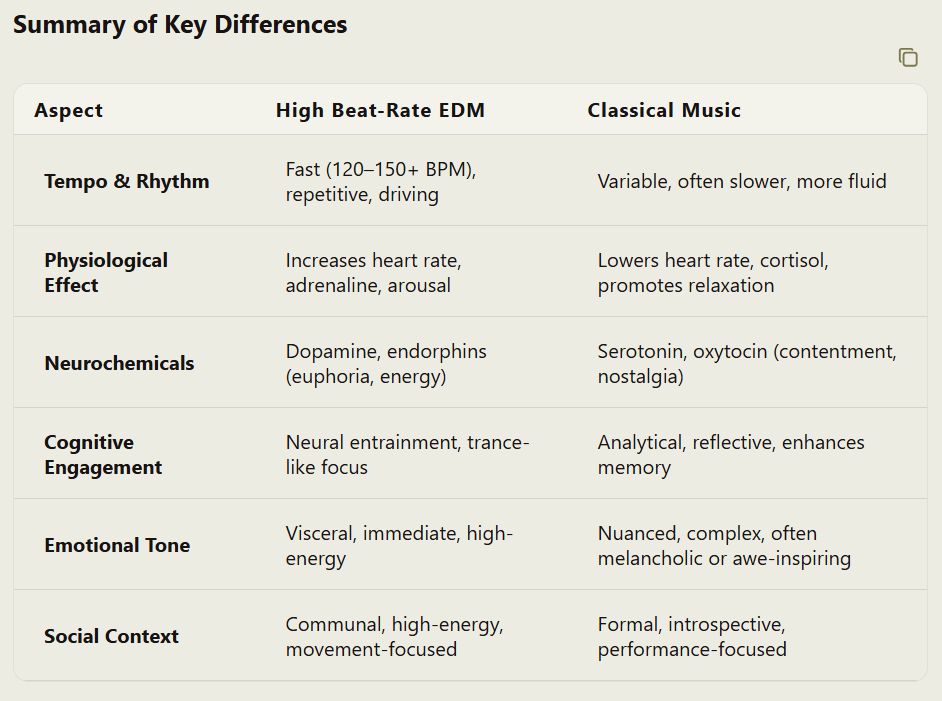
The emotional and psychological effects of listening to high-beat-rate electronic dance music (EDM) differ profoundly from those of listening to classical music, primarily due to their contrasting structural, rhythmic, and harmonic characteristics. While both genres can evoke powerful emotional responses, they engage the brain and body in fundamentally different ways, leading to distinct psychological outcomes.
Neurochemical and Physiological Responses
EDM is designed to be physiologically arousing, with its high tempo (typically 120–150+ beats per minute) and strong, repetitive basslines driving an increase in heart rate, adrenaline, and cortisol release in a way that mimics a “fight or flight” response, but in a controlled, enjoyable context. This arousal is closely tied to the release of dopamine and endorphins, which create feelings of euphoria, energy, and excitement, particularly during the build-up and “drop” phases of a track. The brain’s reward system is heavily engaged by the predictable yet intense anticipation of these moments, making EDM a highly stimulating and emotionally charged experience.
In contrast, classical music, particularly slower, more structured pieces (e.g., adagio or largo movements), tends to have a calming effect on the nervous system. Research has shown that classical compositions can reduce cortisol levels, lower blood pressure, and slow heart rate, inducing a state of relaxation and even altered consciousness similar to meditation. The harmonic complexity and melodic development in classical music engage the brain’s analytical and emotional centers more gently, often leading to the release of serotonin and oxytocin, which are associated with feelings of contentment, nostalgia, and emotional depth.
Cognitive and Emotional Engagement
EDM’s primary psychological effect is one of immersion and entrainment. The repetitive, percussive rhythms encourage neural synchronization, where brainwaves align with the beat, fostering a state of heightened focus and sometimes even time distortion. This can lead to a trance-like state where external concerns fade away, and the listener is fully absorbed in the present moment. The emotional experience is often visceral and immediate, tied to the physical sensation of movement and rhythm.
Classical music, on the other hand, invites a more reflective and narrative form of engagement. The lack of a consistent, driving beat allows the listener to focus on melodic development, harmonic progression, and structural changes (e.g., transitions between movements in a symphony). This engages the prefrontal cortex, which is associated with decision-making, memory, and emotional regulation. Studies have shown that listening to classical music can enhance cognitive function, improve focus, and even temporarily boost spatial-temporal reasoning (the “Mozart Effect,” though its long-term validity is debated). The emotional response is often more nuanced and complex, capable of evoking a wide range of feelings, from melancholy and longing to triumph and awe, through its dynamic shifts and intricate phrasing.
Social and Cultural Context
The social experience of EDM is often communal and high-energy, with festivals and club environments fostering a sense of unity through synchronized movement and shared euphoria. The release of oxytocin in these settings can enhance feelings of connection and belonging, making the experience as much about social bonding as it is about the music itself.
Classical music, while also enjoyed in social settings like concerts, tends to encourage more introspective and individualized emotional responses. The concert hall environment is typically more formal, with listeners seated and focused on the performance, which can lead to a more personal and internalized experience. The emotional connection is often with the composer’s intent or the performer’s interpretation, creating a sense of historical or artistic continuity rather than the immediate, physical release associated with EDM.
– – –
– – –
EDM Affects Those Who Have Been Psychologically Traumatized
The effects of high beat-rate electronic dance music (EDM) on individuals who have been psychologically traumatized are complex and highly dependent on the individual’s stage of recovery, personal preferences, and the nature of their trauma. While music therapy is a recognized and effective tool for psychological trauma recovery, the specific genre of music, including high-energy EDM, must be considered with care.
Potential Benefits of EDM in Trauma Recovery
In certain contexts, EDM can offer unique therapeutic benefits for trauma survivors. The intense, rhythmic nature of EDM can facilitate a state of neural entrainment, where brainwaves synchronize to the music’s tempo, potentially helping to disrupt the intrusive thought patterns and rumination that are common in trauma-related disorders like PTSD.
This immersive quality can provide a powerful form of distraction, allowing the individual to break free from the cycle of negative memories and experience a temporary state of being “in the zone” or fully present in the moment.
Furthermore, the predictable structure of EDM, with its buildups of tension and cathartic “drops”, can create a safe, controlled experience of emotional intensity. For a trauma survivor who may feel overwhelmed by unpredictable emotional triggers, the ability to anticipate and experience a powerful emotional release within the structured framework of a song can be empowering. This can help the individual reconnect with their body and emotions in a way that feels manageable, potentially aiding in emotional regulation and the processing of difficult feelings.
The communal aspect of EDM culture, when experienced in a safe and controlled environment, can also foster a sense of connection and belonging, counteracting the isolation that often accompanies trauma.
When EDM Is Not Advised
Despite these potential benefits, there are critical points in trauma recovery where high beat-rate EDM is not advised and could be counterproductive or even harmful. In the immediate aftermath of a traumatic event or during periods of acute distress, the nervous system is often in a state of hyperarousal. The high tempo, loud volume, and intense sensory input of EDM can easily overwhelm an already dysregulated nervous system, potentially exacerbating symptoms of anxiety, panic, and hyperarousal.
For individuals with hypervigilance, the sudden, sharp sounds and dynamic shifts common in EDM could be perceived as threatening, triggering a fear or trauma response.
For individuals whose trauma involved sensory overload, chaotic environments, or loss of control, the intense and immersive nature of EDM could be re-traumatizing. The very elements that make the genre appealing to some, its power to command attention and dominate the senses, could mirror the overwhelming feelings experienced during the traumatic event, making it a risky choice for therapeutic listening.
A Staged Approach to Using Music in Recovery
A more nuanced approach is to consider the individual’s stage of recovery and tailor the music accordingly. In the early stages of recovery, the focus is typically on stabilization, safety, and grounding. During this phase, calming, predictable, and gentle music is generally recommended to help regulate the nervous system and create a sense of safety. Music with a slower tempo, simple melodies, and minimal dynamic shifts is more likely to be beneficial at this stage.
As an individual progresses in their recovery and begins to develop stronger coping skills, they may be able to tolerate and even benefit from more stimulating music. This is the point where carefully selected EDM might be introduced, perhaps in a therapeutic setting with a trained music therapist who can help the individual process the emotions that arise.
The therapist might use the rhythmic elements of the music to facilitate movement and expression, or use the predictable structure of the music to help the individual practice tolerating and regulating intense emotions in a controlled way.
In the later stages of recovery, as the individual works on reintegrating into society and reclaiming parts of their life that were lost to the trauma, EDM could play a role in helping them reconnect with joy, energy, and social connection. For a younger person in particular, EDM might be a part of their desired identity and social life, and finding a way to safely enjoy it could be an important step in feeling “normal” again.
The Importance of Personalization and Agency
Ultimately, the most critical factor is the individual’s personal preference and sense of agency. Music is a highly personal experience, and what one person finds healing, another may find irritating or triggering.
The principle of “individual choice” is central to effective music therapy; allowing the individual to select the music they feel drawn to can enhance their sense of control and empowerment, which is especially important for trauma survivors who often feel a profound loss of agency.
If an individual has a pre-existing positive connection to EDM and finds it comforting or energizing, it may be a valuable tool in their recovery, even if it seems counterintuitive. Conversely, if they have negative associations with the genre or simply do not enjoy it, forcing it as a therapeutic tool would be counterproductive. The goal is to use music to support the individual’s recovery journey, and that means honoring their unique relationship with music and their individual needs at each stage of the process.
High beat-rate EDM is neither universally beneficial nor universally harmful for trauma survivors. Its effects are highly individual and context-dependent. While it can offer a unique path to emotional release, neural entrainment, and social connection, it also carries the risk of sensory overload and re-traumatization, especially in the early stages of recovery. A thoughtful, staged, and highly personalized approach, ideally guided by a trained music therapist, is essential to determining when and how EDM can be a helpful part of a trauma survivor’s healing journey.
Conclusion
High beat-rate electronic dance music exerts powerful effects on the brain and body through neurochemical activation, rhythmic entrainment, and social synchronization. These effects can support mood elevation, focus, emotional release, and connection when conditions are appropriate. At the same time, intensity, sensory load, and context matter. For individuals with psychological trauma, especially those early in recovery, high-energy stimulation can either aid regulation or overwhelm an already dysregulated nervous system. The determining factors are timing, environment, personal history, and choice. A staged and individualized approach to music exposure allows benefits without increasing risk. When used with awareness and agency, music can become a supportive tool rather than a destabilizing force. The central principle remains matching stimulation to nervous system capacity, not forcing intensity in the name of progress.

Glossary
- Adrenaline Response — Adrenaline response refers to the activation of the body’s arousal system during intense stimulation, such as high-beat-rate music. In this state, heart rate, alertness, and energy increase, which can feel pleasurable or overwhelming depending on nervous system regulation.
- Altered States of Consciousness — Altered states of consciousness describe shifts in awareness, perception, or sense of time that differ from ordinary waking experience. Music-induced entrainment can produce these states, resulting in immersion, detachment from external stressors, or heightened focus.
- Amygdala Activation — Amygdala activation refers to changes in the brain region responsible for emotional processing, fear detection, and threat assessment. Music can either calm or stimulate this area, influencing anxiety, emotional regulation, and trauma responses.
- Anticipation and Reward Cycle — Anticipation and reward cycle describes the brain’s pattern of predicting pleasure and responding with dopamine release when expectations are met. In music, this cycle intensifies emotional response during buildups and drops.
- Auditory Stimulation — Auditory stimulation refers to sound input that affects brain activity, mood, and physiological responses. Rhythmic and repetitive auditory input can strongly influence attention, arousal, and emotional state.
- Autonomic Nervous System — The autonomic nervous system regulates involuntary bodily functions such as heart rate and breathing. Music can shift this system toward activation or relaxation depending on tempo, volume, and individual sensitivity.
- Baseline Regulation — Baseline regulation refers to the nervous system’s resting capacity to maintain emotional and physiological stability. Trauma and overstimulation can disrupt this baseline, altering how music is experienced.
- Cathartic Release — Cathartic release describes the emotional discharge that can occur during intense musical moments. For some individuals, this release feels relieving, while for others it may surface overwhelming emotions.
- Cognitive Load — Cognitive load refers to the amount of mental effort being used at a given time. Complex or intense music can increase cognitive load, which may either focus attention or exhaust mental resources.
- Communal Synchronization — Communal synchronization describes shared rhythmic movement and emotional alignment within a group. This experience can enhance feelings of belonging and reduce perceived isolation.
- Context Sensitivity — Context sensitivity refers to how environmental factors such as crowd size, volume, and safety influence emotional and physiological responses. Music effects vary significantly depending on the setting.
- Cortisol Modulation — Cortisol modulation describes changes in stress hormone levels in response to stimuli. Certain music can raise or lower cortisol, affecting stress, alertness, and emotional balance.
- Dopamine Release — Dopamine release is the brain’s chemical response associated with pleasure, motivation, and reward learning. Rhythmic anticipation in music strongly stimulates this system.
- Emotional Arousal — Emotional arousal refers to the intensity of emotional activation rather than emotional type. High-tempo music tends to increase arousal, which can feel energizing or destabilizing.
- Emotional Regulation — Emotional regulation describes the ability to manage emotional responses without becoming overwhelmed or shut down. Music can support or interfere with this capacity depending on timing and intensity.
- Endorphin Activation — Endorphin activation involves the release of natural pain-relieving and mood-enhancing chemicals. This process contributes to feelings of pleasure and stress reduction during music listening.
- Entrainment — Entrainment is the synchronization of internal biological rhythms with external rhythmic stimuli. In music, this occurs when brainwaves align with tempo, influencing focus and emotional state.
- Executive Function — Executive function includes cognitive skills such as decision-making, impulse control, and attention. Music that overwhelms these systems can impair judgment in vulnerable individuals.
- Fight or Flight Response — The fight or flight response is the body’s automatic reaction to perceived threat. High-energy music can activate this response in a controlled or uncontrolled manner.
- Grounding — Grounding refers to techniques or experiences that restore a sense of safety and present-moment awareness. Gentle music is often used for grounding during early trauma recovery.
- Hyperarousal — Hyperarousal is a state of heightened nervous system activation marked by anxiety, restlessness, or vigilance. Intense music can worsen this state when regulation capacity is low.
- Hypervigilance — Hypervigilance describes constant scanning for danger following trauma. Sudden or loud musical changes can trigger this response unintentionally.
- Immersion — Immersion refers to deep absorption in an experience where external concerns fade. Music-induced immersion can feel restorative or dissociative depending on context.
- Individual Agency — Individual agency is the sense of control over personal choices and experiences. Allowing music selection supports agency, which is critical in trauma recovery.
- Limbic System — The limbic system is a network of brain structures involved in emotion and memory. Music directly engages this system, shaping emotional reactions.
- Mood Elevation — Mood elevation describes a temporary improvement in emotional state. Music can elevate mood without addressing underlying distress, which is important to recognize in recovery.
- Music Therapy — Music therapy is a clinical practice using music intentionally to support psychological healing. Professional guidance helps match music intensity to the recovery stage.
- Neural Oscillations — Neural oscillations are rhythmic electrical patterns in the brain. Music can influence these patterns through entrainment, altering awareness and emotion.
- Neurochemical Cascade — Neurochemical cascade refers to the sequence of neurotransmitter releases triggered by stimulation. Music can initiate cascades involving dopamine, endorphins, and oxytocin.
- Neuroplasticity — Neuroplasticity is the brain’s ability to change in response to experience. Repeated musical engagement can strengthen or weaken emotional patterns over time.
- Overstimulation — Overstimulation occurs when sensory input exceeds processing capacity. Loud, fast music can overwhelm traumatized nervous systems.
- Oxytocin Release — Oxytocin release supports social bonding and trust. Shared musical experiences can stimulate this hormone, enhancing connection.
- Physiological Arousal — Physiological arousal includes changes such as increased heart rate and muscle tension. Music tempo strongly influences this response.
- Predictability — Predictability refers to the ability to anticipate upcoming stimuli. Predictable musical structure can feel safe and regulating for trauma survivors.
- Psychological Safety — Psychological safety is the perception of being free from threat or harm. Music choice should support safety rather than challenge it prematurely.
- Recovery Stage — Recovery stage refers to the phase of healing following trauma. Music suitability varies significantly across stages.
- Rumination Disruption — Rumination disruption describes the interruption of repetitive negative thinking. Music immersion can temporarily reduce rumination.
- Sensory Load — Sensory load is the total amount of sensory input being processed. High sensory load increases the risk of overwhelm.
- Sensory Overload — Sensory overload occurs when the nervous system cannot integrate incoming stimuli. Trauma history increases vulnerability to overload.
- Serotonin Regulation — Serotonin regulation involves neurotransmitter balance associated with calmness and contentment. Certain music styles support this system.
- Social Bonding — Social bonding refers to an emotional connection formed through shared experience. Music-driven bonding can reduce loneliness.
- Sound Intensity — Sound intensity describes the volume and physical impact of sound waves. Excessive intensity can destabilize vulnerable listeners.
- Stabilization Phase — The stabilization phase is the early stage of trauma recovery, focused on safety and regulation. Music during this phase should be calming and predictable.
- Stress Reduction — Stress reduction refers to lowering physiological and psychological tension. Music can support this when matched to nervous system capacity.
- Temporal Distortion — Temporal distortion is an altered perception of time passing. Music entrainment can produce this effect.
- Therapeutic Window — Therapeutic window describes the range of stimulation that is beneficial without being overwhelming. Music selection should stay within this window.
- Tolerance Building — Tolerance building involves gradually increasing the capacity for stimulation. Music intensity may be increased carefully as recovery progresses.
- Trance-Like State — Trance-like state refers to focused absorption with reduced awareness of surroundings. This state can be soothing or destabilizing depending on readiness.
- Trauma Sensitivity — Trauma sensitivity describes heightened reactivity to stimuli following trauma. Music must be chosen with this sensitivity in mind.
- Trigger Response — Trigger response is an automatic emotional or physiological reaction to reminders of past distress. Music dynamics can unintentionally trigger responses.
- Volume Regulation — Volume regulation involves controlling sound intensity to maintain safety. Lower volume often supports regulation in early recovery.
Author Biographies
-/ 30 /-
What do you think about this?
Please share your thoughts in a comment below!
TABLE OF CONTENTS





CATEGORIES
ARTICLE META
Important Information for New Scam Victims
- Please visit www.ScamVictimsSupport.org – a SCARS Website for New Scam Victims & Sextortion Victims.
- SCARS Institute now offers its free, safe, and private Scam Survivor’s Support Community at www.SCARScommunity.org – this is not on a social media platform, it is our own safe & secure platform created by the SCARS Institute especially for scam victims & survivors.
- SCARS Institute now offers a free recovery learning program at www.SCARSeducation.org.
- Please visit www.ScamPsychology.org – to more fully understand the psychological concepts involved in scams and scam victim recovery.
If you are looking for local trauma counselors, please visit counseling.AgainstScams.org
If you need to speak with someone now, you can dial 988 or find phone numbers for crisis hotlines all around the world here: www.opencounseling.com/suicide-hotlines
Statement About Victim Blaming
Some of our articles discuss various aspects of victims. This is both about better understanding victims (the science of victimology) and their behaviors and psychology. This helps us to educate victims/survivors about why these crimes happened and not to blame themselves, better develop recovery programs, and help victims avoid scams in the future. At times, this may sound like blaming the victim, but it does not blame scam victims; we are simply explaining the hows and whys of the experience victims have.
These articles, about the Psychology of Scams or Victim Psychology – meaning that all humans have psychological or cognitive characteristics in common that can either be exploited or work against us – help us all to understand the unique challenges victims face before, during, and after scams, fraud, or cybercrimes. These sometimes talk about some of the vulnerabilities the scammers exploit. Victims rarely have control of them or are even aware of them, until something like a scam happens, and then they can learn how their mind works and how to overcome these mechanisms.
Articles like these help victims and others understand these processes and how to help prevent them from being exploited again or to help them recover more easily by understanding their post-scam behaviors. Learn more about the Psychology of Scams at www.ScamPsychology.org
SCARS INSTITUTE RESOURCES:
If You Have Been Victimized By A Scam Or Cybercrime
♦ If you are a victim of scams, go to www.ScamVictimsSupport.org for real knowledge and help
♦ SCARS Institute now offers its free, safe, and private Scam Survivor’s Support Community at www.SCARScommunity.org/register – this is not on a social media platform, it is our own safe & secure platform created by the SCARS Institute especially for scam victims & survivors.
♦ Enroll in SCARS Scam Survivor’s School now at www.SCARSeducation.org
♦ To report criminals, visit https://reporting.AgainstScams.org – we will NEVER give your data to money recovery companies like some do!
♦ Follow us and find our podcasts, webinars, and helpful videos on YouTube: https://www.youtube.com/@RomancescamsNowcom
♦ Learn about the Psychology of Scams at www.ScamPsychology.org
♦ Dig deeper into the reality of scams, fraud, and cybercrime at www.ScamsNOW.com and www.RomanceScamsNOW.com
♦ Scam Survivor’s Stories: www.ScamSurvivorStories.org
♦ For Scam Victim Advocates visit www.ScamVictimsAdvocates.org
♦ See more scammer photos on www.ScammerPhotos.com
You can also find the SCARS Institute’s knowledge and information on Facebook, Instagram, X, LinkedIn, and TruthSocial
Psychology Disclaimer:
All articles about psychology and the human brain on this website are for information & education only
The information provided in this and other SCARS articles are intended for educational and self-help purposes only and should not be construed as a substitute for professional therapy or counseling.
Note about Mindfulness: Mindfulness practices have the potential to create psychological distress for some individuals. Please consult a mental health professional or experienced meditation instructor for guidance should you encounter difficulties.
While any self-help techniques outlined herein may be beneficial for scam victims seeking to recover from their experience and move towards recovery, it is important to consult with a qualified mental health professional before initiating any course of action. Each individual’s experience and needs are unique, and what works for one person may not be suitable for another.
Additionally, any approach may not be appropriate for individuals with certain pre-existing mental health conditions or trauma histories. It is advisable to seek guidance from a licensed therapist or counselor who can provide personalized support, guidance, and treatment tailored to your specific needs.
If you are experiencing significant distress or emotional difficulties related to a scam or other traumatic event, please consult your doctor or mental health provider for appropriate care and support.
Also read our SCARS Institute Statement about Professional Care for Scam Victims – click here
If you are in crisis, feeling desperate, or in despair, please call 988 or your local crisis hotline – international numbers here.
More ScamsNOW.com Articles





A Question of Trust
At the SCARS Institute, we invite you to do your own research on the topics we speak about and publish. Our team investigates the subject being discussed, especially when it comes to understanding the scam victims-survivors’ experience. You can do Google searches, but in many cases, you will have to wade through scientific papers and studies. However, remember that biases and perspectives matter and influence the outcome. Regardless, we encourage you to explore these topics as thoroughly as you can for your own awareness.