




Scam Victim Recovery Insights
From the SCARS Institute
100th Monkey Effect and Scam Victim Recovery
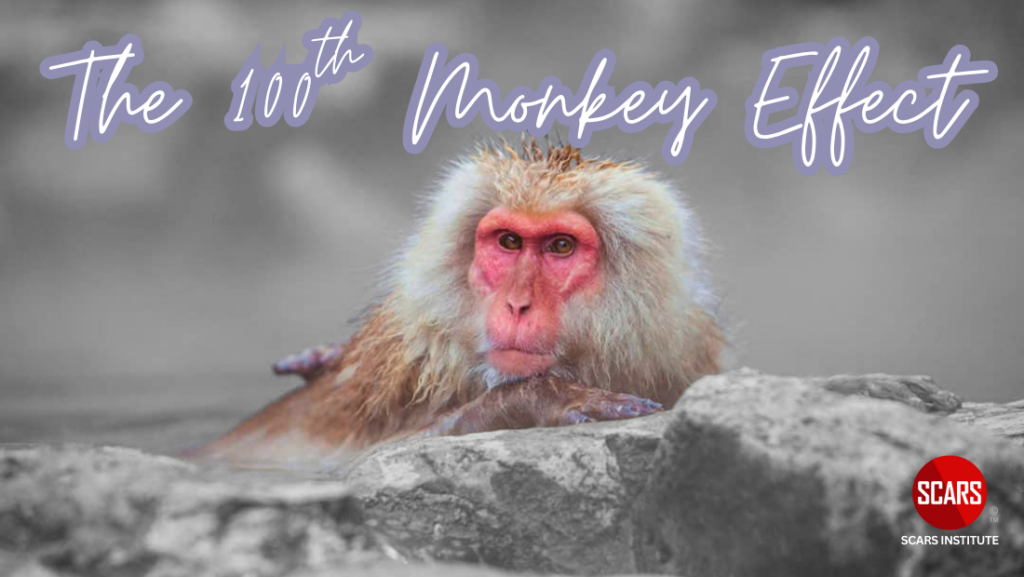
The 100th Monkey Effect is a story about how new ideas or behaviors can spread rapidly through a population once a critical mass is reached. It suggests that once a certain number of individuals adopt a new behavior, that behavior is somehow transmitted to the entire group, even to those who have had no direct contact with the original innovators.
The story originates from observations of Japanese macaque monkeys on the island of Koshima in the 1950s. Researchers were studying the monkeys and began leaving sweet potatoes on the beach for them. A young, innovative female monkey named Imo was the first to solve the problem of the sand-covered potatoes by washing them in a stream or the ocean. At first, only her close associates and her mother learned this new behavior from her. Over several years, more and more younger monkeys adopted the practice.
The 100th Monkey Effect is best understood as a sociological effect, a metaphor for a genuine sociological phenomenon: the tipping point.
The “effect” part of the story begins with a claim, often added by later storytellers and not explicitly detailed in the initial scientific papers, that a critical mass was reached. The popular version of the story states that once the “100th monkey” learned to wash the potatoes, a sudden, spontaneous leap in consciousness occurred.
The actual, documented spread of behavior was a classic example of cultural transmission and learning, which happened gradually and through normal social channels, with younger monkeys learning from older ones, and the behavior eventually spreading across the entire island population over time.
The 100th Monkey Effect remains a powerful and popular metaphor. It is often used in business, marketing, and social movements to describe the concept of a tipping point. It illustrates how an idea can struggle to gain traction initially but can suddenly explode into mainstream acceptance once it is adopted by a critical mass of people. The story serves as an inspirational, if not scientifically literal, illustration of how collective behavior can shift and how new social norms can emerge.
Drawing a parallel from the 100th Monkey Effect, scam survivors who actively resist doing what is asked of them in a recovery community can inadvertently inhibit the healing of the entire group.
In a support setting, a “critical mass” of individuals embracing new, healthier behaviors, like setting boundaries, sharing authentically, more active communication, supporting others, leaving comments and replies both in the community and on articles they read, is what creates a new cultural norm for recovery. When a survivor consistently resists these foundational steps, they act as a powerful anchor to the old, dysfunctional ways of being. Their resistance, whether it’s through constant minimization of their trauma, refusal to let go of the shame and guilt, or public skepticism of the recovery process, sends a conflicting message to newer, more vulnerable members. It provides a tangible example that the difficult work is perhaps optional or unnecessary, thereby slowing down the collective shift toward a healthier mindset. Just as the “100th monkey” is meant to trigger a wave of change, a single, influential resistor can create a counter-wave that stalls progress for many, making it harder for the community as a whole to reach that critical tipping point where healing becomes the shared, expected path.
This phenomenon is particularly damaging because recovery is not just an individual journey but a communal process of relearning safety and trust. The community acts as a microcosm where survivors can practice new ways of thinking and relating. When a member resists, they create a cognitive dissonance that can destabilize others. A newcomer, desperate for hope, may see the resistor’s defiant stance and find a compelling excuse to avoid their own painful work. This can fracture the unified front of the community, diluting its collective wisdom and strength. The resistant survivor, by refusing to adopt the new “behavior” of healthy recovery, prevents the group from achieving the momentum needed for a cultural shift. In this way, their personal struggle becomes a public roadblock, and the promise of the 100th Monkey Effect, a rapid, community-wide adoption of healing, is thwarted not by an outside force but from within.
Prof. Tim McGuinness, Ph.D.
December 2025
One Comment
Leave A Comment
This is but one component, one piece of the puzzle …
Understanding how the human mind is manipulated and controlled involves recognizing that the tactics employed by deceivers are multifaceted and complex. This information is just one aspect of a broader spectrum of vulnerabilities, tendencies, and techniques that permit us to be influenced and deceived. To grasp the full extent of how our minds can be influenced, it is essential to examine all the various processes and functions of our brains and minds, methods and strategies used the criminals, and our psychological tendencies (such as cognitive biases) that enable deception. Each part contributes to a larger puzzle, revealing how our perceptions and decisions can be subtly swayed. By appreciating the diverse ways in which manipulation occurs, we gain a more comprehensive understanding of the challenges we face in avoiding deception in its many forms.
“Thufir Hawat: Now, remember, the first step in avoiding a *trap* – is knowing of its existence.” — DUNE
“If you can fully understand your own mind, you can avoid any deception!” — Tim McGuinness, Ph.D.
“The essence of bravery is being without self-deception.” — Pema Chödrön


Very interesting observation about recovery groups and individual members who resist what may be the most effective yet difficult path and then take the group with them…we tend to look for the “easy way out.”