




Scam Victim Recovery Insights
From the SCARS Institute
Murphy’s Law for Scams, Scammers, and Scam Victims – Part 1
A SCARS Institute Scam Victim Recovery Insight
Murphy’s Law for scams is not about blaming you. It is about naming the predictable ways the brain, the nervous system, and emotion can be pulled off course under coercion, pressure, and manufactured intimacy. Scammers exploit normal human mechanisms like empathy, attachment, pattern-finding, and the need for certainty. When the situation feels confusing or urgent, the mind often tries to reduce distress by making it feel normal, explaining it away, or turning uncertainty into a story that feels safe enough to follow. These principles are written to help scam survivors recognize what happened without shame, and to translate painful hindsight into practical protection and recovery.
Here are but a few. Trust us, there are many more.
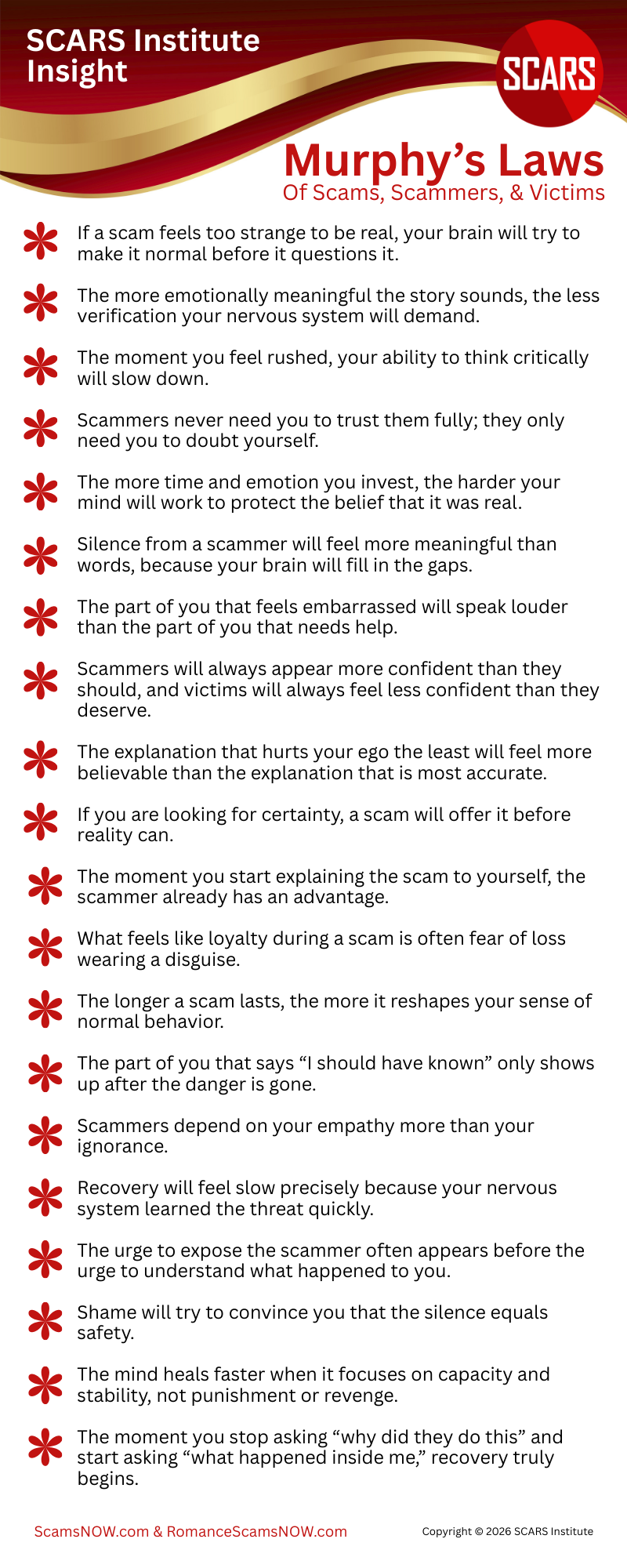
- If a scam feels too strange to be real, your brain will try to make it normal before it questions it.
- The more emotionally meaningful the story sounds, the less verification your nervous system will demand.
- The moment you feel rushed, your ability to think critically will slow down.
- Scammers never need you to trust them fully; they only need you to doubt yourself.
- The more time and emotion you invest, the harder your mind will work to protect the belief that it was real.
- Silence from a scammer will feel more meaningful than words, because your brain will fill in the gaps.
- The part of you that feels embarrassed will speak louder than the part of you that needs help.
- Scammers will always appear more confident than they should, and victims will always feel less confident than they deserve.
- The explanation that hurts your ego the least will feel more believable than the explanation that is most accurate.
- If you are looking for certainty, a scam will offer it before reality can.
- The moment you start explaining the scam to yourself, the scammer already has an advantage.
- What feels like loyalty during a scam is often fear of loss wearing a disguise.
- The longer a scam lasts, the more it reshapes your sense of normal behavior.
- The part of you that says “I should have known” only shows up after the danger is gone.
- Scammers depend on your empathy more than your ignorance.
- Recovery will feel slow precisely because your nervous system learned the threat quickly.
- The urge to expose the scammer often appears before the urge to understand what happened to you.
- Shame will try to convince you that the silence equals safety.
- The mind heals faster when it focuses on capacity and stability, not punishment or revenge.
- The moment you stop asking “why did they do this” and start asking “what happened inside me,” your recovery begins.
These “laws” describe patterns, not flaws. They show how quickly the nervous system learns threat and how slowly it may relearn safety, especially after a relationship scam or prolonged manipulation. The goal is not to replay the past or punish yourself for being human. The goal is to rebuild trust in your perception, strengthen your capacity to pause and verify, and reduce the shame that keeps victims silent. When you treat your reactions as understandable survival responses, you create space for stable recovery. The turning point often arrives when attention shifts away from the scammer’s motives and toward the internal experience that made the scam believable, tolerable, and hard to release. That is where clarity grows, and where lasting safety begins.
Prof. Tim McGuinness, Ph.D.
February 2026
This is but one component, one piece of the puzzle …
Understanding how the human mind is manipulated and controlled involves recognizing that the tactics employed by deceivers are multifaceted and complex. This information is just one aspect of a broader spectrum of vulnerabilities, tendencies, and techniques that permit us to be influenced and deceived. To grasp the full extent of how our minds can be influenced, it is essential to examine all the various processes and functions of our brains and minds, methods and strategies used the criminals, and our psychological tendencies (such as cognitive biases) that enable deception. Each part contributes to a larger puzzle, revealing how our perceptions and decisions can be subtly swayed. By appreciating the diverse ways in which manipulation occurs, we gain a more comprehensive understanding of the challenges we face in avoiding deception in its many forms.
“Thufir Hawat: Now, remember, the first step in avoiding a *trap* – is knowing of its existence.” — DUNE
“If you can fully understand your own mind, you can avoid any deception!” — Tim McGuinness, Ph.D.
“The essence of bravery is being without self-deception.” — Pema Chödrön