



The Selves We Leave Behind: Grieving Identity After Trauma – Grieving Your Own Lost Self – 2026

The SCARS Institute Magazine about Scam Victims-Survivors, Scams, Fraud & Cybercrime
- Published: 8/23/26
- Modified: 8/23/26
- Comments: 0
- Read Status:

The Selves We Leave Behind: Grieving Identity After Trauma – Grieving Your Own Lost Self
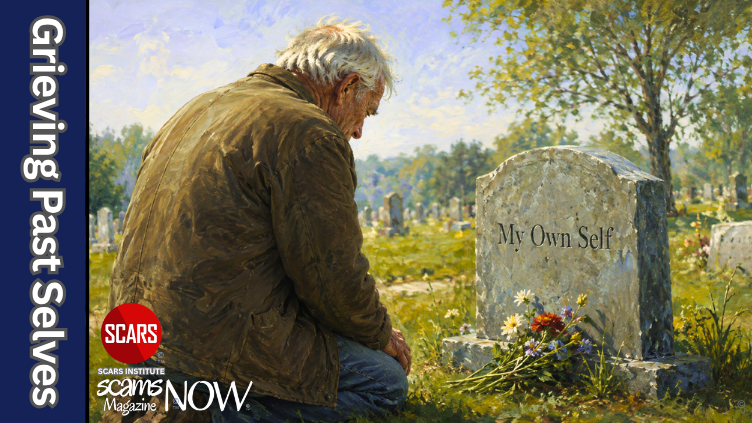
The Cemetery of Former Selves: Grieving the People a Scam Victim Used to Be
Primary Category: Psychology / Healing/Recovery
Authors:
• Tim McGuinness, Ph.D., DFin, MCPO, MAnth – Anthropologist, Scientist, Polymath, Managing Director of the Society of Citizens Against Relationship Scams Inc.
Author Biographies Below
About This Article
This is about grieving your past selves as much as it is about the self you are losing now. Human identity changes throughout life as relationships, responsibilities, losses, trauma, and experience reshape how a person understands themselves. Scam victimization can create a particularly painful identity rupture because a victim can lose not only money and a fraudulent relationship, but also trust, confidence, imagined futures, and a former sense of self. Earlier unresolved losses can reemerge as the newest trauma brings previous identities back into awareness. Healthy grieving does not require restoring those former selves exactly as they were. Instead, a person can remember them, acknowledge what they represented, retain useful qualities, and release beliefs or behaviors that contributed to vulnerability or self-neglect. Ritual, remembrance, and intentional integration can help transform identity grief into a continuing life narrative rather than permanent attachment to what has ended.
Note: This article is intended for informational purposes and does not replace professional medical advice. If you are experiencing distress, please consult a qualified mental health professional.
Keywords
Grieving, Identity Grief, Former Selves, Scam Victimization, Betrayal Trauma, Grief And Loss, Identity Reconstruction, Unresolved Grief, Self-Integration, Ritual Healing, Emotional Recovery

The Cemetery of Former Selves: Grieving the People a Scam Victim Used to Be
Author’s Note
The grieving that follows scam victimization can reach much further than the fraudulent relationship itself. A person can discover that the newest loss has reopened older memories of who they once were, what they once believed, and what earlier experiences forced them to leave behind. Recognizing those former selves can provide language for grief that otherwise feels confusing or excessive. The goal is not to idealize the past or encourage a return to earlier ways of thinking. It is to acknowledge that each version of a person belonged to the same life and contributed something to the person who exists now. Mourning can honor what was lost while allowing useful qualities to continue forward and permitting harmful burdens to end.
Prof. Emeritus Tim McGuinness, Ph.D.
August, 2026
When Betrayal Brings More than One Ending – More than One Funeral
There is a painful idea expressed in the words, “I have buried so many versions of myself that my soul feels like a cemetery. The obedient child, the hopeless romantic, the friend who gave too much, the lover who forgave everything. People say I’ve changed. They’re right. You can only attend your own funeral so many times… Before you stop resurrecting for people who never came to mourn, only to bring another shovel.”
For a traumatized scam victim, those words can carry a meaning far beyond the loss of a fraudulent relationship. The discovery of a scam can feel like another funeral in a lifetime already filled with earlier endings. The trusting child disappeared somewhere along the way. The young adult who believed love would be simple changed after betrayal. The friend who gave without limits eventually learned that generosity could be exploited. The spouse, parent, caregiver, professional, dreamer, romantic, protector, provider, or confident decision-maker can each have existed in forms that no longer survive unchanged.
Human beings live through many versions of themselves. Some disappear gradually as people mature. Others end abruptly because of death, divorce, illness, violence, migration, financial loss, betrayal, retirement, parenthood, aging, trauma, or profound disappointment. Each transition creates a new person, but it also leaves someone behind.
Society rarely gives those losses funerals.
There is no obituary for the person who trusted without hesitation. There is no memorial service for the version of someone who believed a marriage would last forever. No one gathers around a grave for the self that existed before a violent crime, before a parent’s death, before a betrayal, or before a scam destroyed an imagined future.
Yet grief can still occur because something real has ended.
For scam victims, After-Scam Healing requires recognition that the most recent loss can stand among many earlier losses. The scam did not necessarily create every wound. It can reopen graves that were never properly mourned.
Human Identity Is Not Fixed
People commonly speak about identity as though a person possesses one permanent self from childhood until death. Human experience does not work that way. Identity develops continuously through relationships, responsibilities, beliefs, roles, accomplishments, disappointments, losses, and choices.
A child becomes an adolescent. An adolescent becomes an adult. A single person becomes a partner. A partner becomes a parent. A worker becomes a professional. A caregiver becomes someone who needs care. A person who once trusted easily becomes cautious. Someone who depended heavily on others can become independent. Someone who lived through certainty can later live through ambiguity.
Each transition preserves parts of what came before while transforming others.
Most identity change happens gradually enough that people do not experience it as death. They simply notice one day that they no longer think, behave, want, or believe as they once did. Trauma changes that process because trauma can create a sharp dividing line between before and after.
The person before the event can become psychologically distinct from the person who exists afterward.
Scam victims say, “I am not the person I was before this happened,” and that statement is accurate without meaning that the person has been destroyed. The earlier identity has changed because its assumptions about safety, trust, love, judgment, money, relationships, or other people no longer fit what has been learned.
The grief comes from recognizing that returning completely to the former self is impossible.
The Scam Becomes the Latest Funeral
Relationship scams create particularly complicated identity losses because the crime can attack several parts of the self at once.
A victim can lose the person they believed they loved, even though that person never existed as represented. They can lose an imagined future involving marriage, companionship, travel, retirement, financial security, family, or shared purpose. They can lose money and the opportunities that money represented. They can lose confidence in judgment. They can lose trust in other people. They can lose confidence in technology, institutions, relationships, or their ability to recognize danger.
A victim can also lose a version of themselves.
The person who entered the relationship might have believed that love remained possible. That person might have been proud of being generous, loyal, compassionate, independent, intelligent, practical, financially responsible, or emotionally resilient. The scam can injure all of those identities at once.
After discovery, the victim does not simply ask, “Who was the scammer?” Another question begins emerging: “Who am I now?”
That question can become frightening because the answer is not immediately available. The former self has been disrupted, but the next self has not yet fully formed.
The Grief for the Self Before the Scam Is Real
A victim can miss the person they were before the scam. They can miss the ease with which that person trusted. They can miss the excitement that accompanied a new relationship. They can miss the confidence that came from believing they understood people. They can miss the person who opened an email or answered a message without immediately considering deception. They can miss their financial confidence. They can miss the person who made decisions without asking whether judgment had become unreliable. They can miss feeling uncomplicated joy.
This grief deserves recognition because the former self did not deserve what happened. The earlier person made decisions with the knowledge, emotions, assumptions, and circumstances available at the time. A victim looking backward possesses information that earlier version did not possess. Judging the former self exclusively through knowledge gained after discovery turns grief into prosecution.
Healing requires a different relationship with that earlier person. The former self does not need a trial. That person needs mourning, understanding, and eventually integration.
The Scam Can Reopen Older Graves
Trauma rarely arrives in a psychologically empty life. Every victim brings a history into victimization.
Some people enter scams after widowhood, divorce, retirement, illness, relocation, estrangement, caregiving, loneliness, financial disruption, or the death of someone important. Others carry childhood experiences involving abandonment, neglect, excessive responsibility, conditional affection, family instability, or relationships in which they learned to give more than they received.
The scam can activate memories and emotional patterns connected to those earlier selves.
A widow who believed she had finally begun living again can lose not only the fraudulent relationship but also the self that had emerged after bereavement. A divorced person can experience another loss of faith in intimacy. Someone who spent childhood trying to earn affection can discover that the scam relationship recreated the same pattern of proving love through sacrifice.
The newest funeral can suddenly summon all the others.
A victim can grieve the hopeful romantic who was disappointed decades earlier. They can grieve the obedient child who learned to keep everyone happy. They can grieve the young adult who believed hard work guaranteed security. They can grieve the caregiver who never learned that self-protection was legitimate. They can grieve the friend who repeatedly forgave people who did not deserve continued access.
The scam becomes painful partly because it joins a longer biography of loss.
Some Former Selves Were Never Allowed to Be Mourned
Many identity losses happen without social recognition.
A person whose parent dies receives condolences. A person whose old identity disappears after betrayal receives no comparable ritual. A person who loses a home can receive sympathy for the property loss, while the loss of being “the person who built a life there” remains unnamed. A person can leave a marriage, career, country, faith community, friendship, or family role and experience profound grief even when no physical death occurred.
Without recognition, the person can simply continue. They adapt. They become functional. They assume that because life moved forward, mourning must have been completed. Years later, another trauma can expose unfinished grief.
The scam victim can suddenly feel an intensity of sadness that seems disproportionate to the immediate event. The person is not necessarily grieving only the scam. The current loss can provide access to decades of accumulated endings.
The soul feels like a cemetery because the person finally recognizes how many occupants are there.
Grief Does Not Mean the Former Self Should Return
One of the most important distinctions in healing involves mourning without resurrection: A person can honor a former self without trying to become that person again.
A victim can miss being completely trusting without deciding that complete trust should return. They can miss being endlessly generous without returning to unlimited giving. They can remember the romantic who believed every declaration of love while recognizing that future intimacy requires verification, boundaries, and time.
The purpose of grief is not reconstruction of the deceased identity exactly as it existed.
Funerals do not exist to convince the dead to return. They acknowledge that something meaningful existed, that its ending matters, and that those who remain must continue living differently.
The same principle can apply to identity. A victim can say that the former self was real, valuable, imperfect, and worthy of compassion. That person carried strengths worth preserving and vulnerabilities that no longer need to remain unchanged.
The task becomes inheritance rather than resurrection.
The Former Self Leaves an Inheritance
Every previous version of a person leaves something behind.
The obedient child can leave sensitivity to others while surrendering the belief that obedience determines worth. The hopeless romantic can leave the capacity for wonder while releasing unquestioning idealization. The friend who gave too much can leave generosity while developing boundaries. The lover who forgave everything can leave compassion while learning that forgiveness does not require continued access.
The pre-scam self can leave many valuable inheritances.
- Trust does not need to die completely. It can mature into trust with verification.
- Generosity can remain while becoming bounded.
- Hope can remain without becoming fantasy.
- Love can remain while becoming slower and more observant.
- Compassion can remain while self-preservation gains equal moral legitimacy.
A victim does not have to choose between becoming hardened and becoming vulnerable again. A new identity can contain what was best in the old one while refusing to recreate the conditions that allowed exploitation. That process turns grief into integration.
Shame Interferes With Mourning
Shame tells the victim that the former self does not deserve a funeral. It says that person was stupid, gullible, weak, needy, foolish, greedy, lonely, or irresponsible. Shame invites the victim to spit on the grave rather than mourn beside it. That response creates another injury.
The former self was the person who lived through the manipulation with incomplete information. That person experienced real affection, hope, fear, loyalty, excitement, confusion, and pain. The emotional experience was genuine even though the offender’s identity and intentions were fraudulent.
Condemning that former self can keep the victim divided internally.
One part becomes the prosecutor. Another remains the accused.
Healing requires ending that internal courtroom eventually. Accountability for future choices can coexist with compassion for earlier decisions. Learning can occur without humiliation.
The person who existed before discovery does not need to be hated for failing to know what had not yet been discovered.
Grieving All the Earlier Selves
The scam can create an opportunity to recognize losses that were never recognized previously, and never given language.
A victim can look backward across a lifetime and identify former selves without turning the exercise into nostalgia or self-pity. The goal is not to conclude that everything good has been lost. The goal is to acknowledge that identity has changed repeatedly and that some transitions caused genuine grief.
There can be the child who believed adults always knew what they were doing. There can be the teenager who believed friendship lasted forever. There can be the young adult certain that success would solve insecurity. There can be the spouse who believed a relationship was permanent, the parent whose children no longer needed the same care, the worker whose career ended, the caregiver whose purpose changed, or the romantic who continued believing that love alone could overcome danger.
Each version belonged to the same life. None deserves ridicule simply because a later version knows more.
Remembering those selves can produce sadness, gratitude, embarrassment, tenderness, anger, or even relief. Some identities were comforting. Others were exhausting. Some need to be mourned because they were beautiful. Others need to be buried because continuing to inhabit them caused harm.
Both deserve recognition.
A Ritual for the Former Selves
Human cultures have long used ritual to help people cross boundaries that ordinary language cannot fully manage. Funeral traditions across the world repeatedly include several recognizable elements: naming the dead, gathering witnesses, lighting or tending a flame, washing or cleansing, offering food or objects, placing something into earth or water, speaking remembrance, moving physically from one place to another, and returning to ordinary life through a closing act.
A ritual for lost versions of the self should not imitate or appropriate a sacred ceremony belonging to another people. It can draw instead from these widely shared human practices of mourning and transition.
A ritual can be called the Rite of Names and Returning.
Its purpose is not to erase the past. Its purpose is to recognize each former self, identify what that self carried, release what no longer belongs in the present, and consciously inherit what remains valuable.
The Rite of Names and Returning
The ritual begins by choosing a quiet place where interruption is unlikely. The participant gathers:
- several small pieces of paper,
- a bowl of water,
- a candle or other safe source of light,
- a small container of soil or access to the earth, and
- one object that represents the present life. The object can be a key, stone, piece of jewelry, photograph of a safe place, or another ordinary item carrying personal meaning.
The participant then identifies the former selves that deserve recognition. The list should not become an inventory of every stage of life. It should include the identities whose ending still carries emotional weight.
Each receives a name.
- “The child who tried to keep everyone happy.”
- “The woman who believed love required endless forgiveness.”
- “The man who believed providing for everyone made him valuable.”
- “The person who trusted without checking.”
- “The person who believed the scammer.”
- “The person who imagined the future that never came.”
- Add any others you can idetify
Each name is written separately.
Naming matters because unnamed grief remains diffuse. Once the person names the lost identity, the grief has somewhere to belong.
Remembering Before Releasing
The ritual does not begin with destruction. Each paper is held and remembered first.
The participant considers what that former self believed, what that person wanted, what they feared, what they gave, what they survived, and what they never understood because they had not yet lived long enough to learn it.
This can be triggering, since you will be trying to remember what it was like to live in that self.
- The remembrance should include something generous.
- The trusting self might be remembered for courage.
- The overly forgiving self might be remembered for compassion.
- The person who believed the scammer might be remembered for the genuine capacity to attach, care, hope, and commit.
This prevents the ritual from becoming another exercise in self-punishment. Every former self receives dignity before release.
Choosing the Inheritance
The participant then asks what should remain. A former identity does not need to disappear completely. One quality can be consciously inherited from each version.
- From the obedient child can come empathy.
- From the romantic can come imagination.
- From the caregiver can come compassion.
- From the person who survived the scam can come endurance.
- From the person who trusted can come openness, now joined with discernment.
The inherited quality can be written on another piece of paper and placed beside the object representing the present self.
This separates the person’s essence from the behaviors that no longer serve them. The individual is not burying everything. They are choosing what continues.
Returning What No Longer Belongs
The participant next identifies what each former self no longer needs to carry. This can include unquestioning trust, compulsive forgiveness, responsibility for everyone else’s emotions, shame, imagined obligations, fantasy, secrecy, or the belief that love requires self-sacrifice. Those words are written on the original paper containing the former self’s name.
The paper can then be torn into small pieces and placed into the soil. If biodegradable paper is used and local conditions permit, if not, it can later be buried outdoors. The symbolism is straightforward: something has ended, and the material of that ending returns to the earth.
Destruction is not the essential act. Release is. The participant can then touch the water and wash their hands.
Across many traditions, washing marks transition, purification, preparation, or return. In this secular ritual, the water does not erase memory or guilt. It marks the recognition that the person does not need to continue carrying everything that belonged to an earlier version of life.
The Present Self Must Also Be Named
The ritual should not end with the dead. The participant names the person who remains. That name should describe direction rather than perfection.
- “The person who is learning to trust judgment again.”
- “The person who survived betrayal and continues rebuilding.”
- “The person who can love and still verify.”
- “The person who has boundaries.”
- “The person who is grieving and still moving.”
The present identity does not need to sound heroic. After trauma, exaggerated declarations can feel false. A modest statement can carry greater psychological credibility.
The person remains unfinished. That is the point.
Remembering Without Returning
The candle or light remains for a final period of remembrance. During that time, the participant acknowledges that all of the former selves belonged to one life. None existed separately from the person who remains.
The present self carries their memories.
- It carries their mistakes.
- It carries their tenderness.
- It carries what they learned too late.
- It carries what they survived.
The goal is not to forget them. The goal is to stop asking them to come back and solve the present.
The person who existed before the scam cannot be resurrected exactly as they were. Neither can the child, romantic, caregiver, spouse, worker, or dreamer who belonged to another chapter. They can be remembered without being reinhabited.
Closing the Ritual by Returning to Life
Funeral rituals commonly contain some form of return. People leave the cemetery, extinguish the candle, share food, wash, change clothing, gather with others, or resume ordinary activity. The movement back into life matters because mourning cannot remain the only state.
- The Rite of Names and Returning should end similarly.
- The participant extinguishes the light and takes the chosen object representing the present self. The inherited qualities remain written nearby and can be placed somewhere private.
- Then the person does something ordinary. They prepare food. They walk outside. They call someone safe. They make tea. They sit in sunlight. They tend a plant. They return to a familiar room.
- The ordinary act says something psychologically important. The funeral has happened, and life continues.
The Cemetery Does Not Have to Be a Place of Horror
The metaphor of a soul becoming a cemetery sounds bleak, but cemeteries are not only places of death.
They are places of memory. They contain evidence that lives existed and mattered. They preserve names. They create boundaries between what has ended and what continues. They allow the living to visit without requiring the dead to return home with them.
The same understanding can change the way a scam victim thinks about former selves. The cemetery inside does not need to be emptied. The former selves do not need resurrection. They need names, remembrance, dignity, and a proper place in the history of the person who survived them.
Some can be remembered tenderly. Some can be remembered with sadness. Some can inspire gratitude, and some can produce relief because their burdens no longer need to continue. The present self walks among those memories but does not have to live inside their graves.
Healing Is Not Becoming the Old Person Again
Many scam victims initially want restoration. They want their old confidence, old trust, old routines, old financial security, old emotional stability, and old sense of identity back. Some of those things can return.
The person cannot return unchanged. That does not represent failure.
Recovery creates a new version of the self because knowledge changes identity. The person now knows that deception can be sophisticated. They know that emotional attachment can affect judgment. They know that confidence does not guarantee accuracy. They know that trust and verification must coexist.
Those lessons carry pain, but they can also become wisdom. The emerging person does not have to become colder.
- They can become more discerning.
- They do not have to stop trusting.
- They can learn how trust develops through evidence and time.
- They do not have to stop loving.
- They can refuse to confuse love with surrendering self-protection.
- They do not have to hate the earlier self.
- They can mourn that person and inherit what was worth keeping.
No More Resurrections for Those Carrying Shovels
“I have buried so many versions of myself that my soul feels like a cemetery. The obedient child, the hopeless romantic, the friend who gave too much, the lover who forgave everything. People say I’ve changed. They’re right. You can only attend your own funeral so many times… Before you stop resurrecting for people who never came to mourn, only to bring another shovel.”
The image of continually resurrecting past selves for people who return only with another shovel captures a painful truth about repeated self-abandonment. Some people spend much of life recreating versions of themselves that exist mainly to satisfy other people’s needs.
- The agreeable child returns.
- The endlessly forgiving lover returns.
- The rescuer returns.
- The person who gives one more chance returns.
- The person who ignores discomfort to avoid disappointing someone returns.
A scammer typically exploits precisely those identities because they are familiar and morally reinforced.
Recovery creates an opportunity to stop resurrecting identities whose survival depends upon self-neglect. That does not require rejecting the person who once inhabited them. It requires finally allowing those versions to rest.
A victim can visit them in memory without handing them control of the present.
Living as the Person Who Remains
Grief for former selves does not mean that identity has been reduced to a collection of losses. Every ending has also produced another beginning, even when the new person emerged reluctantly.
The traumatized scam victim has already survived multiple versions of a lifetime. Some disappeared quietly. Others ended in catastrophe. Some deserved longer lives, while others carried burdens that needed to end. The scam becomes another funeral, but it does not have to become the final one in the sense of ending growth.
The person who emerges from After-Scam Healing can remember the trusting self without despising trust, remember the romantic without despising love, remember the generous self without despising generosity, and remember the victim without building an identity around victimization.
The former selves remain part of the biography. They are not instructions for the future.
Grief allows the victim to say that those people mattered. Acceptance allows the victim to recognize that they are gone. Integration allows the strengths they carried to continue. Agency allows someone new to decide what happens next.
A life can contain many funerals of identity without becoming nothing but a cemetery.
- The living person still walks among the stones.
- The living person still carries the names.
- The living person also gets to leave the cemetery and continue forward.
Conclusion
Human beings do not pass through life as a single unchanging identity. They become different versions of themselves through relationships, responsibilities, losses, discoveries, disappointments, and trauma. Some of those changes occur so gradually that they barely register. Others create a clear dividing line between who a person was before an event and who that person becomes afterward. Scam victimization can create one of those dividing lines because it can disrupt trust, judgment, identity, imagined futures, financial security, relationships, and confidence at the same time.
For a scam victim, grieving the person who existed before the crime does not mean rejecting the person who exists now. It means acknowledging that something meaningful ended. The trusting person, the romantic, the unquestioningly generous friend, the rescuer, or the person who believed that love required endless forgiveness can deserve remembrance without requiring resurrection. Healing allows a person to retain what was valuable in those identities while leaving behind the beliefs and behaviors that no longer serve them. Trust can survive while becoming more discerning. Generosity can remain while acquiring boundaries. Compassion can continue without requiring self-sacrifice.
Older grief can also surface alongside the newest loss. A scam can reopen memories of earlier betrayals, deaths, divorces, abandoned dreams, changing family roles, lost careers, and previous versions of the self that were never properly mourned. Recognizing those losses does not mean becoming trapped in the past. It gives them names and a place within the person’s life story.
A former self does not need condemnation, prosecution, or humiliation. That person acted with the knowledge, emotional circumstances, and understanding available at the time. The task now is remembrance, integration, and inheritance. The person who remains can carry forward courage, love, imagination, generosity, tenderness, and hope while allowing unhealthy obligations, limitless forgiveness, fantasy, and self-neglect to remain buried.
A life can contain many endings without becoming defined by loss. The cemetery of former selves can become a place of memory rather than imprisonment. A person can visit those earlier identities, honor what they carried, mourn what ended, and still return to the living world.

Glossary
- Accumulated Endings — Accumulated endings are the multiple identity losses that build across a person’s lifetime through relationships, aging, trauma, disappointment, role changes, and major life transitions. A scam can bring several of these earlier endings back into awareness at the same time as the newest loss. Recognizing this accumulation can help a scam victim understand why present grief can feel much larger than the immediate circumstances alone would suggest. — Grief Response
- Biographical Grief — Biographical grief is the sorrow connected to losses that have become part of a person’s life history rather than belonging to one isolated event. Earlier betrayals, deaths, divorces, career changes, family transitions, and abandoned dreams can remain emotionally connected to former versions of the self. Scam victimization can awaken this wider history and reveal that a person is grieving several chapters of life at once. — Grief Response
- Bounded Generosity — Bounded generosity is the ability to remain caring and giving while recognizing limits that protect personal well-being, resources, and judgment. A former self who gave too much does not have to surrender generosity completely in order to become safer. The quality can continue in a healthier form that includes discernment, limits, and recognition that compassion does not require unlimited sacrifice. — Relationship Repair
- Cemetery of Former Selves — The cemetery of former selves is a metaphor for the many identities a person has inhabited and eventually left behind through growth, loss, betrayal, trauma, or changing circumstances. Some former selves disappeared gradually, while others ended through experiences that created a sharp division between life before and afterward. The metaphor allows a scam victim to remember these identities without assuming that they must be restored or erased. — Identity Grief
- Compassionate Remembrance — Compassionate remembrance is the practice of looking back at a former self with understanding rather than ridicule, contempt, or hindsight judgment. A person recognizes what that earlier self wanted, feared, believed, gave, and understood at the time. This form of remembrance allows learning to occur without turning past vulnerability into evidence of personal worthlessness. — Self-Compassion
- Compassion Without Self-Sacrifice — Compassion without self-sacrifice is the ability to care about another person without treating that person’s needs as automatically more important than personal safety or well-being. Scam victims can retain kindness while refusing financial exploitation, manipulation, secrecy, or unlimited emotional demands. This distinction allows compassion to remain part of identity without requiring a return to patterns of self-neglect. — Emotional Regulation
- Continuity of Self — Continuity of self is the recognition that changing identities across a lifetime still belong to one continuing person and one life history. A child, romantic partner, caregiver, professional, scam victim, and later survivor can differ substantially while remaining connected through memory and experience. Recognizing that continuity helps prevent identity change from being interpreted as complete personal destruction. — Identity Development
- Emotional Inheritance — Emotional inheritance consists of the useful qualities, strengths, values, and capacities that a person consciously carries forward from a former identity. A scam victim can retain openness, tenderness, imagination, generosity, loyalty, or courage without preserving the beliefs that made exploitation easier. Choosing this inheritance allows the past to contribute to future identity without controlling it. — Identity Integration
- Former Self — A former self is a previous version of a person’s identity shaped by the beliefs, relationships, roles, expectations, and circumstances that existed during an earlier period of life. Trauma or major change can make that earlier person feel psychologically distant from the person who exists afterward. A former self can be mourned and respected without requiring a return to the same assumptions or behaviors. — Identity Development
- Former-Self Mourning — Former-self mourning is the grieving process directed toward an earlier identity that no longer exists in the same form. A scam victim can mourn lost trust, confidence, innocence, optimism, financial security, or a previous way of understanding relationships. This mourning recognizes that identity loss can be emotionally significant even when no physical death has occurred. — Grief Response
- Funeral Metaphor — The funeral metaphor describes identity change as an ending that deserves acknowledgment, remembrance, and a transition back into continuing life. It does not suggest that a person has literally died or ceased to exist. The metaphor gives language to losses that society rarely recognizes with ceremonies even though they can produce genuine grief. — Recovery Insight
- Grief for the Pre-Scam Self — Grief for the pre-scam self is the sorrow a person can experience for who they were before deception changed their understanding of trust, judgment, relationships, safety, or themselves. A victim can miss the person who trusted easily or made decisions without questioning personal competence. Recognizing this grief allows that earlier identity to be mourned rather than attacked for failing to anticipate the deception. — Identity Grief
- Identity Continuity — Identity continuity is the connection between previous, present, and emerging versions of a person despite substantial psychological and life changes. Experiences can transform beliefs and behavior without erasing everything that existed before them. Scam victims can use this perspective to recognize that trauma changed parts of identity without invalidating the entire life that preceded it. — Identity Development
- Identity Development — Identity development is the continuing process through which a person’s sense of self changes in response to relationships, responsibilities, accomplishments, disappointments, choices, losses, and new knowledge. Human identity does not remain fixed from childhood through later life. Scam victimization can become one major influence within this longer developmental process rather than the final definition of who a person becomes. — Human Development
- Identity Grief — Identity grief is the mourning that occurs when a meaningful version of the self no longer fits the person’s present reality. A scam can disrupt identities connected to trust, competence, romance, independence, financial responsibility, or confidence in judgment. Recognizing identity grief helps explain why a person can feel bereaved even when the most visible losses do not fully account for the intensity of emotion. — Grief Response
- Identity Inheritance — Identity inheritance is the deliberate preservation of valuable qualities from a former self while allowing harmful assumptions or patterns to end. A person can inherit compassion from an overly forgiving self without continuing limitless forgiveness, or inherit generosity without continuing unprotected giving. This approach treats personal growth as selective continuation rather than total rejection of the past. — Identity Integration
- Identity Loss — Identity loss occurs when an important way of understanding oneself can no longer continue after major life change, trauma, betrayal, or new knowledge. The person remains alive, but a familiar role, belief, expectation, or sense of personal certainty has ended. Scam victims can experience several identity losses simultaneously because the crime can affect love, trust, finances, judgment, and imagined futures. — Identity Grief
- Identity Reorientation — Identity reorientation is the process of developing a workable sense of self after previous beliefs, roles, or expectations have been disrupted. A scam victim can move from asking who they were before the crime toward considering what qualities and boundaries should define life now. Reorientation does not require immediate certainty because a new identity develops gradually through experience and deliberate choices. — Recovery Process
- Identity Transition — Identity transition is the movement from one version of the self into another as life circumstances, responsibilities, relationships, or understanding change. Some transitions unfold naturally over time, while trauma can create a much sharper division between before and after. Scam victimization can become such a transition when previous assumptions no longer fit what a person has learned. — Identity Development
- Identity Transformation — Identity transformation is the deeper change that occurs when experience alters how a person understands trust, relationships, values, boundaries, judgment, or personal vulnerability. Transformation does not mean that everything about the earlier person must disappear. Healthier development can preserve valuable qualities while changing the assumptions that no longer serve the person’s present life. — Identity Integration
- Imagined Future Loss — Imagined future loss is the grief created when anticipated events, relationships, security, companionship, travel, marriage, retirement, or shared plans can no longer occur as expected. Relationship scams can make these futures emotionally vivid even though they were built around fraudulent circumstances. Their disappearance can create legitimate grief because the hopes and expectations experienced by a victim were psychologically real. — Future Orientation
- Incomplete Mourning — Incomplete mourning occurs when a significant loss was never fully acknowledged, expressed, or integrated into a person’s understanding of their life. People can continue functioning after identity changes while assuming that adaptation means grief has finished. A later trauma such as scam victimization can reactivate these older losses and reveal that important emotional work remains unfinished. — Grief Response
- Inheritance Rather Than Resurrection — Inheritance rather than resurrection is the principle that a former identity can contribute valuable qualities to the present without needing to return exactly as it once existed. A scam victim can retain love, generosity, hope, tenderness, and openness while changing the beliefs or habits that exposed those qualities to exploitation. This approach allows growth without requiring rejection of everything associated with the former self. — Recovery Insight
- Internal Courtroom — The internal courtroom is a metaphor for the self-judgment that occurs when one part of a person prosecutes an earlier self for decisions made before the truth was known. Shame can place the former self in the role of accused while present knowledge acts as prosecutor and judge. Healing requires replacing this adversarial relationship with accurate learning, compassion, and recognition of the information available at the time. — Shame Response
- Life Biography — A life biography is the larger personal history formed by the different identities, relationships, transitions, losses, accomplishments, and experiences that accumulate over time. Scam victimization becomes one chapter within that history rather than the complete definition of the person. Viewing the experience biographically can help place the newest loss alongside earlier changes without allowing it to erase everything that came before. — Identity Integration
- Living Person Who Remains — The living person who remains is the present individual who carries memories and consequences from former identities while continuing to develop beyond them. This person contains what earlier selves learned, loved, feared, survived, and misunderstood. Recognizing the present person as still developing allows mourning to coexist with continued life rather than turning remembrance into permanent residence in the past. — Future Orientation
- Loss Without Ritual — Loss without ritual occurs when something psychologically significant ends without the ceremonies, social recognition, or communal acknowledgment normally associated with bereavement. Identity changes after betrayal, divorce, career loss, migration, or scam victimization can create this kind of unrecognized grief. Creating a personal ritual can provide structure and recognition when society offers no established way to mark the ending. — Ritual Practice
- Mourning of Former Selves — Mourning of former selves is the conscious acknowledgment that previous versions of identity existed, mattered, and eventually changed or ended. A person can experience sadness, tenderness, embarrassment, gratitude, anger, or relief while remembering them. Mourning allows these identities to become integrated parts of personal history rather than unresolved presences that continue directing present behavior. — Grief Response
- Mourning Without Resurrection — Mourning without resurrection is the recognition that a former self can be loved, valued, and remembered without being recreated. A scam victim can miss complete trust or romantic idealism while recognizing that those qualities need to exist differently in future relationships. This form of mourning respects what ended while accepting that growth makes exact restoration neither possible nor necessary. — Recovery Process
- Naming the Former Self — Naming the former self is the deliberate act of giving a meaningful description to an identity whose ending still carries emotional significance. A person might name a former self according to a role, belief, relationship pattern, hope, or way of responding to others. Naming makes diffuse grief more concrete and allows the person to remember that identity intentionally rather than experiencing it only as unexplained sadness. — Ritual Practice
- New Identity Formation — New identity formation is the gradual development of a sense of self that incorporates what has been learned through betrayal, grief, survival, and reflection. A scam victim does not need to define this emerging identity immediately or make it sound heroic. A credible new identity can begin with modest qualities such as greater discernment, stronger boundaries, renewed judgment, and continued willingness to connect with others. — Identity Development
- Ordinary Return — Ordinary return is the deliberate movement back into everyday life after an emotionally significant act of mourning or release. Preparing food, walking outside, contacting a safe person, tending a plant, or returning to a familiar routine can mark this transition. The ordinary action symbolizes that remembrance has occurred while life continues beyond the ritual moment. — Ritual Practice
- Present Identity — Present identity is the version of a person that exists now while carrying memories, consequences, strengths, and lessons from earlier selves. It does not need to represent a finished or perfected stage of development. For a scam victim, acknowledging an unfinished present identity can reduce pressure to immediately know exactly who they have become after trauma. — Identity Development
- Pre-Scam Self — The pre-scam self is the version of a person who existed before discovering the deception and before the resulting knowledge changed important assumptions. That person can represent lost confidence, trust, financial certainty, romantic hope, or belief in personal judgment. Remembering the pre-scam self compassionately allows learning without blaming that earlier person for information that was not yet available. — Identity Grief
- Psychological Cemetery — A psychological cemetery is a symbolic inner place where memories of former identities can be acknowledged without dominating the present. The metaphor allows earlier selves to have names, histories, meanings, and boundaries rather than being erased or repeatedly resurrected. A person can revisit those memories while recognizing that the present self does not have to live among them permanently. — Recovery Insight
- Release — Release is the conscious decision to stop carrying a belief, obligation, pattern, fantasy, or identity that no longer belongs in a person’s present life. It does not require forgetting what happened or denying that the former identity once mattered. Release creates psychological room for valuable qualities to continue without preserving every burden associated with the past. — Recovery Process
- Remembrance Before Release — Remembrance before release is the principle that a former self should be acknowledged and understood before symbolic letting go occurs. The person considers what that identity believed, wanted, feared, gave, survived, and could not yet know. This step prevents release from becoming another form of rejection or self-punishment and gives the former self dignity before separation. — Ritual Practice
- Resurrection Pattern — A resurrection pattern occurs when a person repeatedly recreates an earlier identity because relationships or social expectations continue rewarding the same self-sacrificing behavior. The agreeable child, rescuer, endlessly forgiving partner, or person who always gives another chance can repeatedly return even after those patterns have caused harm. Recognizing the pattern can help prevent familiar identities from automatically governing new relationships. — Decision-Making Pattern
- Rite of Names and Returning — The Rite of Names and Returning is a secular ritual designed to recognize former selves, preserve their useful qualities, release what no longer belongs, and consciously return attention to present life. It uses naming, remembrance, symbolic inheritance, soil, water, light, and an ordinary closing activity to give structure to identity grief. The ritual draws on widespread human practices of mourning and transition without reproducing a specific sacred tradition. — Ritual Practice
- Ritualized Release — Ritualized release is the use of symbolic action to mark that a former identity, obligation, belief, or burden no longer needs to control present life. Writing, tearing paper, placing material into soil, washing hands, and returning to ordinary activity can make an internal transition physically observable. The ritual does not erase memory but gives the person a deliberate way to acknowledge an ending. — Ritual Practice
- Self-Condemnation — Self-condemnation occurs when a person treats earlier vulnerability, mistaken judgment, trust, or emotional attachment as evidence of personal defect rather than part of a complex human experience. Scam victims can direct anger toward the person they were before discovery because present knowledge makes earlier decisions appear unreasonable. Persistent condemnation can interfere with mourning by replacing compassion and learning with humiliation. — Shame Response
- Self-Neglect — Self-neglect in the context of relational identity occurs when a person repeatedly sacrifices personal safety, boundaries, needs, resources, or judgment to maintain another person’s approval or well-being. Some former identities can become organized around pleasing, rescuing, forgiving, or providing for others without adequate limits. Scam manipulation can exploit these familiar patterns because self-sacrifice can already feel morally expected. — Psychological Vulnerability
- Symbolic Burial — Symbolic burial is a ritual act that represents the ending of an identity, belief, burden, or pattern without suggesting that the person’s history should be erased. Written names or unwanted burdens can be placed into soil as a physical representation of allowing something to rest. The symbolism gives an internal psychological transition a concrete form that can support acknowledgment and release. — Ritual Practice
- Symbolic Inheritance — Symbolic inheritance is the deliberate selection of a quality from a former self that a person wants to carry into present life. Compassion, imagination, courage, endurance, tenderness, or openness can be retained even when other aspects of that identity are released. This process emphasizes that mourning does not require burying everything that belonged to the earlier person. — Identity Integration
- Trauma-Linked Identity Change — Trauma-linked identity change occurs when a distressing experience creates a noticeable division between how a person understood themselves before the event and how they understand themselves afterward. Scam victimization can alter assumptions about safety, love, trust, judgment, finances, and other people. Recognizing this change can help a person understand why returning completely to the old self is neither realistic nor necessary. — Trauma Response
- Trust With Verification — Trust with verification is a form of trust that allows emotional openness while recognizing that important claims should still be supported by evidence and time. Scam victimization can make complete trust feel dangerous, but permanent distrust is not the only alternative. A person can retain the capacity to connect while allowing verification to become a normal part of developing confidence in another person. — Verification Practice
- Unfinished Grief — Unfinished grief is sorrow connected to an earlier loss that remains emotionally active because it was never fully acknowledged or integrated. A scam can reopen this grief by connecting the newest betrayal with earlier deaths, separations, identity changes, disappointments, or abandoned futures. Recognizing unfinished grief can help explain why emotions appear to reach beyond the immediate scam experience. — Grief Response
- Unnamed Grief — Unnamed grief is emotional pain that lacks a clear social or personal label because the loss does not fit conventional ideas about bereavement. A person can grieve a former identity, lost confidence, an imagined future, a previous role, or the person they believed themselves to be. Giving the loss language can make the emotional experience easier to recognize, organize, and mourn. — Grief Response
- Unrecognized Identity Loss — Unrecognized identity loss occurs when an important version of the self ends without acknowledgment from the person or the surrounding community. Life can continue outwardly while the psychological significance of losing that identity remains unresolved. Scam victimization can bring such losses back into awareness by creating another major disruption in how a person understands themselves. — Social Recognition
- Version of Self — A version of self is a distinct expression of identity shaped by a particular period of relationships, responsibilities, beliefs, expectations, and life circumstances. A single person can inhabit many such versions across a lifetime without any one version representing the complete person. Understanding identity this way allows change to be recognized as part of human development rather than proof that the earlier self was false or meaningless. — Identity Development
- Wisdom After Betrayal — Wisdom after betrayal is the practical understanding that develops when painful experience becomes integrated without destroying the person’s capacity for trust, compassion, love, or hope. A scam victim can become more discerning while retaining qualities that previously mattered deeply. This form of wisdom does not celebrate the trauma but recognizes that knowledge gained through it can influence safer and more deliberate future choices. — Recovery Insight
Author Biographies
Author Biography
Prof. (Emeritus) Tim McGuinness, Ph.D. DFin is a co-founder, Managing Director, and Chairman of the SCARS Institute (Society of Citizens Against Relationship Scams Inc.), where he serves as an unsalaried volunteer officer dedicated to supporting scam victims and survivors around the world. With over 34 years of experience in scam education and awareness, he is perhaps the longest-serving advocate in the field.
Dr. McGuinness has an extensive background as a business pioneer, having co-founded several technology-driven enterprises, including the former e-commerce giant TigerDirect.com. Beyond his corporate achievements, he is actively engaged with multiple global think tanks where he helps develop forward-looking policy strategies that address the intersection of technology, ethics, and societal well-being. He is also a computer industry pioneer (he was an Assistant Director of Corporate Research Engineering at Atari Inc. in the early 1980s) and invented core technologies still in use today.
His professional identity spans a wide range of disciplines. He is a scientist, strategic analyst, solution architect, advisor, public speaker, published author, roboticist, Navy veteran, and recognized polymath. He holds numerous certifications, including those in cybersecurity from the United States Department of Defense under DITSCAP & DIACAP, continuous process improvement and engineering and quality assurance, trauma-informed care, grief counseling, crisis intervention, and related disciplines that support his work with crime victims.
Dr. McGuinness was instrumental in developing U.S. regulatory standards for medical data privacy called HIPAA and financial industry cybersecurity called GLBA. His professional contributions include authoring more than 1,000 papers and publications in fields ranging from scam victim psychology and neuroscience to cybercrime prevention and behavioral science.
“I have dedicated my career to advancing and communicating the impact of emerging technologies, with a strong focus on both their transformative potential and the risks they create for individuals, businesses, and society. My background combines global experience in business process innovation, strategic technology development, and operational efficiency across diverse industries.”
“Throughout my work, I have engaged with enterprise leaders, governments, and think tanks to address the intersection of technology, business, and global risk. I have served as an advisor and board member for numerous organizations shaping strategy in digital transformation and responsible innovation at scale.”
“In addition to my corporate and advisory roles, I remain deeply committed to addressing the rising human cost of cybercrime. As a global advocate for victim support and scam awareness, I have helped educate millions of individuals, protect vulnerable populations, and guide international collaborations aimed at reducing online fraud and digital exploitation.”
“With a unique combination of technical insight, business acumen, and humanitarian drive, I continue to focus on solutions that not only fuel innovation but also safeguard the people and communities impacted by today’s evolving digital landscape.”
Dr. McGuinness brings a rare depth of knowledge, compassion, and leadership to scam victim advocacy. His ongoing mission is to help victims not only survive their experiences but transform through recovery, education, and empowerment.
-/ 30 /-
What do you think about this?
Please share your thoughts in a comment below!
GLOSSARY SEARCH
TOPIC SEARCH
TABLE OF CONTENTS








CATEGORIES
More ScamsNOW.com Articles