




ScamsNOW!
The SCARS Institute Magazine about Scam Victims-Survivors, Scams, Fraud & Cybercrime




Trauma and a Broken Sense of Time Make Recovery Difficult
When Trauma Breaks Time – How Psychological Trauma and Relationship Scams Disrupt the Sense of Past, Present, and Future
Primary Category: Scam Victim Recovery Psychology / Neurology
Authors:
• Vianey Gonzalez B.Sc(Psych) – Licensed Psychologist, Specialty in Crime Victim Trauma Therapy, Neuropsychologist, Certified Deception Professional, Psychology Advisory Panel & Director of the Society of Citizens Against Relationship Scams Inc.
• Tim McGuinness, Ph.D., DFin, MCPO, MAnth – Anthropologist, Scientist, Polymath, Director of the Society of Citizens Against Relationship Scams Inc.
Author Biographies Below
About This Article
Psychological trauma disrupts the brain’s ability to construct time by interfering with how events, changes, and emotional experiences are registered and organized. Because time is inferred rather than directly sensed, intense stress, prolonged emotional manipulation, neurological differences, mood states, and substance use can distort how duration, sequence, and continuity are experienced. Relationship scams are especially damaging to time perception due to sustained emotional engagement and chronic uncertainty. Survivors may feel frozen in the present, disconnected from the past, or unable to imagine the future. Recovery depends in part on restoring temporal stability through validation, grounding, routine, and meaningful event registration. As time perception stabilizes, progress becomes perceptible, identity regains coherence, and healing gains momentum.
Note: This article is intended for informational purposes and does not replace professional medical advice. If you are experiencing distress, please consult a qualified mental health professional.

When Trauma Breaks Time – How Psychological Trauma and Relationship Scams Disrupt the Sense of Past, Present, and Future
Why Time Feels Real Even When the Brain Cannot Sense It
Time feels as real as gravity. It appears to move forward relentlessly, carrying people with it whether they want to go or not. People organize their lives around it, measure their worth by it, and grieve what they believe they have lost to it. Yet modern neuroscience and psychology show that time itself is not directly sensed by the human brain. There are no biological receptors that detect time in the way eyes detect light or ears detect sound.
A growing body of research, including work published in 2024 in Frontiers in Psychology, suggests that what humans experience as time is not a flowing substance but a reconstruction. The brain does not register time directly. Instead, it registers change. Neural systems sample events, transitions, actions, emotional shifts, and boundaries in experience. After those events occur, the brain infers duration and sequence. The subjective feeling of time emerges from how experience is organized, not from a clock inside the mind.
This explains why time can feel radically different depending on circumstances. When experience is dense with events, decisions, and emotional shifts, time often feels expanded. A single hour can feel endless. When experience is sparse, repetitive, or emotionally muted, time often feels compressed. Days, weeks, or even years can seem to vanish. Time is not measured in seconds internally. It is inferred from meaning.
The brain fills in missing moments automatically. Gradual change often goes unrecorded. Time is felt only after events have been processed. This means that time, as people experience it, is always a psychological construction. It feels real because the construction is usually stable. Trauma disrupts that stability.
Distorted or Broken Time
Distorted or broken time is a deeply human experience. It refers to the gap between objective, clock-based time and subjective lived time, where minutes, hours, or even years do not feel as they should. In distorted time, moments may race forward, drag endlessly, stall completely, or feel as if they fold back on themselves. Although clocks continue to move with mechanical precision, the inner experience of time becomes unreliable. For people affected by trauma, including relationship scam victims, this distortion can feel frightening, disorienting, and profoundly destabilizing.
At its core, distorted time arises because the human brain does not directly sense time. There are no sensory receptors for seconds or hours. Instead, the brain constructs the feeling of time after experience occurs, using events, changes, actions, and emotional shifts as reference points or milestones. Time is inferred, not detected. This makes subjective time exquisitely sensitive to attention, emotion, stress, and meaning. When experience is orderly and predictable, time tends to feel stable. When experience becomes intense, fragmented, or overwhelming, time begins to behave strangely.
Distorted time is not only a psychological concept. It also exists as a real physical phenomenon. In Einstein’s theory of relativity, time is not fixed. Gravity and speed can alter the rate at which time passes. Clocks move differently near massive objects or at extreme velocities. While this physical form of time distortion occurs at scales far removed from daily life, it offers a powerful parallel. Time is not absolute. It is shaped by conditions. In the psychological realm, those conditions include attention, stress, trauma, and emotional meaning.
One of the most familiar forms of psychological time distortion occurs during a flow state. When a person is deeply engaged in an activity that is both challenging and rewarding, time often seems to disappear. Hours pass unnoticed. Attention narrows. Self consciousness fades. The brain registers a smooth stream of meaningful events, but without frequent internal check ins. In contrast, when a person is bored, under stimulated, or anxious, time can feel unbearably slow. Minutes stretch. Awareness becomes hyper focused on the passage of time itself. These experiences illustrate how attention and emotional engagement shape time perception.
Stress and trauma introduce more severe distortions. In high adrenaline situations, such as accidents, assaults, or emergencies, many people report that time slows down. This phenomenon is often referred to as tachypsychia. During these moments, the brain floods the body with stress hormones, sharpening perception and narrowing focus. Events may appear to unfold in slow motion, allowing for detailed awareness of sights, sounds, and sensations. Although this can sometimes support survival, it also alters how events are encoded in memory. The experience may later feel timeless, frozen, or endlessly replaying.
Neurological conditions can also profoundly affect time perception. Individuals with attention deficit hyperactivity disorder may struggle to sense the passage of time accurately, often underestimating or overestimating duration. Conditions such as schizophrenia and autism have been associated with altered temporal integration, where events are not easily linked into a coherent sequence. Cerebellar dysfunction, sometimes described as dyschronometria, can disrupt the brain’s internal timing mechanisms, affecting coordination, prediction, and the sense of temporal order. These examples highlight that time perception is a complex brain function, not a simple internal clock.
Mood and emotion exert equally powerful effects. Depression is often associated with a slowing of subjective time. Days feel long, heavy, and repetitive. The future may feel distant or unreachable. Anxiety, particularly anticipatory anxiety, can also slow time, especially when attention is fixated on threat or uncertainty. In contrast, intense focus, urgency, or emotional arousal can compress time, making hours feel like minutes. These shifts are not imagined. They reflect real changes in how the brain processes experience.
In recent years, many people became familiar with a broader form of temporal distortion during the global pandemic. Large numbers of individuals reported that days blurred together, weeks vanished, and time lost its usual structure. This phenomenon, sometimes described as temporal disintegration, emerged when routines collapsed, social markers disappeared, and emotional stress became chronic. Without clear events to anchor experience, the brain struggled to construct time. This collective experience offered a striking demonstration of how fragile subjective time can be.
For relationship scam victims, distorted time is often especially severe. These scams unfold over extended periods, combining intense emotional engagement with chronic stress, uncertainty, and manipulation. Victims may experience accelerated time during the scam itself, where emotional cycles dominate awareness and ordinary life fades into the background. After discovery, the opposite often occurs. Survivors may feel as if months or years disappeared. Time may feel broken, stolen, or unreal.
Understanding distorted time is essential because time is not just a backdrop for recovery. It is a core component of it. Healing requires access to the past without being trapped there. It requires the ability to stay in the present without freezing. It also requires the capacity to imagine a future that extends beyond survival. When time is distorted, all three of these capacities are compromised.
Distorted time does not mean something is wrong with the person experiencing it. It means the brain is responding to conditions that disrupted how experience was organized. By understanding how time is constructed, how it becomes distorted, and how it can be gently restored, survivors can begin to make sense of one of trauma’s most unsettling effects. Time may feel broken, but it is not gone. It is waiting to be rebuilt, one meaningful moment at a time.
To Each Their Own
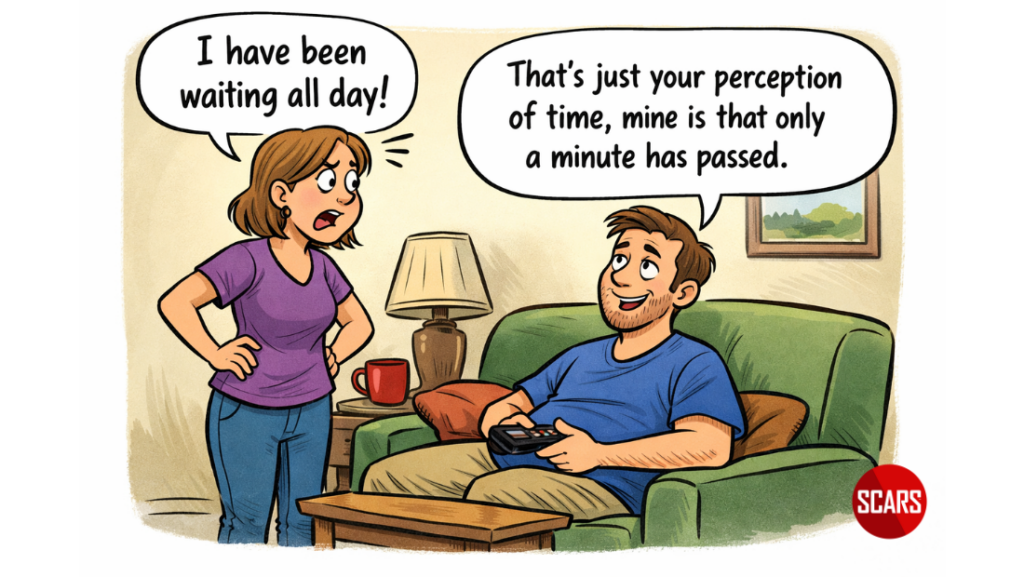
Because time is constructed from experience rather than sensed directly, people rarely perceive the flow of time in the same way. Each person’s sense of duration is shaped by attention, emotional state, stress level, cognitive load, and meaning. When one person is anxious, bored, or waiting, time often feels slow and heavy. When another person is focused, overwhelmed, or managing multiple demands, time may feel compressed and fast. Neither perception is wrong. They are simply built from different internal conditions. Yet in everyday interactions, these invisible differences are rarely recognized or acknowledged.
This mismatch in time perception frequently creates interpersonal friction. One person may feel that another is taking an unreasonably long time, interpreting the delay as carelessness, avoidance, or lack of respect. At the same moment, the other person may feel they are rushing, struggling to keep up, or already moving as fast as they can. Because each person experiences their own sense of time as normal and obvious, the difference can easily turn into frustration, blame, or conflict. In relationships affected by trauma or stress, this friction is often amplified. Distorted time perception can quietly erode patience and understanding, even when both people are doing their best, simply because their internal clocks are not aligned.
How Trauma Disrupts the Architecture of Time
Psychological trauma does more than create distressing memories. It destabilizes the very framework that allows experience to be placed into past, present, and future. Trauma overwhelms the brain’s capacity to organize events into a coherent sequence. When a threat exceeds the nervous system’s ability to cope, the brain shifts into survival mode. In that state, registering time becomes secondary to staying alive.
Traumatic experiences often occur too fast, too intensely, or too unexpectedly for the brain to segment properly. Instead of being encoded as events with a beginning, middle, and end, they are stored as fragments. Sensations, emotions, images, and bodily states are recorded without temporal context. The result is not simply memory disruption, but temporal fracture.
Many trauma survivors describe this as losing time, feeling frozen, or being stuck. The past may feel inaccessible or unreal. The future may feel collapsed, narrow, or impossible to imagine. The present can feel endless, as if the traumatic moment never truly ended. In this sense, trauma does not just happen in time. Trauma alters time.
Some professionals describe trauma as destroying the time continuum that holds experience together. Survivors may feel as though life stopped at the moment of trauma. Others feel as though time suddenly accelerated, leaving them behind. These experiences are not metaphors. They reflect genuine changes in how the brain organizes experience.
The Freeze Framed Present
One of the most disturbing effects of trauma is the sensation of being trapped in an eternal present. Survivors may intellectually know that the traumatic event is over, yet emotionally and physiologically, they continue to react as if it is still happening. The nervous system remains on alert. The body responds to reminders as if danger is immediate.
This freeze-framed state helps to explain why traumatic memories do not feel like memories. They feel like current events. Because the brain did not properly encode the event as something that ended, it cannot reliably place it in the past. Each reminder becomes a reactivation, not a recollection.
At the same time, the future becomes difficult to access. Planning, imagining, and anticipating require a stable sense of time. When the present feels endless and dangerous, the future shrinks. Many survivors struggle to imagine themselves months or years ahead. Goals feel abstract or pointless. Hope feels fragile or fraudulent.
This collapse of temporal range is one of the most overlooked injuries of trauma. It affects decision-making, motivation, identity, and recovery itself.
Why Relationship Scams Are Especially Disruptive to Time
Relationship scams produce a unique and severe disruption of temporal experience. Unlike single-incident traumas, these scams unfold over extended periods. They rely on sustained emotional engagement, repeated cycles of anticipation and crisis, and gradual erosion of external reference points.
Victims are often pulled into a reality that revolves around the scammer’s schedule, needs, and narratives. Daily routines change. Sleep patterns shift. Social connections weaken. Ordinary markers of time, such as weekends, holidays, and milestones, lose meaning. Emotional intensity replaces chronological structure.
During the scam, time often feels accelerated and immersive. Days blur together while emotional highs and lows dominate awareness. Victims may feel as though they are living inside the relationship rather than alongside their own lives. The density of emotional events creates a distorted sense of time that feels full and urgent.
After discovery, the distortion reverses. Survivors frequently report that months or years seem to vanish in retrospect. They may feel as though life was stolen or erased. This sense of lost time often fuels shame, grief, and despair. It can also create panic about aging, missed opportunities, and irreversible damage.
These reactions are not signs that the person is broken or mentally ill. They reflect how trauma and emotional manipulation interfere with event registration. When time is inferred from events, and events are distorted, time itself becomes unstable.
The Role of Memory in Temporal Disruption
Memory and time are inseparable. Memory does not simply store what happened. It stores when it happened in relation to other events. Trauma disrupts this relational encoding.
In trauma, the brain prioritizes survival responses over contextual processing. Sensory and emotional elements are encoded strongly, while temporal markers are weakened. This leads to memories that feel vivid but timeless. Survivors may remember what happened but not where it fits.
This disruption also affects autobiographical memory. Survivors may struggle to recall periods before the trauma clearly. Positive memories may feel distant or inaccessible. Life can begin to feel divided into before and after, with no bridge between them.
Because memory helps construct identity, temporal disruption can also create identity confusion. Survivors may feel disconnected from who they were before the scam. They may struggle to imagine who they will become. This disorientation can be deeply unsettling.
Distorted Time and Substance Use
Drugs and alcohol alter time perception because they interfere with how the brain registers events, attention, and memory, which are the raw materials used to construct subjective time.
Substances such as marijuana commonly slow perceived time by increasing moment-to-moment sensory awareness while disrupting short-term memory and sequence tracking. When attention becomes narrowly focused on sensations, thoughts, or emotions, each moment can feel expanded. At the same time, gaps in memory reduce the brain’s ability to link events smoothly, creating the sensation that time is stretching or looping.
Alcohol often produces a different distortion. By dampening frontal lobe function and emotional awareness, alcohol can compress time. Hours may seem to pass quickly, while later recall reveals missing segments. This is not because time moved differently, but because fewer events were registered and stored.
These effects can create interpersonal and emotional consequences. A person under the influence may sincerely feel that something happened quickly or that they acted promptly, while others experience the same period as slow, delayed, or chaotic. In trauma-affected individuals, substances can further destabilize time perception by amplifying dissociation, emotional numbing, or hyperfocus. This is one reason substance use significantly complicates recovery. It temporarily alters distress, but it also disrupts the brain’s ability to rebuild a stable sense of continuity. Over time, repeated chemical distortion of event registration can make it harder to trust one’s own sense of pacing, progress, and duration, reinforcing confusion rather than restoring temporal stability.
Why Restoring Time Is Central to Recovery
Recovery from trauma is often described in terms of emotional regulation, cognitive restructuring, and behavioral change. Yet beneath all of these processes lies a more fundamental task. The restoration of time.
Healing requires the ability to place the trauma in the past without erasing it. It requires the ability to stay in the present without freezing. It also requires the capacity to imagine a future that is not dominated by threat.
When time remains fractured, recovery efforts often stall. Therapy may feel repetitive. Progress may feel invisible. Setbacks may feel permanent. Survivors may conclude that nothing is changing, even when meaningful change is occurring.
This happens because change itself is not being registered. Without temporal markers, improvement feels unreal. Restoring time allows change to be perceived, acknowledged, and integrated.
Validating a Distorted Sense of Time
One of the most important steps in recovery is validation. Many survivors feel frightened or ashamed of their altered sense of time, even if they are not fully aware of it. They may worry that something is permanently broken or that they are losing their minds. These fears can intensify distress and delay healing.
Validation begins with understanding that time distortion is a normal trauma response. When the brain is overwhelmed, temporal organization suffers. This is not a personal failure. It is a biological and psychological adaptation to threat.
Validation also involves recognizing personal experience without judgment. Feeling stuck, rushed, frozen, or lost in time does not mean recovery is failing. It means the nervous system is still recalibrating.
Naming temporal experiences can be especially helpful. Acknowledging that time feels slow today, or that the future feels unreachable right now, helps externalize the experience. It creates distance between the survivor and the sensation. This naming process itself begins to restore structure. The victim’s journal is essential in recording these changes and giving greater meaning to the person’s sense of time.
How Grounding Techniques Rebuild Time
Grounding techniques are often described as tools for calming anxiety or reducing dissociation. Their deeper function is to help the brain reestablish event registration. Each grounded moment becomes a discrete unit of experience. Over time, these units rebuild the sense of time.
Effective grounding techniques share a common feature. They anchor experience to the present while creating clear boundaries. This allows the brain to register what is happening now as distinct from what happened before.
Examples include orienting to the current date, time of day, and location. These simple statements reinforce temporal and spatial context. They remind the nervous system that the traumatic event is not happening now.
Engaging multiple senses simultaneously also increases event density. Touching a solid object while describing its texture, temperature, and weight creates a richer event. The brain is more likely to register it.
Predictable routines are another powerful tool. Morning and evening rituals create reliable temporal markers. Even small routines, such as making tea or taking a short walk at the same time each day, help reestablish continuity.
Tracking change is equally important. Noticing shifts in mood, energy, or bodily sensations helps the brain perceive movement. Writing brief daily reflections can reinforce the idea that today happened and then ended. Writing in a journal helps to do this.
Grounding does not force time to behave normally. It invites time back gradually by giving the brain what it needs to reconstruct it.
The Importance of Patience in Temporal Healing
Restoring a sense of time does not happen quickly. Trauma disrupted time suddenly. Healing rebuilds it slowly. Survivors often become discouraged when progress feels uneven. Some days, time may feel almost normal. On other days, time may feel distorted again. This fluctuation is part of recovery. The nervous system learns through repetition. Each safe, registered moment strengthens temporal stability. Over time, the extremes become less intense and less frequent.
It is important to understand that the goal is not to eliminate awareness of time loss or distortion. The goal is to develop trust that time can move without danger. This trust allows the nervous system to relax its grip on the present.
When Time Begins to Return
As recovery progresses, many survivors notice subtle changes. Days begin to feel distinct again. The future becomes slightly more imaginable. The past feels less intrusive. These changes often arrive quietly, without dramatic insight.
Survivors may notice that setbacks no longer feel permanent. Bad days still occur, but they end. Progress becomes visible in hindsight. Time begins to function as a container rather than a threat.
This restoration of time supports identity repair. Survivors can reconnect with who they were and begin to shape who they will become. Goals regain meaning. Life regains rhythm.
Time as an Ally Rather Than an Enemy
For many scam victims, time initially feels like an enemy. It feels stolen, wasted, or broken. Recovery invites a different relationship with time. Not as something to chase or mourn, but as something that can be rebuilt.
Time is not lost forever, even when it feels that way. The brain remains capable of reconstructing temporal experience through safe, meaningful events. Each moment of grounding, validation, and connection contributes to that reconstruction.
When time stabilizes, healing accelerates. The past becomes accessible without overwhelm. The present becomes livable. The future becomes possible again.
For trauma survivors, reclaiming time is not a philosophical exercise. It is a physiological and psychological necessity. And with patience, support, and understanding, time can once again become a quiet, reliable companion in recovery.
Conclusion
Distorted time is one of the most invisible yet disruptive consequences of psychological trauma and prolonged emotional manipulation. When trauma fractures the brain’s ability to organize experience into a coherent sequence, the result is not simply confusion or distraction, but a fundamental alteration in how life is felt and understood. Past, present, and future lose their usual boundaries. Memories become untethered from context. The present may feel endless or unreal. The future may feel unreachable or unsafe. These effects are especially pronounced for relationship scam victims, whose trauma unfolds gradually, eroding ordinary temporal markers while replacing them with cycles of emotional intensity and uncertainty.
Understanding the nature of time perception changes the recovery conversation. Distorted time is not a personal failing, a lack of motivation, or a character flaw. It is a predictable response to overwhelming conditions that disrupted how events were registered and stored. Recovery, therefore, is not about forcing progress or regaining lost time. It is about restoring the brain’s ability to recognize sequence, change, and continuity.
Grounding, routine, validation, and reflection are not small coping tools. They are mechanisms for rebuilding time itself. Each meaningful, registered moment strengthens the nervous system’s capacity to recognize that experiences begin and end. With patience and repetition, time gradually becomes less threatening and more reliable. When temporal stability returns, other aspects of healing become possible. Identity stabilizes. Progress becomes visible. Hope becomes grounded rather than abstract. Reclaiming time is not about moving faster. It is about restoring the structure that allows life to move forward safely again.
An Afterthought
An important afterthought in any discussion of time perception involves the everyday friction between parents and children. Children do not experience time the way adults do. Their brains are still developing the capacity to organize experience into longer sequences, anticipate future consequences, and estimate duration reliably. For a child, ten minutes can feel endless, while an entire afternoon can vanish without notice. Emotional intensity, novelty, and attention dominate their sense of time, which means waiting often feels unbearable and transitions feel abrupt or unfair. This is not willfulness or immaturity (in the way we normally think about it). It reflects a nervous system that has not yet learned how to structure time consistently.
Parents, by contrast, tend to experience time as compressed and pressured. Responsibilities, deadlines, and cumulative stress reduce the number of distinct events registered in a day, making time feel scarce. When a parent feels rushed, and a child feels trapped in slow-moving time, conflict easily arises. A parent may interpret delay as defiance, while a child experiences urgency as overwhelming. Recognizing these differences can shift interactions from frustration to understanding. When adults provide clear temporal markers, predictable routines, and compassionate pacing, they help children gradually build their own internal sense of time. In doing so, they are not just managing behavior. They are teaching the brain how time works.

Glossary
- Accelerated Time — A subjective experience in which periods feel as though they pass unusually quickly due to high emotional intensity, sustained focus, or reduced event registration. This commonly occurs during relationship scams when emotional cycles dominate awareness and ordinary life markers fade.
- Adrenaline Narrowing — A stress-driven state in which heightened adrenaline sharpens focus on immediate stimuli while reducing awareness of surrounding context. This narrowing increases perceived detail but disrupts how events are sequenced and later placed in time.
- Anticipatory Anxiety — A forward-focused state of worry in which attention becomes fixated on potential threats or outcomes. This fixation often slows subjective time and makes waiting periods feel heavier and more prolonged.
- Attention Density — The amount of perceptual and emotional information registered within a given period. Higher attention density tends to expand subjective time, while low attention density leads to compressed or missing time.
- Autobiographical Memory Disruption — A breakdown in the ability to organize personal memories into a coherent life narrative. This disruption can cause survivors to feel disconnected from who they were before trauma and uncertain about who they are becoming.
- Boundary Loss — The erosion of clear beginnings and endings in experience, causing moments to blur together. Boundary loss contributes to the sensation that time has stalled or lost structure.
- Cerebellar Timing Function — The role of the cerebellum in coordinating prediction, sequencing, and internal timing. Disruption in this function can impair the sense of duration and temporal order.
- Chronological Anchors — External markers such as routines, calendars, and social events that help structure time. Trauma often weakens these anchors, making days and weeks feel indistinct.
- Clock Time — Objective, measured time tracked by clocks and calendars. Clock time continues unchanged even when subjective time perception becomes distorted.
- Cognitive Load — The total mental effort required to process information at a given moment. High cognitive load can compress time by limiting how many events are consciously registered.
- Compressed Time — A subjective experience in which long periods feel as though they passed quickly or disappeared. This often emerges after trauma or during prolonged emotional stress.
- Continuity Breakdown — The loss of a felt connection between past, present, and future. This breakdown makes life feel fragmented and disrupts planning, memory, and identity.
- Dissociation — A protective psychological response in which awareness disconnects from the present moment. Dissociation reduces event registration and contributes to missing or distorted time.
- Dyschronometria — A neurological disruption in internal timing mechanisms associated with cerebellar dysfunction. This condition affects the ability to estimate duration and sequence actions accurately.
- Emotional Event Dominance — A state in which emotionally charged moments outweigh neutral experiences in memory. This dominance distorts time by overcrowding awareness with high-intensity events.
- Emotional Meaning Weighting — The process by which emotionally significant experiences are given greater importance in memory formation. This weighting influences how long or short periods feel in retrospect.
- Event Registration — The brain’s process of recognizing and encoding discrete experiences. Trauma interferes with this process, leading to fragmented or timeless memories.
- Event Sequencing — The ability to organize experiences into a logical order. When sequencing fails, memories lose their temporal placement.
- Flow State — A condition of deep engagement in which attention narrows and self-awareness recedes. Time often feels as though it disappears because internal check-ins decrease.
- Fragmented Memory Encoding — The storage of sensory and emotional elements without contextual integration. This leads to memories that feel vivid but disconnected from time.
- Future Foreshortening — A trauma-related effect in which the future feels shortened, inaccessible, or impossible to imagine. This limits goal-setting and hope.
- Grounding Practice — A technique that anchors awareness to the present moment through sensory and cognitive cues. Grounding increases event registration and supports temporal rebuilding.
- Hyperfocus — An intense concentration on a narrow range of stimuli. Hyperfocus can distort time by amplifying moment-to-moment awareness while reducing sequence tracking.
- Identity Discontinuity — A sense of being disconnected from one’s past or future self. Temporal disruption often underlies this experience in scam survivors.
- Internal Time Construction — The brain’s process of inferring time from events rather than sensing it directly. This construction is vulnerable to stress and trauma.
- Memory Context Loss — The weakening of information about when and where an event occurred. Context loss makes memories feel timeless or intrusive.
- Moment Expansion — A subjective sensation in which brief periods feel extended due to heightened perception. This often occurs during fear or intense focus.
- Narrative Collapse — The loss of a coherent life story linking experiences across time. Trauma fragments narrative continuity and destabilizes meaning.
- Neural Sampling of Change — The brain’s reliance on detecting changes rather than continuous flow. This sampling forms the basis of subjective time perception.
- Objective Time — Time as defined by physical measurement and external standards. Objective time remains constant regardless of psychological state.
- Past Inaccessibility — Difficulty recalling or emotionally accessing pre-trauma experiences. This contributes to a feeling that life began at the moment of trauma.
- Present Fixation — A trauma-driven state in which awareness remains locked in the now. This fixation prevents normal movement between time frames.
- Routine Anchoring — The use of predictable daily actions to mark time. Routines help restore continuity by creating reliable temporal reference points.
- Sensory Encoding Bias — A tendency for trauma to strengthen sensory memory while weakening contextual details. This imbalance contributes to timeless recollections.
- Subjective Duration — The felt length of time as experienced internally. Subjective duration varies widely based on emotional and cognitive conditions.
- Temporal Compression — The experience of time passing quickly with little recall of events. Compression often follows prolonged stress or emotional overload.
- Temporal Disintegration — The breakdown of structured time perception when routines and social markers disappear. This phenomenon became widespread during prolonged collective stress.
- Temporal Foreshortening — A reduced sense of future depth that limits planning and imagination. This effect is common in trauma recovery phases.
- Temporal Marker Loss — The disappearance of meaningful events that separate days and weeks. Without markers, time becomes indistinct.
- Temporal Reconstruction — The gradual rebuilding of time perception through repeated, meaningful experiences. This process supports recovery and identity repair.
- Temporal Stability — A balanced ability to experience past, present, and future as distinct but connected. Stability is a key outcome of trauma healing.
- Timeless Memory — A memory that lacks a clear sense of when it occurred. Such memories feel current rather than historical.
- Trauma Encoding Bias — The tendency for traumatic experiences to be stored in survival-oriented brain systems. This bias disrupts sequencing and time placement.
- Validation of Time Distortion — The acknowledgment that altered time perception is a normal trauma response. Validation reduces shame and supports healing.
- Victim Journal — A reflective practice used to document daily experiences and changes. Journaling increases event registration and reinforces temporal continuity.
- Waiting Distress — Emotional discomfort experienced during perceived delays. Waiting distress often reflects slowed subjective time rather than actual delay.
- Zero Reference Point — A perceived reset of time following trauma discovery. Survivors may feel as though life began again at that moment.
Reference
There are multiple studies, reviews, and research findings that support key ideas presented in the article about how trauma, mood, neurological conditions, flow states, and altered states influence time perception. Here are some of the relevant scientific sources:
Distorted Time as a Recognized Phenomenon in Psychology
Research defines time distortion as a fundamentally altered subjective experience of duration and temporal order, with sensations of speeding up, slowing down, or loss of chronological structure. This has been discussed in systematic reviews of time distortion cases across psychological conditions.
https://pmc.ncbi.nlm.nih.gov/articles/PMC8138562/
Emotion, Stress, and Altered Time Perception
Experimental work and theoretical perspectives link emotions such as fear, anxiety, and heightened states with changes in how time is perceived. These effects are noted in studies on high adrenaline responses like tachypsychia, where intense emotional activation is associated with perceived slowing of time.
Trauma and Disrupted Time Perspective
Time perception differences are documented in trauma and posttraumatic stress contexts. Research with adolescents showing that posttraumatic stress symptoms correlate with an imbalanced time perspective supports the notion that trauma affects how past, present, and future are experienced psychologically.
https://www.mdpi.com/2254-9625/15/9/177
Studies also find time perception differences in people with posttraumatic stress or co-occurring disorders such as depression, indicating that trauma-related cognitive patterns shape temporal experience.
https://pmc.ncbi.nlm.nih.gov/articles/PMC9898469/
Flow States and Time Alteration
A meta-analysis of research on flow states confirms that an altered subjective sense of time is one of several characteristic features of flow, providing evidence that deep engagement and enjoyment consistently change duration judgments.
https://pubmed.ncbi.nlm.nih.gov/31279183/
Neurological Conditions and Time Perception
Reviews in neuroscience highlight that attention deficit hyperactivity disorder (ADHD) is associated with significant differences in time estimation, time monitoring, and timing tasks, supporting the idea that neurological variation affects temporal experience.
https://pmc.ncbi.nlm.nih.gov/articles/PMC8293837/
Pandemic-related Temporal Disintegration
The widespread disruption of routines and psychological stress during events like the COVID-19 pandemic produced phenomena where days and weeks felt as if they blended together or lost structure, an effect documented in research on pandemic-related time perception changes.
Drug Effects on Time Perception
Substance use literature notes that psychoactive substances such as cannabis produce distortions in motor coordination and time perception, providing biological evidence that external chemicals change the brain processes underlying subjective time.
https://www.ncbi.nlm.nih.gov/books/NBK424849/
Foundational Frameworks of Time Perception
Reviews of the neuroscience of time perception illustrate how subjective time is shaped by neural processes and cognitive mechanisms rather than direct sensory detection.
Taken together, these studies support the idea that subjective time is constructed by the brain and that factors such as emotion, trauma, engagement, neurological differences, and psychoactive substances can systematically alter how time is experienced.
Author Biographies
-/ 30 /-
What do you think about this?
Please share your thoughts in a comment below!
One Comment
Leave A Comment
TABLE OF CONTENTS
- When Trauma Breaks Time – How Psychological Trauma and Relationship Scams Disrupt the Sense of Past, Present, and Future
- When Trauma Breaks Time – How Psychological Trauma and Relationship Scams Disrupt the Sense of Past, Present, and Future
- Why Time Feels Real Even When the Brain Cannot Sense It
- Distorted or Broken Time
- To Each Their Own
- How Trauma Disrupts the Architecture of Time
- The Freeze Framed Present
- Why Relationship Scams Are Especially Disruptive to Time
- The Role of Memory in Temporal Disruption
- Distorted Time and Substance Use
- Why Restoring Time Is Central to Recovery
- Validating a Distorted Sense of Time
- How Grounding Techniques Rebuild Time
- The Importance of Patience in Temporal Healing
- When Time Begins to Return
- Time as an Ally Rather Than an Enemy
- Conclusion
- An Afterthought
- Glossary
- Reference







CATEGORIES
ARTICLE META
Important Information for New Scam Victims
- Please visit www.ScamVictimsSupport.org – a SCARS Website for New Scam Victims & Sextortion Victims.
- SCARS Institute now offers its free, safe, and private Scam Survivor’s Support Community at www.SCARScommunity.org – this is not on a social media platform, it is our own safe & secure platform created by the SCARS Institute especially for scam victims & survivors.
- SCARS Institute now offers a free recovery learning program at www.SCARSeducation.org.
- Please visit www.ScamPsychology.org – to more fully understand the psychological concepts involved in scams and scam victim recovery.
If you are looking for local trauma counselors, please visit counseling.AgainstScams.org
If you need to speak with someone now, you can dial 988 or find phone numbers for crisis hotlines all around the world here: www.opencounseling.com/suicide-hotlines
Statement About Victim Blaming
Some of our articles discuss various aspects of victims. This is both about better understanding victims (the science of victimology) and their behaviors and psychology. This helps us to educate victims/survivors about why these crimes happened and not to blame themselves, better develop recovery programs, and help victims avoid scams in the future. At times, this may sound like blaming the victim, but it does not blame scam victims; we are simply explaining the hows and whys of the experience victims have.
These articles, about the Psychology of Scams or Victim Psychology – meaning that all humans have psychological or cognitive characteristics in common that can either be exploited or work against us – help us all to understand the unique challenges victims face before, during, and after scams, fraud, or cybercrimes. These sometimes talk about some of the vulnerabilities the scammers exploit. Victims rarely have control of them or are even aware of them, until something like a scam happens, and then they can learn how their mind works and how to overcome these mechanisms.
Articles like these help victims and others understand these processes and how to help prevent them from being exploited again or to help them recover more easily by understanding their post-scam behaviors. Learn more about the Psychology of Scams at www.ScamPsychology.org
SCARS INSTITUTE RESOURCES:
If You Have Been Victimized By A Scam Or Cybercrime
♦ If you are a victim of scams, go to www.ScamVictimsSupport.org for real knowledge and help
♦ SCARS Institute now offers its free, safe, and private Scam Survivor’s Support Community at www.SCARScommunity.org/register – this is not on a social media platform, it is our own safe & secure platform created by the SCARS Institute especially for scam victims & survivors.
♦ Enroll in SCARS Scam Survivor’s School now at www.SCARSeducation.org
♦ To report criminals, visit https://reporting.AgainstScams.org – we will NEVER give your data to money recovery companies like some do!
♦ Follow us and find our podcasts, webinars, and helpful videos on YouTube: https://www.youtube.com/@RomancescamsNowcom
♦ Learn about the Psychology of Scams at www.ScamPsychology.org
♦ Dig deeper into the reality of scams, fraud, and cybercrime at www.ScamsNOW.com and www.RomanceScamsNOW.com
♦ Scam Survivor’s Stories: www.ScamSurvivorStories.org
♦ For Scam Victim Advocates visit www.ScamVictimsAdvocates.org
♦ See more scammer photos on www.ScammerPhotos.com
You can also find the SCARS Institute’s knowledge and information on Facebook, Instagram, X, LinkedIn, and TruthSocial
Psychology Disclaimer:
All articles about psychology and the human brain on this website are for information & education only
The information provided in this and other SCARS articles are intended for educational and self-help purposes only and should not be construed as a substitute for professional therapy or counseling.
Note about Mindfulness: Mindfulness practices have the potential to create psychological distress for some individuals. Please consult a mental health professional or experienced meditation instructor for guidance should you encounter difficulties.
While any self-help techniques outlined herein may be beneficial for scam victims seeking to recover from their experience and move towards recovery, it is important to consult with a qualified mental health professional before initiating any course of action. Each individual’s experience and needs are unique, and what works for one person may not be suitable for another.
Additionally, any approach may not be appropriate for individuals with certain pre-existing mental health conditions or trauma histories. It is advisable to seek guidance from a licensed therapist or counselor who can provide personalized support, guidance, and treatment tailored to your specific needs.
If you are experiencing significant distress or emotional difficulties related to a scam or other traumatic event, please consult your doctor or mental health provider for appropriate care and support.
Also read our SCARS Institute Statement about Professional Care for Scam Victims – click here
If you are in crisis, feeling desperate, or in despair, please call 988 or your local crisis hotline – international numbers here.
More ScamsNOW.com Articles







A Question of Trust
At the SCARS Institute, we invite you to do your own research on the topics we speak about and publish. Our team investigates the subject being discussed, especially when it comes to understanding the scam victims-survivors’ experience. You can do Google searches, but in many cases, you will have to wade through scientific papers and studies. However, remember that biases and perspectives matter and influence the outcome. Regardless, we encourage you to explore these topics as thoroughly as you can for your own awareness.



I know since my experience i know what time I am supposed to be there but I get my mind on other things and it is time to go and I haven’t even showered and I have to hustle There is sometimes I get engrossed in for instance my Bible study home work and wow it is past noon but most days seem to drag will it get better will I get more interested in my house work like my friend compulsed to clean all the time she is ocd will I ever be normal again it is discouraging dont tall to strangers as a nurse I have talked to strangers all my life now the time thing real makes sense why I am doing what I am doing ty