




ScamsNOW!
The SCARS Institute Magazine about Scam Victims-Survivors, Scams, Fraud & Cybercrime




When Safety Arrives, and the Mind and Body Finally Break Down
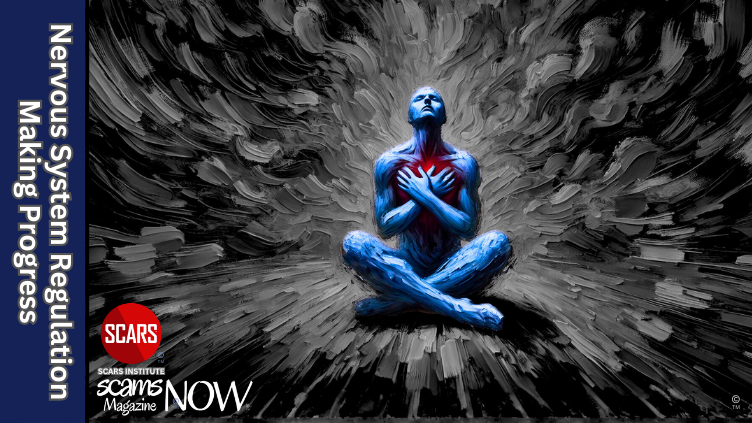
When Safety Finally Arrives, and the Body Finally Feels Safe Enough to Let it All Out
Primary Category: Scam Victim Recovery Psychology
Author:
• Tim McGuinness, Ph.D., DFin, MCPO, MAnth – Anthropologist, Scientist, Polymath, Director of the Society of Citizens Against Relationship Scams Inc.
Author Biographies Below
About This Article
Some relationship scam survivors experience symptom flare-ups after life becomes safer, including panic, insomnia, intrusive memories, body pain, emotional swings, and cognitive fog. This pattern is framed as a nervous system shift from survival mode, focused on short-term functioning, into processing mode, where postponed stress and grief can surface. The article distinguishes early calming from later acceptance of safety, noting that reliable safety can open access to deeper emotional processing. It describes autonomic state shifts, stress hormone aftereffects, threat and memory circuitry, memory reconsolidation, and the window of tolerance as factors that shape symptoms. It outlines warning signs needing added support, emphasizes stabilization and pacing, and presents a Neural Reset Protocol framework to support safe integration.
Note: This article is intended for informational purposes and does not replace professional medical advice. If you are experiencing distress, please consult a qualified mental health professional.

When Safety Finally Arrives, and the Body Finally Feels Safe Enough to Let it All Out
Author’s Note
This article is a continuation of a previous article about making progress in recovery, as the nervous system regulates it can still feel difficult as it seeks to establish safety. This is the other part of that progression. Read the first article here: https://scamsnow.com/nervous-system-regulation-making-progress-2026/
When Safety Finally Arrives
Many relationship scam survivors expect that life will get steadily better once the scam ends. They may imagine that distance, therapy, staying busy, learning, a stable home, or a support group will calm everything down. Instead, some survivors notice a strange and frightening pattern. The moment life becomes safer, symptoms surge. Panic can spike. Sleep can fall apart. Old memories can surface. The body can ache. The mind can race. It can feel like healing is making things worse.
In trauma recovery, that pattern is often not a sign of failure. It can be a sign that the nervous system is finally shifting out of emergency survival mode and into processing mode. In survival mode, the brain and body prioritize short-term functioning. They focus on getting through the day, staying alert, and avoiding collapse. When safety increases, the system may finally allow what it postponed. The result can look like a breakdown, but it can also be the start of real integration.
Part 1: The Safe-Enough Phase
The Difference Between the In-Between State and a State of Safety
When the nervous system is calming, it is primarily reducing acute threat responses rather than engaging in deeper healing work. Hypervigilance softens, panic decreases, and baseline arousal lowers enough for basic functioning to stabilize (regulation). This in-between phase is protective and energy-conserving. The nervous system is testing whether danger has truly ended, not yet committing resources to grief or integration. Emotional distance, fatigue, and limited motivation are common because the system remains cautious. Calm at this stage is conditional and provisional, shaped by vigilance rather than trust. We describe this as a STEP 1 characteristic.
Acceptance of safety is a later and more demanding shift. At this point, the nervous system no longer treats calm as temporary or fragile. Safety begins to feel reliable, which frees capacity for emotional processing. Only then does grief surface in fuller form, along with sadness, anger, loss, and meaning-questions that were previously inaccessible. This processing is not a sign of regression. It indicates that the system now believes it can feel without being overwhelmed or endangered. Trauma and grief work require safety as a prerequisite. The nervous system must first trust that feeling will not lead to collapse before it allows the deeper material to emerge. We describe this as a STEP 2 characteristic, though the SCARS Institute Recovery Steps are a guide and not really fixed for all survivors.
For survivors of relationship scams, this experience can be especially intense. A relationship scam is not only a financial crime. It is a betrayal trauma, meaning the harm centers on a violation of trust within a relationship the victim believed was real. Betrayal trauma is commonly described as trauma that occurs when a person or institution that someone depends on violates that person’s trust or well-being. The survivor’s nervous system has been trained, day after day, to stay on guard. It may have learned that closeness is dangerous, that hope is risky, and that rest is unsafe. When safety finally appears, the nervous system can respond with a huge backlog of unfinished stress.
This article explains the psychological and neurological processes involved, why symptoms can flare when life calms down, what the mind and body may be doing, and how a structured approach, such as a Neural Reset Protocol, can support the processing phase.
This is also the period that can trigger a very dangerous psychological crisis that we call an ‘Identity Crisis’. “How am I? How could I have allowed this?” In our experience, other than the initial shock period of the first couple of months, this is another period where suicide is a high risk.
What is this Safety Phase?
The “safe enough to fall apart” phase is a period in recovery when symptoms intensify after the threat has reduced. Survivors may have more intrusive memories, more body sensations, more emotional swings, and more sleep disruption than they had during the active crisis.
This phase can be confusing because it contradicts a common belief: “If I am safe now, I should feel calm.” In trauma recovery, safety can uncover what was suppressed. The nervous system may be saying, in its own language, “Now there is room to feel what could not be felt before.”
How This Phase Works?
The body has multiple systems that coordinate survival. During the aftermath of a relationship scam, the survivor often lives with constant uncertainty, fear, humiliation, urgency, and social pressure. Those conditions keep the brain’s threat circuitry engaged.
Several systems matter most in this “delayed processing” pattern.
Autonomic Nervous System State Shifts
The autonomic nervous system manages automatic survival functions like heart rate, breathing, digestion, and muscle tension. In chronic threat, many survivors spend long periods in sympathetic activation. That is the “fight or flight” pattern. The body runs hot, fast, vigilant, and tense. It produces stress hormones, narrows attention, and prepares for action.
When safety increases, the body may swing. Some survivors drop into exhaustion, heaviness, numbness, or shutdown. Others remain keyed up but become more aware of the sensations that were there all along. Many survivors alternate between the two.
Polyvagal Theory uses the language of state shifts to describe how bodies move between mobilization and connection. It also highlights “neuroception,” the nervous system’s rapid, mostly unconscious scanning for cues of safety or danger. When the system detects safety more often, it loosens its grip on suppression. That is helpful long term, but it can feel terrifying at first.
HPA Axis And Stress Hormone Aftereffects
The HPA axis is a hormone system that helps the body respond to stress. It influences cortisol levels, energy availability, and alertness. Chronic stress can dysregulate this system, which can contribute to sleep problems, mood symptoms, and bodily wear and tear.
During the scam and its aftermath, the survivor may function on adrenaline, urgency, and fear. When the pressure drops, the body can experience a “letdown” effect. The survivor may notice shakiness, fatigue, emotional flooding, headaches, stomach upset, or a sense of crashing. This can feel like “something is wrong,” even though it may be the body shifting away from a constant alarm. This seems contrary to normal illness, where the body feels better.
Brain Circuitry: Threat, Memory, And Meaning
Trauma symptoms are not “weakness.” Trauma is an injury. They are strongly linked to brain networks that detect threat, store memory, and regulate emotion.
In PTSD research, threat responding and hyperarousal are commonly associated with increased activation in areas such as the amygdala and related circuits, alongside reduced regulatory support from regions involved in contextual memory and regulation. Even when a survivor is physically safe, the brain can keep predicting danger. Relationship scams teach the brain a painful lesson: “What looks loving can be a trap.” That lesson can generalize to people, messages, money, intimacy, and even to quiet moments.
At the same time, the brain is a meaning-making organ. Survivors often replay details because the mind is trying to resolve contradictions. “How could this be real and not real?” “How did I miss it?” “Who was I talking to?” Those loops can intensify when life finally slows down, because the brain has more space to search for coherence.
Memory Reconsolidation And Why Old Material Surfaces
When a memory is reactivated, it can become changeable for a short window. That is a key idea in memory reconsolidation research. In everyday terms, when the brain opens a file, it can sometimes rewrite parts of the emotional meaning before saving it again.
In recovery, reminders of the scam, new relationships, therapy conversations, new knowledge learned, or support group stories can reactivate stored emotional memories. When the survivor has more safety and support, the brain can attempt to update those memories. That process can bring vivid images, dreams, body sensations, grief waves, and sudden anger. The surfacing material may be the nervous system trying to integrate what was previously too dangerous to feel.
Window Of Tolerance And The Feeling Of “Worse”
Many clinicians describe regulation using the “window of tolerance,” a zone where a person can think, feel, and stay present without becoming overwhelmed or shutting down. The concept is widely attributed to Daniel Siegel’s work and is used to explain hyperarousal and hypoarousal patterns.
After a relationship scam, the window of tolerance can narrow. When safety increases, the survivor may start approaching painful material that sits just outside the window. That can look like regression. In reality, it can be a sign that the system is testing the edges of what it can process. This is why symptom spikes often happen in therapy or in the first months of real stability. Stability creates contact with what was avoided.
Why It Affects Scam Survivors So Strongly
Relationship scams have features that push the nervous system into prolonged survival mode.
- Chronic Uncertainty: Scammers create constant micro-crises. Money problems. Travel emergencies. “Prove your love.” Sudden anger, then affection. This pattern keeps the body in alertness. It also teaches the survivor to distrust calm.
- Attachment and Betrayal: The survivor often bonded with the scammer’s persona. That bond can be reinforced by love bombing, future promises, sexualized attention, and daily contact. When the truth comes out, the survivor loses a relationship and a reality at the same time. The nervous system reads this as danger, even after the scam ends, because attachment systems and threat systems overlap in the brain.
- Shame and Self-Blame as Threat Signals: Many survivors carry intense shame. Shame is not only a feeling. It is a bodily state. It can cause collapse, hiding impulses, and social withdrawal. Shame also signals danger, because the nervous system interprets rejection as a survival risk. When safety appears, shame can surface more strongly because the survivor is no longer in action mode, and the mind starts reviewing what happened.
The Body’s Ledger: Allostatic Load
Chronic stress builds “wear and tear” across systems, sometimes described as allostatic load. Research links prolonged stress dysregulation with changes in brain regions involved in memory, emotion, and regulation. When the crisis ends, the body can finally report the cost: fatigue, immune shifts, pain sensitivity, digestive issues, and sleep disruption. The survivor may interpret these as new problems when they may be delayed consequences.
- What Symptoms Can Show Up and Why: This phase can look different for each survivor, but common experiences include:
- Panic Attacks That Appear “Out Of Nowhere”: Panic can rise when the body notices internal sensations it previously ignored. A calmer environment can also reduce distractions, making sensations louder. The mind may label the sensations as danger. The cycle builds.
- Insomnia and Nightmares: Hyperarousal can keep the body alert at night. PTSD resources commonly list sleep disturbance, hypervigilance, and being on edge as key symptoms. Sleep disruption can worsen memory intrusions and emotional intensity, creating a feedback loop.
- Intrusive Memories and Flashback-Like Moments: When the brain feels safer, it may “open the file” more often. A smell, a ringtone, a certain phrase, or a quiet evening can reactivate memory networks.
- Body Pain, Gut Symptoms, and Fatigue: Threat states change breathing patterns, muscle tension, digestion, and inflammation signals. When the system downshifts, sensations can become more noticeable. Fatigue can also appear as the body repays a long sleep debt and hormone imbalance.
- Emotional Flooding: Grief, anger, disgust, and longing can arrive together. Survivors may feel love and hate in the same hour. This is common in betrayal trauma because attachment needs do not shut off just because the truth is known.
- Cognitive Fog and Difficulty Concentrating: Threat states narrow attention. When the system shifts, concentration may feel worse before it improves, especially if sleep is poor and intrusive thinking is high.
What to Watch For in this Phase
This “processing surge” phase or “safe enough” phase is often manageable, but it deserves respect and should have a therapist’s support. A survivor may need added support if any of the following occur:
- Symptoms escalate rapidly and interfere with basic functioning for weeks at a time.
- The survivor uses alcohol, drugs, gambling, or risky behavior to shut symptoms down.
- The survivor has persistent thoughts of self-harm or feels unsafe when alone.
- Panic becomes constant, or dissociation becomes frequent.
- Medical symptoms appear that need evaluation, such as chest pain, fainting, severe weight loss, or uncontrolled blood pressure.
Trauma-informed care emphasizes safety, trust, and peer support as key principles in recovery systems. If safety is slipping, the priority becomes stabilizing before deep processing.
What To Do Next
A survivor does not need to force the breakdown, and a survivor does not need to fear it. The goal is to support the nervous system so it can process without overwhelming the person.
- Name The Phase Without Judging It: A survivor can treat symptom flare-ups as information, not as proof of failure. The system may be saying, “There is enough safety to feel.” That reframe can reduce secondary fear, which is the fear of the symptoms themselves.
- Build A Stabilization Plan Before Deep Work: A survivor can focus on basic regulation practices first, especially if therapy is exploring traumatic material. Stabilization can include sleep routines, hydration, regular meals, and predictable daily structure. These simple supports send safety signals to the brain.
- Work Inside The Window Of Tolerance: A survivor can pace processing. Short, contained sessions. Grounding before and after. Stopping while still okay, not after collapse. This helps widen capacity over time.
- Use Body-Based Regulation Tools: The nervous system often responds faster to body cues than to logic. A survivor can use slow breathing, longer exhales, gentle movement, and temperature shifts like cool water on the face. These tools can lower arousal and help the brain regain context.
- Strengthen Safe Connection: Support groups, trusted friends, and trauma-informed clinicians can provide co-regulation, meaning one calm nervous system helps another settle. The survivor’s body learns safety through repeated experiences of being believed, not pressured, and not blamed.
- Choose Trauma-Informed, Scam-Informed Support: A survivor benefits most from helpers who understand coercive control, manipulation, and betrayal trauma dynamics. That reduces the chance of accidental shaming and speeds up nervous system trust.
- Track Patterns Without Obsessing: A survivor can keep brief notes on triggers, sleep, and symptom intensity. This builds a map. The map often shows that flare-ups rise after stress, conflict, anniversaries, or therapy sessions, and then fall again. Seeing the pattern can reduce fear.
Talk About this with Your Therapist
Talking about these distinctions with your therapist is an important part of recovery. When you and your therapist share a clear understanding of the difference between a calming nervous system and one that has begun to accept safety, it becomes easier to interpret what you are experiencing without fear or self-judgment. Symptoms such as fatigue, low motivation, or emotional flatness can be understood in context rather than mistaken for failure or resistance. This shared framework helps your therapist accurately assess where you may be within the recovery, trauma, and grief cycles, and to pace the work in a way that supports your nervous system rather than overwhelming it.
These conversations also allow therapy to become more collaborative and precise. When you bring in what you are learning, you give your therapist valuable information about how your body and mind are responding outside of sessions. Together, you can decide when it is appropriate to focus on stabilization, when to gently expand capacity, and when deeper grief or trauma processing may be possible and safe. Sharing this information supports better timing, clearer expectations, and reduced shame. Survivors are encouraged to openly discuss what they learn about nervous system recovery with their therapist so both of you can interpret signals accurately and apply interventions that match your current level of safety and readiness.
Part 2: Neural Reset Protocol
The term “Neural Reset Protocol” emerged in the early twenty-first century as clinicians and researchers sought practical ways to describe structured approaches for helping traumatized nervous systems return toward baseline functioning. It did not originate as a single proprietary method or branded therapy. Instead, it developed as a descriptive framework that drew from decades of trauma research, including work on stress physiology, autonomic regulation, learning theory, and attachment. The phrase was used to communicate a central idea: after prolonged threat, the nervous system requires deliberate conditions of safety, repetition, and pacing to interrupt survival patterns and restore adaptive functioning.
Over time, the concept became more defined as trauma-informed care expanded beyond insight-based psychotherapy alone. Clinicians observed that many survivors, including scam victims, could fully understand what happened yet remained physiologically stuck. The Neural Reset Protocol came to describe an organized sequence that prioritizes stabilization first, then gradual capacity building, and only later, deeper trauma or grief processing. It emphasized regulation skills, predictable routines, and titrated exposure rather than emotional flooding or forced catharsis.
Today, the Neural Reset Protocol is best understood as a guiding structure rather than a fixed technique. It integrates nervous system regulation, cognitive meaning making, and relational safety, allowing interventions to be adapted to the individual. Its historical value lies in helping survivors and clinicians share a common language for recovery timing, reducing shame, preventing retraumatization, and supporting healing that unfolds at the pace the nervous system can tolerate.
None of this is easy, but if done with commitment and supported by knowledgeable therapists and trauma-informed support providers, it does work.
What is the Neural Reset Protocol?
A Neural Reset Protocol is a structured, trauma-informed framework (therapy) used to help the nervous system move out of prolonged survival mode and regain regulatory balance after chronic stress or trauma. It is not a single technique or branded method. It is a coordinated sequence of practices designed to stabilize, regulate, and gradually integrate traumatic stress responses without overwhelming the mind or body.
In the context of relationship scam recovery, a Neural Reset Protocol recognizes that the survivor’s nervous system has been operating under sustained threat. The protocol focuses first on restoring physiological safety rather than forcing emotional processing. This approach aligns with modern trauma science, which shows that regulation must precede insight (knowledge) for lasting recovery.
- Psychologically, the protocol works by reducing hypervigilance, interrupting threat-prediction loops, and restoring a sense of agency. Survivors learn to recognize internal signals of activation and apply grounding strategies before the system escalates into panic, shutdown, or dissociation. Over time, this retrains the brain’s threat-detection circuits to distinguish past danger from present safety.
- Neurologically, a Neural Reset Protocol supports recalibration of autonomic nervous system patterns, stress hormone signaling, and memory integration processes. Techniques often emphasize slow, controlled breathing, predictable routines, sensory grounding, and gentle body-based regulation to signal safety to the brainstem and limbic system. Once baseline regulation improves, higher cortical regions involved in reflection, meaning-making, and decision-making can reengage more reliably.
A key principle of a Neural Reset Protocol is pacing. Traumatic material is approached gradually and only when the survivor’s nervous system demonstrates sufficient stability. This prevents re-traumatization and reduces the risk of symptom escalation that can occur when emotional processing is attempted too early or too intensely.
Importantly, a Neural Reset Protocol does not aim to erase memories or emotions. Its purpose is to help the nervous system complete interrupted stress responses, integrate fragmented experiences, and restore flexible regulation. Progress is measured by increased emotional tolerance, improved sleep, reduced reactivity, and a growing sense of internal safety rather than by emotional intensity or catharsis.
For scam survivors, this type of protocol can be especially protective. Relationship scams condition the nervous system through deception, intermittent reinforcement, and betrayal. A Neural Reset Protocol helps reverse that conditioning by replacing chaos with predictability, threat with safety cues, and self-blame with physiological understanding.
Be sure to ask your therapist when or if this might be useful for you!
A Neural Reset Protocol As A Support Structure
A Neural Reset Protocol can function as a stabilizing framework during the phase when suppressed trauma responses begin to surface. This phase often follows a period of relative safety and can feel confusing or frightening to survivors of relationship scams (romance or investment). Symptoms may intensify just as life appears calmer. A structured protocol provides containment during this transition by giving the nervous system predictable signals of safety, pacing, and support.
At its core, a Neural Reset Protocol is designed to work with the nervous system rather than against it. Instead of pushing for emotional release or insight too quickly, it recognizes that the body must first feel safe before it can process unresolved stress. The protocol is not a single technique. It is a coordinated sequence of principles and practices that support regulation, integration, and restored agency.
Prioritizing Safety And Stabilization
The first and most essential feature of an effective Neural Reset Protocol is its emphasis on safety and stabilization. After a relationship scam, the survivor’s nervous system has often spent months or years in survival mode. During that time, the brain learns that vigilance, urgency, and emotional suppression are necessary to survive. Attempting deep emotional processing before restoring basic regulation can reinforce threat rather than resolve it.
Stabilization focuses on helping the nervous system reach a baseline where the survivor can remain present without becoming overwhelmed or shut down. This may include predictable daily routines, consistent sleep and meal timing, and simple grounding practices. These elements may appear modest, but they are powerful signals to the brain that the environment is no longer chaotic or dangerous.
In this stage, the protocol avoids forced emotional catharsis. Intense emotional release without adequate regulation can flood the system and reinforce fear responses. Safety-first pacing allows the nervous system to learn that it can approach difficult material without being consumed by it.
Building Nervous System Regulation Skills
A Neural Reset Protocol includes practical tools that help survivors regulate physiological arousal. These skills are not optional additions. They are foundational. Insight alone does not calm a nervous system shaped by chronic threat.
Regulation skills may involve mindfulness breathwork that emphasizes slow, extended exhalation, which supports parasympathetic activation. They may include gentle movement that releases muscle tension without triggering alarm. Sensory grounding can also play a role, such as using temperature, sound, or tactile input to anchor the body in the present moment. See our “Color Walk” or “Spiral Walking” as examples.
Over time, repeated use of regulation tools helps retrain threat-prediction circuits. The brain begins to recognize that internal sensations are not always signals of danger. This reduces secondary fear, which is the fear of symptoms themselves. As regulation improves, the survivor gains more choice in how to respond rather than reacting automatically.
Pacing Exposure And Allowing Recovery
Another defining trait of an effective Neural Reset Protocol is careful pacing. The protocol does not attempt to process everything at once. Instead, it works in small, contained segments. Painful material is approached gradually, and each period of engagement is followed by intentional recovery time. Unfortunately, this is hard in support groups with individuals at different stages of recovery, but this is a primary purpose of professional therapy.
This pacing respects the nervous system’s limits. When trauma material is activated, stress hormones rise, and attention narrows. Without adequate recovery, the system can remain stuck in activation. The protocol intentionally alternates between activation and settling, which teaches the nervous system that it can return to calm after stress.
Recovery time may include rest, soothing activities, or safe social connections. This phase is not avoidance. It is a consolidation. It allows the nervous system to integrate what was touched without becoming overwhelmed. Over repeated cycles, the window of tolerance expands, and the survivor can engage with more complex material without destabilization.
Integrating Body, Mind, And Relationship Repair
A Neural Reset Protocol recognizes that trauma lives across multiple systems. It does not treat the body, thoughts, and relationships as separate problems. Instead, it integrates these domains in a coordinated way.
Body regulation addresses the physiological imprint of threat. Cognitive meaning-making helps the survivor understand what happened without collapsing into self-blame. Relationship repair focuses on restoring trust, both internally and with safe others. This may involve learning how to set boundaries, recognize healthy signals, and tolerate closeness without panic.
For relationship scam survivors, this integration is especially important. The trauma involved deception, attachment manipulation, and emotional conditioning. Healing, therefore, requires more than calming symptoms. It requires rebuilding the capacity to connect while maintaining self-protection. A protocol that addresses only one domain may leave others unresolved.
Measuring Progress By Capacity, Not Intensity
A critical principle of a Neural Reset Protocol is how progress is measured. The goal is not emotional intensity or dramatic breakthroughs. The goal is increased capacity and improved functioning.
Capacity refers to the survivor’s ability to feel emotions without becoming overwhelmed, to think clearly under mild stress, and to recover more quickly after activation (triggers). Improved functioning may show up as better sleep, fewer panic spirals, increased concentration, or greater confidence in daily decisions.
This approach helps counter a common misconception in trauma recovery that feeling worse means failure or that feeling more intensely means progress. In reality, regulation and integration often look quiet. They involve steadier moods, shorter recovery times, and a growing sense of internal safety.
Completing The Stress Cycle And Restoring Choice (Agency)
When used in this spirit, a Neural Reset Protocol does not attempt to erase pain or delete memory. Its purpose is to help the nervous system complete stress responses that were interrupted by prolonged survival demands. During the scam and its aftermath, the body often could not afford to rest, grieve, or fully register what was happening. The protocol creates conditions where those processes can unfold safely.
As integration occurs, memories become less charged, bodily reactions soften, and the survivor gains more flexibility in how they respond to reminders. Choice returns. The survivor is no longer driven solely by reflexive threat responses but can pause, assess, and decide.
In this way, a Neural Reset Protocol supports genuine recovery rather than symptom suppression. It helps the nervous system learn that safety is not temporary and that processing does not require collapse. For survivors of relationship scams, this structured support can transform a frightening breakdown phase into a meaningful step toward stability, clarity, and restored agency.
Neural Reset Protocol Self-Help Guide
A self-guided Neural Reset Protocol can be used as a stabilization and processing support plan. It is meant to help a traumatized scam victim reduce nervous system overload, widen the window of tolerance, and process safely in small doses. It is not a replacement for medical care, crisis care, or trauma therapy, and it should be paused if symptoms escalate beyond what the person can manage.
This is written as a step-by-step self-help protocol that a survivor can do alone, with optional support from a trusted person. However, we do recommend that this be done in consultation with a professional trauma-informed licensed therapist.
Neural Reset Protocol Self-Help Steps
To do this properly, you will need to journal – you will be keeping notes and recoding your progress day in and day out.
You will normally be doing all 10 steps each day. This will take about an hour to follow the protocol – do not force it – do not rush. Do not do it while distracted; your recovery deserves your full attention.
Step 1: Set safety rules before starting
The survivor begins by setting clear guardrails. The protocol works best when the nervous system learns “this is contained, and it ends on time.”
-
- A survivor sets three safety rules.
- The session is time-limited. Start with 10 to 15 minutes.
- The session ends with calming steps, even if the survivor feels unfinished.
- If distress rises above a seven out of ten, the survivor stops processing and returns to regulation.
- A survivor sets three safety rules.
A survivor also chooses a consistent place to practice. The same chair, the same corner of a room, the same lighting, and the same time of day can create powerful safety cues.
Step 2: Do a 60-second nervous system check-in
Before any processing, the survivor checks the body for signs of activation.
-
- A survivor asks three questions.
- How fast is the heart beating?
- How tight are the jaw, shoulders, and belly?
- How connected does the survivor feel to the present moment?
- A survivor asks three questions.
A survivor gives each area a simple rating from zero to ten. This creates a baseline and reduces the sense of mystery.
Step 3: Regulate first with a short “downshift” routine
The goal is to send the nervous system a clear signal that the present moment is safe enough to settle.
-
- A survivor does one breathing cycle for two minutes.
- Inhale through the nose for four seconds.
- Exhale slowly for six to eight seconds.
- Keep the exhale longer than the inhale.
- A survivor adds one physical cue for safety for one minute.
- Place one hand on the chest and one on the belly.
- Press both feet into the floor.
- Lean back into the chair and feel the support.
- A survivor does one breathing cycle for two minutes.
If the survivor feels too activated, the survivor can use cold temperature briefly, such as cool water on the face or holding a cold drink, then return to slow exhale breathing.
Step 4: Create a “container” so the brain knows it will not be flooded
Trauma processing becomes dangerous when it feels endless.
-
- A survivor picks one topic only.
- One memory fragment.
- One body sensation.
- One emotion.
- One trigger event from today.
- A survivor picks one topic only.
The survivor writes the topic on a piece of paper in one sentence. This is the session’s container. If the mind jumps to other topics, the survivor notes them briefly and returns to the one sentence.
Step 5: Do a micro-dose of processing for three to five minutes
This step is not about reliving everything. It is about allowing a small amount of truth to be felt while staying present.
A survivor chooses one track.
-
- Track A: Body sensation track
- The survivor names the sensation in simple language. Tight chest. Warm face. Heavy stomach.
- The survivor locates it. Center chest. Throat. Belly.
- The survivor describes it as if describing the weather. Pressure. Tingling. Buzzing. Hollow.
- The survivor says a grounding phrase out loud. This is a memory. This is not happening now.
-
or
- Track B: Emotion track
- The survivor names one emotion. Fear. Grief. Anger. Shame.
- The survivor rates it from zero to ten.
- The survivor asks one supportive question. What does this emotion want me to know right now.
- The survivor answers in one sentence, without debate.
- Track A: Body sensation track
or
-
- Track C: Meaning track
- The survivor writes two short sentences.
- What happened, in plain facts.
- What it meant to the survivor then.
- The survivor adds one updating sentence. What it means now, with today’s knowledge.
- The survivor writes two short sentences.
- Track C: Meaning track
The survivor stays slow and gentle. If distress climbs, the survivor returns to Step 3 immediately.
Step 6: Complete the stress cycle with a discharge action
Trauma locks energy in the body. A short, safe discharge helps the nervous system finish the loop.
-
- A survivor picks one discharge option for two minutes.
- Walk slowly around the room and swing arms gently.
- Do five wall push-ups. (Learn forward against a wall and push back to vertical.)
- Shake out hands and feet for 20 seconds, then stop and notice the body.
- Stretch the neck, shoulders, and jaw slowly.
- A survivor picks one discharge option for two minutes.
The survivor ends discharge with stillness. Ten seconds of quiet helps the nervous system register that movement is finished and safety remains.
Step 7: Reorient to present safety using the “five cues” method
The survivor teaches the brain to update from past danger to present safety.
-
- The survivor identifies five present cues.
- Name five things seen.
- Name four things felt through touch.
- Name three things heard.
- Name two things smelled.
- Name one thing tasted.
- Then the survivor says three factual statements out loud.
- The scam is over.
- I am here, in this room.
- I am safe enough in this moment.
- The survivor identifies five present cues.
These are not affirmations or axioms; they are safety instructions to the mind and body.
Step 8: Repair the inner narrative with a brief compassion statement
Relationship scam betrayal trauma often leaves a cruel inner voice. This step reduces shame, which keeps the nervous system in threat.
-
- A survivor writes or says a three-line statement.
- What happened was deception, not consent.
- My nervous system reacted the way a human nervous system reacts under coercion and betrayal.
- I can recover in steps, even when symptoms surge.
- A survivor writes or says a three-line statement.
The survivor keeps the statement calm and factual. The goal is credibility, not forced positivity.
Step 9: Close the session with a “return to life” bridge
The survivor must transition out of the work. This reduces lingering activation.
-
- A survivor does a two-minute routine.
- Drink water.
- Eat a small snack if blood sugar is low.
- Wash hands or face with warm water.
- Do one ordinary task, such as folding a towel or wiping a counter.
- A survivor does a two-minute routine.
Ordinary tasks are powerful because they remind the brain that life continues and the danger is not current.
Step 10: Track outcomes in a two-minute log
Tracking builds agency and shows progress that feelings may hide. You should record this in your journal.
-
- A survivor records five items.
- Date and time.
- Topic.
- Starting distress rating.
- Ending distress rating.
- One thing that helped.
- A survivor records five items.
A survivor looks for trends across weeks, not days.
How Often to do the Protocol
- A survivor starts small.
- Three times per week is often enough at first.
- On difficult days, a survivor can do only Steps 2, 3, 7, and 9 as a “stabilization-only” version.
A survivor avoids doing deep processing right before sleep. Many survivors do better earlier in the day.
Common problems and fixes
- If the survivor feels worse afterward: The survivor shortens the processing step to one to two minutes and lengthens the regulation and reorientation steps. The survivor also reduces frequency until symptoms settle.
- If shame spikes during the protocol: The survivor returns to body cues. Shame is often a threat state. The survivor focuses on feet on the floor, longer exhales, and factual self-talk.
- If the survivor dissociates or feels unreal: The survivor should use stronger grounding. Stand up, hold ice briefly, name objects in the room, and speak out loud. The survivor keeps their eyes open and avoids intense memory work.
- If panic rises quickly: The survivor stops processing and moves directly to regulation, then reorientation. The survivor may also add rhythmic movement, such as walking, to burn adrenaline.
- When to get added support: A survivor should not do memory processing alone if there are frequent flashbacks, persistent dissociation, self-harm thoughts, or severe sleep deprivation. In those cases, the survivor can still use the stabilization steps and seek trauma-informed professional support.
This protocol works best when it is consistent, gentle, and paced. The nervous system learns safety through repetition, not through force. Over time, survivors often notice that symptoms still appear, but they do not last as long, the body returns to calm more easily, and the survivor feels more choice and less fear during the processing phase.
Using The Neural Reset Protocol With A Therapist
When used with a therapist, a Neural Reset Protocol becomes a collaborative, safety-centered structure rather than a solo self-help practice. The presence of a regulated professional nervous system provides external stability, pacing, and reality anchoring that many traumatized scam survivors cannot yet generate consistently on their own. The protocol helps both survivor and therapist work from the same map, reducing fear, confusion, and accidental overwhelm during trauma processing.
This section explains how a traumatized scam victim can use the Neural Reset Protocol in therapy in a deliberate, step-by-step way.
However, many therapists use variations on the protocol or prefer other therapies. Talk with your therapist about what therapies or protocols are right for you.
Establishing Shared Safety Agreements
The protocol begins before any trauma material is discussed. The survivor and therapist explicitly agree on safety rules for sessions. These agreements protect the survivor from feeling trapped, pressured, or flooded, which are common triggers after coercive relationship scams.
Typical agreements include time limits for trauma-focused work within a session, clear permission for the survivor to pause or stop at any time, and a shared plan for what to do if distress rises too quickly. The therapist helps normalize the idea that stopping is a sign of regulation, not avoidance. This restores agency, which is often damaged by manipulation and betrayal.
The therapist also helps the survivor identify early warning signs of nervous system overload, such as breath changes, muscle locking, dissociation, or racing thoughts. These cues become shared signals during sessions.
Beginning Each Session with Regulation
A Neural Reset Protocol used in therapy always starts with regulation rather than narrative. Even brief regulation at the beginning of a session helps establish a baseline and reduces the likelihood that the nervous system will spike too quickly.
The therapist may guide slow breathing, grounding through posture, or simple sensory orientation. The goal is not relaxation but present-moment safety. The survivor learns to notice internal state changes with the therapist’s support, which strengthens interoceptive awareness without fear.
This step also allows the therapist to assess the survivor’s current capacity. If the survivor arrives already highly activated or exhausted, the session may shift toward stabilization only rather than processing.
Using Containment to Prevent Flooding
Containment is a central feature of the Neural Reset Protocol in therapy. The survivor and therapist choose one narrow focus for the session. This might be a single interaction with the scammer, a specific body sensation, or one belief that surfaced during the week.
The therapist helps keep the work contained when the mind tries to jump to multiple memories or themes. This is especially important for scam survivors, whose trauma often includes long timelines and repeated betrayals. Containment prevents the nervous system from interpreting the session as endless danger.
If additional material arises, the therapist helps the survivor note it and set it aside for later sessions. This reinforces the sense that nothing will be lost and nothing must be processed all at once.
Processing in Small, Regulated Increments
During the processing phase, the therapist actively monitors the survivor’s nervous system rather than focusing only on content. The therapist may slow the pace, ask grounding questions, or shift attention to the body when signs of overload appear.
The survivor is encouraged to track sensations, emotions, and thoughts without being pulled into reliving the trauma. The therapist may repeatedly orient the survivor to the present moment, reinforcing the distinction between memory and current reality.
This approach differs from unstructured emotional expression. The goal is integration, not catharsis. The therapist helps the survivor stay within the window of tolerance, where learning and updating can occur.
Completing the Stress Cycle Before Ending the Session
A Neural Reset Protocol never ends a therapy session while the survivor is highly activated. Time is reserved for downshifting and reorientation. This may include grounding exercises, gentle movement, or quiet reflection.
The therapist helps the survivor notice any reduction in intensity, even if it is small. This teaches the nervous system that activation can resolve rather than escalate endlessly. Over time, this expectation of resolution becomes internalized.
Ending sessions this way is particularly important for scam survivors who may otherwise leave therapy feeling destabilized, ashamed, or unsafe.
Between-Session Support and Integration
The protocol extends beyond the therapy room. The therapist and survivor often agree on simple between-session practices that reinforce regulation without deep processing. These may include breathing exercises, body awareness practices, or brief journaling focused on current safety rather than trauma content.
The survivor is encouraged to notice daily-life improvements, such as faster recovery after triggers, improved sleep, or clearer thinking. These changes are highlighted as meaningful progress, even when emotional pain still exists.
If symptom surges occur between sessions, the therapist helps the survivor understand them as part of nervous system processing rather than as signs of deterioration. This reframing reduces fear and secondary distress.
Repairing Attachment and Trust Through the Process
Using a Neural Reset Protocol with a therapist also supports relational healing. Many scam survivors experience difficulty trusting authority figures, helpers, or emotionally close relationships. The protocol emphasizes predictability, transparency, and consent, which gradually rebuild trust.
When the therapist respects pacing, honors boundaries, and responds calmly to distress, the survivor’s nervous system receives repeated corrective experiences. These experiences help decouple closeness from danger and reduce attachment-based threat responses.
This relational repair is not separate from neurological healing. It is one of its primary drivers.
When to Adjust or Pause the Protocol
A skilled therapist helps the survivor recognize when the protocol needs adjustment. If symptoms escalate sharply, dissociation increases, or daily functioning declines, the focus returns to stabilization. Processing resumes only when capacity improves.
The protocol is flexible. Its purpose is not to push progress but to support the nervous system’s natural capacity to heal when conditions are right.
Used in therapy, the Neural Reset Protocol becomes a shared language for safety, pacing, and recovery. It helps traumatized scam survivors experience therapy not as another ordeal to survive, but as a structured, humane environment where healing can occur without collapse.
Part 3: Conclusion & Review
Recovery Notes And Resources
For many survivors, the hardest part of this phase is the fear that it means they are broken. In reality, the nervous system often does what it was designed to do. It protects first, then processes when it can.
A survivor’s job is to make the “when it can” conditions more consistent. That means steady support, trauma-informed care, and practical regulation skills. It also means reducing shame. Shame tells the nervous system it is still unsafe. Compassion and accurate education tell the nervous system it can come back online.
Key Takeaways
- A symptom surge after safety can be a nervous system processing phase, not a relapse.
- Chronic scam stress can dysregulate stress hormones, sleep, and threat circuitry, which may show up later when the crisis ends.
- Intrusive memories and emotional waves can reflect memory reactivation and updating, especially when support is present.
- Pacing matters. Working inside the window of tolerance often prevents overwhelm and builds capacity over time.
- A structured Neural Reset Protocol can help when it emphasizes safety, stabilization, and gradual integration rather than forced intensity.
Conclusion
When safety finally arrives, it can feel like the ground gives way instead of getting steadier. That shift often alarms survivors because it looks like relapse. In many cases, it is the nervous system changing jobs. During the scam and its aftermath, survival required suppression, speed, vigilance, and short-term functioning. When the threat reduces, the body may finally allow what it postponed. Symptoms can surge because there is now room to feel, remember, and integrate.
This phase deserves respect. It may include panic, insomnia, intrusive memories, body pain, emotional flooding, cognitive fog, and a sharp rise in shame and self-blame. These experiences can feel personal, but they are often biological and learned responses to prolonged coercion, uncertainty, and betrayal. The most important task is to respond with stabilization and pacing, not force. Naming the phase without judgment, working inside the window of tolerance, using body-based regulation, strengthening safe connection, and tracking patterns can reduce fear and prevent escalation.
This is also a period where risk can rise, especially if identity collapse and hopelessness appear. If safety feels fragile, the priority is immediate support, not deeper processing. With trauma-informed, scam-informed care, survivors can move through this surge without being overwhelmed by it. Over time, the nervous system learns that safety can hold, feelings can be tolerated, and recovery can continue without collapse.

Glossary
• Acceptance of Safety — the phase in recovery when the nervous system no longer treats calm as temporary or fragile. Safety begins to feel reliable, allowing emotional processing, grief, and integration to emerge without immediate shutdown or overwhelm.
• Allostatic Load — the cumulative physiological wear and tear caused by prolonged stress and survival mode. In scam survivors, this load may surface later as fatigue, pain sensitivity, immune changes, and sleep disruption once the crisis ends.
• Amygdala Activation — heightened threat detection activity in brain circuits responsible for fear and vigilance. Relationship scams can condition these circuits to remain active even after danger ends, contributing to panic and intrusive reactions.
• Attachment and Betrayal Trauma — trauma that occurs when a trusted relationship is revealed to be harmful or deceptive. For scam survivors, attachment bonds formed through manipulation intensify nervous system distress when the truth emerges.
• Autonomic Nervous System State Shifts — changes between mobilization, shutdown, and regulation that occur as safety increases. These shifts can feel destabilizing as the body transitions out of chronic survival patterns.
• Baseline Arousal — the underlying level of nervous system activation that supports daily functioning. In early recovery, baseline arousal may lower without yet restoring full capacity or motivation.
• Betrayal Trauma — psychological injury caused by a violation of trust by someone the survivor depended on emotionally. This form of trauma deeply affects threat perception, attachment systems, and self-concept.
• Body Ledger — the delayed physical accounting of stress costs stored during prolonged threat. When safety increases, the body may finally express fatigue, pain, or illness linked to earlier survival demands.
• Brain Meaning-Making Loops — repetitive mental replay aimed at resolving contradictions and unanswered questions. These loops often intensify when life slows and the brain has space to search for coherence.
• Calming Phase — an early recovery stage where acute threat responses soften but deeper healing has not begun. Calm remains provisional as the nervous system continues to monitor for danger.
• Capacity Building — the gradual expansion of what the nervous system can tolerate without triggering threat responses. Capacity increases through pacing, regulation, and repeated experiences of safety.
• Chronic Uncertainty Conditioning — sustained exposure to unpredictable crises that trains the nervous system to distrust calm. Relationship scams rely heavily on this pattern to maintain control.
• Cognitive Fog — difficulty concentrating or thinking clearly due to prolonged threat activation and poor sleep. Fog can temporarily worsen when the nervous system begins processing delayed material.
• Conditional Calm — a state of reduced symptoms that depends on continued vigilance rather than trust. This calm can dissolve quickly if the system perceives a potential threat.
• Delayed Processing — the surfacing of trauma responses after safety increases. The nervous system allows postponed emotions and memories to emerge once survival demands ease.
• Dissociation — a protective response involving detachment or unreality when activation exceeds capacity. Dissociation may increase temporarily during processing surges.
• Emotional Flooding — the rapid arrival of multiple intense emotions once suppression lifts. In betrayal trauma, grief, anger, longing, and disgust may coexist.
• Emergency Survival Mode — a state where the body prioritizes immediate functioning over long-term health. Scam survivors often remain in this mode long after the scam ends.
• Energy Conservation Response — reduced motivation and fatigue caused by the nervous system limiting output after prolonged stress. This response protects against collapse.
• Flashback-Like Moments — sudden sensory or emotional reactivation of past experiences. These moments can occur without conscious memory recall when safety increases.
• Grief Processing Readiness — the point at which the nervous system feels safe enough to experience loss fully. Grief often emerges only after stabilization is established.
• HPA Axis Dysregulation — disruption in stress hormone regulation affecting sleep, mood, and energy. Survivors may notice hormone-related symptoms after the crisis ends.
• Hyperarousal — sustained high activation marked by vigilance, tension, and anxiety. Hyperarousal may persist even in safe environments.
• Hypervigilance Softening — the gradual reduction of constant scanning for danger. This change can precede emotional processing rather than prevent it.
• Identity Crisis — intense self-questioning about competence, judgment, and self-worth following realization of deception. This phase carries elevated emotional risk.
• Intrusive Memories — unwanted recollections or images that surface when the brain reopens stored material. These memories may intensify as safety improves.
• Letdown Effect — physical and emotional collapse that occurs when sustained adrenaline drops. Survivors may feel worse precisely because pressure has eased.
• Memory Reconsolidation — a process where reactivated memories become temporarily modifiable. In safe contexts, the brain may attempt to update emotional meaning.
• Micro-Crisis Conditioning — repeated exposure to urgent demands that keeps the nervous system in constant alertness. This pattern undermines trust in stability.
• Neural Reset Protocol — a structured framework emphasizing safety, regulation, pacing, and gradual integration. It supports nervous system recalibration without overwhelming processing.
• Neuroception — the nervous system’s unconscious scanning for safety or danger cues. Changes in neuroception influence whether suppression or processing occurs.
• Panic Without External Threat — panic reactions triggered by internal sensations rather than current danger. Reduced distraction can make sensations feel more intense.
• Polyvagal State Shifts — changes between mobilization, connection, and shutdown described in polyvagal theory. These shifts help explain alternating exhaustion and agitation.
• Processing Mode — a nervous system state where integration of emotion and memory becomes possible. This mode often follows increased safety, not immediate relief.
• Prolonged Survival Conditioning — long-term training of the nervous system to prioritize threat detection. Scam dynamics reinforce this conditioning daily.
• Regulation — the nervous system’s ability to settle after activation. Regulation supports presence but does not automatically restore full functioning.
• Secondary Fear — fear of symptoms themselves rather than external danger. Secondary fear can amplify distress during processing surges.
• Shame as Threat Signal — shame experienced as a bodily danger cue that increases withdrawal and collapse. Shame often intensifies when reflection replaces action.
• Shutdown Response — a low-energy state marked by numbness and heaviness. Shutdown may alternate with hyperarousal during recovery transitions.
• Stabilization — establishing a baseline where activation can resolve without overwhelm. Stabilization is a foundation for later processing, not an endpoint.
• Stress Hormone Aftereffects — lingering physical and emotional effects following prolonged cortisol and adrenaline exposure. These effects may surface when vigilance drops.
• Symptom Surge Phase — a period of intensified symptoms following increased safety. This surge reflects processing rather than relapse.
• Threat Generalization — expansion of danger expectations to neutral cues such as quiet, intimacy, or rest. Relationship scams strongly reinforce this pattern.
• Window of Tolerance — the range of activation where a person can think, feel, and stay present. This window may narrow before expanding during recovery.
• Working Inside the Window — pacing emotional engagement to remain within tolerable limits. This approach reduces overwhelm and builds long-term capacity.
Author Biographies
-/ 30 /-
What do you think about this?
Please share your thoughts in a comment below!
One Comment
Leave A Comment
TABLE OF CONTENTS
- When Safety Finally Arrives, and the Body Finally Feels Safe Enough to Let it All Out
- When Safety Finally Arrives, and the Body Finally Feels Safe Enough to Let it All Out
- When Safety Finally Arrives
- Part 1: The Safe-Enough Phase
- The Difference Between the In-Between State and a State of Safety
- What is this Safety Phase?
- How This Phase Works?
- Why It Affects Scam Survivors So Strongly
- The Body’s Ledger: Allostatic Load
- What to Watch For in this Phase
- What To Do Next
- Talk About this with Your Therapist
- Part 2: Neural Reset Protocol
- What is the Neural Reset Protocol?
- Neural Reset Protocol Self-Help Guide
- Using The Neural Reset Protocol With A Therapist
- Part 3: Conclusion & Review
- Recovery Notes And Resources
- Conclusion
- Glossary






CATEGORIES
ARTICLE META
Important Information for New Scam Victims
- Please visit www.ScamVictimsSupport.org – a SCARS Website for New Scam Victims & Sextortion Victims.
- SCARS Institute now offers its free, safe, and private Scam Survivor’s Support Community at www.SCARScommunity.org – this is not on a social media platform, it is our own safe & secure platform created by the SCARS Institute especially for scam victims & survivors.
- SCARS Institute now offers a free recovery learning program at www.SCARSeducation.org.
- Please visit www.ScamPsychology.org – to more fully understand the psychological concepts involved in scams and scam victim recovery.
If you are looking for local trauma counselors, please visit counseling.AgainstScams.org
If you need to speak with someone now, you can dial 988 or find phone numbers for crisis hotlines all around the world here: www.opencounseling.com/suicide-hotlines
Statement About Victim Blaming
Some of our articles discuss various aspects of victims. This is both about better understanding victims (the science of victimology) and their behaviors and psychology. This helps us to educate victims/survivors about why these crimes happened and not to blame themselves, better develop recovery programs, and help victims avoid scams in the future. At times, this may sound like blaming the victim, but it does not blame scam victims; we are simply explaining the hows and whys of the experience victims have.
These articles, about the Psychology of Scams or Victim Psychology – meaning that all humans have psychological or cognitive characteristics in common that can either be exploited or work against us – help us all to understand the unique challenges victims face before, during, and after scams, fraud, or cybercrimes. These sometimes talk about some of the vulnerabilities the scammers exploit. Victims rarely have control of them or are even aware of them, until something like a scam happens, and then they can learn how their mind works and how to overcome these mechanisms.
Articles like these help victims and others understand these processes and how to help prevent them from being exploited again or to help them recover more easily by understanding their post-scam behaviors. Learn more about the Psychology of Scams at www.ScamPsychology.org
SCARS INSTITUTE RESOURCES:
If You Have Been Victimized By A Scam Or Cybercrime
♦ If you are a victim of scams, go to www.ScamVictimsSupport.org for real knowledge and help
♦ SCARS Institute now offers its free, safe, and private Scam Survivor’s Support Community at www.SCARScommunity.org/register – this is not on a social media platform, it is our own safe & secure platform created by the SCARS Institute especially for scam victims & survivors.
♦ Enroll in SCARS Scam Survivor’s School now at www.SCARSeducation.org
♦ To report criminals, visit https://reporting.AgainstScams.org – we will NEVER give your data to money recovery companies like some do!
♦ Follow us and find our podcasts, webinars, and helpful videos on YouTube: https://www.youtube.com/@RomancescamsNowcom
♦ Learn about the Psychology of Scams at www.ScamPsychology.org
♦ Dig deeper into the reality of scams, fraud, and cybercrime at www.ScamsNOW.com and www.RomanceScamsNOW.com
♦ Scam Survivor’s Stories: www.ScamSurvivorStories.org
♦ For Scam Victim Advocates visit www.ScamVictimsAdvocates.org
♦ See more scammer photos on www.ScammerPhotos.com
You can also find the SCARS Institute’s knowledge and information on Facebook, Instagram, X, LinkedIn, and TruthSocial
Psychology Disclaimer:
All articles about psychology and the human brain on this website are for information & education only
The information provided in this and other SCARS articles are intended for educational and self-help purposes only and should not be construed as a substitute for professional therapy or counseling.
Note about Mindfulness: Mindfulness practices have the potential to create psychological distress for some individuals. Please consult a mental health professional or experienced meditation instructor for guidance should you encounter difficulties.
While any self-help techniques outlined herein may be beneficial for scam victims seeking to recover from their experience and move towards recovery, it is important to consult with a qualified mental health professional before initiating any course of action. Each individual’s experience and needs are unique, and what works for one person may not be suitable for another.
Additionally, any approach may not be appropriate for individuals with certain pre-existing mental health conditions or trauma histories. It is advisable to seek guidance from a licensed therapist or counselor who can provide personalized support, guidance, and treatment tailored to your specific needs.
If you are experiencing significant distress or emotional difficulties related to a scam or other traumatic event, please consult your doctor or mental health provider for appropriate care and support.
Also read our SCARS Institute Statement about Professional Care for Scam Victims – click here
If you are in crisis, feeling desperate, or in despair, please call 988 or your local crisis hotline – international numbers here.
More ScamsNOW.com Articles







A Question of Trust
At the SCARS Institute, we invite you to do your own research on the topics we speak about and publish. Our team investigates the subject being discussed, especially when it comes to understanding the scam victims-survivors’ experience. You can do Google searches, but in many cases, you will have to wade through scientific papers and studies. However, remember that biases and perspectives matter and influence the outcome. Regardless, we encourage you to explore these topics as thoroughly as you can for your own awareness.



I will put in saved so I can read and reread