




Your Memory Book – The Highlights of Your Life – 2026

The SCARS Institute Magazine about Scam Victims-Survivors, Scams, Fraud & Cybercrime
- Published: 9/24/26
- Modified: 10/6/26
- Comments: 0
- Read Status:
Free, Safe, and Confidential After-Scam Healing & Support is Available from the SCARS Institute
Join Us www.SCARScommunity.org

Your Memory Book – The Highlights of Your Life
Reclaiming the Full Story of Your Life
Primary Category: Psychology / Philosophy / Recoverology
Author:
• Tim McGuinness, Ph.D., DFin, MCPO, MAnth – Anthropologist, Scientist, Polymath, Managing Director of the Society of Citizens Against Relationship Scams Inc.
Author Biographies Below
About This Article
A Memory Book uses a physical notebook to organize a person’s life one year per page, beginning with birth and continuing into the future. Each page contains brief entries describing important experiences, relationships, achievements, losses, hardships, locations, and family events. The entries serve as memory prompts rather than complete autobiographical narratives. Memories enter the book in any order because recall follows association rather than chronology. Photographs, records, letters, conversations, and family stories help restore forgotten details. The process places earlier trauma and scam victimization within a broader personal history without minimizing their effects. It also restores identities and accomplishments that scam-related grief pushed into the background. Over time, the notebook becomes both a recovery resource and an intergenerational record that preserves family history, personal meaning, and evidence of a full life.
Note: This article is intended for informational purposes and does not replace professional medical advice. If you are experiencing distress, please consult a qualified mental health professional.
Keywords
Memory Book, Scam Recovery, Trauma Recovery, Life Review, Personal History, Memory Prompts, Identity Restoration, Family Legacy, Associative Memory, Survivor Healing

The Memory Book – Reclaiming the Full Story of Your Life
Author’s Note
The Memory Book provides a practical way to recover the larger story of a life after trauma narrows attention around victimization. It helps a survivor reconnect with earlier identities, recognize patterns of survival, and place the scam within its proper historical proportion. It also preserves personal and family history for future generations who would otherwise never know many of these experiences.
Introduction to Your Memory Book
After a relationship scam, the crime sometimes grows so large in your mind that it appears to divide your life into two periods: before the scam and after the scam. The months or years connected to the criminal receive intense attention because trauma repeatedly pulls your thoughts back toward what happened, what you lost, and what you failed to recognize. Your earlier life begins to fade behind the emotional force of the crime, while your future starts to look like an uncertain extension of the damage.
A Memory Book helps restore the proper scale of your life. It places the scam within the larger record of everything you experienced, survived, learned, created, loved, lost, and accomplished. The crime remains part of your history, but it stops occupying the entire landscape. When you see your life spread across many pages, the scam becomes a small number of entries within a much fuller human story.
A Page for Every Year
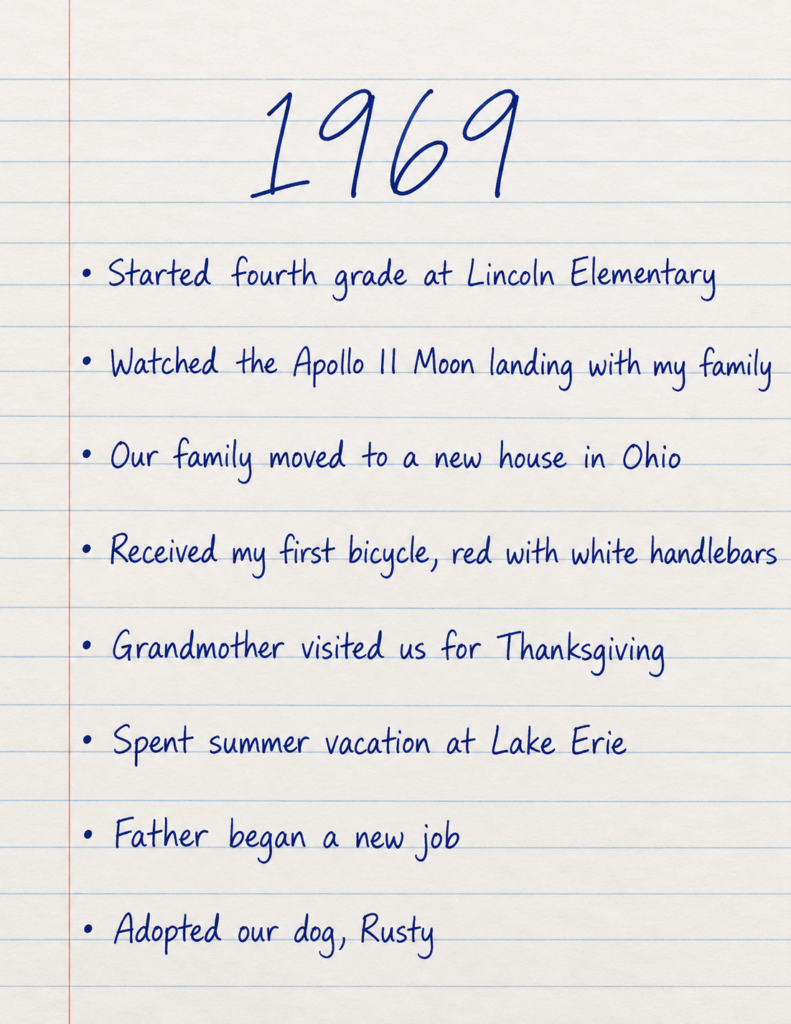
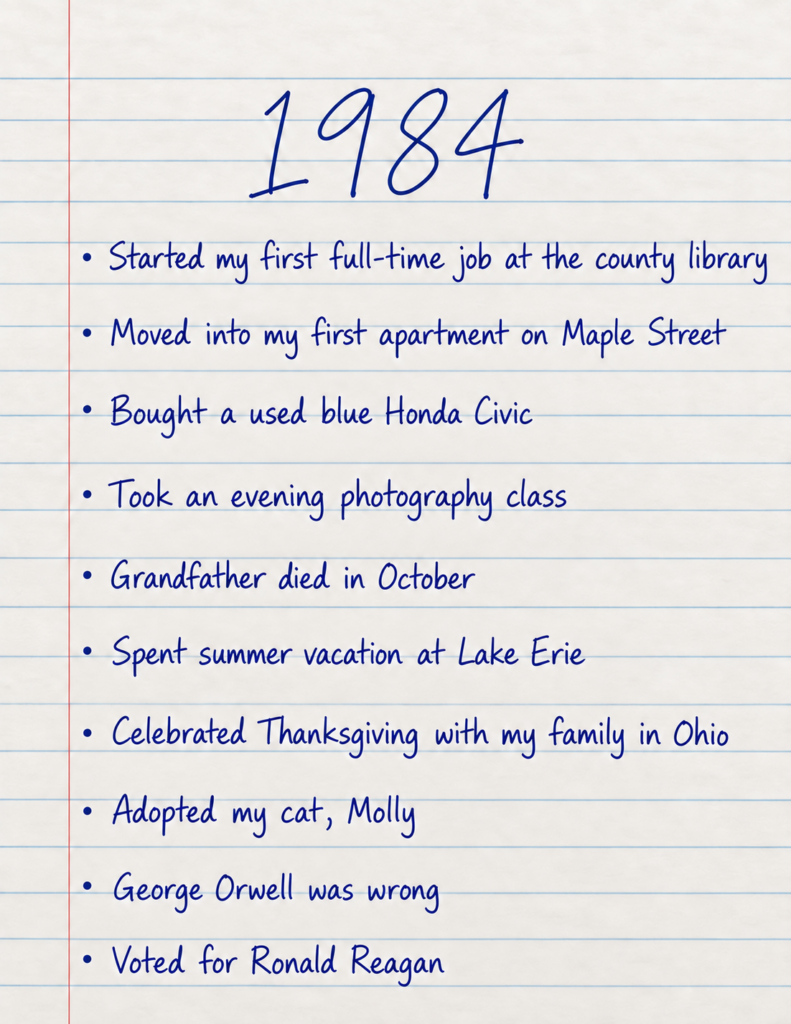
The Memory Book begins with a physical notebook. Choose one with approximately 100 pages and give each page to one year of your life, beginning with the year of your birth. Write the year at the top of each page before you add any memories. If you were born in 1960, the first page begins with 1960, the second with 1961, and the sequence continues through the present year.
A 100-page notebook carries a quiet message of optimism. It provides space for the years you have already lived and the years that still wait ahead. Blank future pages do not represent emptiness. They represent time that has not yet received its memories. They remind you that your life continues beyond the crime and that future events will eventually claim their own places in the record.
Preparing the pages also gives the exercise structure. You do not face an empty notebook and wonder where to begin. Every page already has a purpose. Each year becomes a container waiting for whatever fragments, events, people, places, and feelings your memory supplies.
A Catalog Rather Than an Autobiography
The Memory Book does not require you to write the complete story of your life. You do not need polished prose, long explanations, perfect grammar, or a carefully constructed narrative. The goal involves cataloging significant memories so your mind receives prompts to find the fuller stories connected to them.
Write brief entries that contain enough information to awaken recognition later. An entry such as “moved to Ohio,” “started third grade,” “Grandmother died,” “first family dog,” “father lost his job,” or “summer at the lake” provides a mental doorway. Behind each short phrase sits a larger network of people, places, sensations, emotions, and related events. Your mind begins searching those networks once you place the prompt on the page.
This method removes the pressure to explain everything. A detailed autobiography demands order, continuity, interpretation, and extensive writing. A Memory Book asks only that you preserve the important points. You record the location of the memory before time, stress, illness, or ordinary forgetting carries it farther away.
Include the Good and the Bad
Your life contains joy, pain, achievement, embarrassment, love, disappointment, adventure, loss, humor, and hardship. The Memory Book should reflect all of it. Record birthdays, graduations, friendships, marriages, children, jobs, travels, pets, celebrations, discoveries, and moments of pride. Also record deaths, illnesses, family conflict, abuse, accidents, financial hardship, displacement, divorce, betrayal, and other painful experiences.
Including difficult memories does not mean that suffering defines your life. It gives those experiences their proper locations within it. Past trauma sometimes remains disconnected from the rest of personal history. You remember the emotional effect without remembering when the event occurred, what surrounded it, or how it influenced later choices. Placing the event on its page begins reconnecting it to time and context.
The same principle applies to positive experiences that trauma pushed into the background. Scam-related grief narrows attention and makes life seem empty or wasted. Your pages provide evidence against that distortion. They reveal relationships that mattered, problems you solved, risks you took, places you visited, people you helped, skills you developed, and periods of happiness that still belong to you.
Begin With What Others Told You
You will not personally remember your birth or earliest years, but those years still form part of your history. Record what parents, grandparents, siblings, relatives, or family friends told you. Include where the family lived, who cared for you, what circumstances surrounded your birth, illnesses you experienced, family events that occurred, and stories people repeatedly shared about you.
Family photographs, old letters, school records, certificates, newspaper clippings, military records, passports, employment documents, and family Bibles also provide useful prompts. Dates printed on photographs help place people and locations into specific years. Addresses reveal movements between homes. School names identify periods that otherwise blend together.
You do not need absolute certainty about every detail. If relatives disagreed about an event, record the uncertainty in a few words. The Memory Book preserves what you remember and what others passed down to you. It does not function as a sworn historical record. Its value comes from gathering the surviving pieces before more of them disappear.
Memory Does Not Work in Order
You do not need to complete the Memory Book from the first page to the last. Human memory does not unfold like a calendar. A smell, song, photograph, conversation, holiday, or familiar object suddenly brings back an event from decades earlier. Another memory then appears from an entirely different period.
Follow that movement. If you remember something from age forty while working on age twelve, turn to the correct page and record it. If a conversation reminds you of three events from three different decades, place each one where it belongs. The book’s structure provides chronological order even when your process does not.
This freedom removes another source of pressure. You never need to “finish” one year before moving to another. Some pages will fill quickly, while others will remain sparse for months. A nearly blank page does not mean that nothing happened during that year. It means that the prompts for those memories have not arrived yet.
Keep the notebook accessible so you can add an entry when a memory surfaces. The process works through continued attention rather than a single marathon session. Each addition increases the number of connections your mind explores, which leads other forgotten details back into awareness.
How One Memory Leads to Another
Memory operates through association. A single event connects to people, places, emotions, routines, objects, sounds, and other experiences. When you write “first apartment,” your mind starts searching for the neighborhood, the furniture, the job you held, the people who visited, the food you cooked, and the person you were at that time.
One short entry also prompts memories from surrounding years. Recording the year you began a job reminds you of the training period, the coworker who became a friend, the car you drove, and the home you returned to each evening. Those details lead to other entries. The Memory Book gradually develops through this chain of associations.
You do not need to force memories or judge yourself when details remain unavailable. The purpose involves creating places for memories to land when they return. A page with only two entries still holds value because those two entries preserve part of your history and invite further exploration.
Seeing the Shape of Your Life
As the pages fill, patterns begin to appear. You see periods of stability and disruption, relationships that supported you, recurring hardships, major transitions, and choices that redirected your path. Events that once seemed random start forming a recognizable life course.
You also see evidence of survival. The page containing a death, betrayal, illness, or crisis does not stand alone. Pages follow it. You continued into another year, encountered other people, faced other responsibilities, and created new memories. The book demonstrates that painful events changed your life without ending it.
This perspective matters after a scam because trauma compresses your identity around victimization. You start thinking of yourself primarily as the person who was deceived. The Memory Book restores the many identities that existed before the criminal appeared. You were a child, student, friend, worker, partner, parent, traveler, caregiver, creator, neighbor, learner, and survivor of earlier difficulties. The scam entered a life already filled with meaning and experience.
Placing the Scam in Proportion
The year or years of the scam belong in the Memory Book. Record the major events honestly. Include when contact began, when financial demands started, when doubts emerged, when discovery occurred, when you reported the crime, and when recovery began. Keep the entries brief, just as you do with every other part of your life.
When you place those points among decades of other memories, their proportion changes. The scam remains serious, painful, and consequential, but it no longer occupies every page. It becomes part of a larger sequence that began long before the offender and continues long after the offender disappears.
This does not minimize what happened. Proper proportion does not equal denial. It prevents the crime from claiming ownership over your entire identity. A criminal entered a few pages of your life. The criminal did not write the whole book.
A Record for Future Generations
Almost no one preserves a useful record of an ordinary human life. Families save photographs without names, dates, or explanations. Children hear fragments of stories and forget important details. Grandchildren inherit objects without knowing why those objects mattered. Within a few generations, much of a person’s lived experience disappears.
Your Memory Book interrupts that loss. It gives your children, grandchildren, relatives, or other people who follow you a map of your life. They will know where you lived, what you experienced, whom you loved, what hardships shaped you, and what events mattered enough for you to preserve.
The book does not need literary beauty to hold value. Its handwritten notes carry your presence. The shape of your writing, the words you chose, the memories you included, and the spaces where later entries appear all reveal something about you. What begins as a recovery exercise becomes an inheritance of identity and family history.
Remembering That Your Life Is/Was Full
Trauma tells a narrow story. It repeats the betrayal, the losses, the warnings you missed, and the decisions you regret. The Memory Book answers with a broader record. It reminds you that your life contains thousands of events that had nothing to do with the scammer.
Page by page, you recover experiences that still belong to you. You remember people who valued you before the offender arrived. You rediscover achievements that the crime did not erase. You recognize earlier pain that you already survived and earlier periods of uncertainty that eventually changed.
The scam deserves a truthful place in your history, but it does not deserve the entire notebook. Your life began before the crime, carried meaning throughout the crime, and continues after it. The Memory Book helps you see that reality in physical form.
Begin by writing the years at the tops of the pages. Then record whatever comes back to you, wherever it belongs. Move through time in any order. Keep remembering, keep adding, and allow the full record of your life to grow.
One day, you will hold a book that contains far more than a scam. You will hold evidence of a rich, complicated, painful, joyful, and deeply human life. You will also leave behind something rare: a record that says you were here, your life mattered, and you remembered enough to pass it forward.
Conclusion
A Memory Book restores the full scale of your life at a time when trauma tries to reduce your identity to one crime, one offender, and one period of suffering. By assigning one page to every year, you create a physical record that shows how much existed before the scam and how much still remains ahead. The empty pages represent future experiences that have not yet occurred, while the completed pages preserve the people, places, relationships, hardships, achievements, and ordinary moments that shaped you.
You do not need to remember everything or write a polished autobiography. Brief entries give your mind enough information to locate the fuller stories connected to them. You can move freely between years because memory follows association rather than chronology. A photograph, familiar song, family conversation, or old address might return an experience that has remained quiet for decades. Each recovered memory adds another piece to the broader understanding of who you are.
The painful years also deserve their pages. Recording trauma places it within time and context instead of allowing it to spread across your entire identity. The scam receives an honest place in the record, but it does not receive the whole book. It becomes one part of a life filled with other relationships, responsibilities, losses, discoveries, struggles, joys, and accomplishments.
Your Memory Book also preserves something valuable for the people who follow you. Children, grandchildren, relatives, and future generations receive a map of the life you lived and the experiences that mattered to you. Through this continuing record, you reclaim your history, strengthen your identity, and leave evidence that your life was far greater than the crime committed against you.

Glossary
- Associative Memory — Associative memory connects one event with related people, places, emotions, sounds, objects, and experiences. A brief written entry activates these connections and helps additional details return to awareness. This process allows the survivor to recover memories without forcing them into chronological order. — Memory Process
- Autobiography — An autobiography presents a detailed narrative of a person’s life with continuity, interpretation, and developed explanations. The Memory Book does not require this level of writing because it focuses on recording significant points. This distinction reduces pressure and makes the exercise more accessible during recovery. — Personal History
- Blank Future Pages — Blank future pages represent years and experiences that have not yet entered the survivor’s personal record. They provide physical evidence that life continues beyond the crime and its immediate consequences. Their presence encourages optimism without denying the seriousness of the survivor’s present difficulties. — Future Orientation
- Cataloging Significant Memories — Cataloging significant memories involves recording important events in short, recognizable entries instead of writing complete stories. Each entry identifies the location of a memory within the survivor’s life. The method preserves essential information while allowing fuller details to emerge later. — Memory Practice
- Chain of Associations — A chain of associations forms when one remembered detail activates several connected memories. A job might recall a coworker, a vehicle, a neighborhood, and a particular period of life. Each connection gives the survivor additional material to place within the Memory Book. — Memory Process
- Chronological Order — Chronological order arranges life events according to the years in which they occurred. The Memory Book supplies this structure even when memories return in an unpredictable sequence. The survivor places each recollection on its proper page without needing to remember events from beginning to end. — Organizational Method
- Crime Discovery — Crime discovery marks the point when the survivor recognized that the relationship or interaction involved deception and exploitation. Recording this event establishes its place within the survivor’s wider history. A brief entry also separates the moment of discovery from the recovery work that followed. — Scam Experience
- Emotional Force of the Crime — The emotional force of the crime describes the intensity with which victimization commands attention and repeatedly draws the survivor toward painful events. This force pushes earlier experiences into the background and makes the future appear defined by damage. The Memory Book counters this narrowing by restoring a broader record of life. — Trauma Impact
- Family History — Family history includes the people, movements, relationships, hardships, traditions, and events that shaped the survivor’s life. The Memory Book gathers these details before ordinary forgetting removes more of them. Preserving this information also gives later generations a clearer understanding of their origins. — Family Legacy
- Family Photographs — Family photographs provide visual prompts that help identify people, locations, relationships, and periods of life. Dates and surrounding details help the survivor place remembered experiences within specific years. Written names and explanations also prevent future generations from inheriting images without meaningful context. — Historical Source
- Fuller Human Story — The fuller human story includes the survivor’s joys, losses, achievements, relationships, hardships, discoveries, and ordinary experiences across a lifetime. It prevents the scam from becoming the only story through which the survivor understands personal identity. Recovering this larger story restores balance and historical perspective. — Identity Restoration
- Historical Proportion — Historical proportion places the scam within the complete timeline of the survivor’s life. It acknowledges the crime’s seriousness without allowing it to occupy the entire personal record. This perspective shows that the offender entered part of an existing life rather than creating or defining that life. — Recovery Perspective
- Life Course — A life course describes the recognizable path formed by relationships, transitions, disruptions, decisions, and periods of stability across many years. Reviewing annual pages helps the survivor identify this path more clearly. Events that once appeared disconnected begin to form a meaningful pattern. — Life Review
- Memory Book — A Memory Book is a physical notebook that assigns one page to every year of the survivor’s life. It catalogs significant events through brief entries that prompt fuller memories. The completed record helps restore identity, place the scam in proportion, and preserve personal history. — Recovery Tool
- Memory Fragment — A memory fragment is a partial recollection involving an event, person, place, feeling, object, or experience. It does not need to contain every detail before the survivor records it. Preserving the fragment gives related memories a place to connect when they return. — Memory Process
- Memory Prompt — A memory prompt is a word, phrase, image, sound, object, document, or conversation that activates a recollection. A short entry such as “first apartment” gives the mind a doorway into a larger network of experiences. Effective prompts support remembering without demanding immediate completeness. — Recall Method
- Memory Surface — A memory surface occurs when an experience or detail returns to conscious awareness. Keeping the notebook accessible allows the survivor to record that information before attention shifts. Regular recording strengthens the growing network of connections among different periods of life. — Memory Process
- Narrow Story — A narrow story centers the survivor’s identity on betrayal, loss, regret, and missed warnings. Trauma reinforces this limited account by repeatedly directing attention toward the crime. The Memory Book challenges it with documented evidence of a much broader life. — Trauma Narrative
- Ordinary Forgetting — Ordinary forgetting gradually removes names, dates, places, and experiences from accessible memory over time. Stress, illness, and the passage of years accelerate the loss of important personal details. Recording brief entries preserves essential information before more of it disappears. — Memory Preservation
- Page for Every Year — A page for every year gives each year of the survivor’s life a defined physical location. The structure creates an organized container for memories regardless of when they return. It also demonstrates that the scam occupies only a limited number of pages within a much longer history. — Memory Book Structure
- Past Trauma — Past trauma refers to painful earlier experiences that remain connected to emotional distress, later choices, or patterns of response. Placing each event within a specific year restores time and context around it. This placement helps the survivor recognize that the experience changed life without ending it. — Trauma History
- Personal History — Personal history consists of the events, relationships, transitions, losses, accomplishments, and experiences that formed the survivor’s life. Trauma often obscures large portions of this history by concentrating attention on victimization. The Memory Book gathers the surviving pieces into an accessible record. — Identity and History
- Physical Notebook — A physical notebook gives memories a visible, organized, and lasting place outside the survivor’s mind. Handwritten entries record both information and the survivor’s personal presence. The notebook gradually becomes a recovery resource, historical record, and inheritance for others. — Recovery Resource
- Positive Experiences — Positive experiences include relationships, celebrations, discoveries, achievements, travels, skills, and periods of happiness that remain part of the survivor’s history. Scam-related grief often pushes these experiences out of immediate awareness. Recording them provides evidence that the crime did not erase the value already present in life. — Strength Recognition
- Proper Scale of Life — The proper scale of life reflects the complete range of experiences that existed before, during, and after the scam. Trauma distorts this scale by making one period appear larger than everything else. The Memory Book restores balance by displaying the crime among decades of other events. — Recovery Perspective
- Recovery Exercise — A recovery exercise uses purposeful activity to support stabilization, understanding, identity restoration, or continued healing. The Memory Book performs this function by organizing memories and reconnecting the survivor with a larger life story. Its continuing value also extends to family members and future generations. — Recovery Practice
- Relationship Scam — A relationship scam involves an offender creating a deceptive personal or emotional connection for exploitation. The resulting crime often divides the survivor’s perception of life into periods before and after victimization. Recording its major events places the experience within history without granting it ownership of the survivor’s identity. — Scam Victimization
- Scam-Related Grief — Scam-related grief follows the loss of the perceived relationship, financial security, trust, expectations, and imagined future. It narrows attention and makes earlier sources of meaning feel distant or unimportant. Reconnecting with positive and difficult memories helps restore a more accurate view of the survivor’s life. — Trauma Response
- Survival Evidence — Survival evidence consists of the later pages that follow periods of death, betrayal, illness, crisis, or hardship. These pages show that the survivor continued living, meeting responsibilities, forming relationships, and creating experiences. Their existence provides concrete proof that painful events changed life without bringing the entire story to an end. — Resilience Recognition
- Uncertain Memory — An uncertain memory contains details that remain incomplete, disputed, or difficult to place precisely. The survivor records the uncertainty instead of excluding the experience or presenting it as verified fact. This approach preserves available information while respecting the limits of personal and family recollection. — Memory Documentation
- Victimization-Compressed Identity — Victimization-compressed identity occurs when trauma reduces the survivor’s self-concept to the experience of being deceived. Earlier roles as a child, student, friend, worker, parent, caregiver, creator, traveler, or learner fade from immediate awareness. Recovering these identities helps the survivor recognize a self that remains larger than the crime. — Identity Restoration
- Written Record — A written record preserves events that memory, time, illness, or family change would otherwise remove. Brief notes provide enough information for the survivor or later generations to recognize important experiences. The record gains value through accuracy, personal meaning, and continued additions rather than literary polish. — Memory Preservation
Author Biographies
Author Biography
Prof. (Emeritus) Tim McGuinness, Ph.D. DFin is a co-founder, Managing Director, and Chairman of the SCARS Institute (Society of Citizens Against Relationship Scams Inc.), where he serves as an unsalaried volunteer officer dedicated to supporting scam victims and survivors around the world. With over 34 years of experience in scam education and awareness, he is perhaps the longest-serving advocate in the field.
Dr. McGuinness has an extensive background as a business pioneer, having co-founded several technology-driven enterprises, including the former e-commerce giant TigerDirect.com. Beyond his corporate achievements, he is actively engaged with multiple global think tanks where he helps develop forward-looking policy strategies that address the intersection of technology, ethics, and societal well-being. He is also a computer industry pioneer (he was an Assistant Director of Corporate Research Engineering at Atari Inc. in the early 1980s) and invented core technologies still in use today.
His professional identity spans a wide range of disciplines. He is a scientist, strategic analyst, solution architect, advisor, public speaker, published author, roboticist, Navy veteran, and recognized polymath. He holds numerous certifications, including those in cybersecurity from the United States Department of Defense under DITSCAP & DIACAP, continuous process improvement and engineering and quality assurance, trauma-informed care, grief counseling, crisis intervention, and related disciplines that support his work with crime victims.
Dr. McGuinness was instrumental in developing U.S. regulatory standards for medical data privacy called HIPAA and financial industry cybersecurity called GLBA. His professional contributions include authoring more than 1,000 papers and publications in fields ranging from scam victim psychology and neuroscience to cybercrime prevention and behavioral science.
“I have dedicated my career to advancing and communicating the impact of emerging technologies, with a strong focus on both their transformative potential and the risks they create for individuals, businesses, and society. My background combines global experience in business process innovation, strategic technology development, and operational efficiency across diverse industries.”
“Throughout my work, I have engaged with enterprise leaders, governments, and think tanks to address the intersection of technology, business, and global risk. I have served as an advisor and board member for numerous organizations shaping strategy in digital transformation and responsible innovation at scale.”
“In addition to my corporate and advisory roles, I remain deeply committed to addressing the rising human cost of cybercrime. As a global advocate for victim support and scam awareness, I have helped educate millions of individuals, protect vulnerable populations, and guide international collaborations aimed at reducing online fraud and digital exploitation.”
“With a unique combination of technical insight, business acumen, and humanitarian drive, I continue to focus on solutions that not only fuel innovation but also safeguard the people and communities impacted by today’s evolving digital landscape.”
Dr. McGuinness brings a rare depth of knowledge, compassion, and leadership to scam victim advocacy. His ongoing mission is to help victims not only survive their experiences but transform through recovery, education, and empowerment.
-/ 30 /-
What do you think about this?
Please share your thoughts in a comment below!
Your Memory Book – The Highlights of Your Life – 2026
Please Leave a Comment
Please Tell Us What You Learned From This?
Commenting Is An Essential Part Of Healing
Read • Think • Write
GLOSSARY SEARCH
TOPIC SEARCH
TABLE OF CONTENTS
- Reclaiming the Full Story of Your Life
- The Memory Book – Reclaiming the Full Story of Your Life
- Author’s Note
- Introduction to Your Memory Book
- A Page for Every Year
- A Catalog Rather Than an Autobiography
- Include the Good and the Bad
- Begin With What Others Told You
- Memory Does Not Work in Order
- How One Memory Leads to Another
- Seeing the Shape of Your Life
- Placing the Scam in Proportion
- A Record for Future Generations
- Remembering That Your Life Is/Was Full
- Conclusion
- Glossary







CATEGORIES
Important Information for New Scam Victims
- Please visit www.ScamVictimsSupport.org – a SCARS Website for New Scam Victims & Sextortion Victims.
- SCARS Institute now offers its free, safe, and private Scam Survivor’s Support Community at www.SCARScommunity.org – this is not on a social media platform; it is our own safe & secure platform created by the SCARS Institute especially for scam victims & survivors.
- SCARS Institute now offers a free recovery learning program at www.SCARSeducation.org.
- Please visit www.ScamPsychology.org – to more fully understand the psychological concepts involved in scams and scam victim recovery.
If you are looking for local trauma counselors, please visit counseling.AgainstScams.org
If you need to speak with someone now, you can dial 988 or find phone numbers for crisis hotlines all around the world here: www.opencounseling.com/suicide-hotlines
Statement About Victim Blaming
Some of our articles discuss various aspects of victims. This is both about better understanding victims (the science of victimology) and their behaviors and psychology. This helps us to educate victims/survivors about why these crimes happened and not to blame themselves, better develop recovery programs, and help victims avoid scams in the future. At times, this may sound like blaming the victim, but it does not blame scam victims; we are simply explaining the hows and whys of the experience victims have.
These articles, about the Psychology of Scams or Victim Psychology – meaning that all humans have psychological or cognitive characteristics in common that can either be exploited or work against us – help us all to understand the unique challenges victims face before, during, and after scams, fraud, or cybercrimes. These sometimes talk about some of the vulnerabilities the scammers exploit. Victims rarely have control of them or are even aware of them until something like a scam happens, and then they can learn how their mind works and how to overcome these mechanisms.
Articles like these help victims and others understand these processes and how to help prevent them from being exploited again or to help them recover more easily by understanding their post-scam behaviors. Learn more about the Psychology of Scams at www.ScamPsychology.org
SCARS INSTITUTE RESOURCES: If You Have Been Victimized By A Scam Or Cybercrime
♦ If you are a victim of scams, go to www.ScamVictimsSupport.org for real knowledge and help
♦ Join our free, safe, and private Scam Survivors After Scam Healing and Recovery Community at www.SCARScommunity.org
♦ Enroll in SCARS Scam Survivor’s School now at www.SCARSeducation.org
♦ To report criminals, visit https://reporting.AgainstScams.org – we will NEVER give your data to money recovery companies like some do!
♦ Follow us and find our podcasts, webinars, and helpful videos on YouTube: https://www.youtube.com/@RomancescamsNowcom
♦ Learn about the Psychology of Scams at www.ScamPsychology.org
♦ Dig deeper into the reality of scams, fraud, and cybercrime at www.ScamsNOW.com and www.RomanceScamsNOW.com
♦ Scam Survivor’s Stories: www.ScamSurvivorStories.org
♦ For Scam Victim Advocates visit www.ScamVictimsAdvocates.org
♦ See more scammer photos on www.ScammerPhotos.com
You can also find the SCARS Institute’s knowledge and information on Facebook and LinkedIn
Psychology Disclaimer:
All articles about psychology and the human brain on this website are for information & education only
The information provided in this and other SCARS articles are intended for educational and self-help purposes only and should not be construed as a substitute for professional therapy or counseling.
Note about Mindfulness: Mindfulness practices have the potential to create psychological distress for some individuals. Please consult a mental health professional or experienced meditation instructor for guidance should you encounter difficulties.
While any self-help techniques outlined herein may be beneficial for scam victims seeking to recover from their experience and move towards recovery, it is important to consult with a qualified mental health professional before initiating any course of action. Each individual’s experience and needs are unique, and what works for one person may not be suitable for another.
Additionally, any approach may not be appropriate for individuals with certain pre-existing mental health conditions or trauma histories. It is advisable to seek guidance from a licensed therapist or counselor who can provide personalized support, guidance, and treatment tailored to your specific needs.
If you are experiencing significant distress or emotional difficulties related to a scam or other traumatic event, please consult your doctor or mental health provider for appropriate care and support.
Also read our SCARS Institute Statement about Professional Care for Scam Victims – click here
If you are in crisis, feeling desperate, or in despair, please call 988 or your local crisis hotline – international numbers here.
A Question of Trust
At the SCARS Institute, we invite you to do your own research on the topics we speak about and publish. Our team investigates the subject being discussed, especially when it comes to understanding the scam victims-survivors’ experience. You can do Google searches, but in many cases, you will have to wade through scientific papers and studies. However, remember that biases and perspectives matter and influence the outcome. Regardless, we encourage you to explore these topics as thoroughly as you can for your own awareness.
More ScamsNOW.com Articles