




ScamsNOW!
The SCARS Institute Magazine about Scam Victims-Survivors, Scams, Fraud & Cybercrime


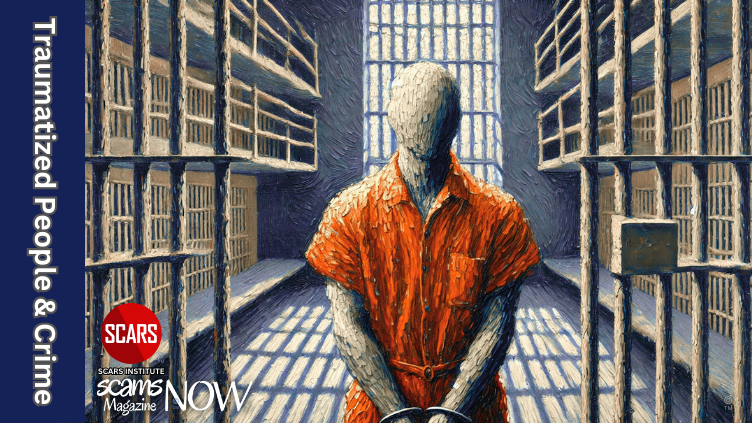
Are Traumatized People More Likely to Commit Crimes? – Including Crime Victims?
3 Questions: Does Psychological Trauma Increase Tendencies Toward Criminality?
Primary Category: Psychology / Criminology
Author:
• Tim McGuinness, Ph.D., DFin, MCPO, MAnth – Anthropologist, Scientist, Polymath, Director of the Society of Citizens Against Relationship Scams Inc.
Author Biographies Below
About This Article
Researchers and practitioners examining the relationship between psychological trauma and criminal behavior report that trauma increases risk but does not predetermine offending. Studies show a measurable victim–offender overlap, where individuals who experience crime are statistically more likely to engage in later offending than non-victims, though most trauma survivors never commit crimes. Trauma affects emotional regulation, threat perception, and reward processing, which may create vulnerabilities toward impulsive or retaliatory behavior when combined with environmental and social risk factors. Offenders emerge through different pathways, including trauma-driven reactions, opportunistic or personality-based motivations, and situational pressures. Scam victims rarely progress into fraud themselves and more frequently face re-victimization or internalized harm. Trauma explains some criminal behavior, but accountability and individual choice remain central to outcomes.
Note: This article is intended for informational purposes and does not replace professional medical advice. If you are experiencing distress, please consult a qualified mental health professional.

Advisory
This article addresses topics related to scams, scammers, victim psychology, and general crime. The content may be emotionally challenging. For individuals in the early stages of recovery from a scam, reading about this topic may be highly triggering. This material may intensify feelings of trauma, anger, or shame before you have developed the coping mechanisms to process them effectively. Your well-being is our priority. If you are a recent victim or feel particularly vulnerable, we strongly advise you to skip this article for now. Please focus on other, more supportive resources and consider returning to this content only when you feel more stable and have a stronger support system in place.
3 Questions: Does Psychological Trauma Increase Tendencies Toward Criminality?
Author’s Note:
These are questions I was recently asked to explore, to see if there is clear evidence of a causal effect between trauma and criminality in their various forms. The answer is “sort of”.
QUESTION #1: Does Trauma Shift Someone to Criminality?
There is some relationship between serious victimization and later offending, including property crime, but it is indirect, probabilistic, and heavily shaped by pre-existing risk factors and environment. Most crime victims do not go on to commit crimes themselves.
One area where we see this in our support activities is with the hater communities, who generally seem to believe that anything goes to get back at scammers, including “scam baiting” which, while not prosecuted, actually does break many laws.
I will walk through what is known and what is still unclear, with a focus on larceny and fraud.
The Basic Finding: “Victim–Offender Overlap”
Modern criminology talks about a “victim–offender overlap.” People who are victims of crime are statistically more likely to be offenders, and offenders are more likely to be victims, compared to those with no involvement in crime at all.
Key points from large reviews and longitudinal studies:
- In community samples, a sizable share of offenders report serious prior victimization, and many victims report prior offending, especially in adolescence and young adulthood.
- This overlap is seen across many crime types, especially violence and property crime, and is stronger in high-risk populations such as marginalized urban youth.
- Much of the overlap is explained by shared risk factors such as early childhood maltreatment, low self-control, high-crime environments, delinquent peers, and substance use, not simply “being victimized” by itself.
So there is a statistical relationship, but it is not a simple “victim turns into criminal” story.
Trauma from crime and its psychological effects
Psychological trauma from crime victimization tends to produce a cluster of changes in:
- Threat perception: hypervigilance, mistrust, exaggerated sense of danger
- Emotional regulation: intrusive memories, anger, shame, guilt, emotional numbing
- Belief systems: changes in beliefs about self (“I am weak” or “I am stupid”), others (“people are dangerous”), and the world (“the world is unfair”).
Neurobiologically, studies of trauma and PTSD show:
- Heightened amygdala reactivity, which increases fear and threat sensitivity
- Altered functioning in prefrontal regions that normally help regulate impulses and emotions
- Dysregulation of stress systems, such as the HPA axis
- In some cases, changes in reward circuitry (ventral striatum, orbitofrontal cortex) affect how people respond to risk, reward, and punishment.
These changes do not predetermine criminal behavior. They do, however, create vulnerabilities: more intense anger, more black-and-white thinking about justice and fairness, more difficulty with impulse control under stress, and more temptation to use maladaptive coping strategies.
How trauma can feed into offending: theoretical pathways
Several well-established criminological theories explain how victimization and trauma might contribute to later offending:
General Strain Theory
- Severe negative experiences, such as crime victimization, create “strain” in the form of anger, humiliation, and a sense of injustice.
- If people lack coping resources, social support, or legitimate options, they are more likely to cope through aggression, substance use, or property crime.
Social learning
- Exposure to crime and victimization can normalize rule-breaking, especially if offenders are seen to “get away with it,” or if family and peers also offend.
- Some victims grow up in environments where both victimization and offending are part of everyday life, which makes offending feel like a normal option.
Self-control and lifestyle/routine activity
- The same characteristics and circumstances that make someone vulnerable to victimization (impulsivity, risky settings, chaotic lifestyles) also increase the chance of offending.
- In this view, victimization is more of a marker of underlying risk than a cause by itself.
What about larceny and fraud specifically?
Most of the strong victim-offender overlap evidence comes from violent and general property crime. The connection between being a crime victim and later committing fraud or other deceptive, white-collar offenses is less clearly documented and more nuanced.
Existing research suggests:
- Many property offenders (theft, burglary, robbery) have substantial histories of prior victimization, including childhood abuse, family violence, and neighborhood crime.
- White-collar and fraud offenders show more mixed patterns. Some studies report higher-than-average rates of early adversity or victimization among certain fraud offenders, but their pathways into crime are also strongly shaped by opportunity, occupational position, and rationalization rather than by trauma alone.
- Qualitative work on “fraud victim turned money mule” or “victim turned recruiter” suggests that some scam victims are later coerced or seduced into participating in fraud schemes, not so much because of intrinsic criminal tendencies, but because of financial desperation, ongoing manipulation, or a need to “get their money back.” These cases usually look more like continued victimization and exploitation than a clean transition into intentional criminality.
There is some overlap between victimization and later involvement in fraud or larceny, but it is far from universal, and the motives and pathways differ from those of chronic street offenders.
Psychological Mechanisms specific to fraud-type offending
When a trauma survivor does move into deceptive or acquisitive crime, the mechanisms tend to look like this:
Rationalization and moral disengagement
- “No one helped me. I am just taking back what the world owes me.”
- “Banks, companies, or ‘the system’ are corrupt, so what I do is minor in comparison.”
- After severe unfairness, a person may loosen internal constraints on harming abstract entities such as corporations or faceless strangers.
Shame and identity repair
- Deep shame about having been “weak” or “stupid” may create a drive to flip the script and feel powerful and in control.
- Committing fraud, manipulating others, or outsmarting institutions can be experienced as a way to reclaim agency, especially if the person feels permanently damaged or stigmatized.
Desensitization
- Repeated exposure to deception, especially in environments where scams and hustles are common, can blunt moral reactions to lying, cheating, or exploiting others.
- If someone has been repeatedly tricked, they may begin to see trust as a weakness and manipulation as normal.
Instrumental coping
- When victimization produces serious financial hardship, some individuals turn to illicit means to survive, including small-scale theft, welfare fraud, or financial deception.
- This is less about thrill seeking and more about short-term problem-solving in the absence of perceived legitimate options.
Brain Processes: From trauma to possible criminal behavior
At the brain level, several systems that are altered by trauma also play roles in decision-making about crime:
- Emotion and threat systems: A hyperreactive amygdala and chronically stressed HPA axis can amplify anger, mistrust, and “fight or flight” reactions. Under stress, this may push a person toward aggressive or impulsive acts, including theft or retaliatory fraud.
- Reward systems: Trauma and chronic stress can reshape dopamine-driven reward pathways, increasing the appeal of quick relief, risk-taking, and “wins.” The anticipation of money, status, or revenge can feel disproportionately rewarding, which makes opportunistic crime feel more attractive in the moment.
- Control and ethics circuits: Prefrontal regions such as the dorsolateral prefrontal cortex and orbitofrontal cortex support self-control, long-term planning, and moral reasoning. Trauma, especially when combined with substance use or ongoing stress, can weaken these capacities, so immediate emotion outweighs longer-term ethical concerns or fear of punishment.
Again, these are risk mechanisms, not destiny. Most traumatized victims experience these same brain changes and never offend. Those who do offend tend to have additional factors stacked on top: early conduct problems, antisocial peers, poor supervision, cognitive vulnerabilities, substance use, or severe social and economic marginalization.
Why most victims do not become offenders
It is important to emphasize what the data also show:
- The majority of crime victims do not later commit serious offenses. Even in high-risk samples, many victims abstain from offending.
- Protective factors such as strong social support, stable employment, prosocial role models, religious or ethical commitments, and access to treatment buffer against offending, even among highly traumatized individuals.
- For many victims, trauma leads not to criminality, but to advocacy, caretaking roles, and prosocial engagement, the so-called “altruism born of suffering.”
So any model that treats victimization as a pipeline to crime is misleading. Victimization and offending overlap for some people because of shared causes and some causal effects, but there is no simple transformation built into the trauma itself.
Specific to Scam Victims: Are they at risk of becoming scammers?
When the focus narrows from “trauma victims” to “relationship or financial scam victims,” the evidence for a systematic shift into larceny or fraud on the victim’s part becomes even weaker.
Available observations suggest:
- A significant minority of fraud victims later become “money mules” or intermediaries in new schemes, but most appear to be unwitting, manipulated, or misled into these roles rather than consciously deciding to become criminals.
- Some scam victims, particularly those with prior risk factors, do drift into low-level deceptive behaviors such as hiding debts, misrepresenting finances to family, or engaging in minor benefit fraud, usually as coping strategies rather than organized criminal careers. These behaviors are under-researched and typically surface in clinical rather than criminological literature.
- There is anecdotal evidence of “victim turned scammer” narratives inside certain online fraud networks, but systematic data are sparse. Though at the SCARS Institute, we have experienced this with desperate victims taking advantage of other survivors, but it is indeed very rare. When examined closely, many of these individuals report long histories of adversity, delinquency, and economic exploitation, so the scam is one episode in a broader pattern instead of the sole trigger.
For scam victims specifically, the more common psychological trajectories are:
- Internalized harm: depression, anxiety, PTSD, self-blame, and withdrawal
- Externalized advocacy: education, prevention work, peer support
- Maladaptive coping that is self-directed rather than other-directed, such as: hate-rage-anger against scammers, scam baiting to get “justice”, substance use, or self-neglect
A small subset will engage in some form of acquisitive or deceptive behavior, but this tends to be indirect, context-driven, and heavily conditioned by prior risk factors.
How is this Useful for Professional Practice?
For clinicians, advocates, and researchers working with scam victims or other crime survivors, this body of research suggests several practical conclusions:
- Expect heightened anger, a preoccupation with justice, and sometimes fantasies of revenge. These emotional states are natural parts of trauma recovery and do not automatically imply genuine criminal tendencies.
- Assess for broader risk factors if there is concern about offending: earlier delinquency, substance use, antisocial peers, chronic economic pressure, or pre-existing “hustle” culture involvement.
- Be alert to recruitment into secondary victimization roles, such as money mule work, “recovery scams,” or pyramid schemes, where traumatized victims are re-exploited and may technically become offenders on paper, even though their role is primarily coerced or misled.
- Focus on stabilizing shame, rebuilding moral identity, and strengthening prosocial coping so that trauma-driven rationalizations for harmful behavior never harden into a new identity.
Review
There is a real but nuanced relationship between psychological trauma from crime and later criminal behavior, including property crime. Research on the victim–offender overlap shows that both victimization and offending concentrate in the same individuals and environments, but much of that overlap is due to shared risk factors rather than a simple causal chain from “victim” to “offender.”
Trauma-related changes in emotion, cognition, and brain function can increase the temptation to use antisocial coping strategies such as theft, fraud, or other offenses, particularly under severe stress and in high-risk environments. At the same time, most victims never offend, and many move toward prosocial roles instead. For scam victims in particular, the typical dangers are re-victimization and internal harm, not a wholesale shift into scamming others.
So the evidence supports a guarded, differentiated answer: trauma from crime, including scams, is one risk factor among many for later larceny or fraud, but it is neither necessary nor sufficient on its own. Context, prior history, and support determine whether that trauma contributes to criminal behavior, to deeper suffering, or to growth and advocacy.
QUESTION #2: Is Every Criminal Someone Who Was Traumatized, or are They Simply the Ones Who Could Not Heal?
No. Many offenders have trauma histories, but not every criminal is acting from trauma, and not every traumatized person becomes an offender.
Here is the clearer picture that decades of research support:
Trauma is very common among offenders, but not universal
Large studies show that offenders, especially those involved in violent crime, report high rates of:
- Childhood abuse or neglect
- Household instability
- Community violence
- Early victimization
These experiences increase the likelihood of later aggression, impulsivity, and risk-taking. Trauma can shape how a person reacts to stress, threat, or shame, which may push some toward harmful coping strategies.
But “common” is not the same as “cause.” Some offenders commit crimes without any major trauma; they offend for greed, status, thrill, or ideology.
Trauma is not enough to explain criminal behavior
If trauma automatically created criminals, the world would be overwhelmed with offenders. Most trauma survivors never harm others. Many become helpers, caregivers, or advocates. Their pain turns into empathy rather than aggression.
So something else must explain the divide.
The key factor is how trauma is responded to and supported
Two survivors with similar traumatic backgrounds might take very different paths because of:
- Family support or isolation
- Prosocial vs antisocial peer groups
- Access to emotional care and treatment
- Early interventions (or lack of them)
- Opportunities for safety, education, and healing
Trauma does not define destiny. Environment, support, and choices shape the outcome.
Some criminals are not trauma-driven at all
For a portion of offenders:
- There is no major trauma in their history
- Their behavior is driven by entitlement, greed, power, or pleasure
- They possess certain antisocial traits that develop independently of victimization
These are the calculated exploiters. Many organized fraudsters, for example, show:
- Low empathy
- High manipulativeness
- Moral disengagement
- A belief system that justifies harming others
They do not act from brokenness. They act from advantage.
Criminal behavior exists on a spectrum
There are different groups:
- Those who are victims first, then drift into crime because of pain or desperation
- Those who alternate between being victims and offenders
- Those who offend without ever being victimized, driven by self-interest or ideology
Every path is different. No single narrative works for everyone.
A more accurate conclusion
Instead of saying:
“Every criminal is a traumatized person who failed to heal”
The research says:
A significant number of offenders were victimized, but trauma only becomes criminality when it goes unsupported, unrecognized, and untreated.
Healing is the divergence point:
- Some receive help and channel pain into growth
- Some receive none and turn their pain outward
- Some never had the pain to begin with
Why this distinction matters for scam victims
You deserve to understand this truth:
- Scammers did not hurt you because they were hurting
- Many scammers are not “wounded souls” seeking relief
- They choose their behavior because it benefits them
- Accountability does not get erased by sympathy
You did not meet a person who simply needed love.
You met a predator who saw an opportunity.
Review
Trauma influences criminal behavior in many offenders, but it does not excuse it and it does not explain all of it. Healing closes the path to harming others. Lack of healing leaves that path open. And some offenders were never wounded in the first place.
Criminal choices belong to the offender, not to their past.
QUESTION #3: Should offenders be divided between those who offend because of their personality type and those who have experienced trauma?
Not quite. The divide is more nuanced than personality versus trauma. Criminology and forensic psychology show that offenders fall into three broad overlapping pathways rather than two:
Trauma-Driven Offenders
These individuals were victims first. Their criminal behavior emerges as a maladaptive survival strategy or coping mechanism.
Trauma can disrupt:
- Impulse control (prefrontal cortex changes)
- Stress response (chronic fight-or-flight activation)
- Trust, attachment, and worldview
- Moral reasoning and empathy
They offend because they feel threatened, powerless, or hopeless. Examples:
- A survivor of domestic abuse who later commits violence in relationships
- Someone manipulated them into criminal activity by organized crime
- People who steal out of necessity after abandonment or neglect
Their motivation is reactive. They are trying to feel safe, in control, or emotionally numb.
Opportunistic or Personality-Based Offenders
These offenders do not act from pain. They act from pleasure, entitlement, or advantage.
They tend to show:
- Callousness
- Manipulation
- Low empathy
- A sense of superiority or justification
Common traits include:
- Psychopathic tendencies
- Narcissistic personality patterns
- Antisocial belief systems learned from peers or culture
Here, the brain’s reward circuitry responds strongly to power and profit, with little emotional inhibition to slow them down.
Scammers typically fall into this category.
Their motivation is proactive, not reactive. They choose crime strategically.
Situational Offenders
This group would not have offended unless placed in specific pressure conditions:
- A moment of desperation
- Influence from a criminal group
- Extreme financial stress
- A temporary moral collapse
They do not see themselves as “criminals,” yet they made a harmful choice. Once the situation resolves, they may never offend again.
Their motivation is circumstantial.
Why these distinctions matter
If we boil offenders down to only “traumatized” versus “born bad,” we miss essential truths:
Trauma-driven offenders are those whose criminal behavior originates in the emotional wounds of their past. They were victims first. Trauma damaged their sense of safety, trust, and control, and crime became a maladaptive way to cope with overwhelming fear or pain. They react defensively or impulsively to their environment. Even though trauma plays a powerful role in how they think and behave, they are still fully responsible for the harm they cause.
Personality-based offenders commit crimes because they value power, status, and personal gain above the wellbeing of others. Their decision to harm someone is intentional and strategic rather than reactive. These individuals tend to show callousness, manipulation, low empathy, and a pattern of entitlement. They commit crimes because it benefits them and they feel justified in doing so. They are fully accountable for the choices they make.
Situational offenders engage in criminal acts only when pushed into specific, high-pressure circumstances. Under normal conditions, they might never break the law. Something in their situation creates a moment of desperation, moral collapse, or extreme influence that leads them to take actions they would not otherwise consider. Even when their offending behavior is temporary and out of character, they remain responsible for the consequences.
These distinctions help us understand why someone commits harm without excusing what they did. Trauma explains but does not make crime acceptable. Personality traits can motivate harmful choices, yet they do not remove accountability. Situational pressure may influence behavior, but it never justifies victimization. Crime arises from pain, personality, or pressure, and in every case offenders remain responsible for the damage they cause.
Even when trauma plays a role, trauma explains — it does not excuse.
How this relates to scams
Scam victims sometimes search for reasons like:
- “They must be hurting.”
- “They must have been forced into this.”
- “They must have suffered too.”
That instinct shows compassion.
But in the case of organized scammers, research shows:
- Most are opportunistic, not traumatized
- Some are groomed, but still choose harm
- Empathy is suppressed because crime brings status and reward
Their psychological story is not the victim’s responsibility to solve.
Review
A more accurate modern framework is:
Crime emerges from one of three roots
Pain, personality, or pressure.
All offenders remain accountable, regardless of the path that led them there.
And scam victims deserve clarity without self-blame:
- You did not attract someone who was wounded
- You did not meet someone who simply needed kindness
- You were targeted by someone who benefitted from harming you
Their choices belong to them.
Your recovery belongs to you.
Making Sense of This
Humans do not all commit harmful acts for the same reason. Some individuals are shaped by the pain they never learned to heal. Others pursue their desires without concern for who gets hurt. Some collapse only under extreme pressure. Yet all three groups cause real harm.
A helpful way to understand this is to separate why someone offends from what they choose to do about their inner world.
- Trauma-driven offenders carry emotional injuries that were never cared for or confronted. Crime becomes a coping strategy, a way to feel control or relieve unbearable distress. Their story begins with victimhood and then goes in the wrong direction.
- Personality-based offenders know what they are doing and choose personal gain over empathy. Their harm is rooted not in suffering, but in disregard. They pursue exploitation because it benefits them.
- Situational offenders derail when life pushes them farther than their skills and stability allow. Their values bend to crisis, and a single bad decision reshapes their future.
Making sense of this complexity starts with recognizing both compassion and accountability at the same time. Every offender is responsible for their actions. Trauma does not excuse crime. Stress does not erase victims. Personality does not make harm inevitable. Understanding cause simply helps us see what needs to be changed if future harm is to be prevented.
For those who experience crime-related trauma and do not heal, there is a fork in the road. One path leads inward: facing the pain, seeking support, and rebuilding identity. The other path leads outward: projecting that pain into the world and making others suffer. People who choose the first path become survivors with empathy. People who choose the second create new victims.
This is where clarity matters for scam victims in recovery. You lived through trauma, too, and you are choosing the healing path by learning, reflecting, and protecting yourself instead of harming others. That choice separates recovery from criminality.
The simplest way to make sense of it:
- Trauma shapes people.
- Pain influences behavior.
- But choices decide the future.
Victims become survivors when they take responsibility for healing their wounds. Offenders become criminals when they inflict their wounds on someone else.

Glossary
- Accountability for harm – This term describes the responsibility an offender holds for the damage they cause, regardless of their past or their reasons. Trauma, stress, or pressure may influence why someone offends, but accountability keeps the focus on choices and actions. When you remember this, you stop excusing criminals in your mind and place responsibility where it belongs.
- Altruism born of suffering – This phrase refers to people who turn their own pain into motivation to help others. Many trauma survivors choose advocacy, support, or education instead of harming anyone. When you move toward helping others after what happened to you, you are living this form of altruism.
- Brain-based risk factors – This term covers changes in brain systems that increase the chance of impulsive or harmful behavior, such as altered emotion control or reward processing. These changes may follow trauma, chronic stress, or substance use. They make some choices harder, but they do not remove a person’s responsibility for what they do.
- Chronic economic pressure – This describes long-lasting financial strain, such as ongoing debt, job loss, or basic needs insecurity. Under this pressure, some people begin to consider illegal options that they would normally reject. When you understand this, you see how financial desperation can push people toward poor choices without making those choices acceptable.
- Crime-related trauma – This phrase refers to psychological injury that results from being the target of a crime, such as a scam, assault, or robbery. The trauma affects thoughts, emotions, and behavior long after the event ends. When you feel jumpy, mistrustful, or ashamed after a scam, you are experiencing crime-related trauma, not weakness.
- Emotional numbing – Emotional numbing is a state where feelings become dulled, shut down, or distant as a way to cope with overwhelming pain. After a scam, a person may feel disconnected, flat, or unable to care about anything. Numbing protects the mind in the short term, but it blocks healing if it continues unchecked.
- General Strain Theory – This theory explains how severe negative experiences create strain, such as anger, humiliation, and a sense of injustice. When people lack support or healthy coping tools, they are more likely to act out through aggression, substance use, or property crime. The theory helps you see how unresolved strain can push some victims toward harmful choices, while others move toward healing.
- Hater communities – This term refers to online or offline groups that focus their energy on rage, ridicule, and revenge against scammers or institutions. Members may support illegal tactics such as harassment or scam baiting while denying the harm they cause. When you fall into these spaces, your own trauma risks being channeled into new harm instead of recovery.
- Healing path – The healing path is the set of choices that move a victim from raw trauma toward stability, growth, and meaning. It includes seeking support, learning, setting boundaries, and refusing to harm others in response to pain. When you choose the healing path, you honor what happened to you without letting it turn you into someone you do not want to be.
- High-risk environments – High-risk environments are settings where crime, exploitation, and instability are common, such as unsafe neighborhoods or criminal social circles. In these spaces, both victimization and offending become more likely. When a person lives or works here, their trauma and their opportunities mix in ways that can pull them toward either harm or recovery.
- Internalized harm – Internalized harm happens when the damage from crime turns inward instead of outward. You see this in depression, self-blame, self-neglect, or withdrawal from life. Instead of attacking others, the person punishes themselves, which delays healing and keeps the trauma active.
- Larceny and fraud pathways – This phrase refers to the routes by which a person moves from victimization or stress into theft or deception-based crimes. The pathways mix personal history, opportunity, rationalization, and emotional pain. Understanding them helps you see why a few victims drift toward illegal behavior while most do not.
- Maladaptive coping strategies – Maladaptive coping strategies are ways of dealing with pain that bring short-term relief but long-term harm. Examples include substance abuse, lying about money, or harassing scammers. When you notice yourself leaning on these habits, you are seeing places where your trauma is steering you away from true recovery.
- Money mule recruitment – This term describes the process where fraud groups draw vulnerable people into moving stolen money for them. Scam victims who are desperate, confused, or still manipulated sometimes get pulled into these roles. On paper, they look like offenders, but in reality, they are being used as tools in someone else’s crime.
- Moral disengagement – Moral disengagement happens when a person loosens their inner rules so they feel less guilty about harming others. They may tell themselves that victims deserve it, that companies are fair game, or that everyone cheats. When moral disengagement grows after trauma, crime feels easier to justify, and empathy feels weaker.
- Moral identity rebuilding – This phrase refers to the process of repairing a person’s sense of themselves as a decent and ethical human being after trauma or moral injury. Scam victims need this when shame and self-blame tell them that they are bad or broken. Offenders need it if they want to stop harming others and live in line with healthier values.
- Opportunistic offenders – Opportunistic offenders are people who harm others when they see a chance for gain with low risk, regardless of whether they were ever traumatized. Their crimes are strategic and calculated rather than desperate reactions. Many organized scammers fall into this group and choose crime because it is profitable and socially rewarded in their circles.
- Pain personality or pressure model – This model groups offenders by three main roots of their behavior: unhealed pain, exploitive personality traits, or powerful situational pressure. It reminds you that not all criminals are the same and that their paths into crime differ. At the same time, it reinforces that every offender remains responsible for the damage they cause.
- Pre-existing risk factors – Pre-existing risk factors are vulnerabilities that are present before a scam or crime occurs. They include childhood maltreatment, low self-control, criminal peers, high crime neighborhoods, and substance use. These factors help explain why some victims are more likely than others to drift toward offending after trauma.
- Prosocial coping – Prosocial coping describes responses to trauma that respect both your well-being and the well-being of others. Examples include therapy, peer support, advocacy, and honest communication. When you choose prosocial coping, you move your pain toward healing instead of turning it into new harm.
- Prosocial engagement – Prosocial engagement is active involvement in roles that help or protect others, such as community work, support groups, or education efforts. Many crime survivors move in this direction as a way to reclaim meaning and power. When you use your story to warn or comfort others, you are practicing prosocial engagement.
- Rationalization after victimization – This term describes the mental stories people tell themselves to make harmful actions feel acceptable after they have been hurt. A person might think that cheating a company is just repayment for their own losses, or that scamming others balances the scales. Rationalization turns pain into permission instead of into healing.
- Reward-seeking behavior – Reward-seeking behavior is action driven mainly by the chase for pleasure, relief, money, or status. Trauma and stress can reshape the brain’s reward systems so that quick gains feel especially tempting. When someone chooses fraud or theft to get that rush, they are putting short-term reward ahead of long-term safety and ethics.
- Scam baiting – Scam baiting involves engaging scammers on purpose to waste their time, humiliate them, or collect information, usually without law enforcement coordination. While it feels like justice, it frequently involves deception, harassment, and legal risk. For a traumatized victim, scam baiting keeps the nervous system locked in battle instead of moving toward closure.
- Scam victim re-exploitation – This phrase refers to situations where previous victims are targeted again by criminals, sometimes in new ways, such as recovery scams or fake legal help. Offenders see these victims as easy to manipulate because of unresolved fear, shame, and financial need. When you understand this pattern, you are better able to spot new traps that use your old wounds.
- Secondary victimization roles – Secondary victimization roles describe positions where a traumatized person is pulled into helping criminals without fully understanding or freely choosing it. Money mules and fake “recruiters” sit in this space. They risk legal consequences while still being used by the same types of exploiters who harmed them before.
- Self-directed harm – Self-directed harm includes behaviors that injure your body, reputation, or future without directly targeting others. Examples are self-neglect, isolation, reckless spending, or substance abuse. After a scam, this pattern shows that your anger and shame are turning inward instead of being processed and released.
- Situational offenders – Situational offenders are people who commit crimes only under specific high-pressure conditions, such as extreme debt or heavy group influence. Their behavior is not part of a lifelong criminal identity. Once the crisis passes and they receive support, many of them never offend again, although the harm they caused still matters.
- Social learning influences – Social learning influences are the lessons people absorb from watching others in their family, peer group, or community. When a person grows up seeing crime rewarded and victims ignored, offending feels normal and expected. When a person sees accountability and care instead, they are more likely to choose non-harmful paths, even after trauma.
- Stress response systems – Stress response systems include the body and brain networks that react to threat, such as the HPA axis and fight or flight reactions. Trauma can cause these systems to stay on high alert, which makes anger, fear, and impulsive behavior more likely. When these systems are not calmed and healed, they may push some people toward aggressive or risky actions.
- Trauma-driven offenders – Trauma-driven offenders are people whose criminal actions grow out of unhealed emotional wounds and survival strategies. They were victims first, and crime becomes a way to feel in control, safe, or numb. Their history helps explain their behavior, but it never removes responsibility for what they choose to do.
- Victim offender overlap – Victim offender overlap is a research term that describes how some individuals show up both as crime victims and as offenders more than the general population. Shared risk factors and environments explain much of this pattern. Understanding this overlap helps you see that trauma and crime sometimes cluster together, but one does not automatically turn into the other.
- Violence and property crime – Violence and property crime are broad categories that include offenses against the body and against belongings, such as assault, robbery, and theft. Studies of victim-offender overlap are strongest in these areas. When experts talk about links between victimization and later crime, they usually draw on data from these types of offenses.
- Vulnerability stack – Vulnerability stack describes the way multiple risks pile up in one person’s life, such as trauma history, financial strain, unsafe environments, and lack of support. The more layers that stack, the harder it becomes to make safe choices under stress. Recognizing your own stack helps you see where you need protection and care rather than shame.
- White collar fraud offenders – White collar fraud offenders are people who commit financial and deception-based crimes in professional or institutional settings. Some of them have trauma histories, but many act from opportunity, greed, and rationalization instead. Their behavior relies on access, social status, and skill at manipulation rather than on visible violence.
Reference
- “Adverse Childhood Experiences (ACEs): What are ACEs?” — Centers for Disease Control and Prevention (CDC)
https://www.cdc.gov/aces/about/index.html CDC - “Prevalence of Adverse Childhood Experiences Among U.S. Adults — Behavioral Risk Factor Surveillance System, 2011–2020” — CDC MMWR, 2023
https://www.cdc.gov/mmwr/volumes/72/wr/mm7226a2.htm CDC - “Adverse Childhood Experiences and Adult Criminality” — Journal article on childhood adversity and later criminal behavior (PMC)
https://pmc.ncbi.nlm.nih.gov/articles/PMC3662280/ PMC - “Adverse Childhood Experiences and Crime” — Article summarizing links between ACEs and violent crime (FBI / LEB)
- “Trauma, Delinquency, and Substance Use: Co-occurring Problems Among Girls in the Juvenile Justice System” — Research on trauma among juvenile offenders (PMC)
https://pmc.ncbi.nlm.nih.gov/articles/PMC3771528/ PMC - “Longitudinal effects of adverse childhood experiences on substance use and mental health outcomes” — Study linking early trauma to later risk behaviors (PMC)
https://pmc.ncbi.nlm.nih.gov/articles/PMC8384697/ PMC - “Adverse Childhood Experiences Prevention: A Resource for Action” — Comprehensive guide from CDC for preventing and mitigating ACEs
https://www.cdc.gov/violence-prevention/media/pdf/resources-for-action/ACEs-Prevention-Resource_508.pdf CDC - “To Improve Safety, Understanding and Addressing Link Between Childhood Trauma and Crime” — Policy analysis discussing ACEs and crime risk (Urban Institute)
https://www.urban.org/urban-wire/improve-safety-understanding-and-addressing-link-between-childhood-trauma-and-crime-key Urban Institute - “Adverse Childhood Experiences and Pathways to Violent Behavior” — Recent study showing correlation between ACEs and violent criminal behavior later in life (PMC)
https://pmc.ncbi.nlm.nih.gov/articles/PMC9852029/ PMC - “Trauma and Young Offenders — A Review of the Research and Practice Literature” — Comprehensive review of how trauma relates to youth offending (BYC report, PDF)
https://www.beyondyouthcustody.net/wp-content/uploads/Trauma-and-young-offenders-a-review-of-the-research-and-practice-literature.pdf Beyond Youth Custody
Author Biographies
-/ 30 /-
What do you think about this?
Please share your thoughts in a comment below!
One Comment
Leave A Comment
TABLE OF CONTENTS







CATEGORIES
ARTICLE META
Important Information for New Scam Victims
- Please visit www.ScamVictimsSupport.org – a SCARS Website for New Scam Victims & Sextortion Victims.
- SCARS Institute now offers its free, safe, and private Scam Survivor’s Support Community at www.SCARScommunity.org – this is not on a social media platform, it is our own safe & secure platform created by the SCARS Institute especially for scam victims & survivors.
- SCARS Institute now offers a free recovery learning program at www.SCARSeducation.org.
- Please visit www.ScamPsychology.org – to more fully understand the psychological concepts involved in scams and scam victim recovery.
If you are looking for local trauma counselors, please visit counseling.AgainstScams.org
If you need to speak with someone now, you can dial 988 or find phone numbers for crisis hotlines all around the world here: www.opencounseling.com/suicide-hotlines
Statement About Victim Blaming
Some of our articles discuss various aspects of victims. This is both about better understanding victims (the science of victimology) and their behaviors and psychology. This helps us to educate victims/survivors about why these crimes happened and not to blame themselves, better develop recovery programs, and help victims avoid scams in the future. At times, this may sound like blaming the victim, but it does not blame scam victims; we are simply explaining the hows and whys of the experience victims have.
These articles, about the Psychology of Scams or Victim Psychology – meaning that all humans have psychological or cognitive characteristics in common that can either be exploited or work against us – help us all to understand the unique challenges victims face before, during, and after scams, fraud, or cybercrimes. These sometimes talk about some of the vulnerabilities the scammers exploit. Victims rarely have control of them or are even aware of them, until something like a scam happens, and then they can learn how their mind works and how to overcome these mechanisms.
Articles like these help victims and others understand these processes and how to help prevent them from being exploited again or to help them recover more easily by understanding their post-scam behaviors. Learn more about the Psychology of Scams at www.ScamPsychology.org
SCARS INSTITUTE RESOURCES:
If You Have Been Victimized By A Scam Or Cybercrime
♦ If you are a victim of scams, go to www.ScamVictimsSupport.org for real knowledge and help
♦ SCARS Institute now offers its free, safe, and private Scam Survivor’s Support Community at www.SCARScommunity.org/register – this is not on a social media platform, it is our own safe & secure platform created by the SCARS Institute especially for scam victims & survivors.
♦ Enroll in SCARS Scam Survivor’s School now at www.SCARSeducation.org
♦ To report criminals, visit https://reporting.AgainstScams.org – we will NEVER give your data to money recovery companies like some do!
♦ Follow us and find our podcasts, webinars, and helpful videos on YouTube: https://www.youtube.com/@RomancescamsNowcom
♦ Learn about the Psychology of Scams at www.ScamPsychology.org
♦ Dig deeper into the reality of scams, fraud, and cybercrime at www.ScamsNOW.com and www.RomanceScamsNOW.com
♦ Scam Survivor’s Stories: www.ScamSurvivorStories.org
♦ For Scam Victim Advocates visit www.ScamVictimsAdvocates.org
♦ See more scammer photos on www.ScammerPhotos.com
You can also find the SCARS Institute’s knowledge and information on Facebook, Instagram, X, LinkedIn, and TruthSocial
Psychology Disclaimer:
All articles about psychology and the human brain on this website are for information & education only
The information provided in this and other SCARS articles are intended for educational and self-help purposes only and should not be construed as a substitute for professional therapy or counseling.
Note about Mindfulness: Mindfulness practices have the potential to create psychological distress for some individuals. Please consult a mental health professional or experienced meditation instructor for guidance should you encounter difficulties.
While any self-help techniques outlined herein may be beneficial for scam victims seeking to recover from their experience and move towards recovery, it is important to consult with a qualified mental health professional before initiating any course of action. Each individual’s experience and needs are unique, and what works for one person may not be suitable for another.
Additionally, any approach may not be appropriate for individuals with certain pre-existing mental health conditions or trauma histories. It is advisable to seek guidance from a licensed therapist or counselor who can provide personalized support, guidance, and treatment tailored to your specific needs.
If you are experiencing significant distress or emotional difficulties related to a scam or other traumatic event, please consult your doctor or mental health provider for appropriate care and support.
Also read our SCARS Institute Statement about Professional Care for Scam Victims – click here
If you are in crisis, feeling desperate, or in despair, please call 988 or your local crisis hotline – international numbers here.
More ScamsNOW.com Articles






A Question of Trust
At the SCARS Institute, we invite you to do your own research on the topics we speak about and publish. Our team investigates the subject being discussed, especially when it comes to understanding the scam victims-survivors’ experience. You can do Google searches, but in many cases, you will have to wade through scientific papers and studies. However, remember that biases and perspectives matter and influence the outcome. Regardless, we encourage you to explore these topics as thoroughly as you can for your own awareness.



I found the article to be interesting in terms of the background of explaining trauma. As a scam victim I view the scammers as being opportunistic and they fully intended to benefit from their manipulation tactics. I am slowly working on moving forward and have no intention of tracking down scammers or taking revenge.