



Scam Victim Recovery Insights
From the SCARS Institute
Another Aspect of Moral Injury
A SCARS Institute Scam Victim Recovery Insight
This is not complementary, exactly. It is also judgmental. However, we do not know you individually, but we present this to give you an insight into a form of behavior that can also induce Moral Injury and recovery.
Moral Injury, Outrage, and Cancel Culture
Moral injury can also help explain one possible psychological pathway behind some forms of public outrage, woke and cancel culture.
This does not mean that every expression of moral anger is defensive, hypocritical, performative, or psychologically unhealthy. People can respond appropriately to real cruelty, exploitation, discrimination, dishonesty, and abuse. Public accountability can protect others, clarify social standards, and challenge conduct that should not be ignored.
The concern begins when public outrage and condemnation becomes less focused on correcting harm and more focused on proving the moral purity of the person doing the condemning.
Moral injury can develop when a person behaves in ways that conflict with deeply held values, participates in conduct that feels morally wrong, or becomes unable to reconcile actual behavior with the person they believe they should be. Often this happens without the person even acknowledging it.
Moral dissonance describes the internal conflict created when behavior in a morally difficult situation contradicts the response the person considers morally desirable. That dissonance does not always lead to moral injury, but unresolved conflict can contribute to guilt, shame, damaged moral identity, and psychological distress. That, in turn, can fuel outrage and performative anti-social behavior.
This conflict can occur privately and remain largely unrecognized.
- A person can believe in compassion while behaving cruelly toward selected groups.
- A person can believe in tolerance while treating disagreement as evidence of moral corruption.
- A person can value fairness while supporting punishment without proportion, evidence, context, or an opportunity for correction.
- A person can condemn humiliation while participating in public shaming.
- A person can oppose dehumanization while describing ideological opponents as irredeemably evil.
Each contradiction creates a gap between professed values and performed behavior.
When that gap becomes psychologically uncomfortable, the person must find some way to manage it.
One response is honest self-examination. The person can acknowledge the contradiction, accept responsibility, reconsider the behavior, make amends, and bring future conduct into closer alignment with personal values. Unfortunately, far too often it just reinforces their digging in on their surface beliefs.
We have seen this over and over with Saviors and other forms of Haters.
Another Response is Externalization.
Instead of confronting the moral conflict within, the person directs attention toward the moral failures of someone else.
Public outrage can then become a method of demonstrating goodness, restoring a threatened moral identity, and temporarily reducing guilt. Experimental research has found that personal guilt can increase outrage toward third-party wrongdoing and support for punishment.
Expressing that outrage can reduce guilt and restore the person’s perception of personal morality, suggesting that some moral condemnation functions partly as a response to threats against the condemner’s own moral identity.
This does not establish that moral injury is the cause of outrage culture as a whole.
It does support the more limited conclusion that moral anger can often serve a self-protective psychological function – a negative defense mechanism.
A person can condemn another’s transgression partly because condemnation creates distance from similar qualities, beliefs, or conduct within the self.
The Internal Message Becomes:
“I cannot be morally compromised because I am publicly opposing someone who is worse.”
The person can then seek increasingly visible evidence of moral alignment. Public statements, accusations, denunciations, demands for punishment, refusals to associate, and participation in organized exclusion can function as demonstrations of belonging and moral identity. The target’s wrongdoing can become the stage on which the condemner performs personal innocence.
Performance Contrary to Core Beliefs
Moral injury does not require a person to abandon moral beliefs consciously. The person can continue affirming those beliefs while repeatedly behaving against them.
- A person raised to believe in forgiveness can support permanent social exclusion.
- A person raised to believe in mercy can demand maximum punishment for a mistake.
- A person committed to due process can accept accusations without evidence when the accused belongs to a disliked group.
- A person who values human dignity can participate in ridicule, harassment, exposure, or reputational destruction.
- A person who opposes prejudice can make sweeping judgments about everyone associated with an opposing political, cultural, or religious identity.
This performance can injure moral identity because the behavior conflicts with the values that continue to organize the person’s self-understanding. Moral injury scholarship describes the problem as a rupture between actions, moral beliefs, identity, and the person’s understanding of personal goodness.
The individual does not always experience this rupture as conscious guilt. It can appear as irritability, defensiveness, intolerance of ambiguity, compulsive judgment, moral rigidity, contempt, or repeated efforts to identify and punish wrongdoing in others. The person can become increasingly dependent on external moral enemies because those enemies help keep attention away from unresolved contradictions within the self.
By the way, this also contributes to a scam survivor’s identity crisis because performing recovery conflicts with what a survivor knows deep down they should be doing. This creates friction before the performance of recovery and the actual engagement. Resulting is guilt, self-loathing, and anger.
This creates a cycle:
- The person behaves contrary to a core value.
- Moral dissonance creates internal discomfort.
- The discomfort threatens moral identity.
- Attention shifts toward another person’s wrongdoing.
- Public condemnation provides temporary moral relief.
- Social approval rewards the condemnation.
- The underlying contradiction remains unresolved.
- Another target becomes necessary when discomfort returns.
The cycle can become especially powerful in digital environments because social approval arrives immediately through likes, reposts, comments, praise, and increased visibility.
Research on online moral outrage has found that social reinforcement can increase later expressions of outrage, creating a feedback process in which condemnation becomes behaviorally rewarded. Research on canceling also indicates that people commonly support social sanctions in response to statements they regard as disagreeable or offensive, while often overestimating how willing opposing groups are to cancel others.
The result can be an environment where moral expression becomes increasingly performative. The person learns that visible anger communicates loyalty, membership, and virtue. Hesitation can be interpreted as complicity. Context can be interpreted as excuse-making. Proportion can be treated as weakness. Forgiveness can be treated as betrayal of the group.
Outrage as Displacement
Displacement occurs when an emotion connected with one source is redirected toward another target that feels safer or more available. In the context of moral injury, a person can direct anger toward another individual because anger feels easier to tolerate than guilt, shame, or disappointment in the self.
The condemned person becomes a container for unwanted moral conflict.
This can help explain why some public reactions become disproportionate to the original offense. The reaction is no longer responding only to what the target did. It is also carrying unresolved fear, guilt, identity threat, group pressure, and personal contradiction from the people participating in the condemnation.
The target can be turned into a symbol of everything the group rejects. Once that happens, ordinary human complexity becomes inconvenient. Evidence of remorse, changed behavior, context, or misunderstanding can threaten the moral clarity supporting the condemnation.
This happens in support frequently.
- A person who acknowledges complexity must also tolerate uncertainty.
- A person who accepts that the target is not entirely evil must confront the possibility that morally compromised behavior can coexist with ordinary human worth.
That recognition can lead back toward the condemner’s own unresolved contradictions. Absolute condemnation prevents that return.
The Moral Injury of Participating in Cancellation
Woke or Cancel Culture can also create new moral injury in the people who participate in it.
A person can initially believe that public exposure, ridicule, professional punishment, social exclusion, or harassment serves justice. Later, the person can recognize that the accusation was incomplete, the punishment was excessive, the evidence was unreliable, or the target experienced consequences far beyond what was intended.
- The participant can then confront another moral contradiction.
- The person believed they were protecting others but helped harm someone.
- The person believed they were supporting truth but repeated information that had not been verified.
- The person believed they opposed bullying but joined a mass campaign of humiliation.
- The person believed they supported accountability but denied the target any meaningful path toward correction, restitution, or return.
This recognition can create guilt, shame, self-disgust, and a damaged sense of moral identity. The person can then respond through accountability and repair, or attempt to escape the new injury through greater justification and renewed condemnation.
Cancel culture can therefore become self-perpetuating. Moral conflict generates outrage. Outrage produces punitive behavior. Punitive behavior creates additional moral conflict. The person then requires stronger certainty that the punishment was justified because acknowledging excess would threaten the moral identity the original condemnation was meant to protect.
Accountability and Cancellation Are Not the Same
- Accountability identifies harmful conduct, evaluates evidence, considers context, applies proportionate consequences, and allows some form of repair when repair is possible.
- Cancellation often moves more quickly toward identity judgment.
- Accountability says that a person committed a harmful act.
- Cancellation can declare that the person is permanently harmful.
- Accountability can establish boundaries while preserving truth, proportionality, and human dignity.
- Cancellation can make humiliation, exclusion, and reputational destruction into the primary objectives.
- Accountability asks what must change.
- Cancellation can ask who must disappear.
This distinction is important because moral repair requires more than punishment. It requires acknowledgment, responsibility, amends, behavioral change, restored values, and a credible path toward reintegration when safety allows. A culture that allows no possibility of moral repair can intensify shame while weakening the very processes that support accountability.
The Connection to Scam Victim Recovery
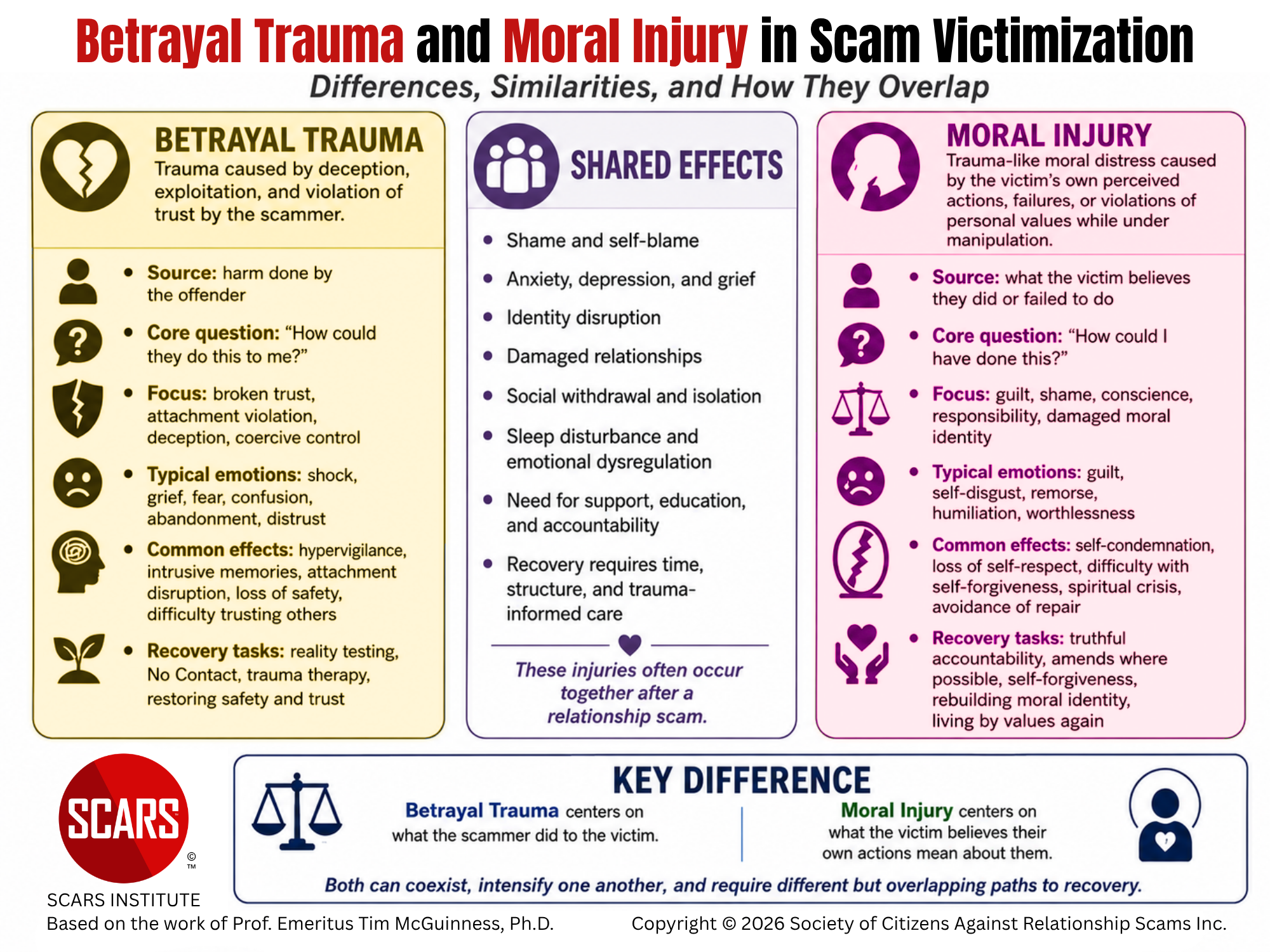
This pattern has direct relevance for scam survivors because many survivors already understand what it means to behave contrary to personal values while under powerful emotional and social pressure.
During the scam, loyalty can become secrecy. Compassion can become financial compliance. Hope can become denial. Protection of the relationship can become hostility toward concerned family members.
Within an outrage culture, similar distortions can occur through group pressure rather than offender grooming. Loyalty to a cause can become refusal to examine evidence. Compassion for one group can become cruelty toward another. Commitment to justice can become support for humiliation. Fear of appearing disloyal can suppress independent judgment.
The mechanisms and circumstances are not identical. Scam victims are subjected to targeted criminal manipulation, while participants in public outrage can possess greater access to information and freedom of choice. The comparison concerns the broader psychological danger of allowing emotional pressure, identity needs, and social reinforcement to move behavior away from professed values.
The central recovery lesson remains the same.
- Moral injury cannot be healed by finding a person who appears more blameworthy.
- It cannot be healed by demonstrating moral superiority through public punishment.
- It cannot be healed by transferring shame into contempt for another person.
Moral repair begins when the individual examines the contradiction directly:
- “What did I do?”
- “What did I believe I was doing?”
- “What value did my behavior violate?”
- “Was my response proportionate?”
- “Did I seek truth, or did I seek moral relief?”
- “Did I protect someone, or did I participate in harm?”
- “What responsibility belongs to me now?”
A person can oppose wrongdoing without using another person’s destruction to avoid moral self-examination. Moral courage requires more than visible outrage. It requires the willingness to recognize contradiction within the self, accept responsibility for harmful conduct, and return behavior to the values that public condemnation claims to defend.
If this crossed your moral outrage threshold, no worries. By all means, cancel me – please – I need a vacation. But, at least admit you are not here to recover. We will let you go and wish you all the best.
Prof. (Emeritus) Tim McGuinness, Ph.D.
July 2026
This is but one component, one piece of the puzzle …
Understanding how the human mind is manipulated and controlled involves recognizing that the tactics employed by deceivers are multifaceted and complex. This information is just one aspect of a broader spectrum of vulnerabilities, tendencies, and techniques that permit us to be influenced and deceived. To grasp the full extent of how our minds can be influenced, it is essential to examine all the various processes and functions of our brains and minds, methods and strategies used the criminals, and our psychological tendencies (such as cognitive biases) that enable deception. Each part contributes to a larger puzzle, revealing how our perceptions and decisions can be subtly swayed. By appreciating the diverse ways in which manipulation occurs, we gain a more comprehensive understanding of the challenges we face in avoiding deception in its many forms.
“Thufir Hawat: Now, remember, the first step in avoiding a *trap* – is knowing of its existence.” — DUNE
“If you can fully understand your own mind, you can avoid any deception!” — Tim McGuinness, Ph.D.
“The essence of bravery is being without self-deception.” — Pema Chödrön