



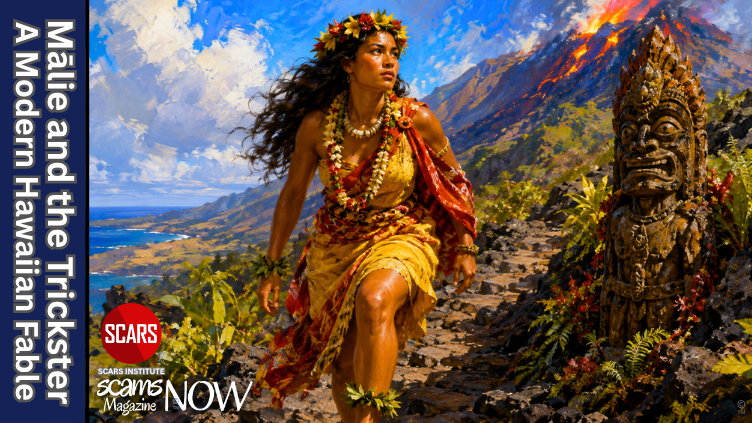
Mālie and the Trickster, and Her Search for Recovery – A New Hawaiian Fable – 2026

The SCARS Institute Magazine about Scam Victims-Survivors, Scams, Fraud & Cybercrime

- Published: 8/8/26
- Modified: 8/9/26
- Comments: 0
- Read Status:
Free, Safe, and Confidential After-Scam Healing & Support is Available from the SCARS Institute
Join Us www.SCARScommunity.org

Mālie and the Trickster, and Her Search for Recovery – A New Hawaiian Fable
Mālie and the Trickster – The Woman Who Climbed to Pele
A New Hawaiian Fable of Pele, Betrayal, and Renewal
Primary Category: Recovery / Philosophy / Anthropology
This is an original fable of pain and recovery inspired by the peoples and stories of Hawai’i
Authors:
• Tim McGuinness, Ph.D., DFin, MCPO, MAnth – Anthropologist, Scientist, Polymath, Managing Director of the Society of Citizens Against Relationship Scams Inc.
Author Biographies Below
Pele’s Test
Mālie and the Trickster – The Woman Who Climbed to Pele
A New Hawaiian Fable of Pele, Betrayal, and Renewal
A Tale of Love and Fire – An Original Tale Inspired by the Moʻolelo of Hawaiʻi
Long before strange sails appeared upon the horizon of Hawaiʻi, when the paths between mountain and sea were traveled by bare feet, and the histories of families were carried in memory and chant, there lived a young woman named Mālie on the great island of Hawaiʻi.
Her village lay in Puna, where the land descended from the forests of ʻōhiʻa toward the restless Pacific. Families there knew the mountain and the sea as parts of the same living world. Men returned at dawn in canoes carrying fish silver with seawater. Women beat wauke into kapa, wove lau hala, tended food gardens, gathered plants, prepared meals, and taught children the obligations that bound one generation to another. Farther inland, people cultivated kalo and ʻuala, while the forest provided timber, medicine, feathers, and plants known by names handed down through generations.
Above them all stood the mountains.
Mauna Loa filled much of the distant sky, enormous enough to seem less like a mountain than the back of the world itself. Kīlauea breathed nearer to them. On certain nights a red glow stained the clouds above the summit, and the elders said that Pelehonuamea was awake.
Mālie loved those nights.
She was not unhappy among her people, but she had always carried a quietness that separated her slightly from everyone else. While other young women gathered together after the day’s work, Mālie often walked toward the shore. She would sit where old lava met the sea and watch waves break themselves against black stone.
Sometimes she stayed there until the stars appeared.
She knew which stars rose from which part of the horizon. She listened when navigators spoke about swells arriving from places beyond sight and about birds whose evening flight could reveal distant land. She loved the idea that the ocean, which seemed empty to an untrained eye, was filled with signs for anyone who had learned how to see them.
The stars particularly fascinated her because they appeared to wander and yet never seemed lost.
Mālie sometimes wondered whether people could learn to do the same.
It was on one of those evenings that she met the stranger.
She first saw him standing beside a narrow canoe drawn upon the stones beyond the village. No one had seen him arrive. The sea was unusually calm, and the western sky still held the last red light of sunset.
He was young, or appeared to be. His body was strong from voyaging, his hair black and wild from salt and wind, and his eyes carried the easy amusement of someone who seemed to know more than he intended to say.
“You watch the sea as though you expect it to answer you,” he told her.
Mālie was startled that he had approached without her hearing him.
“The sea answers everyone,” she replied. “Most people simply ask questions too loudly.”
The stranger laughed.
It was not the laughter of someone mocking her. It was warm, delighted laughter, and Mālie found herself smiling despite her caution.
He sat several arm lengths away.
For a long while they watched the water without speaking.
That was the beginning.
The Stranger from the Sea
He stayed near the village for several days, although no one seemed to know precisely where he slept. He helped fishermen pull a canoe beyond the surf one morning and astonished them by reading a shift in the waves before anyone else noticed it. He repaired a broken cord almost without looking at his hands. He could throw a stone farther than the strongest young men, climb a tree with ridiculous speed, and tell stories so outrageous that everyone laughed even while wondering whether some part of them might somehow be true.
He told Mālie that he had traveled farther than she could imagine.
He spoke of islands beyond the horizon and winds with different smells. He claimed he had once argued with the sun because it crossed the sky too quickly.
“You argued with the sun?” Mālie asked.
“It was being unreasonable,” he said.
She laughed.
Another evening he told her that a sufficiently clever fisherman could hook something much larger than a fish.
“How large?” Mālie asked.
“An island,” he said.
“You are a liar.”
“Sometimes,” he admitted.
That answer should have troubled her.
Instead, she found it charming.
The stranger never seemed embarrassed by anything. He could turn a question aside with a joke and make uncertainty feel like mystery. Whenever Mālie tried to discover where his family lived, he answered with another story. Whenever she asked where he would go next, he pointed toward the horizon.
Yet when he asked about her, he listened intensely.
That was what reached her.
He wanted to know why she preferred the stars to village conversation. He asked what she dreamed about when she watched voyaging canoes disappear beyond the coast. He remembered things she had said several nights earlier and returned to them as though her smallest thoughts mattered.
Nobody had ever listened to Mālie that way.
Soon she began waiting for sunset because she knew he would find her.
They walked along the coast together. He brought her flowers from places she had not shown him. They watched flying fish break the ocean surface beneath moonlight. Once, beneath an ʻōhiʻa tree growing impossibly from hard lava, he touched a lehua blossom and told her that some things survived because they learned to grow where nothing should be able to live.
She remembered those words.
Later, she would hate herself for remembering them.
He told her that she was unlike anyone he had known. He said he had wandered because no place had ever given him a reason to remain.
Then he told her that she had.
Mālie knew people could deceive. She was not a foolish woman. She understood that promises were easy to make in darkness, when the sea was soft, and desire made every word sound larger than it was.
But knowing that people could lie was not the same as recognizing a lie spoken by someone she had come to trust.
The stranger did not ask for her heart all at once.
He took it carefully.
A little through laughter. A little through attention. A little through mystery. A little through the feeling that someone had finally discovered the private world she had carried alone.
By the time he told her he loved her, the words seemed merely to name something that had already become true.
And Mālie loved him.
She loved him completely.
The Morning He Was Gone
One night they climbed a low ridge overlooking the ocean. The moon silvered the water, and the stars seemed close enough to touch.
He told Mālie that he would leave briefly.
“There is something I must finish,” he said.
“Where?” she asked.
“You ask the same questions.”
“And you never answer them.” she said.
He smiled and placed his hand against her cheek.
“I will return before the moon grows round again.”
“Promise me,” she said.
He looked directly into her eyes.
“I promise,” he said.
That night she gave herself to him with the trust she had guarded from everyone else.
Before dawn, Mālie awoke alone.
At first she smiled because she imagined he had gone down to the water.
Then morning came. His canoe was gone.
By midday there was still no sign of him.
The moon grew round. Then thin. Then disappeared.
He never returned.
Mālie searched first with hope, then with worry, and finally with desperation. She questioned fishermen from neighboring settlements. She watched every canoe that approached the coast. She walked farther each evening as though changing where she stood might change what appeared on the horizon.
Nobody knew the stranger.
An old fisherman listened carefully when she repeated some of the things he had said. The story about arguing with the sun caused the man’s expression to change.
“What else did he tell you?” asked the old man.
“That he could fish an island from the sea.” she said
The old man’s eyes lowered. He would say nothing more.
Mālie understood only that the man knew something he was unwilling to tell her.
The realization wounded her almost as deeply as the disappearance itself.
The stranger had not been taken by the ocean. He had chosen to leave.
Everything that had felt sacred now became uncertain. Every conversation replayed itself differently. Every tenderness acquired another possible meaning.
Had he ever loved her? Had anything he said been true?
Had he laughed afterward at how easily she believed him?
Mālie stopped going to the shore because the sea had become the place where she had waited for someone who was never coming back. She stopped looking at the stars because he had sat beneath them with her.
She spoke less. She ate because her family insisted. She worked because work was expected, but she moved through each day as though some essential part of her remained outside her body.
What tormented her most was not simply that he had left. It was that she no longer trusted the woman who had believed him.
The Mountain Answers
Many nights later, Mālie finally returned alone to the black lava shore.
She stood where she had first met him. Anger came before tears.
“You stole my heart!” she shouted toward the ocean.
The waves answered against the rocks.
“You came from nowhere. You filled me with promises. You made me believe you, and then you carried everything away.”
She fell to her knees.
“I want it back.”
Her voice broke.
“I want myself back.”
Behind her, far inland, the mountain answered.
A deep sound traveled through the earth. Mālie froze.
It was not thunder. The ground trembled beneath her palms.
She turned toward Kīlauea.
Above the mountain, clouds that had been black only moments before began glowing red from beneath.
The villagers saw it too. People emerged from their hale and looked toward the uplands. Voices called to one another. Children were drawn back toward their families.
But Mālie heard something inside the rumbling that no one else seemed to hear.
Not words exactly. A summons.
She remained facing the mountain until the red glow faded. Then she understood what she must do.
“I am going to Pele.”
Her family tried to persuade her otherwise. The journey upward was difficult, the land dangerous, and the dwelling of Pele was not a place approached thoughtlessly.
Mālie would not be moved.
“If she can consume forests and make land from fire,” she said, “then she can burn this pain out of me.”
At dawn she began walking.
The Path Toward Fire
She carried water in a gourd, food wrapped carefully for the journey, and a small woven bundle containing ʻōhelo berries she intended to offer before approaching the sacred volcanic realm.
The first part of her journey took her through familiar country. She followed paths connecting families and cultivated lands, passing places where people worked beneath the morning sun. Children called greetings. Dogs barked from beside houses. Smoke rose from cooking fires. The ordinary life of Hawaiʻi continued around her, and for the first time she realized how completely grief had convinced her that the whole world had stopped when only her own world had broken.
As she climbed farther, familiar coastal vegetation gave way to upland forest.
ʻŌhiʻa surrounded her. Their dark limbs twisted from old lava, crowned with lehua blossoms brilliant against the green.
Mālie remembered stories she had heard as a child, stories in which love, jealousy, death, loyalty, and transformation followed one another so closely that no person could separate one from another. She thought especially of Hiʻiaka, who had crossed great distances because of a promise and returned toward Kīlauea carrying grief and anger powerful enough to shake the earth.
“If Hiʻiaka could walk with grief,” Mālie whispered, “then grief can walk with me.”
She continued upward. Strangely, that path turned from dark red and black to a golden yellow.
Near evening she encountered an old woman sitting beside the path.
The woman’s hair was gray and tangled. Her skin was deeply lined, and she leaned against a wooden staff.
“You have food,” the old woman said.
“I have enough.” Mālie said.
“Enough for whom?” the old woman asked.
Mālie hesitated. The climb ahead was long.
Then she sat beside the stranger and opened her bundle.
“For both of us.”
They ate together. The old woman watched her carefully.
“Why are you climbing?” the old woman asked.
“To ask Pele for something.” Mālie said.
“What?”
“I want her to punish a liar.”
The old woman smiled faintly.
“That is not what you said beside the sea.”
Mālie stared at her.
“What do you know about what I said?”
But the woman had already risen.
When Mālie blinked against a gust of cold mist, the old woman was gone.
The Second Test
The next day the mountain became harsher. The yellow path continued upward.
Rain swept across the trail and disappeared as quickly as it came. Mist hid the world below. Underfoot, smooth pāhoehoe gave way in places to broken, unforgiving lava.
Mālie stumbled and cut her hand.
For the first time she considered returning home. Then she remembered the stranger’s promise.
I will return before the moon grows round again.
She hated those words. She pushed herself upright.
Hours later she saw the old woman again.
This time she stood beside an ʻōhiʻa tree.
“You are tired,” the woman said.
“Yes.”
“Go home.”
“No.” Mālie said.
“Perhaps the man will return.”
Mālie’s face hardened.
“I do not care whether he returns.”
The old woman studied her.
“That is a lie.” the old woman said.
Mālie felt anger rise.
“Yes,” she finally said. “Part of me still wants him to return. Part of me wants him to explain everything so that I can make what happened mean something different.”
“And if he returned?”
Mālie looked toward the mountain.
“I would want to believe him.”
The admission hurt more than the cut in her hand.
The old woman nodded.
“Now you are telling the truth.”
Once again mist crossed the path. Once again the woman disappeared. Mālie continued climbing.
At the House of Pele
By the time Mālie reached the summit country of Kīlauea, the world she knew seemed impossibly far away.
Steam rose from openings in the earth. Sulfur touched the air and covered the ground. The ground itself seemed alive beneath her feet.
Ahead lay the immense volcanic realm where generations had understood Pele to dwell.
Mālie stopped. For all her determination, fear finally entered her.
She placed the ʻōhelo berries she had carried as an offering and spoke respectfully into the wind.
“Pelehonuamea, I have come because I cannot carry this anymore.”
Nothing happened. Then she saw the old woman.
She stood several steps away.
“You came a long way to give something away,” she said.
“My pain.” Mālie said.
“Is it yours to give?”
“He gave it to me.” Mālie said.
“Then perhaps you should return it to him.”
“I cannot. He is gone.” Mālie said.
The old woman stepped closer.
“Who was he?” she asked.
“I do not know.” Mālie said.
The old woman laughed softly. It was a familiar laugh.
Mālie suddenly remembered the stranger sitting beside the sea.
Her blood went cold. The old woman’s eyes changed. Firelight moved within them.
The air around her seemed to shimmer, and Mālie understood before the woman spoke.
She dropped to her knees.
“Pele.”
The mountain rumbled.
Pele stood before her no longer as a frail traveler but as something Mālie could barely comprehend: woman and flame, beauty and terror, destruction and creation occupying the same form.
“You asked who deceived you,” Pele said.
Mālie could not raise her eyes.
“His name is Māui.”
The stories suddenly became truth.
The sun. The hook. The impossible skill upon the sea. The laughter.
Mālie began trembling.
“The trickster,” Mālie said.
“The clever one,” Pele answered. “The restless one. The breaker of boundaries. The maker of wonders and trouble. He desired you, and desire was enough for him. When he had what he wanted, the road called him again.”
“Then everything was a lie.”
“No.” Pele said.
Mālie looked up.
“That would be easier, would it not?” Pele asked. “To make every moment false because the man who gave it to you was false in his purpose?”
Mālie said nothing.
“Your laughter was real. Your trust was real. Your love was real. His deception does not travel backward through time and turn your heart into a lie.” Pele said.
“Then why did you let him do this?” Mālie said.
The mountain became very still.
“I did not send Māui to you.”
Pele’s voice hardened. “His deception belongs to him.”
Then she stepped closer.
“But when you cried beside the sea, I heard you.”
Mālie remembered the earth trembling beneath her hands.
“The lie was his,” Pele said. “The testing was mine.”
Mālie finally understood.
“The old woman.”
Pele smiled.
“You fed me when you feared there would not be enough for yourself. You continued when your body hurt. You admitted the truth when a comforting lie would have been easier. You climbed seeking vengeance and arrived seeking freedom.”
“Then free me.” Mālie begged.
Pele looked at her for a long time.
“No.”
Mālie felt something inside her collapse.
“Please.”
“I cannot return what was never stolen,” Pele said.
“He stole my heart.” Mālie said.
Pele shook her head.
“No man carries your heart across the sea, Mālie. He wounded it. He confused it. He made you ashamed of it. But he did not take it.”
Pele touched two fingers against Mālie’s forehead.
“You carried it here. And here it still is.”
Mālie began to cry. Not as she had cried beside the ocean. These tears were different.
They came without pleading.
Pele pointed toward the trail below.
“You believed you climbed this mountain so that I could make you strong enough to return home.”
Mālie waited.
“You misunderstand the path to the mountain.”
Pele’s eyes burned brighter.
“You climbed because you were already strong enough,” Pele said at last.
The Descent
Mālie remained near Kīlauea until the first light of morning.
When she looked again for Pele, she was alone. Nothing miraculous had been erased.
She still remembered the stranger’s touch. She remembered the promises. She remembered waking to an empty place beside her. But the memories no longer seemed to own her. The bitterness had faded.
She began walking downhill.
The journey home took several days, yet it felt shorter. She passed the same ʻōhiʻa forests, but now she noticed lehua glowing among the branches. She heard birds above her. She smelled rain approaching before it arrived.
When she reached the place where she had shared food with the old woman, Mālie laughed.
Farther down, she saw the ocean.
For the first time since Māui disappeared, its vastness did not frighten her. The sea had not betrayed her. The stars had not betrayed her. Love itself had not betrayed her.
One man had. A trickster.
That difference returned the world to her.
The Woman Who Watched the Stars
Mālie returned to her family and resumed the life she had abandoned while waiting for someone who had chosen not to return.
She went again to the shoreline at night. She watched the stars.
Eventually, children began sitting beside her because she could tell them where certain stars would rise and how the moon changed the water. Voyagers spoke with her about winds and swells, and she listened as closely as she always had. She became known not because she had climbed to Pele but because she had learned to see things carefully.
Years passed.
One evening a man from her own side of the island sat several arm lengths away from her on the rocks.
He did not tell her that he had captured the sun. He did not claim he could pull islands from the ocean. He did not promise forever.
He simply asked what she was watching.
Mālie pointed toward a star rising above the horizon. She told him its name.
The following evening he returned. Then he returned again.
He never dazzled her. He never made mystery feel like proof of importance. He simply kept returning.
In time Mālie loved him.
It was a quieter love than the one Māui had awakened in her, but she discovered that quietness could contain depths that excitement never reached. They built a life among their families. They worked, laughed, argued, forgave, grew older, and watched children become adults beneath the same stars Mālie had loved when she was young.
Sometimes, on nights when Kīlauea cast red light against the clouds, Mālie would turn toward the mountain.
She never forgot the stranger from the sea. She never needed to.
The memory became a story instead of a wound. And whenever someone asked why she still spent so many nights watching the ocean and the heavens, Mālie would smile.
“The stars wander,” she would tell them, “but they know how to return.”
Then she would look toward the red glow of Pele’s mountain and remember the lesson she had carried all the way home:
The trickster had deceived her. He had broken her trust. He had left her grieving upon the shore.
But he had never possessed the power to decide how her story ended.
That power had remained with her all along.
~ The End ~
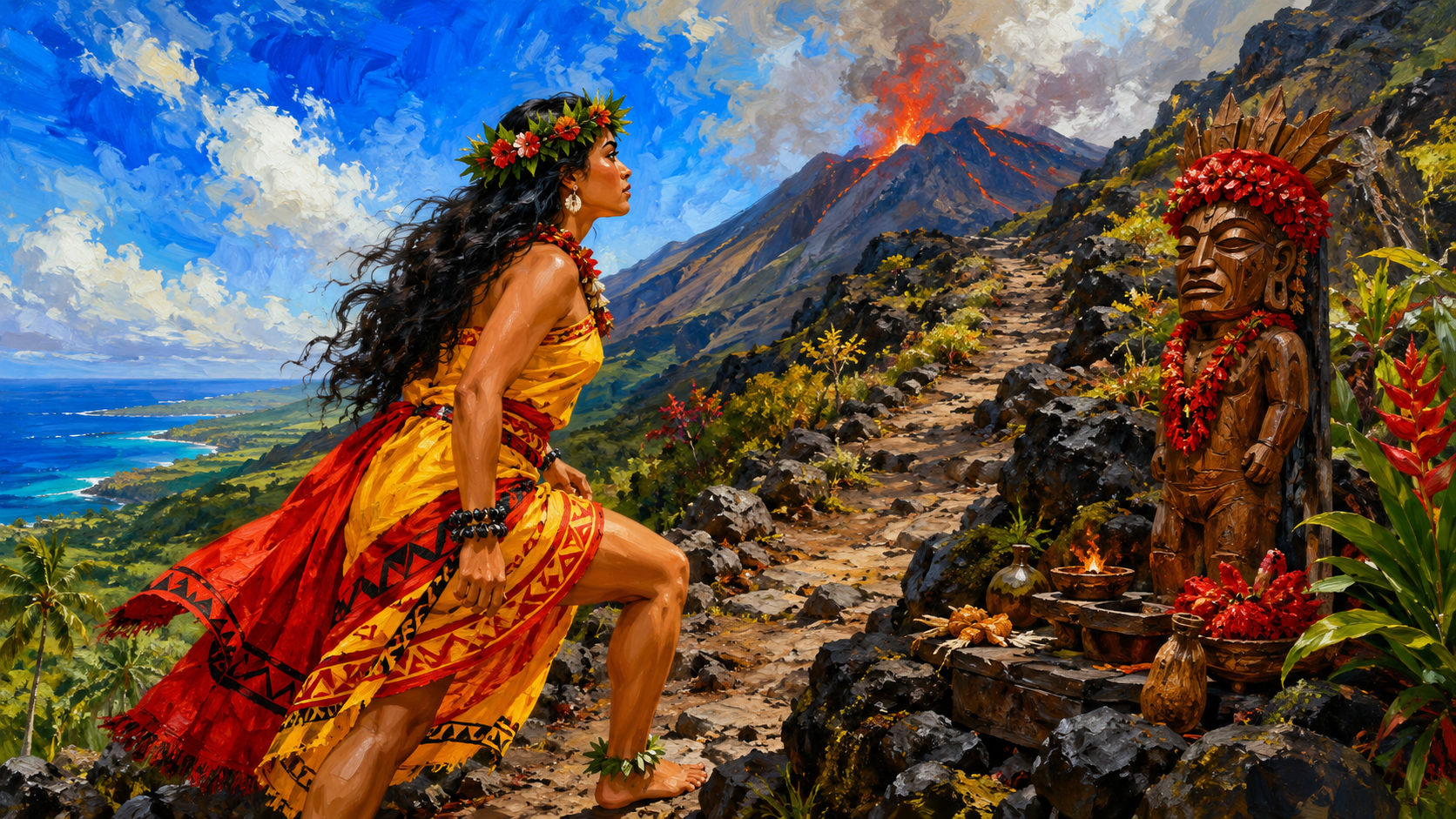


Lyrics to the Song
“Pele’s Test”
An Original Hawaiian Fable of Strength
By Dr. Tim McGuinness
Stomp Your Feet and Clap Along …
Lyrics
– – – – – – – – – – – – – –
He came to me smiling, a trickster dressed in light.
Ua hele mai ʻo ia me ka minoʻaka, he kupua hoʻopunipuni i ʻaʻahu ʻia i ka mālamalama.
He promised me forever, then vanished with the night.
Ua hoʻohiki ʻo ia i ke ao pau ʻole, a laila nalowale pū me ka pō.
He stole the world I trusted and left my heart in flame.
Ua ʻaihue ʻo ia i koʻu ao hilinaʻi, a waiho i kuʻu puʻuwai i ke ahi.
So I turned toward the mountain and called out Pele’s name.
No laila huli au i ka mauna, a kāhea aku i ka inoa ʻo Pele.
I climbed before the sunrise through ash beneath my feet.
Piʻi au ma mua o ka puka ʻana o ka lā, ma luna o ka lehu ma lalo o koʻu mau wāwae.
The wind pulled at my clothing, the stone burned with its heat.
Huki ka makani i koʻu kapa, a wela ka pōhaku i kona wela.
Every step remembered every lie that I believed.
Hoʻomanaʻo kēlā me kēia kapuaʻi i kēlā me kēia wahaheʻe aʻu i manaʻoʻiʻo ai.
Every breath became a prayer for all that I had grieved.
Lilo kēlā me kēia hanu i pule no nā mea a pau aʻu i kanikau ai.
Pele, hear me, I have carried this too far.
E Pele, e hoʻolohe mai, ua hali lōʻihi au i kēia ʻeha.
Take the poison from my spirit, burn away the scar.
E lawe aku i ka ʻawaʻawa mai kuʻu ʻuhane, e puhi aku i ka ʻeha i koe.
I do not ask for vengeance, I do not ask for gold.
ʻAʻole au e noi i ka hoʻopaʻi, ʻaʻole hoʻi au e noi i ke gula.
Only free the heart he captured, only give me back my soul.
E hoʻokuʻu i kuʻu puʻuwai āna i hopu ai, e hoʻihoʻi mai i kuʻu ʻuhane.
Higher still I climbed alone where clouds concealed the sky.
Piʻi aʻe nō au hoʻokahi, kahi a nā ao i uhi ai i ka lani.
I heard his voice behind me, but I would not turn or cry.
Lohe au i kona leo ma hope oʻu, akā ʻaʻole au i huli a uē paha.
The mountain shook beneath me, red fire split the stone.
Haʻalulu ka mauna ma lalo oʻu, a māhele ke ahi ʻula i ka pōhaku.
Yet for the first time since he left, I knew my strength was mine.
Akā no ka manawa mua mai kona haʻalele ʻana, ʻike au noʻu iho koʻu ikaika.
At the crater stood a woman with fire within her eyes.
Ma ka lua pele kū maila kekahi wahine me ke ahi i loko o kona mau maka.
She asked me why I climbed there, and I told her of the lies.
Nīnau maila ʻo ia no ke aha au i piʻi ai, a haʻi aku au i nā wahaheʻe.
I told her how he fooled me, how shame had bound me fast.
Haʻi aku au i kona hoʻopunipuni ʻana iaʻu, a me ka hoʻopaʻa ʻana o ka hilahila iaʻu.
She said, “The lie has ended, but you still obey the past.”
ʻĪ maila ʻo ia, “Ua pau ka wahaheʻe, akā ke hoʻolohe mau nei ʻoe i ka wā i hala.”
Then fire rose around her and Pele spoke my name.
A laila kū aʻe ke ahi a puni ona, a kāhea ʻo Pele i koʻu inoa.
“The lie was his, the testing mine; I called you through the flame.”
“Na ke kupua ka wahaheʻe, naʻu ka hoʻāʻo; ua kāhea au iā ʻoe ma waena o ke ahi.”
“I watched you climb through sorrow when you thought your strength was gone.”
“Ua nānā au iā ʻoe e piʻi ma waena o ke kaumaha, i kou manaʻo ua nalowale kou ikaika.”
“You came here asking freedom, yet you carried it all along.”
“Ua hele mai ʻoe e noi i ke kūʻokoʻa, akā ua hali mau ʻoe iā ia i loko ou.”
“You thought the mountain judged you; it only showed you who you are.”
“Ua manaʻo ʻoe ua hoʻokolokolo ka mauna iā ʻoe; ua hōʻike wale ia iā ʻoe i kou ʻano.”
“The woman who survived the fire has traveled farther than the scar.”
“ʻO ka wahine i ola mai ke ahi, ua hele ʻoi aku ʻo ia ma mua o kona ʻeha.”
Then Pele touched my forehead, and the mountain became still.
A pā maila ʻo Pele i kuʻu lae, a mālie ihola ka mauna.
The fire erased the bitterness and gave me back my soul!
Ua holoi ke ahi i ka ʻawaʻawa a ua hoʻihoʻi mai iaʻu i koʻu ʻuhane!
This is the journey, this is the way.
ʻO kēia ka huakaʻi, ʻo kēia ke ala.
Author Biographies
Prof. (Emeritus) Tim McGuinness, Ph.D. DFin is a co-founder, Managing Director, and Chairman of the SCARS Institute (Society of Citizens Against Relationship Scams Inc.), where he serves as an unsalaried volunteer officer dedicated to supporting scam victims and survivors around the world. With over 34 years of experience in scam education and awareness, he is perhaps the longest-serving advocate in the field.
Dr. McGuinness has an extensive background as a business pioneer, having co-founded several technology-driven enterprises, including the former e-commerce giant TigerDirect.com. Beyond his corporate achievements, he is actively engaged with multiple global think tanks where he helps develop forward-looking policy strategies that address the intersection of technology, ethics, and societal well-being. He is also a computer industry pioneer (he was an Assistant Director of Corporate Research Engineering at Atari Inc. in the early 1980s) and invented core technologies still in use today.
His professional identity spans a wide range of disciplines. He is a scientist, strategic analyst, solution architect, advisor, public speaker, published author, roboticist, Navy veteran, and recognized polymath. He holds numerous certifications, including those in cybersecurity from the United States Department of Defense under DITSCAP & DIACAP, continuous process improvement and engineering and quality assurance, trauma-informed care, grief counseling, crisis intervention, and related disciplines that support his work with crime victims.
Dr. McGuinness was instrumental in developing U.S. regulatory standards for medical data privacy called HIPAA and financial industry cybersecurity called GLBA. His professional contributions include authoring more than 1,000 papers and publications in fields ranging from scam victim psychology and neuroscience to cybercrime prevention and behavioral science.
“I have dedicated my career to advancing and communicating the impact of emerging technologies, with a strong focus on both their transformative potential and the risks they create for individuals, businesses, and society. My background combines global experience in business process innovation, strategic technology development, and operational efficiency across diverse industries.”
“Throughout my work, I have engaged with enterprise leaders, governments, and think tanks to address the intersection of technology, business, and global risk. I have served as an advisor and board member for numerous organizations shaping strategy in digital transformation and responsible innovation at scale.”
“In addition to my corporate and advisory roles, I remain deeply committed to addressing the rising human cost of cybercrime. As a global advocate for victim support and scam awareness, I have helped educate millions of individuals, protect vulnerable populations, and guide international collaborations aimed at reducing online fraud and digital exploitation.”
“With a unique combination of technical insight, business acumen, and humanitarian drive, I continue to focus on solutions that not only fuel innovation but also safeguard the people and communities impacted by today’s evolving digital landscape.”
Dr. McGuinness brings a rare depth of knowledge, compassion, and leadership to scam victim advocacy. His ongoing mission is to help victims not only survive their experiences but transform through recovery, education, and empowerment.
-/ 30 /-
What do you think about this?
Please share your thoughts in a comment below!
Mālie and the Trickster, and Her Search for Recovery – A New Hawaiian Fable – 2026
Please Leave a Comment
Please Tell Us What You Learned From This?
Commenting Is An Essential Part Of Healing
Read • Think • Write
GLOSSARY SEARCH
TOPIC SEARCH
TABLE OF CONTENTS








CATEGORIES

Important Information for New Scam Victims
- Please visit www.ScamVictimsSupport.org – a SCARS Website for New Scam Victims & Sextortion Victims.
- SCARS Institute now offers its free, safe, and private Scam Survivor’s Support Community at www.SCARScommunity.org – this is not on a social media platform; it is our own safe & secure platform created by the SCARS Institute especially for scam victims & survivors.
- SCARS Institute now offers a free recovery learning program at www.SCARSeducation.org.
- Please visit www.ScamPsychology.org – to more fully understand the psychological concepts involved in scams and scam victim recovery.
If you are looking for local trauma counselors, please visit counseling.AgainstScams.org
If you need to speak with someone now, you can dial 988 or find phone numbers for crisis hotlines all around the world here: www.opencounseling.com/suicide-hotlines
Statement About Victim Blaming
Some of our articles discuss various aspects of victims. This is both about better understanding victims (the science of victimology) and their behaviors and psychology. This helps us to educate victims/survivors about why these crimes happened and not to blame themselves, better develop recovery programs, and help victims avoid scams in the future. At times, this may sound like blaming the victim, but it does not blame scam victims; we are simply explaining the hows and whys of the experience victims have.
These articles, about the Psychology of Scams or Victim Psychology – meaning that all humans have psychological or cognitive characteristics in common that can either be exploited or work against us – help us all to understand the unique challenges victims face before, during, and after scams, fraud, or cybercrimes. These sometimes talk about some of the vulnerabilities the scammers exploit. Victims rarely have control of them or are even aware of them until something like a scam happens, and then they can learn how their mind works and how to overcome these mechanisms.
Articles like these help victims and others understand these processes and how to help prevent them from being exploited again or to help them recover more easily by understanding their post-scam behaviors. Learn more about the Psychology of Scams at www.ScamPsychology.org
SCARS INSTITUTE RESOURCES: If You Have Been Victimized By A Scam Or Cybercrime
♦ If you are a victim of scams, go to www.ScamVictimsSupport.org for real knowledge and help
♦ Join our free, safe, and private Scam Survivors After Scam Healing and Recovery Community at www.SCARScommunity.org
♦ Enroll in SCARS Scam Survivor’s School now at www.SCARSeducation.org
♦ To report criminals, visit https://reporting.AgainstScams.org – we will NEVER give your data to money recovery companies like some do!
♦ Follow us and find our podcasts, webinars, and helpful videos on YouTube: https://www.youtube.com/@RomancescamsNowcom
♦ Learn about the Psychology of Scams at www.ScamPsychology.org
♦ Dig deeper into the reality of scams, fraud, and cybercrime at www.ScamsNOW.com and www.RomanceScamsNOW.com
♦ Scam Survivor’s Stories: www.ScamSurvivorStories.org
♦ For Scam Victim Advocates visit www.ScamVictimsAdvocates.org
♦ See more scammer photos on www.ScammerPhotos.com
You can also find the SCARS Institute’s knowledge and information on Facebook and LinkedIn
Psychology Disclaimer:
All articles about psychology and the human brain on this website are for information & education only
The information provided in this and other SCARS articles are intended for educational and self-help purposes only and should not be construed as a substitute for professional therapy or counseling.
Note about Mindfulness: Mindfulness practices have the potential to create psychological distress for some individuals. Please consult a mental health professional or experienced meditation instructor for guidance should you encounter difficulties.
While any self-help techniques outlined herein may be beneficial for scam victims seeking to recover from their experience and move towards recovery, it is important to consult with a qualified mental health professional before initiating any course of action. Each individual’s experience and needs are unique, and what works for one person may not be suitable for another.
Additionally, any approach may not be appropriate for individuals with certain pre-existing mental health conditions or trauma histories. It is advisable to seek guidance from a licensed therapist or counselor who can provide personalized support, guidance, and treatment tailored to your specific needs.
If you are experiencing significant distress or emotional difficulties related to a scam or other traumatic event, please consult your doctor or mental health provider for appropriate care and support.
Also read our SCARS Institute Statement about Professional Care for Scam Victims – click here
If you are in crisis, feeling desperate, or in despair, please call 988 or your local crisis hotline – international numbers here.
A Question of Trust
At the SCARS Institute, we invite you to do your own research on the topics we speak about and publish. Our team investigates the subject being discussed, especially when it comes to understanding the scam victims-survivors’ experience. You can do Google searches, but in many cases, you will have to wade through scientific papers and studies. However, remember that biases and perspectives matter and influence the outcome. Regardless, we encourage you to explore these topics as thoroughly as you can for your own awareness.
More ScamsNOW.com Articles