




The Paradox of Trying to Answer Unanswerable Questions – 2026

The SCARS Institute Magazine about Scam Victims-Survivors, Scams, Fraud & Cybercrime

- Published: 8/7/26
- Modified: 8/7/26
- Comments: 0
- Read Status:
Free, Safe, and Confidential After-Scam Healing & Support is Available from the SCARS Institute
Join Us www.SCARScommunity.org

The Paradox of Trying to Answer Unanswerable Questions
A Paradox That Some Questions Cannot Be Answered Without Altering the Answer
The Logic Trap of Shame After a Scam, or When Every Answer Becomes Self-Blame
Primary Category: Psychology / Philosophy / Recoverology
Authors:
• Tim McGuinness, Ph.D., DFin, MCPO, MAnth – Anthropologist, Scientist, Polymath, Managing Director of the Society of Citizens Against Relationship Scams Inc.
Author Biographies Below
About This Article
Shame after scam victimization can create a self-referential pattern in which victims interpret nearly every fact as evidence of personal failure. Feelings of guilt, foolishness, contamination, or unworthiness can be mistaken for proof of actual responsibility. This reasoning can distort support, reinforce self-blame, and cause victims to judge manipulated actions as though they were freely chosen with complete knowledge. Recovery requires an external reference point through psychoeducation, evidence, therapy, trusted support, verification, and a clearer understanding of how scammers manipulate information, attachment, fear, hope, and decision-making. Victims can remain accountable for recovery and future safeguards without accepting responsibility for the offender’s crime. Breaking the shame loop requires changing the underlying question rather than continuing to seek answers inside assumptions that already presume guilt.
Note: This article is intended for informational purposes and does not replace professional medical advice. If you are experiencing distress, please consult a qualified mental health professional.
Keywords
Shame, Self-Blame, Probability Paradox, Self-Reference, Scam Victim Recovery, Betrayal Trauma, Moral Responsibility, Psychoeducation, Reality Testing, Recovery Insight

A Paradox That Some Questions Cannot Be Answered Without Altering the Answer
The Logic Trap of Shame After a Scam, or When Every Answer Becomes Self-Blame
Author’s Note
Shame is especially dangerous because it can feel like evidence when it is actually an emotional interpretation. Scam victims can become trapped inside questions that already assume guilt, weakness, or failure before the facts have been examined. Understanding this pattern helps separate legitimate learning and accountability from false self-condemnation. Recovery becomes possible when victims step outside shame’s closed reasoning, examine what actually occurred, and allow evidence, education, and trusted support to help reconstruct meaning.
Prof. Emeritus Tim McGuinness, Ph.D.
August, 2026
We Asked a Simple Question
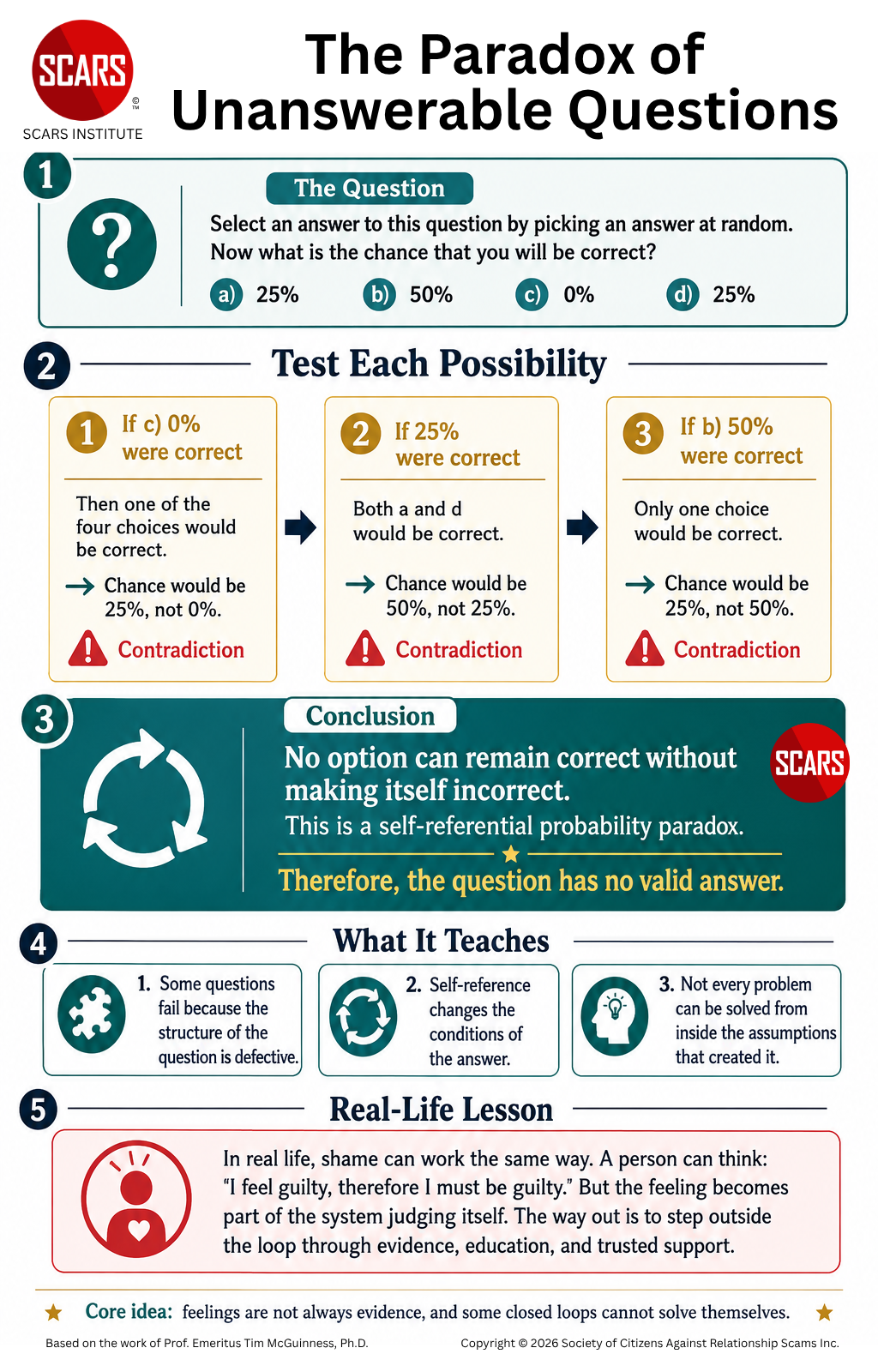
Select an answer to this question by picking an answer at random.
Now what is the chance that you will be correct?
- 25%
- 50%
- 0%
- 25%
However …
- If c) 0% were correct, then one of the four choices would be correct, so the chance of selecting it randomly would be 25%, not 0%.
- If 25% were correct, both a) and d) would be correct, giving a 50% chance, not 25%.
- If b) 50% were correct, only one choice would be correct, giving a 25% chance, not 50%.
Therefore, none of the options can remain correct without making itself incorrect. It is a probability paradox, a question without a valid answer.
But What Does It Mean???
The deeper meaning is that some questions change the conditions under which they are answered.
The paradox is not really about arithmetic. It is about self-reference. The answer becomes part of the situation it is trying to describe. Once that happens, the system can no longer be evaluated from a neutral distance. Each proposed answer changes the probability that the answer itself is correct.
In other words, answering the question by selecting what you think is the right answer changes the value of the answer making it incorrect. So, every answer is wrong. Yet it seems so simple.
Real life often works this way.
Beliefs Can Change the Reality They Describe
People frequently treat beliefs as though they merely observe reality. In practice, beliefs can influence behavior, and behavior can alter the outcome.
A person who believes they will fail can become hesitant, avoid opportunities, prepare poorly, or withdraw when difficulty appears. The original belief then helps create the failure that seems to confirm it.
A person who believes success is guaranteed can become careless, ignore warning signs, or take excessive risks. Their confidence can help produce the very failure they believed was impossible.
The belief is no longer separate from the result. It becomes one of the causes.
This resembles the paradox because the attempt to state the probability changes the probability itself.
Prediction Can Alter What Is Predicted
Many human systems become unstable when people know the prediction.
If everyone is told that a bank is about to fail, people can rush to withdraw their money and cause the failure. If everyone is told that a particular investment will rise, their buying can temporarily drive up the price. If people are told that a neighborhood is dangerous, they can avoid it, businesses can leave, services can decline, and the prediction can help produce the deterioration.
The forecast enters the system and changes it.
This is why social life cannot always be understood like a mechanical process. Human beings respond to descriptions, warnings, expectations, labels, and predictions. Once people react, the original conditions no longer exist.
Labels Can Become Traps
The paradox also reflects the danger of defining a person too completely.
Someone who says, “I am incapable of trusting anyone,” has created a belief that affects every future relationship. They can become guarded, suspicious, distant, or controlling. Other people then respond to that behavior, perhaps by withdrawing, which appears to confirm that no one can be trusted.
A traumatized person who believes, “I will always be damaged,” can interpret every difficult emotion as proof that recovery is impossible. The belief can stop them from participating fully in the very process that could disprove it.
The statement becomes self-protecting. Any evidence against it can be dismissed, while every setback is treated as confirmation.
Like the probability question, the belief constructs a system in which no answer can easily escape the assumptions already built into it.
Some Problems Have No Answer Within Their Own Structure
The question also teaches that not every problem can be solved using the choices provided.
People often assume that because a question offers several answers, one of them must be correct. That is not always true. The structure itself can be defective.
This matters in life because people can become trapped between false alternatives:
- “I must either forgive immediately or remain bitter forever.”
- “I must trust completely or trust no one.”
- “I must recover perfectly or I have failed.”
- “I must return to who I was or remain broken.”
These choices appear complete, but they are not. The real answer can exist outside the offered options.
The person might forgive partially, slowly, or not at all while still releasing destructive anger. They might learn calibrated trust rather than total trust. They might recover unevenly while still making real progress. They might become someone new instead of returning to a previous identity.
Sometimes the solution is not choosing the correct box. It is recognizing that the boxes are wrong.
Certainty Can Be Impossible
The paradox also exposes the human discomfort with uncertainty.
People often want every question to have one stable answer. When no answer fits, they can feel compelled to force certainty anyway. They choose the least uncomfortable option, defend it, and mistake decisiveness for truth.
Real life contains many situations in which the available evidence does not support a final conclusion. Relationships, motives, political outcomes, diagnoses, financial decisions, and personal futures often remain partly uncertain.
Maturity does not always mean finding certainty. Sometimes it means recognizing that certainty is not available and refusing to manufacture it.
The logically honest answer to the probability question is not one of the choices. It is that the system has no internally consistent solution.
Once upon a time, there was a challenge or test in the Star Trek series called the “Kobayashi Maru.” In attempting to find a functional solution, everyone failed without exception. Except for Kirk. He discovered that the ONLY solution was not to take the bait – in other words, don’t play along.
The psychologically honest answer in life can sometimes be the same:
- “I do not know yet.”
- “The evidence is incomplete.”
- “The question is framed incorrectly.”
- “More than one thing can be true.”
Observation Is Not Always Neutral
The paradox also reflects a broader philosophical insight: the observer can become part of the observed system. In other words, you become part of the problem.
In ordinary life, people do not simply look at events. They interpret them. Their expectations affect what they notice, what they ignore, how they respond, and what happens next.
A therapist’s expectations can influence a client interaction. A teacher’s expectations can affect a student’s performance. A manager’s assumptions can shape an employee’s opportunities. A victim’s belief that every stranger is dangerous can influence how every encounter unfolds. Or a survivor’s belief that recovery is hard makes it hard.
This does not mean reality is purely subjective. It means human participation can alter the reality being interpreted.
The Deeper Lesson
The most important lesson is that logic can fail when a system refers back to itself without an external point of reference.
Human beings experience the same problem when they try to evaluate themselves using only beliefs formed inside shame, trauma, fear, ideology, or isolation.
- A person trapped inside self-blame asks: “What does my judgment say about whether my judgment can be trusted?”
- A traumatized person asks: “If I failed to recognize deception before, how can I trust myself to recognize reality now?”
- An ashamed person asks: “If I believe I am unworthy, why should I trust anyone who tells me I am worthy?”
These are closed systems. Every answer is filtered through the very condition being questioned.
That is why outside perspective matters. Education, evidence, trusted support, therapy, verification, and dialogue introduce information from beyond the closed loop.
The paradox therefore has a deeply human message:
- Sometimes a person cannot solve a problem by thinking harder inside the same assumptions.
- They must step outside the structure, question the framing, and allow a new reference point to enter.
- The correct answer is sometimes not an answer.
It is a change to the question.
Looking Deeper at Scam Survivors
The paradox relates closely to scam victims because shame creates a closed system of reasoning. Once shame becomes the frame through which the victim interprets everything, every possible answer seems to confirm the same conclusion.
- A victim can think: “I was deceived, therefore I cannot trust my judgment.”
- Then: “If I cannot trust my judgment, I cannot trust my conclusion that I was manipulated.”
- Then: “If I cannot trust that I was manipulated, perhaps I really was responsible.”
The person becomes trapped inside a self-referential loop. The same injured judgment is being asked to evaluate whether that judgment is injured. Every answer circles back into shame.
That is very similar to the probability paradox. Each answer changes the conditions of the question. For the scam victim, each attempt to explain what happened is altered by the belief, “There is something wrong with me.”
Shame Changes the Meaning of Every Fact
Shame does not merely add pain to the recovery process. It changes interpretation.
- When the victim hears, “You were manipulated,” shame can translate it into: “You were weak enough to be manipulated.”
- When the victim hears, “The scammer exploited your trust,” shame can translate it into: “You should not have trusted anyone.”
- When the victim hears, “It was not your fault,” shame can translate it into: “They are only saying that because they feel sorry for you.”
- When the victim is encouraged to learn from what happened, shame can translate it into: “They think I was stupid and need to be taught basic things.”
The information itself has not changed. The interpretive system has.
This is why shame is so destructive. It makes recovery messages appear to prove the very thing they are meant to correct.
Shame Creates an Unwinnable Question
- A scam victim often asks: “How could I have allowed this to happen?”
- The question appears reasonable, but it can contain a hidden assumption: “If this happened, I must have allowed it.”
That assumption already assigns responsibility before the evidence is examined.
The victim then searches for an answer inside a question that has already declared them guilty. Every explanation becomes another form of self-accusation.
- If they trusted, they blame themselves for trusting.
- If they ignored doubts, they blame themselves for ignoring doubts.
- If they questioned the offender, they blame themselves for not questioning harder.
- If they sought advice, they blame themselves for not following it sooner.
- If they were emotionally attached, they blame themselves for needing connection.
There is no answer that can satisfy the question because the structure of the question is defective.
- A better question is: “How did the offender create conditions in which this became believable?”
That question opens the system. It allows examination of grooming, controlled information, coercion, urgency, attachment, emotional conditioning, fear, hope, and deception.
It does not remove the victim’s need to learn. It removes the false assumption that the victim caused the crime.
Shame Confuses Outcome With Intention
Another closed loop develops when victims judge themselves according to what happened rather than what they intended.
They might think:
- “My money funded criminals, therefore I supported criminals.”
- “My family suffered, therefore I harmed my family.”
- “I concealed what was happening, therefore I betrayed everyone.”
- “I returned to the scammer, therefore I wanted the scam.”
These conclusions ignore the conditions under which the actions occurred.
Moral responsibility normally requires meaningful knowledge, freedom, and intent. A scammer interferes with all three. The offender withholds truth, constructs false circumstances, manipulates emotional pressure, and narrows perceived choices.
The victim can still examine decisions and strengthen future safeguards. But that is different from accepting moral guilt for consequences they never intended and would never have knowingly chosen.
- Shame collapses this distinction. It treats manipulated action as freely chosen action.
- Shame Makes Support Feel Like Proof of Failure
The paradox also appears when a victim receives help.
- If they accept support, shame can say: “You need help because you are incapable.”
- If they resist support, shame can say: “You are failing recovery.”
- If they ask questions, shame can say: “You should already understand this.”
- If they remain silent, shame can say: “You are hiding because you know you are guilty.”
Again, there is no winning answer inside the shame system.
This is why victims often withdraw. They can feel judged even when no one is judging them because shame interprets every interaction through anticipated condemnation.
Recovery requires an external reference point. That can come from psychoeducation, therapy, trusted support, evidence, structured verification, and repeated explanations of how manipulation and trauma work.
The victim needs information that does not originate inside the shame loop.
“It Was Not Your Fault” Must Become More Than Reassurance
The statement “It was not your fault” is often rejected because shame treats it as emotional comfort rather than factual analysis.
For it to become meaningful, the victim needs to understand why it was not their fault.
- They need to understand that the offender controlled information.
- They need to understand that trust was deliberately manufactured.
- They need to understand that attachment was reinforced through repeated cycles of reward, fear, urgency, and reassurance.
- They need to understand that the person they believed they were helping did not exist as presented.
- They need to understand that their decisions were made inside a false reality.
Once the mechanics are understood, the statement changes. It no longer means, “Nothing you did mattered.” It means, “You were not the author of the crime.”
That distinction preserves both compassion and accountability.
The victim did not cause the deception. The victim can still take responsibility for recovery, future safeguards, and learning.
The Lesson About Shame
The central lesson is that shame cannot serve as an accurate judge of guilt.
Shame feels like evidence, but it is not evidence.
It says:
- “If I feel guilty, I must be guilty.”
- “If I feel foolish, I must be foolish.”
- “If I feel contaminated, I must be morally damaged.”
- “If I cannot forgive myself, I must be unforgivable.”
These are emotional conclusions, not logical ones.
Like the paradoxical probability question, shame creates a system in which every answer defeats itself. The victim cannot reason their way to innocence while continuing to accept shame’s hidden assumptions.
Recovery begins when the person steps outside the closed loop and questions the frame itself.
- Not: “What is wrong with me that this happened?”
- Instead: “What was done to me, how did it affect me, and what do I need to learn now?”
- Not: “Why was I too weak to stop it?”
- Instead:“How was my trust, attachment, fear, hope, or compassion deliberately exploited?”
- Not: “Do I deserve recovery?”
- Instead:“What support and knowledge will help me recover?”
The scammer created the deception. Shame tries to make the victim inherit authorship of it.
Recovery means returning that responsibility to where it belongs.
The Answer
Sometimes there is no answer. You just have to accept it.
Can you do that?
Conclusion
Shame can become one of the most convincing traps in recovery because it does not merely create painful feelings. It changes the questions you ask, the evidence you accept, and the conclusions you believe. Once shame becomes the frame through which you judge yourself, almost every answer can be turned into proof of personal failure. If you trusted, shame tells you that you were foolish. If you doubted but remained, it tells you that you should have acted sooner. If you seek help, it tells you that you are incapable. If you struggle to accept help, it tells you that you are failing recovery. Inside that closed system, there is no answer that allows you to win.
The way forward begins by questioning the structure itself. Feeling guilty does not prove guilt. Feeling foolish does not prove foolishness. Feeling morally damaged does not establish moral responsibility. The scammer created a false reality, controlled information, manipulated attachment, and influenced decisions that you believed were being made under entirely different circumstances. You were not the author of that crime.
Recovery therefore requires more than repeatedly telling yourself that it was not your fault. You need enough knowledge to understand why it was not your fault. Psychoeducation, evidence, trusted support, therapy, verification, and honest examination provide reference points outside the closed loop of shame. They allow you to replace a question such as “What is wrong with me?” with a more useful question: “What happened to me, how did it affect me, and what do I need to learn now?”
Sometimes recovery does not begin by finding a better answer. It begins by realizing that shame gave you the wrong question.

Glossary
- Anticipated Condemnation — Anticipated condemnation is the expectation that other people will judge, criticize, or reject a scam victim because of what happened. Shame can create this expectation even when other people have not actually expressed condemnation. The expectation can cause withdrawal from support and reinforce the belief that the victim deserves blame. — Shame Response
- Answer-Dependent Probability — Answer-dependent probability occurs when selecting an answer changes the probability that makes the answer correct or incorrect. The random-choice paradox demonstrates this because each proposed percentage alters the number of choices that would qualify as correct. The concept shows how some systems cannot produce a stable answer when the answer itself changes the conditions being measured. — Logical Paradox
- Assumption-Embedded Question — An assumption-embedded question contains an unproven conclusion inside the wording of the question itself. A scam victim who asks how they allowed the crime to happen can unknowingly begin with the assumption that they permitted or caused it. Recognizing the hidden assumption allows the person to examine the crime without accepting guilt before the evidence is considered. — Belief Distortion
- Belief-Caused Outcome — A belief-caused outcome develops when a person’s expectations influence behavior strongly enough to help produce the result they predicted. A person expecting failure can withdraw, hesitate, or reduce effort, which can make failure more likely. Scam survivors can recognize that beliefs about permanent damage or impossible recovery can influence participation without proving that those beliefs are objectively true. — Decision-Making Pattern
- Belief Confirmation Loop — A belief confirmation loop occurs when a belief influences behavior and the resulting consequences are then interpreted as proof that the original belief was correct. A traumatized person who expects rejection can become guarded, causing others to withdraw and apparently confirming the expectation. Breaking the loop requires examining whether behavior influenced the outcome being treated as independent evidence. — Cognitive Bias
- Calibrated Trust — Calibrated trust is the practice of replacing absolute trust or absolute distrust with trust that develops according to evidence, verification, consistency, and experience. Scam victims can become trapped between believing everyone or believing no one. Calibrated trust provides a more realistic alternative that allows relationships while preserving appropriate caution. — Verification Practice
- Closed Reasoning System — A closed reasoning system is a pattern of thought in which every conclusion is interpreted through assumptions that the system itself never permits to be questioned. The person can continue reasoning carefully while still arriving at distorted conclusions because the starting assumptions remain protected. Outside evidence and alternative framing are needed to evaluate whether the reasoning structure itself is defective. — Cognitive Process
- Closed Shame Loop — A closed shame loop develops when shame becomes both the source of a negative belief and the evidence used to confirm that belief. The victim feels guilty and then interprets the feeling of guilt as proof of actual guilt. Recovery requires information from outside the loop so that emotion no longer serves simultaneously as accusation, evidence, and verdict. — Shame Response
- Contradictory Answer Structure — A contradictory answer structure exists when every available answer creates conditions that make that same answer incorrect. The probability question demonstrates this because 0 percent, 25 percent, and 50 percent each contradict the number of answer choices that would then be correct. The lesson is that an offered set of choices does not guarantee that any choice is logically valid. — Logical Paradox
- Decisiveness-as-Truth Error — Decisiveness-as-truth error occurs when a person mistakes confidence or certainty for evidence that a conclusion is correct. People often prefer a definite answer when uncertainty feels uncomfortable, even when available evidence does not justify certainty. Scam victims can protect themselves by distinguishing emotional conviction from verified information. — Cognitive Bias
- Defective Question Frame — A defective question frame occurs when the structure of a question prevents a fair or logically consistent answer. Questions built around false assumptions can force a person toward conclusions that were embedded before the reasoning began. Scam victims benefit from examining whether a self-blaming question must be reframed before attempting to answer it. — Reality Testing
- Emotional Conclusion — An emotional conclusion is a judgment treated as factual because it feels emotionally convincing. Shame can produce conclusions such as believing that feeling foolish proves foolishness or feeling guilty proves guilt. Recovery becomes more accurate when emotional experiences are acknowledged without automatically treating them as evidence about responsibility, character, or worth. — Emotional Regulation
- Evidence-Incomplete State — An evidence-incomplete state exists when available information does not support a final or certain conclusion. Human discomfort with uncertainty can encourage people to fill these gaps with assumptions that feel emotionally satisfying. Recognizing incomplete evidence allows a scam victim to delay judgment rather than manufacture certainty about motives, responsibility, or future outcomes. — Reality Testing
- External Reference Point — An external reference point is reliable information that comes from outside a self-reinforcing belief system. Education, evidence, therapy, trusted support, verification, and dialogue can provide perspectives that shame or trauma cannot generate internally. These reference points help scam victims test whether conclusions formed inside self-blame accurately reflect what happened. — Support Systems
- False Alternative Trap — A false alternative trap occurs when a person believes only two extreme choices are available even though other possibilities exist. Scam victims can believe they must trust completely or trust nobody, recover perfectly or fail, or return to their former identity or remain permanently broken. Recognizing additional possibilities creates more realistic choices and reduces rigid recovery thinking. — Decision-Making Pattern
- False Guilt Assumption — A false guilt assumption occurs when a scam victim treats the existence of harmful consequences as proof of personal guilt. The person can believe that because money reached criminals or family members suffered, they knowingly caused those outcomes. This assumption ignores deception, incomplete knowledge, manipulated circumstances, and the victim’s actual intentions. — Moral Emotion
- Forced Certainty — Forced certainty is the attempt to create a definite answer when the available evidence does not support one. People can prefer an uncomfortable certainty over an unresolved question because uncertainty itself creates distress. Scam recovery requires the ability to tolerate unanswered questions without replacing missing knowledge with blame, fear, or speculation. — Uncertainty Management
- Framing Error — A framing error occurs when the way a problem is presented directs reasoning toward a distorted or incomplete conclusion. A question can appear reasonable while quietly limiting which explanations are considered possible. Scam victims can reduce self-blame by examining whether the frame assumes personal failure instead of considering manipulation, controlled information, and criminal intent. — Cognitive Bias
- Guilt-as-Evidence Belief — Guilt-as-evidence belief is the assumption that feeling guilty demonstrates actual responsibility for an event. Emotional guilt can arise after manipulation even when the person lacked knowledge, freedom, or criminal intent. Separating the feeling from the evidence allows a victim to examine responsibility according to what was actually known and intended. — Moral Emotion
- Hidden Assumption of Responsibility — Hidden assumption of responsibility occurs when a victim begins evaluating the crime from a question that already presumes personal responsibility. Asking why the victim allowed the scam to happen can quietly transform criminal deception into a supposed personal decision. Identifying the assumption makes room for a more accurate examination of how the offender created believable conditions. — Self-Blame Pattern
- Interpretive Distortion — Interpretive distortion occurs when shame, trauma, fear, or another powerful state changes the meaning assigned to otherwise accurate information. A statement intended to explain manipulation can be interpreted as evidence of weakness. Recovery requires examining not only what information was received but also how the person’s emotional state translated its meaning. — Belief Distortion
- Interpretive System — An interpretive system is the internal framework through which a person assigns meaning to events, statements, emotions, and evidence. Shame can alter this framework so that supportive information is repeatedly transformed into self-condemnation. Education and outside perspectives can help rebuild the framework so that new information is interpreted more accurately. — Cognitive Process
- Kobayashi Maru Principle — The Kobayashi Maru principle describes the recognition that some problems cannot be solved by accepting the conditions imposed by the problem. The useful response can involve refusing the false choices and questioning the rules that created the impossible situation. Scam victims can apply this principle by refusing self-blaming questions whose structure guarantees a condemning answer. — Philosophical Insight
- Manufactured Certainty — Manufactured certainty is a conclusion created to relieve uncertainty rather than because the evidence supports it. A person can adopt a simple explanation such as personal stupidity or failure because it feels more manageable than unresolved complexity. Recovery requires distinguishing explanations that provide emotional certainty from explanations that accurately reflect manipulation, trauma, and available evidence. — Belief Distortion
- Meaning Reconstruction — Meaning reconstruction is the process of developing a more accurate understanding of an experience after earlier interpretations have been disrupted or distorted. Scam victims often need to reconsider what trust, responsibility, betrayal, intention, and personal judgment mean after deception. Evidence, education, dialogue, and reflection allow the person to rebuild meaning without allowing shame to determine the conclusion. — Recovery Process
- Neutral-Distance Loss — Neutral-distance loss occurs when a person becomes part of the system they are attempting to evaluate and can no longer observe it independently. Beliefs, expectations, and emotional reactions can change the situation being judged. Scam victims can experience this when shame influences both their interpretation of the crime and their evaluation of whether that interpretation is trustworthy. — Self-Reference
- Observer Participation Effect — Observer participation effect describes how a person’s expectations and responses can influence the reality they are attempting to understand. Human interactions differ from purely mechanical systems because people respond to labels, predictions, expectations, and judgments. Recognizing this effect helps distinguish between observing an outcome and unintentionally helping shape it. — Social Psychology
- Outcome-Intention Confusion — Outcome-intention confusion occurs when a person judges moral responsibility according to the consequences of an action while ignoring what the person actually intended. Scam victims can believe that harmful outcomes prove they knowingly supported criminal activity or betrayed loved ones. Accurate evaluation requires separating unintended consequences created through deception from actions deliberately chosen with full knowledge. — Moral Injury
- Paradoxical Probability Question — A paradoxical probability question is a probability problem whose available answers alter the conditions that determine their own correctness. The random-choice example produces contradictions regardless of whether 0 percent, 25 percent, or 50 percent is selected. Its broader lesson is that some questions contain structural problems that cannot be corrected simply by choosing among the supplied answers. — Logical Paradox
- Prediction-Driven Outcome — A prediction-driven outcome occurs when knowledge of a prediction changes human behavior and helps produce the predicted result. Expectations about markets, institutions, neighborhoods, relationships, or personal failure can influence the actions people take. Scam survivors can use this concept to recognize that expecting recovery to fail can affect participation without establishing that recovery itself is impossible. — Social Psychology
- Question Reframing — Question reframing is the deliberate replacement of a misleading or self-condemning question with one that allows evidence to be considered more accurately. A victim can replace a question about personal weakness with a question about how trust, attachment, fear, hope, or compassion were exploited. Reframing changes the structure of inquiry without denying the need for learning or accountability. — Recovery Insight
- Recovery Difficulty Belief — Recovery difficulty belief is the expectation that recovery must be overwhelmingly hard, impossible, or permanently beyond the person’s abilities. That belief can influence participation, persistence, and interpretation of ordinary setbacks. A difficult moment can then appear to confirm the belief even when the person is making meaningful progress. — Recovery Insight
- Recovery Perfection Trap — Recovery perfection trap is the belief that recovery must proceed without setbacks, confusion, emotional activation, or mistakes in order to count as successful. This false alternative turns ordinary difficulties into evidence of failure. A more realistic view recognizes uneven progress while still requiring continued learning, support, and participation. — Recovery Process
- Responsibility Presumption — Responsibility presumption is the assumption that because a victim participated in transactions or decisions, they must therefore be responsible for the crime. This reasoning ignores the false reality, manipulated information, and emotional pressure created by the offender. Responsibility can be evaluated accurately only after the conditions surrounding the victim’s choices are considered. — Self-Blame Pattern
- Self-Blame Loop — A self-blame loop occurs when every explanation for a scam is redirected toward a conclusion of personal failure. Trust becomes evidence of gullibility, doubt becomes evidence that the victim should have acted sooner, and attachment becomes evidence of weakness. The loop can only be interrupted when the underlying assumption of guilt is examined rather than continually reinforced. — Shame Response
- Self-Protecting Statement — A self-protecting statement is a belief structured so that contradictory evidence is dismissed while confirming evidence is accepted. A person who believes they will always be damaged can interpret every setback as confirmation and every improvement as temporary or irrelevant. Such statements protect themselves from correction and can preserve distorted recovery beliefs. — Belief Distortion
- Self-Referential Judgment — Self-referential judgment occurs when a person uses the very capacity being questioned to evaluate whether that capacity can be trusted. A scam victim with damaged confidence can ask whether their judgment is reliable while relying entirely on that injured judgment to answer the question. External evidence and trusted perspectives can help interrupt this circular evaluation. — Self-Reference
- Self-Referential Probability Paradox — Self-referential probability paradox is the logical problem created when an answer changes the probability that determines whether the answer is correct. Each answer in the random-choice problem modifies the number of correct options and therefore invalidates itself. The paradox illustrates how self-reference can make an apparently simple question internally inconsistent. — Logical Paradox
- Shame-Based Interpretation — Shame-based interpretation occurs when information is understood primarily through an existing expectation of personal defect or guilt. Supportive statements can then be heard as disguised criticism, pity, or confirmation of weakness. Recovery requires separating the actual content of a message from the meaning that shame automatically assigns to it. — Shame Response
- Shame-Filtered Evidence — Shame-filtered evidence is information that has been selectively interpreted through a prior belief that the victim is guilty, foolish, weak, or unworthy. Facts supporting self-condemnation receive greater attention while evidence contradicting shame can be minimized or rejected. An external perspective helps the person evaluate the full evidence rather than only the portion that supports shame. — Cognitive Bias
- Shame-Framed Question — A shame-framed question is a question whose wording reflects an underlying expectation of guilt, inadequacy, or failure. Questions such as what is wrong with the victim can make self-condemnation appear to be the only possible conclusion. Replacing the question with one focused on what occurred and how manipulation operated creates a more accurate path toward understanding. — Shame Response
- Shame-Induced Withdrawal — Shame-induced withdrawal occurs when a scam victim retreats from support because they expect judgment, pity, disappointment, or condemnation. The withdrawal can reduce access to the evidence and perspectives needed to challenge self-blaming beliefs. Continued isolation allows shame to become increasingly self-confirming because fewer outside reference points remain available. — Withdrawal Pattern
- Shame Logic — Shame logic is a closed pattern of reasoning in which feelings of guilt, foolishness, contamination, or unworthiness are treated as proof of those conditions. Every attempt to challenge the conclusion can be reinterpreted through the same assumption of personal defect. Recovery requires questioning the logic itself rather than trying endlessly to produce a different answer inside it. — Shame Response
- Shame Translation — Shame translation is the process through which a neutral or compassionate statement is converted into a self-condemning meaning. A victim can hear that trust was exploited and internally translate that statement into a belief that trusting made them foolish. Recognizing this translation helps the person distinguish what was actually said from what shame added afterward. — Cognitive Process
- Social Prediction Effect — Social prediction effect occurs when predictions about people or communities influence behavior and thereby change the situation being predicted. Expectations can alter relationships, markets, institutions, and individual choices because people respond to what they believe will happen. The concept demonstrates why human systems cannot always be understood as though observers remain separate from outcomes. — Social Psychology
- Structural No-Answer Problem — Structural no-answer problem exists when a question cannot produce a valid answer because the contradiction is built into its design. More effort, confidence, or calculation does not solve the problem when every offered solution invalidates itself. Scam victims can use this insight to recognize that some self-blaming questions need to be abandoned rather than answered. — Philosophical Insight
- Trust Absolutism — Trust absolutism is the belief that a person must either trust completely or refuse trust entirely. Scam victimization can make this false choice seem protective because complete distrust appears safer than risking another betrayal. Calibrated evaluation allows trust to develop gradually through evidence and verification rather than through unconditional acceptance or permanent suspicion. — Belief Distortion
- Uncertainty Acceptance — Uncertainty acceptance is the ability to recognize that some questions remain unanswered because evidence is incomplete or certainty is unavailable. The person does not manufacture an explanation simply to escape discomfort. Scam recovery benefits from this capacity because unanswered questions about motives, identities, or alternate outcomes do not need to be replaced with self-blame. — Uncertainty Management
- Unwinnable Question — An unwinnable question is structured so that every available response appears to confirm the same negative conclusion. Shame can create this condition when accepting help, refusing help, speaking, or remaining silent are all interpreted as evidence of personal failure. The solution requires challenging the premise rather than continuing to search for a safe answer inside the question. — Shame Response
- Wrong-Question Recognition — Wrong-question recognition is the realization that progress is blocked because the person is attempting to answer a question built on distorted assumptions. A scam victim can recognize that asking what is wrong with them already places blame where it has not been established. Recovery can move forward when the person asks what happened, how manipulation worked, and what knowledge or support is needed now. — Recovery Insight
Reference
Several philosophy books address exactly the territory this article is describing, although from different directions. The closest subjects are self-reference, paradox, skepticism, unknowability, and the limits of reasoning inside a closed system.
The random-choice question is primarily a self-referential paradox. Its possible answers affect the conditions that would make those answers correct. The broader philosophical lesson is that some questions cannot be answered consistently from within the framework that produced them. Philosophers have explored this problem in logic, epistemology, language, and theories of self-knowledge.
A Brief History of the Paradox
Roy Sorensen
This is probably the best general starting point. Sorensen traces paradoxes from ancient philosophy through modern logic and explains how apparently reasonable premises and valid reasoning can produce contradictions or impossible conclusions. The book is accessible enough for a broad philosophical discussion while still providing serious intellectual depth.
This supports the idea that sometimes the failure is not in the person trying to answer, but in the structure of the question itself.
Paradoxes
R. M. Sainsbury
Sainsbury defines a paradox as an unacceptable conclusion reached through apparently acceptable reasoning from apparently acceptable premises. The book examines paradoxes involving truth, belief, morality, vagueness, and rational decision-making. It would be especially useful for explaining why a person can reason carefully and still become trapped when the underlying assumptions are contradictory.
For this discussion of shame, this connects directly to questions that already contain a hidden verdict, such as, “What is wrong with me that I allowed this?” The reasoning cannot produce a fair answer because guilt has already been inserted into the premise.
Gödel, Escher, Bach: An Eternal Golden Braid
Douglas Hofstadter
This is the most imaginative and expansive treatment of self-reference. Hofstadter examines how systems can refer to themselves, how levels of meaning become entangled, and how “strange loops” appear in logic, language, art, music, and consciousness. The book’s dialogues and structure repeatedly demonstrate self-reference rather than merely explaining it.
This is particularly relevant to the shame loop. A victim uses a judgment injured by trauma to judge whether that judgment can be trusted. The reasoning circles back into itself, and every conclusion is filtered through the condition being evaluated.
It is a long and demanding book, but conceptually it is very close to what is described.
The Road to Paradox
Vann McGee
This book focuses more directly on truth, provability, circularity, self-reference, Gödel’s incompleteness theorems, and semantic paradoxes. It explains how systems can generate statements that cannot be consistently resolved using the resources available within those systems.
It is more technical than Sorensen or Sainsbury, but it provides a strong philosophical and logical support for the claim that some closed systems cannot supply their own solution.
Knowledge and Its Limits
Timothy Williamson
Williamson examines knowledge, evidence, skepticism, probability, and the boundaries of what can be known. Its final section addresses “structural unknowability,” including the paradox of knowability, which shows that some truths can be unknowable rather than merely unknown.
This is relevant to the wider conclusion that uncertainty is not always the result of insufficient effort. Sometimes the structure of the problem places a real limit on what can be known from within it.
Unknowability: An Inquiry into the Limits of Knowledge
Nicholas Rescher
Rescher directly examines the practical and theoretical limits of human knowledge. The book considers why human beings should expect some matters to remain unresolved because of limitations in evidence, cognition, methods, or the structure of inquiry itself.
This is particularly useful for discussing the difference between healthy uncertainty and shame-driven certainty. Shame frequently invents a definite answer, usually personal guilt, where the evidence does not justify one.
Knowing Our Limits
Nathan Ballantyne
Ballantyne focuses on intellectual humility, disagreement, bias, incomplete evidence, and the difficulty of recognizing when people do not possess enough information to reach a reliable conclusion. The book argues for greater openness to the possibility that one’s present answer is incomplete or mistaken.
This is highly applicable to recovery. A victim can believe that the emotional certainty of shame is the same as knowledge. Intellectual humility permits a different conclusion: “My current interpretation feels true, but trauma and incomplete information can be shaping it.”
Classical Philosophical Foundations
Several older works also provide foundations for the same idea.
René Descartes’ Meditations on First Philosophy examines whether any belief can survive systematic doubt. It is relevant to the problem of attempting to identify a trustworthy foundation when ordinary beliefs have become uncertain.
David Hume’s An Enquiry Concerning Human Understanding explores the limits of causal reasoning and shows that people often claim more certainty than experience can justify.
Immanuel Kant’s Critique of Pure Reason argues that human knowledge is shaped and limited by the structures through which the mind experiences reality. Some questions exceed the conditions under which human knowledge is possible.
Ludwig Wittgenstein’s On Certainty explores the background assumptions that make doubt, knowledge, and questioning possible. It is particularly useful for understanding that doubt cannot operate endlessly without relying on some external or foundational points of reference.
Sextus Empiricus’ Outlines of Pyrrhonism presents ancient skepticism and the suspension of judgment when competing claims cannot be decisively resolved.
These books do not focus specifically on self-referential probability questions, but they address the broader issue of when certainty is unavailable or when the mind exceeds what it can legitimately know.
The Closest Books to Our Shame Argument
For the philosophical structure of this discussion, we would recommend these three books together:
- Paradoxes by R. M. Sainsbury for defective structures and contradictory conclusions.
- Gödel, Escher, Bach by Douglas Hofstadter for self-reference and closed loops.
- Knowing Our Limits by Nathan Ballantyne for intellectual humility and recognizing when one’s current interpretation cannot be trusted.
The resulting philosophical argument would be:
Shame creates a self-referential system. The victim’s damaged self-judgment becomes both the accused and the judge. Every piece of evidence is interpreted through the prior belief of personal defect. Because the system contains its conclusion inside its assumptions, the person cannot escape merely by reasoning harder within it. An outside reference point is required, such as evidence, psychoeducation, trauma knowledge, trusted support, or therapy.
That is closely related to a major lesson running through philosophical work on paradox and unknowability: Some problems remain impossible only while the person accepts the structure in which they were first presented.
Author Biographies
Prof. (Emeritus) Tim McGuinness, Ph.D. DFin is a co-founder, Managing Director, and Chairman of the SCARS Institute (Society of Citizens Against Relationship Scams Inc.), where he serves as an unsalaried volunteer officer dedicated to supporting scam victims and survivors around the world. With over 34 years of experience in scam education and awareness, he is perhaps the longest-serving advocate in the field.
Dr. McGuinness has an extensive background as a business pioneer, having co-founded several technology-driven enterprises, including the former e-commerce giant TigerDirect.com. Beyond his corporate achievements, he is actively engaged with multiple global think tanks where he helps develop forward-looking policy strategies that address the intersection of technology, ethics, and societal well-being. He is also a computer industry pioneer (he was an Assistant Director of Corporate Research Engineering at Atari Inc. in the early 1980s) and invented core technologies still in use today.
His professional identity spans a wide range of disciplines. He is a scientist, strategic analyst, solution architect, advisor, public speaker, published author, roboticist, Navy veteran, and recognized polymath. He holds numerous certifications, including those in cybersecurity from the United States Department of Defense under DITSCAP & DIACAP, continuous process improvement and engineering and quality assurance, trauma-informed care, grief counseling, crisis intervention, and related disciplines that support his work with crime victims.
Dr. McGuinness was instrumental in developing U.S. regulatory standards for medical data privacy called HIPAA and financial industry cybersecurity called GLBA. His professional contributions include authoring more than 1,000 papers and publications in fields ranging from scam victim psychology and neuroscience to cybercrime prevention and behavioral science.
“I have dedicated my career to advancing and communicating the impact of emerging technologies, with a strong focus on both their transformative potential and the risks they create for individuals, businesses, and society. My background combines global experience in business process innovation, strategic technology development, and operational efficiency across diverse industries.”
“Throughout my work, I have engaged with enterprise leaders, governments, and think tanks to address the intersection of technology, business, and global risk. I have served as an advisor and board member for numerous organizations shaping strategy in digital transformation and responsible innovation at scale.”
“In addition to my corporate and advisory roles, I remain deeply committed to addressing the rising human cost of cybercrime. As a global advocate for victim support and scam awareness, I have helped educate millions of individuals, protect vulnerable populations, and guide international collaborations aimed at reducing online fraud and digital exploitation.”
“With a unique combination of technical insight, business acumen, and humanitarian drive, I continue to focus on solutions that not only fuel innovation but also safeguard the people and communities impacted by today’s evolving digital landscape.”
Dr. McGuinness brings a rare depth of knowledge, compassion, and leadership to scam victim advocacy. His ongoing mission is to help victims not only survive their experiences but transform through recovery, education, and empowerment.
-/ 30 /-
What do you think about this?
Please share your thoughts in a comment below!
The Paradox of Trying to Answer Unanswerable Questions – 2026
Please Leave a Comment
Please Tell Us What You Learned From This?
Commenting Is An Essential Part Of Healing
Read • Think • Write
GLOSSARY SEARCH
TOPIC SEARCH
TABLE OF CONTENTS








CATEGORIES
Important Information for New Scam Victims
- Please visit www.ScamVictimsSupport.org – a SCARS Website for New Scam Victims & Sextortion Victims.
- SCARS Institute now offers its free, safe, and private Scam Survivor’s Support Community at www.SCARScommunity.org – this is not on a social media platform; it is our own safe & secure platform created by the SCARS Institute especially for scam victims & survivors.
- SCARS Institute now offers a free recovery learning program at www.SCARSeducation.org.
- Please visit www.ScamPsychology.org – to more fully understand the psychological concepts involved in scams and scam victim recovery.
If you are looking for local trauma counselors, please visit counseling.AgainstScams.org
If you need to speak with someone now, you can dial 988 or find phone numbers for crisis hotlines all around the world here: www.opencounseling.com/suicide-hotlines
Statement About Victim Blaming
Some of our articles discuss various aspects of victims. This is both about better understanding victims (the science of victimology) and their behaviors and psychology. This helps us to educate victims/survivors about why these crimes happened and not to blame themselves, better develop recovery programs, and help victims avoid scams in the future. At times, this may sound like blaming the victim, but it does not blame scam victims; we are simply explaining the hows and whys of the experience victims have.
These articles, about the Psychology of Scams or Victim Psychology – meaning that all humans have psychological or cognitive characteristics in common that can either be exploited or work against us – help us all to understand the unique challenges victims face before, during, and after scams, fraud, or cybercrimes. These sometimes talk about some of the vulnerabilities the scammers exploit. Victims rarely have control of them or are even aware of them until something like a scam happens, and then they can learn how their mind works and how to overcome these mechanisms.
Articles like these help victims and others understand these processes and how to help prevent them from being exploited again or to help them recover more easily by understanding their post-scam behaviors. Learn more about the Psychology of Scams at www.ScamPsychology.org
SCARS INSTITUTE RESOURCES: If You Have Been Victimized By A Scam Or Cybercrime
♦ If you are a victim of scams, go to www.ScamVictimsSupport.org for real knowledge and help
♦ Join our free, safe, and private Scam Survivors After Scam Healing and Recovery Community at www.SCARScommunity.org
♦ Enroll in SCARS Scam Survivor’s School now at www.SCARSeducation.org
♦ To report criminals, visit https://reporting.AgainstScams.org – we will NEVER give your data to money recovery companies like some do!
♦ Follow us and find our podcasts, webinars, and helpful videos on YouTube: https://www.youtube.com/@RomancescamsNowcom
♦ Learn about the Psychology of Scams at www.ScamPsychology.org
♦ Dig deeper into the reality of scams, fraud, and cybercrime at www.ScamsNOW.com and www.RomanceScamsNOW.com
♦ Scam Survivor’s Stories: www.ScamSurvivorStories.org
♦ For Scam Victim Advocates visit www.ScamVictimsAdvocates.org
♦ See more scammer photos on www.ScammerPhotos.com
You can also find the SCARS Institute’s knowledge and information on Facebook and LinkedIn
Psychology Disclaimer:
All articles about psychology and the human brain on this website are for information & education only
The information provided in this and other SCARS articles are intended for educational and self-help purposes only and should not be construed as a substitute for professional therapy or counseling.
Note about Mindfulness: Mindfulness practices have the potential to create psychological distress for some individuals. Please consult a mental health professional or experienced meditation instructor for guidance should you encounter difficulties.
While any self-help techniques outlined herein may be beneficial for scam victims seeking to recover from their experience and move towards recovery, it is important to consult with a qualified mental health professional before initiating any course of action. Each individual’s experience and needs are unique, and what works for one person may not be suitable for another.
Additionally, any approach may not be appropriate for individuals with certain pre-existing mental health conditions or trauma histories. It is advisable to seek guidance from a licensed therapist or counselor who can provide personalized support, guidance, and treatment tailored to your specific needs.
If you are experiencing significant distress or emotional difficulties related to a scam or other traumatic event, please consult your doctor or mental health provider for appropriate care and support.
Also read our SCARS Institute Statement about Professional Care for Scam Victims – click here
If you are in crisis, feeling desperate, or in despair, please call 988 or your local crisis hotline – international numbers here.
A Question of Trust
At the SCARS Institute, we invite you to do your own research on the topics we speak about and publish. Our team investigates the subject being discussed, especially when it comes to understanding the scam victims-survivors’ experience. You can do Google searches, but in many cases, you will have to wade through scientific papers and studies. However, remember that biases and perspectives matter and influence the outcome. Regardless, we encourage you to explore these topics as thoroughly as you can for your own awareness.
More ScamsNOW.com Articles