

The Paradox of Praise
A SCARS Institute Scam Victim Recovery Insight
TRIGGER WARNING
I want to talk about a topic I see very often in victim language. Praising the strength of other trauma sufferers. Some of this will be triggering to some victims-survivors.
I have to be very careful here, because this is not gender specific, but different genders perform this to the detriment of the person suffering. Men simply do not talk about it and are just there for the other man suffering. Women tend to be very vocal about praising the “strength” of someone who hides their trauma away and appears to be strong.
We have to be very careful about praising coping – it is not all good. This is the fertile ground of toxic positivity.
So, this is going to be a sledgehammer moment.
PART 1: The Paradox of Praise
Why Trauma Survivors Admire the Mask That Hides Pain
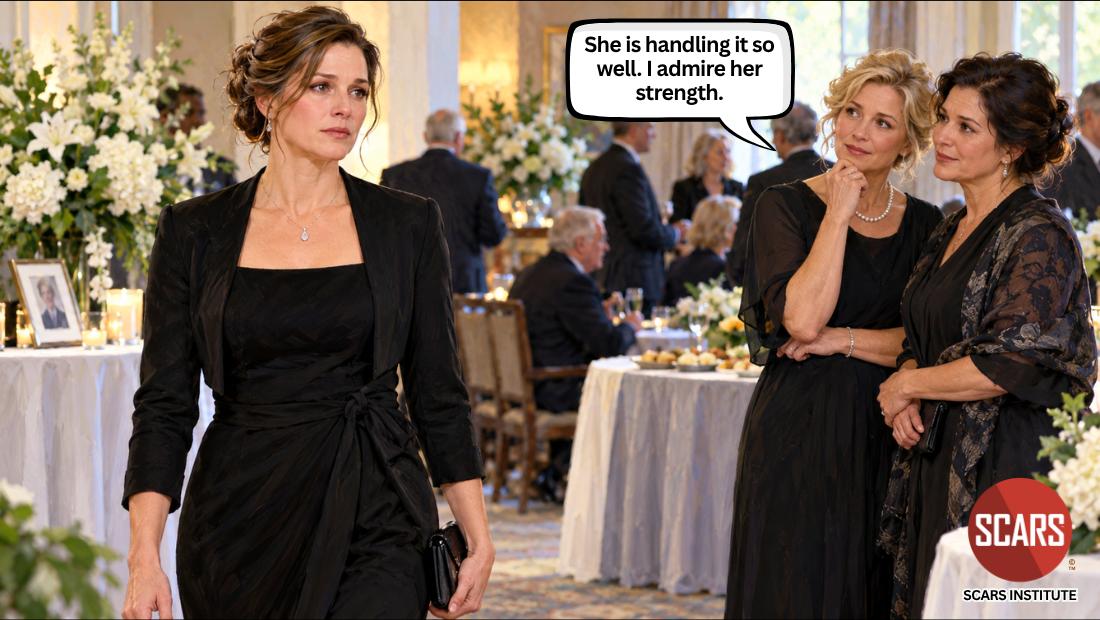
In the quiet aftermath of tragedy, a peculiar phenomenon unfolds among those who have walked similar paths of loss and trauma. A survivor maintains composure, answers messages, attends appointments, and cares for others with remarkable steadiness. Other survivors, who know intimately the chaos that simmers beneath such composure, offer admiration: “You are so strong,” they say. “You’re handling this so well.” These words, intended as support, become perhaps the most insidious form of invalidation; not because they come from those who don’t understand trauma, but precisely because they come from those who do.
The Shared Language of False Strength
When trauma survivors praise the apparent strength of others who are masking their pain, they participate in a collective denial that serves multiple psychological functions. First, they reinforce their own coping mechanisms. If someone who appears composed is truly “strong,” then their own moments of composure feel meaningful rather than fraudulent. This shared validation creates a fragile sense of normalcy in abnormal circumstances.
Second, they perpetuate what trauma therapist Bessel van der Kolk calls “the compulsion to repeat the trauma.” Just as trauma survivors may unconsciously recreate patterns of their traumatic experiences, they may also recreate patterns of emotional suppression that helped them survive initially but now impede healing. When they praise others for similar suppression, they are essentially saying, “Your survival strategy matches mine; therefore we are both okay.”
This phenomenon becomes particularly pronounced in support groups or communities of survivors. The person who appears least affected becomes an example for everyone else, while those who struggle visibly risk being treated as less determined. A support community then begins rewarding presentation rather than honesty. Members learn which feelings receive approval and which feelings should remain private. A peer does not need to openly criticize grief to discourage it; repeatedly changing the subject, offering immediate positive interpretations, or praising someone only when they sound optimistic can communicate the same expectation.
Understand that when we say “you are stronger than you know,” we do not mean you are strong by not showing your trauma. The opposite: strength is the ability to let your pain show.
The Societal Stereotype of Strength
Our cultural narratives about strength are deeply embedded in our collective consciousness. The stoic hero who endures without complaint, the widow who maintains composure for her children, the victim who testifies with unwavering resolve, these archetypes resonate because they appear to transcend human vulnerability. They represent not just strength but transcendence of human limitation.
When trauma survivors praise this performance in others, they are often echoing societal messages that have been internalized since childhood. Messages like “crying is for babies,” “big girls don’t cry,” or “real men don’t show emotion” become particularly toxic in the context of trauma. The survivor who appears composed is seen as having transcended the limitations of ordinary human response to extraordinary circumstances.
What we fail to recognize is that this transcendence is often achieved at tremendous cost. The person maintaining composure may be displacing sleep, relationships, nourishment, or treatment. The same outward activity can serve different purposes and carry different costs. Work can provide structure, contact, and a sense of competence. Working constantly to avoid memories or feelings becomes harmful when it displaces essential needs.
The Necessary Collapse
Trauma and grief fundamentally shatter our assumptions about the world, ourselves, and our place in it. They create what psychologist Ronnie Janoff-Bulman calls “the shattering of basic assumptions,” the belief that the world is benevolent, meaningful, and that we ourselves are worthy. To integrate these shattering experiences requires a period of deconstruction and reconstruction that often looks like what observers might call “falling apart.”
This “falling apart” is not weakness; it is the psyche’s natural process of making space for a reality too large to be contained within previous frameworks. It is the necessary surrender that precedes integration. When we praise strength that prevents this process, we are essentially asking someone to build a new structure without first clearing the rubble of the old one.
The essential change is permission to recognize what happened and respond to its effects. That change can begin quietly, through an honest conversation, a reduced workload, a request for assistance, or an appointment with a qualified professional. Healing does not need a dramatic scene to become legitimate. But it does need permission to happen.
The Trauma of Praise
What we often fail to recognize is how praise itself can become traumatic when it rewards concealment. Calling someone strong can become a way of prescribing how they should behave. The admired person is expected to remain composed, make decisions, support relatives, and continue functioning. If they later express fear, anger, exhaustion, or a need for assistance, those responses appear to contradict the identity others have assigned.
That contradiction creates an additional source of shame. The person is already struggling with loss and now worries about losing respect. Instead of saying that they cannot manage another task, they agree. Instead of admitting that the night was difficult, they reassure everyone that they are fine. Approval becomes attached to how successfully they conceal their needs.
This is a form of harm inflicted through a relationship. It does not require cruelty or deliberate intent. A friend or fellow survivor can sincerely believe that admiration is encouraging while repeatedly communicating that vulnerability is unwelcome. The effect deserves attention even when the words were meant kindly.
The Hierarchy of Suffering
Among trauma survivors, a subtle hierarchy often emerges where those who appear less affected become elevated above those who struggle visibly. Statements such as “I went through the same thing and kept going” turn one person’s experience into a standard for someone else. The comparison overlooks differences in circumstances, resources, health, relationships, and the meaning of the loss.
This hierarchy serves a protective function for those at the top. If their way of coping is superior, then their suffering is somehow more noble, more meaningful. But it also creates a terrible isolation. The person at the top of the hierarchy is trapped by their own performance, unable to descend without losing status. Those at the bottom are doubly invalidated, first by their trauma, then by their inadequate response to it.
Creating Space for Real Strength
True strength after trauma includes the ability to respond to reality. It includes knowing when an approach is no longer helping, allowing others to assist, and learning ways to manage distress without sacrificing essential needs. Nobody needs to prove recovery by remaining untouched, and nobody needs to prove injury by collapsing.
- What would it look like if we created different spaces for trauma survivors?
- Spaces where vulnerability is not just tolerated but celebrated as the necessary foundation for healing?
- Where the person who says “I can’t” is seen as having taken a step forward rather than backward?
Supportive relationships would leave room for more than one emotional response. They would recognize effort without making endurance a condition of respect. “You have been carrying a great deal” acknowledges the burden. “What would help right now?” creates space for a need that composure might conceal. Survivors also need relationships in which they remain valued when their capacity changes. A person who was organized yesterday may need assistance today. Someone who spoke calmly about the event may later feel overwhelmed. Neither change cancels their dignity or means that earlier coping was fraudulent.
The Language of Validation
Changing our patterns of praise requires conscious attention to language. Instead of “You’re so strong for handling this so well,” we might say, “I’m here with you through this, whatever it looks like.” Instead of “I admire your composure,” we might say, “Your feelings are valid and welcome here.”
When we see someone maintaining composure after trauma, we might gently inquire about the cost of that composure: “How are you really doing with all this?” or “What are you doing to take care of yourself through this?” These questions acknowledge the effort without reinforcing the performance.
The Collective Responsibility
The burden of change should not rest solely on individual survivors. Our communities, institutions, and media representations all contribute to the cultural narrative that equates strength with suppression. When news outlets highlight victims who “spoke eloquently” or “remained composed” as examples of strength, they send a message about how trauma should be performed.
Support communities can consciously shift their culture by celebrating vulnerability as courage. They can create rituals that honor the full spectrum of trauma response, including the messy, uncertain, and nonlinear nature of healing. They can recognize that the person who cries today and laughs tomorrow is not failing at healing but engaging in the complex process of integrating trauma into their life story.
The Freedom in Authenticity
Ultimately, the freedom to respond authentically to trauma is perhaps the most fundamental form of recovery. When survivors no longer need to perform strength for external validation, they can begin to discover what authentic strength looks like for them. For some, this might indeed be periods of composure and functioning. For others, it might be openly expressing distress, seeking support, and adjusting responsibilities.
The goal is not to replace one stereotype of strength with another, but to recognize that strength after trauma includes the ability to respond to reality. It includes knowing when an approach is no longer helping, allowing others to assist, and learning ways to manage distress without sacrificing essential needs.
A New Narrative of Resilience
What if we told a different story about trauma? One where the person who falls apart is not broken but breaking open to make space for a new reality? Where the person who asks for help is not weak but wise? Where the person who cannot function today is not failing but conserving limited resources for the journey ahead?
This new narrative would recognize that trauma fundamentally changes us, and that pretending otherwise only prolongs the suffering. It would honor the full range of human response to extraordinary circumstances, recognizing that there is no one right way to survive.
The most meaningful support we can offer fellow trauma survivors is not admiration for their composure but companionship through their pain. Not praise for their strength but presence in their vulnerability. Not validation for their performance but acceptance of their authentic experience, whatever that looks like on any given day.
In the end, perhaps the greatest strength we can offer each other is accepting them as they are, not praising how we would like them to be.
PART 2: The Mirror of Praise
Projecting Our Desired Strength onto Others
When we witness a fellow trauma survivor maintaining composure, functioning efficiently, and appearing unaffected by their ordeal, our praise often contains a hidden reflection of ourselves. In admiring their “strength,” we are frequently projecting our own deepest desires, not just to be strong, but to be seen as strong by others. This projection is a complex psychological mechanism that reveals as much about our own struggles as it does about the person we’re praising.
The Projection of Aspired Invulnerability
At its core, this projection stems from a profound discomfort with our own vulnerability. Trauma shatters our sense of safety and control, leaving us feeling exposed and fragile. When we see someone who appears to have navigated the same experience without visible cracks, we project onto them the invulnerability we desperately crave. Their composure becomes a canvas onto which we paint our idealized self; the self who could have endured without breaking, without showing the world our pain.
This projection is particularly potent among those who have themselves been traumatized because we understand the magnitude of what the composed survivor is supposedly managing. Our praise carries the weight of knowing just how difficult their journey must be, making their apparent ease seem all the more remarkable. In elevating their performance, we are simultaneously creating a standard against which we measure our own perceived shortcomings.
The Currency of Social Validation
Praise becomes a form of social currency in trauma communities. When we commend someone for their strength, we are often implicitly acknowledging the value of being perceived as strong. This creates a feedback loop where we begin to associate external validation with internal worth. The person who appears to be handling trauma well receives admiration and respect, which becomes a form of emotional compensation for their suffering.
For those of us offering praise, we are often expressing what we secretly hope to receive. We see how the community responds to the composed survivor and wish for that same validation. We may find ourselves subtly performing our own strength in moments when others are watching, hoping to earn the same admiration. This creates a culture where authentic expression becomes secondary to the performance of resilience.
The Secret Competition Among Survivors
Trauma creates an unspoken competition that few will acknowledge, but many feel. When we praise another’s strength, we may be simultaneously measuring ourselves against them. “She’s handling this so well,” might translate internally to, “She’s handling this better than I am.” This comparison can trigger shame about our own struggles and a desperate desire to measure up.
This competition is particularly insidious because it masquerades as support. We genuinely believe we are encouraging others when we praise their composure, but underneath lies a complex web of comparison and self-evaluation. The person we praise becomes an unwitting participant in our internal struggle with self-worth.
The Desire to Escape the Burden of Visible Pain
Those of us who have been visibly affected by trauma know the heavy burden of that visibility. The well-intentioned but exhausting concern from others, the constant need to explain our emotional state, the feeling of being defined by our trauma; all of these create a longing to escape the notice that comes with visible suffering.
When we praise someone who appears to have avoided these burdens, we are expressing our desire to be free from them ourselves. Their invisibility becomes a form of privilege we wish we possessed. We may find ourselves thinking, “If only I could handle this as well as they do, people wouldn’t worry about me, and I could just heal in peace.”
The Reinforcement of Our Own Coping Mechanisms
Many trauma survivors develop coping mechanisms that involve minimizing or suppressing their pain. These strategies often helped us survive initially but may now impede our healing. When we praise others who appear to be using similar strategies, we are reinforcing the validity of our own approach.
This reinforcement serves a protective function. If someone else’s suppression is praised as strength, then our own suppression feels justified rather than problematic. We can continue to avoid the difficult work of confronting our pain because we’ve seen it modeled as admirable by others. This creates a collective avoidance that masquerades as mutual support.
The Longing for a Simpler Narrative
Trauma creates messy, complicated narratives that don’t fit neatly into our cultural stories of heroism and resilience. We struggle to integrate these complex experiences into our sense of self. When we see someone who appears to have a simpler narrative, one of strength and overcoming, we project our desire for that same simplicity.
Their apparent strength offers a template for a more palatable story about trauma, one where the protagonist endures and emerges stronger, without the messy middle part of falling apart. We wish our own story could be so clean, so inspiring to others. In praising their strength, we are momentarily escaping the complexity of our own experience.
Breaking the Projection Cycle
Recognizing this projection is the first step toward breaking the cycle. When we feel the impulse to praise someone’s apparent strength, we can pause and ask ourselves: What am I really seeing here? What am I projecting? What does this praise say about my own desires and fears?
This self-awareness allows us to offer more authentic support. Instead of projecting our desired strength onto others, we can acknowledge their reality and our own. We might say, “I see you’re holding things together. I know how exhausting that can be. How are you really doing with all this?” This creates space for honesty rather than performance.
Embracing Our Own Vulnerability
Ultimately, breaking free from this projection requires us to embrace our own vulnerability as strength rather than weakness. When we can accept that our authentic response to trauma—including our pain, confusion, and moments of collapse is valid and necessary, we no longer need to project an idealized strength onto others.
This self-acceptance transforms how we view others’ responses to trauma. We begin to see that true strength lies not in composure but in authenticity. We recognize that the person who falls apart is not failing at healing but engaging in the difficult work of integration. We can then offer support that celebrates this authentic strength rather than performance.
The mirror of praise reflects our deepest desires and fears. By examining what we see in that reflection, we can move toward a more authentic form of support, both for others and for ourselves.
PART 3: TRUE STRENGTH
True strength following trauma is never being afraid to show your suffering. It is found in the courageous willingness to display the uncomfortable pain and vulnerability that you feel, even if it makes others uncomfortable. This is true honesty, the kind that doesn’t pretend or perform or hide behind masks of composure. If there is strength to be found in the aftermath of trauma, it is precisely this: the unflinching acknowledgment of your own experience, whatever form it takes. This authenticity becomes the foundation upon which genuine healing is built, not despite the vulnerability it requires, but because of it.
Remember that trauma and grief are not what you want them to be. They simply are what they are.
You can hide the monster or hide from it; you can let it devour you, or you can make friends with the monster.
Never be afraid to sit with your monster.
And for those who praise strength, instead sit with the person and let them know it is ok not to be ok.
Excellentia Per Scientia.™
Prof. Emeritus Tim McGuinness, Ph.D. DFin.
SCARS Institute ™
Society of Citizens Against Relationship Scams Inc.
Scientific Center for the Analysis and Research into Scams™
September 2026