



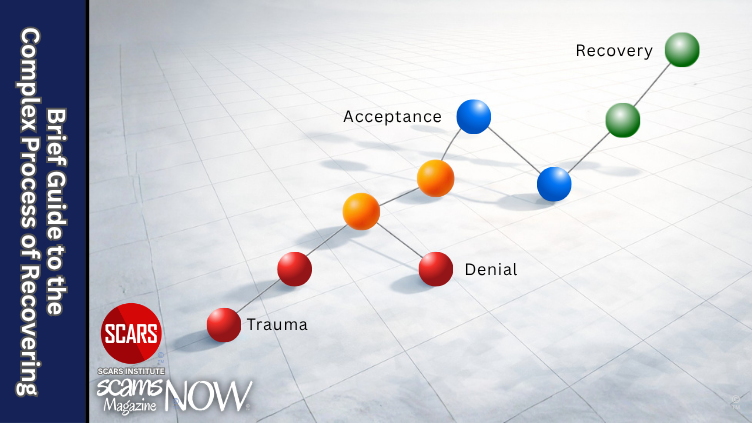
A SCARS Institute Brief Guide to the Complex Process of Recovering from Relationship Scam Betrayal Trauma

The SCARS Institute Magazine about Scam Victims-Survivors, Scams, Fraud & Cybercrime
- Published: 4/18/26
- Modified: 5/18/26
- Comments: 3
- Read Status:


A SCARS Institute Brief Guide to the Complex Process of Recovering from Relationship Scam Betrayal Trauma
A Brief Guide for New Scam Victims – How To Begin the Complex Process of Recovering from Betrayal Trauma
Primary Category: Scam Victim Recovery Psychology / Recoverology
Authors:
• Vianey Gonzalez B.Sc(Psych) – Licensed Psychologist, Specialty in Crime Victim Trauma Therapy, Neuropsychologist, Certified Deception Professional, SCARS Institute Advisor & Psychology Advisory Panel
• Tim McGuinness, Ph.D., DFin, MCPO, MAnth – Anthropologist, Scientist, Polymath, Managing Director of the Society of Citizens Against Relationship Scams Inc.
Author Biographies Below
About This Article
Recovery from relationship scam victimization involves a structured progression from acute trauma to long-term stability, addressing neurological, emotional, and behavioral disruption. Immediate actions focus on stopping contact, securing the environment, and stabilizing the nervous system. Subsequent steps emphasize understanding the biological manipulation involved, engaging trauma-informed counseling, and participating in professionally managed support systems. Reporting the crime and rebuilding personal agency reinforce identity as a survivor rather than a target. Over time, the process shifts toward developing self-compassion, reconstructing trust, and integrating the experience into a stable personal narrative. The end state is not the removal of memory, but the reduction of its emotional and physiological impact, allowing functional recovery and sustained resilience.
A Brief Guide for New Scam Victims – How To Begin the Complex Process of Recovering from Betrayal Trauma
Recovering from relationship scam betrayal trauma is a complex process that involves repairing neurological, emotional, and financial damage. According to the SCARS Institute and the research of Dr. Tim McGuinness and Lic. Vianey Gonzalez, the goal is to move from a state of “bleeding wound” to a “scar,” a reminder of something you survived that no longer actively hurts.
10 Essential Steps to Help You Navigate the Path to Recovery
Here are the 10 essential steps to help yourself navigate the path to recovery:
1. Stop All Contact Immediately
The most critical first step is “Going Dark.” You must block the scammer on all platforms without a “parting shot” or an explanation. Any further engagement allows the scammer to re-groom you or use your emotional vulnerability to initiate a “recovery scam.”
2. Acknowledge the “Biological Hijack”
Understand that your “hysteria” or inability to see the signs was not a lack of intelligence, but a physiological event. Scammers use techniques that trigger an amygdala hijack, shutting down your prefrontal cortex (logic center). Accepting that you were neurologically manipulated helps reduce the weight of self-blame.
3. Seek Specialized Trauma Counseling
General therapy may not be enough. Look for a professional who understands betrayal trauma and cybercrime victimology. Organizations like SCARS recommend trauma-informed care to help pull your nervous system back into the “Window of Tolerance.”
4. Practice “Zero-Tasking” for Mental Reset
Trauma creates a state of hyper-arousal where your brain feels “scattered.” Practice doing exactly one thing at a time, even something as simple as washing a dish or focusing on your breathing. This helps stabilize your nervous system and stops the “mental time travel” back to the scam.
5. Report the Crime (When Ready)
Reporting to authorities (like the FBI’s IC3 in the U.S.) is an act of reclaiming power. While financial recovery is rare, reporting helps break the silence and contributes to a collective effort to stop these criminal enterprises. However, please note that you must report the crime to protect yourself – it does not matter if it is possible to arrest the criminals, but like it or not, you were involved in sending money to crimes, and that money could also wind up in the hands of terrorists.
6. Join a Professionally Managed Support Group
Isolation is a scammer’s greatest tool. Joining a group of fellow survivors provides “intersubjective” healing, realizing that your experience is shared. However, ensure the group is professionally managed to avoid “re-scammers” who infiltrate unmoderated forums. To join the SCARS Institute Scam Survivors’ Community, visit www.SCARScommunity.org
7. Conduct a “Digital Sanitation”
Secure your life to reduce anxiety. Change your passwords, update your privacy settings, and consider changing your phone number if necessary. Creating a “digital fortress” helps restore the sense of spatial safety in your home that the scammer violated.
8. Prioritize “Self-Compassion” Over “Self-Correcting”
Victims often spend months asking: “How could I be so stupid?” Replace this narrative with the fact that you acted out of goodness and empathy, traits that are inherently valuable. The scammer’s cruelty is not a reflection of your character. Remember, it was not your fault.
9. Educate Yourself on the “Victimology Paradigm”
Learn the mechanics of how you were groomed. Understanding the “science of the scam” turns a confusing, emotional nightmare into a structured, understandable event. Knowledge is the primary tool for rebuilding your internal “I can do it” agency.
10. Set Realistic Expectations for Trust
Do not expect to “trust your gut” again immediately, maybe not for a long while. Trust is a skill that must be rebuilt slowly. Start by trusting yourself with small decisions, and move toward trusting others in low-stakes environments. Rebuilding your “trust architecture” takes time and deliberate effort.
Review
Recovery is not about forgetting; it is about reaching a point where the memory no longer triggers a physical trauma response. By following these steps, you transition from being a “target” to becoming a Survivor.
How to Get There From Here
That tells you what you must do, but how do you get there from where you are?
The journey from an open “bleeding” emotional wound to a “scar” is a psychological transition from acute trauma to integrated stability and wisdom. In the context of relationship scams, a wound is a state where the trauma still controls your physiology, nervous system, and psychology, causing flashbacks, panic, and shame. A scar, however, is a permanent mark of what you survived; it is closed, no longer bleeding, and serves as a testament to your resilience. However, you need to understand that this is not fast. In fact, it is a multi-year journey.
The following list is a step-by-step progression designed to move a person through this healing architecture.
1. Close the Wound (Immediate Stabilization)
The very first priority is to stop the damage. This is a purely protective phase. You must immediately terminate all communication with the perpetrators. This is not about being rude; it is about medical-grade emotional safety. Block every channel and resist the urge to get “closure,” as scammers use closure as a hook for re-engagement.
2. Decontaminate the Environment
Trauma often leaves a victim feeling that their own home is no longer safe. Perform a “digital sanitation.” Change passwords, update bank security, and remove any physical or digital reminders of the scammer from your immediate view. By cleaning your “spatial” world, you begin to lower the constant state of hyper-arousal in your nervous system.
3. Diagnose the Hijack
Educate yourself on the neurology of the scam. You must accept that your brain was essentially drugged by a cycle of dopamine (the high of the romance) and cortisol (the stress of the “emergencies”). Recognizing that your “blindness” to the scam was a biological byproduct of the perpetrator’s manipulation, not a lack of intelligence, is the first step in stopping the “internal bleeding” of self-shame.
4. Enter the “Zero-Tasking” Recovery Zone
Trauma shatters the ability to focus. For a period of time, stop trying to fix your whole life at once. Commit to “zero-tasking” or single-tasking. Focus on basic biological needs: sleep, hydration, and movement. By narrowing your focus to the immediate present, you prevent the brain from “time-traveling” back to the trauma or forward into a catastrophic future.
5. Reconstruct the Narrative with a Professional
This is where the deep stitching happens. Work with a trauma-informed counselor or therapist to process the betrayal trauma; the SCARS Institute can provide free therapy to its community members. Understand this is different from standard grief; it is the specific pain of having your empathy weaponized against you. A professional helps you organize the “shattered glass” of the experience into a coherent story so that it no longer feels like a chaotic, ongoing nightmare.
6. Seek Intersubjective Validation
Isolation is where the wound festers. Find a professionally managed, secure support group or community. Hearing others describe the exact same “unoriginal” tactics used against them provides intersubjective proof that you were targeted by a system, not a personal flaw. This collective sharing helps “dry out” the shame. You can join the free, safe, and confidential SCARS Institute Scam Survivors’ Community at www.SCARScommunity.org
7. Reclaim Your Agency Through Reporting
When you feel stable enough, file a formal report with agencies like the FBI’s IC3 or your local equivalent. Do this without the expectation of getting money back. Do it as a way to say, “I am no longer a victim; I am a survivor and a witness.” This shifts your identity from a passive recipient of harm to an active participant in justice. It also declares your innocence should something come up in the future.
8. Cultivate Radical Self-Compassion
The “scarring” process requires you to stop picking at the wound with self-criticism (shame, blame, and guilt). Practice radical self-compassion. Remind yourself daily that it was not your fault, and you were targeted because you are a person of value, someone with the capacity to love, trust, and help. The scammer’s actions are a reflection of their criminality and intention, not your worth. You are worthy – axios!
9. Build a “Trust Architecture”
A scar is tougher than original skin, but it is less flexible. As you heal, you will find that your “natural attitude” of trust has changed. This is okay. Start building a new, more rigorous “trust architecture.” This involves slowing down new relationships, verifying information, and listening to your body’s physical signals of discomfort.
10. Integrity: The Final Scar
The final step is reaching a state of integration. You know you have reached the “scar” stage when you can tell your story, or even just think about it, without your heart racing or your stomach turning – that is total acceptance. The event is now a part of your history, but it is no longer your identity. It is no longer a wound, it is a scar. You are now a survivor with a hard-earned, protective layer of wisdom.
Conclusion
Recovery from a relationship scam is not a single decision or a moment of insight. It is a structured process that unfolds over time, requiring deliberate action, repetition, and patience. Each step described reflects a necessary shift from instability toward control, from confusion toward understanding, and from isolation toward connection. Progress begins with stopping the source of harm, but it continues through education, emotional regulation, and the rebuilding of personal agency.
A clear pattern emerges across all stages of recovery. Stabilization must come first, followed by understanding, then connection, and finally integration. Skipping steps often leads to setbacks, while consistent engagement supports gradual improvement. The movement from an open wound to a stable scar represents more than emotional healing. It reflects neurological regulation, restored thinking, and the reestablishment of personal identity that is no longer defined by the crime.
This process does not erase what happened. Instead, it changes the relationship to the experience. The memory remains, but its power over the nervous system and daily functioning is reduced. Over time, what once triggered distress becomes manageable, and eventually neutral. Recovery is measured not by forgetting, but by the ability to live without being controlled by the past. With structure, support, and continued effort, stability becomes sustainable, and a new sense of grounded resilience begins to take hold.

Glossary
- Acceptance of Manipulation — Acceptance of manipulation is the recognition that one’s actions during the scam were influenced by external control rather than personal failure. This understanding reduces shame. It supports cognitive clarity. It is a critical step in recovery.
- Agency Reclamation — Agency reclamation refers to the process through which a scam victim begins to regain a sense of control over decisions, actions, and identity after exploitation. It involves moving from passivity and confusion toward deliberate, informed choices. This process often includes reporting the crime, setting boundaries, and re-engaging with structured recovery actions. Over time, it helps restore confidence and reduces feelings of helplessness.
- Amygdala Hijack — Amygdala hijack describes a neurological response in which emotional processing overwhelms logical thinking. In scam contexts, perpetrators deliberately trigger emotional intensity to bypass rational judgment. This leads to impulsive decisions that feel urgent and justified in the moment. Understanding this mechanism helps reduce self-blame and reframes the experience as a biological response rather than a personal failure.
- Biological Hijack — Biological hijack refers to the manipulation of the brain’s chemical and emotional systems by scammers to influence behavior. This process involves cycles of emotional reward and stress that impair judgment and reinforce compliance. Victims often experience confusion, attachment, and urgency as a result. Recognizing this helps individuals understand that their reactions were shaped by neurochemical processes rather than a lack of intelligence.
- Bleeding Emotional Wound — A bleeding emotional wound represents an active state of trauma where emotional pain is intense and ongoing. In this state, the nervous system remains dysregulated, and symptoms such as panic, shame, and intrusive thoughts are common. The individual may feel overwhelmed and unable to stabilize. This stage requires immediate protective actions to prevent further harm.
- Catastrophic Future Projection — Catastrophic future projection refers to the tendency to imagine worst-case outcomes repeatedly. This pattern increases anxiety and reinforces helplessness. It often emerges after trauma. Addressing it helps restore balanced thinking.
- Closure Seeking Trap — Closure seeking trap refers to the tendency of victims to re-engage with scammers in an attempt to gain understanding or emotional resolution. Scammers exploit this need by offering false explanations or continued manipulation. This behavior often prolongs harm and delays recovery. Avoiding this trap is essential for maintaining emotional safety.
- Coherent Experience Structuring — Coherent experience structuring refers to organizing fragmented memories and emotions into a clear and understandable narrative. This reduces confusion and distress. It is often facilitated by professional support. It supports psychological integration.
- Cybercrime Victimology — Cybercrime victimology is the study of how individuals are targeted, manipulated, and affected by online crimes. It focuses on patterns of grooming, psychological tactics, and victim responses. This field provides structured explanations that replace confusion with understanding. Learning these principles helps victims contextualize their experience within broader criminal systems.
- Decontamination of Environment — Decontamination of the environment refers to the process of removing digital and physical elements associated with the scam. This includes changing passwords, securing accounts, and eliminating reminders of the perpetrator. These actions help reduce anxiety and restore a sense of safety. Environmental control supports nervous system stabilization.
- Digital Fortress — Digital fortress describes a secure personal digital environment created to protect against further intrusion or exploitation. It involves strong passwords, privacy controls, and communication boundaries. Establishing this structure reduces vulnerability and supports recovery. It also reinforces a sense of personal control over one’s digital life.
- Digital Sanitation — Digital sanitation is the systematic process of securing all digital accounts and communication channels after a scam. It includes updating credentials, reviewing permissions, and removing unauthorized access. This step reduces ongoing risk and helps rebuild a sense of safety. It is a foundational action in early recovery.
- Dopamine-Cortisol Cycle — Dopamine-cortisol cycle refers to the alternating pattern of emotional highs and stress used by scammers to control victims. Dopamine reinforces attachment and excitement, while cortisol increases urgency and fear. This cycle creates dependency and confusion. Understanding it helps explain why victims remained engaged despite warning signs.
- Emotional Regulation Stabilization — Emotional regulation stabilization refers to the process of bringing emotional responses back within manageable limits. This involves techniques that reduce intensity and increase control. It is essential for recovery progression. Stable regulation supports clearer thinking and decision-making.
- Emotional Safety — Emotional safety refers to the condition in which an individual is free from ongoing psychological harm or manipulation. In recovery, this means eliminating contact with the scammer and reducing triggers. Establishing emotional safety allows the nervous system to begin stabilizing. It is a prerequisite for deeper healing work.
- Empathy Weaponization — Empathy weaponization occurs when a scammer exploits a victim’s natural capacity for care and compassion. This manipulation turns positive human traits into tools for control. Victims may feel responsible for helping or rescuing the perpetrator. Recognizing this dynamic helps reframe empathy as a strength rather than a weakness.
- Going Dark — Going dark refers to the complete and immediate cessation of all communication with the scammer. This includes blocking all known channels and refusing further engagement. It is a critical protective measure that prevents re-grooming. This action supports both safety and the beginning of emotional separation.
- Healing Architecture — Healing architecture describes the structured sequence of steps required to move from trauma toward recovery. It emphasizes order, progression, and deliberate action. Each stage builds on the previous one to support stability and integration. This framework helps prevent confusion and reduces the risk of setbacks.
- Hyper-Arousal State — Hyper-arousal state is a condition in which the nervous system remains in a heightened state of alertness and stress. Symptoms may include anxiety, racing thoughts, and difficulty relaxing. This state often follows trauma and prolongs emotional distress. Stabilization techniques are necessary to reduce this activation.
- Identity Integration — Identity integration refers to the process of incorporating the traumatic experience into one’s broader sense of self without allowing it to dominate identity. This stage represents advanced recovery. The individual recognizes the experience as part of their history but not their defining feature. It supports long-term stability and resilience.
- Immediate Stabilization — Immediate stabilization refers to the first phase of recovery focused on stopping harm and restoring basic safety. It includes ending contact, securing the environment, and addressing urgent emotional distress. This phase prioritizes protection over deeper processing. Stabilization creates the foundation for all subsequent recovery work.
- Intersubjective Validation — Intersubjective validation occurs when individuals share experiences and recognize common patterns of victimization. This process reduces isolation and reinforces that the experience is not unique or a personal failure. It provides emotional relief and clarity. Group support environments often facilitate this validation.
- Internal Bleeding of Self-Shame — Internal bleeding of self-shame refers to the ongoing psychological damage caused by persistent self-blame and negative self-perception. This condition can prolong suffering and delay recovery. It often results from misunderstanding the manipulation involved in the scam. Addressing this requires education and self-compassion.
- Justice Participation — Justice participation refers to the act of reporting the crime and contributing to legal or investigative processes. This step helps shift identity toward active engagement. It supports accountability and broader prevention efforts. It reinforces personal agency.
- Logical Shutdown — Logical shutdown describes the temporary impairment of rational thinking during emotional overwhelm. In scam situations, this occurs when intense emotions override cognitive processing. Victims may act against their usual judgment. Recognizing this helps explain behavior during the scam.
- Mental Time Travel — Mental time travel refers to the tendency of the mind to repeatedly revisit past traumatic events or anticipate future negative outcomes. This pattern sustains anxiety and prevents present-focused functioning. It is common in trauma states. Grounding techniques help reduce this cycle.
- Multi-Year Recovery Process — Multi-year recovery process describes the extended timeframe often required to fully recover from scam-related trauma. Healing involves gradual changes in emotional regulation, cognition, and identity. Progress may occur unevenly over time. Recognizing this timeline helps set realistic expectations.
- Narrative Reconstruction — Narrative reconstruction is the process of organizing and understanding the traumatic experience into a coherent story. This is often done with professional guidance. It transforms chaotic memories into structured understanding. This process reduces distress and supports integration.
- Neurological Manipulation — Neurological manipulation refers to the deliberate use of psychological and emotional tactics to influence brain function and behavior. Scammers exploit this by triggering specific emotional responses. This affects decision-making and perception. Understanding this reduces self-blame and increases awareness.
- Physiological Event — Physiological event describes the body-based processes that occur during manipulation and trauma. These include hormonal changes and nervous system activation. Such responses can impair thinking and increase emotional intensity. Recognizing this helps explain reactions during the scam.
- Prefrontal Cortex Shutdown — Prefrontal cortex shutdown refers to the reduced activity of the brain’s logical and decision-making center during emotional overwhelm. This impairs reasoning and judgment. In scam situations, this contributes to compliance and trust. Understanding this helps reframe behavior as neurologically influenced.
- Professional Support Environment — A professional support environment is a structured and moderated group setting designed to provide safe and informed assistance. These environments reduce the risk of further exploitation. They offer guidance, validation, and accountability. Participation supports recovery and reduces isolation.
- Protective Boundary Formation — Protective boundary formation refers to the establishment of clear limits to prevent further harm. This includes blocking communication and controlling access. These boundaries support safety and recovery. They must be consistently maintained.
- Recovery Scam — Recovery scam refers to a secondary fraud targeting victims who have already been scammed. Perpetrators pose as helpers offering to recover lost funds. This exploits ongoing vulnerability and hope. Awareness of this risk is critical for prevention.
- Re-Grooming — Re-grooming is the process by which a scammer attempts to re-establish emotional control after initial contact has been broken. This often involves renewed manipulation or promises. It can occur if communication resumes. Preventing re-grooming requires strict no-contact boundaries.
- Resilience Marker — Resilience marker refers to the symbolic representation of survival and recovery after trauma. In this context, it is the transition from wound to scar. It signifies strength and endurance. This concept supports positive identity reconstruction.
- Self-Compassion Practice — Self-compassion practice involves treating oneself with understanding and kindness rather than criticism. This approach reduces shame and supports emotional healing. It helps counteract negative internal narratives. Regular practice strengthens recovery.
- Self-Correcting Behavior — Self-correcting behavior refers to the tendency to analyze and criticize one’s actions excessively after the scam. This often leads to increased shame and distress. It does not contribute to recovery. Replacing this with self-compassion is more effective.
- Single-Tasking Focus — Single-tasking focus is the practice of concentrating on one task at a time to reduce cognitive overload. This technique helps stabilize attention and reduce anxiety. It is particularly useful in early recovery. It supports nervous system regulation.
- Spatial Safety Restoration — Spatial safety restoration refers to re-establishing a sense of safety within one’s physical and digital environment. This involves removing threats and creating secure spaces. It reduces hyper-arousal and anxiety. This step supports emotional stabilization.
- Stability Progression — Stability progression describes the gradual improvement in emotional, cognitive, and behavioral functioning over time. It reflects successful engagement in recovery steps. Progress may be uneven but cumulative. It leads toward long-term integration.
- Survivor Identity Shift — Survivor identity shift is the transition from viewing oneself as a victim to recognizing oneself as a survivor. This involves reclaiming agency and reframing the experience. It supports empowerment and recovery. This shift develops over time.
- Trauma-Induced Scattered Thinking — Trauma-induced scattered thinking (also called scam fog or brain fog) refers to difficulty concentrating and organizing thoughts following emotional shock. This condition disrupts daily functioning. It reflects nervous system dysregulation. Structured practices help restore focus.
- Trust Architecture — Trust architecture refers to the deliberate rebuilding of trust through structured and cautious interactions. It involves setting boundaries and verifying information. This process replaces instinctive trust with informed judgment. It develops gradually during recovery.
- Victimology Paradigm — Victimology paradigm is the framework used to understand how victims are targeted and affected by crime. It provides structured explanations for experiences that may feel confusing. This knowledge supports clarity and reduces self-blame. It is a key component of recovery education.
- Window of Tolerance — The window of tolerance describes the optimal range of emotional and physiological arousal where a person can function effectively. Trauma often pushes individuals outside this range. Recovery work aims to restore this balance. Maintaining this state supports stability.
- Zero-Tasking — Zero-tasking is the intentional reduction of activity to focus on basic needs and single tasks. This approach helps calm the nervous system. It prevents overwhelm and supports stabilization. It is particularly useful in early recovery stages.
Author Biographies
Author Biography
Prof. (Emeritus) Tim McGuinness, Ph.D. DFin is a co-founder, Managing Director, and Chairman of the SCARS Institute (Society of Citizens Against Relationship Scams Inc.), where he serves as an unsalaried volunteer officer dedicated to supporting scam victims and survivors around the world. With over 34 years of experience in scam education and awareness, he is perhaps the longest-serving advocate in the field.
Dr. McGuinness has an extensive background as a business pioneer, having co-founded several technology-driven enterprises, including the former e-commerce giant TigerDirect.com. Beyond his corporate achievements, he is actively engaged with multiple global think tanks where he helps develop forward-looking policy strategies that address the intersection of technology, ethics, and societal well-being. He is also a computer industry pioneer (he was an Assistant Director of Corporate Research Engineering at Atari Inc. in the early 1980s) and invented core technologies still in use today.
His professional identity spans a wide range of disciplines. He is a scientist, strategic analyst, solution architect, advisor, public speaker, published author, roboticist, Navy veteran, and recognized polymath. He holds numerous certifications, including those in cybersecurity from the United States Department of Defense under DITSCAP & DIACAP, continuous process improvement and engineering and quality assurance, trauma-informed care, grief counseling, crisis intervention, and related disciplines that support his work with crime victims.
Dr. McGuinness was instrumental in developing U.S. regulatory standards for medical data privacy called HIPAA and financial industry cybersecurity called GLBA. His professional contributions include authoring more than 1,000 papers and publications in fields ranging from scam victim psychology and neuroscience to cybercrime prevention and behavioral science.
“I have dedicated my career to advancing and communicating the impact of emerging technologies, with a strong focus on both their transformative potential and the risks they create for individuals, businesses, and society. My background combines global experience in business process innovation, strategic technology development, and operational efficiency across diverse industries.”
“Throughout my work, I have engaged with enterprise leaders, governments, and think tanks to address the intersection of technology, business, and global risk. I have served as an advisor and board member for numerous organizations shaping strategy in digital transformation and responsible innovation at scale.”
“In addition to my corporate and advisory roles, I remain deeply committed to addressing the rising human cost of cybercrime. As a global advocate for victim support and scam awareness, I have helped educate millions of individuals, protect vulnerable populations, and guide international collaborations aimed at reducing online fraud and digital exploitation.”
“With a unique combination of technical insight, business acumen, and humanitarian drive, I continue to focus on solutions that not only fuel innovation but also safeguard the people and communities impacted by today’s evolving digital landscape.”
Dr. McGuinness brings a rare depth of knowledge, compassion, and leadership to scam victim advocacy. His ongoing mission is to help victims not only survive their experiences but transform through recovery, education, and empowerment.
Vianey Gonzalez is a licensed psychologist in Mexico and a survivor of a romance scam that ended eight years ago. Through her recovery and the support she received, she was able to refocus on her future, eventually attending a prestigious university in Mexico City to become a licensed psychologist with a specialization in crime victims and their unique trauma. She was a Board Member and now serves as an Advisor to the SCARS Institute (Society of Citizens Against Relationship Scams Inc.) and holds the position of Chief Psychology Officer. She also manages our Mexican office, providing support to Spanish-speaking victims around the world. Vianey has been instrumental in helping thousands of victims and remains an active contributor to the work we publish on this and other SCARS Institute websites.
La Lic. Vianey Gonzalez es profesional licenciada en psicología en México y sobreviviente de una estafa romántica que terminó hace ocho años. Gracias a su recuperación y al apoyo recibido, pudo reenfocarse en su futuro y, finalmente, cursó sus estudios en una prestigiosa universidad en la Ciudad de México para obtener su licencia como psicóloga con especialización en víctimas de crimen y sus traumas particulares. Actualmente, es miembro de la junta directiva del Instituto SCARS (Sociedad de Ciudadanos Contra las Estafas en las Relaciones) y ocupa el cargo de Directora de Psicología. También dirige nuestra oficina en México, brindando apoyo a víctimas en español en todo el mundo. Vianey ha sido fundamental para ayudar a miles de víctimas y continúa contribuyendo activamente las obras que publicamos en este y otros sitios web del Instituto SCARS.
-/ 30 /-
What do you think about this?
Please share your thoughts in a comment below!
GLOSSARY SEARCH
TOPIC SEARCH
TABLE OF CONTENTS








CATEGORIES
A SCARS Institute Brief Guide to the Complex Process of Recovering from Relationship Scam Betrayal Trauma
Please Leave a Comment
Please Tell Us What You Learned From This?
Commenting Is An Essential Part Of Healing
Read • Think • Write
3 Comments
Leave A Comment Cancel reply
More ScamsNOW.com Articles









The journey is take a long time. Processing all the information provided to us will help. I will try to focus on one thing at a time. It’s nice reminder to know it’s not our fault. They are criminals.
Great short guide for new scam victims. I am trying to follow all of these steps and know it takes time. Though I do have a lot of trouble with the “zero-tasking”. Reading articles like this with regularity will help me understand and realize that this was not my fault.
At eight months post scam reveal, it is helpful to review areas that need reinforcement and also good to read areas that have progressed.