



Scam Victim Recovery Insights
From the SCARS Institute
The Scam Survivor’s Recovery Hero’s Journey
A SCARS Institute Scam Victim Recovery Insight
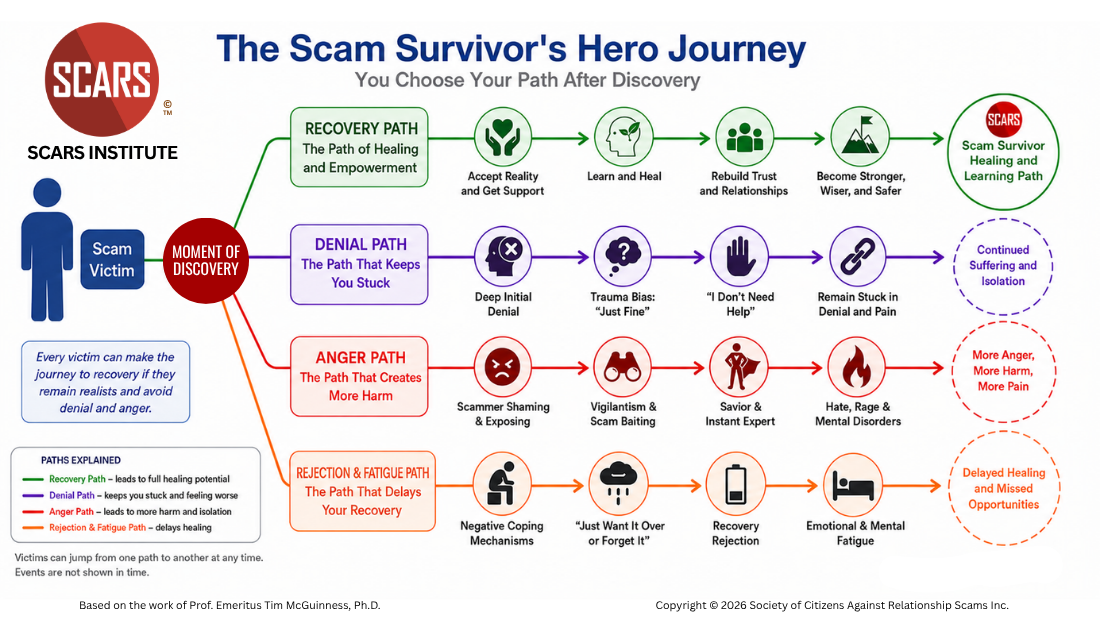
The moment a scam is discovered is not the end of the victimization experience. It is the point at which the victim suddenly has to decide what to do with everything that has happened. The deception may have ended, but the emotional attachment, financial damage, shame, anger, confusion, grief, damaged trust, and disrupted relationships remain. The Scam Survivor’s Hero Journey represents this moment as a crossroads because discovery opens several possible psychological and behavioral paths.
The central idea is that healing and recovery are possible, but it is not automatic.
A victim can move toward healing, become trapped in denial, become consumed by anger, or withdraw from recovery because of exhaustion and emotional overload. These paths are not permanent identities. A person can move between them at different times. The diagram is not showing a fixed timeline, nor is it suggesting that every victim will experience each path. It shows recurring directions that can influence whether a person moves toward greater healing or remains caught in reactions created by the crime.
The Moment of Discovery Changes Everything
Before discovery, a victim is making decisions inside a false reality created by the criminal. The relationship appears genuine. The emergency seems real. The investment appears legitimate. The promises seem possible. The victim’s behavior is shaped by information that has been deliberately manipulated.
Discovery destroys that structure.
The victim now has to reinterpret what happened. Someone believed to be trustworthy becomes a criminal. Conversations remembered as intimate become evidence of manipulation. Financial decisions that seemed reasonable inside the scam can suddenly appear incomprehensible. Future plans disappear. Memories remain, but their meaning changes.
This is why the diagram begins at the Moment of Discovery rather than treating discovery as the conclusion. It is the beginning of another psychological process.
The Recovery Path
The Recovery Path represents the direction most likely to support long-term healing. It begins with accepting reality and receiving appropriate support. Acceptance does not mean approving of what happened or immediately understanding every part of the crime. It means gradually allowing the facts to replace the criminal’s story.
From there, the victim begins learning and healing. Education becomes important because understanding manipulation can reduce the tendency to interpret victimization as evidence of stupidity or personal defect. The victim begins recognizing how trust, attachment, urgency, hope, fear, authority, repetition, and deception were used.
Recovery also requires rebuilding trust and relationships. Scam victimization can damage trust in other people and trust in the self. Family relationships can have been strained by arguments, secrecy, warnings, or financial consequences. Repair takes time and usually requires repeated participation rather than one conversation or one decision.
The end of the Recovery Path is not perfection. The phrase “Scam Survivor Healing and Learning Path” describes a continuing process in which a survivor becomes more knowledgeable, safer, more aware of personal vulnerabilities, and increasingly capable of living without the crime controlling everyday life. The lower-left explanation describes this as the path leading toward full healing potential. That wording matters because healing is not a standardized destination. Different victims can reach different levels of stability, confidence, acceptance, and renewed participation in life.
The Denial Path
The Denial Path represents a different response to discovery. Denial can initially protect a victim from psychological overload. Accepting that a trusted person was fictional, that money is gone, or that months or years of emotional experience were manipulated can be extremely painful. The mind can resist taking in everything at once.
The danger appears when denial stops being temporary protection and becomes a continuing position.
A victim can remain in deep initial denial, minimize the effects of trauma, insist that everything is fine, or decide that help is unnecessary. The person may be functioning well enough to maintain ordinary responsibilities while important emotional and psychological consequences remain unresolved.
The diagram below describes this as a path that keeps the person stuck. It does not mean that a victim experiencing denial is incapable of recovery. It means that denial can delay the work necessary for recovery when it prevents the person from examining what happened, accepting support, learning about manipulation, or acknowledging continuing distress.
The Anger Path
The Anger Path represents another understandable but potentially destructive response.
Anger after victimization is normal. A crime was committed. Trust was exploited. Money may have been stolen. Relationships may have been damaged. The victim has every reason to recognize the injustice of what happened.
The problem develops when anger stops being one emotion among many and becomes the organizing purpose of life after the scam.
Some victims become intensely focused on exposing or humiliating scammers. Others become involved in scam baiting or vigilantism. A person can quickly begin presenting as an expert because personal victimization created an urgent desire to protect others. Some become increasingly hostile toward professionals, organizations, law enforcement, banks, support providers, or anyone who does not respond to the crime in the way the victim expects.
These activities can create the feeling of taking back control. They can also keep attention permanently attached to scammers.
A victim can spend hundreds of hours researching criminals, arguing online, exposing profiles, pursuing revenge, or repeatedly immersing in scam material while believing that this activity represents recovery. The person remains psychologically organized around the crime.
The diagram below warns that unchecked anger can lead toward greater rage, isolation, conflict, and worsening psychological distress. The message is not that anger should be suppressed. Anger needs somewhere constructive to go. It becomes dangerous when it replaces healing.
The Recovery Rejection and Fatigue Path
The Recovery Rejection and Fatigue Path represents something different from denial or anger. Some victims understand what happened and even understand what recovery requires, but become exhausted by the work.
Trauma itself is tiring. Financial problems require attention. Family members have questions. Support communities ask for participation. Therapy can bring painful material into awareness. Educational work requires concentration. Ordinary responsibilities continue at the same time.
Eventually a person can begin thinking, “I just want this over,” or “I don’t want to think about it anymore.”
That reaction is understandable. The danger appears when wanting relief turns into rejection of the recovery process itself.
Negative coping behaviors can increase. Participation declines. Meetings stop. Educational work ends. The person withdraws because recovery feels like another burden rather than the route out of the burden.
Recovery fatigue does not mean that the person has failed. It means that the pace, intensity, expectations, or emotional demands may need adjustment. Rest and disengagement are not the same thing. A person can slow down without abandoning the process.
Victims Can Move Between Paths
One of the most important statements in the diagram appears near the bottom: victims can move from one path to another at any time.
A victim can begin in denial and later accept support. Someone moving well through recovery can experience a period of intense anger. A person consumed with exposing scammers can eventually recognize that the activity is keeping the crime psychologically alive and return attention to personal healing. Someone exhausted by recovery can rest, reconsider priorities, and become involved again.
The diagram below does not describe four types of scam victims. It describes four directions.
That distinction protects the survivor from turning a temporary state into an identity.
The Meaning of the Hero’s Journey
Calling this a Hero’s Journey does not mean that scam victimization was necessary, beneficial, or somehow given to a person so that growth could occur. The crime remains a crime.
The heroic element comes afterward. A survivor is confronted with something that cannot be undone and still has choices about what happens next. The person can learn what happened, seek support, tolerate difficult truths, repair damaged relationships, confront financial reality, rebuild trust carefully, and gradually reclaim parts of life that the criminal disrupted.
There will be movement between paths. There can be setbacks. Anger can return. Denial can briefly reappear. Fatigue can interrupt participation.
The direction remains more important than a perfectly straight line.
The central message of the Scam Survivor’s Hero Journey is that discovery creates a crossroads. The criminal controlled much of the path during the scam. After discovery, the survivor increasingly gains the ability to decide which path receives attention, effort, and repetition.
Recovery begins when more of those choices start pointing toward healing.
Prof. Emeritus Tim McGuinness, Ph.D.
August 2026
This is but one component, one piece of the puzzle …
Understanding how the human mind is manipulated and controlled involves recognizing that the tactics employed by deceivers are multifaceted and complex. This information is just one aspect of a broader spectrum of vulnerabilities, tendencies, and techniques that permit us to be influenced and deceived. To grasp the full extent of how our minds can be influenced, it is essential to examine all the various processes and functions of our brains and minds, methods and strategies used the criminals, and our psychological tendencies (such as cognitive biases) that enable deception. Each part contributes to a larger puzzle, revealing how our perceptions and decisions can be subtly swayed. By appreciating the diverse ways in which manipulation occurs, we gain a more comprehensive understanding of the challenges we face in avoiding deception in its many forms.
“Thufir Hawat: Now, remember, the first step in avoiding a *trap* – is knowing of its existence.” — DUNE
“If you can fully understand your own mind, you can avoid any deception!” — Tim McGuinness, Ph.D.
“The essence of bravery is being without self-deception.” — Pema Chödrön