


The Battle Between Darkness and Light After the Scam Ends – 2026

The SCARS Institute Magazine about Scam Victims-Survivors, Scams, Fraud & Cybercrime

- Published: 10/15/26
- Modified: 10/15/26
- Comments: 0
- Read Status:
Free, Safe, and Confidential After-Scam Healing & Support is Available from the SCARS Institute
Join Us www.SCARScommunity.org

The Battle Between Darkness and Light After the Scam Ends
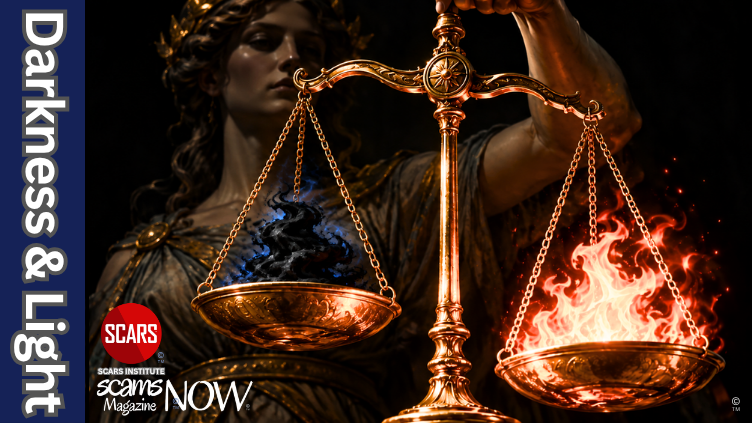
The Scale and Balance Between the Dark and the Light
Primary Category: Philosophy / Recoverology
Author:
• Tim McGuinness, Ph.D., DFin, MCPO, MAnth – Anthropologist, Scientist, Polymath, Managing Director of the Society of Citizens Against Relationship Scams Inc.
Author Biographies Below
About This Article
Scam recovery involves an evolving balance between distress and returning stability, represented through the imagery of darkness and light. Discovery disrupts attachment, confidence, sleep, concentration, and daily routines. Silence, learning how the deception worked, disclosure, financial consequences, and anniversaries introduce further challenges. Crises threaten fragile progress when structure, connection, or self-trust collapses. Rumination, shame, and isolation reinforce distress, while meals, rest, movement, meaningful activities, and dependable support strengthen recovery. The first year receives particular emphasis, with continued preparation and participation extending into later years. Reclaiming daily responsibilities and relationships gradually reduces the crime’s dominance over life. The central goal is sufficient stability to withstand setbacks, preserve connection, and restore functioning while acknowledging enduring losses and memories without allowing them to govern the survivor’s entire future.
Note: This article is intended for informational purposes and does not replace professional medical advice. If you are experiencing distress, please consult a qualified mental health professional.
Keywords
Scam Recovery, Emotional Balance, Betrayal Trauma, Recovery Setbacks, Rumination, Isolation, Daily Structure, Anniversary Reactions, Support Communities, Rebuilding Self-Trust

The Scale and Balance Between the Dark and the Light
Article Key Points
- Scam discovery disrupts the survivor’s emotional connection, expected future, confidence, and ordinary routines.
- Returning enjoyment and clarity appear through small experiences that deserve recognition.
- The scale represents the changing balance between distress and the resources supporting recovery.
- Silence, disclosure, financial consequences, and anniversaries place additional pressure on survivors.
- Crises become especially disruptive when they undermine structure, trust, or confidence.
- Shame and rumination turn specific difficulties into sweeping judgments about the survivor’s worth or ability.
- Sleep, food, movement, meaningful activity, and dependable contact provide practical support during setbacks.
- Friends, therapists, and recovery communities help distribute burdens that isolation leaves unsupported.
- Continued preparation remains important beyond the first year as new circumstances revive familiar difficulties.
- Lasting stability develops as survivors reclaim daily life and strengthen their ability to respond to disruption.
Author’s Note
The imagery of darkness and light gives emotional form to the struggle between withdrawal and renewed participation after betrayal. Darkness represents the shame, repetitive thoughts, and isolation that restrict daily life, while light represents the experiences and relationships that restore its substance. The emphasis rests on sustained care, shared support, and the practical work of rebuilding a life that holds through difficulty.
The World Goes Dark
The discovery arrives, and the world goes black.
Not metaphorically black. Practically black. The scam victim wakes to a Tuesday and by nightfall the ordinary furniture of life has rearranged itself into something hostile. The phone that once carried good morning messages now carries silence. The bank balance is a wound. The photographs are evidence. The future that was being built in a foreign city has collapsed into a folder of screenshots.
For a period measured in weeks, everything is dark.
This is the baseline state of the newly discovered victim. The light is not gone in some poetic sense. It is gone in the practical sense that nothing feels warm, nothing feels safe, nothing feels true. The victim moves through days that have lost their color and their logic. Food has no taste. Sleep comes in fragments. Concentration breaks apart mid-sentence. The body carries a weight that has no location.
Then, slowly, the light returns.
It comes back the way light always comes back after a long night. Not all at once. In increments. A morning where the coffee tastes like coffee. An afternoon where a song on the radio lands instead of passing through. An evening where the victim laughs at something small and hears the laugh and recognizes it as their own.
These increments are fragile. They are also real. Each one adds a gram of weight to the light side of the scale.
The scale is the central fact of the first year.
Every recovering victim lives with this scale. It sits somewhere behind the ribs. On one side is the returning light: routine, connection, sleep, food, small pleasures, moments of clarity, the slow rebuilding of a self that was shattered. On the other side is the dark: rumination, shame, isolation, sleeplessness, memory loops, the replay of messages, the endless forensic search for the moment when everything should have been obvious.
Most days the scale moves a little in one direction or the other. Most days the movement is small. This is normal. This is survivable.
The danger lies in the crises.
The Catastrophes of the First Year
The first year after discovery is a minefield laid with predictable explosive catastrophes. They arrive on a schedule the victim does not know, but the darkness does.
The First Catastrophe Is The Silence. The scam ends and the daily contact stops. For fourteen months, or six, or two years, there was a message at six in the morning and a message at night with a moon and a heart. Then there is nothing. The withdrawal of contact lands harder than the loss of money. The victim is left with an absence shaped exactly like a person who never existed.
The Second Catastrophe Is The Discovery Of The Mechanism. The victim learns how the scam worked. They learn about the fake photographs, the scripted messages, the borrowed identity of a fitness instructor in another country. This knowledge arrives as both relief and insult. Relief because it proves the victim was neither foolish nor alone in this. Insult because it proves the whole relationship was a construction.
The Third Catastrophe Is The First Public Telling. The victim tells a friend, a sibling, a coworker. The response is rarely what is needed. It arrives as a question. How could you let this happen? The question is not cruel, but it lands as a verdict. The victim hears judgment in a voice that meant only curiosity.
The Fourth Catastrophe Is The First Big Money Problem. A bill that cannot be paid. A credit card that reaches its limit. A retirement account that is smaller than it should be. The abstract loss becomes a concrete consequence, and the concrete consequence has a date attached.
The Fifth Catastrophe Is The Anniversary. The first holiday. The first birthday. The first New Year. The first date on the calendar that once belonged to the relationship and now belongs to its absence.
Each Catastrophe tips the scale.
Of course, there are also large-scale crises as well: after a couple of months, after 6 months, and more.
A small crisis or catastrophe, a friend’s awkward question or a bad night’s sleep, tips the scale a little. The victim rebalances within days. The light returns. The scale settles.
A large catastrophe, a financial collapse or a second betrayal or a public humiliation, tips the scale a lot. If the tip is large enough and if it lands before the light has accumulated sufficient weight, the scale can tip all the way over and stay there.
When the scale stays tipped, the darkness wins the year. Sometimes it wins several years. Sometimes it wins a decade.
The Practical Mechanics of the Tip
The practical mechanics are easy to describe and hard to live.
A victim who is 1 month out and quits the recovery community, not yet understanding that this is a longer journey than a couple of weeks. The world goes dark, but it is disguised by the anger and the desperate need to get justice. Who becomes retraumatized by the institutions they trusted and their own actions. Any progress is gone, and the dark sets in for the long haul.
A victim who is three months out and holding a fragile routine loses a job. The routine collapses. The days lose their shape. Sleep goes. The rumination returns with full force. Without work, there is no external structure to substitute for the internal structure that trauma has dismantled. The victim sits in an apartment, and the apartment fills with the replay. Within weeks, the progress of three months is erased. It gets darker.
A victim who is six months out and beginning to trust again meets someone new. The new person is real and present and kind. Then the new person does something small that resembles a behavior from the scam. A delayed reply. A changed story. A request for a small favor. The victim’s nervous system does not distinguish between the new person and the old ghost. The trust collapses. The victim withdraws. The light dims.
A victim who is nine months out and beginning to feel competent makes a financial decision that goes wrong. A small investment. A new lease. A purchase. The decision is reasonable, but the outcome is bad. The victim reads the bad outcome as proof that their judgment is permanently broken. The shame explodes. The confidence built over nine months drains out in a week.
In each case, the practical tip is the same. External structure collapses, or internal trust collapses, or self-confidence collapses. The scale tips. The darkness gains ground.
The practical remedy is also the same. Restore structure. Restore contact. Restore routine. Sleep. Food. Movement. A phone call with someone who understands. A return to the support community. A small win deliberately engineered and deliberately noticed.
This works when the tip is small. This works less well when the tip is large.
The Metaphysical Mechanics of the Tip
Beneath the practical mechanics runs a second layer.
The darkness is not the trauma. The trauma is an injury. Injuries heal and scar over, and then they are managed. A scarred knee still works. A scarred mind still works. The trauma is a permanent feature of the terrain, but it is not the enemy.
The enemy is the darkness that uses the terrain.
The darkness is old. It does not begin with the scam, and it does not end with the scam. It finds the victim through the scam the way water finds a crack. It was looking for an entrance, and the scam opened one. Once inside, the darkness does not leave. It is patient. It does not need to win every day. It needs only to remain.
The darkness works through the injury. It speaks through the shame. It speaks through the negative rumination. It speaks through the isolation. It uses the practical crises and catastrophe as opportunities. When the victim has a setback or loses a job, the darkness says: see, you cannot hold anything together. When the victim is betrayed again, the darkness says: see, you never could read people. When the victim fails at something small, the darkness says: see, you are broken, and you will stay broken.
The darkness does not argue. It repeats. It waits for the repetition to become belief.
The light works differently. The light works through increments. It does not shout. It accumulates. A good morning. A support call attended. An article read even with imperfect understanding. A comment to other survivors. A good meal. A completed task. A night of full sleep. A moment of genuine laughter. A conversation where the victim tells the truth and is not judged. Each of these adds weight to the light side.
The problem is that light accumulates slowly and darkness attacks suddenly. This asymmetry is the whole game. A year of light can be tipped in a week of dark. This is why the large catastrophes and crises matter so much. This is why the first year is the dangerous year, “The Year of Living Dangerously.” This is why the scale must be guarded and at least kept balanced.
The Rule of the First Year
The practical rule of the first year is simple and brutal. Protect the light. Avoid the large crises where possible. Survive the ones that cannot be avoided. Rebuild structure fast after every tip. Do not let a small tip become a large one through neglect.
The metaphysical rule is the same rule seen from underneath. The darkness is a tenant. It pays no rent and it does not leave on its own. It must be evicted. The eviction is not a single event. The eviction is a long campaign of small resistances.
Every time the victim chooses contact over isolation, the darkness loses a room. Every time the victim chooses sleep over rumination, the darkness loses an hour. Every time the victim chooses to tell the truth about what happened instead of managing the reactions of others, the darkness loses a foothold.
The darkness does not give up. It retreats and regroups. It waits for the next crisis. It waits for the next job loss, the next betrayal, the next anniversary, the next bad night. As long as some part of it remains inside the victim, it fights for the whole.
The fight continues until the darkness is banished. Banished does not mean destroyed. Banished means driven out of the territory. The scar remains. The injury remains. The memory remains. The darkness does not.
The Balance of the Year
The first year is a balance. On one side the light returns, gram by gram, through routine and connection and rest and truth. On the other side the darkness waits, patient and old, looking for the crack through which it can return. Most victims tip a little and rebalance. Some tip hard and fall back for months. A few tip all the way and stay in the dark for years.
The difference between the three outcomes is rarely the size of the crisis alone. The difference is what surrounds the crisis. A victim with structure, contact, sleep, and truth survives a large tip and rebalances. A victim without those things falls from a small tip and stays down. The scale is the same. The weight around it is not.
This is the practical reason why recovery cannot be done alone. The isolated victim carries the whole scale on their own back. When the tip comes, there is no counterweight. When the darkness presses, there is no second hand on the other side of the beam. The victim who is held by a group, a friend, a therapist, a community of people who have been through the same fire, carries the scale with help. The tip still comes. The rebalance still takes work. But the weight is distributed and the beam does not break.
The metaphysical reason is the same reason seen from beneath. Darkness is a solitary tenant by preference. It thrives in isolation. It speaks loudest when no other voice is present to answer. A victim alone in an apartment at three in the morning hears only the darkness and mistakes it for the truth. A victim on a phone call at three in the morning hears the darkness and then hears a friend say it is not the truth, and the darkness loses its grip for that night.
The Return of the Light
The light does not return on its own. The light returns because it is invited. This is the part that recovering victims resist the most. After the scam, after the betrayal, after the 14 or 6 or 24 months of a love that turned out to be a construction, the victim does not want to invite anything. The victim wants to be left alone. The victim wants to sit in the dark and count what is gone.
But the light does not enter a closed room. It enters an open one. The victim who opens a window, literally or figuratively, lets the light in. A walk outside. A meal with a friend. A group meeting. A phone call. A book. A dog. A garden. A small craft. A routine. Each of these is a window. Each of these is an invitation.
The light arrives through the smallest openings. It does not need a grand gesture. It needs a crack. The darkness knows this and attacks the cracks. It tells the victim that the walk is pointless, that the friend does not really understand, that the group is a room full of strangers, that the phone call is a burden, that the book is too long, that the dog is too much work. The darkness is a salesman for its own territory. It sells the victim on staying in the dark.
The victim who learns to recognize the sales pitch wins a small battle every time. The victim who does not, loses ground.
The Long Game
The first year is the decisive year, but it is not the whole war. Victims who survive the first year with the scale intact move into a second phase. The light grows heavier. The dark grows thinner. The crises continue, but the victim is stronger. The tips come, but the rebalances are faster.
This is not because the darkness has weakened. It is because the victim has learned the terrain. The victim knows the tricks now. The victim knows the rumination loop and knows how to break it. The victim knows the shame spiral and knows how to interrupt it. The victim knows the anniversary and prepares for it in advance. The victim knows the bad night and has a plan for the morning after.
Knowledge is a counterweight.
The darkness adapts. It finds new entrances. A new relationship that echoes the old one. A new financial decision that echoes the old one. A new crisis that resembles the first. The darkness does not attack the same door twice. It tries the windows.
The victim who has been through the first year and survived knows that the second year is not safe. It is merely familiar. Familiarity is an advantage but it is not a guarantee. The darkness is old and the victim is still young in the fight.
The Banishing
Banishing the darkness is not a single act.
It is not a therapy session where the victim cries, and the darkness leaves. It is not a book the victim reads, and the darkness evaporates. It is not a decision the victim makes, and the darkness obeys. Banishing is a campaign. It is a series of small evictions that add up to a full clearing.
The victim who banishes the darkness does so by taking back the rooms one at a time. The room of sleep. The room of food. The room of work. The room of friendship. The room of trust. The room of self. Each room reclaimed is a room the darkness can no longer occupy. When all the rooms are reclaimed, the darkness has no place to stand, and it leaves.
The scar remains. The loss remains. The injury remains. The memory remains. The victim does not forget the scam and does not need to. The victim simply stops living in it.
The darkness does not give up while some part remains. The victim must take every part back. This is the whole work of the first year and the years after. The work is not dramatic. The work is the small resistance against the darkness that is repeated until it becomes the ordinary condition of a life.
The Scale at Rest
The scale at rest does not mean the scale is even. The scale at rest means the light outweighs the dark enough that a tip does not threaten the whole. A victim at rest can lose a job and still be okay. A victim at rest can be betrayed again and still trust again. A victim at rest can have a bad night and still wake up in the morning with a reason to get up. This is the goal. Not happiness. Not closure. Not the absence of pain. The goal is a scale that holds.
The darkness remains a possibility. It always remains a possibility. But it stops being the default. It stops being the weather. It becomes the exception. The victim who reaches this point has not defeated the darkness in the cosmic sense. The victim has simply evicted it from the territory of their own life. The darkness moves on to find another crack in another person. It is always working. It is always looking. It never retires. But for the victim who has cleared the rooms, the darkness is now outside the door. It is no longer behind the eyes.
The Last Word
The first year is the year of the scale.
The light returns slowly. The darkness waits patiently. The crises come. The tips happen. The victim either rebalances or falls. The practical work is structure, contact, sleep, food, movement, and truth. The metaphysical work is the same work seen from underneath, the slow eviction of an old tenant who pays no rent and does not leave on its own.
The darkness does not represent the trauma. The trauma is the field. The darkness is the enemy that fights on the field. The trauma scars and heals and is managed. The darkness fights until it is banished.
Banished does not mean destroyed. Banished means driven out. The victim does not need to kill the dark. The victim needs to take back the house.
The light does not return on its own. The light returns because the victim opens the window.
The first year is the decisive year. The work of the first year is the whole work. Open the window. Take back a room. Count the light in grams. Resist the salesman. Keep the scale. And when the tip comes, and it will come, rebalance fast.
The darkness fights for the soul. The light fights for the soul. The soul decides which one stays and which one wins.
Conclusion
Recovery after a relationship scam involves rebuilding a life while carrying the consequences of betrayal. The loss reaches into ordinary experiences, changing the meaning of a phone notification, a quiet evening, a financial decision, or a familiar date. Returning stability takes shape through the gradual restoration of these everyday experiences, supported by people who understand why seemingly small moments carry substantial emotional weight.
The scale between darkness and light reflects this continuing work. Rumination, shame, isolation, and disrupted routines add pressure to an already injured person, while nourishment, rest, meaningful activity, and dependable contact provide counterweight. Their importance becomes especially clear during a crisis, when the survivor needs resources already in place rather than another demand to manage everything alone. Support distributes the burden and helps preserve access to practical next steps.
A setback deserves attention without becoming a verdict on the survivor’s future. Financial difficulty does not establish permanent incompetence, an anniversary does not require surrendering the present, and a painful reminder does not invalidate earlier progress. The immediate task involves recognizing what has become unstable and restoring the structure, contact, or care that the situation requires.
Reclaiming life also means allowing worthwhile experiences to matter before every difficulty has ended. A completed task, an honest conversation, or an afternoon spent outside adds something real to the survivor’s day. Repeated participation gradually gives these experiences a stronger place in daily life.
The lasting goal is a balance supported by enough routine, connection, knowledge, and self-trust to withstand disruption. The crime remains part of the survivor’s history, while the survivor regains room to live beyond it. Taking back the house means restoring the daily life that betrayal interrupted, with support and sustained attention to what keeps it standing.
Article Review
- The darkness-and-light metaphor describes competing experiences within recovery rather than equating trauma itself with darkness.
- The loss of daily messages leaves an absence connected to the relationship the victim believed existed.
- Learning the scam’s mechanism brings both clarification and grief over the constructed relationship.
- An awkward response to disclosure adds distress when the survivor experiences it as judgment.
- Financial losses become immediate pressures when bills, debts, and reduced savings affect daily decisions.
- Anniversaries and holidays require preparation because they carry associations with the lost relationship.
- A crisis warrants identifying whether routine, connection, trust, or confidence needs attention.
- Practical rebalancing begins with restoring basic care, daily structure, and contact with dependable support.
- Small completed activities and moments of enjoyment add meaningful weight to returning stability.
- Recovery knowledge helps survivors recognize recurring patterns and prepare responses to difficult periods.
- Reclaiming sleep, work, friendship, and self-trust reduces the crime’s control over daily life.
- A stable scale represents enough support and resilience to withstand setbacks while preserving reasons to participate in life.
Closing Question
When a setback tips your recovery toward darkness, what routines, relationships, and sources of support help you regain your balance?
Glossary
- Anniversaries
- Anniversary preparation
- Borrowed identity
- Collapse of confidence
- Collapse of routine
- Constructed relationship
- Daily contact
- Darkness
- Darkness-and-light metaphor
- Delayed replies
- Dependable contact
- Discovery of the mechanism
- Disrupted sleep
- Emotional balance
- Emotional counterweight
- External structure
- Financial collapse
- Financial consequences
- First public telling
- First-year recovery
- Forensic search
- Fragile progress
- Internal structure
- Job loss
- Knowledge as a counterweight
- Large catastrophe
- Light
- Long game
- Loss of expected future
- Meaningful activity
- Memory loops
- Practical rebalancing
- Public humiliation
- Reclaiming daily life
- Recovery community
- Recovery scale
- Recovery setback
- Repeated participation
- Retraumatization
- Scripted messages
- Second betrayal
- Self-trust
- Shame spiral
- Shared burden
- Small resistances
- Small wins
- Support call
- Taking back the house
- Trauma reminders
- Withdrawal of contact
Author Biography
Prof. (Emeritus) Tim McGuinness, Ph.D. DFin is a co-founder, Managing Director, and Chairman of the SCARS Institute (Society of Citizens Against Relationship Scams Inc.), where he serves as an unsalaried volunteer officer dedicated to supporting scam victims and survivors around the world. With over 34 years of experience in scam education and awareness, he is perhaps the longest-serving advocate in the field.
Dr. McGuinness has an extensive background as a business pioneer, having co-founded several technology-driven enterprises, including the former e-commerce giant TigerDirect.com. Beyond his corporate achievements, he is actively engaged with multiple global think tanks where he helps develop forward-looking policy strategies that address the intersection of technology, ethics, and societal well-being. He is also a computer industry pioneer (he was an Assistant Director of Corporate Research Engineering at Atari Inc. in the early 1980s) and invented core technologies still in use today.
His professional identity spans a wide range of disciplines. He is a scientist, strategic analyst, solution architect, advisor, public speaker, published author, roboticist, Navy veteran, and recognized polymath. He holds numerous certifications, including those in cybersecurity from the United States Department of Defense under DITSCAP & DIACAP, continuous process improvement and engineering and quality assurance, trauma-informed care, grief counseling, crisis intervention, and related disciplines that support his work with crime victims.
Dr. McGuinness was instrumental in developing U.S. regulatory standards for medical data privacy called HIPAA and financial industry cybersecurity called GLBA. His professional contributions include authoring more than 1,000 papers and publications in fields ranging from scam victim psychology and neuroscience to cybercrime prevention and behavioral science.
“I have dedicated my career to advancing and communicating the impact of emerging technologies, with a strong focus on both their transformative potential and the risks they create for individuals, businesses, and society. My background combines global experience in business process innovation, strategic technology development, and operational efficiency across diverse industries.”
“Throughout my work, I have engaged with enterprise leaders, governments, and think tanks to address the intersection of technology, business, and global risk. I have served as an advisor and board member for numerous organizations shaping strategy in digital transformation and responsible innovation at scale.”
“In addition to my corporate and advisory roles, I remain deeply committed to addressing the rising human cost of cybercrime. As a global advocate for victim support and scam awareness, I have helped educate millions of individuals, protect vulnerable populations, and guide international collaborations aimed at reducing online fraud and digital exploitation.”
“With a unique combination of technical insight, business acumen, and humanitarian drive, I continue to focus on solutions that not only fuel innovation but also safeguard the people and communities impacted by today’s evolving digital landscape.”
Dr. McGuinness brings a rare depth of knowledge, compassion, and leadership to scam victim advocacy. His ongoing mission is to help victims not only survive their experiences but transform through recovery, education, and empowerment.
-/ 30 /-
What do you think about this?
Please share your thoughts in a comment below!
The Battle Between Darkness and Light After the Scam Ends – 2026
Please Leave a Comment
Please Tell Us What You Learned From This?
Commenting Is An Essential Part Of Healing
Read • Think • Write
GLOSSARY SEARCH
TOPIC SEARCH
TABLE OF CONTENTS
- The Scale and Balance Between the Dark and the Light
- The Scale and Balance Between the Dark and the Light
- Article Key Points
- Author’s Note
- The World Goes Dark
- The Catastrophes of the First Year
- The Practical Mechanics of the Tip
- The Metaphysical Mechanics of the Tip
- The Rule of the First Year
- The Balance of the Year
- The Return of the Light
- The Long Game
- The Banishing
- The Scale at Rest
- The Last Word
- Conclusion
- Article Review
- Closing Question
- Glossary






CATEGORIES
Important Information for New Scam Victims
- Please visit www.ScamVictimsSupport.org – a SCARS Website for New Scam Victims & Sextortion Victims.
- SCARS Institute now offers its free, safe, and private Scam Survivor’s Support Community at www.SCARScommunity.org – this is not on a social media platform; it is our own safe & secure platform created by the SCARS Institute especially for scam victims & survivors.
- SCARS Institute now offers a free recovery learning program at www.SCARSeducation.org.
- Please visit www.ScamPsychology.org – to more fully understand the psychological concepts involved in scams and scam victim recovery.
If you are looking for local trauma counselors, please visit counseling.AgainstScams.org
If you need to speak with someone now, you can dial 988 or find phone numbers for crisis hotlines all around the world here: www.opencounseling.com/suicide-hotlines
Statement About Victim Blaming
Some of our articles discuss various aspects of victims. This is both about better understanding victims (the science of victimology) and their behaviors and psychology. This helps us to educate victims/survivors about why these crimes happened and not to blame themselves, better develop recovery programs, and help victims avoid scams in the future. At times, this may sound like blaming the victim, but it does not blame scam victims; we are simply explaining the hows and whys of the experience victims have.
These articles, about the Psychology of Scams or Victim Psychology – meaning that all humans have psychological or cognitive characteristics in common that can either be exploited or work against us – help us all to understand the unique challenges victims face before, during, and after scams, fraud, or cybercrimes. These sometimes talk about some of the vulnerabilities the scammers exploit. Victims rarely have control of them or are even aware of them until something like a scam happens, and then they can learn how their mind works and how to overcome these mechanisms.
Articles like these help victims and others understand these processes and how to help prevent them from being exploited again or to help them recover more easily by understanding their post-scam behaviors. Learn more about the Psychology of Scams at www.ScamPsychology.org
SCARS INSTITUTE RESOURCES: If You Have Been Victimized By A Scam Or Cybercrime
♦ If you are a victim of scams, go to www.ScamVictimsSupport.org for real knowledge and help
♦ Join our free, safe, and private Scam Survivors After Scam Healing and Recovery Community at www.SCARScommunity.org
♦ Enroll in SCARS Scam Survivor’s School now at www.SCARSeducation.org
♦ To report criminals, visit https://reporting.AgainstScams.org – we will NEVER give your data to money recovery companies like some do!
♦ Follow us and find our podcasts, webinars, and helpful videos on YouTube: https://www.youtube.com/@RomancescamsNowcom
♦ Learn about the Psychology of Scams at www.ScamPsychology.org
♦ Dig deeper into the reality of scams, fraud, and cybercrime at www.ScamsNOW.com and www.RomanceScamsNOW.com
♦ Scam Survivor’s Stories: www.ScamSurvivorStories.org
♦ For Scam Victim Advocates visit www.ScamVictimsAdvocates.org
♦ See more scammer photos on www.ScammerPhotos.com
You can also find the SCARS Institute’s knowledge and information on Facebook and LinkedIn
Psychology Disclaimer:
All articles about psychology and the human brain on this website are for information & education only
The information provided in this and other SCARS articles are intended for educational and self-help purposes only and should not be construed as a substitute for professional therapy or counseling.
Note about Mindfulness: Mindfulness practices have the potential to create psychological distress for some individuals. Please consult a mental health professional or experienced meditation instructor for guidance should you encounter difficulties.
While any self-help techniques outlined herein may be beneficial for scam victims seeking to recover from their experience and move towards recovery, it is important to consult with a qualified mental health professional before initiating any course of action. Each individual’s experience and needs are unique, and what works for one person may not be suitable for another.
Additionally, any approach may not be appropriate for individuals with certain pre-existing mental health conditions or trauma histories. It is advisable to seek guidance from a licensed therapist or counselor who can provide personalized support, guidance, and treatment tailored to your specific needs.
If you are experiencing significant distress or emotional difficulties related to a scam or other traumatic event, please consult your doctor or mental health provider for appropriate care and support.
Also read our SCARS Institute Statement about Professional Care for Scam Victims – click here
If you are in crisis, feeling desperate, or in despair, please call 988 or your local crisis hotline – international numbers here.
A Question of Trust
At the SCARS Institute, we invite you to do your own research on the topics we speak about and publish. Our team investigates the subject being discussed, especially when it comes to understanding the scam victims-survivors’ experience. You can do Google searches, but in many cases, you will have to wade through scientific papers and studies. However, remember that biases and perspectives matter and influence the outcome. Regardless, we encourage you to explore these topics as thoroughly as you can for your own awareness.
More ScamsNOW.com Articles