



The Book of Pressed Scammers – Whimsy/Humor – 2026

The SCARS Institute Magazine about Scam Victims-Survivors, Scams, Fraud & Cybercrime

- Published: 8/15/26
- Modified: 8/15/26
- Comments: 2
- Read Status:

Welcome to the Book of Pressed Scammers
A Curious Field Guide to Flattened Fraudsters and Other Peculiar Villains
Primary Category: Whimsy & Humor
Welcome to the Book of Pressed Scammers
A Curious Field Guide to Flattened Fraudsters and Other Peculiar Villains
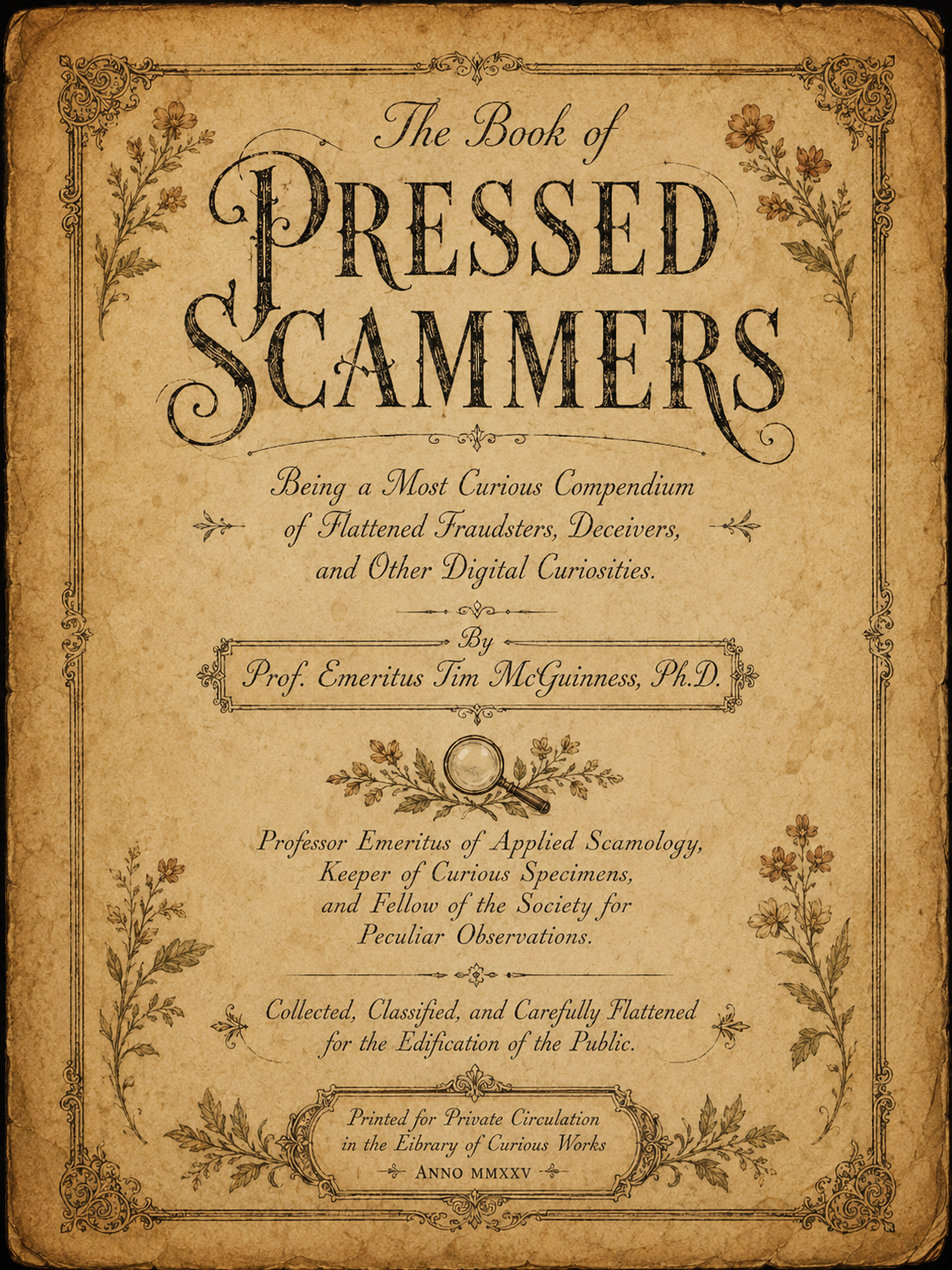
Being a Most Curious Compendium of Flattened Fraudsters, Deceivers, and Other Digital Curiosities. Collected, Classified, and Carefully Flattened for the Edification of the Public.
A Book of Whimsy for No Particular Reason Other Than We Could!
Printed for Private Circulation in the Library of Curious Works: ANNO MMXXVI
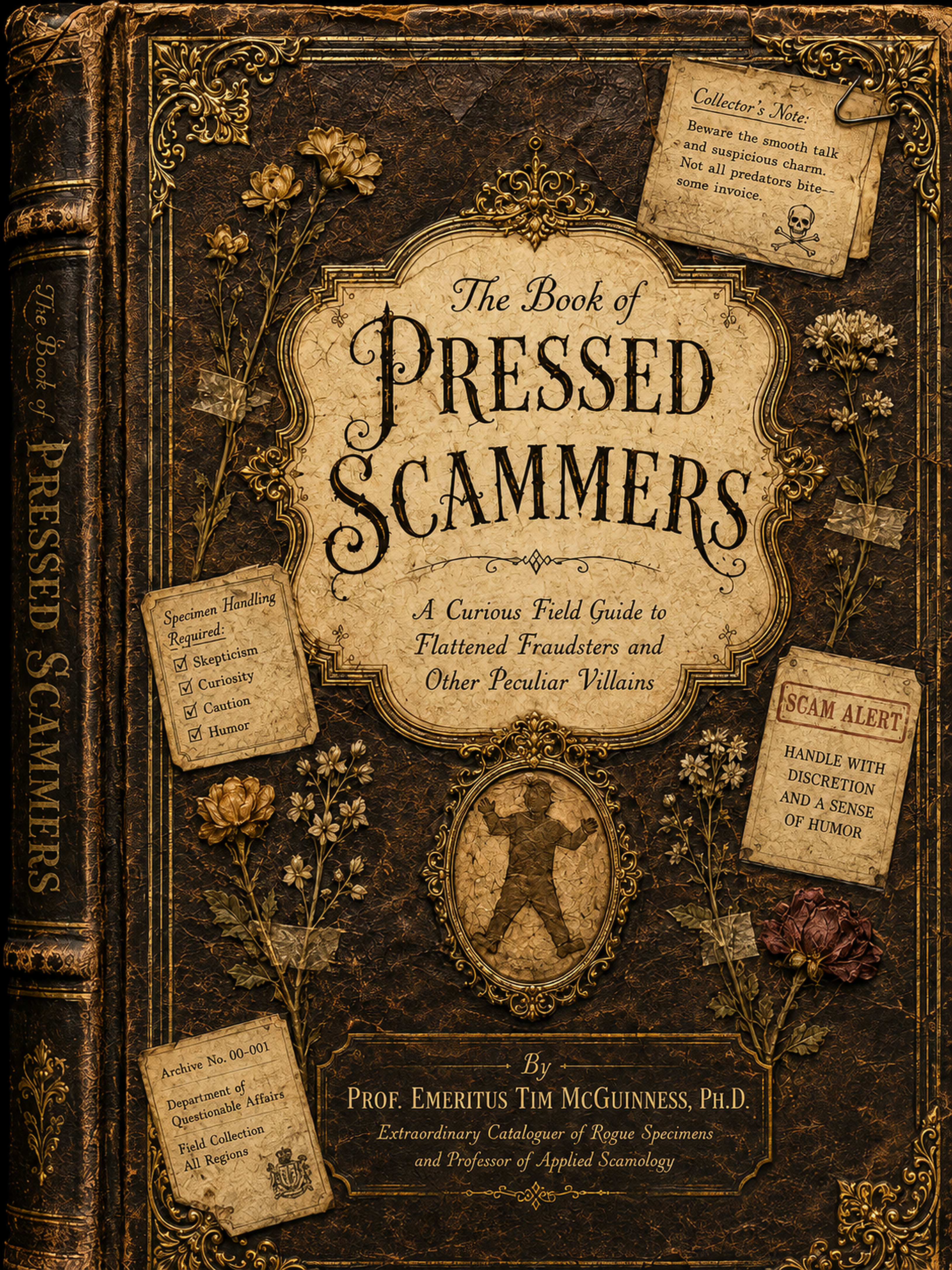
Collector’s Note: Beware the smooth talk and suspicious charm. Not all predators bite; some invoice.
Specimen Handling Required: Skepticism, Curiosity, Caution, Humor
SCAM ALERT: HANDLE WITH DISCRETION AND A SENSE OF HUMOR
Department of Questionable Affairs, Field Collection, All Regions: Archive No. 00-001
Introduction
A Few Necessary Remarks Before Examining the Specimens
Every respectable naturalist eventually encounters a creature that refuses to remain politely within the boundaries assigned to it.
Some creep beneath stones. Some hide beneath leaves. Some emerge only after rain. Others appear without warning in one’s email, text messages, social media accounts, dating applications, telephone calls, investment groups, and occasionally beneath the highly suspicious heading, “Congratulations, Dear Beneficiary.”
It was therefore inevitable that someone would eventually undertake the unpleasant but necessary work of collecting, classifying, pressing, labeling, and preserving representative examples of that most adaptable modern pest: the scammer.
The specimens contained within these pages were not gathered from tropical forests, remote islands, forgotten caves, or deep ocean trenches. Their preferred habitats are rather less romantic. They flourish in inboxes, messaging applications, social media platforms, fake investment websites, telephone call centers, dating services, and wherever human trust can be converted into opportunity. Their range is global. Their migration patterns are unpredictable. Their plumage varies considerably. Their stories vary even more.
The attentive observer will quickly discover that scammers possess one remarkable characteristic shared by very few creatures in the natural world: they are capable of becoming almost anything required by the environment. When affection is useful, the scammer becomes a lover. When authority is useful, the scammer becomes a police officer, government official, banker, soldier, customs agent, attorney, or technical support specialist. When wealth is useful, the scammer becomes an investor, cryptocurrency expert, lottery representative, successful entrepreneur, oil executive, or mysterious heir to an inconveniently inaccessible fortune. When sympathy is required, the specimen develops a sudden medical emergency, stranded child, wounded relative, frozen bank account, delayed shipment, lost passport, detained package, broken telephone, hostile customs official, or previously unknown tax obligation.
The organism is extraordinarily adaptive. Unfortunately, its adaptations are paid for by everyone except the organism itself.
For many years, scammers were studied primarily by their financial traces. Investigators examined payment methods, telephone numbers, bank accounts, email addresses, cryptocurrency wallets, websites, and networks of criminal associates. These remain essential areas of examination, but they reveal only part of the animal.
The more curious characteristics appear when the specimen is observed in its preferred relationship with a human host.
Here the scammer demonstrates a remarkable ability to identify hope, loneliness, generosity, ambition, fear, urgency, empathy, obligation, curiosity, and trust. None of these human qualities are defects. They are ordinary characteristics of social beings. The scammer’s particular talent lies in recognizing which characteristic can be stimulated, cultivated, and eventually harvested.
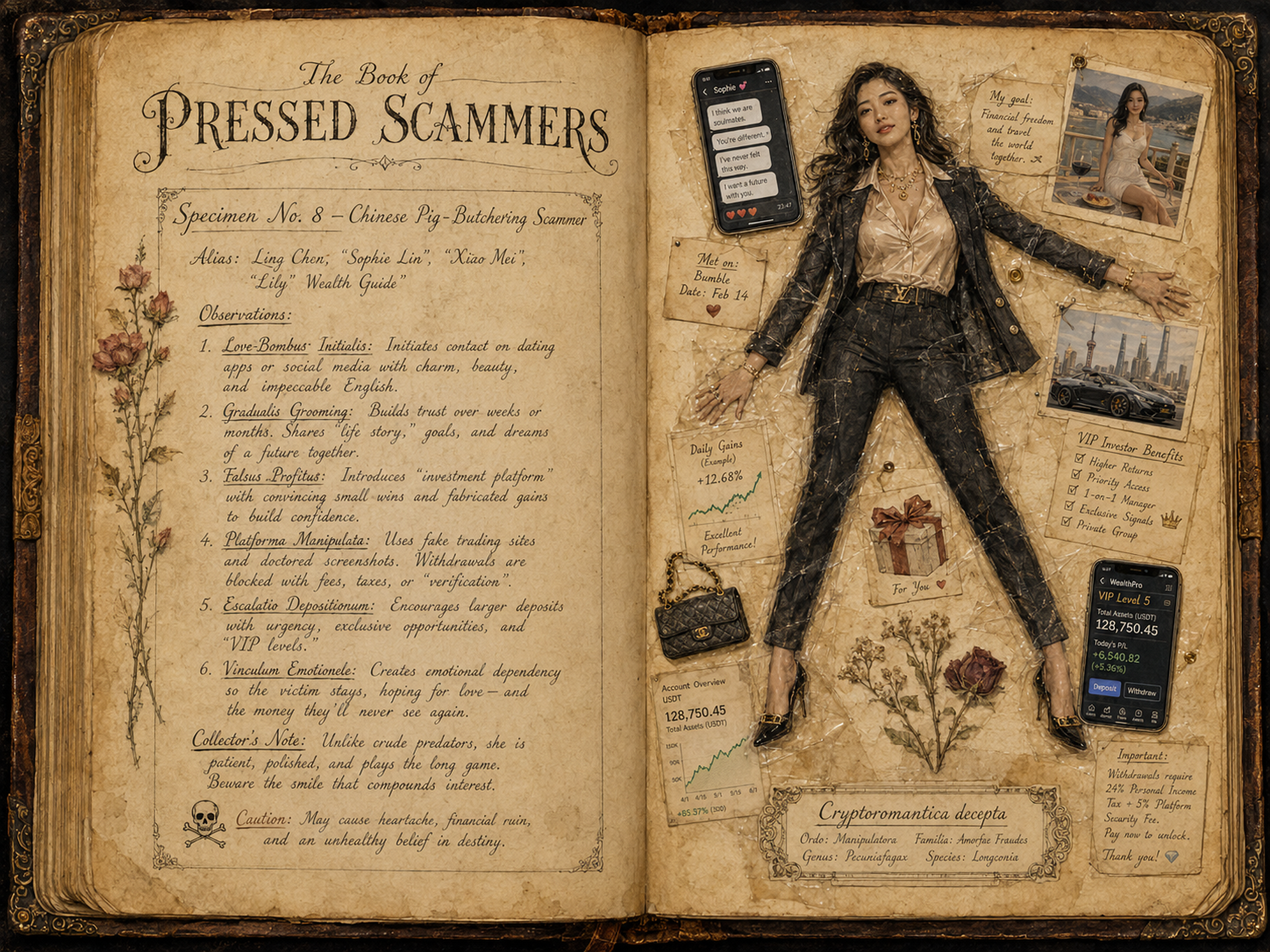
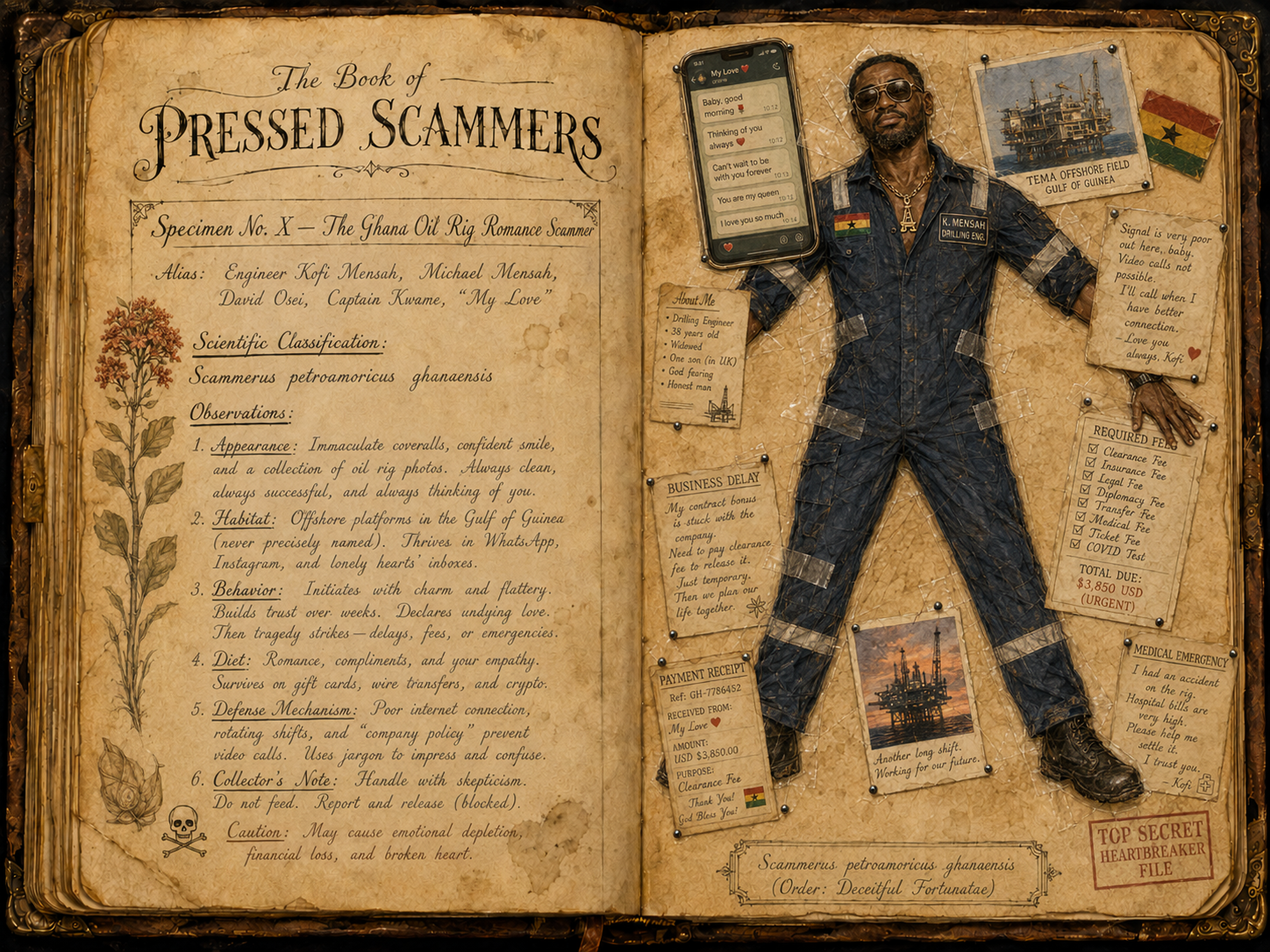
The romance variety, for example, rarely begins by requesting money. Such crude feeding behavior would frighten away the host. Instead, it establishes contact, develops familiarity, encourages emotional disclosure, creates routines, and gradually becomes important in the victim’s daily life. Only after sufficient attachment has been established does the creature begin displaying the characteristic emergency behavior for which the species is widely known.
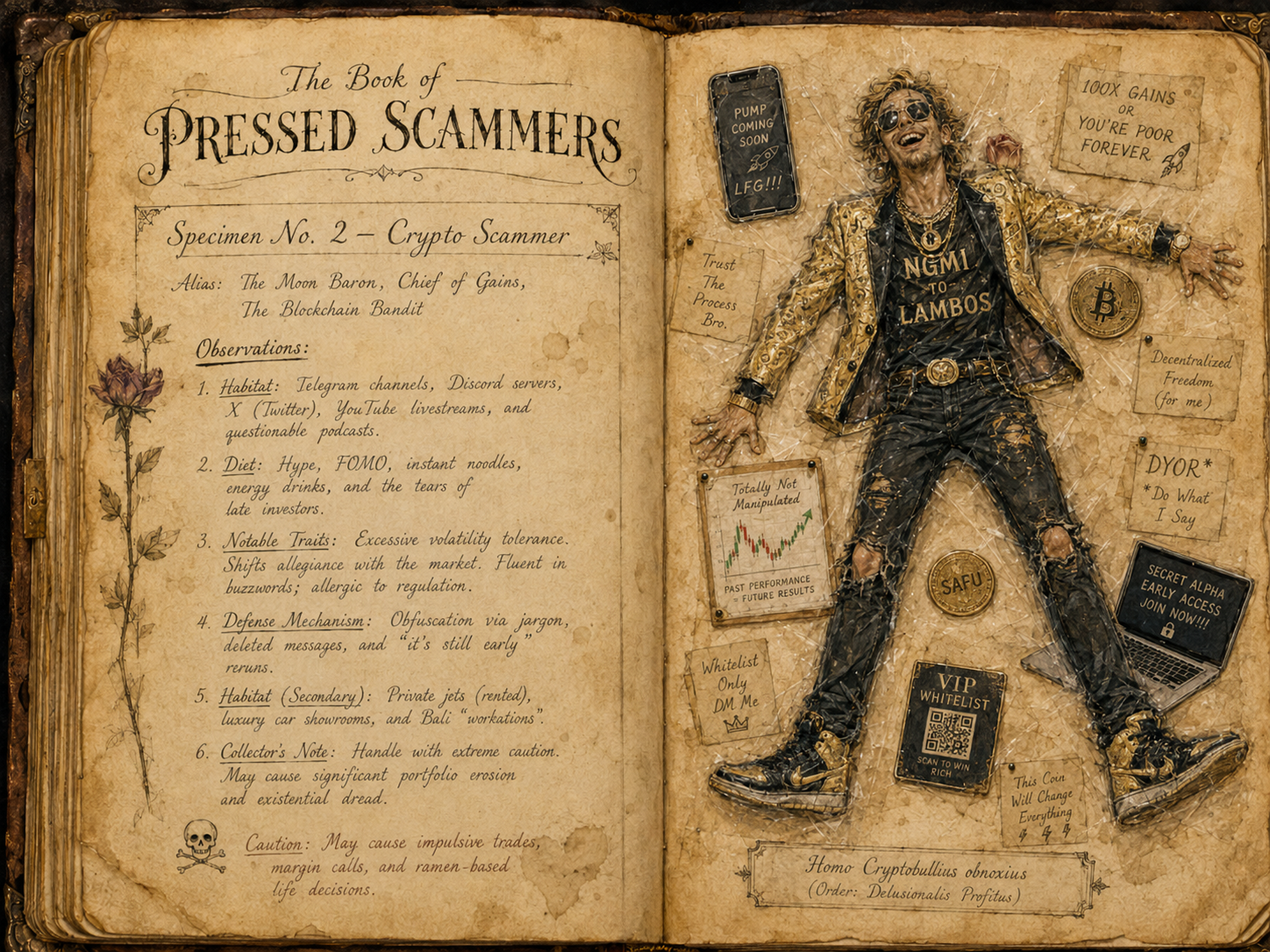
- The investment specimen follows a different courtship ritual. It displays charts.
- The lottery variety prefers congratulations.
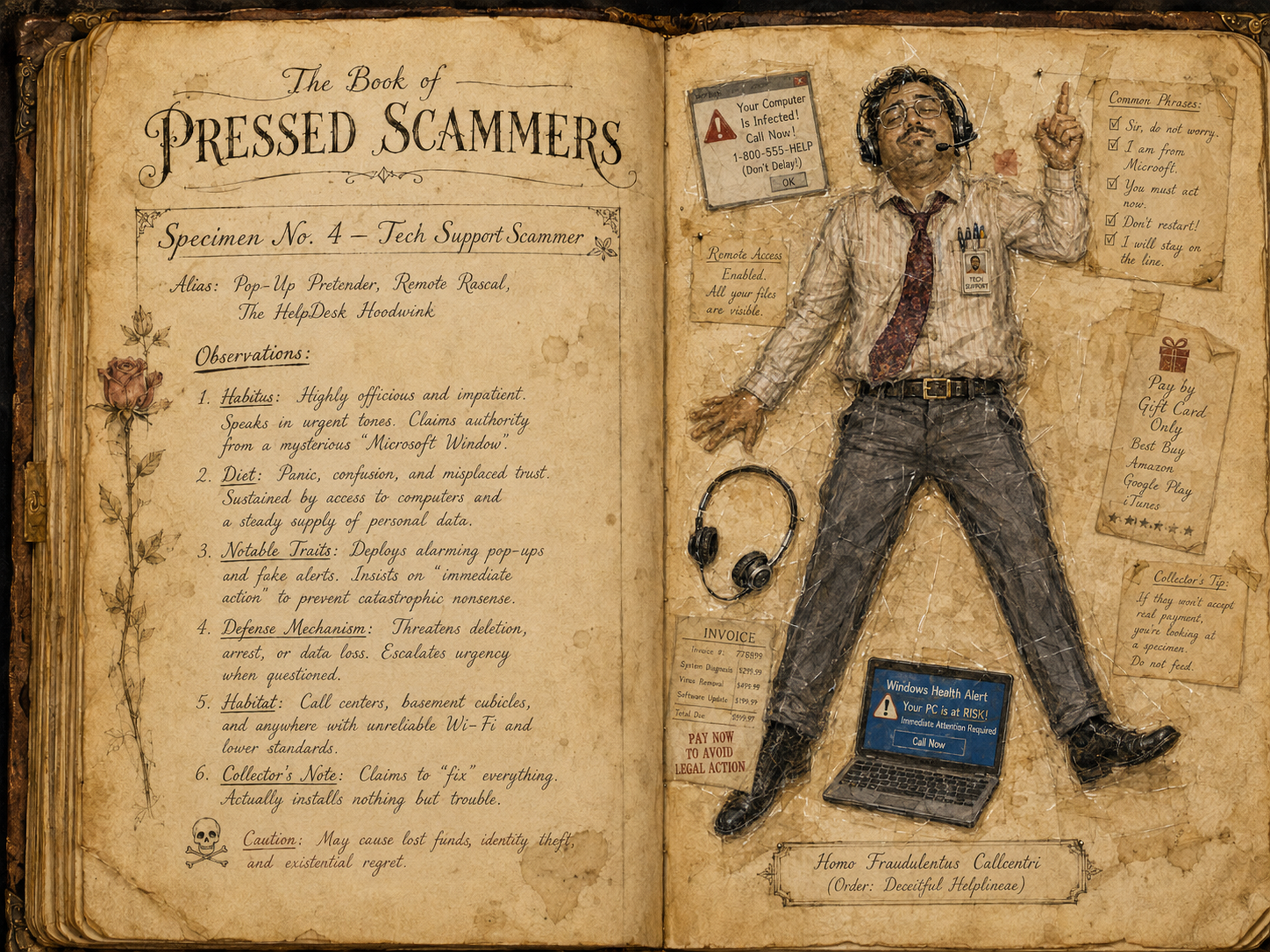
- The technical support specimen favors panic.
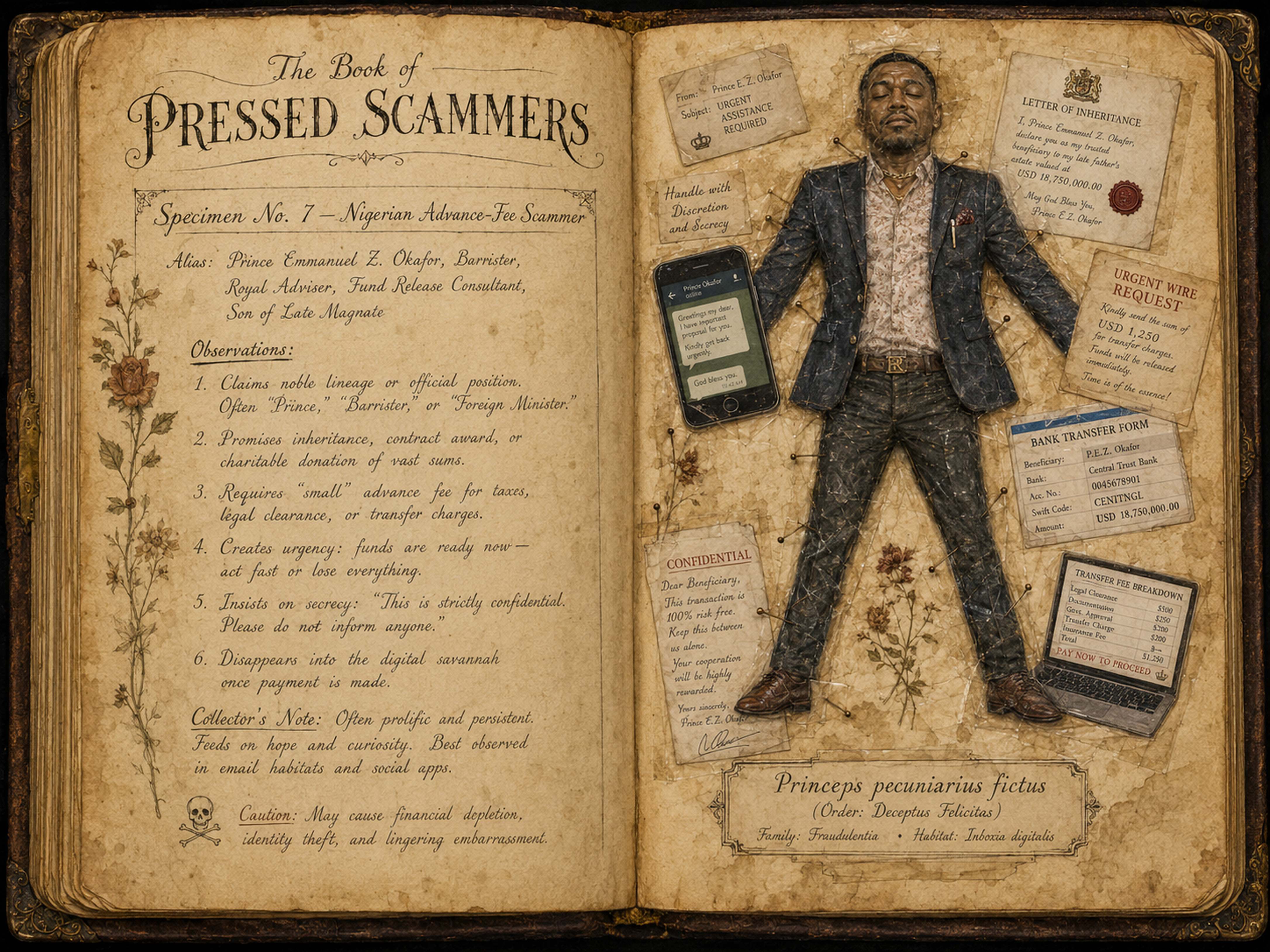
- The advance-fee variety has historically demonstrated an unusual fondness for deceased relatives, diplomatic titles, enormous inheritances, and paperwork requiring surprisingly modest fees before astonishing quantities of money can be released.
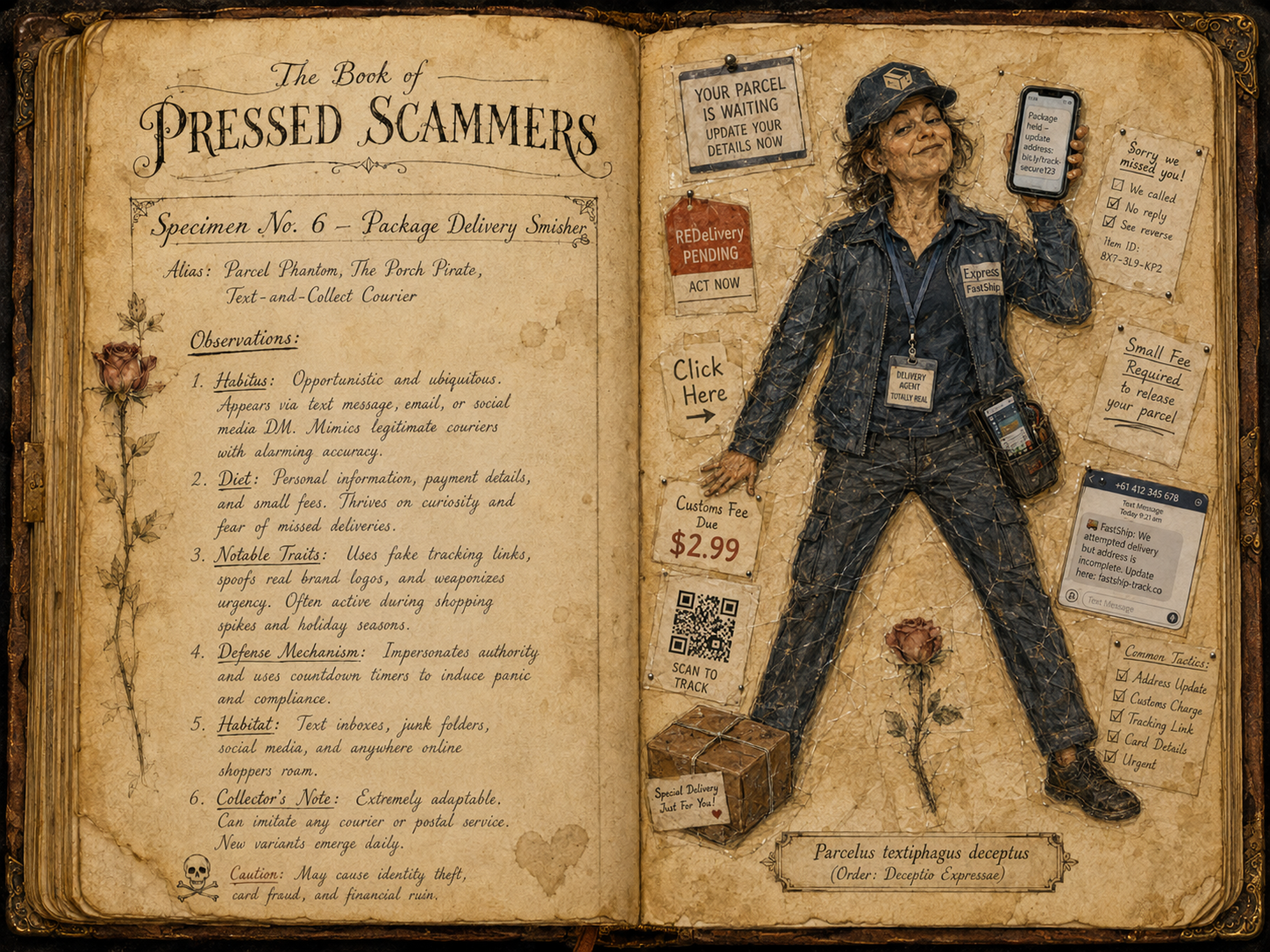
- The package-delivery specimen has evolved more recently and has discovered that nearly everyone is expecting something from somewhere.
Despite their differences, the various species share recognizable behavioral patterns. They attract attention. They establish credibility. They manufacture urgency. They discourage outside verification. They isolate the target from conflicting information. They create explanations for inconsistencies. They transform doubt into guilt and skepticism into an obstacle that must somehow be overcome.
Above all, they prefer not to be examined too closely. That is precisely why they have been pressed. Once flattened upon the page, stripped of charm, urgency, borrowed photographs, fabricated authority, and dramatic storytelling, the scammer becomes considerably easier to study.
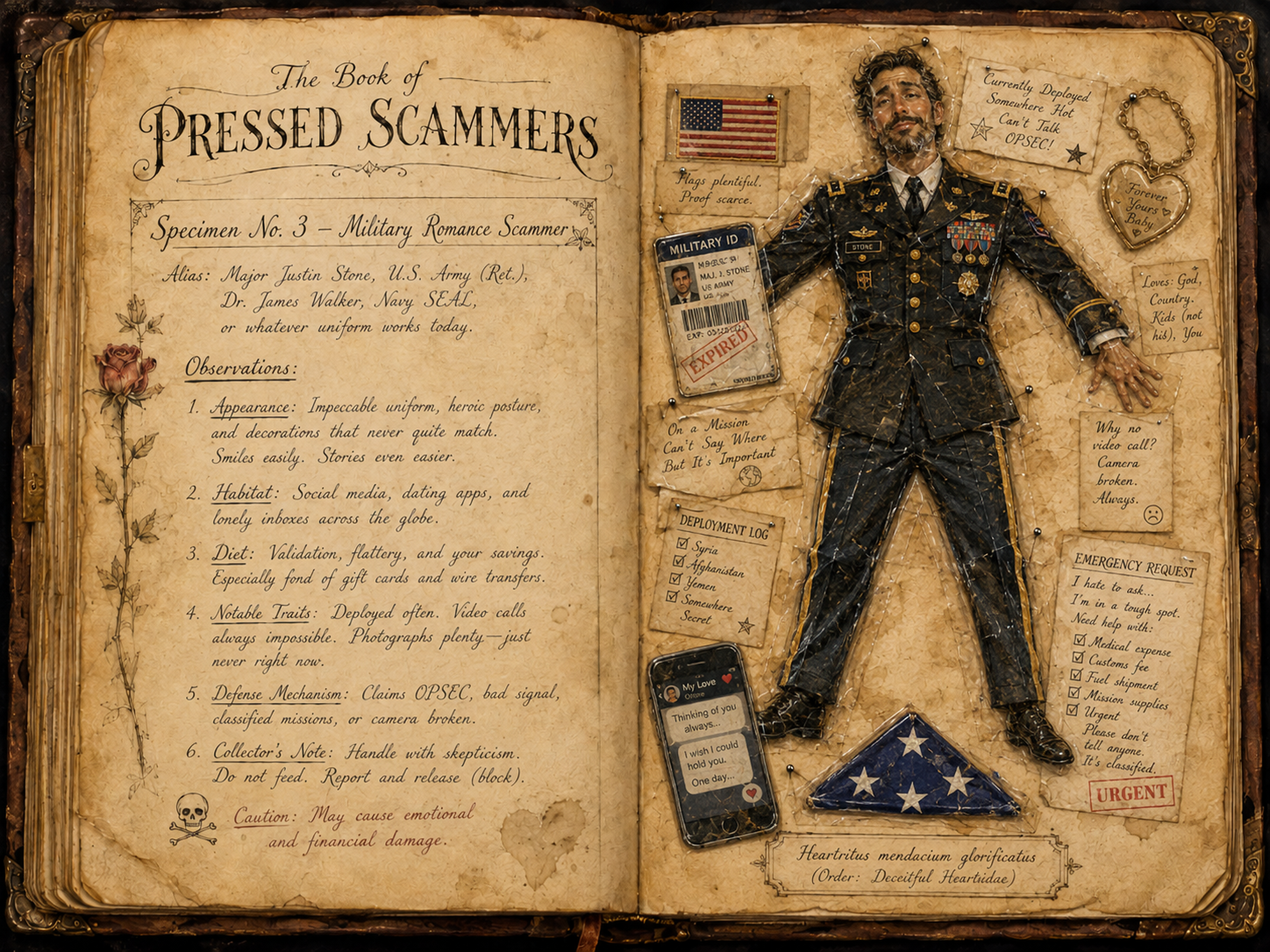
The reader can inspect the distinctive markings without being asked to send a gift card. One can examine the plumage without downloading a cryptocurrency application. One can contemplate the mating ritual without being informed that the specimen has unexpectedly been deployed to an undisclosed military location where video calls are forbidden but wire transfers remain mysteriously possible.
The preservation process has other advantages. A pressed scammer cannot delete a conversation, invent a customs officer, lose a passport, suffer an emergency appendectomy, become trapped on an oil rig, discover a new investment opportunity, or announce that an international lottery has selected the reader’s email address from several billion extraordinarily fortunate possibilities.
For Scientific Purposes, this is a Considerable Improvement
The classification system used throughout this collection should not be mistaken for conventional zoology. Latin has been employed where appropriate because nearly everything sounds more authoritative when written in Latin, particularly when nobody is entirely certain what it means. The scientific names assigned to the specimens should therefore be approached with the same healthy skepticism recommended for unsolicited investment opportunities and people who introduce themselves online as princes.
Nevertheless, the behaviors illustrated throughout the collection are anything but imaginary.
Behind the whimsy are real methods of deception that have harmed people around the world. Victims have lost savings, homes, businesses, relationships, confidence, health, and years of their lives to criminal manipulation. Many have also experienced profound psychological consequences after discovering that relationships, opportunities, investments, or emergencies they believed were real had been deliberately manufactured.
Humor Does Not Diminish that Harm
Sometimes humor helps expose it.
A scammer depends heavily upon emotional atmosphere. Urgency must feel urgent. Authority must feel intimidating. Romance must feel irresistible. Investment opportunities must feel exclusive. The victim must remain inside the story long enough for the deception to work.
Ridicule punctures the atmosphere.
- Once a supposed international financier has been pinned beside a fake trading graph and labeled *Cryptoromantica decepta*, some of the magic disappears.
- Once the decorated military hero who cannot possibly make a video call has been carefully flattened between two sheets of parchment, his mysterious operational security begins looking considerably less impressive.
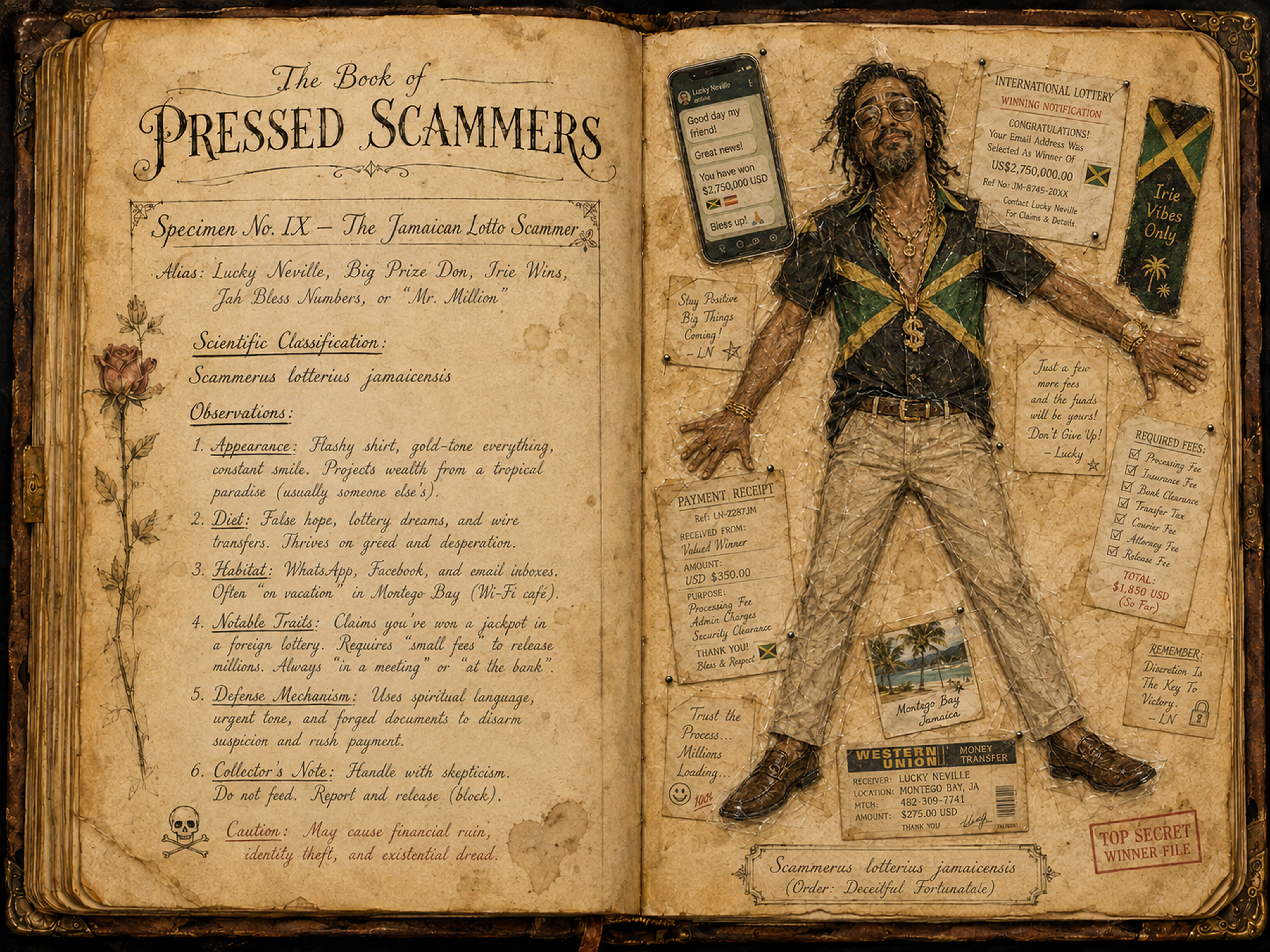
- Once the lottery official demanding the seventh processing fee has been properly classified as *Scammerus lotterius jamaicensis*, the specimen becomes less mysterious and more recognizable.
Recognition is one of the purposes of the collection. Another is perspective.
Scam victims frequently emerge from these crimes carrying shame that properly belongs to the offender. They can ask how they believed the story, why they trusted the person, or why they continued after doubts appeared. Examining scammer behavior from a distance helps reveal that the deception was not simply one foolish decision made by one individual. It was often a sustained process of manipulation designed to influence ordinary human emotions and decisions.
The specimens therefore deserve scrutiny. The victims deserve compassion. And the rest of us deserve the opportunity to laugh occasionally while learning where the danger actually resides.
Readers are encouraged to examine each specimen carefully. Note its habitat. Observe its preferred vocabulary. Study its feeding habits. Pay attention to its emergency rituals, camouflage, displays of authority, mating behavior, financial appetite, and remarkable ability to become temporarily unavailable whenever independent verification is suggested.
Should a living specimen be encountered in the wild, however, collection is strongly discouraged.
Do not attempt to press them personally. Block it. Report it. Preserve the evidence. And under no circumstances feed it.
The pages that follow contain specimens collected from some of the more curious branches of the fraudulent family tree. New species continue to emerge, and existing varieties mutate rapidly in response to technology, law enforcement, public awareness, and the unfortunate human habit of learning how yesterday’s scam worked shortly before tomorrow’s scam arrives.
The work of classification will therefore never be entirely complete.
Still, a beginning had to be made. This cabinet of curiosities is open. The specimens are dry. And, with any luck, none of them are moving.
We hope that you enjoy these still-life scammers in their unmoving pressed state.
PROF. EMERITUS TIM McGUINNESS, Ph.D.
Extraordinary Cataloguer of Rogue Specimens and Professor of Applied Scamology
Afterword
The Place of Whimsy and Humor in Healthy Recovery
Recovery from a relationship scam is serious work because the harm itself is serious. Victims can lose money, relationships, stability, confidence, trust, imagined futures, and their sense of safety in the world. They can experience grief, shame, anger, anxiety, confusion, intrusive memories, damaged self-trust, and profound difficulty reconciling what they believed with what they eventually discovered. None of this should be minimized, mocked, or treated casually.
At the same time, healthy recovery cannot remain solemn forever.
A person who has been traumatized can gradually become surrounded by seriousness. There are reports to make, accounts to secure, losses to understand, conversations with family members, recovery information to read, support meetings to attend, memories to reconsider, and emotions to process. The survivor can spend enormous amounts of time examining what happened and trying to understand why it happened. Even recovery itself can begin to feel like another burden demanding constant attention.
Humor and whimsy can create necessary openings in that seriousness.
They do not erase trauma. They do not make the crime less important, and they should never be used to ridicule the victim or dismiss genuine pain. Their value lies somewhere very different. Humor and whimsy remind the survivor that trauma is not entitled to occupy every emotional space indefinitely.
A person can grieve and laugh in the same week, the same day, and sometimes within the same conversation. Those experiences do not invalidate each other. Laughter does not mean that grief was exaggerated. Enjoyment does not mean that the survivor has forgotten what happened. A moment of absurdity does not mean the person has stopped taking recovery seriously. Instead, these moments can demonstrate that the survivor’s emotional world is beginning to expand again.
That expansion matters.
Trauma tends to narrow attention toward danger, loss, uncertainty, and unresolved questions. The mind repeatedly returns to the offender, the deception, the financial consequences, the messages, the memories, and the unanswered questions. Recovery eventually requires the world to become larger than those subjects.
Humor helps create that larger world.
A ridiculous observation, a playful argument, an embarrassing story, a strange historical fact, a terrible joke, or an absurd illustration can occupy attention without requiring the survivor to analyze anything. For several minutes, nothing needs to be solved. Nobody needs to understand the scam better. Nobody needs to explain why they believed something or why they still feel a particular emotion. The person is simply participating in ordinary human life.
That experience can be surprisingly important.
Whimsy has a related role. Whimsy introduces imaginative playfulness into environments that can otherwise become dominated by fear and seriousness. It permits people to approach difficult subjects indirectly, to exaggerate what deserves ridicule, and to reduce the apparent power of things that once seemed intimidating.
A scammer depends heavily upon psychological atmosphere. The offender tries to appear important, desirable, authoritative, mysterious, successful, desperate, endangered, powerful, or uniquely connected to the victim. The story works partly because the emotional atmosphere surrounding it is treated seriously.
Humor can puncture that atmosphere.
The supposedly brilliant international investor can look considerably less impressive when reduced to an obvious collection of predictable tactics. The mysterious military hero becomes less imposing when the contradictions in the story are made visible. The elaborate emergency loses some of its power when its repetitive absurdity becomes recognizable. The scammer who once appeared larger than life can eventually become smaller in the survivor’s mind.
That change in scale matters psychologically.
The victim once lived inside the scammer’s story. Recovery gradually allows the survivor to stand outside it and examine it. Humor can sometimes help create that distance because it changes the relationship between the survivor and the memory. The victim is no longer required to experience every reminder from the same emotional position that existed during the crime.
Eventually, some things can become ridiculous.
That does not mean the victim was ridiculous.
The distinction is essential.
The manipulation can be absurd without the victim being foolish. The scammer’s story can become laughable without the survivor’s attachment becoming laughable. A fabricated emergency can be mocked without mocking the person who responded compassionately to it. Humor should direct attention toward deception, contradiction, criminal behavior, and the absurd machinery of fraud rather than toward the humanity of the person who was harmed.
When humor is used this way, it can help relocate shame.
Victims frequently carry embarrassment about what happened. They can imagine that everyone else sees obvious warning signs that they somehow failed to recognize. They can replay decisions and interpret them through knowledge that was only available later. The scammer’s behavior can gradually become normalized in the victim’s memory because it was experienced repeatedly over time.
Whimsical reframing can expose how extraordinary some of those behaviors actually were.
- A fake customs officer requiring gift cards is absurd.
- A millionaire who cannot access enough money to purchase an airline ticket is absurd.
- A decorated military officer who can communicate continuously but can never participate in a spontaneous video call is suspiciously absurd.
- A cryptocurrency expert who promises guaranteed profits but requires increasingly large deposits before withdrawals become possible is absurd.
Once the survivor can see the absurdity from outside the manipulation, some of the shame can begin moving back toward the offender, where it belongs.
Humor can also help restore social connection. Trauma can make people cautious around others, particularly after interpersonal deception. Ordinary laughter creates experiences in which people respond to one another without manipulation, obligation, or hidden purpose. A person makes a joke, another person laughs, and nothing is demanded afterward. Someone tells an embarrassing story, other people respond warmly, and the relationship remains safe. People can tease one another gently, disagree over something trivial, or become completely distracted by an irrelevant subject and still remain connected.
These small social experiences help remind survivors that communication does not always contain hidden consequences.
The same principle applies to support communities. A healthy recovery environment should make room for grief, anger, education, reflection, accountability, and serious conversation. It should also make room for ordinary humanity. Members should be able to laugh, tell stories, discuss unrelated subjects, and occasionally be ridiculous together.
A support community that becomes permanently solemn risks unintentionally reinforcing the idea that trauma must remain the organizing center of life.
Recovery should move in the opposite direction.
The scam gradually becomes one part of personal history rather than the defining subject of every day. People recover hobbies. They develop new interests. They reconnect with family. They travel. They learn. They create. They complain about ordinary inconveniences. They laugh at things that have absolutely nothing to do with scams.
Those experiences are not distractions from recovery in the larger sense. They are evidence of recovery.
There is, however, an important boundary. Humor should never become a method of avoiding pain that still needs attention. Someone who jokes constantly to prevent any serious conversation can be using humor defensively rather than restoratively. A support provider who uses jokes to silence grief or move away from uncomfortable subjects can unintentionally communicate that painful emotions are unwelcome.
Healthy humor sits beside serious recovery rather than replacing it.
A survivor can discuss a devastating loss and later laugh about something unrelated. A group can spend part of a meeting examining painful betrayal and another part joking about something completely absurd. Both experiences belong within a psychologically healthy range.
The deeper purpose is flexibility.
Trauma can make emotional life rigid. Certain thoughts produce predictable reactions. Certain memories feel permanently painful. Certain subjects become impossible to approach. Healthy recovery gradually restores the ability to move between emotional states rather than becoming trapped inside one of them.
Humor and whimsy can help restore that movement.
A survivor who can laugh is not necessarily recovered. A survivor who cannot laugh is not necessarily failing. Recovery does not have a required emotional performance. But when genuine humor begins returning naturally, it can represent something valuable. It can mean that attention is no longer completely occupied by danger, grief, or the offender.
It can mean that parts of the person’s former emotional range are coming back.
The purpose of recovery is not to create someone who understands scams perfectly but remains psychologically imprisoned by what happened. The purpose is to help the person understand enough, process enough, and rebuild enough that life begins expanding again.
There should be room in that life for seriousness because serious things happened.
There should also be room for curiosity, absurdity, playfulness, laughter, and delight.
A scammer already took enough.
Recovery does not require giving the scammer the survivor’s sense of humor too.

-/ 30 /-
What do you think about this?
Please share your thoughts in a comment below!
GLOSSARY SEARCH
TOPIC SEARCH
TABLE OF CONTENTS








CATEGORIES
The Book of Pressed Scammers – Whimsy/Humor – 2026
Please Leave a Comment
Please Tell Us What You Learned From This?
Commenting Is An Essential Part Of Healing
Read • Think • Write
2 Comments
Leave A Comment Cancel reply
More ScamsNOW.com Articles









Love it! Without a sometimes-bizarre sense of humor, I would have gone insane a long time ago! Life can get way too serious if I’m not careful to find humor in all sorts of situations, whenever possible. And there are lots of categories of humor too. Someone might not agree with me that something or other is amusing, and that’s OK. That’s one of those characteristics that make each of us unique. And if someone needs me to listen to what they say in a serious manner, I can do that too. We humans have such a rich variety of emotions and ways of expressing them!
Thank you Barbara for your comment.