




Where You See The Future and What That Says About You – 2026

The SCARS Institute Magazine about Scam Victims-Survivors, Scams, Fraud & Cybercrime
- Published: 8/4/26
- Modified: 8/4/26
- Comments: 0
- Read Status:

Where You See The Future and What That Says About You
Where Do You Believe Humanity Stands in Its Own History? What Does This Say About Your Own Psychology and Recovery?
Primary Category: Psychology / Recoverology
Authors:
• Tim McGuinness, Ph.D., DFin, MCPO, MAnth – Anthropologist, Scientist, Polymath, Managing Director of the Society of Citizens Against Relationship Scams Inc.
Author Biographies Below
About This Article
A person’s belief that humanity is near the end, middle, or beginning of its history can reveal how they currently experience danger, continuity, uncertainty, and hope. For traumatized scam victims, the question can become autobiographical because betrayal trauma often changes their relationship with time and makes the future feel unsafe or unavailable. An end-oriented response can reflect threat sensitivity, pessimism, withdrawal, and a foreshortened future. A middle-oriented response can suggest growing tolerance for uncertainty, emotional integration, and recognition that trauma is a chapter rather than the whole life story. A beginning-oriented response can indicate renewed imagination, agency, purpose, and future participation, although excessive optimism can also conceal avoidance. The meaning depends on the explanation, emotional function, and personal consequences of the response.
Note: This article is intended for informational purposes and does not replace professional medical advice. If you are experiencing distress, please consult a qualified mental health professional.
Keywords
Betrayal Trauma, Future Orientation, Foreshortened Future, Recovery Mindset, Trauma Psychology, Reclaimed Agency, Psychological Flexibility, Posttraumatic Growth, Uncertainty Tolerance, Scam Victim Recovery

Where Do You Believe Humanity Stands in Its Own History?
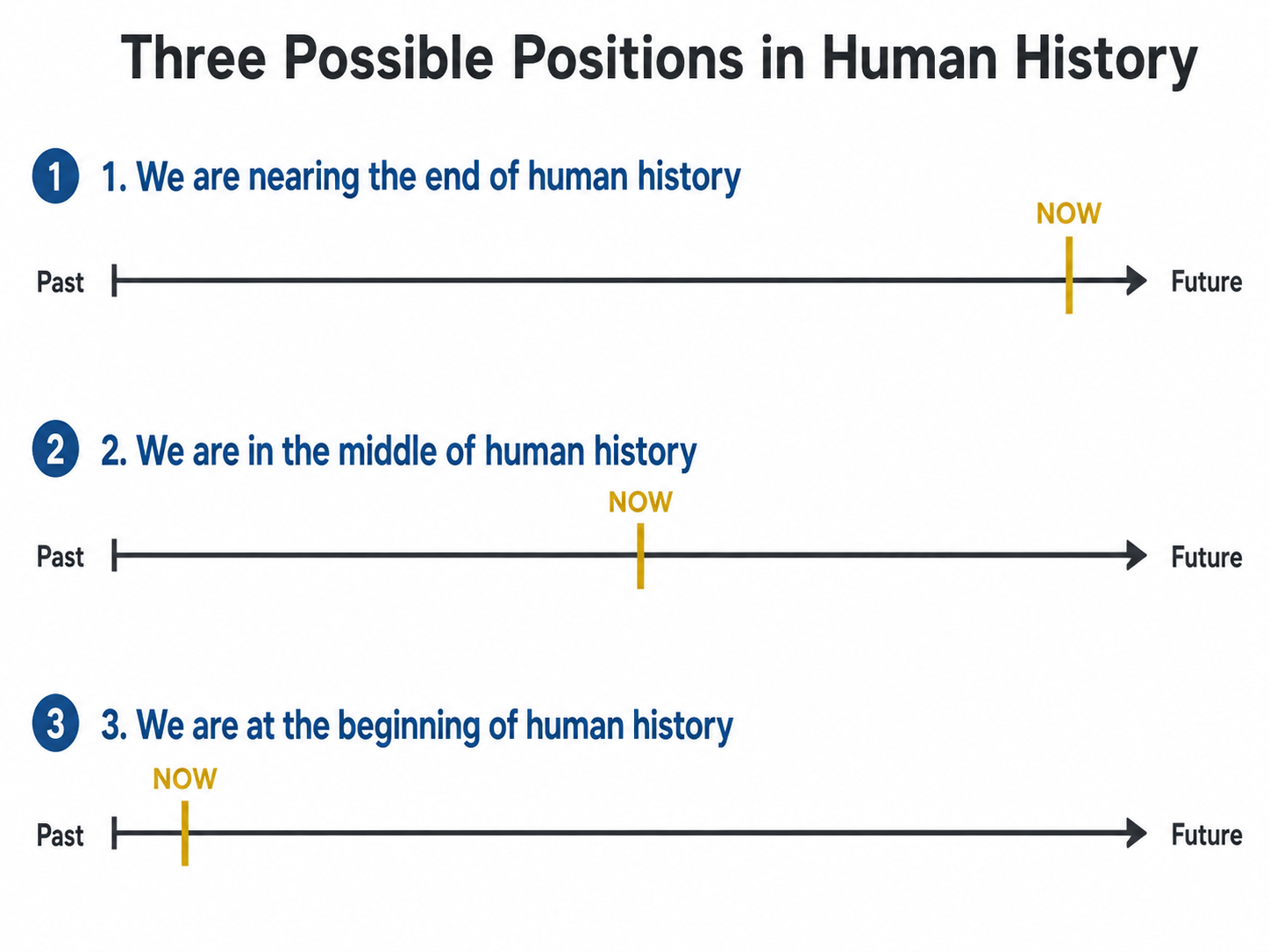
Is humanity near the end, somewhere in the middle, or still near the beginning of its history?
We recently asked a sample of traumatized scam victims to answer the above question. Interestingly, it was uniformly answered as option #1: near the end!
Author’s Note
The purpose of this inquiry is not to classify a person as optimistic, pessimistic, healthy, or unhealthy. It is to explore how betrayal trauma can shape the meaning of time, safety, possibility, and personal continuity. The most important information is not the option selected, but what that answer reveals about the person’s ability to imagine, enter, and participate in a future beyond the crime.
Prof. Emeritus Tim McGuinness, Ph.D.
August, 2026
A Question About Time, Trauma, and Recovery
At first glance, asking whether humanity is near the end, somewhere in the middle, or still near the beginning of its history appears to be a philosophical question. It invites speculation about civilization, technology, war, climate, religion, artificial intelligence, and the long-term survival of the human species. Yet for a traumatized scam victim, the answer can reveal something more immediate and personal.
It can reveal how the person currently experiences the future.
The question does not directly ask about the scam, the offender, the financial loss, or the trauma. This makes it psychologically useful. Instead of asking the victim to describe recovery in familiar terms, it asks them to project their present understanding of danger, continuity, and possibility onto the whole of human history. Their answer can reveal whether the future feels as though it is closing, continuing, or opening. In other words, are they pessimistic, neutral, or optimistic about the future, and by extension, about their future?
This is not a diagnostic question, and no answer should automatically be labeled healthy or unhealthy. A person can reach any of the three conclusions through thoughtful historical, religious, scientific, or political reasoning, though most often it is an emotional response. What matters most is not simply which answer the person selects. The deeper meaning lies in why they select it, how emotionally certain they feel, what evidence they emphasize, and what their answer allows them to imagine about their own life.
For the general population, the question is often abstract. For traumatized scam victims, it can become autobiographical.
Trauma can cause people to interpret the wider world through what happened to them personally. A victim who discovered that trust could be manufactured, love could be imitated, institutions could fail, and apparent safety could disappear without warning can begin to experience the scam as evidence about reality itself. The private betrayal becomes a general theory of human nature. The destruction of one future begins to resemble the destruction of every future.
The question therefore offers a way to explore how far the traumatic experience has expanded beyond the crime and entered the person’s worldview.
The Psychology Beneath the Question
Trauma changes more than mood. It can change the person’s relationship with time.
- Before the crime, the future might have felt largely continuous. The person could imagine next year, retirement, travel, family events, professional goals, relationships, or ordinary daily life. Even when uncertainty existed, the future remained psychologically available.
- After betrayal trauma, the future can become difficult to imagine. The person can feel suspended in the aftermath of the crime, unable to return to the life that existed before it and unable to picture a believable life beyond it. The past feels contaminated, the present feels unstable, and the future feels unsafe.
This altered relationship with time can shape the answer to the human-history question. The victim is not necessarily evaluating the probable lifespan of civilization. They can be expressing whether they personally believe continuity remains possible.
The answer can also reveal the person’s current relationship with uncertainty. Trauma often increases the need for certainty because uncertainty became the environment in which the crime developed. The person did not know who the offender truly was, what information was real, whether promised events would occur, or whether danger was approaching. Afterward, absolute conclusions can feel safer than ambiguity.
- “We are nearing the end” creates one kind of certainty.
- “We are in the middle” preserves uncertainty and continuity.
- “We are at the beginning” creates a different form of certainty, one based on possibility and expansion.
Each answer can therefore reveal not only optimism or pessimism, but how the person manages ambiguity, danger, hope, and the limits of their own knowledge.
Position One: We Are Nearing the End of Human History
For a traumatized scam victim, this answer can reflect a contracted future horizon. The future does not feel expansive. It feels short, fragile, threatened, and increasingly difficult to trust. The person can experience civilization in the same way they now experience their own life: as something that once appeared stable but could collapse without warning.
Trauma frequently heightens attention to danger. The mind begins scanning for evidence that another harmful event is developing. News about war, crime, political conflict, social instability, artificial intelligence, economic decline, climate change, or institutional failure can become incorporated into a larger conclusion that everything is deteriorating. it does not matter if that assessment is reality; it only matters how they feel about it.
The person might not merely believe that humanity faces serious risks. They can begin to believe that collapse is the natural and inevitable conclusion of human behavior.
This mirrors the psychological effect of betrayal. The scam can teach the victim that appearances cannot be trusted, good intentions can be exploited, and apparently safe relationships can hide predatory motives. Once this lesson becomes generalized, the person can begin to interpret civilization itself as another deceptive structure whose collapse is only beginning to become visible.
Their internal reasoning can take forms such as:
- “People cannot be trusted.”
- “Institutions do not protect anyone.”
- “Technology only gives criminals greater power.”
- “Everything eventually becomes corrupted.”
- “The future will be worse than the past.”
- “Safety is temporary.”
- “Another disaster is always approaching.”
This answer can also reflect a foreshortened sense of the future. The person might struggle to imagine a long, coherent, meaningful life beyond the trauma. They can make fewer plans, avoid commitments, withdraw from relationships, or feel that rebuilding is pointless because another loss will eventually destroy whatever they create.
Recovery then becomes defensive rather than developmental. The goal is not to build a meaningful future. It is to survive the next threat.
The person can remain vigilant, suspicious, and emotionally braced. They might learn scam-prevention information but use it primarily to reinforce the belief that danger is everywhere. They can become more knowledgeable without becoming more secure. Education is absorbed as evidence that the world is even more threatening than they previously understood.
This is an important distinction. Recovery education should increase awareness, but awareness without restored proportion can become hypervigilance.
In the general population, believing humanity is near its end can arise from religious eschatology, ecological concern, nuclear-risk analysis, political extremism, technological anxiety, or philosophical pessimism. A person can hold this belief while remaining emotionally stable, socially engaged, and personally hopeful.
For the traumatized scam victim, the question is whether the conclusion is primarily analytical or emotionally necessary. Does the person believe humanity is approaching its end because they have weighed evidence and reached that conclusion? Or do they need the world to be ending because their own world already ended?
- A useful recovery question is: “Do you believe the future is actually closing, or has trauma made it difficult for you to experience the future as open?”
- Another is: “If humanity had an enormous future ahead of it, would that feel hopeful to you, or would it feel unsafe to believe?”
The answer can reveal whether pessimism functions as analysis, protection, resignation, or avoidance of renewed hope.
Position Two: We Are in the Middle of Human History
For a traumatized scam victim, this answer can reflect a more integrated relationship with time. The person recognizes that much has already happened, much has been lost, and serious dangers remain. At the same time, they do not interpret the present crisis as the conclusion of the whole story.
This position represents continuity. The person can acknowledge that humanity has survived wars, pandemics, social collapse, persecution, exploitation, and extraordinary suffering. They can also recognize that survival is not guaranteed and progress is not automatic. The future remains uncertain, but uncertainty is no longer interpreted only as danger.
This is psychologically significant because trauma often produces absolute thinking. The mind moves toward conclusions such as “nothing is safe,” “everyone lies,” “I will never trust again,” or “my life has been destroyed.” These statements emerge from real pain, but they extend one experience into a total explanation.
The middle position allows differentiation.
- Some people are dangerous, but not everyone is dangerous.
- Some institutions fail, but not every institution is useless.
- Trust carries risk, but trust itself is not the enemy.
- The scam destroyed important parts of life, but it did not eliminate every possible future.
- Recovery is difficult, but difficulty does not make it impossible.
This position can indicate that the victim is beginning to place the traumatic experience within a larger life narrative. The scam remains important, but it no longer defines the meaning of everything that came before or everything that can come afterward.
The person can begin to say:
- “This was catastrophic, but it was not the end of my life.”
- “I lost a future, but I did not lose every future.”
- “I cannot return to who I was, but I can continue becoming someone.”
- “I remain vulnerable to harm, but I can also become more capable.”
- “I do not know what will happen, but I can participate in what happens next.”
This reflects growing tolerance for ambiguity. The person no longer requires the world to be completely safe before engaging with it. They can accept that recovery takes place under conditions of uncertainty.
That capacity is essential. No support provider, therapist, educational program, or prevention practice can guarantee that another betrayal will never occur. Recovery cannot be built on absolute certainty. It must be built on greater knowledge, stronger judgment, more effective boundaries, improved verification, emotional regulation, and the understanding that risk can be managed without pretending it can be eliminated.
In the general population, the middle position often reflects realism, moderation, institutional confidence, or pragmatic historical thinking. The person sees civilization as established but unfinished. Problems remain serious, yet reform, adaptation, and continuity remain possible.
For the scam victim, the same answer can carry a more personal meaning. It can suggest that the traumatic event has become a chapter rather than the final page.
The person has not necessarily reached peace. They can still experience grief, anger, fear, and intrusive memories. Recovery does not require the absence of pain. It requires that pain no longer occupy the whole timeline.
- A useful follow-up question is: “Can you imagine your life continuing even though you do not yet know what it will become?”
- Another is: “Do you experience the scam as the defining event of your life, or as one major event within a life that is still unfolding?”
The second answer can indicate that recovery is moving from survival toward integration.
Position Three: We Are at the Beginning of Human History
For a traumatized scam victim, this answer can reflect an expanding future horizon. Humanity appears unfinished, and the present becomes an early stage rather than a final decline. The person sees the possibility that knowledge, ethics, institutions, technology, and human understanding could continue developing across centuries or millennia.
Psychologically, this can represent the return of imagination.
Trauma often restricts imagination because imagining the future becomes dangerous. The victim once imagined a relationship, a shared life, financial security, belonging, or a new identity. The offender entered that imagined future and used it as an instrument of manipulation. Afterward, the person can become afraid of hope itself.
They can conclude that imagining a better future makes them vulnerable.
Choosing the beginning position can suggest that the person is recovering the ability to imagine a better future without immediately condemning imagination as foolishness. They can begin to understand that the offender exploited hope, but did not invalidate hope. The scammer weaponized trust, but did not prove that trust has no value. The fraudulent future was false, but the human capacity to build a real future remains.
The person begins asking different questions.
- Instead of asking only, “How do I make sure this never happens again?” they can ask, “What can I still create?”
- Instead of asking, “How do I recover what was taken?” they can ask, “What can I build that did not exist before?”
- Instead of seeing the current self as permanently damaged, they can see that self as unfinished.
This can reflect reclaimed agency, renewed curiosity, and a willingness to participate in life beyond the trauma. The person can begin contributing to others, developing new relationships, pursuing neglected goals, creating meaning from experience, or using what they learned to support safer communities.
The beginning position can also align with posttraumatic growth, but it should be interpreted carefully. Genuine growth does not require the person to claim that the trauma was beneficial. The crime was not a gift, and suffering does not become morally valuable merely because the person later develops strength or purpose.
Healthy growth means the person has expanded beyond what happened.
The trauma remains part of the story, but it no longer owns the future.
There is also a possible danger in this answer. Expansive optimism can become another form of avoidance. A person can speak enthusiastically about purpose, destiny, transformation, or helping others while remaining unwilling to grieve, examine the crime, accept financial reality, or address ongoing traumatic symptoms.
This is optimism without integration.
The person can use grand future narratives to escape the present rather than move through it. They might declare themselves fully recovered because they have found a mission, while unresolved shame, attachment, anger, or impulsivity continues beneath the surface.
Healthy future orientation remains connected to reality. It includes practical choices, emotional honesty, ongoing learning, and acceptance of loss. It does not require denying pain.
In the general population, the beginning position commonly reflects technological optimism, long-term thinking, scientific humanism, transhumanism, space-faring visions, or confidence in humanity’s capacity for progress.
For the traumatized scam victim, it can mean something more intimate:
- “My life is not over.”
- “My capacity for trust is not over.”
- “My ability to contribute is not over.”
- “My identity is not finished.”
- “The future is larger than what happened to me.”
This is the optimistic view.
- A useful follow-up question is: “When you imagine an enormous human future, can you also imagine yourself belonging within it?”
- Another is: “Are you moving toward the future, or using the future to avoid the present?”
That distinction separates grounded hope from psychological escape.
The Contrast With the General Population
Among people without a recent traumatic disruption, the question generally reflects philosophy, politics, religion, scientific knowledge, or temperament. Their answer can express optimism or pessimism without revealing a major disturbance in their sense of personal continuity.
- A member of the general population can believe humanity is near its end while continuing to plan, love, work, invest, travel, and imagine a meaningful personal future. Their civilizational pessimism does not necessarily control their daily functioning.
- A traumatized scam victim can answer the same way because the personal future has become psychologically unavailable. The answer is then less about humanity and more about the victim’s own inability to imagine continuation.
Likewise, a member of the general population can believe humanity is near the beginning because of space exploration, artificial intelligence, biotechnology, or long-term demographic reasoning. A scam victim can choose it because they are beginning to recover hope, or because they are escaping into grand possibilities to avoid unresolved grief.
The difference is not the answer itself. It is the psychological work the answer is performing.
- For the general population, the answer often describes a worldview.
- For the traumatized person, it can also regulate emotion, defend against uncertainty, preserve despair, justify withdrawal, support endurance, or permit renewed hope.
This is why the person’s explanation matters more than the selection.
The Three Recovery Mindsets
The three positions can be understood as three possible relationships with the future.
The Future Is Closing
The person is organized around threat, loss, urgency, and anticipated destruction. They can believe that recovery offers only temporary protection from an increasingly dangerous world. Their attention remains fixed on what can go wrong, and hope itself can feel unsafe.
The Future Is Continuing
The person recognizes that the traumatic period is serious but not final. They can hold loss and possibility at the same time. Recovery becomes the process of reentering an unfinished life rather than escaping a permanently ruined one.
The Future Is Opening
The person can imagine possibilities beyond survival. They begin orienting toward creation, contribution, relationship, purpose, and growth. The future is no longer merely where danger will come from. It becomes somewhere they can go.
These positions should not be treated as fixed stages. A person can move among them. They can feel that the future is opening one day and closing the next. Emotional activation, anniversaries, financial stress, renewed contact from an offender, family conflict, or frightening world events can temporarily contract the future again.
Recovery does not require the person to remain optimistic at all times. It requires increasing flexibility. The person gradually becomes able to notice when trauma is shaping the meaning of the future and to reconsider that interpretation rather than automatically accepting it as fact.
The Most Revealing Follow-Up
The original question becomes most useful when followed by a second question: “What does your answer make possible for you, and what does it make impossible?”
- If the person believes humanity is near its end, does that make planning feel pointless? Does it justify withdrawal, suspicion, or refusal to rebuild?
- If the person believes humanity is in the middle, does that allow patience, continuity, and gradual recovery? Does it help them understand that one catastrophic period does not define the entire human story or their personal story?
- If the person believes humanity is near its beginning, does that restore curiosity and participation? Or does it permit them to avoid grief by escaping into an idealized future?
The answer reveals what the worldview does, not merely what it says.
A second revealing question is: “Where are you in your own history?”
- Do you feel that your meaningful life is ending?
- Do you feel that you are somewhere in the middle, passing through a devastating but survivable chapter?
- Or do you believe that, despite everything that happened, the most meaningful part of your life could still be ahead?
That question reaches the deeper purpose of the exercise. The location assigned to humanity can become a mirror for the location assigned to the self.
The traumatized scam victim is not only being asked to consider the future of civilization. They are being invited to notice whether trauma has closed their future, whether recovery has restored continuity, or whether they are beginning to imagine an entirely new life beyond what was taken from them.
Conclusion
Where you believe humanity stands in its own history can reveal how you currently experience your own future. When trauma has narrowed your sense of time, the world can appear to be approaching collapse because your personal world already collapsed. Danger can seem more powerful than resilience, institutions can appear incapable of protecting anyone, and rebuilding can feel pointless when another loss seems inevitable. In that state, the future becomes something to defend against rather than somewhere you can live.
Recovery gradually restores proportion. You begin to recognize that the crime was catastrophic without allowing it to become the explanation for all human behavior or every future possibility. You can acknowledge that some people are dangerous without concluding that everyone is dangerous. You can accept that trust carries risk without deciding that trust itself must be abandoned. The traumatic experience remains part of your history, but it no longer has to occupy your entire timeline.
Eventually, the future can begin to open again. This does not require forced optimism, denial of loss, or the belief that suffering was beneficial. It requires enough psychological flexibility to imagine that life can continue without knowing exactly what it will become. You can grieve the future that was stolen while still creating another one.
The deeper question is not only where humanity stands in its history. It is where you believe you stand in yours. Your answer can reveal whether trauma has convinced you that your meaningful life is ending, whether you are moving through a survivable chapter, or whether you are beginning to believe that much of your life remains unwritten.

Glossary
- Absolute Conclusions — Absolute conclusions are rigid beliefs that describe people, safety, trust, or the future in total and unqualified terms. Betrayal trauma can produce statements such as everyone lies, nothing is safe, or life will never improve. Recognizing these conclusions helps scam victims replace total judgments with more accurate and flexible interpretations. — Belief Distortion
- Ambiguity Tolerance — Ambiguity tolerance is the ability to remain emotionally present when an outcome, explanation, or future direction is not completely known. Scam victims often struggle with uncertainty because deception developed within an environment of missing, false, and contradictory information. Greater tolerance allows the person to continue recovering without requiring guarantees that no future harm will ever occur. — Emotional Regulation
- Analytical Pessimism — Analytical pessimism is a negative conclusion about humanity or the future that results from deliberate consideration of evidence rather than trauma-driven emotional necessity. A person can hold serious concerns about civilization while remaining engaged, hopeful, and functional in personal life. Distinguishing analysis from trauma-based pessimism helps clarify what psychological purpose the belief currently serves. — Reality Testing
- Anticipated Destruction — Anticipated destruction is the expectation that another major loss, betrayal, or collapse will eventually destroy anything the person rebuilds. This expectation can discourage planning, commitment, relationships, and meaningful participation in life. Recovery helps the person recognize that possible future harm does not make all rebuilding pointless. — Future Orientation
- Autobiographical Projection — Autobiographical projection occurs when a person interprets a broad philosophical question through the emotional meaning of personal experience. A traumatized scam victim can describe humanity as ending because their own world feels as though it already ended. Recognizing this projection helps separate civilizational judgment from the psychological effects of personal betrayal. — Psychological Process
- Catastrophic Generalization — Catastrophic generalization occurs when one devastating experience becomes evidence that all people, institutions, technologies, or futures are dangerous. The scam becomes more than a crime and begins functioning as a general explanation of reality. Recovery requires the person to acknowledge the catastrophe without extending it into every part of human existence. — Belief Distortion
- Civilizational Pessimism — Civilizational pessimism is the belief that society, humanity, or major institutions are moving toward decline or collapse. In the general population, this belief can arise from political, environmental, religious, or technological concerns. In traumatized scam victims, it can also express a personal inability to imagine safety, stability, or continuity after betrayal. — Worldview Pattern
- Continuity Belief — Continuity belief is the understanding that life can continue even after a catastrophic and permanently changing event. The person does not deny the severity of the scam or expect life to return to its previous form. Instead, the person begins to recognize that the future remains available even when its exact shape is unknown. — Recovery Insight
- Contracted Future Horizon — A contracted future horizon is a narrowed ability to imagine a long, coherent, or meaningful life ahead. The future can feel short, unsafe, fragile, or unavailable after betrayal trauma. Expanding this horizon allows the person to move from temporary survival toward planning, participation, and renewed development. — Trauma Response
- Defensive Recovery — Defensive recovery is an approach focused primarily on preventing another threat rather than building a meaningful future. The person can learn extensively about scams while using that knowledge mainly to confirm that danger exists everywhere. Recovery becomes more balanced when awareness supports safety without turning life into permanent vigilance. — Recovery Process
- Differentiated Thinking — Differentiated thinking is the ability to recognize important distinctions instead of interpreting reality through absolute categories. A person can understand that some people are dangerous without concluding that everyone is dangerous. This form of thinking supports safer trust, more accurate judgment, and greater emotional flexibility. — Cognitive Process
- Emotional Necessity — Emotional necessity occurs when a belief feels psychologically required because it protects the person from uncertainty, hope, grief, or vulnerability. A victim can need the future to appear hopeless because renewed hope feels dangerous after exploitation. Identifying this function helps determine whether a conclusion reflects evidence or emotional self-protection. — Emotional Regulation
- Expanding Future Horizon — An expanding future horizon is the restored ability to imagine possibilities beyond the immediate aftermath of trauma. The person begins to see the future as a place for relationships, contribution, purpose, and new experiences. This expansion suggests that trauma no longer completely controls the person’s understanding of what remains possible. — Future Orientation
- Foreshortened Future — A foreshortened future is the trauma-related expectation that meaningful life, safety, relationships, or personal development will not continue for very long. The person can avoid plans because the future feels unreal, inaccessible, or likely to end badly. Recovery helps restore the ability to imagine continuity without demanding certainty. — Trauma Response
- Future Availability — Future availability is the psychological sense that a person has access to a believable and usable future. Before betrayal, future plans often feel natural and emotionally reachable. Trauma can make the future feel absent, while recovery gradually restores the capacity to imagine and participate in what comes next. — Future Orientation
- Future Closing — Future closing is the perception that possibility, safety, and meaningful life are narrowing or approaching an end. The person becomes organized around loss, threat, urgency, and expected collapse. This mindset can turn recovery into a defensive effort to endure danger rather than a process of rebuilding life. — Recovery Mindset
- Future Continuation — Future continuation is the belief that life remains unfinished despite severe loss and lasting change. The person recognizes that the traumatic experience is a major chapter but not the conclusion of the entire story. This position supports patience, gradual recovery, and participation under uncertain conditions. — Recovery Mindset
- Future Opening — Future opening is the perception that meaningful possibilities are becoming visible again after trauma. The person can imagine creating, contributing, trusting carefully, and developing beyond the identity shaped by the crime. This mindset reflects renewed possibility while remaining grounded in reality and acknowledged loss. — Recovery Mindset
- Future Participation — Future participation is the willingness to become actively involved in a life that has not yet been fully defined. The person stops relating to the future only as a source of danger. Participation can include planning, learning, building relationships, helping others, and pursuing meaningful goals. — Recovery Participation
- Generalized Betrayal — Generalized betrayal occurs when the meaning of one offender’s deception expands into a belief that people, institutions, and systems are fundamentally untrustworthy. The person can interpret every appearance of safety as possible manipulation. Recovery helps restore distinctions between actual warning signs, ordinary uncertainty, and trauma-generated suspicion. — Trust Distortion
- Grounded Hope — Grounded hope is a future-oriented belief that remains connected to reality, responsibility, grief, and practical action. It does not require the person to deny the crime, minimize loss, or claim that suffering was beneficial. Grounded hope allows possibility to return without becoming fantasy or emotional escape. — Hope Restoration
- Historical Positioning — Historical positioning is the act of locating humanity near the beginning, middle, or end of its possible history. The selected position can reflect philosophy, politics, religion, scientific reasoning, or emotional experience. For traumatized scam victims, it can also reveal whether their personal future feels closed, continuous, or open. — Projective Insight
- Hope Avoidance — Hope avoidance is the reluctance to imagine a positive future because hope was previously exploited by an offender. The person can experience optimism as dangerous, naive, or likely to produce another betrayal. Recovery helps separate the human capacity for hope from the criminal misuse of that capacity. — Hope Distortion
- Human History Projection — Human history projection occurs when a person places their current emotional relationship with the future onto the imagined timeline of humanity. A victim who feels personally finished can conclude that civilization is also nearing its end. The projection becomes useful when it helps reveal how trauma has shaped expectations about continuity and possibility. — Projective Insight
- Hypervigilant Awareness — Hypervigilant awareness is an intensified focus on danger that develops when prevention knowledge becomes organized around constant threat detection. The person can become highly informed about scams while feeling less secure rather than more capable. Healthy recovery education increases awareness while also restoring proportion, judgment, and emotional regulation. — Trauma Activation
- Identity Unfinishedness — Identity unfinishedness is the recognition that the current trauma-affected self is not the person’s final form. The scam can alter identity, confidence, trust, and future expectations without permanently determining who the person will become. This understanding supports renewed development and agency beyond the crime. — Identity Recovery
- Imagination Recovery — Imagination recovery is the return of the ability to envision a meaningful future after imagination was exploited during the scam. The offender used anticipated love, security, belonging, or shared life to manipulate the victim. Recovery allows the person to imagine again without treating all hope or possibility as evidence of foolishness. — Human Imagination
- Institutional Distrust — Institutional distrust is the belief that governments, financial institutions, law enforcement, technology companies, or support systems cannot or will not protect people. Scam victimization can intensify this belief when reporting, intervention, or financial recovery efforts fail. Recovery requires realistic evaluation of institutional limits without concluding that every system is useless or hostile. — Support Systems
- Life Narrative Integration — Life narrative integration is the process of placing the scam and its traumatic effects within the larger story of the person’s life. The event remains significant without defining everything that came before or everything that can follow. Integration allows the person to experience the crime as part of personal history rather than the total meaning of identity. — Recovery Process
- Meaningful Future — A meaningful future is an imagined life that contains purpose, connection, contribution, development, or belonging beyond the traumatic event. It does not require the restoration of the exact future that the scam destroyed. Recovery supports the creation of new possibilities that are real, grounded, and personally significant. — Future Orientation
- Optimism Without Integration — Optimism without integration occurs when positive future language is used to avoid grief, financial reality, traumatic symptoms, or unresolved attachment. The person can describe purpose, transformation, or growth while remaining emotionally organized around the crime. Genuine recovery connects hope with honest reflection, practical action, and acceptance of loss. — Hope Distortion
- Personal Continuity — Personal continuity is the sense that a person remains connected across the past, present, and future despite major psychological disruption. Betrayal trauma can make the former self feel lost and the future self feel unimaginable. Recovery restores continuity by helping the person understand that identity can change without disappearing. — Identity Recovery
- Personal Timeline — A personal timeline is the internal organization of life into what existed before the crime, what is happening now, and what can still occur. Trauma can cause the aftermath to occupy the entire timeline. Recovery helps the person recognize that the crime is a major period within life rather than the whole of life. — Time Perspective
- Philosophical Projection — Philosophical projection occurs when an abstract belief about humanity carries unrecognized personal emotional meaning. A statement about civilization can function as a statement about the person’s own hope, safety, or expected survival. Exploring the reasoning behind the belief helps separate intellectual judgment from trauma-shaped interpretation. — Psychological Process
- Posttraumatic Expansion — Posttraumatic expansion is the development of greater purpose, participation, perspective, or personal capacity after trauma has been processed and integrated. It does not make the crime beneficial or morally necessary. The person expands beyond what happened without denying the suffering, damage, and injustice involved. — Posttraumatic Growth
- Pragmatic Historical Thinking — Pragmatic historical thinking views civilization as established, imperfect, adaptable, and unfinished. The person recognizes serious dangers without assuming immediate collapse or unlimited progress. For scam victims, this perspective can reflect a growing ability to hold loss, risk, continuity, and possibility at the same time. — Reality Testing
- Present Escape — Present escape occurs when a person uses grand ideas about the future to avoid current grief, responsibility, or emotional pain. The future becomes a psychological hiding place rather than a direction supported by present action. Recovery requires hope that remains connected to current realities and practical participation. — Avoidance Pattern
- Psychological Flexibility — Psychological flexibility is the ability to reconsider interpretations, tolerate changing emotions, and respond according to present evidence rather than rigid trauma-based beliefs. The person can feel afraid without concluding that all danger is inevitable. This flexibility allows movement among grief, caution, hope, and participation without becoming permanently trapped in one state. — Emotional Regulation
- Psychological Work of Belief — The psychological work of belief refers to the emotional function a worldview performs for the person who holds it. A belief can preserve despair, justify withdrawal, create certainty, support endurance, or permit hope. Understanding this function is often more useful than evaluating only whether the belief sounds optimistic or pessimistic. — Recovery Insight
- Recovery Mindset — A recovery mindset is the person’s current orientation toward danger, continuity, possibility, and participation after victimization. It influences whether recovery feels pointless, survivable, or capable of producing a new life. The mindset can change over time as trauma is processed and psychological flexibility increases. — Recovery Process
- Recovery Proportion — Recovery proportion is the ability to recognize danger without allowing danger to define the entire world. The person learns that scam awareness should strengthen judgment rather than create permanent fear. Restored proportion allows caution, trust, uncertainty, and hope to coexist more realistically. — Reality Testing
- Renewed Curiosity — Renewed curiosity is the return of interest in experiences, ideas, relationships, and possibilities beyond the scam. Trauma can narrow attention until the person focuses mainly on loss, danger, and explanation. Curiosity signals that psychological energy is beginning to move outward toward life again. — Recovery Participation
- Risk Management — Risk management is the practical acceptance that safety can be strengthened without being guaranteed. The person uses education, boundaries, verification, judgment, and emotional regulation to reduce vulnerability. This approach replaces the impossible demand for complete certainty with realistic and informed protective practices. — Victim Safety
- Safety Temporariness — Safety temporariness is the belief that every period of stability will eventually be interrupted by betrayal or disaster. The person can remain emotionally braced even when no immediate threat exists. Recovery helps distinguish the possibility of future harm from the expectation that safety must always collapse. — Belief Distortion
- Threat-Dominated Attention — Threat-dominated attention occurs when the mind repeatedly prioritizes information about danger, decline, deception, or approaching harm. Neutral or positive evidence receives less psychological weight than information confirming risk. This pattern can make the world appear increasingly dangerous even as the person becomes objectively safer and more informed. — Trauma Response
- Time Relationship — A time relationship is the way a person emotionally experiences the past, present, and future. Betrayal trauma can contaminate the past, destabilize the present, and make the future feel unsafe. Recovery gradually restores a more continuous relationship with time and allows meaningful planning to return. — Time Perspective
- Trauma-Shaped Worldview — A trauma-shaped worldview is a broad understanding of people, institutions, trust, and the future that has been reorganized around the meaning of the traumatic event. The person can treat the scam as evidence of how all reality operates. Recovery helps preserve the lessons of the crime without allowing one offender to define the entire human world. — Worldview Pattern
- Uncertainty Intolerance — Uncertainty intolerance is the difficulty of remaining emotionally stable when information, outcomes, or future conditions cannot be known with confidence. Scam victims can develop this difficulty because uncertainty was repeatedly used to manipulate attention, emotion, and decision-making. Recovery strengthens the ability to act responsibly without waiting for complete certainty. — Psychological Vulnerability
- Worldview Function — Worldview function refers to what a person’s general beliefs allow or prevent them from doing psychologically and behaviorally. A worldview can support planning, withdrawal, suspicion, endurance, or renewed participation. Examining its function helps reveal whether the belief advances recovery or protects trauma-driven avoidance. — Recovery Insight
- Worldview Generalization — Worldview generalization occurs when conclusions drawn from the scam expand into broad beliefs about humanity, society, technology, relationships, or the future. The private betrayal becomes a total explanation of human behavior. Recovery helps the person retain appropriate caution while limiting conclusions to what the available evidence actually supports. — Belief Distortion
Sources & References
- Shattering World Assumptions: A Prospective View of the Impact of Adverse Events on World Assumptions
Eric R. Schuler and Adriel Boals
https://pubmed.ncbi.nlm.nih.gov/26214070/ - From Shattered Assumptions to Weakened Worldviews: Trauma Symptoms Signal Anxiety Buffer Disruption
Donald Edmondson, Stephenie R. Chaudoir, Mary Alice Mills, Crystal L. Park, Julie Holub, and Jennifer M. Bartkowiak
https://pubmed.ncbi.nlm.nih.gov/24077677/ - When the Future Escapes: Study of the Sense of Control in Predictions About the Future Over Time After Exposure to a Traumatic Event
Laura Charretier, Mickael Laisney, Jacques Dayan, Florence Fraisse, Denis Peschanski, Vincent de La Sayette, Pierre Gagnepain, Francis Eustache, and Peggy Quinette
https://pubmed.ncbi.nlm.nih.gov/40214111/ - Psychological Predictors of the Time Perspective: The Role of Posttraumatic Stress Disorder, Posttraumatic Growth, and Temporal Triggers in a Sample of Bereaved Adults
Leia Y. Saltzman and Lauren Terzis
https://pubmed.ncbi.nlm.nih.gov/38427669/ - Trapped in Time: Time Perspective Explains PTSD Symptom Severity Following Childhood Abuse
Anastasia Keidar, Lee Gafter, and Yael Lahav
https://pubmed.ncbi.nlm.nih.gov/40250022/ - The Mediating Effect of World Assumptions on the Relationship Between Trauma Exposure and Depression
Michelle M. Lilly, Christine E. Valdez, and Sandra A. Graham-Bermann
https://pubmed.ncbi.nlm.nih.gov/20829232/ - The Trajectory of Bombing-Related Posttraumatic Stress Disorder Among Iraqi Civilians: Shattered World Assumptions and Altered Self-Capacities as Mediators; Attachment and Crisis Support as Moderators
Man Cheung Chung and Fuaad Mohammed Freh
https://pubmed.ncbi.nlm.nih.gov/30634110/ - Posttraumatic Stress or Posttraumatic Growth? Using Network Analysis to Explore the Relationships Between Coping Styles and Trauma Outcomes
Jacqueline Peters, Benjamin W. Bellet, Payton J. Jones, Gwyneth W. Y. Wu, Li Wang, and Richard J. McNally
https://pubmed.ncbi.nlm.nih.gov/33524701/ - Posttraumatic Growth in Accident Survivors: Openness and Optimism as Predictors of Its Constructive or Illusory Sides
Tanja Zoellner, Sirko Rabe, Anke Karl, and Andreas Maercker
https://pubmed.ncbi.nlm.nih.gov/18302209/ - Posttraumatic World Assumptions Among Treatment-Seeking Refugees
F. Jackie June Ter Heide, Marieke Sleijpen, and Niels van der Aa
https://pubmed.ncbi.nlm.nih.gov/29226792/
Author Biographies
Author Biography
Prof. (Emeritus) Tim McGuinness, Ph.D. DFin is a co-founder, Managing Director, and Chairman of the SCARS Institute (Society of Citizens Against Relationship Scams Inc.), where he serves as an unsalaried volunteer officer dedicated to supporting scam victims and survivors around the world. With over 34 years of experience in scam education and awareness, he is perhaps the longest-serving advocate in the field.
Dr. McGuinness has an extensive background as a business pioneer, having co-founded several technology-driven enterprises, including the former e-commerce giant TigerDirect.com. Beyond his corporate achievements, he is actively engaged with multiple global think tanks where he helps develop forward-looking policy strategies that address the intersection of technology, ethics, and societal well-being. He is also a computer industry pioneer (he was an Assistant Director of Corporate Research Engineering at Atari Inc. in the early 1980s) and invented core technologies still in use today.
His professional identity spans a wide range of disciplines. He is a scientist, strategic analyst, solution architect, advisor, public speaker, published author, roboticist, Navy veteran, and recognized polymath. He holds numerous certifications, including those in cybersecurity from the United States Department of Defense under DITSCAP & DIACAP, continuous process improvement and engineering and quality assurance, trauma-informed care, grief counseling, crisis intervention, and related disciplines that support his work with crime victims.
Dr. McGuinness was instrumental in developing U.S. regulatory standards for medical data privacy called HIPAA and financial industry cybersecurity called GLBA. His professional contributions include authoring more than 1,000 papers and publications in fields ranging from scam victim psychology and neuroscience to cybercrime prevention and behavioral science.
“I have dedicated my career to advancing and communicating the impact of emerging technologies, with a strong focus on both their transformative potential and the risks they create for individuals, businesses, and society. My background combines global experience in business process innovation, strategic technology development, and operational efficiency across diverse industries.”
“Throughout my work, I have engaged with enterprise leaders, governments, and think tanks to address the intersection of technology, business, and global risk. I have served as an advisor and board member for numerous organizations shaping strategy in digital transformation and responsible innovation at scale.”
“In addition to my corporate and advisory roles, I remain deeply committed to addressing the rising human cost of cybercrime. As a global advocate for victim support and scam awareness, I have helped educate millions of individuals, protect vulnerable populations, and guide international collaborations aimed at reducing online fraud and digital exploitation.”
“With a unique combination of technical insight, business acumen, and humanitarian drive, I continue to focus on solutions that not only fuel innovation but also safeguard the people and communities impacted by today’s evolving digital landscape.”
Dr. McGuinness brings a rare depth of knowledge, compassion, and leadership to scam victim advocacy. His ongoing mission is to help victims not only survive their experiences but transform through recovery, education, and empowerment.
-/ 30 /-
What do you think about this?
Please share your thoughts in a comment below!
GLOSSARY SEARCH
TOPIC SEARCH
TABLE OF CONTENTS








CATEGORIES
More ScamsNOW.com Articles