



Your Brain’s Memory System with Trauma – 2026

The SCARS Institute Magazine about Scam Victims-Survivors, Scams, Fraud & Cybercrime

- Published: 7/30/26
- Modified: 7/30/26
- Comments: 1
- Read Status:

Your Brain’s Memory System with Trauma
How Memories Are Created and Recalled Normally, and How Psychological Trauma Changes the Process
Primary Category: Neurology / Psychology / Recoverology
Authors:
• Tim McGuinness, Ph.D., DFin, MCPO, MAnth – Anthropologist, Scientist, Polymath, Managing Director of the Society of Citizens Against Relationship Scams Inc.
Author Biographies Below
About This Article
Human memory is an active, distributed, and reconstructive process rather than an exact recording of experience. Attention determines which information enters working memory, while encoding, consolidation, storage, and retrieval shape what later becomes accessible. Psychological trauma can shift brain processing toward survival, strengthening emotional significance, bodily sensations, threat associations, and defensive responses while weakening chronology, context, and peripheral detail. Traumatic memories can return through intrusive thoughts, images, nightmares, emotions, physical reactions, or flashbacks that feel immediate. Memory gaps and inconsistencies can result from narrowed attention, dissociation, extreme arousal, sleep disruption, or later reconstruction. Recovery involves placing the event within accurate time and context, reducing automatic threat activation, and integrating the experience into a coherent life narrative.
Note: This article is intended for informational purposes and does not replace professional medical advice. If you are experiencing distress, please consult a qualified mental health professional.
Keywords
Human Memory, Trauma Memory, Memory Encoding, Memory Consolidation, Memory Retrieval, Memory Reconstruction, Reconsolidation, Intrusive Memories, Dissociation, Contextual Processing

Your Brain’s Memory System – How Memories Are Created and Recalled Normally, and How Psychological Trauma Changes the Process
Author’s Note
Human memory and the brain’s memory system are often misunderstood as a permanent recording of experience. Memory actually develops through attention, interpretation, encoding, consolidation, retrieval, reconstruction, and reconsolidation. Psychological trauma can alter these processes by prioritizing threat, emotional significance, bodily sensation, and survival responses over chronology, context, and peripheral detail. Understanding these differences can help survivors and those supporting them respond to memory gaps, inconsistencies, intrusive recollections, and changing interpretations with greater accuracy and compassion.
Prof. Emeritus Tim McGuinness, Ph.D.
July, 2026
1: Memory Is a Living Brain Process
Human memory is not a recording system. The brain does not preserve an exact audiovisual copy of an experience and then replay it unchanged. Memory is a biological and psychological process through which the brain selects information, interprets it, links it with existing knowledge, stabilizes portions of it, and later reconstructs an account of what occurred.
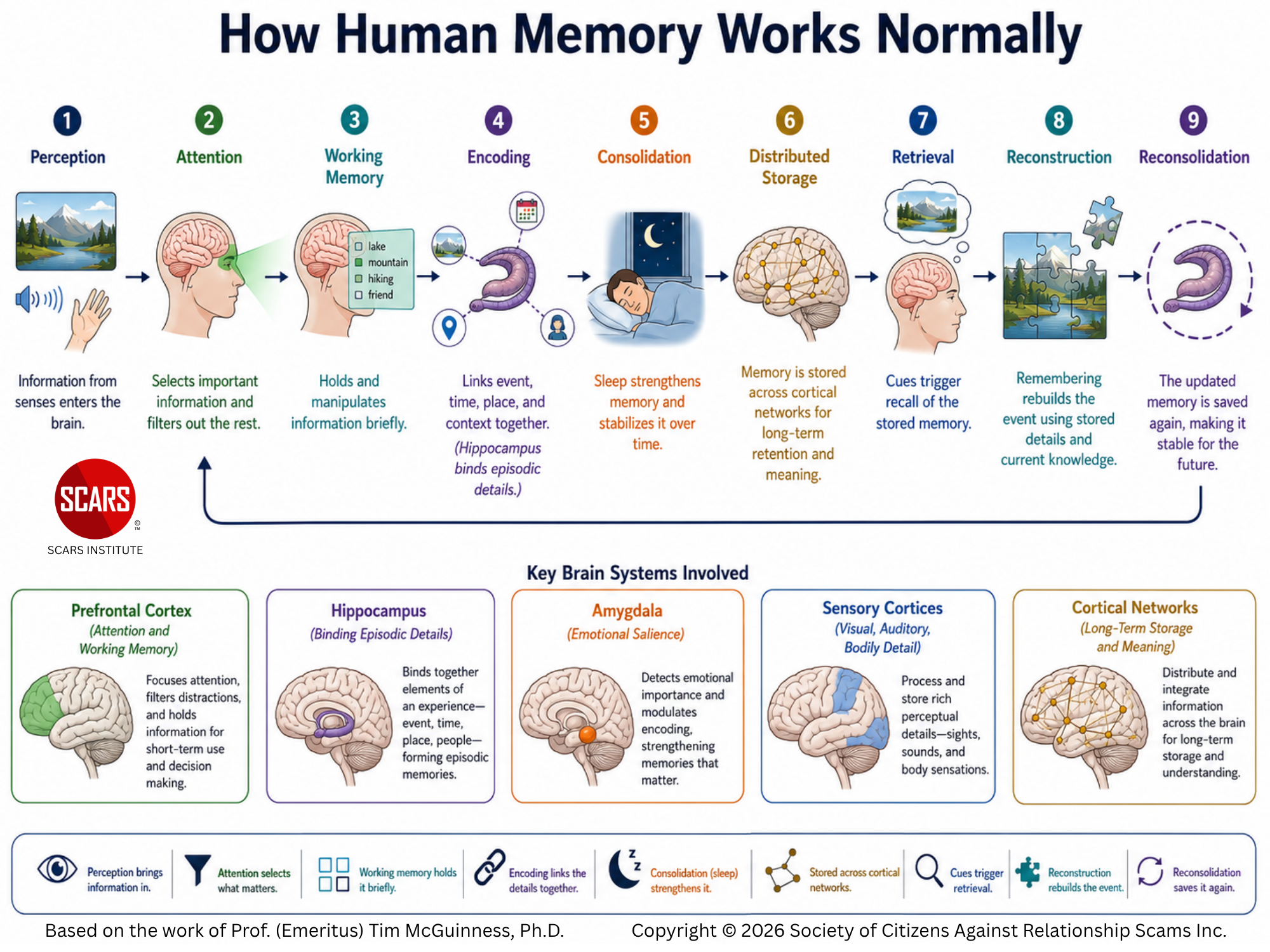
A memory is not stored in one location. It exists as a distributed pattern involving sensory regions, emotional systems, attention networks, language systems, motor systems, and areas that organize events according to time, place, meaning, and personal significance. The hippocampus helps bind these different elements into a retrievable episode, while cortical regions retain many of the sensory, conceptual, and autobiographical components. The amygdala contributes emotional significance, especially when an experience involves threat, reward, fear, or intense personal importance.
Memory normally develops through several overlapping processes: perception, attention, working memory, encoding, consolidation, storage, retrieval, reconstruction, and reconsolidation. These processes influence one another. A disruption at an early stage can affect everything remembered later.
Perception: The Brain Receives an Experience
Memory begins with perception. Light reaches the eyes, sound reaches the ears, pressure and temperature activate the skin, and internal sensations arise from the body. These signals are processed through specialized sensory systems.
The brain does not process every available detail equally. At any moment, the nervous system receives more information than conscious awareness can hold. Attention therefore selects a limited portion of the environment for deeper processing. Details that receive little or no attention are less likely to become accessible memories.
Perception is already interpretive. The brain compares incoming information with prior knowledge, expectations, beliefs, emotional states, and predictions. Two people can witness the same event while noticing and later remembering different details because their attention and interpretation differed from the beginning.
Attention and Working Memory
Attention determines which parts of an experience enter working memory. Working memory temporarily holds and manipulates information while a person thinks, speaks, makes decisions, or responds to events.
The prefrontal cortex plays an important role in maintaining attention, organizing information, comparing alternatives, and connecting present experience with goals and prior knowledge. Working memory has a limited capacity. A person can consciously manage only a relatively small amount of information at one time.
Attention is essential for many forms of explicit memory. A person who never consciously noticed a detail often cannot later retrieve it as a deliberate autobiographical memory. Divided attention, exhaustion, intoxication, emotional overload, and distraction can all reduce the amount of information encoded with clarity.
Encoding: Turning Experience Into a Memory Trace
Encoding is the process through which perceived information produces lasting changes in neural activity and connectivity. The brain does not encode every feature with equal strength. It prioritizes information according to attention, novelty, emotion, repetition, meaning, and relevance.
Information becomes more memorable when it connects with existing knowledge. A new fact that has no context can remain weak and isolated. A new fact connected to a familiar concept becomes part of a larger network and gains more possible routes for later retrieval.
Encoding includes several forms of information. The brain can encode what happened, where it happened, when it occurred, who was present, what the person felt, what the body was doing, and what the event seemed to mean. These elements can later be remembered together or separately.
The hippocampus is especially important for binding elements of an experience into an episodic memory. It helps associate a face with a location, an action with a sequence, and an emotion with the event that produced it. The amygdala helps mark emotionally significant experiences, which can increase the probability that they will receive further processing.
Encoding does not guarantee perfect accuracy. A person can encode an incorrect interpretation, misidentify a source, overlook a detail, or combine assumptions with direct perception. Later confidence does not reveal whether the original encoding was complete or accurate.
Consolidation: Stabilizing the Memory
After encoding, a memory remains biologically unstable for a period. Consolidation refers to processes that strengthen and stabilize the memory so that it becomes more resistant to disruption.
Early consolidation involves cellular and molecular changes. Frequently activated neural connections can become more efficient through processes such as long-term potentiation. Protein synthesis, gene expression, neurotransmitter activity, and structural changes at synapses contribute to the persistence of memory traces.
Broader systems consolidation develops over a longer period. The hippocampus repeatedly interacts with cortical networks, helping organize and strengthen the distributed elements of an experience. Over time, many memories become less dependent on the hippocampus for ordinary retrieval, although autobiographical recollection can continue to involve hippocampal activity.
Sleep supports consolidation. During sleep, patterns associated with recent experience can be reactivated. This process can strengthen important information, integrate it with existing knowledge, extract general meaning, and weaken some less useful details. The result is not a perfect preservation of the original event. Consolidation can already involve selection, reorganization, and abstraction.
How Different Kinds of Memory Are Stored
Long-term memory includes several interacting systems.
Episodic memory contains personal experiences connected with time and place. It allows a person to remember attending a meeting, receiving a telephone call, visiting a location, or having a particular conversation.
Semantic memory contains facts, concepts, meanings, vocabulary, and general knowledge. A person can know that Paris is the capital of France without remembering when or where that fact was learned.
Procedural memory supports learned skills and routines. Riding a bicycle, typing, driving, and performing familiar movements rely heavily on procedural systems involving the basal ganglia, cerebellum, and motor networks.
Emotional learning connects people, places, objects, or situations with feelings and physiological responses. A person can experience tension around a stimulus without consciously recalling the event that established the association.
Sensory memory preserves brief traces of sights, sounds, smells, tastes, and bodily sensations. Some of these traces contribute to explicit recollection, while others influence behavior without entering conscious narrative memory.
Memory storage is therefore distributed. The visual aspects of an event involve visual cortices. Sounds involve auditory systems. Bodily states involve somatosensory and interoceptive networks. Meanings involve language and association areas. Emotional importance involves the amygdala and related systems. The remembered event emerges through coordination among these components rather than retrieval from one biological storage container.
Retrieval: Reactivating a Memory
Retrieval occurs when a cue activates part of a stored memory network. A cue can be a question, place, smell, emotion, person, photograph, word, body sensation, or related thought.
The hippocampus helps reinstate patterns of cortical activity associated with the original experience. This reactivation can produce a conscious sense of recollection. The brain reconstructs the event by combining available memory traces with present knowledge and interpretation.
Recall depends heavily on cues. A memory can be inaccessible under one condition and easily recalled under another. Returning to a location, encountering a familiar smell, or hearing a particular phrase can make previously unavailable details accessible.
Current mood and physiological state can also shape retrieval. A person who feels frightened can more easily retrieve threat-related material. A person who feels safe can interpret the same memory differently. Context, expectation, and purpose influence which parts of a memory become active.
Retrieval failure does not necessarily mean that the memory has been erased. The available cue might be insufficient, competing memories might interfere, or the person might be searching for the event through an ineffective route.
Reconstruction: Remembering Is Not Replay
During recall, the brain does not retrieve every component of an experience simultaneously or with equal strength. It assembles a usable representation from surviving traces.
Gaps are often filled through general knowledge, expectations, habits, emotional meaning, and inference. This usually happens automatically. It does not necessarily involve dishonesty or conscious invention.
A person can accurately remember the central meaning of an event while misremembering its exact wording, timing, sequence, clothing, location, or peripheral details. The brain often preserves the gist more effectively than the complete surface detail.
Reconstruction can introduce several types of change. Details from similar experiences can become combined. Information learned later can become incorporated into the remembered event. A person can remember a true detail but assign it to the wrong source. Repeated questioning can strengthen some elements while suppressing others. Suggestive language can influence the form in which an event is later recalled.
Confidence and accuracy are not identical. Repetition can increase familiarity and confidence even when the repeated account contains errors. Emotional vividness can also create a strong sense of certainty without guaranteeing complete factual precision. Research consistently shows that memory is reconstructive and vulnerable to distortion, source confusion, suggestion, and later information.
Reconsolidation: Recalled Memories Can Be Updated/Edited
When a memory is retrieved, parts of it can temporarily become flexible. The brain can then restabilize the memory through reconsolidation.
During this period, new information can become associated with the original memory. The memory can gain context, lose emotional intensity, become more generalized, or acquire new interpretations. In some conditions, it can also become more distorted.
Reconsolidation does not mean that every act of recall completely rewrites a memory. The degree of change depends on factors such as emotional arousal, novelty, prediction error, attention, repetition, and whether meaningful new information is introduced. Human reconsolidation remains an active and sometimes debated area of research, especially regarding old and strongly established traumatic memories.
The important principle is that remembering is an active event. Each recollection can preserve, strengthen, weaken, reorganize, or update aspects of what is remembered.
2: How Psychological Trauma Changes Memory Processing
Trauma Does Not Create One Universal Memory Pattern
Psychological trauma does not affect every person or every memory in the same way. Some people retain highly coherent accounts. Others remember central details clearly but struggle with sequence or context. Some experience intrusive images or bodily reactions. Others develop avoidance, emotional numbing, or partial gaps.
Exposure to a traumatic event does not automatically produce posttraumatic stress disorder. Many people experience acute stress reactions that diminish naturally. PTSD develops when a persistent pattern of intrusion, avoidance, negative changes in mood or cognition, and heightened arousal causes significant impairment.
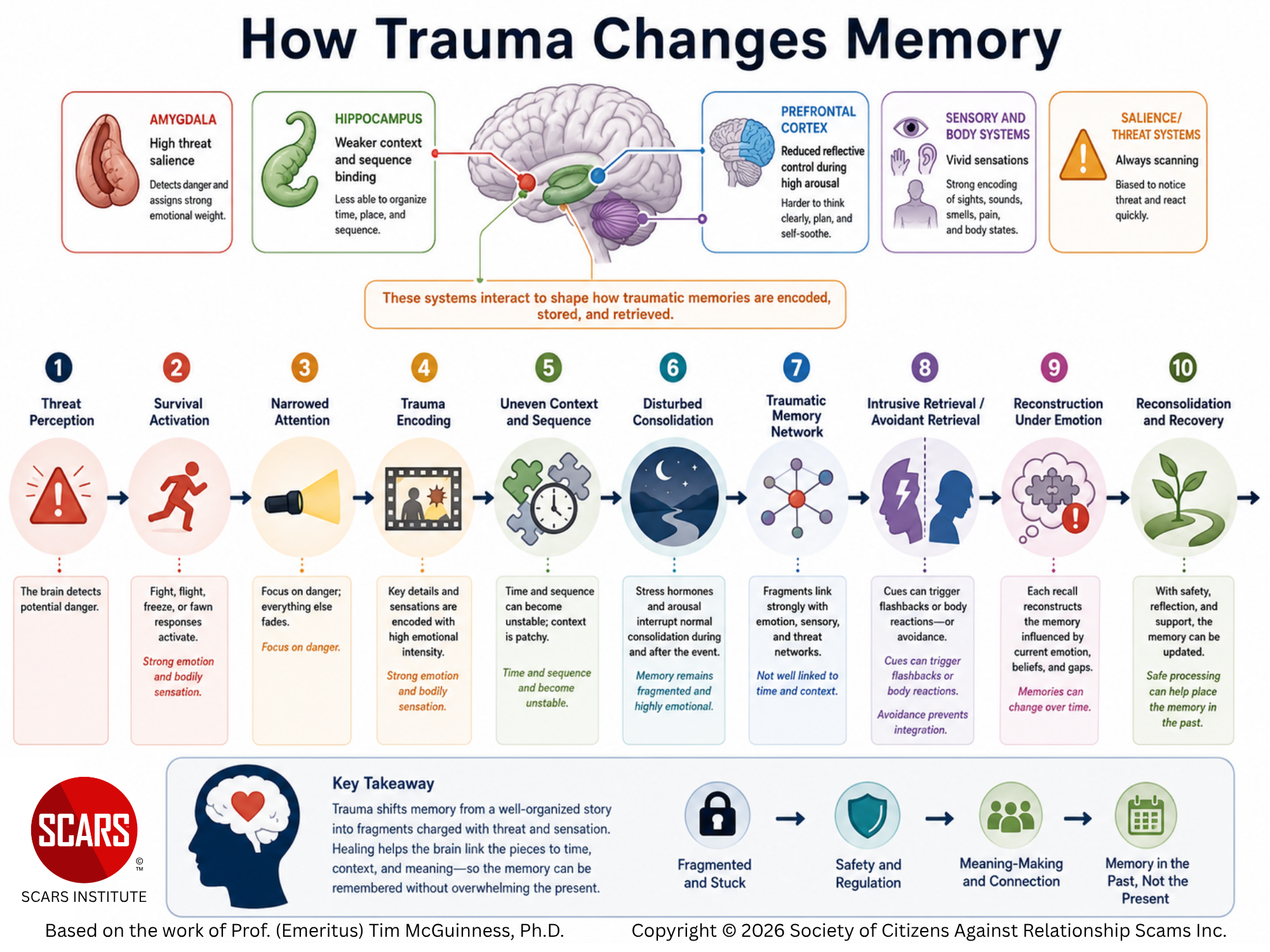
Trauma-related memory differences therefore exist along a spectrum. The following processes describe common tendencies rather than rules that apply to every survivor.
Perception Under Threat
During overwhelming danger, the brain shifts resources toward survival. Threat-detection systems become highly active. The amygdala rapidly evaluates sensory information for danger, while the hypothalamus and brainstem activate autonomic and hormonal stress responses.
Heart rate can increase, muscles tense, breathing changes, pain perception shifts, and attention narrows toward information considered essential for immediate survival. The person can become intensely focused on a weapon, face, voice, escape route, threatening message, or bodily sensation.
This survival prioritization can sharpen memory for some central emotional details while weakening attention to peripheral information. A person might remember a threatening expression, particular sentence, or feeling of terror but remain uncertain about the room, date, sequence, or unrelated objects.
Very high arousal can also overwhelm working memory. The prefrontal cortex can become less effective at deliberate reasoning, organization, impulse control, and temporal sequencing. The person can act automatically, freeze, submit, dissociate, or follow previously learned survival patterns without constructing a calm, continuous narrative of the event.
Encoding Under Trauma
During ordinary encoding, the hippocampus helps bind sensory, temporal, spatial, emotional, and conceptual information into a contextualized episode. Under severe stress, this coordination can become less efficient.
The amygdala can strongly encode emotional salience and threat associations. At the same time, hippocampal processing of context, sequence, and time can become impaired or uneven. The result can be a memory that is powerful in emotional and sensory content but weaker in narrative organization.
This does not mean that traumatic memories are stored only as fragments or that coherent trauma memories are abnormal. It means that the balance among memory systems can shift. Threat, bodily state, and emotional significance can receive stronger encoding than chronology, surrounding context, or peripheral detail.
Stress hormones can strengthen certain memories, especially information closely related to danger. However, intense or prolonged stress can impair flexible learning, working memory, contextual encoding, and later retrieval. The effect depends on the intensity, duration, timing, and meaning of the stress response.
Dissociation and Reduced Integration
Some people experience dissociation during overwhelming events. They can feel detached from their body, emotionally numb, unreal, or as though the event is happening to someone else. Time can feel slowed, accelerated, or discontinuous.
Dissociation can reduce the integration of attention, emotion, bodily awareness, and autobiographical encoding. The person can remember isolated images, statements, sensations, or actions without initially possessing a continuous account.
A survivor might therefore know that something occurred without being able to describe every stage. Another survivor might provide a coherent factual account while feeling emotionally disconnected from it. Neither presentation proves or disproves the event.
Storage and Consolidation After Trauma
After the event, stress activation can continue. The nervous system can remain vigilant, sleep can become disrupted, and intrusive thoughts can repeatedly reactivate the experience.
Because sleep contributes to memory consolidation, disturbed sleep can interfere with the ordinary integration of the event. Nightmares and repeated reactivation can also strengthen some emotional components.
Traumatic memories can become strongly associated with survival responses. A smell, phrase, account notification, location, facial expression, or body sensation can become linked with fear even when it was not itself dangerous. These associations can later activate rapidly and automatically.
The memory can be stored across several systems:
- The hippocampal system retains aspects of the event and its context.
- The amygdala retains learned threat significance and emotional salience.
- Sensory cortices retain visual, auditory, olfactory, and tactile components.
- The insula and somatosensory systems retain bodily and internal sensations.
- Habit and motor systems retain automatic defensive patterns.
- Cortical association networks retain meaning, beliefs, language, and autobiographical interpretation.
A traumatic memory is therefore not one object. It is a network that can include facts, meanings, emotions, images, movements, physical sensations, and conditioned responses.
Why Traumatic Memories Can Feel Present
Ordinary autobiographical memory usually carries a sense of pastness. A person remembers that something happened before and recognizes that the current environment is different.
Trauma-related recall can lose some of this contextual separation. When a cue activates the threat network, the brain and body can respond as though the danger is occurring again. The person can intellectually know that the event is over while still experiencing fear, bodily activation, urgency, helplessness, or shame.
This can happen because emotional and sensory elements are strongly reactivated while contextual systems fail to provide enough information that distinguishes the present from the past. Difficulties in contextual processing and regulation are prominent in many neurobiological models of PTSD.
The reaction is not simply a person choosing to dwell on the event. It reflects automatic activation of a learned survival network.
Intrusive Retrieval
Traumatic memories can enter awareness without deliberate effort. A cue can trigger an image, emotion, sensation, nightmare, or flashback before the person consciously recognizes the connection.
The amygdala and salience systems can respond rapidly, while prefrontal regions responsible for evaluating context and regulating emotion can be less effective during intense activation. PTSD research frequently identifies altered functioning within interconnected networks involving the amygdala, hippocampus, medial prefrontal cortex, anterior cingulate cortex, and insula. These findings describe group-level patterns and should not be treated as a brain scan formula that diagnoses individual survivors.
During intrusive retrieval, the memory can be experienced as something happening rather than something being remembered. Sensory and emotional components can dominate while language and chronological organization temporarily weaken.
Avoidant Retrieval
Trauma can also produce the opposite pattern. A person can avoid thoughts, conversations, places, people, records, or emotions connected with the experience.
Avoidance reduces distress in the short term, but it can prevent the memory from being examined in a safe context. The brain receives fewer opportunities to learn that reminders can be tolerated and that the present situation differs from the original danger.
Avoidance does not erase the memory. It can leave threat associations intact while limiting deliberate access to the broader autobiographical account.
Memory Gaps and Uneven Recall
Traumatic memory can contain gaps for several reasons. Attention might have narrowed during the event. The person might have dissociated. Extreme arousal might have disrupted working memory or contextual encoding. Sleep deprivation, injury, substances, repeated victimization, or later stress can also affect recall.
A gap does not automatically prove repression, neurological damage, or deception. Human memory is incomplete under ordinary conditions, and intense stress can make it more uneven.
Details can also return when an effective retrieval cue becomes available. The later appearance of a memory does not by itself establish whether every component is accurate. The recovered material still requires the same careful evaluation applied to all reconstructed memory.
Reconstructing Traumatic Memories
Traumatic memories are reconstructed during recall like other memories, but reconstruction can occur under unusually powerful emotional conditions.
Current fear can make ambiguous details seem more threatening. Shame can reorganize the narrative around self-blame. Anger can increase attention to betrayal or injustice. Grief can emphasize what was lost. New knowledge can radically alter the remembered meaning of earlier events.
For example, a person deceived in a relationship scam might initially remember a conversation as affectionate and reassuring. After discovering the deception, the same conversation can be reconstructed as manipulation. The words might not have changed, but their meaning has.
This reinterpretation is not necessarily a false memory. It can represent a more accurate understanding of the event. However, interpretation and literal detail remain different. A new understanding of motive should not automatically be treated as proof of every remembered word, date, or action.
Repeated retelling also affects reconstruction. Each account selects certain details, places them into language, and organizes them around a purpose. Telling the story to police, family members, therapists, support groups, or journalists can produce different emphases because each audience asks different questions.
Repeated rehearsal can strengthen the central narrative while allowing peripheral details to drift. Leading questions, social pressure, misinformation, speculation, and repeated exposure to other people’s accounts can introduce additional changes.
Trauma, Confidence, and Accuracy
Traumatic memories can be vivid, emotionally intense, and deeply convincing. These qualities do not make them entirely inaccurate, but they also do not guarantee exact accuracy.
Central details directly connected with danger can be remembered well. Peripheral details can remain incomplete or unstable. A person can accurately remember that an assault occurred while misremembering the exact duration. A scam victim can accurately remember sending money while confusing which conversation preceded a particular transfer.
Minor inconsistencies are therefore compatible with genuine memory. At the same time, trauma should not be used to declare every inconsistency meaningless or every recollection unquestionably accurate. A scientifically responsible approach respects the survivor while distinguishing confidence, emotional truth, interpretation, and independently verifiable fact.
Reconsolidation of Traumatic Memory
When a traumatic memory is safely reactivated, it can enter a state in which new information becomes connected with it. The person can learn that the event is over, that present reminders are not the original danger, that survival responses were automatic, and that responsibility belongs to the offender rather than the victim.
Through reconsolidation and new learning, the memory can become more contextualized. It can move from an experience that repeatedly invades the present toward an autobiographical event recognized as part of the past.
The purpose is not necessarily to erase the memory. Healthy recovery often changes its organization, meaning, emotional intensity, and relationship to the present.
A formerly overwhelming memory can become:
- More connected to time and place.
- More integrated into the person’s life story.
- Less likely to trigger automatic survival activation.
- Less dominated by shame or self-blame.
- More accessible without emotional flooding.
- More accurate because assumptions and known facts have been separated.
Reconsolidation-based explanations are promising, but the exact mechanisms and clinical limits remain under study. It would be inaccurate to claim that every recalled trauma memory becomes fully changeable or that one intervention can simply rewrite it.
The Central Difference
Normal memory processing organizes experience according to attention, meaning, context, and existing knowledge. It produces a distributed, incomplete, and reconstructive representation rather than a permanent recording.
Under psychological trauma, the brain prioritizes survival. Threat, emotion, bodily sensation, and defensive action can become strongly encoded, while contextual organization, sequence, working memory, and reflective interpretation can become uneven. Later reminders can reactivate the survival system before the person consciously recognizes that a memory has been triggered.
The traumatic memory is not necessarily stronger in every respect. It is often stronger in emotional urgency and threat association while remaining weaker or less stable in chronology, context, and peripheral detail.
Recovery becomes possible because memory remains dynamic. Through safety, careful processing, contextualization, new learning, and repeated experiences of present-day control, the brain can update how it interprets and responds to what happened. The person does not need to forget the event to recover. The memory can remain historically important without continuing to function as an immediate alarm.
Review
Human memory is an active, distributed, and reconstructive process rather than an exact recording of experience.
Under normal conditions, the brain selects information through attention, encodes it through interconnected sensory, emotional, and cognitive systems, stabilizes it through consolidation, and later rebuilds it during retrieval.
Psychological trauma changes this process by shifting the brain toward survival. Threat, emotion, bodily sensation, and defensive responses can become strongly encoded, while sequence, context, and peripheral details can become fragmented or uneven. Traumatic memories can later return through intrusive images, sensations, emotions, nightmares, or flashbacks that feel immediate rather than historical. Each act of recall can also alter the memory through reconstruction and reconsolidation.
Recovery does not require erasing the event. It involves helping the brain place the memory in the past, connect it with accurate context, reduce automatic threat activation, and integrate it into a coherent life narrative.
Conclusion
Human memory is a living biological and psychological process that continually selects, organizes, retrieves, and updates information. It does not preserve an exact copy of experience. Every memory reflects what the person noticed, how the brain interpreted the event, which details received attention, what emotional meaning became attached to them, and how the experience was later reconstructed during recall.
Psychological trauma can change the balance of these processes because the brain prioritizes survival during overwhelming danger. Threat-related sensations, emotions, statements, faces, and defensive responses can become strongly encoded, while time, sequence, context, and peripheral details remain incomplete or unstable. A survivor can therefore remember the central reality of an event while struggling with dates, wording, duration, or the order in which particular actions occurred.
Trauma-related memory differences do not follow one universal pattern. Some survivors retain coherent accounts, while others experience intrusive images, bodily reactions, fragmented recollections, avoidance, emotional numbing, or partial gaps. Emotional vividness does not guarantee complete factual accuracy, and minor inconsistencies do not establish deception. Responsible understanding requires separating confidence, interpretation, emotional meaning, reconstructed detail, and independently verifiable fact.
Recovery does not require forgetting what happened. Safety, contextualization, careful processing, and new learning can help the brain recognize that the event belongs to the past. The memory can remain meaningful without continuing to activate the nervous system as though the danger were still present.

Glossary
- Amygdala Salience Marking — Amygdala salience marking is the process through which the amygdala assigns emotional importance to an experience, especially when it involves threat, fear, reward, or intense personal meaning. This marking can strengthen attention toward emotionally significant details without guaranteeing that every part of the event will be remembered accurately. Trauma can intensify this process, causing danger-related sensations, words, faces, or messages to remain especially vivid. — Neurological Process
- Attention Narrowing — Attention narrowing occurs when the brain concentrates on information considered essential for immediate survival while giving less attention to surrounding details. A survivor can remember a threatening message, expression, demand, or bodily sensation while remaining uncertain about timing, sequence, or unrelated events. This pattern reflects survival prioritization rather than deliberate inattention or dishonesty. — Trauma Response
- Autobiographical Context — Autobiographical context connects a remembered experience with the person’s broader life story, including when it occurred, where it happened, and what followed. Trauma can weaken this organization, allowing emotional or sensory elements to return without a strong sense that the event belongs to the past. Recovery can help integrate the memory into a more coherent and historically located personal narrative. — Memory Process
- Avoidant Retrieval — Avoidant retrieval occurs when a person avoids thoughts, conversations, records, places, people, or emotions connected with a traumatic experience. Avoidance can reduce distress temporarily, but it can prevent the brain from learning that reminders can be tolerated safely in the present. The memory remains active even when deliberate access to the broader event is restricted. — Withdrawal Pattern
- Bodily Memory Activation — Bodily memory activation occurs when a reminder produces physical sensations or defensive responses associated with an earlier traumatic experience. The person can experience tension, nausea, rapid breathing, pain, trembling, or urgency before consciously recognizing the connection. These reactions reflect stored associations among bodily systems, emotional learning, and threat detection. — Physiological Response
- Central Detail Preservation — Central detail preservation describes the tendency for information directly connected with danger or emotional significance to remain more accessible than peripheral details. A survivor can accurately remember the central action, loss, threat, or transfer while confusing the exact wording, date, duration, or sequence. Strong central memory does not require complete accuracy across every surrounding detail. — Memory Process
- Confidence-Accuracy Distinction — Confidence-accuracy distinction refers to the difference between feeling certain about a memory and remembering every part of it correctly. Repetition, familiarity, and emotional vividness can increase confidence without improving factual precision. A responsible evaluation therefore separates certainty, emotional truth, interpretation, and independently verifiable information. — Reality Testing
- Consolidation — Consolidation is the biological process through which newly encoded information becomes more stable and resistant to disruption. Cellular changes, neural efficiency, protein activity, synaptic modification, and interactions between the hippocampus and cortical networks contribute to this process. Consolidation strengthens memory while also allowing selection, reorganization, and abstraction. — Neurological Process
- Contextual Encoding — Contextual encoding is the process through which the brain records where, when, and under what circumstances an experience occurred. Severe stress can weaken this process even when emotional and sensory details remain strongly encoded. The resulting memory can feel intense while remaining uncertain in chronology, location, or surrounding circumstances. — Memory Process
- Contextual Separation — Contextual separation is the brain’s ability to distinguish a past event from the person’s current environment. Trauma-related recall can weaken this separation, causing fear, urgency, helplessness, or bodily activation to return as though the danger were present. Recovery strengthens recognition that the remembered event is historically important but no longer occurring. — Recovery Process
- Cortical Association Networks — Cortical association networks retain meanings, beliefs, language, concepts, and autobiographical interpretations connected with remembered experience. These networks interact with sensory, emotional, and contextual systems rather than storing the entire event in one location. New information can change how earlier events are interpreted without changing every literal detail. — Neurological Process
- Cue-Dependent Recall — Cue-dependent recall occurs when a question, place, smell, photograph, word, emotion, person, or body sensation activates part of a stored memory network. A memory can remain inaccessible under one condition and become available when a more effective cue appears. Later recall therefore does not automatically mean that the memory was previously erased. — Memory Process
- Dissociative Encoding — Dissociative encoding occurs when detachment, numbness, unreality, or altered awareness interferes with the integration of an overwhelming experience. The person can retain isolated images, words, sensations, or actions without initially possessing a continuous narrative. This uneven organization does not prove that the experience did or did not occur. — Trauma Response
- Distributed Memory Storage — Distributed memory storage describes how different parts of an experience are retained across sensory, emotional, motor, language, and association systems. Visual details involve visual regions, sounds involve auditory systems, and bodily states involve somatosensory and interoceptive networks. A remembered event emerges through coordination among these systems rather than retrieval from one storage location. — Neurological Process
- Emotional Learning — Emotional learning connects a person, place, object, message, or situation with a feeling and physiological response. A survivor can experience fear or tension around a reminder without consciously recalling the event that established the association. These learned responses can remain active until new experiences provide safety and updated context. — Neurological Process
- Emotional Salience — Emotional salience is the importance assigned to information because of its emotional meaning, personal relevance, or connection with threat and reward. Highly salient details often receive more attention and processing than neutral information. Emotional salience can strengthen vividness while leaving timing, sequence, and peripheral detail less stable. — Neurological Process
- Encoding — Encoding is the process through which perceived information produces lasting changes in neural activity and connectivity. Attention, novelty, emotion, repetition, meaning, and relevance influence what becomes encoded and how strongly it is retained. Encoding can include direct perception, interpretation, assumptions, bodily states, and emotional meaning. — Memory Process
- Encoding Under Trauma — Encoding under trauma occurs when overwhelming stress changes which aspects of an experience receive the strongest neural processing. Threat, bodily sensation, and emotional significance can receive priority while time, sequence, and surrounding context become less organized. This pattern can produce a vivid but uneven traumatic memory. — Trauma Response
- Episodic Binding — Episodic binding is the hippocampal process that connects people, actions, locations, emotions, and sequences into a retrievable personal event. Effective binding allows separate details to be remembered as parts of one experience. Severe stress can disrupt this coordination, leaving some components strongly remembered and others weakly connected. — Neurological Process
- Episodic Memory — Episodic memory contains personal experiences connected with a particular time and place. It allows a person to remember a conversation, telephone call, meeting, transfer, location, or other lived event. Trauma can alter its organization without eliminating the central reality of what occurred. — Memory Process
- Explicit Memory — Explicit memory consists of information that a person can deliberately recall and describe, including personal events and factual knowledge. Attention is important because details that never entered conscious awareness are less likely to become accessible through deliberate recollection. Emotional or bodily learning can still influence behavior when explicit recall remains incomplete. — Memory Process
- Flashback Reactivation — Flashback reactivation occurs when part of a traumatic memory returns with a powerful sense of immediacy. Sensory, emotional, and bodily components can dominate while language, context, and awareness of present safety temporarily weaken. The person can experience the memory as something happening rather than something being remembered. — Trauma Activation
- Gist Preservation — Gist preservation is the brain’s tendency to retain the central meaning of an event more effectively than every surface detail. A person can accurately remember what happened while misremembering exact wording, clothing, timing, or sequence. This pattern reflects ordinary reconstructive memory and can become more pronounced under stress. — Memory Process
- Hippocampal Binding — Hippocampal binding is the process through which the hippocampus connects sensory, spatial, temporal, emotional, and conceptual elements into an organized episode. It helps associate a face with a location, an action with a sequence, and an emotion with its source. Severe stress can make this binding less efficient or uneven. — Neurological Process
- Intrusive Retrieval — Intrusive retrieval occurs when a memory, image, nightmare, sensation, emotion, or bodily reaction enters awareness without deliberate effort. A cue can activate the memory network before the person consciously understands why distress has begun. Intrusive retrieval is commonly associated with trauma-related survival activation. — Trauma Activation
- Long-Term Potentiation — Long-term potentiation is a process through which repeated neural activation makes particular connections more efficient and persistent. It contributes to the stabilization and strengthening of memory traces during consolidation. Stronger connections support later recall but do not guarantee that the remembered interpretation was originally accurate. — Neurological Process
- Memory Gap — A memory gap is an incomplete portion of recall involving timing, sequence, wording, actions, or surrounding detail. Narrowed attention, dissociation, intense arousal, sleep disruption, substances, injury, repeated victimization, or later stress can contribute to these gaps. A gap does not automatically prove repression, deception, or neurological damage. — Memory Process
- Memory Network — A memory network is the distributed collection of facts, meanings, emotions, images, movements, sensations, and conditioned responses connected with an experience. Different cues can activate different parts of the same network. Trauma can make emotional and threat-related components easier to activate than contextual or chronological components. — Neurological Process
- Memory Reactivation — Memory reactivation occurs when a cue activates neural patterns associated with an earlier experience. Reactivation can produce conscious recollection, emotional responses, bodily sensations, or automatic defensive behavior. The activated memory can also become available for strengthening, updating, reorganization, or distortion. — Memory Process
- Memory Reconstruction — Memory reconstruction is the process through which the brain assembles a remembered event from surviving traces, present knowledge, emotional meaning, and interpretation. Gaps can be filled automatically through expectations, habits, inference, or information learned later. Reconstruction is a normal feature of memory and does not necessarily involve deliberate invention. — Memory Process
- Memory Trace — A memory trace is the lasting pattern of neural change produced when information is encoded. Its persistence depends on attention, repetition, emotional importance, consolidation, and connection with existing knowledge. A trace can remain partial, distributed, or difficult to retrieve even when the central event was significant. — Neurological Process
- Narrative Organization — Narrative organization is the arrangement of remembered information into a coherent account with sequence, context, language, and meaning. Trauma can weaken this organization while leaving emotional and sensory components intense. A survivor can therefore possess a genuine memory without being able to describe every stage in chronological order. — Memory Process
- Peripheral Detail Instability — Peripheral detail instability refers to uncertainty or change in information that was not central to the perceived danger or emotional meaning of an event. Clothing, background objects, exact duration, room arrangement, and minor sequencing can remain incomplete or shift during recall. This instability can coexist with accurate memory for the central event. — Memory Process
- Perception — Perception is the process through which sensory information is received, organized, and interpreted by the brain. Prior knowledge, expectations, beliefs, emotions, and predictions influence what a person notices from the beginning. Memory therefore starts with an interpretation of experience rather than a neutral recording. — Neurological Process
- Perception Under Threat — Perception under threat occurs when the brain prioritizes possible danger and immediate survival needs. Attention can become concentrated on a threatening face, voice, message, demand, escape route, or bodily sensation. This prioritization can sharpen awareness of central threats while reducing awareness of surrounding details. — Trauma Response
- Prefrontal Regulation — Prefrontal regulation involves brain processes that support attention, planning, comparison, impulse control, organization, and interpretation of context. Intense arousal can temporarily reduce the effectiveness of these functions. The person can then freeze, submit, act automatically, or struggle to construct a calm and continuous account. — Neurological Process
- Procedural Memory — Procedural memory supports learned skills, routines, habits, and familiar movements. Driving, typing, riding a bicycle, and performing practiced actions rely heavily on procedural systems. Trauma can also leave automatic defensive patterns that activate without deliberate thought. — Memory Process
- Recalled Meaning Revision — Recalled meaning revision occurs when later knowledge changes how a person understands an earlier event. A conversation once remembered as affectionate can later be understood as manipulation after the deception becomes known. The changed meaning can be more accurate even when the original words remain unchanged. — Recovery Insight
- Reconsolidation — Reconsolidation is the process through which a reactivated memory becomes temporarily flexible before being stabilized again. New information can add context, reduce emotional intensity, strengthen assumptions, or introduce distortion. The degree of change depends on arousal, novelty, prediction error, attention, and meaningful new learning. — Neurological Process
- Repeated Retelling — Repeated retelling occurs when a person recounts an experience to family members, police, therapists, support groups, or other audiences. Each account selects details and organizes them according to the purpose and questions of that setting. Rehearsal can strengthen the central narrative while allowing peripheral details to drift. — Memory Process
- Retrieval — Retrieval is the process through which a cue reactivates stored information and produces recollection. The brain reconstructs the event by combining available memory traces with current knowledge, emotion, and interpretation. Retrieval is therefore an active rebuilding process rather than a literal replay. — Memory Process
- Retrieval Cue — A retrieval cue is a stimulus that activates part of a memory network. It can include a smell, word, question, location, photograph, person, account notification, emotion, or bodily sensation. Effective cues can make details accessible that were unavailable under different conditions. — Memory Process
- Retrieval Failure — Retrieval failure occurs when stored information cannot be accessed under the current conditions. The cue can be insufficient, competing memories can interfere, or the person can be searching through an ineffective route. Retrieval failure does not necessarily mean that the information has been erased. — Memory Process
- Salience System Activation — Salience system activation occurs when brain networks rapidly identify information considered important for safety, emotion, or immediate action. During trauma, these systems can respond before conscious evaluation fully develops. The person can experience fear or urgency before understanding which reminder triggered the response. — Neurological Process
- Semantic Memory — Semantic memory contains facts, concepts, meanings, vocabulary, and general knowledge that are not necessarily tied to one remembered learning event. A person can know a fact without recalling when or where it was acquired. Trauma can change the meaning assigned to facts without eliminating the factual knowledge itself. — Memory Process
- Sensory Memory — Sensory memory preserves brief traces of sights, sounds, smells, tastes, touch, and bodily sensations. Some traces contribute to conscious recollection, while others influence emotional or behavioral responses without entering narrative awareness. Trauma can strengthen the later impact of sensory reminders associated with danger. — Memory Process
- Sleep-Dependent Consolidation — Sleep-dependent consolidation is the strengthening and integration of recent memory through processes that occur during sleep. Neural patterns can be reactivated, connected with existing knowledge, and reorganized around broader meaning. Trauma-related sleep disruption can interfere with integration while repeated nightmares strengthen emotional components. — Health Impact
- Source Confusion — Source confusion occurs when a person remembers information but assigns it to the wrong conversation, person, event, or period. A true detail can become connected with an incorrect source during reconstruction. Repetition, similar experiences, later information, and suggestive questioning can increase this risk. — Memory Distortion
- Stress Hormone Influence — Stress hormone influence refers to the effect of physiological stress responses on attention, learning, encoding, consolidation, and retrieval. Moderate activation can strengthen some danger-related information, while intense or prolonged stress can impair working memory and contextual processing. The outcome depends on the intensity, duration, timing, and meaning of the stress. — Physiological Response
- Survival Prioritization — Survival prioritization is the brain’s shift toward immediate threat detection, defensive action, and bodily readiness during overwhelming danger. This shift directs resources away from reflective reasoning, broad attention, and detailed temporal organization. The resulting memory can be emotionally powerful while remaining incomplete in context or sequence. — Evolutionary Psychology
- Temporal Sequencing — Temporal sequencing is the organization of remembered events according to the order in which they occurred. The hippocampus and prefrontal systems contribute to this process during ordinary memory formation. Intense arousal, dissociation, or overload can make sequence less stable even when central facts remain accessible. — Memory Process
- Threat Association — Threat association is the learned connection between a reminder and a survival response. A phrase, account alert, location, face, smell, or bodily sensation can become linked with fear even when it is not dangerous by itself. Later exposure can activate the response rapidly and automatically. — Trauma Response
- Trauma-Related Recall — Trauma-related recall is the reactivation of memories shaped by overwhelming stress, survival prioritization, and strong emotional learning. It can appear through coherent narrative, fragmented images, bodily sensations, nightmares, avoidance, or emotional numbing. No single recall pattern applies to every trauma survivor. — Trauma Response
- Working Memory — Working memory temporarily holds and manipulates information while a person thinks, speaks, compares alternatives, or responds to events. Its capacity is limited and can be reduced by exhaustion, distraction, intoxication, emotional overload, and severe stress. Disruption during trauma can weaken reasoning, organization, and later recall of sequence or detail. — Cognitive Process
Author Biographies
Author Biography
Prof. (Emeritus) Tim McGuinness, Ph.D. DFin is a co-founder, Managing Director, and Chairman of the SCARS Institute (Society of Citizens Against Relationship Scams Inc.), where he serves as an unsalaried volunteer officer dedicated to supporting scam victims and survivors around the world. With over 34 years of experience in scam education and awareness, he is perhaps the longest-serving advocate in the field.
Dr. McGuinness has an extensive background as a business pioneer, having co-founded several technology-driven enterprises, including the former e-commerce giant TigerDirect.com. Beyond his corporate achievements, he is actively engaged with multiple global think tanks where he helps develop forward-looking policy strategies that address the intersection of technology, ethics, and societal well-being. He is also a computer industry pioneer (he was an Assistant Director of Corporate Research Engineering at Atari Inc. in the early 1980s) and invented core technologies still in use today.
His professional identity spans a wide range of disciplines. He is a scientist, strategic analyst, solution architect, advisor, public speaker, published author, roboticist, Navy veteran, and recognized polymath. He holds numerous certifications, including those in cybersecurity from the United States Department of Defense under DITSCAP & DIACAP, continuous process improvement and engineering and quality assurance, trauma-informed care, grief counseling, crisis intervention, and related disciplines that support his work with crime victims.
Dr. McGuinness was instrumental in developing U.S. regulatory standards for medical data privacy called HIPAA and financial industry cybersecurity called GLBA. His professional contributions include authoring more than 1,000 papers and publications in fields ranging from scam victim psychology and neuroscience to cybercrime prevention and behavioral science.
“I have dedicated my career to advancing and communicating the impact of emerging technologies, with a strong focus on both their transformative potential and the risks they create for individuals, businesses, and society. My background combines global experience in business process innovation, strategic technology development, and operational efficiency across diverse industries.”
“Throughout my work, I have engaged with enterprise leaders, governments, and think tanks to address the intersection of technology, business, and global risk. I have served as an advisor and board member for numerous organizations shaping strategy in digital transformation and responsible innovation at scale.”
“In addition to my corporate and advisory roles, I remain deeply committed to addressing the rising human cost of cybercrime. As a global advocate for victim support and scam awareness, I have helped educate millions of individuals, protect vulnerable populations, and guide international collaborations aimed at reducing online fraud and digital exploitation.”
“With a unique combination of technical insight, business acumen, and humanitarian drive, I continue to focus on solutions that not only fuel innovation but also safeguard the people and communities impacted by today’s evolving digital landscape.”
Dr. McGuinness brings a rare depth of knowledge, compassion, and leadership to scam victim advocacy. His ongoing mission is to help victims not only survive their experiences but transform through recovery, education, and empowerment.
-/ 30 /-
What do you think about this?
Please share your thoughts in a comment below!
GLOSSARY SEARCH
TOPIC SEARCH
TABLE OF CONTENTS








CATEGORIES

Your Brain’s Memory System with Trauma – 2026
Please Leave a Comment
Please Tell Us What You Learned From This?
Commenting Is An Essential Part Of Healing
Read • Think • Write
One Comment
Leave A Comment Cancel reply
More ScamsNOW.com Articles









This was packed full of good information. With my first scam my memory for details: time, date, what was going on is very vague. That’s where I lost the most money. I don’t know maybe I don’t want to remember. This last scam was only 30 days ago n I still remember most of it.