


Moral Injury – A Different Kind of Trauma – 2026

The SCARS Institute Magazine about Scam Victims-Survivors, Scams, Fraud & Cybercrime
- Published: 7/28/26
- Modified: 7/30/26
- Comments: 3
- Read Status:

Moral Injury – A Different Kind of Trauma
Moral Injury After Relationship Scam Victimization Trauma – When a Survivor Believes the Scam Changed Who They Are
Primary Category: Trauma / Psychology / Recoverology
Authors:
• Tim McGuinness, Ph.D., DFin, MCPO, MAnth – Anthropologist, Scientist, Polymath, Managing Director of the Society of Citizens Against Relationship Scams Inc.
Author Biographies Below
About This Article
Moral injury can develop when scam survivors believe that actions taken under deception and coercive influence violated personal values, harmed others, or damaged their identity. It can involve acts of commission, omission, failure to prevent harm, perceived complicity, self-betrayal, institutional betrayal, and role-based moral failure. Guilt can support repair when it remains connected to specific behavior, while shame can turn harmful actions into a global judgment about the self. Recovery requires accurate responsibility, acknowledgment of consequences, appropriate amends, legal or professional guidance when necessary, and repeated behavior that reflects honesty, safety, and accountability. Self-forgiveness does not erase harm. It allows survivors to reject permanent self-condemnation while rebuilding trust and moral identity through present choices.
Note: This article is intended for informational purposes and does not replace professional medical advice. If you are experiencing distress, please consult a qualified mental health professional.
Keywords
Moral Injury, Moral Repair, Another Trauma, Relationship Scams, Moral Identity, Self-Forgiveness, Guilt And Shame, Perceived Complicity, Accountability, Family Trust, Coercive Control
Moral Injury After Relationship Scam Victimization Trauma – When a Survivor Believes the Scam Changed Who They Are
Author’s Note
Moral injury can emerge when scam survivors believe that actions taken under deception, coercive influence, and emotional manipulation violated their personal values or harmed other people. The resulting guilt, shame, self-condemnation, and loss of moral identity can remain even after the survivor understands that the relationship was fraudulent. Recovery requires a truthful examination of responsibility, consequences, values, and repair without confusing accountability with permanent moral worthlessness.
Prof. Emeritus Tim McGuinness, Ph.D.
July, 2026
Damages a Survivor’s Relationship with Personal Values
Relationship scam victimization can injure far more than financial security, emotional stability, or trust in other people. It also damages a survivor’s relationship with personal values, moral identity, and sense of being a decent human being.
Many survivors eventually recognize that the scammer deceived, manipulated, groomed, and exploited them. However, that understanding does not always resolve the pain associated with what they did while under the offender’s influence. They can remain troubled by money taken from shared savings, lies told to family members, warnings ignored, debts created, accounts opened, packages forwarded, or relationships damaged while they defended the scammer.
The survivor will begin asking questions that extend beyond ordinary self-blame:
- “What kind of person does this make me?”
- “How could I have betrayed the people who trusted me?”
- “Can my family ever believe me again?”
- “Do I deserve forgiveness after what I did?”
These questions can point toward a real moral injury that is different than the betrayal trauma caused by the scammers’ actions.
Moral injury is not a formal psychiatric diagnosis. It describes the lasting psychological, behavioral, relational, social, and sometimes spiritual distress that can follow an event perceived as violating deeply held moral beliefs or values. It can develop after a person acts against those values, fails to prevent harm, witnesses wrongdoing, or experiences betrayal by someone trusted or powerful. Guilt, shame, anger, disgust, damaged trust, self-condemnation, and difficulty with self-forgiveness commonly appear in moral injury.
Research on moral injury has focused primarily on military personnel, veterans, healthcare professionals, first responders, and other populations exposed to morally distressing circumstances. Direct research applying the concept to relationship scam victims remains limited. Its application to scam victimization should therefore be understood as a clinically informed framework rather than an established diagnosis or a conclusion that every survivor experiences moral injury.
Even with that limitation, the framework can explain an important part of recovery that discussions of financial loss, grief, and betrayal do not fully address.
Moral Injury Is a Wound to Conscience and Identity
Moral injury begins when a person believes that a meaningful moral boundary has been crossed.
The boundary can involve honesty, loyalty, responsibility, protection of family, financial stewardship, care for others, obedience to law, religious commitment, or the belief that a responsible adult should recognize danger. The survivor does not merely regret an outcome. The survivor can interpret the event as evidence that something essential has become damaged within the self.
This creates an injury to moral identity.
Moral identity refers to the values and ethical qualities through which a person understands who they are. Someone can see themselves as honest, dependable, protective, generous, careful, faithful, or responsible. When behavior during the scam appears to contradict those qualities, the survivor can experience a painful division between the former self and the person they now believe themselves to be.
Contemporary moral injury scholarship increasingly describes the problem as involving disrupted meaning, conscience, relational trust, moral identity, responsibility, forgiveness, and reconciliation. This extends moral injury beyond fear-based trauma models because the central wound often concerns what an experience means about the person, other people, and the moral order of life.
A survivor can therefore know that the offender committed the crime and still feel morally contaminated by participation in it.
How Relationship Scammers Create Moral Conflict
Scammers rarely begin by asking a victim to violate major values. They usually shape behavior gradually.
The victim can first be asked to keep a harmless secret, offer reassurance, avoid discussing the relationship with skeptical relatives, or provide a small favor. The offender presents these actions as evidence of loyalty, trust, love, maturity, or compassion.
As attachment and dependence grow, the requests can become more consequential. The victim can be pressured to conceal financial transfers, mislead a spouse, borrow from relatives, obtain credit, disregard bank warnings, receive money, forward packages, use another person’s account, or provide false explanations.
Each step can be framed as necessary to protect the relationship or save someone from catastrophe.
The scammer can transform the survivor’s virtues into instruments of exploitation:
- Loyalty becomes secrecy.
- Compassion becomes financial compliance.
- Responsibility becomes rescue.
- Hope becomes continued investment.
- Faith becomes unquestioning belief.
- Persistence becomes refusal to accept evidence.
- Protectiveness becomes hostility toward concerned relatives.
The victim can believe that the requested action expresses love or moral duty. Only later does the person discover that the same behavior harmed family members, creditors, employers, institutions, or other victims.
This delayed recognition can produce moral shock.
The survivor is not only discovering that the relationship was false. The survivor is also discovering that the offender manipulated personal values into supporting conduct that would otherwise have been rejected.
Acts of Commission, Omission, and Betrayal
Moral injury literature commonly distinguishes among several forms of morally injurious experience.
- An act of commission involves doing something that appears to violate one’s values.
- An act of omission involves failing to do something the person believes should have been done.
- Moral injury can also involve witnessing wrongdoing or experiencing betrayal by trusted people or institutions.
These categories can appear in relationship scam victimization.
A survivor can experience commission-related distress after lying about transfers, forwarding funds, opening accounts, concealing debts, or accusing relatives of trying to destroy the relationship.
- Omission-related distress can arise from failing to protect family savings, failing to listen to warnings, failing to report suspicious transactions, or failing to intervene before another person was harmed.
- Betrayal-related moral injury can develop from the scammer’s deliberate corruption of trust. It can also involve institutions that dismissed the survivor, mocked the report, failed to intervene effectively, or treated the victim as a willing participant rather than a person under manipulation.
These experiences can overlap. A survivor can feel betrayed by the offender, guilty about personal actions, ashamed of perceived weakness, and angry with organizations that failed to recognize the crime.
See more below.
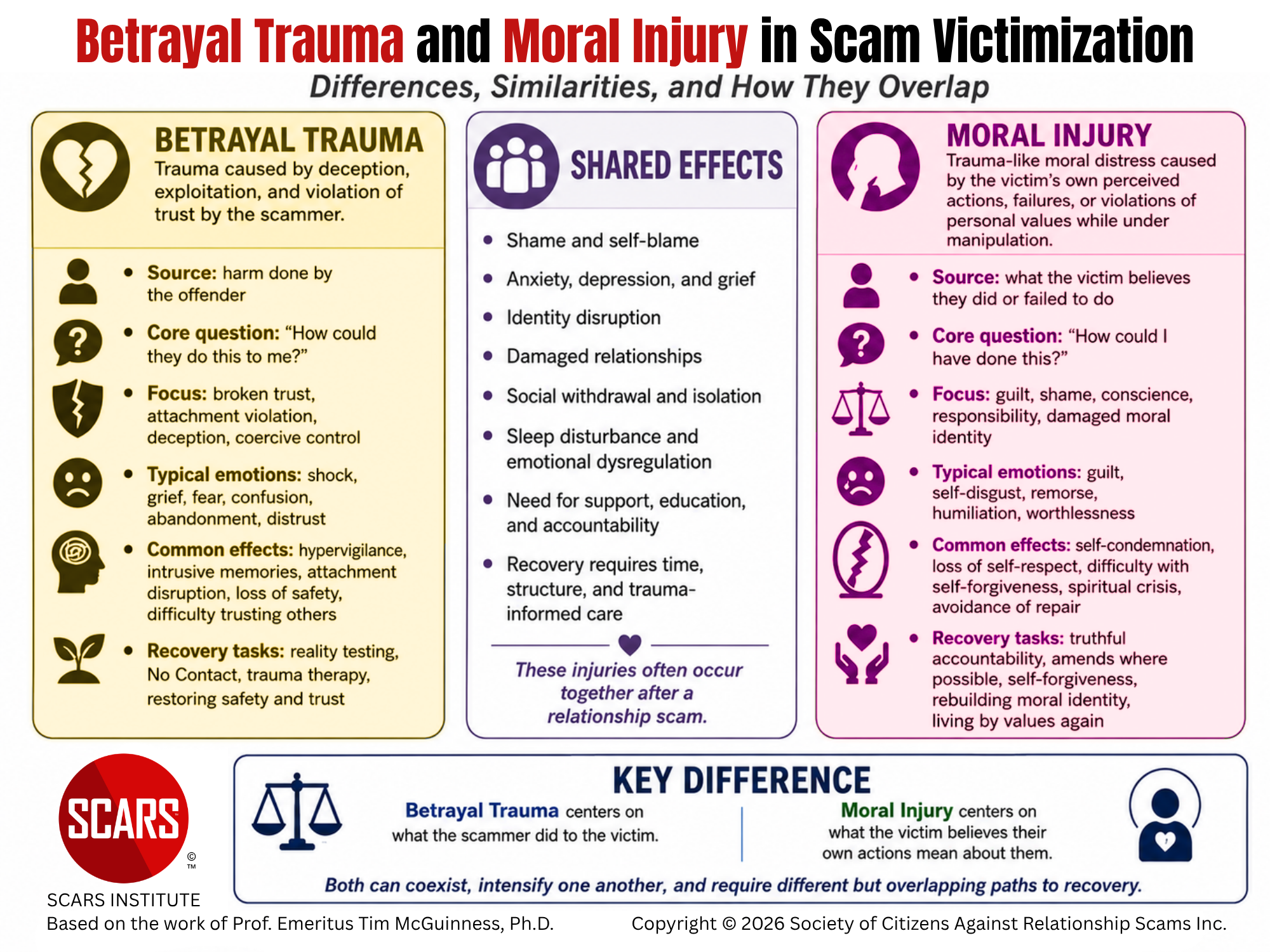
Moral Injury and Betrayal Trauma Are Connected but Different
Betrayal trauma centers on harm committed through a trusted or depended-upon relationship. The trusted person becomes the source of danger, deception, or exploitation. This can disrupt attachment, safety, memory, identity, judgment, and the ability to trust future relationships.
Moral injury centers on the perceived violation of moral beliefs and the meaning assigned to that violation.
- Betrayal trauma often asks: “How could someone I trusted do this to me?”
- Moral injury often asks: “How could I have done what I did?”
The two can occur together.
A relationship scammer creates the betrayal. The survivor can then interpret behavior performed under deception and coercive influence as a betrayal of family, values, judgment, or self. The offender’s wrongdoing becomes intertwined with the survivor’s moral self-condemnation.
Research on romantic betrayal describes experiences of shock, destabilization, shame, low self-esteem, fear, damaged expectations, and barriers to future intimacy. Research on fraud victimization also identifies shame, self-blame, trust erosion, family strain, withdrawal, depression, anxiety, and trauma-like reactions.
Moral injury can provide additional language for survivors whose deepest pain is not only that they were betrayed, but that they believe they became someone they no longer respect.
Forms of Morally Injurious Experience – In Depth
Moral injury literature commonly distinguishes among several forms of potentially morally injurious experience. These forms can overlap, and a single event can contain more than one. The classification depends on what happened, how the person understood it, which value appeared to be violated, and who was believed to be responsible. Moral injury develops from the meaning assigned to the event and its aftermath, not from exposure alone.
First, remember this. Moral Injury comes after the scam ends. This means that you were being manipulated expertly to do harm to yourself and perhaps others during the scam. IT WAS NOT YOUR FAULT. You were coerced and controlled.
Second, you may think you saw red flags and suspected it was false, but this is just cognitive bias. You did not really. You were being controlled. It was not your fault.
Acts of Commission
An act of commission occurs when a person does something that appears to violate deeply held moral beliefs or personal values. The person can later believe that the action contradicted who they were, what they stood for, or how they should have treated others.
In relationship scams, this can include:
- Lying to a spouse or family member about the relationship
- Concealing financial transfers or debts
- Borrowing money under false pretenses
- Accusing concerned relatives of jealousy, control, or prejudice
- Forwarding money, phones, packages, gift cards, or documents
- Opening accounts or conducting transactions for the scammer
- Giving the offender access to shared property or financial resources
- Breaking promises made to family members
- Continuing contact after agreeing to stop
- Participating unknowingly in activity that harmed another victim
The moral injury can become especially severe when the survivor believes that the behavior violated a defining value such as honesty, loyalty, responsibility, protection, faithfulness, or care for family. The central question often becomes, “How could I have done that?”
Acts of Omission
An act of omission involves failing to do something the person believes should have been done. The distress comes from perceived inaction, delay, silence, or failure to intervene rather than from a direct action.
In scam victimization, this can include:
- Failing to listen to warnings from family, banks, police, or friends
- Failing to protect shared savings
- Failing to report suspicious activity
- Failing to stop contact when doubts first appeared
- Failing to question implausible claims
- Failing to seek professional advice before transferring money
- Failing to prevent another person from becoming involved
- Failing to act after discovering that money or property might be stolen
- Failing to protect dependents from financial consequences
- Failing to acknowledge the concerns of a spouse or adult child
Omission-related injury often contains hindsight distortion. Once the deception becomes visible, the survivor can imagine that the correct action should also have been obvious earlier. This can obscure the fact that the offender controlled information, created urgency, punished doubt, and deliberately prevented informed judgment.
Failure to Prevent Harm
Failure to prevent harm is closely related to omission but often carries a stronger sense of personal duty. The person believes they occupied a position from which they should have protected someone, stopped an event, or prevented damage.
A scam victim can feel this form of injury when shared money was lost, a spouse’s credit was damaged, a family home was sold, or another person’s funds passed through an account. Parents can feel that they failed to protect their children’s inheritance or stability. Business owners can believe they failed employees, partners, or customers by allowing the offender access to business resources.
This form of moral injury can persist even when the survivor lacked the information or practical power necessary to prevent the outcome. The belief that protection was a personal obligation can remain stronger than the evidence showing how extensively the scammer obstructed that protection.
Bearing Witness to Wrongdoing
Witnessing-related moral injury can occur when a person observes conduct that violates deeply held values but cannot stop it, does not intervene, or later believes the response was inadequate. The person does not need to have committed the wrongful act directly.
Within scams, this can arise when the survivor discovers:
- Other victims were being manipulated
- Stolen funds were moving through accounts
- You received gifts and other stolen property
- The scammer was exploiting vulnerable people
- Members of a criminal group were threatening or abusing others, such as your family
- Institutions ignored clear warning signs
- Family members were being emotionally harmed by the ongoing deception
- Another victim was being recruited or used
The survivor can feel guilt for having witnessed part of the scheme without recognizing it, reporting it sooner, or protecting others. This distress can remain even when the person only understood the significance of what they saw after the scam was exposed.
Learning About Wrongdoing
Moral injury can also follow learning about conduct that violates a person’s moral expectations, even when the person did not directly witness it. Litz and colleagues included learning about morally transgressive acts within their broader description of potentially morally injurious experiences.
A scam survivor can later learn that:
- Money sent to the offender financed organized crime or terrorism
- Their account received money stolen from another victim
- A package contained stolen property
- Their identity was used to deceive others
- The scammer maintained several victims simultaneously
- Threats, fabricated deaths, or emergencies were reused against other people
- The offender used intimate information to target new victims
The injury can develop from the survivor’s perceived connection to those acts. The person can feel morally implicated even when the criminal purpose was deliberately concealed.
Betrayal by a Trusted Person
Betrayal-related moral injury occurs when a person trusted to act according to shared values violates those expectations. Jonathan Shay’s original formulation emphasized betrayal of what is right by someone holding legitimate authority in a high-stakes situation. Later models expanded betrayal to include leaders, institutions, peers, and other trusted people.
In a relationship scam, the scammer presents themselves as a trusted partner, protector, adviser, business associate, military member, professional, or future spouse. The survivor can experience moral injury when that person uses love, trust, loyalty, faith, or compassion to produce harmful behavior.
The injury can involve more than deception. The survivor can feel that the offender corrupted something sacred or morally important by turning intimacy, generosity, or responsibility into tools of exploitation.
Betrayal by an Institution
Institutional betrayal occurs when an organization expected to provide protection, justice, expertise, or care fails to respond appropriately. The institution can dismiss the victim, blame the victim, ignore evidence, refuse meaningful assistance, or treat the person as a willing participant without considering manipulation.
Potential sources include:
- Banks and financial institutions
- Law enforcement agencies
- Social media platforms
- Dating services
- Government agencies
- Employers
- Professional advisers
- Religious organizations
- Healthcare providers
- Victim support organizations
The moral injury can arise from the belief that the institution abandoned its responsibilities or protected itself while leaving the victim exposed. This form often damages trust beyond the original scam because the systems expected to restore order appear to repeat the betrayal.
Betrayal by Family, Friends, or Peers
A survivor can also experience moral injury when trusted relatives, friends, or peers respond with ridicule, contempt, rejection, or abandonment. The person can believe that those relationships carried an obligation of care that was violated during a period of crisis.
Examples can include:
- A family member publicly exposing the victim
- A spouse using humiliation rather than boundaries
- Friends disappearing after the loss became known
- Relatives repeatedly using the scam as a weapon
- Peers encouraging unsafe contact or retaliation
- Community members violating confidentiality
- Another survivor exploiting shared vulnerability
This does not mean every disagreement or boundary is a betrayal. Family members can have legitimate anger and protect themselves. The morally injurious element appears when the response is experienced as a profound violation of trust, dignity, or expected care.
Self-Betrayal
Self-betrayal occurs when a person believes they abandoned their own judgment, values, identity, or prior commitments. The injury concerns not only a particular act but the perceived loss of loyalty to the self.
A survivor can believe they betrayed themselves by:
- Ignoring persistent doubts
- Silencing their own intuition
- Crossing financial boundaries
- Abandoning long-held values
- Accepting treatment they once considered unacceptable
- Giving up independence to preserve the relationship
- Repeatedly choosing the scammer’s demands over personal safety
- Acting against earlier promises to stop
The person can experience a painful division between the former identity and the behavior performed during the scam. Recovery then requires rebuilding confidence that present choices can again reflect personal values.
Perceived Complicity
Perceived complicity develops when a survivor believes they became part of the offender’s wrongdoing, even without knowingly sharing the criminal intent. This is especially relevant when the victim received, transferred, stored, converted, or forwarded money or property.
The survivor can feel that being deceived does not remove the consequences experienced by others. This can produce guilt, fear, disgust, and uncertainty about moral or legal responsibility.
Moral repair requires careful differentiation among intention, knowledge, coercion, actual conduct, and resulting harm. It also requires qualified legal guidance when transactions or property movement could create legal exposure. Compassion should not erase the seriousness of the conduct, and seriousness should not erase the deception that produced it.
Role-Based Moral Failure
Role-based moral injury occurs when a person believes they failed duties attached to a valued role. The injured identity can involve being a spouse, parent, grandparent, professional, caregiver, business owner, community leader, or financially responsible adult.
A survivor can believe:
- A spouse failed to protect shared assets
- A parent failed to preserve family stability
- A professional failed to exercise expected judgment
- A caregiver neglected another person’s needs
- A community leader violated expectations of integrity
- A financially responsible adult became reckless or secretive
The distress can become stronger when others reinforce that judgment. The survivor can begin to believe that one period of manipulated behavior permanently invalidates the entire role.
Value Corruption
Value corruption occurs when the offender converts a positive moral quality into a pathway for exploitation. The survivor can feel that something good within them was contaminated by the scam.
Examples include:
- Compassion being used to obtain money
- Loyalty being converted into secrecy
- Faith being converted into unquestioning obedience
- Generosity being converted into repeated financial sacrifice
- Responsibility being converted into rescue
- Forgiveness being used to excuse continuing abuse
- Hope being used to sustain further investment
The survivor can later reject the value itself, believing that kindness, trust, faith, or generosity caused the harm. Moral repair involves separating the value from the offender’s misuse of it. The value was exploited, but exploitation does not make the value defective.
Identity-Based Moral Injury
Identity-based moral injury develops when the survivor interprets the event as proof of a damaged or unacceptable character. The judgment moves beyond behavior and becomes a conclusion about the entire self.
The person can believe:
- “I am dishonest.”
- “I am disloyal.”
- “I am dangerous.”
- “I cannot be trusted.”
- “I am no longer a good parent or spouse.”
- “I am morally weak.”
- “I do not deserve respect.”
This form is closely connected with shame. It can be especially destructive because repairable actions become transformed into a permanent identity sentence.
Collective or Relational Moral Injury
Collective moral injury involves damage to the moral relationships connecting families, communities, and institutions. The harm is not confined to one person’s conscience.
A scam can divide a family into opposing sides, destroy confidence in shared decision-making, damage intergenerational trust, and produce lasting arguments about blame and responsibility. The survivor can feel excluded from a moral community that once provided identity and belonging.
Repair can therefore require more than individual self-forgiveness. It can involve truthful conversation, acknowledgment of shared harm, appropriate boundaries, restitution, and gradual rebuilding of relational trust.
Spiritual or Existential Moral Injury
Spiritual or existential moral injury occurs when the experience disrupts a person’s relationship with faith, meaning, justice, or the belief that life follows a moral order. The survivor can feel abandoned by God, unworthy of forgiveness, spiritually contaminated, or unable to reconcile the crime with prior beliefs.
A nonreligious person can experience a similar crisis involving justice, human goodness, fairness, or meaning. The central injury concerns the collapse of a moral framework that once made life understandable.
Spiritual care can help when it respects the survivor’s beliefs and does not impose confession, forgiveness, or religious interpretations. Psychological and spiritual support can work together, but one should not be used to replace the other.
These Forms Often Overlap
A single scam victim can experience several forms simultaneously. A survivor can feel betrayed by the offender, guilty about personal actions, ashamed of failing a family role, distressed about unknowingly helping the criminal, and abandoned by institutions that refused to help.
The categories are therefore not competing diagnoses. They are ways of identifying where the moral pain is located and what kind of repair could be needed.
An act of commission can require acknowledgment and changed behavior. An omission can require a more accurate understanding of what was realistically possible. Institutional betrayal can require validation and restored access to trustworthy systems. Self-betrayal can require renewed alignment with personal values. Perceived complicity can require legal guidance, truthfulness, and appropriate corrective action.
Moral repair becomes more precise when the survivor can move from the global statement, “I am a terrible person,” to the more accurate questions:
- “What happened?”
- “What value did this appear to violate?”
- “What did the scammer control or conceal?”
- “What responsibility belongs to the offender?”
- “What responsibility belongs to the survivor?”
- “What harm can still be repaired?”
- “What present behavior would express the injured value now?”
Guilt and Shame Must Be Separated
Guilt and shame are related but psychologically different.
- Guilt focuses on behavior: “I did something wrong.”
- Shame expands the judgment to the whole person: “I am wrong.”
This distinction is especially important in scam recovery.
Guilt can sometimes support repair. A survivor can acknowledge a lie, apologize, repay what can be repaid, correct a record, or establish stronger safeguards. Healthy guilt remains connected to a specific action and can motivate responsible change.
Shame does not remain specific. It turns the action into a permanent identity.
- The survivor no longer thinks, “I concealed the transfer because I was being manipulated and afraid of losing the relationship.” The survivor thinks, “I am dishonest.”
- The survivor no longer thinks, “I failed to recognize what was happening.” The survivor thinks, “I am stupid and cannot be trusted.”
- The survivor no longer thinks, “I harmed people while under deceptive influence.” The survivor thinks, “I am harmful.”
The National Center for PTSD describes guilt as distress and remorse about a morally injurious event, while shame generalizes the event into a judgment about the entire self. Moral injury can also involve self-disgust, anger, inability to self-forgive, and self-sabotaging behavior.
Recovery requires keeping conduct, circumstances, intent, knowledge, coercive influence, and identity separate enough for accountability to remain possible without total self-condemnation.
Manipulation Does Not Eliminate Responsibility, but It Changes Its Meaning
Survivors can become trapped between two extreme explanations.
- The first says that they bear complete responsibility because they performed the action.
- The second says that they bear no responsibility because the scammer manipulated them.
Neither position fully captures the complexity.
- A survivor can have performed an action while operating under deception, emotional conditioning, fabricated emergencies, attachment pressure, threats of loss, isolation, and systematically distorted information. These conditions do not transform every action into meaningful, informed, and freely chosen consent.
- At the same time, recovery can require acknowledgment that real harm occurred.
- A spouse can have lost shared savings. An adult child can have been falsely accused. A loan can remain unpaid. Another victim’s money can have passed through an account. A family relationship can have been damaged by secrecy and hostility.
Accountability does not require accepting the scammer’s version of responsibility. It requires an accurate allocation of responsibility.
- The offender is responsible for designing and conducting the deception.
- Institutions can bear responsibility for inadequate safeguards or dismissive responses.
- Other participants can bear responsibility for their own conduct.
- The survivor can accept responsibility for repairable consequences without adopting the belief that manipulated behavior reveals a permanently corrupt character.
This is sometimes described as apportioning responsibility. Moral injury interventions frequently examine context, intent, available knowledge, coercion, alternatives, consequences, and the responsibilities of all involved parties rather than assigning every outcome to one person.
The Problem of Unknowing Participation
Some scam victims become involved in actions that later raise legal, financial, or ethical concerns.
They can receive funds and send them elsewhere. They can forward phones, packages, gift cards, cryptocurrency, or identity documents. They can open accounts, establish businesses, sign documents, receive deposits, or provide access to financial systems.
The victim can believe these actions are helping a romantic partner, completing a legitimate business task, assisting a military member, protecting an inheritance, or resolving an emergency.
Discovery can create terror and moral confusion. The survivor can fear being seen as a criminal. The person can also feel responsible for harm to unknown victims whose funds or property moved through the scheme.
This is one of the clearest areas in which moral injury can develop. The survivor can have participated in a harmful process without understanding its actual purpose.
The appropriate response requires both compassion and seriousness.
The person should stop all transfers, preserve records, secure accounts, obtain qualified legal advice when necessary, and cooperate appropriately with legitimate authorities. The survivor should not destroy evidence, continue acting for the offender, or assume that good intentions automatically remove legal risk.
However, legal exposure and moral worth are not identical. A person can need legal guidance and corrective action without accepting the belief that deception made them morally equivalent to the architect of the crime.
Family Betrayal and the Survivor’s Moral Pain
Many survivors describe the loss of family trust as more painful than the money. A spouse can feel betrayed by hidden transfers or secret loans. Adult children can feel that the scammer was repeatedly chosen over them. Siblings can become angry after warnings were rejected. Friends can withdraw after being accused of jealousy, cruelty, or interference.
The survivor can later remember every argument with painful clarity. Moral injury can deepen when loved ones say:
- “You lied to us.”
- “You chose a stranger over your family.”
- “You destroyed our future.”
- “You would not listen.”
These statements can contain legitimate pain. They can also become global judgments that leave little room for understanding manipulation.
Family repair requires both truths to remain present.
- The survivor was subjected to calculated deception and coercive influence.
- Family members were also affected by the survivor’s behavior during that manipulation.
- Acknowledging one truth does not erase the other.
A trauma-informed family response does not demand that relatives deny their anger, financial loss, or broken trust. It asks them to understand the context in which the behavior developed. The survivor, in turn, should not use victimization to silence every complaint or avoid appropriate repair.
Why Reassurance Alone Does Not Heal Moral Injury
Telling a survivor, “It was not your fault,” can be compassionate and necessary. However, the statement can feel incomplete when the survivor is looking at consequences that cannot be denied.
A person can think:
- “If none of this was my responsibility, why is my spouse bankrupt?”
- “If I did nothing wrong, why did I lie?”
- “If I was only a victim, why did another victim’s money enter my account?”
The survivor can reject reassurance because it appears to erase reality. Moral repair requires greater precision.
The person needs help understanding what was done, why it was done, what information was available, how the scammer shaped the decision, what harm followed, what can be repaired, and what should never be repeated.
This process does not excuse the offender or condemn the victim. It establishes a truthful account. Truthful accountability is more durable than empty absolution because it gives the survivor something concrete to do with guilt.
Self-Punishment Is Not Moral Repair
A survivor can believe that continued suffering is evidence of conscience. The person can refuse pleasure, intimacy, success, or financial recovery because feeling better appears undeserved. Therapy appointments can be missed. Relationships can be ended. Opportunities can be rejected. The survivor can tolerate mistreatment because punishment feels morally appropriate.
These behaviors do not repair the original harm. They create additional harm.
Moral injury is often associated with difficulty forgiving oneself and with self-sabotaging behavior based on the belief that the person does not deserve recovery, love, or success.
Self-punishment can also preserve the scammer’s control. The offender has already taken money, trust, time, relationships, and emotional safety. When the survivor continues imposing suffering indefinitely, the crime keeps expanding without further action from the criminal.
- Accountability asks what responsible action is possible.
- Self-punishment asks how long the survivor should continue hurting.
Only the first question supports repair.
Moral Injury Can Affect Spiritual and Existential Beliefs
For some survivors, the scam damages faith, spiritual identity, or confidence in a moral universe. A person can ask why prayer did not reveal the deception, why a loving God allowed the exploitation, or whether generosity and faith were foolish. A survivor can believe that religious commitments were violated through lying, financial secrecy, infidelity, or participation in unlawful activity.
Other survivors can feel abandoned by a faith community that responded with judgment, oversimplified forgiveness, or pressure to reconcile with people who remained unsafe.
Moral injury can include spiritual crisis, loss of meaning, alienation from community, and difficulty reconciling events with prior beliefs. The problem does not require religious faith, because nonreligious survivors can experience similar crises involving conscience, justice, identity, and meaning.
Spiritual support can be helpful when it respects the survivor’s beliefs and does not replace psychological care. Survivors should not be pressured into confession, forgiveness, religious interpretation, or reconciliation before they are ready or when doing so would increase danger.
Moral Injury Is Not the Same as PTSD
Moral injury and posttraumatic stress disorder can overlap, but they are not interchangeable. PTSD can include intrusive memories, avoidance, negative changes in mood and beliefs, hyperarousal, sleep disturbance, and exaggerated threat responses. Moral injury more centrally involves guilt, shame, betrayal, anger, moral conflict, damaged trust, self-condemnation, and difficulty with forgiveness.
A person can experience moral injury without meeting diagnostic criteria for PTSD. A person can also experience both. When moral injury and PTSD occur together, research in veteran populations has associated the combination with greater symptom severity, depression, functional impairment, and suicide-related risk. These findings should not be assumed to apply identically to scam victims, but they demonstrate the importance of taking severe guilt and shame seriously.
Fraud victimization research has documented depression, anxiety, shame, self-blame, reduced quality of life, social withdrawal, damaged trust, family strain, and trauma-like reactions. A recent systematic review concluded that fraud victimization should be treated as a public mental health concern requiring trauma-informed and psychosocial support.
A survivor experiencing persistent depression, inability to function, substance misuse, self-hatred, or thoughts of self-harm needs qualified professional assessment. Moral injury language can help organize the experience, but it should not become a substitute for diagnosis or treatment.
The Beginning of Moral Repair
Moral repair does not erase history. It changes the survivor’s relationship with that history. Repair begins by creating an accurate account of what happened. The survivor identifies the action, the value believed to have been violated, the manipulation surrounding the decision, the actual consequences, and the responsibility of every participant.
The process can include several connected tasks:
- Naming the specific moral injury rather than using global self-condemnation
- Distinguishing intention from outcome
- Distinguishing deception from informed choice
- Identifying coercive pressure and restricted alternatives
- Accepting legitimate responsibility without absorbing the offender’s responsibility
- Making appropriate apologies or restitution where possible
- Correcting unsafe behavior and strengthening safeguards
- Rebuilding trust through repeated responsible conduct
- Developing self-forgiveness without denying harm
- Reconnecting with values through present action
Moral repair is not achieved by repeatedly declaring that the survivor is a good person. It develops when current behavior provides evidence of honesty, reliability, courage, boundaries, and responsibility.
Naming the Value That Was Violated
A survivor can begin by identifying the value beneath the pain. The pain can concern honesty because the person lied.
- It can concern loyalty because family relationships were sacrificed.
- It can concern responsibility because money was borrowed or lost.
- It can concern protection because dependents were placed at risk.
- It can concern justice because another person’s funds were unknowingly transferred.
- It can concern faithfulness because the scam relationship existed alongside a marriage.
Naming the value creates direction.
- If honesty was injured, repair requires radical truthfulness.
- If financial responsibility was injured, repair requires transparent financial practices.
- If family trust was injured, repair requires consistent reliability and willingness to hear the family’s experience.
- If personal judgment was injured, repair requires verification, consultation, and delayed decisions.
The violated value is not only evidence of failure. It can become the foundation for recovery. The survivor feels pain precisely because the value still matters.
Apology, Restitution, and Amends
Some survivors need to make amends. An apology should not become a performance of total self-condemnation. It should identify the behavior, recognize its effect, provide relevant context without using context as an excuse, and describe what will change.
A responsible apology can communicate: “I concealed the transfers and rejected your warnings. I understand that this damaged your trust and affected your financial security. I was being manipulated, but I recognize that my actions harmed you. I am maintaining No Contact, using financial safeguards, and working with support so that this pattern is not repeated.”
Restitution can involve repayment plans, corrected records, cooperation with institutions, return of property, or other appropriate actions. Not every loss can be repaired financially, and survivors should not promise what they cannot realistically provide.
Amends also require consent and boundaries. A harmed relative is not obligated to forgive immediately, restore access, or resume a former relationship. The survivor’s responsibility is to act honestly and consistently, not to force a particular response.
Rebuilding Trust Through Evidence
Trust rarely returns because of one conversation. Family members can remain skeptical after repeated promises made during the scam. They can watch behavior rather than listen to explanations. This can feel painful, but it is understandable.
The survivor can rebuild credibility through transparent and repeated practices:
- Maintaining No Contact
- Disclosing suspicious communications
- Using independent verification before financial action
- Accepting appropriate financial safeguards
- Attending therapy or structured support
- Following through on agreed responsibilities
- Telling the truth when the truth is uncomfortable
- Respecting the boundaries of affected family members
These actions are not punishment. They are evidence.
Moral identity is rebuilt through what the survivor repeatedly chooses after discovering the truth.
Self-Forgiveness Is Not Self-Exoneration
Self-forgiveness can be misunderstood as declaring that nothing wrong happened. That is not its purpose. Self-forgiveness involves acknowledging harm, accepting appropriate responsibility, committing to repair, and refusing to reduce the entire self to the worst behavior performed under manipulation.
The survivor can say:
- “I did things that violated my values.”
- “I was acting under deception and emotional coercion.”
- “Real people were affected.”
- “I am responsible for the repair that is possible.”
- “The offender remains responsible for the crime.”
- “I will not make permanent self-hatred the price of having a conscience.”
This position holds accountability and compassion together.
Moral injury can be addressed through several trauma-informed approaches, including Cognitive Processing Therapy, Acceptance and Commitment Therapy, Adaptive Disclosure, and interventions focused on forgiveness, values, responsibility, amends, and moral repair. Prolonged Exposure can also help when moral injury occurs alongside trauma symptoms such as avoidance, intrusive memories, and distress linked to specific events. Because the evidence base is still developing, treatment should be guided by a qualified trauma professional who can distinguish guilt, shame, PTSD symptoms, legal concerns, family conflict, and the survivor’s need for appropriate accountability.
An even more direct statement for scam victims would be:
Moral injury treatment focuses on helping survivors examine what happened, separate responsibility from self-condemnation, process guilt and shame, reconnect with personal values, and make appropriate amends where possible. Different trauma-informed therapies can support this work, especially when moral injury occurs alongside PTSD, depression, anxiety, or severe self-blame. A qualified trauma professional can help the survivor determine which approach fits the actual symptoms and circumstances.
Community and Witnessing
Moral injury often pushes survivors into silence because they fear disgust, rejection, or condemnation. Silence allows shame to remain unchallenged and expand.
A safe support community can provide witnessing. Other survivors can hear the account without pretending that harmful consequences did not occur. They can help distinguish manipulation from character, accountability from humiliation, and remorse from permanent moral unworthiness.
Moral emotions are social. They influence whether people attempt repair or withdraw from the community. Compassion, gratitude, acknowledgment, and responsible acceptance can support reconnection, while contempt and humiliation can deepen alienation.
Moral Repair Requires a Future
Moral injury traps the survivor in a permanent trial of the past. Every memory becomes evidence. Every mistake becomes a verdict. Every good experience can feel undeserved. Recovery requires a future in which values can still be lived.
The survivor cannot return to the exact person who existed before the scam. Knowledge, grief, and consequence have changed that life. However, the person can become someone whose values are more deliberate, whose boundaries are clearer, and whose compassion includes both others and the self.
- The survivor can become more honest because secrecy caused harm.
- The survivor can become more careful because trust was exploited.
- The survivor can become more accountable because consequences were real.
- The survivor can become more compassionate because shame once made recovery feel impossible.
The objective is not moral innocence. No adult possesses an untouched history. The objective is moral integration.
Moral integration allows the survivor to hold the truth that manipulation occurred, harm followed, responsibility is shared unequally, repair remains possible, and personal worth is larger than actions taken inside a criminally engineered relationship.
The Central Recovery Insight
Relationship scammers do not only steal money and create false attachment. They can manipulate victims into actions that conflict with the people they believed themselves to be. That conflict can remain after the scam ends. A survivor can leave the offender yet continue living under an internal sentence of shame, disgust, and self-punishment. Moral injury provides language for this wound, but language alone does not heal it.
Healing requires truth without cruelty.
- It requires accountability without total condemnation.
- It requires compassion without denial.
- It requires amends where amends are possible and acceptance where consequences cannot be reversed.
The survivor did not freely design the criminal system. The offender created the deception, controlled the information, exploited attachment, and repeatedly shaped behavior. Yet the survivor can still reclaim responsibility for what happens next.
The past cannot be rewritten. The moral meaning of the future remains open. Every honest disclosure, maintained boundary, verified decision, repaired relationship, and responsible act becomes evidence that the scam did not permanently determine the survivor’s character.
Moral repair begins when the survivor stops asking only, “What did the scam make me do?” and begins asking, “What values will guide what I do now?”
Conclusion
Moral injury after relationship scam victimization can leave survivors struggling with far more than financial loss or betrayal. The deepest wound can involve the belief that the scam changed who they are, damaged their moral character, or made them unworthy of trust, forgiveness, and belonging. Acts of commission, omission, perceived complicity, institutional betrayal, self-betrayal, and role-based failure can overlap, creating a complex pattern of guilt, shame, grief, and damaged identity.
Recovery requires a careful separation of intention, knowledge, coercion, conduct, and consequence. The offender remains responsible for designing the deception, controlling information, exploiting attachment, and shaping behavior. The survivor can still acknowledge real harm, make appropriate amends, seek legal or professional guidance when needed, and rebuild trust through repeated responsible action. Accepting responsibility for what can be repaired does not require accepting the belief that manipulated behavior defines the whole person.
Moral repair depends on truthful accountability, not self-punishment. It asks what value was injured, what responsibility belongs to each person, what harm can still be addressed, and what present behavior can express that value now. Honest disclosure, No Contact, verification, restitution where possible, respect for boundaries, and consistent follow-through can gradually restore moral identity.
The past cannot be erased, but it does not have to become a permanent sentence. Survivors can live their values again through present choices, allowing conscience to guide repair rather than using shame to justify endless suffering.

Glossary
- Acts of Commission — Acts of commission are behaviors through which a scam victim does something that later appears to violate deeply held values or responsibilities. Examples can include concealing transfers, lying to relatives, forwarding property, opening accounts, or accusing concerned family members of interference. The resulting distress often centers on the belief that the behavior contradicted the person’s established moral character. — Moral Injury
- Acts of Omission — Acts of omission involve actions a survivor believes should have been taken but were delayed, avoided, or never completed. The person can blame themselves for failing to question claims, protect shared money, report suspicious activity, or accept warnings. Moral repair requires examining what information, freedom, and practical ability were actually available at the time. — Moral Injury
- Adaptive Disclosure — Adaptive Disclosure is a trauma-focused approach developed to help people process morally injurious events, traumatic loss, and experiences involving life threat. It can help a person examine guilt, shame, responsibility, forgiveness, and the meaning assigned to past behavior. A qualified trauma professional can determine whether this approach fits the survivor’s symptoms and circumstances. — Trauma Treatment
- Amends — Amends are responsible actions intended to acknowledge and address harm without reducing the survivor to the harmful behavior. They can include sincere apologies, corrected records, repayment plans, restored boundaries, or cooperation with affected people and institutions. Amends demonstrate commitment to changed behavior, but they do not guarantee immediate forgiveness or restored relationships. — Social Repair
- Apportioning Responsibility — Apportioning responsibility is the process of determining how responsibility should be distributed among the offender, survivor, institutions, and other participants. It considers intention, knowledge, coercion, available alternatives, actual conduct, and resulting harm. This process helps prevent the survivor from absorbing responsibility that properly belongs to the criminal. — Accountability Practice
- Betrayal-Related Moral Injury — Betrayal-related moral injury develops when a trusted person or institution violates expectations of honesty, protection, justice, or care. A scammer can create this injury by corrupting intimacy, loyalty, compassion, or faith for criminal purposes. Institutions can deepen it when they dismiss the victim, ignore evidence, or respond with humiliation instead of assistance. — Betrayal Trauma
- Coercive Influence — Coercive influence occurs when deception, emotional pressure, threatened loss, isolation, and controlled information restrict the victim’s ability to evaluate choices freely. The person can still perform an action while lacking the knowledge and psychological freedom required for fully informed consent. Recognizing coercive influence changes how responsibility is understood without denying that consequences occurred. — Coercive Control
- Collective Moral Injury — Collective moral injury involves damage to the shared values, trust, and moral relationships connecting families, communities, or institutions. A relationship scam can divide relatives, damage intergenerational trust, and create lasting conflicts about blame and responsibility. Repair can require family dialogue, acknowledgment of shared harm, boundaries, and gradual restoration of reliable behavior. — Community Dynamics
- Commission-Related Distress — Commission-related distress is the guilt, shame, fear, or disgust connected with something the survivor personally did during the scam. The behavior can have occurred under deception while still producing real consequences for family members, institutions, or other victims. Recovery requires naming the conduct precisely rather than converting it into a permanent judgment about the whole person. — Moral Emotion
- Conscience Injury — Conscience injury occurs when a survivor believes that behavior during the scam violated an internal understanding of right, responsibility, loyalty, or decency. The person can continue feeling morally damaged even after recognizing that the offender created the deception. Healing requires allowing conscience to guide repair instead of using conscience as justification for endless suffering. — Moral Injury
- Contextual Accountability — Contextual accountability examines harmful behavior within the conditions that influenced it, including manipulation, attachment pressure, false emergencies, isolation, and restricted information. It does not erase consequences or excuse unsafe conduct. It creates a truthful understanding that supports responsible repair without imposing total moral condemnation. — Accountability Practice
- Damaged Moral Identity — Damaged moral identity develops when the survivor believes that actions during the scam disproved defining qualities such as honesty, loyalty, responsibility, or care for family. The person can experience a painful division between the former self and the identity now feared. Repeated responsible conduct can gradually provide evidence that moral character was injured but not permanently destroyed. — Identity Reconstruction
- Deception-Conditioned Conduct — Deception-conditioned conduct consists of actions shaped by false information, emotional manipulation, fabricated emergencies, and repeated pressure from the scammer. The behavior can appear voluntary from the outside while developing inside a controlled relationship. Understanding this context helps distinguish manipulated action from deliberate participation in the offender’s criminal purpose. — Behavioral Manipulation
- Existential Moral Injury — Existential moral injury occurs when the scam disrupts beliefs about justice, fairness, human goodness, meaning, or the moral order of life. The survivor can struggle to understand how sincere trust and generosity produced exploitation rather than connection. Recovery can involve rebuilding meaning without requiring the person to deny the injustice that occurred. — Meaning Reconstruction
- Failure to Prevent Harm — Failure to prevent harm describes the belief that the survivor should have protected another person, preserved shared resources, or stopped the scam before damage occurred. Parents, spouses, caregivers, and business owners can experience this form of moral distress intensely because protection is central to their roles. A realistic review must consider whether the survivor possessed sufficient knowledge and power to prevent the outcome. — Moral Responsibility
- Family Trust Repair — Family trust repair is the gradual restoration of reliability after secrecy, financial harm, accusations, or rejected warnings damaged important relationships. It requires honesty, consistent follow-through, respect for boundaries, and willingness to hear how relatives were affected. Trust usually returns through repeated evidence rather than one apology or explanation. — Relationship Repair
- Forgiveness Difficulty — Forgiveness difficulty occurs when a survivor cannot imagine releasing self-hatred, accepting compassion, or allowing life to improve after harmful consequences. The person can fear that forgiveness would deny what happened or disrespect those who were affected. Recovery can separate forgiveness from denial by combining acknowledgment, accountability, repair, and changed behavior. — Moral Emotion
- Global Self-Condemnation — Global self-condemnation occurs when a survivor turns specific actions into a total judgment about personal worth. Instead of recognizing that harmful conduct occurred under manipulation, the person concludes that they are permanently dishonest, dangerous, or undeserving. This judgment blocks repair because it treats identity as fixed rather than behavior as changeable. — Belief Distortion
- Guilt — Guilt is the moral emotion associated with believing that a specific action, decision, or failure caused harm or violated a value. It can support recovery when it motivates apology, restitution, safer conduct, or renewed responsibility. Guilt becomes less constructive when it expands into permanent shame or endless self-punishment. — Moral Emotion
- Identity-Based Moral Injury — Identity-based moral injury develops when the survivor interprets scam-related behavior as proof of an unacceptable or corrupted character. The person can believe they are no longer a good spouse, parent, professional, caregiver, or responsible adult. Repair requires rebuilding identity through present actions that reflect honesty, boundaries, verification, and care. — Identity Reconstruction
- Institutional Betrayal — Institutional betrayal occurs when an organization expected to provide protection, justice, expertise, or care fails the survivor. Banks, law enforcement agencies, platforms, employers, healthcare providers, or support organizations can contribute through dismissal, blame, neglect, or inadequate response. This experience can deepen distrust because the systems expected to restore order appear to repeat the original betrayal. — Institutional Harm
- Intention-Outcome Distinction — The intention-outcome distinction separates what the victim believed they were doing from what the action actually produced. A person can intend to help a romantic partner while unknowingly transferring stolen funds or supporting a criminal operation. Understanding the difference does not erase consequences, but it prevents criminal intent from being falsely assigned where it did not exist. — Reality Testing
- Legal Exposure — Legal exposure refers to possible legal consequences arising from receiving, transferring, storing, converting, or forwarding money, property, accounts, or identity information. A survivor can face questions even when the criminal purpose was concealed. Preserving evidence, stopping all activity, securing accounts, and obtaining qualified legal advice are essential protective steps. — Legal Risk
- Moral Conflict — Moral conflict occurs when behavior, circumstances, or consequences appear inconsistent with the survivor’s deeply held beliefs about right and wrong. The person can feel divided between knowledge of manipulation and awareness that others were still harmed. Recovery requires holding both realities without transferring all responsibility to either the survivor or the offender. — Moral Injury
- Moral Contamination — Moral contamination is the feeling that participation in the scam made the survivor permanently tainted, corrupt, or unworthy. The person can experience disgust toward themselves even when they lacked knowledge of the offender’s criminal purpose. Moral repair challenges the belief that contact with wrongdoing permanently determines moral worth. — Moral Emotion
- Moral Dissonance — Moral dissonance is the internal tension created when a person’s behavior appears inconsistent with personal values, ethical upbringing, or professed beliefs. The discomfort can lead to honest self-examination and repair, or it can produce denial, defensiveness, displacement, and condemnation of others. Resolution requires bringing current behavior back into alignment with the values that remain important. — Moral Psychology
- Moral Identity — Moral identity consists of the values and ethical qualities through which a person understands who they are. Honesty, loyalty, responsibility, generosity, protection, faithfulness, and dependability can form important parts of that identity. Scam-related conduct can injure this self-understanding when behavior under manipulation appears to contradict those qualities. — Identity Reconstruction
- Moral Injury — Moral injury is the lasting psychological, relational, behavioral, social, or spiritual distress associated with a perceived violation of deeply held moral values. It can follow personal action, inaction, witnessing wrongdoing, perceived complicity, or betrayal by a trusted person or institution. Moral injury is not a formal psychiatric diagnosis, and its direct application to scam victimization remains a clinically informed framework. — Moral Injury
- Moral Integration — Moral integration allows a survivor to hold several difficult truths without collapsing into denial or self-condemnation. The person can recognize that manipulation occurred, real harm followed, responsibility is shared unequally, and repair remains possible. Integration supports an identity that includes the experience without allowing it to define the survivor’s entire character. — Recovery Insight
- Moral Repair — Moral repair is the process of addressing damaged values, responsibility, trust, and identity after a morally injurious experience. It can include truthful acknowledgment, contextual accountability, apologies, restitution, changed behavior, renewed values, and self-forgiveness. The process does not erase history but changes how the survivor lives in relation to it. — Recovery Process
- Moral Shock — Moral shock is the intense distress that can occur when a survivor discovers that apparently loving or responsible actions contributed to harm. The person learns that loyalty, compassion, faith, or generosity was manipulated to serve a criminal purpose. This delayed recognition can disrupt identity and produce guilt, disbelief, disgust, and grief. — Trauma Activation
- Moral Worthlessness — Moral worthlessness is the belief that the survivor no longer deserves dignity, respect, love, recovery, or belonging because of scam-related behavior. The belief converts consequences into a permanent sentence against the self. Recovery challenges it by distinguishing human worth from actions performed under deception and coercive influence. — Belief Distortion
- Perceived Complicity — Perceived complicity develops when a survivor believes they became part of the offender’s wrongdoing without knowingly sharing the criminal intent. It often arises after funds, packages, phones, accounts, or documents were received or forwarded. Careful evaluation of knowledge, intention, coercion, conduct, and harm is necessary for both moral and legal clarity. — Legal Risk
- Radical Truthfulness — Radical truthfulness is the recovery practice of speaking accurately about the scam, personal behavior, consequences, and continuing risks without concealment or distortion. It replaces secrecy with honesty while avoiding exaggerated self-condemnation. Repeated truthfulness can help restore credibility with family members, professionals, institutions, and the survivor. — Accountability Practice
- Relational Moral Injury — Relational moral injury involves damage to the values and obligations that hold important relationships together. Secrecy, financial harm, rejected warnings, accusations, and divided loyalties can injure trust between survivors and family members. Repair requires acknowledgment of both the manipulation experienced by the survivor and the consequences experienced by others. — Relationship Repair
- Restitution — Restitution is an effort to repair material or practical harm through repayment, return of property, corrected records, cooperation, or another appropriate action. It should remain realistic and should not involve promises the survivor cannot fulfill. Restitution can support accountability, but it cannot force forgiveness or restore every loss. — Social Repair
- Role-Based Moral Injury — Role-based moral injury occurs when a survivor believes they failed the responsibilities attached to being a spouse, parent, caregiver, professional, or financially responsible adult. One period of manipulated behavior can appear to invalidate the person’s entire role. Recovery involves demonstrating responsibility again through consistent and observable conduct. — Identity Reconstruction
- Self-Betrayal — Self-betrayal is the belief that the survivor abandoned personal judgment, values, safety, or prior commitments to preserve the fraudulent relationship. The person can feel that they ignored internal warnings or crossed boundaries that once seemed firm. Rebuilding trust in the self requires repeated decisions that align with verified reality and personal values. — Identity Reconstruction
- Self-Exoneration — Self-exoneration is the attempt to remove all personal responsibility without examining conduct, consequences, or opportunities for repair. It can prevent honest accountability just as total self-condemnation can prevent recovery. A balanced response recognizes coercive influence while still addressing actions that caused harm. — Accountability Practice
- Self-Forgiveness — Self-forgiveness involves acknowledging harm, accepting appropriate responsibility, committing to repair, and refusing permanent self-hatred. It does not declare that nothing wrong occurred or that consequences should disappear. It allows the survivor to continue living according to personal values after taking responsible corrective action. — Moral Repair
- Self-Punishment — Self-punishment occurs when a survivor uses suffering, deprivation, isolation, or self-sabotage as proof of remorse. The person can reject relationships, treatment, pleasure, financial recovery, or future opportunities because improvement feels undeserved. These actions create new harm without repairing the original consequences. — Accountability Distortion
- Shame — Shame is the painful belief that the entire self is defective, unworthy, or morally unacceptable. Unlike guilt, which focuses on specific conduct, shame converts behavior into an identity judgment. Persistent shame can produce withdrawal, secrecy, self-disgust, hopelessness, and resistance to repair. — Moral Emotion
- Spiritual Moral Injury — Spiritual moral injury occurs when the scam damages a survivor’s relationship with faith, forgiveness, divine justice, or religious identity. The person can feel abandoned, contaminated, condemned, or unable to reconcile victimization with prior beliefs. Respectful spiritual support can complement psychological care but should not impose confession, reconciliation, or premature forgiveness. — Spiritual Crisis
- Truthful Accountability — Truthful accountability identifies what happened, what influenced the behavior, who was harmed, and what responsibility belongs to each participant. It rejects both empty absolution and total condemnation. This approach gives the survivor specific actions for repair while preserving an accurate understanding of the offender’s responsibility. — Accountability Practice
- Unknowing Participation — Unknowing participation occurs when a victim becomes involved in harmful activity without understanding its criminal purpose. The person can receive funds, forward property, open accounts, sign documents, or provide access while believing the action serves a legitimate relationship or emergency. Discovery can create moral confusion, legal fear, and concern for unknown victims. — Scam Facilitation Risk
- Value Corruption — Value corruption occurs when a scammer converts a positive moral quality into a pathway for exploitation. Loyalty can become secrecy, compassion can become financial compliance, and responsibility can become compulsive rescue. Recovery requires separating the value itself from the offender’s deliberate misuse of it. — Emotional Manipulation
- Value Reconnection — Value reconnection is the process through which a survivor begins expressing injured values through present behavior. Honesty can be restored through truthful disclosure, responsibility through financial safeguards, and care through respect for affected family members. Current action transforms values from sources of shame into guides for recovery. — Recovery Process
- Virtue Exploitation — Virtue exploitation occurs when the offender targets generosity, faith, loyalty, hope, protectiveness, or compassion because those qualities can support compliance. The scammer does not create the virtue but redirects it toward secrecy, payment, and continued attachment. Recognizing exploitation helps the survivor preserve valued qualities while developing stronger boundaries. — Scam Tactics
- Witnessing-Related Moral Injury — Witnessing-related moral injury can occur when a survivor observes wrongdoing but cannot stop it, does not understand it, or later believes the response was inadequate. The person can discover that other victims were being harmed, stolen funds were moving through accounts, or family members were suffering. The distress can remain even when the significance became clear only after the scam ended. — Moral Injury
- Wrongdoing Awareness — Wrongdoing awareness develops when a survivor later learns that money, property, identity information, or personal cooperation supported broader criminal activity. The discovery can include learning about other victims, organized crime, reused emergencies, or stolen property. This awareness can create perceived moral implication even when the true purpose was intentionally concealed. — Awareness and Education
Sources and References
- Moral Injury and Moral Repair in War Veterans: A Preliminary Model and Intervention Strategy, Brett T. Litz, Nathan Stein, Eileen Delaney, Leslie Lebowitz, William P. Nash, Caroline Silva, and Shira Maguen – https://doi.org/10.1016/j.cpr.2009.07.003
- Moral Injury: An Integrative Review, Brandon J. Griffin, Natalie Purcell, Kristine Burkman, Brett T. Litz, Craig J. Bryan, Michele Schmitz, Camille Villierme, Jessica Walsh, and Shira Maguen – https://doi.org/10.1002/jts.22362
- Moral Injury, Jonathan Shay – https://doi.org/10.1037/a0036090
- The Role of Moral Emotions in Military Trauma: Implications for the Study and Treatment of Moral Injury, Jacob K. Farnsworth, Kent D. Drescher, Jason A. Nieuwsma, Robyn D. Walser, and Joseph M. Currier – https://doi.org/10.1037/gpr0000018
- Moral Injury, Posttraumatic Stress Disorder, and Suicidal Behavior Among National Guard Personnel, Craig J. Bryan, AnnaBelle O. Bryan, Elizabeth Roberge, Fiona R. Leifker, and David C. Rozek – https://doi.org/10.1037/tra0000290
- Adaptive Disclosure: An Open Trial of a Novel Exposure-Based Intervention for Service Members with Combat-Related Psychological Stress Injuries, Matt J. Gray, Yusra Schorr, William Nash, Leslie Lebowitz, Amy Amidon, Amy Lansing, Maggie Maglione, Alan J. Lang, and Brett T. Litz – https://doi.org/10.1016/j.beth.2011.09.001
- Using Prolonged Exposure and Cognitive Processing Therapy to Treat Veterans with Moral Injury-Based PTSD: Two Case Examples, Philip Held, Brian J. Klassen, Michael B. Brennan, and Alyson K. Zalta – https://doi.org/10.1016/j.cbpra.2017.09.003
- The Moral Injury and Distress Scale: Psychometric Evaluation and Initial Validation in Three High-Risk Populations, Sonya B. Norman, Brandon J. Griffin, Robert H. Pietrzak, Carmen P. McLean, Jessica L. Hamblen, and Shira Maguen – https://doi.org/10.1037/tra0001533
- Is Romantic Partner Betrayal a Form of Traumatic Experience? A Qualitative Study, Michelle Lonergan, Alain Brunet, Marjolaine Rivest-Beauregard, and Danielle Groleau – https://doi.org/10.1002/smi.2968
- Mental Health and Psychosocial Sequelae of Fraud Victimization: A Systematic Review, Jie Bai, Mei-Hsin Ho, Hsiang-Te Sung, Chuan-Sheng Hung, and Jui-Hsiu Tsai – https://doi.org/10.3389/fpsyg.2026.1805536
Author Biographies
Author Biography
Prof. (Emeritus) Tim McGuinness, Ph.D. DFin is a co-founder, Managing Director, and Chairman of the SCARS Institute (Society of Citizens Against Relationship Scams Inc.), where he serves as an unsalaried volunteer officer dedicated to supporting scam victims and survivors around the world. With over 34 years of experience in scam education and awareness, he is perhaps the longest-serving advocate in the field.
Dr. McGuinness has an extensive background as a business pioneer, having co-founded several technology-driven enterprises, including the former e-commerce giant TigerDirect.com. Beyond his corporate achievements, he is actively engaged with multiple global think tanks where he helps develop forward-looking policy strategies that address the intersection of technology, ethics, and societal well-being. He is also a computer industry pioneer (he was an Assistant Director of Corporate Research Engineering at Atari Inc. in the early 1980s) and invented core technologies still in use today.
His professional identity spans a wide range of disciplines. He is a scientist, strategic analyst, solution architect, advisor, public speaker, published author, roboticist, Navy veteran, and recognized polymath. He holds numerous certifications, including those in cybersecurity from the United States Department of Defense under DITSCAP & DIACAP, continuous process improvement and engineering and quality assurance, trauma-informed care, grief counseling, crisis intervention, and related disciplines that support his work with crime victims.
Dr. McGuinness was instrumental in developing U.S. regulatory standards for medical data privacy called HIPAA and financial industry cybersecurity called GLBA. His professional contributions include authoring more than 1,000 papers and publications in fields ranging from scam victim psychology and neuroscience to cybercrime prevention and behavioral science.
“I have dedicated my career to advancing and communicating the impact of emerging technologies, with a strong focus on both their transformative potential and the risks they create for individuals, businesses, and society. My background combines global experience in business process innovation, strategic technology development, and operational efficiency across diverse industries.”
“Throughout my work, I have engaged with enterprise leaders, governments, and think tanks to address the intersection of technology, business, and global risk. I have served as an advisor and board member for numerous organizations shaping strategy in digital transformation and responsible innovation at scale.”
“In addition to my corporate and advisory roles, I remain deeply committed to addressing the rising human cost of cybercrime. As a global advocate for victim support and scam awareness, I have helped educate millions of individuals, protect vulnerable populations, and guide international collaborations aimed at reducing online fraud and digital exploitation.”
“With a unique combination of technical insight, business acumen, and humanitarian drive, I continue to focus on solutions that not only fuel innovation but also safeguard the people and communities impacted by today’s evolving digital landscape.”
Dr. McGuinness brings a rare depth of knowledge, compassion, and leadership to scam victim advocacy. His ongoing mission is to help victims not only survive their experiences but transform through recovery, education, and empowerment.
-/ 30 /-
What do you think about this?
Please share your thoughts in a comment below!
GLOSSARY SEARCH
TOPIC SEARCH
TABLE OF CONTENTS








CATEGORIES
Moral Injury – A Different Kind of Trauma – 2026
Please Leave a Comment
Please Tell Us What You Learned From This?
Commenting Is An Essential Part Of Healing
Read • Think • Write
3 Comments
Leave A Comment Cancel reply
More ScamsNOW.com Articles









I am not sure if I do have moral injuries but I relate with some of the thoughts that exemplify some moral injury types described in the article. Right after arriving home after the phone call with a real bank representative who told me I’ve been scammed I felt guilty, I thought that by loosing money to the scammers I had indirectly and unwillingly supported their continued criminal actions. Which might fit on learning about wrongdoing. I thought about victims of extortion, how they losse money because their lives are threatened. And how the money they stole from me was going to be used to keep committing crimes and me falling as a victim was proof/motivation for them to continue fishing victims. I thought about how I lost money because of that alleged opportunity the scammers offered, and being greedy even when I did not need the money at that moment. Which might fit into identity-based moral injury. I also felt I could not be trusted, was mentally and moraly weak, and that I did not deserve respect. And yes, shame was sticked to me and I attentively listened to it. Spiritual moral injury seems to have been present as well. I was raised in a catholic family and after discovering the scam I felt greedy, a sinner, and unworthy of forgiveness. I prayed to be strong and able to survive the consequences of the scam, to pay the debt. I thought the scam was somekind of lesson I had to learn and that it was a divine punishment for the resentment I had towards my parents’ families. Because of hinsight bias I also thought I failed to see and consider the red flags, I thought I could have protected myself and did not. I did felt betrayed by the bank, but I could not understand myself how I did everything the scammers asked menduring the two phone calls and how it seemed I did it willfully and aware. So I did not fight back, even though back then there was this support by Condusef to reclaim from the bank money lost to fraud. I made a request, got a follow back email requesting more details, but I stopped there. I felt I did not deserve help. And also there could be role-based moral injury. I remember I continuously asked myself how could a PhD student be fooled, how could I not acted rationally, how I crossed a financial boundary. I thought the scam was a piece of evidence of my lack of worth. And the information outhere only deepened my feeling of unworthiness. I self-sabotaged myself, I needed to feel in control by reminding myself what I did was wrong, thinking that way it would not happen again.
I held myself responsible for everything and even admired the scammers’ skills. I felt so small. So guilty. While it was good to pay the debt and acknowledge that it was a mistake taking those calls, it was bad to feel that I commited the crime and self-sabotage me, and delayed reporting the crime.
When I started the survivors school I realized about many vulnerabilities which I had not seen, such as cognitive biases and fallacies. But it wasn’t until taking therapy for n-th time (but first session with Vianey) that I realized that those two calls were like a break to me since I was doing tasks I did not specially liked and I had agreed on out of fear and an inability of saying no, out of an already existing feeling of unworthiness. And made me realize that internally I was still blaming myself. While slowly I have responsible action on the consequences of the scam, it has take me a while to be fully aware of all it involves. Of all which made me vulnerable to it, all the harm it did to me, and how ignorant I was about these crimes. I thank SCARS for showing me and supporting me inbthe recovery journey.
Thank you for sharing this so openly and thoughtfully. What you have described contains several experiences associated with moral injury, including identity-based, spiritual, and role-based injury. You do not have to decide whether you officially “have” a moral injury for the concept to help you understand what happened inside you.
One of the most important distinctions in your reflection is the difference between criminal responsibility and responsible recovery action. You did not commit the crime. The scammers committed the crime. They created the deception, controlled the information you received, manufactured urgency, and deliberately guided your decisions during those calls. The fact that you followed their instructions does not mean that you acted with the same knowledge, intent, or freedom that they had.
You were not knowingly financing crime. You believed you were responding to a legitimate situation. Feeling horrified about how the money could be used reflects your conscience and concern for other people. It does not make you morally responsible for what the criminals chose to do.
Your belief that you needed to keep blaming yourself in order to remain safe is also very understandable. Self-blame can create an impression of control. The mind tells itself, “If I caused this, then I can guarantee it will never happen again.” Unfortunately, that kind of control comes at a terrible cost. It turns accountability into punishment, discourages reporting, prevents people from seeking help, and allows the criminals’ actions to become evidence against the victim’s worth.
Your education and status as a PhD student could not make you immune to manipulation. Scammers do not succeed because their victims lack intelligence or morality. They succeed because they understand how to exploit normal human trust, fear, urgency, authority, cognitive biases, emotional needs, and moments of vulnerability. Your education became another standard you used to condemn yourself, rather than protection against a professionally engineered deception.
It is also important that you are now recognizing the conditions that existed before the scam, including difficulty saying no, fear of disappointing others, unwanted obligations, and an existing feeling of unworthiness. These discoveries should not become a new list of charges against you. They provide context. They help explain what the scammers were able to exploit, and they show you where healing, boundaries, and self-respect can continue to grow.
Paying the debt, learning about these crimes, seeking therapy, reporting when possible, and participating in recovery are responsible actions. Believing that you committed the crime, deserved the consequences, or were unworthy of help was not accountability. That was shame speaking through the injury.
You were never small, morally weak, or unworthy of respect. You were deceived during a period when several vulnerabilities were present, and afterward you tried to understand the experience using the knowledge you had at the time. You now have more knowledge, greater awareness, and a much more compassionate understanding of what happened.
Thank you for trusting the community with this part of your journey. Your reflection demonstrates how recovery can gradually move a person from “What is wrong with me?” toward the more truthful questions: “What happened to me, what was exploited, and what do I need in order to heal?”
So many important points to keep in mind! And this really struck me: “When the survivor continues imposing suffering indefinitely, the crime keeps expanding without further action from the criminal.” Very true; I need to remember to have this perspective toward my own thoughts and behavior regarding the crime.