




Taking a Pause from Recovery – 2026

The SCARS Institute Magazine about Scam Victims-Survivors, Scams, Fraud & Cybercrime

- Published: 7/28/26
- Modified: 7/28/26
- Comments: 0
- Read Status:

Taking a Pause from Recovery
When Recovery Needs Rest, Not Retreat – The Difference Between Rest and Recovery Avoidance
Primary Category: Psychology / Recovery / Recoverology
Authors:
• Tim McGuinness, Ph.D., DFin, MCPO, MAnth – Anthropologist, Scientist, Polymath, Managing Director of the Society of Citizens Against Relationship Scams Inc.
Author Biographies Below
About This Article
Scam recovery can become exhausting, making temporary rest necessary for emotional and physical stabilization. A healthy pause remains intentional, time-limited, accountable, and connected to basic recovery practices. Recovery avoidance differs because it removes contact with discomfort without preserving a clear path back. Unstructured withdrawal can weaken new habits, increase isolation, encourage excuse-making, and allow denial, rumination, impulsive contact, or hopelessness to return. Early recovery carries particular risk because emotional stability and protective routines are still developing. Survivors can protect progress by maintaining recovery anchors, setting review dates, informing support providers, and returning through small, manageable actions. Cognitive biases can distort expectations in either direction, but consistent participation remains more effective than cycles of excessive effort followed by complete disengagement.
Note: This article is intended for informational purposes and does not replace professional medical advice. If you are experiencing distress, please consult a qualified mental health professional.
Keywords
Recovery Fatigue, Recovery Avoidance, Restorative Pause, Recovery Anchors, Trauma Recovery, Emotional Regulation, Cognitive Biases, Sustained Participation, No Contact, Recovery Accountability

When Recovery Needs Rest, Not Retreat – The Difference Between Rest and Recovery Avoidance
Author’s Note
Recovery after scam victimization cannot be sustained through constant emotional intensity. Survivors often need periods of reduced activity, but those pauses must remain purposeful, structured, and connected to recovery. The central concern is whether rest restores capacity or whether avoidance begins weakening habits, support, accountability, and willingness to return.
Prof. Emeritus Tim McGuinness, Ph.D.
July, 2026
When Rest Helps and When Withdrawal Begins to Undo the Work
Recovery after a scam can become exhausting. During the first few months, you can feel as though every part of your life requires attention at the same time. You are trying to understand what happened, contain financial damage, manage grief, regain emotional stability, rebuild routines, protect yourself from further contact, respond to family members, and learn how betrayal trauma has affected your thinking and behavior.
At some point, you can feel tired of recovery itself.
You can become tired of talking about the scam, reading recovery information, attending support meetings, completing exercises, answering questions, watching your thoughts, and trying to make responsible choices while your emotions remain unstable. You can begin to think that you need a break from all of it.
Sometimes you do.
A deliberate pause can protect you from emotional overload, reduce unnecessary pressure, and give your nervous system time to settle. A short reduction in recovery activity can help you sleep, think more clearly, and return with greater capacity.
However, a pause can also become one of the most dangerous turning points in early recovery. What begins as two days of rest can become two weeks of disengagement. Two weeks can become a month. The longer you remain disconnected from recovery activity, the more difficult it can become to restart. New habits weaken, avoidance grows, shame returns, and the temporary relief of doing nothing begins to feel easier than resuming the work.
The danger is not the pause itself. The danger is losing the distinction between restorative rest and recovery avoidance.
Why You Can Need a Pause
Trauma recovery consumes psychological and physical energy. Betrayal trauma can affect sleep, concentration, memory, motivation, emotional regulation, decision-making, and the ability to tolerate uncertainty. People experiencing traumatic stress can feel exhausted, confused, anxious, emotionally numb, agitated, or unable to concentrate. These reactions can interfere with ordinary responsibilities and make even modest recovery tasks feel overwhelming.
Your nervous system cannot remain under continuous demand without consequences. If every day becomes filled with crisis management, painful reflection, financial decisions, family conflict, and repeated exposure to reminders of the scam, your recovery efforts can begin to exceed your present capacity.
At that point, reducing the intensity can be responsible.
A restorative pause gives your mind and body relief without abandoning the direction of recovery. You can temporarily reduce difficult exercises, limit emotionally intense conversations, or step back from material that repeatedly activates you. You can focus on basic stabilization, including sleep, meals, hydration, movement, medical care, household responsibilities, and contact with trusted people.
This kind of pause recognizes that recovery has to be paced. It accepts that you cannot process everything at once. It protects your ability to continue rather than providing a reason to stop.
A healthy pause does not mean that you have failed. It can mean that you noticed your limits before exhaustion became collapse.
Recovery Cannot Be Sustained Through Constant Intensity
Many scam victims enter recovery with a sense of urgency. They want to understand everything immediately. They read for hours, repeatedly review messages, investigate the criminal, discuss the experience constantly, and attempt to solve every emotional and practical problem at once.
This intensity can feel productive because activity creates a temporary sense of control. However, recovery built on constant urgency often becomes unstable. The person pushes beyond reasonable limits, becomes emotionally flooded, and then withdraws completely.
This creates a boom-and-bust pattern. During the active phase, you do too much. During the crash, you do almost nothing. Similar cycles of excessive activity followed by extended disengagement can reinforce avoidance, isolation, low mood, and reluctance to reengage.
Sustainable recovery usually develops through consistency rather than intensity. A small amount of meaningful participation repeated over time can become more valuable than occasional periods of extreme effort.
You do not need to spend every day deeply examining the trauma. You do need to remain connected to the recovery process.
Why Even a Short Pause Can Feel Beneficial
When you stop recovery activity for several days, you can experience immediate relief. You no longer have to confront painful facts. You do not have to explain your feelings, complete an exercise, attend a meeting, or think deliberately about the scam.
That relief is real.
Your emotional activation can decrease. You can feel less pressured and less exposed. Ordinary life can briefly seem more familiar. You can begin to believe that stepping away has solved the problem.
This is where confusion begins.
Relief does not always indicate healing. Sometimes relief results from removing an unnecessary burden. At other times, relief results from avoiding something necessary but painful.
Avoidance commonly produces short-term relief because the person no longer encounters the thought, feeling, memory, or situation that creates distress. The problem is that repeated avoidance prevents the nervous system from learning that the reminder can be tolerated and that the danger has ended. The United States Department of Veterans Affairs explains that avoidance of trauma-related thoughts and feelings can make recovery more difficult, even though it can feel helpful in the moment.
The important question is not whether the pause feels good. The important question is what the pause is doing to your capacity, behavior, and willingness to return.
The Difference Between Rest and Avoidance
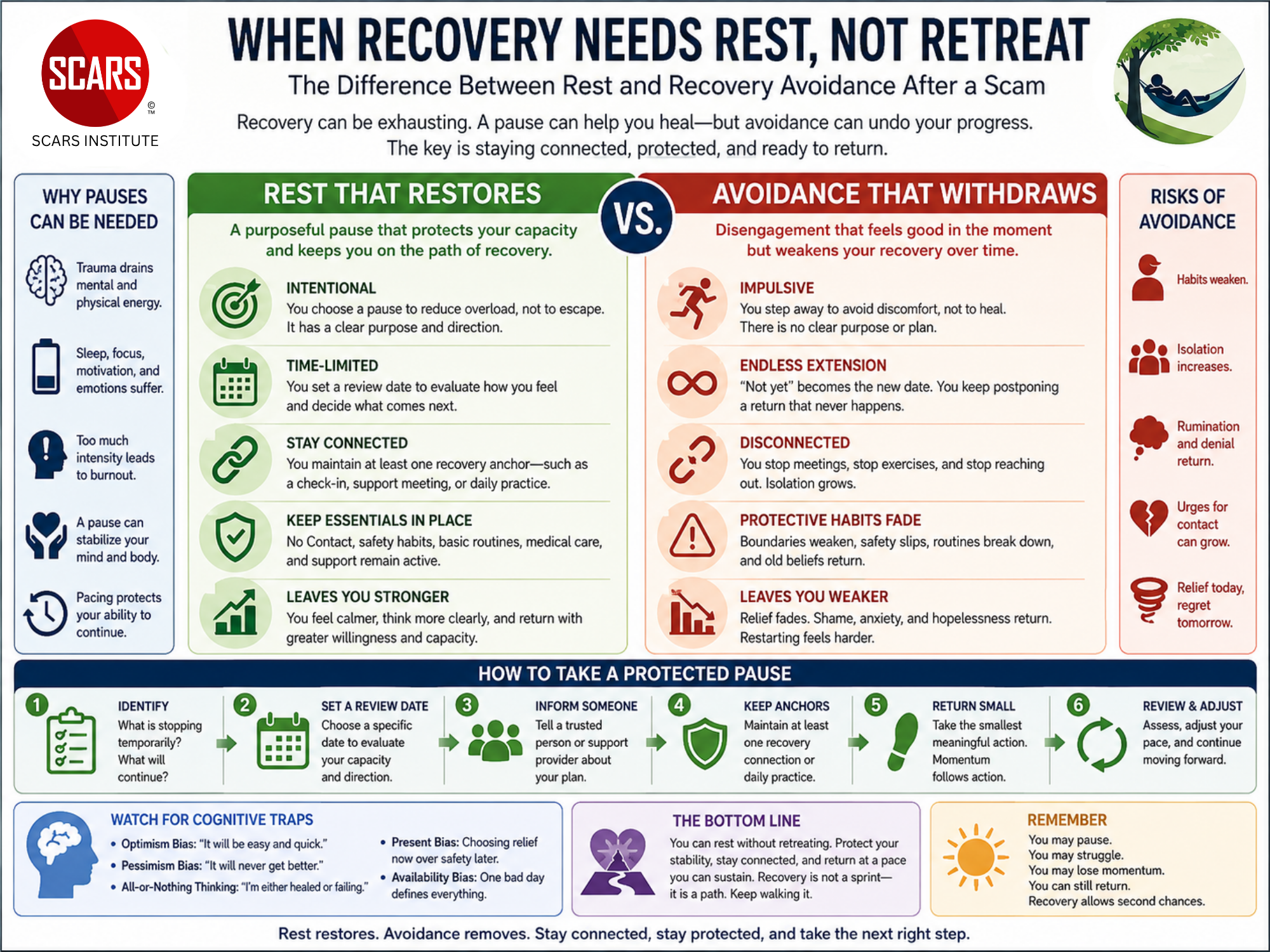
Rest restores capacity. Avoidance reduces contact with discomfort.
These can look similar from the outside. In both cases, you can stop attending meetings, reduce reading, postpone exercises, or spend less time discussing the trauma. The difference appears in the purpose, structure, and outcome.
A restorative pause has limits. You know why you are taking it, what you are reducing, what you are maintaining, and when you will review the decision. You remain connected to basic recovery supports. You preserve enough structure that returning does not require beginning again.
An avoidant pause has no clear boundary. You tell yourself that you will return when you feel better, less busy, more motivated, or completely ready. Because those conditions are vague, the return date keeps moving.
- Rest leaves you more able to participate. Avoidance leaves you less willing to participate.
- Rest helps you regain strength. Avoidance trains you to escape discomfort.
- Rest reduces excessive pressure while protecting recovery. Avoidance removes recovery because recovery itself has become uncomfortable.
What a Healthy Pause Looks Like
A healthy pause is intentional rather than impulsive.
You decide that your current recovery workload is too demanding and identify what needs to change. You can reduce the number of meetings, postpone one difficult exercise, shorten the time spent reading, or take several days away from repeated discussion of the scam.
- You do not disappear without explanation. You inform the therapist, support provider, group facilitator, or trusted person who is helping you maintain accountability.
- You choose a reasonable duration. The pause can last several days or a couple of weeks, depending on the circumstances, but it has a defined review point. You do not require yourself to feel completely ready before returning.
- You continue basic stabilizing activities. These can include maintaining sleep routines, eating regularly, taking prescribed medication as directed, avoiding contact with the scammer, protecting accounts, attending necessary medical appointments, and remaining in contact with at least one safe person.
- You preserve one or two recovery anchors. A recovery anchor is a small action that keeps the identity and direction of recovery active. It can include reading one brief recovery message each day, checking in weekly with a support person, attending one meeting, writing several sentences in a journal, or reviewing your safety boundaries.
- You return according to the plan unless a genuine crisis requires adjustment.
The pause remains part of recovery rather than becoming an escape from it.
What Recovery Avoidance Looks Like
Recovery avoidance usually develops gradually. It often begins with understandable fatigue and then becomes protected by increasingly persuasive explanations.
- You stop attending because the meetings feel repetitive.
- You stop reading because you believe you already understand the material.
- You stop journaling because writing brings up too much emotion.
- You stop speaking with supportive people because you do not want to burden them.
- You avoid professional help because discussing the trauma feels uncomfortable.
- You become irritated when someone asks about your recovery.
- You insist that you need to handle it alone.
- You spend more time distracting yourself and less time addressing essential tasks.
- You return to monitoring the scammer, researching the criminal, or revisiting old communications while avoiding activities that would help you detach.
- You tell yourself that ordinary work, entertainment, travel, family obligations, or exhaustion make recovery participation impossible.
Any one of these choices can have a reasonable explanation. The pattern becomes concerning when the explanations consistently lead away from engagement and no realistic alternative is put in place.
Avoidance is a central feature of persistent traumatic stress. It can include avoiding external reminders, but it can also involve avoiding thoughts, emotions, conversations, and treatment itself. Evidence-based trauma treatment specifically addresses avoidance because it tends to maintain fear and interfere with recovery.
How Excuse-Making Protects Avoidance
Excuse-making does not always involve deliberate dishonesty. The mind can create explanations that reduce internal conflict and protect a preferred behavior.
- You can sincerely believe that you are pausing because you are too busy. However, you might still find hours for social media, television, criminal investigation, or conversations unrelated to recovery.
- You can believe that the support group no longer has anything to offer. However, the deeper problem might be that the group asks you to accept facts that remain painful.
- You can say that journaling does not work for you. However, you might be avoiding the emotional clarity that writing creates.
- You can claim that you are tired of discussing the past. However, you might still spend significant time imagining alternate outcomes, reviewing evidence, or searching for the offender.
- You can say that you will return when life settles down. However, life rarely becomes completely free of competing demands.
The purpose of examining excuses is not to shame yourself. It is to determine whether your explanations match your behavior.
- A useful question is: “Does this reason help me modify recovery responsibly, or does it give me permission to abandon it?”
- Another is: “Am I replacing this activity with a more suitable recovery activity, or am I replacing it with nothing?”
When every problem leads to less participation, the problem can be avoidance rather than the activity itself.
Apathy Often Follows Avoidance
Apathy can appear after the initial relief of stepping away. You can lose interest in recovery, stop believing that your actions matter, and become emotionally indifferent to outcomes that previously concerned you.
This does not necessarily mean that you no longer want to recover. Apathy can develop from exhaustion, depression, hopelessness, emotional numbing, prolonged stress, or repeated avoidance.
When you stop performing recovery behaviors, you receive less evidence that change is possible. You no longer experience the small accomplishments that create confidence. You stop noticing improvement because you are no longer measuring or supporting it.
Inactivity then becomes evidence for hopelessness.
- You think, “Nothing is changing,” while doing less of what could produce change.
- You think, “Recovery does not work,” after withdrawing from the process.
- You think, “I have lost all motivation,” while waiting for motivation to return before taking action.
This reversal is dangerous because motivation often follows action rather than preceding it. You can regain motivation after resuming a manageable routine. Waiting to feel motivated can keep you inactive indefinitely.
How Pauses Damage New Recovery Habits
The first months of recovery are often devoted to replacing unstable reactions with deliberate practices. You can be learning to stop contact, tolerate grief, question distorted beliefs, use support appropriately, maintain boundaries, manage triggers, and perform basic daily tasks.
These behaviors are not yet deeply established. They require attention and repetition.
When you stop practicing them, older patterns remain available. Rumination, checking, isolation, emotional reasoning, fantasy, denial, self-blame, and impulsive contact can return because they were repeated extensively during the scam or its aftermath.
The loss does not always happen dramatically. You can simply become less likely to do the helpful behavior.
- You stop checking in.
- You stop reviewing safety rules.
- You stop using grounding skills.
- You stop separating facts from assumptions.
- You stop following a daily structure.
- You stop asking for help before making consequential decisions.
- You stop replying and leaving comments
Each omission makes the next omission easier.
A pause of one or two weeks does not erase everything you have learned. However, it can interrupt the behavioral momentum that made those actions increasingly natural. Returning can then feel harder than expected, not because recovery has become impossible, but because the routine has lost its automatic place in your life.
The First Few Months Carry Special Risk
Early recovery is vulnerable because emotional stability and recovery habits are still developing.
- You can remain attached to the false relationship or identity created by the scammer.
- You can still feel strong urges to seek explanations, recover money, obtain closure, defend the offender, or prove that some part of the relationship was real.
- Your mind can continue to move between acceptance and denial.
- You can understand the scam intellectually while emotionally resisting what that understanding means.
During this period, regular support and structure serve as external stabilizers. They help you act according to verified reality even when emotion pulls in another direction.
When you take an unstructured pause, you remove those stabilizers at the moment you still rely on them. The pause creates space for old beliefs and behaviors to return without challenge.
- You can begin rewriting the history of the scam.
- You can minimize the offender’s actions.
- You can exaggerate your responsibility.
- You can imagine that renewed contact will bring resolution.
- You can withdraw from people who reinforce reality.
- You can become vulnerable to another scam because loneliness, hope, and impaired judgment remain active.
This is why early recovery pauses require more care than ordinary vacations from a mature routine.
When Overwhelm Requires More than a Pause
Sometimes the problem is not excessive recovery activity. The problem is that symptoms have intensified beyond what informal support can safely manage.
Persistent inability to function, severe sleep disruption, overwhelming panic, major depression, escalating substance use, inability to care for basic needs, or thoughts of self-harm require professional assessment rather than simple withdrawal from recovery.
A pause cannot substitute for mental healthcare.
If recovery activities repeatedly destabilize you, the answer is not always to stop. The pace, method, or level of support might need to change. Trauma-focused treatment is designed to help people approach painful material gradually and safely while reducing avoidance and restoring a sense of control.
- You may need more stabilization before intensive processing.
- You may need a different therapist, a different treatment approach, clearer boundaries, or fewer simultaneous demands.
The correct adjustment is the one that protects your health while preserving a path forward.
○ Questions that Reveal the Nature of Your Pause
You can evaluate a pause by examining your choices rather than your stated intentions.
Ask yourself:
- Did I choose a clear beginning and ending date?
- Did I explain the pause to someone who supports my recovery?
- Am I maintaining at least one recovery connection?
- Am I resting from overload, or escaping from discomfort?
- Am I continuing essential safety and self-care practices?
- Do I feel increasingly able to return, or increasingly resistant to returning?
- Have I replaced demanding recovery activities with gentler ones, or with nothing?
- Am I avoiding one unsuitable method, or rejecting recovery as a whole?
- Do my reasons remain consistent, or do they change whenever someone offers a solution?
- Am I waiting for a perfect emotional state before I resume?
- Has the pause helped me become calmer and more capable, or more isolated and indifferent?
- Would I encourage another victim in my situation to make the same choices?
Your answers can reveal whether the pause is serving restoration or avoidance.
The Moving Goalpost
One of the clearest signs of avoidance is a return date that continually moves.
- You plan to restart on Monday, but Monday arrives during a stressful week.
- You decide to begin the following month, but work becomes demanding.
- You plan to return after a family event, vacation, financial problem, or medical appointment.
Each delay sounds temporary. Together they create permanent disengagement.
The standard for returning cannot be that all stress has ended. Recovery exists partly because life remains difficult. You return when you have enough capacity to perform a small, sustainable action, not when you feel completely free of discomfort.
The longer the pause continues, the smaller the restart should become.
You do not have to resume every activity at once. You can attend one meeting, complete one exercise, contact one support person, or restore one daily routine. The goal is to reestablish movement.
How to Take a Pause Without Abandoning Recovery
A protected pause begins with a written decision.
State why you need it. Identify the specific signs of overload. Decide which activities will stop temporarily and which will continue.
Choose a review date.
- Select at least one recovery anchor. Keep it small enough that it does not recreate the overwhelm you are trying to reduce.
- Tell someone about the plan. Accountability protects you from quietly extending the pause whenever discomfort returns.
- Avoid major decisions during the pause when possible. Emotional exhaustion can impair judgment. Do not interpret temporary relief as proof that support, boundaries, or recovery practices are no longer necessary.
- Monitor what you do instead of recovery. Rest, sleep, exercise, quiet recreation, household stability, and safe social connection can restore capacity. Compulsive distraction, isolation, renewed contact, substance misuse, obsessive investigation, and endless screen use can deepen avoidance.
- Review the pause honestly. At the end of the planned period, ask whether you are more stable, more capable, and more willing to resume. If not, determine whether you need additional support rather than another undefined extension.
Returning Before You Feel Ready
You can expect some resistance when the pause ends.
The first meeting can feel uncomfortable. The first journal entry can feel forced. The first conversation can reactivate emotions you had temporarily avoided.
Discomfort does not necessarily mean that returning is harmful. It can mean that the avoidance cycle is losing its protection. You do not have to return at full intensity. Resume with the smallest meaningful action and repeat it.
Recovery becomes active again through behavior.
- You attend even though you do not feel enthusiastic.
- You read for ten minutes rather than an hour.
- You write one paragraph rather than several pages.
- You tell one person how you are actually doing.
- You restore one boundary that has weakened.
- You identify one excuse and choose one responsible action despite it.
These choices rebuild momentum and remind the brain that discomfort can be tolerated without escape.
Compassion Without Permission to Disappear
Recovery requires compassion, but compassion is not the same as unlimited permission to withdraw.
You deserve rest when you are overwhelmed. You also deserve protection from the part of trauma that urges you to avoid everything associated with pain.
Supportive people should not shame you for needing a pause. They also should not automatically agree with every reason you give for disengaging. Compassionate support can include questions, accountability, limits, and encouragement to return.
A person who cares about your recovery can respect your exhaustion while still noticing when rest has become retreat.
- You can do the same for yourself.
- You can say, “I am tired, and I need several days with less pressure.”
- You can also say, “I am beginning to hide inside this pause, and it is time to reconnect.”
Both statements can be compassionate and true.
Recovery is Allowed to Breathe, but It Must Continue
A pause does not have to destroy recovery. It becomes destructive when it loses purpose, structure, accountability, and an endpoint.
The healthiest recovery process does not demand constant intensity. It allows periods of lower activity, rest, stabilization, and ordinary life. However, it maintains continuity. Some small part of recovery remains present even when the larger workload decreases.
The danger begins when temporary relief becomes the primary goal. Once you organize your life around avoiding discomfort, recovery activity starts to appear threatening, unnecessary, or impossible.
You can then mistake disengagement for independence and numbness for healing.
- Real rest helps you return.
- Avoidance gives you reasons not to return.
A healthy pause preserves the bridge back to recovery. It leaves the date on the calendar, the support connection open, the safety rules active, and at least one habit intact.
You do not need to recover without interruption. You do need to notice when the interruption has started making decisions for you.
Recovery can slow down. It can become gentler. It can temporarily ask less of you.
It cannot continue if you abandon it every time it becomes uncomfortable.
- The objective is not perfect participation.
- The objective is sustained direction.
Even during exhaustion, grief, or temporary retreat, you protect one small path back. Then, before avoidance becomes your new routine, you take the next step.
Cognitive Biases that Make it Harder Than it Needs to Be
Several cognitive biases can distort expectations about recovery in opposite directions. There is no single bias that explains both.
Biases That Make Recovery Seem Easier Than It Is
Optimism Bias: A person expects recovery to proceed more smoothly and quickly than is realistic. They can believe that motivation, intelligence, determination, or a few weeks of effort will protect them from setbacks that commonly affect other survivors.
Planning Fallacy: A person underestimates how much time, effort, repetition, and support recovery will require. They imagine the best-case path while failing to account for triggers, grief, exhaustion, avoidance, practical disruptions, and periods of reduced functioning.
Illusion of Control: A person overestimates how completely they can control emotional reactions, intrusive thoughts, attachment responses, or the pace of healing. They can assume that deciding to “move on” should be enough to end symptoms.
Overconfidence Bias: A person places too much confidence in their present understanding or ability to manage alone. Early insight can be mistaken for completed recovery, even though understanding what happened is different from changing the emotional and behavioral effects.
Present Bias: A person prioritizes immediate relief over long-term recovery. Because avoiding meetings, reflection, or difficult exercises feels better now, they underestimate the later cost of disengagement.
Peak-End Simplification: A few good days can be interpreted as proof that recovery is nearly complete. The person judges the whole process by a recent improvement rather than by the stability of functioning over time.
Normalcy Bias: A person assumes that life and emotional functioning will quickly return to their former state. They can underestimate how extensively betrayal, grief, financial harm, and loss of trust have disrupted their assumptions and routines.
Biases That Make Recovery Seem Harder Than It Is
Pessimism Bias: A person expects negative outcomes to be more likely than positive ones. Temporary setbacks can be interpreted as evidence that recovery will fail or that improvement is impossible.
Impact Bias: A person overestimates the intensity and duration of future emotional suffering. They imagine that the distress they feel today will continue at the same strength indefinitely.
Durability Bias: This is a form of impact bias in which a person specifically overestimates how long an emotional state will last. Grief, shame, fear, or hopelessness can feel permanent because the mind has difficulty imagining adaptation.
Neglect of Psychological Adaptation: A person fails to account for the human capacity to adjust, learn, form new habits, and regain stability. They predict the future using their current distress without considering how repeated safe experiences can change their reactions.
Availability Heuristic: The most vivid and painful experiences dominate judgment. A severe trigger, sleepless night, relapse in contact, or emotional collapse can make recovery appear universally unbearable, even when other days show gradual improvement.
Recency Bias: A recent setback is given more weight than months of progress. The person concludes that they are “back at the beginning” because the most recent experience feels more important than the larger pattern.
Negativity Bias: Failures, symptoms, and difficult days receive more attention than improvements. Ten successful choices can be discounted because one mistake feels emotionally stronger.
Focusing Illusion: The person concentrates on one painful part of recovery and treats it as though it represents the entire process. For example, persistent grief can make them overlook improvements in safety, judgment, sleep, boundaries, or daily functioning.
Learned Helplessness: After repeated experiences of manipulation, failed attempts to recover money, or emotional setbacks, a person can begin to believe that their actions no longer matter. This is more than a simple bias, but it strongly distorts expectations about the possibility of recovery.
Catastrophizing: Catastrophizing is usually classified as a cognitive distortion rather than a formal cognitive bias. It causes a person to interpret setbacks as disasters, predict unbearable outcomes, and assume that difficulty means permanent failure.
Biases That Can Distort Expectations in Either Direction
Affect Heuristic: Current emotion becomes evidence about reality. When a person feels hopeful, recovery can seem easy. When they feel overwhelmed, it can seem impossible.
Projection Bias: A person assumes that their future emotional state will resemble their present state. During a good period, they underestimate future difficulties. During a crisis, they underestimate their future ability to cope.
Anchoring Bias: Expectations become fixed around an arbitrary recovery timeline, such as three months, six months, or one year. Later progress is judged against that anchor rather than against the person’s actual circumstances and needs.
All-or-Nothing Thinking: Recovery is interpreted as either complete success or complete failure. A person can believe they are fully recovered after a brief improvement, then believe they have made no progress after one setback.
Confirmation Bias: A person notices evidence that supports what they already believe. Someone who expects rapid recovery notices good days and dismisses warning signs. Someone who expects permanent damage notices every symptom and discounts improvement.
The Central Distortion
The most important paired concepts are:
- Planning fallacy and optimism bias when recovery is underestimated.
- Impact bias, durability bias, and neglect of adaptation when recovery is overestimated as impossibly difficult.
A realistic understanding lies between them. Recovery is usually harder, slower, and less linear than people initially hope, but it is also more achievable and more responsive to sustained participation than people fear during their darkest periods.
This is Where Your Recovery Goes Away
As we have previously said, only a few victims will become sustained survivors.
This one issue is the dividing line for most of the realists who seek help. Being able to sustain it is hard, but you spent months, maybe years, being manipulated and indoctrinated. And when it gets hard, very few will remain committed.
We told you up front that this would be one of the hardest things you would ever do.
Most of you had no idea what that actually meant. But successful alcoholics know. If they remained sober, they know how much effort is needed every day, and how hard this is. They also know something else: the world does not care. Family and friends have no idea how much effort goes into recovery, and they will actively undermine your effort with distractions and false encouragement. Only you can hold your commitment by saying no when recovery requires your time.
You are responsible for your recovery. And you are responsible for its failure.
But recovery always allows for second chances. You can pause, or quit, or fail, and then come back. Everyone can, but few will.
Some understand this. We can only hope you are one of them.
Conclusion
Recovery does not require constant effort at maximum intensity. It does require continuity, honesty, and a protected path back when exhaustion makes a pause necessary. Rest can be responsible when it reduces overload, supports stabilization, and preserves the ability to return. It becomes dangerous when the pause loses structure, accountability, recovery anchors, and a clear review date.
The difference appears in behavior. Rest usually leaves a survivor calmer, more capable, and more willing to resume. Avoidance produces short-term relief while gradually increasing resistance, isolation, apathy, and disengagement. It can weaken new habits, remove external stabilizers, and allow rumination, denial, renewed contact, self-blame, fantasy, and unsafe decision-making to return.
A protected pause should identify what is stopping temporarily, what will continue, who will provide accountability, and when the decision will be reviewed. Basic safety practices, medical care, No Contact, stable routines, and at least one recovery connection should remain active. Returning does not require complete readiness. It requires one manageable action repeated until movement becomes familiar again.
Cognitive biases can make recovery appear either easier or more impossible than it is. Sustainable recovery usually falls between those extremes. It is slower, less predictable, and more demanding than many survivors initially expect, but it remains responsive to consistent participation.
A survivor can pause, struggle, withdraw, or lose momentum and still return. Recovery allows second chances. The essential responsibility is to recognize when rest has become retreat and take the next responsible step before avoidance becomes a new routine.

Glossary
- Affect Heuristic — The affect heuristic occurs when a survivor uses a current emotional state as evidence about the reality or difficulty of recovery. Hope can make recovery appear easier than it is, while distress can make recovery appear impossible. Recognizing this pattern helps the survivor evaluate progress through behavior and evidence rather than temporary emotion. — Cognitive Bias
- All-or-Nothing Recovery Thinking — All-or-nothing recovery thinking interprets recovery as either complete success or complete failure. A good period can create the belief that recovery is finished, while one setback can create the belief that no progress has occurred. A more realistic view recognizes that improvement and difficulty can exist at the same time. — Belief Distortion
- Anchored Recovery Timeline — An anchored recovery timeline develops when a survivor fixes expectations around an arbitrary period such as three months, six months, or one year. Progress is then judged against that chosen deadline rather than the person’s actual circumstances and needs. This comparison can create unnecessary disappointment, pressure, or false confidence. — Cognitive Bias
- Apathy After Avoidance — Apathy after avoidance can develop when a survivor experiences temporary relief from stepping away and then gradually loses interest in recovery. Reduced participation provides fewer experiences of accomplishment, progress, and personal effectiveness. Inactivity can then appear to confirm the mistaken belief that change is no longer possible. — Withdrawal Pattern
- Avoidance Cycle — The avoidance cycle begins when disengagement reduces discomfort and teaches the survivor that withdrawal provides immediate relief. The short-term relief makes future avoidance more likely, even when the long-term consequences include isolation, fear, and stalled recovery. Repeated avoidance can make ordinary recovery activities feel increasingly threatening or impossible. — Recovery Process
- Availability Heuristic — The availability heuristic causes vivid and painful experiences to dominate a survivor’s judgment about recovery. A severe trigger, sleepless night, or renewed contact can feel more representative than weeks of gradual improvement. Reviewing the broader pattern helps prevent one memorable event from defining the entire recovery process. — Cognitive Bias
- Basic Stabilization — Basic stabilization focuses on sleep, nutrition, hydration, movement, medical care, household responsibilities, and safe human contact. These activities protect functioning when emotionally demanding recovery work exceeds the survivor’s present capacity. Stabilization reduces intensity without abandoning the direction of recovery. — Recovery Process
- Behavioral Momentum Loss — Behavioral momentum loss occurs when previously repeated recovery practices stop occupying a regular place in daily life. Grounding, journaling, support participation, safety review, and help-seeking can become less automatic after an extended pause. Restarting can feel difficult because the routine has weakened, not because recovery has become impossible. — Recovery Momentum
- Boom-and-Bust Recovery Pattern — A boom-and-bust recovery pattern alternates between excessive effort and almost complete withdrawal. The survivor can read, investigate, attend meetings, and process emotions intensely until exhaustion produces a crash. Sustainable recovery replaces this cycle with smaller actions that can be repeated consistently. — Decision-Making Pattern
- Capacity Restoration — Capacity restoration occurs when rest improves the survivor’s ability to think, regulate emotions, maintain responsibilities, and return to recovery activity. The pause reduces excessive demands while preserving essential routines and support. Increased willingness and ability to resume indicate that the pause has served a restorative purpose. — Recovery Process
- Catastrophic Setback Interpretation — Catastrophic setback interpretation occurs when a survivor treats a difficult event as proof of permanent failure or unbearable future suffering. One mistake, trigger, or lapse can appear to erase every previous gain. A practical recovery response identifies the problem, corrects the behavior, and returns attention to the larger pattern of progress. — Belief Distortion
- Compassionate Reengagement — Compassionate reengagement allows a survivor to return after pausing, withdrawing, or losing momentum without using humiliation as motivation. The person acknowledges what happened, identifies a manageable next action, and resumes participation at a sustainable level. Compassion supports accountability when it leads back toward responsible behavior. — Recovery Participation
- Confirmation-Based Recovery Judgment — Confirmation-based recovery judgment occurs when a survivor notices evidence that supports an existing belief about recovery and discounts contradictory information. A person expecting rapid recovery can overlook warning signs, while a person expecting permanent damage can dismiss improvement. Deliberate review of both progress and difficulty produces a more balanced assessment. — Cognitive Bias
- Constant Recovery Intensity — Constant recovery intensity occurs when a survivor attempts to understand, process, investigate, and correct every consequence of the scam at once. The activity can create a temporary sense of control but can exceed emotional and physical capacity. Excessive intensity increases the risk of flooding, exhaustion, and complete disengagement. — Recovery Pattern
- Continuity Preservation — Continuity preservation keeps some part of recovery active during a temporary reduction in workload. A survivor can maintain No Contact, one support connection, a daily safety practice, or a brief recovery exercise. This continuity protects the bridge back and reduces the difficulty of restarting. — Recovery Process
- Delayed Restart Pattern — A delayed restart pattern develops when a survivor repeatedly moves the date for returning to recovery activity. Work, travel, family events, medical issues, or emotional discomfort can become new reasons for postponement each time the planned date arrives. Repeated temporary delays can eventually produce permanent disengagement. — Withdrawal Pattern
- Deliberate Recovery Pause — A deliberate recovery pause is a planned reduction in recovery activity designed to reduce overload without abandoning recovery. It identifies what will stop, what will continue, how long the pause will last, and when the decision will be reviewed. Clear structure distinguishes the pause from unplanned withdrawal. — Recovery Process
- Discomfort Avoidance — Discomfort avoidance occurs when a survivor reduces contact with thoughts, feelings, conversations, or activities because they create emotional distress. The immediate reduction in activation can feel helpful, but it prevents the person from learning that the discomfort can be tolerated. Repeated escape can maintain fear and interfere with recovery. — Trauma Response
- Durability Bias — Durability bias causes a survivor to overestimate how long grief, shame, fear, or hopelessness will remain at its current intensity. The present emotional state can feel permanent because future adaptation is difficult to imagine. Recovery experiences gradually demonstrate that emotional states can change even when they initially feel enduring. — Cognitive Bias
- Early Recovery Instability — Early recovery instability describes the period when emotional regulation, safety practices, and recovery habits remain underdeveloped. The survivor can continue moving between acceptance and denial while experiencing urges for contact, closure, explanation, or financial recovery. Regular structure and support provide external stability while internal stability is still developing. — Trauma Response
- Emotional Capacity Limit — An emotional capacity limit is the point at which recovery demands exceed the survivor’s current ability to process stress safely and effectively. Concentration, sleep, motivation, memory, decision-making, and emotional regulation can deteriorate under sustained pressure. Recognizing the limit early allows the survivor to reduce intensity before exhaustion becomes collapse. — Emotional Regulation
- Emotional Flooding — Emotional flooding occurs when painful information, memories, decisions, and recovery demands overwhelm the survivor’s ability to regulate responses. The person can become confused, agitated, numb, exhausted, or unable to continue productive activity. Reducing intensity and strengthening stabilization can restore enough capacity for recovery to continue. — Trauma Activation
- Excuse-Protected Withdrawal — Excuse-protected withdrawal develops when reasonable-sounding explanations repeatedly lead away from recovery without creating a safer alternative. Work, exhaustion, travel, family responsibilities, or dissatisfaction with a method can become permission to stop participating entirely. The important test is whether the explanation modifies recovery responsibly or removes it. — Withdrawal Pattern
- External Stabilizer — An external stabilizer is a person, routine, meeting, safety rule, or professional relationship that helps a survivor remain aligned with verified reality. These supports become especially important when emotions pull toward denial, renewed contact, fantasy, or self-blame. Removing stabilizers too early can leave old beliefs and behaviors unchallenged. — Support Systems
- Focusing Illusion — The focusing illusion causes one painful part of recovery to appear representative of the entire process. Persistent grief can overshadow improvements in safety, sleep, judgment, boundaries, or daily functioning. Reviewing several areas of life gives the survivor a more accurate picture of change. — Cognitive Bias
- Immediate Relief Misinterpretation — Immediate relief misinterpretation occurs when a survivor assumes that feeling better after disengaging proves that recovery activity was harmful or unnecessary. Relief can result from healthy rest, but it can also result from escaping necessary discomfort. The effect on future capacity and willingness to return provides a more reliable measure than temporary comfort. — Decision-Making Pattern
- Impact Bias — Impact bias causes a survivor to overestimate the future intensity and duration of emotional suffering. Current pain can make future life appear permanently dominated by the same distress. This bias overlooks the effects of adaptation, support, learning, and repeated safe experiences. — Cognitive Bias
- Impulsive Recovery Pause — An impulsive recovery pause begins without a defined purpose, duration, review date, or plan for maintaining essential protections. The survivor stops participating because recovery feels uncomfortable in the moment. The absence of structure allows temporary withdrawal to expand without deliberate evaluation. — Decision-Making Pattern
- Inactivity-Hopelessness Loop — The inactivity-hopelessness loop develops when reduced recovery behavior produces fewer signs of progress, and the lack of progress strengthens hopelessness. The survivor can conclude that recovery does not work while doing less of what could support change. Small completed actions interrupt this loop by restoring evidence of personal influence. — Belief Distortion
- Long-Term Safety Tradeoff — A long-term safety tradeoff occurs when a survivor accepts temporary discomfort to protect future stability, judgment, and recovery. Attending a meeting, maintaining No Contact, or completing an exercise can feel difficult while producing safer long-term outcomes. Recovery often requires choosing sustained protection over immediate emotional relief. — Decision-Making Pattern
- Motivation-Follows-Action Principle — The motivation-follows-action principle recognizes that willingness often increases after a survivor resumes manageable behavior. Waiting for enthusiasm or complete readiness can keep the person inactive indefinitely. A small completed action can generate confidence, momentum, and greater willingness for the next step. — Recovery Insight
- Moving Return Goalpost — A moving return goalpost appears when the conditions for resuming recovery repeatedly change. The survivor plans to return after one stressor ends, then identifies another reason to delay when that time arrives. A fixed review point and a small restart action help prevent indefinite postponement. — Withdrawal Pattern
- Neglect of Psychological Adaptation — Neglect of psychological adaptation occurs when a survivor predicts the future using current distress without considering the human capacity to adjust. The person can overlook how repeated safe experiences, new habits, support, and time alter emotional responses. This distortion makes recovery appear more permanently difficult than it is likely to remain. — Cognitive Bias
- Normalcy Bias — Normalcy bias causes a survivor to expect emotional functioning and ordinary life to return quickly to their previous state. The expectation underestimates the effects of betrayal, grief, financial damage, disrupted trust, and changed assumptions. Realistic pacing allows the survivor to rebuild without treating continued difficulty as abnormal failure. — Cognitive Bias
- Optimism Bias — Optimism bias leads a survivor to expect recovery to proceed more smoothly and quickly than is realistic. Intelligence, determination, or early understanding can appear sufficient to prevent setbacks that commonly occur. Realistic optimism combines hope with preparation for repetition, support, fatigue, and uneven progress. — Cognitive Bias
- Overconfidence in Recovery Knowledge — Overconfidence in recovery knowledge occurs when understanding scam tactics is mistaken for completing emotional and behavioral recovery. A survivor can accurately explain manipulation while remaining vulnerable to attachment, denial, impulsive contact, or avoidance. Knowledge becomes protective when it is translated into repeated safe behavior. — Cognitive Bias
- Overload Recognition — Overload recognition is the ability to identify when recovery work is exceeding present physical and psychological capacity. Warning signs can include severe fatigue, disrupted sleep, poor concentration, emotional flooding, and reduced daily functioning. Early recognition allows the survivor to adjust the pace without abandoning recovery. — Recovery Insight
- Pause Review Point — A pause review point is a predetermined date or moment when the survivor evaluates whether reduced activity has restored capacity. The review examines stability, willingness to return, current safety, and the need for additional support. A defined review point prevents the pause from continuing automatically. — Accountability Practice
- Peak-End Simplification — Peak-end simplification occurs when a survivor judges recovery primarily by a recent high point, low point, or emotionally intense ending. Several good days can create false confidence, while one difficult episode can erase awareness of wider progress. A longer review period gives a more accurate picture of stability. — Cognitive Bias
- Pessimism Bias — Pessimism bias causes a survivor to expect negative recovery outcomes more readily than positive ones. Temporary difficulty can become evidence that improvement is impossible or that every future attempt will fail. Recognizing progress alongside setbacks helps correct this distorted expectation. — Cognitive Bias
- Planning Fallacy — The planning fallacy causes a survivor to underestimate the time, repetition, effort, and support required for recovery. The person imagines a best-case path without accounting for grief, triggers, exhaustion, practical disruptions, and avoidance. Realistic planning includes setbacks and periods of reduced capacity without treating them as failure. — Cognitive Bias
- Present Bias — Present bias causes a survivor to prioritize immediate relief over long-term recovery outcomes. Avoiding a meeting, exercise, conversation, or boundary can feel better now while increasing later vulnerability. Recognizing the delayed cost of disengagement supports more responsible choices. — Cognitive Bias
- Projection Bias — Projection bias occurs when a survivor assumes that future emotional states will resemble the present one. A good period can lead to underestimating future challenges, while a crisis can make future coping feel impossible. Planning for changing emotional states creates more stable recovery decisions. — Cognitive Bias
- Protected Recovery Pause — A protected recovery pause preserves safety, accountability, support, and at least one recovery habit while reducing excessive demands. The survivor chooses a duration, identifies maintained activities, and informs a trusted person or professional. This structure allows rest to remain part of recovery rather than becoming an escape from it. — Recovery Process
- Recovery Anchor — A recovery anchor is a small repeated action that keeps the survivor connected to recovery during a period of reduced activity. It can include a brief reading, a weekly check-in, one support meeting, a short journal entry, or review of safety boundaries. The anchor protects continuity without recreating the overload that required the pause. — Recovery Participation
- Recovery Avoidance — Recovery avoidance occurs when a survivor withdraws from necessary thoughts, feelings, conversations, support, or treatment because they create discomfort. It often begins with understandable fatigue and becomes protected by increasingly persuasive explanations. The pattern becomes concerning when every adjustment leads toward less participation and no suitable replacement. — Withdrawal Pattern
- Recovery Fatigue — Recovery fatigue is the psychological and physical exhaustion that develops from prolonged emotional processing, crisis management, decision-making, and repeated attention to scam-related harm. The survivor can become tired of meetings, education, journaling, self-monitoring, and responsible choices. Appropriate pacing reduces exhaustion while maintaining recovery direction. — Health Impact
- Recovery Workload Adjustment — Recovery workload adjustment changes the amount or intensity of recovery activity without rejecting the process as a whole. A survivor can reduce meetings, shorten reading periods, postpone one difficult exercise, or focus temporarily on stabilization. The adjustment remains responsible when essential safety and support continue. — Recovery Process
- Restorative Rest — Restorative rest reduces excessive pressure and helps the survivor regain emotional, physical, and cognitive capacity. It supports sleep, clearer thinking, daily functioning, and greater willingness to resume recovery. Rest remains restorative when it strengthens participation rather than creating growing resistance to it. — Health Impact
- Return Resistance — Return resistance is the discomfort, reluctance, or emotional activation that can arise when a planned recovery pause ends. The first meeting, journal entry, or honest conversation can feel difficult because avoided material becomes present again. Resistance does not automatically mean that returning is harmful. — Trauma Activation
- Smallest Meaningful Restart — The smallest meaningful restart is the least demanding action that reestablishes movement toward recovery. A survivor can attend one meeting, read for ten minutes, contact one support person, or restore one weakened boundary. Repeating a manageable action rebuilds momentum without recreating excessive intensity. — Recovery Momentum
- Sustained Direction — Sustained direction means maintaining movement toward safety, reality, stability, and autonomy without requiring perfect participation. Recovery can slow down, become gentler, and temporarily demand less. It remains active as long as the survivor preserves a path forward and resumes responsible action after interruptions. — Recovery Process
- Temporary Relief Trap — The temporary relief trap occurs when the immediate comfort of disengagement becomes the primary reason for continuing to avoid recovery. The survivor can mistake numbness for healing and withdrawal for independence. The longer relief is protected through avoidance, the harder reengagement can become. — Psychological Vulnerability
- Trauma Processing Overload — Trauma processing overload occurs when the amount or intensity of scam-related reflection exceeds the survivor’s ability to remain regulated. Continuous discussion, investigation, message review, and emotional analysis can create exhaustion rather than understanding. Pacing and professional guidance can reduce overload while preserving progress. — Trauma Response
- Unstructured Disengagement — Unstructured disengagement is a pause without a clear purpose, endpoint, recovery anchor, or accountability. The survivor waits to return until life feels easier, motivation appears, or discomfort disappears. These vague conditions allow withdrawal to continue and make reengagement progressively more difficult. — Withdrawal Pattern
Reference
• https://www.ncbi.nlm.nih.gov/books/NBK207191/ “Understanding the Impact of Trauma – NCBI”
• https://www.ptsd.va.gov/professional/treat/cooccurring/chronic_pain_guide.asp “Chronic Pain and PTSD – PTSD: National Center for PTSD”
• https://www.ptsd.va.gov/understand/what/avoidance.asp “Avoidance – PTSD: National Center for PTSD”
• https://www.nice.org.uk/guidance/ng116/chapter/recommendations “Recommendations | Post-traumatic stress disorder”
• https://www.ptsd.va.gov/apps/decisionaid/for-clinicians/ “Information for Clinicians”
Author Biographies
Author Biography
Prof. (Emeritus) Tim McGuinness, Ph.D. DFin is a co-founder, Managing Director, and Chairman of the SCARS Institute (Society of Citizens Against Relationship Scams Inc.), where he serves as an unsalaried volunteer officer dedicated to supporting scam victims and survivors around the world. With over 34 years of experience in scam education and awareness, he is perhaps the longest-serving advocate in the field.
Dr. McGuinness has an extensive background as a business pioneer, having co-founded several technology-driven enterprises, including the former e-commerce giant TigerDirect.com. Beyond his corporate achievements, he is actively engaged with multiple global think tanks where he helps develop forward-looking policy strategies that address the intersection of technology, ethics, and societal well-being. He is also a computer industry pioneer (he was an Assistant Director of Corporate Research Engineering at Atari Inc. in the early 1980s) and invented core technologies still in use today.
His professional identity spans a wide range of disciplines. He is a scientist, strategic analyst, solution architect, advisor, public speaker, published author, roboticist, Navy veteran, and recognized polymath. He holds numerous certifications, including those in cybersecurity from the United States Department of Defense under DITSCAP & DIACAP, continuous process improvement and engineering and quality assurance, trauma-informed care, grief counseling, crisis intervention, and related disciplines that support his work with crime victims.
Dr. McGuinness was instrumental in developing U.S. regulatory standards for medical data privacy called HIPAA and financial industry cybersecurity called GLBA. His professional contributions include authoring more than 1,000 papers and publications in fields ranging from scam victim psychology and neuroscience to cybercrime prevention and behavioral science.
“I have dedicated my career to advancing and communicating the impact of emerging technologies, with a strong focus on both their transformative potential and the risks they create for individuals, businesses, and society. My background combines global experience in business process innovation, strategic technology development, and operational efficiency across diverse industries.”
“Throughout my work, I have engaged with enterprise leaders, governments, and think tanks to address the intersection of technology, business, and global risk. I have served as an advisor and board member for numerous organizations shaping strategy in digital transformation and responsible innovation at scale.”
“In addition to my corporate and advisory roles, I remain deeply committed to addressing the rising human cost of cybercrime. As a global advocate for victim support and scam awareness, I have helped educate millions of individuals, protect vulnerable populations, and guide international collaborations aimed at reducing online fraud and digital exploitation.”
“With a unique combination of technical insight, business acumen, and humanitarian drive, I continue to focus on solutions that not only fuel innovation but also safeguard the people and communities impacted by today’s evolving digital landscape.”
Dr. McGuinness brings a rare depth of knowledge, compassion, and leadership to scam victim advocacy. His ongoing mission is to help victims not only survive their experiences but transform through recovery, education, and empowerment.
-/ 30 /-
What do you think about this?
Please share your thoughts in a comment below!
GLOSSARY SEARCH
TOPIC SEARCH
TABLE OF CONTENTS








CATEGORIES
More ScamsNOW.com Articles