


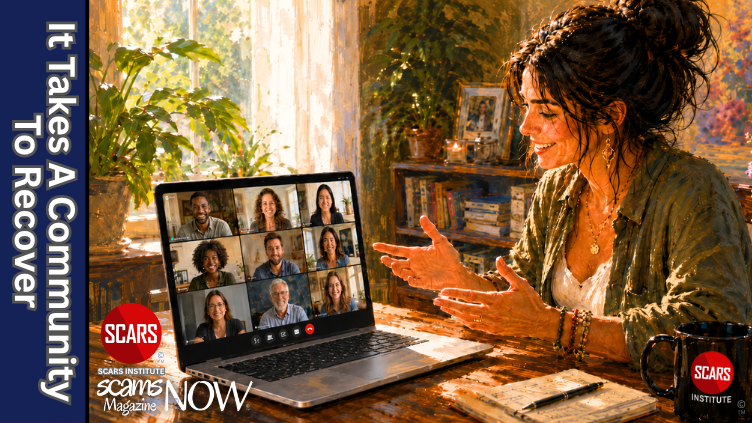
It Takes a Community to Recover – 2026

The SCARS Institute Magazine about Scam Victims-Survivors, Scams, Fraud & Cybercrime
- Published: 7/27/26
- Modified: 7/27/26
- Comments: 0
- Read Status:

It Takes a Community to Recover
Recovery Requires A Community – Don’t Try This Alone!
Primary Category: Psychology / Scam Victim Recovery / Recoverology
Authors & Contributors:
• Vianey Gonzalez B.Sc(Psych) – Licensed Psychologist, Specialty in Crime Victim Trauma Therapy, Neuropsychologist, Certified Deception Professional, SCARS Institute Advisor & Psychology Advisory Panel
• Tim McGuinness, Ph.D., DFin, MCPO, MAnth – Anthropologist, Scientist, Polymath, Managing Director of the Society of Citizens Against Relationship Scams Inc.
• Debby Montgomery Johnson, President and CEO of BenfoComplete.com, Online Scam/Fraud Survivors Advocate, Author, Keynote Speaker, Trainer, Podcast Host, USAF Veteran, SCARS Institute Advisor & Former Chairperson
• Janina Morcinek – Certified and Licensed Educator, SCARS Institute Advisor & Former Director
Author Biographies Below
About This Article
Recovery communities can help traumatized scam victims reduce shame, restore perspective, maintain accountability, and remain connected to long-term recovery. Survivors benefit when they participate actively rather than remaining silent observers. Gradual disclosure, thoughtful discussion, support meetings, shared learning, and compassionate responses can turn isolation into connection and confusion into greater understanding. Healthy participation also requires boundaries, confidentiality, privacy protection, and respect for different recovery timelines. Members should avoid dependency, rescuing others, giving professional advice beyond their competence, encouraging renewed contact, or trusting strangers without verification. Peer support can strengthen recovery but does not replace qualified mental health, legal, financial, or crisis services when they are needed. Effective communities help survivors rebuild agency without surrendering personal responsibility or independent judgment.
Note: This article is intended for informational purposes and does not replace professional medical advice. If you are experiencing distress, please consult a qualified mental health professional.
Keywords
Recovery Community, Peer Support, Scam Victim Recovery, Community Participation, Compassionate Accountability, Recovery Boundaries, No Contact, Reality Testing, Shame Reduction, Survivor Connection
Recovery Requires A Community
Author’s Note
Recovery communities can provide traumatized scam victims with understanding, structure, accountability, and continuing support that isolation cannot provide. Participation must remain active, reciprocal, and responsible. Survivors benefit when they speak honestly, listen to others, respect boundaries, protect confidentiality, accept appropriate feedback, and contribute to the emotional safety of the group. Community support should strengthen personal agency rather than create dependency, encourage unsafe behavior, or replace qualified professional care when it is needed.
Prof. Emeritus Tim McGuinness, Ph.D.
July, 2026
Don’t Try This Alone!
Trauma often tells you to withdraw.
After a relationship scam, you can feel ashamed, exposed, angry, confused, and uncertain about whom to trust. You can begin to believe that isolation is safer than connection. You might avoid telling your story because you fear judgment. You might remain silent because you do not want to appear weak, foolish, or emotionally overwhelmed. You can convince yourself that recovery is something you should handle privately.
That instinct is understandable, but isolation can prolong suffering.
Recovery requires personal responsibility, but personal responsibility does not mean recovering alone. You must make your own decisions, complete your own work, attend your own therapy, practice your own boundaries, and choose your own direction. No community can do those things for you. However, a healthy recovery community can give you the structure, knowledge, connection, encouragement, and accountability that make those actions easier to sustain.
A support community works when its members understand that recovery is both individual and shared.
Warning:
The truth is that if you try to do this your way or on your own, the odds of significantly delaying or stalling your recovery go up astronomically. Every victim needs to understand that the decisions made now affect your future. Let real expert crime victims’ assistance providers and trauma professionals support you.
The Core Message
A recovery community can become one of the strongest supports in your healing, but it must not become another environment where you surrender judgment, ignore boundaries, follow unverified claims, or depend entirely on others.
- Participate, but remain thoughtful.
- Share, but protect your privacy.
- Listen, but verify advice.
- Support others, but do not rescue them.
- Accept accountability, but reject humiliation.
- Build connection, but maintain boundaries.
A healthy community should help you regain agency, not replace it.
The Fatal Mistake of Remaining Silent
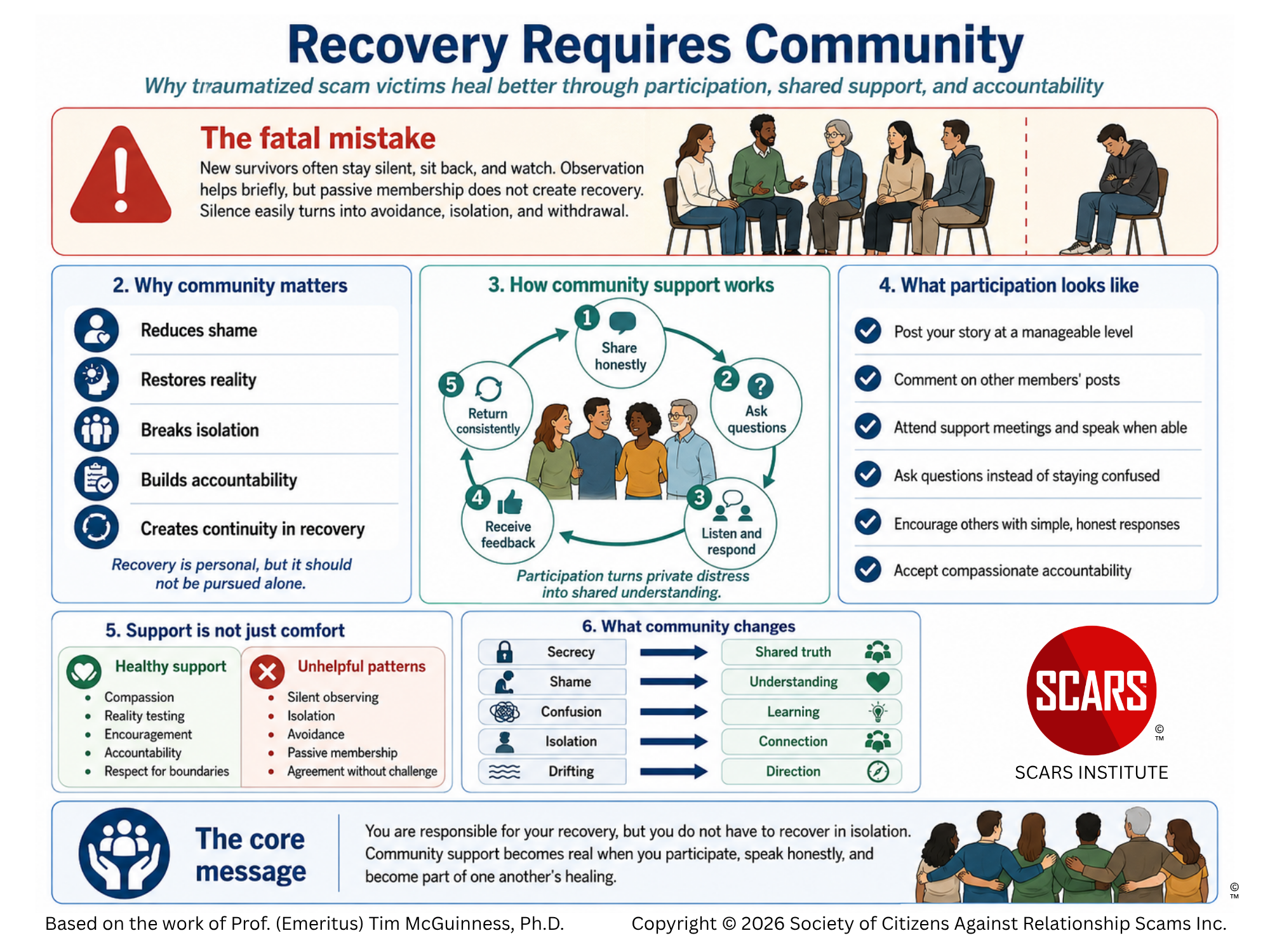
One of the most damaging mistakes new survivors make when entering a recovery group is remaining silent, sitting back, and watching everyone else.
You might enter the community feeling frightened, ashamed, or uncertain. You might tell yourself that you will observe for a while before participating. You can read posts, watch conversations, attend meetings without speaking, and wait for something inside you to change.
Observation can be useful during the first few days. You need time to understand the community, learn its expectations, and determine whether it feels safe. However, silent observation cannot become your permanent form of participation.
A recovery community is not television. You cannot sit back, watch other people recover, and expect their participation to produce your recovery.
You learn by becoming involved.
Caution:
Do not remain a permanent observer. Sitting back, reading, and watching can feel like participation, but passive membership does not allow the community to understand what you need or help correct dangerous beliefs. Avoid waiting until you feel completely ready, because readiness often develops through gradual participation rather than before it.
You begin by introducing yourself. You tell your story at a level that feels manageable. You ask questions about what you do not understand. You respond to other members. You attend meetings and allow others to hear your voice. You share what you are learning and acknowledge where you remain stuck.
Silence can feel protective, but it often preserves the very conditions that allow shame, denial, distorted beliefs, and isolation to continue.
When you remain invisible, other members cannot know what you need. They cannot correct misunderstandings that you never express. They cannot help you recognize manipulation patterns that you do not describe. They cannot support you through urges, setbacks, or dangerous decisions that you keep private.
You can also begin convincing yourself that participation is unnecessary because you are reading what others write. Reading is important, but passive consumption does not provide the same psychological benefits as expression, reflection, dialogue, and connection.
You need to take the knowledge out of the page and bring it into your own recovery.
This does not mean that you must disclose every painful detail immediately. It does not mean that you must speak continuously or make yourself the center of attention. It means that you must become visible enough for the community to know you, respond to you, and include you in the shared work of recovery.
The longer you remain silent, the easier silence becomes. What begins as caution can turn into avoidance. Avoidance can become withdrawal, and withdrawal can eventually lead you to leave the community without ever receiving the support that was available.
A person who remains on the edge of the group can feel excluded even when no one has rejected them. Participation is often the bridge between being present in a community and actually belonging to it.
Caution:
Do not mistake isolation for safety. Withdrawal can temporarily reduce discomfort, but it can also strengthen shame, rumination, denial, and emotional dependence on the scammer’s version of reality. Avoid disappearing from support simply because participation feels uncomfortable.
You Are Not Only Receiving Support
When you join a community for traumatized scam victims, you are not entering a service where everyone else speaks while you remain a silent observer. You become part of a living group of people who are trying to understand what happened, reduce shame, rebuild trust, and develop safer ways of thinking and acting.
You receive support, but you also help create it.
Your presence matters. Your comments matter. Your questions matter. Your willingness to acknowledge another person’s experience matters. Even when you do not feel qualified to give advice, you can listen, respond with compassion, and remind another member that they are not alone.
Community support does not require you to become a therapist, expert, or rescuer. It requires participation.
- You can say, “I understand that feeling.”
- You can say, “Something similar happened to me.”
- You can say, “Thank you for sharing this.”
- You can ask, “What helped you through that moment?”
These simple responses reduce isolation. They show another person that their story has been heard and that their pain has not disappeared into silence.
Caution:
Do not treat the community as a one-way service that exists only to respond to your pain. Recovery communities weaken when members expect attention but never acknowledge, encourage, or support anyone else. Avoid becoming so focused on being heard that you stop listening.
Sharing Helps Restore Reality
Relationship scams often depend on secrecy, emotional isolation, and controlled information. The scammer creates a private reality in which only the offender’s explanations appear trustworthy. Family members become enemies. Banks become obstacles. Police become threats. Friends become people who supposedly do not understand the relationship.
A recovery community reverses this isolation.
When you tell your story, you allow other people to help restore perspective. They can recognize manipulation patterns that remain difficult for you to see. They can identify familiar tactics, emotional pressure, false emergencies, grooming behaviors, and repeated excuses.
You also benefit from hearing other stories. And that means you have to share your story too.
You begin to recognize that many victims received similar promises, explanations, photographs, emergencies, and demands. The details differ, but the underlying methods often repeat. This recognition weakens the belief that your experience was uniquely shameful or that your scammer was somehow different from every other offender.
Shared experience supports reality testing.
It helps you move from the private world created by the scammer into a larger and more accurate understanding of what occurred.
Warning:
Do not share information without reasonable limits. Avoid posting passwords, account numbers, identity documents, private addresses, legal evidence, or details that could expose you to further fraud. Share enough to receive perspective and support, but keep sensitive evidence in secure locations and provide it only to appropriate professionals.
Participation Reduces Shame
Shame grows in secrecy and silence.
When you hide what happened, the experience can begin to feel like evidence of a personal defect. You can imagine that everyone else would have recognized the scam immediately. You can believe that no intelligent, responsible, or experienced person could have been manipulated in the same way.
A community challenges those beliefs.
You meet people from different professions, cultures, ages, educational backgrounds, and life experiences. You discover that victimization does not belong to one kind of person. Scammers exploit human needs, emotions, attachment, hope, trust, grief, loneliness, and responsibility. These qualities are not signs of stupidity.
Speaking honestly allows shame to lose some of its power.
You do not need to disclose every detail immediately. You can share gradually and within your emotional capacity. The goal is not to expose yourself without limits. The goal is to stop carrying the entire experience in isolation.
Caution:
Do not force yourself into overwhelming disclosure. Speaking honestly can reduce shame, but revealing too much too quickly can leave you emotionally flooded, exposed, or regretful. Avoid confusing openness with the obligation to tell every detail before you have developed trust and emotional stability.
Community Requires Mutual Engagement
A healthy community cannot function when most members only observe.
If everyone waits to receive support, no one creates it.
You help sustain the community when you read what others share, respond thoughtfully, participate in discussions, attend meetings, ask questions, and return consistently. Your engagement tells other members that their recovery matters.
You also help yourself each time you participate. Writing a response requires you to think about what you believe. Asking a question exposes what remains unclear. Speaking during a meeting gives language to experiences that can remain confused and overwhelming when they stay inside your mind.
Participation converts private distress into shared understanding.
This does not mean responding to every post or remaining available at all times. Healthy participation includes boundaries. You can step away when emotionally overwhelmed. You can avoid subjects that are too activating. You can decide how much personal information to share.
Participation should be steady, not self-destructive.
The important point is that membership alone does not create recovery. The value comes from meaningful involvement.
Warning:
Do not allow participation to become compulsive or emotionally consuming. Reading every post, responding to every crisis, or remaining constantly available can lead to exhaustion and vicarious distress. Avoid sacrificing sleep, work, therapy, family responsibilities, or personal boundaries in the name of supporting the group.
Accountability Is Part of Support
Support is not the same as agreement.
A recovery community should offer compassion, but it should also help members recognize avoidance, unsafe choices, continued contact, repeated denial, or refusal to participate in recovery.
- You can care about someone while still telling them that a behavior is dangerous.
- You can validate their pain without validating a false belief.
- You can acknowledge their attachment without agreeing that the scammer loved them.
- You can understand why they want contact while reinforcing the need for No Contact.
Compassionate accountability helps protect the individual and the community. It prevents support from becoming passive reassurance that leaves harmful patterns unchanged.
You should also be willing to receive accountability.
Another member or support provider can identify something you do not want to hear. You might feel defensive, embarrassed, or misunderstood. Before rejecting the feedback, pause and consider whether the discomfort is coming from the truth being difficult rather than the guidance being wrong.
Recovery often requires listening to people who are not emotionally invested in preserving the scammer’s story.
Caution:
Do not confuse compassionate accountability with criticism, control, or humiliation. Healthy accountability identifies unsafe patterns and encourages change without attacking the person. Avoid communities or individuals who use shame, threats, public embarrassment, or forced disclosure as methods of correction.
You Learn by Helping Others
Supporting another member can strengthen your own recovery.
- When you explain a manipulation tactic to someone else, you deepen your own understanding.
- When you remind another victim that the crime was not their fault, you practice applying the same truth to yourself.
- When you encourage someone to verify information, maintain No Contact, or attend therapy, you reinforce those behaviors in your own life.
You also begin to see your growth.
A newer member can ask a question that you once asked. Their confusion can remind you how much you have learned. Their crisis can show you that your reactions have become more regulated. Their struggle can reveal that you now possess knowledge and perspective that were unavailable when your recovery began.
Helping others should not become a way to avoid your own work. You are not responsible for rescuing anyone. You can offer support without taking control of another person’s recovery.
Each member remains responsible for themselves.
Warning:
Do not become a savior. Supporting another survivor can strengthen your recovery, but taking responsibility for their choices, emotional stability, finances, safety, or continued participation can become unhealthy. Avoid believing that another person’s setback means that you failed them.
Respect Protects the Community
A recovery community must remain emotionally safe.
You support that safety when you protect confidentiality, avoid gossip, respect boundaries, and refrain from attacking members who are struggling. You do not pressure people to reveal more than they are ready to share. You do not compete over who suffered more. You do not dismiss another person’s grief because their financial loss was smaller or their scam lasted less time.
You also avoid giving medical, legal, or financial instructions beyond your competence.
You can share what helped you, but personal experience does not become a universal prescription. Encourage members to consult qualified professionals when they need therapy, legal guidance, financial advice, or emergency assistance.
Respect also means allowing people to recover at different rates. One person can accept the scam quickly, while another struggles with denial for months. One member can speak openly, while another needs more time. Different pacing does not remove the need for participation, but it does require patience.
Caution:
Do not share another member’s story outside the group without explicit permission. Avoid gossip, screenshots, private-message forwarding, speculation, and public identification. Confidentiality is essential because many members are already struggling with fear, exposure, and damaged trust. Individual communities typically prohibit this and in some places this may violate law.
Community Creates Continuity
Recovery can become difficult after the initial crisis passes.
The first weeks can bring urgent activity, reporting, account protection, and repeated conversations. Later, support from family and friends can decrease. Other people return to their routines while you are still dealing with grief, distrust, financial consequences, and trauma responses.
A recovery community provides continuity.
Members understand that the effects do not disappear simply because the scam has ended. They recognize anniversaries, unexpected triggers, urges to search, periods of anger, and delayed grief. They understand that progress can coexist with difficult days.
Regular participation helps you remain connected to recovery when motivation declines.
- You attend even when you do not feel like attending.
- You read even when the information is uncomfortable.
- You comment even when you feel uncertain.
- You ask questions instead of pretending to understand.
- You speak instead of disappearing.
These actions create consistency, and consistency supports long-term change.
Warning:
Do not present personal opinions as medical, psychological, legal, financial, or law-enforcement guidance. Personal experience can be useful, but it does not replace professional evaluation, expert knowledge, and therapeutic guidance. Avoid telling another member to stop medication, confront an offender, transfer money, ignore authorities, pursue legal action, or make major financial decisions.
The Community Becomes What You Contribute
A strong recovery community does not appear automatically.
It is created each time a member tells the truth, asks a question, offers encouragement, accepts correction, respects a boundary, or returns after a difficult period.
You help create the kind of community you need.
- When you participate honestly, you make honesty safer for others.
- When you respond compassionately, you reduce another person’s shame.
- When you practice accountability, you help maintain reality.
When you remain engaged, you show that recovery deserves sustained effort.
You are responsible for your own recovery, but you do not have to pursue it in isolation. The community cannot walk the path for you, yet it can walk beside you. It can help you understand where you are, recognize when you are drifting, and remember why continuing matters.
Recovery becomes stronger when people act together.
- You learn together.
- You speak honestly together.
- You challenge distorted beliefs together.
- You practice safer behaviors together.
- You rebuild trust gradually together.
- You remain separate individuals with separate responsibilities, but you form a community through participation, reciprocity, respect, and shared commitment.
That is what support means.
- It is not simply being surrounded by people.
- It is refusing to remain invisible.
- It is choosing to become part of one another’s recovery.
Additional Cautions
Do not compare recovery progress. One person’s ability to accept the scam, speak openly, maintain No Contact, or return to daily functioning does not establish a standard for everyone else. Avoid telling another survivor that they should be over it, that their recovery is too slow, or that their pain is less legitimate.
Do not reinforce denial, fantasy, or continued attachment simply to avoid upsetting someone. Compassion does not require agreement with false beliefs. Avoid validating claims that the scammer will return, secretly loved the victim, will repay the money, or can be safely contacted for closure.
Do not use the support community to gather encouragement for renewed contact. Avoid asking members to help locate the scammer, deliver messages, test the scammer’s honesty, or participate in confrontation. Contact can reactivate attachment, manipulation, hope, fear, and financial risk.
Do not assume that every person inside or around a support community is trustworthy. Scammers, recovery scammers, opportunists, and emotionally exploitative individuals can enter victim spaces. Avoid sending money, sharing account access, moving quickly into private conversations, or trusting someone solely because they claim to be another victim.
Do not trust anyone who guarantees the recovery of stolen money, claims to know the offender, promises special access to law enforcement, or demands advance payment. Recovery scammers often target people who have publicly disclosed losses and emotional distress. Avoid urgency, secrecy, cryptocurrency payments, gift cards, and unverifiable recovery services.
A peer community can provide education, understanding, encouragement, and shared experience, but it cannot replace qualified mental health care, unless it is provided by a professional expert organization or therapist. Avoid expecting group members to manage severe depression, suicidal thoughts, panic, trauma symptoms, medication concerns, or psychiatric emergencies. Professional care is necessary when symptoms exceed the role of peer support.
Do not depend on the community as your only source of stability. Groups can change, meetings can be canceled, members can leave, and support providers can become unavailable. Avoid building recovery around a single person, platform, or meeting. Develop several sources of support and personal recovery practices.
Do not replace dependence on the scammer with dependence on the community. Support should strengthen your ability to make safe, informed decisions rather than make you afraid to act without constant approval. Avoid seeking reassurance for every feeling, choice, or ordinary problem.
Do not allow shared trauma to create instant intimacy. A person can feel familiar because they have experienced something similar, but familiarity is not the same as established trust. Avoid immediate financial involvement, romantic relationships, shared accounts, housing arrangements, or major personal commitments with new group members.
Avoid comparing losses, duration, emotional harm, or the apparent sophistication of different scams. Financial loss does not determine the seriousness of trauma, and a larger loss does not make one member more deserving of support. Competition creates division and can silence people who already feel ashamed.
Do not make every discussion return to your own experience. Repeatedly interrupting, correcting, lecturing, or demanding immediate responses can prevent others from participating. Share honestly, but leave room for other members to speak, ask questions, and receive support.
Do not post highly disturbing details without considering their effect on others. Repeated descriptions of threats, suicide claims, abuse, sexual manipulation, financial devastation, or offender messages can activate other survivors. Use content warnings when appropriate and share only the details necessary for support.
Avoid turning support participation into collective surveillance, retaliation, or amateur investigation. Searching identities, contacting associates, confronting suspected offenders, or publishing unverified accusations can increase legal, emotional, and physical risk. Evidence should be preserved and reported through appropriate channels.
Do not expect a healthy community to sustain itself without your responsible participation. Silence, hostility, gossip, misinformation, dependency, and repeated boundary violations damage the group for everyone. Contribute honesty, respect, compassion, accountability, and reasonable limits.
Conclusion
Recovery from relationship scam victimization requires personal responsibility, but it should not be attempted in isolation. A healthy support community gives survivors opportunities to speak honestly, compare experiences, challenge distorted beliefs, reduce shame, restore reality, and remain connected to recovery after the immediate crisis has passed.
The benefits of community depend on meaningful participation. Remaining silent, watching others, and waiting to feel completely ready can preserve avoidance and prevent other members from understanding what support is needed. Gradual participation allows survivors to become visible without forcing overwhelming disclosure. Asking questions, attending meetings, responding to others, and sharing manageable parts of the experience can transform private distress into shared understanding.
Community involvement also requires boundaries and judgment. Survivors should protect private information, verify advice, avoid instant trust, reject recovery scams, and refuse pressure to contact offenders. They should not provide professional guidance beyond their competence or assume responsibility for another member’s decisions. Compassionate support should validate pain without reinforcing denial, fantasy, unsafe contact, or false hope.
A recovery group becomes safer and more effective when its members contribute honesty, respect, confidentiality, accountability, and patience. Support does not mean rescuing others, surrendering personal judgment, or depending on the group for every decision. It means walking beside other survivors while each person remains responsible for their own recovery.
Community participation can help rebuild trust, agency, perspective, and connection. The strongest communities are not created by membership alone. They are created through consistent and responsible engagement.

Glossary
- Accountability Acceptance — Accountability acceptance is the willingness of a survivor to consider corrective feedback without automatically treating discomfort as rejection or attack. A recovery community can identify unsafe choices, denial, continued contact, or avoidance that the survivor cannot yet recognize independently. The survivor remains responsible for evaluating guidance while staying open to information that supports safety and recovery. — Accountability Practice
- Active Community Participation — Active community participation occurs when a survivor contributes through questions, comments, meetings, shared experiences, and thoughtful responses to others. Participation moves recovery beyond passive reading and allows the community to understand the survivor’s needs. Consistent involvement can strengthen knowledge, belonging, accountability, and emotional connection. — Recovery Participation
- Advice Verification — Advice verification is the practice of evaluating guidance before applying it to medical, psychological, legal, financial, or law enforcement decisions. Peer experience can provide useful perspective, but it does not automatically establish professional competence or factual accuracy. Survivors protect themselves when they confirm important recommendations through qualified and appropriate sources. — Verification Practice
- Amateur Investigation Risk — Amateur investigation risk develops when survivors use a support community to search for offenders, contact suspected associates, publish accusations, or organize retaliation. These actions can increase legal exposure, emotional activation, physical danger, and interference with official investigations. Evidence should be preserved carefully and directed to appropriate authorities rather than turned into a group pursuit. — Legal Risk
- Boundary-Conscious Participation — Boundary-conscious participation allows a survivor to remain involved without surrendering privacy, time, emotional stability, or personal judgment. The survivor can choose when to step back, what information to share, and which discussions feel manageable. Healthy boundaries make continued participation more sustainable and reduce the risk of exhaustion or dependency. — Boundary Practice
- Community Continuity — Community continuity is the ongoing support that remains available after the immediate crisis, reporting process, and initial concern from family or friends begin to decline. Scam-related grief, triggers, financial consequences, and distrust can continue long after the crime ends. Regular community connection helps survivors remain engaged with recovery during quieter and more difficult periods. — Support Community Dynamics
- Community Dependency — Community dependency occurs when a survivor becomes unable or afraid to make ordinary decisions without constant reassurance or approval from the group. Support should strengthen independent judgment rather than replace dependence on the scammer with dependence on other people. A balanced recovery includes community participation, professional guidance when needed, and personal coping practices. — Psychological Vulnerability
- Community Reciprocity — Community reciprocity means that members both receive and contribute support within a recovery group. A survivor can ask for help while also listening, acknowledging another person’s experience, and offering appropriate encouragement. This mutual exchange prevents the community from becoming a one-way service and strengthens connection among members. — Community Dynamics
- Compassionate Accountability — Compassionate accountability identifies unsafe behavior, denial, avoidance, or continued contact without humiliating or attacking the survivor. It validates emotional pain while refusing to reinforce false beliefs or dangerous choices. Effective accountability combines respect, honesty, safety, and encouragement toward corrective action. — Accountability Practice
- Confidentiality Protection — Confidentiality protection requires members to keep another survivor’s identity, story, messages, and personal information within the boundaries established by the community. Gossip, screenshots, forwarded messages, speculation, and public identification can deepen fear and damage trust. Protecting confidentiality helps create the emotional safety required for honest participation. — Victim Safety
- Connection Building — Connection building occurs when survivors gradually develop trust, familiarity, and mutual recognition through responsible participation. Simple acts such as listening, commenting, attending meetings, and acknowledging another person’s pain can reduce isolation. Genuine connection develops through repeated respectful interactions rather than immediate emotional intensity. — Social Repair
- Controlled Disclosure — Controlled disclosure is the gradual sharing of personal experiences at a level the survivor can emotionally tolerate. The survivor does not need to reveal every painful detail immediately to receive support or become known within the group. Thoughtful pacing reduces the risk of emotional flooding, regret, or unnecessary exposure. — Emotional Regulation
- Corrective Perspective — Corrective perspective develops when other survivors and support providers help a person recognize manipulation patterns, false emergencies, repeated excuses, and distorted beliefs. The scammer’s private version of reality can become less convincing when compared with shared experience and verified information. This wider perspective supports clearer judgment and greater acceptance of what occurred. — Reality Testing
- Crisis Detail Restraint — Crisis detail restraint involves limiting disturbing descriptions that could unnecessarily activate other survivors. Repeated accounts of threats, suicide claims, sexual manipulation, abuse, or severe financial harm can intensify distress within the group. Content warnings and carefully selected details allow members to seek support without overwhelming others. — Community Safety
- Emotional Safety — Emotional safety exists when members can speak, ask questions, receive feedback, and acknowledge uncertainty without humiliation, coercion, or attack. Respectful boundaries, confidentiality, patience, and responsible moderation help preserve this environment. Emotional safety supports honest participation while allowing members to protect their individual limits. — Support Systems
- Expert Support Reliance — Expert support reliance means allowing qualified crime victim assistance providers, trauma professionals, and other appropriate specialists to guide decisions beyond the role of peers. Community members can offer understanding and shared experience, but they cannot manage every clinical, legal, or financial need. Professional involvement becomes especially important when severe symptoms, complex decisions, or immediate risks are present. — Professional Support
- False Hope Reinforcement — False hope reinforcement occurs when a community member supports the belief that the scammer loved the victim, will return, will repay the money, or can provide safe closure. Agreement can feel compassionate in the moment but can preserve denial and attachment. Responsible support acknowledges grief while returning attention to verified reality and safety. — Belief Distortion
- Gradual Participation — Gradual participation allows a new survivor to move from observation into involvement through manageable actions. An introduction, a question, a brief comment, or limited meeting participation can begin the process without requiring immediate full disclosure. Readiness often develops through these small experiences rather than appearing before participation begins. — Recovery Momentum
- Group Belonging — Group belonging develops when a survivor becomes known, heard, and included through ongoing interaction with other members. Physical or digital presence alone does not automatically create this experience. Participation provides the bridge between standing at the edge of a community and feeling genuinely connected to it. — Support Community Dynamics
- Group Contribution — Group contribution includes the honesty, compassion, respect, questions, encouragement, and accountability that each member brings to the community. Strong recovery groups do not sustain themselves through membership numbers alone. Their usefulness depends on responsible actions repeated by individual participants. — Recovery Participation
- Group Observation Trap — The group observation trap occurs when a survivor watches others participate but avoids speaking, asking questions, or revealing personal concerns. Observation can help briefly while the survivor learns whether the environment feels safe. Prolonged observation can become avoidance and prevent the survivor from receiving meaningful support. — Withdrawal Pattern
- Helping Without Rescuing — Helping without rescuing means supporting another survivor without taking responsibility for that person’s choices, emotions, finances, safety, or recovery progress. A member can listen, encourage, and share information while respecting the other person’s autonomy. This boundary protects both people from unhealthy responsibility and emotional exhaustion. — Support Relationship
- Honest Self-Expression — Honest self-expression occurs when a survivor gives language to confusion, grief, fear, uncertainty, or continuing attachment within appropriate limits. Speaking or writing about the experience allows others to respond to what is actually happening. Expression can also reveal beliefs and misunderstandings that remain hidden during silence. — Recovery Process
- Information Privacy — Information privacy involves protecting passwords, account numbers, identity documents, addresses, legal evidence, and other sensitive material when participating in a community. Shared trauma does not make every member or observer trustworthy. Survivors should provide protected information only through secure and appropriate professional channels. — Victim Safety
- Instant Intimacy Risk — Instant intimacy risk arises when shared victimization creates a rapid feeling of closeness that is mistaken for established trust. Another person’s similar experience can feel deeply familiar, but familiarity does not confirm reliability, judgment, or good intentions. Survivors should avoid immediate romantic, financial, residential, or account-sharing commitments with new members. — Psychological Vulnerability
- Isolation as False Safety — Isolation as false safety occurs when withdrawal temporarily reduces discomfort while allowing shame, rumination, denial, and distorted beliefs to continue. A survivor can feel protected by silence even as the absence of corrective support prolongs suffering. Safe connection can feel uncomfortable at first but provides opportunities for reality testing and recovery. — Withdrawal Pattern
- Listening Reciprocity — Listening reciprocity is the practice of giving attention to others while also seeking support for personal needs. A survivor who listens thoughtfully helps another member feel recognized and less alone. Reciprocal listening creates balance and prevents conversations from becoming dominated by one person’s experience. — Community Dynamics
- Meaningful Involvement — Meaningful involvement occurs when a survivor applies community knowledge through discussion, reflection, questions, meetings, and safer personal choices. Reading material can provide information, but information alone does not guarantee behavioral or emotional change. Involvement brings recovery knowledge into the survivor’s lived experience. — Recovery Participation
- Mutual Engagement — Mutual engagement is the shared participation through which members respond to one another, exchange experiences, and maintain the community. A group cannot function effectively when most members wait silently for support from a small number of active participants. Consistent mutual engagement strengthens trust, continuity, and shared responsibility. — Support Community Dynamics
- No Contact Reinforcement — No Contact reinforcement occurs when community members support the survivor’s decision to avoid renewed communication, searching, testing, confrontation, or message delivery involving the scammer. Contact can reactivate manipulation, attachment, fear, hope, and financial risk. Community accountability can help the survivor maintain the boundary during moments of doubt or longing. — Victim Safety
- Overdisclosure Risk — Overdisclosure risk appears when a survivor reveals more personal or traumatic information than they can emotionally manage or safely protect. Rapid disclosure can lead to emotional flooding, regret, vulnerability, or unwanted exposure. Survivors benefit from sharing gradually after trust, stability, and community expectations become clearer. — Trauma Activation
- Passive Membership — Passive membership describes being present in a recovery community without asking questions, speaking, responding, or allowing others to provide individualized support. A survivor can mistake reading and watching for full participation. Membership becomes therapeutically meaningful when the survivor begins interacting at a manageable and responsible level. — Recovery Participation
- Peer Support Limits — Peer support limits define what community members can responsibly provide through shared experience, encouragement, education, and understanding. Peers generally cannot replace qualified mental health care, legal counsel, financial guidance, emergency response, or crisis intervention. Recognizing these limits protects survivors from misinformation and unmet clinical needs. — Support Systems
- Personal Recovery Responsibility — Personal recovery responsibility means that each survivor remains responsible for personal decisions, boundaries, participation, professional care, and continuing effort. A community can provide knowledge, encouragement, perspective, and accountability, but it cannot complete recovery work for the individual. Shared support and individual responsibility must operate together. — Accountability Practice
- Professional Advice Boundary — A professional advice boundary prevents members from presenting personal opinions as authoritative medical, psychological, legal, financial, or law enforcement instructions. Personal experience does not qualify someone to direct medication changes, legal action, financial transfers, or confrontation with an offender. Appropriate referrals protect both the person seeking help and the member offering support. — Professional Ethics
- Recovery Community — A recovery community is a group in which scam victims and survivors share knowledge, support, accountability, encouragement, and lived experience. Its purpose is to reduce isolation while helping members restore reality, trust, safety, and personal agency. The community functions best when participation remains active, reciprocal, responsible, and boundaried. — Support Systems
- Recovery Comparison — Recovery comparison occurs when survivors measure their progress, losses, symptoms, or acceptance against another person’s experience. These comparisons can create shame, competition, invalidation, or unrealistic expectations. Recovery remains individual, and differences in pace do not determine effort, worth, or legitimacy. — Decision-Making Pattern
- Recovery Consistency — Recovery consistency is the repeated participation that continues even when motivation declines or difficult emotions return. Attending meetings, reading, commenting, asking questions, and speaking honestly help maintain connection to the recovery process. Consistency supports long-term change more reliably than occasional intense involvement. — Recovery Momentum
- Recovery Scam Exposure — Recovery scam exposure arises when criminals enter victim spaces or contact survivors who have publicly discussed their losses. They can promise guaranteed fund recovery, insider access, offender identification, or special law enforcement assistance in exchange for payment. Verification, privacy, and refusal of urgent advance-payment demands reduce this renewed risk. — Scam Tactics
- Recovery Timeline Respect — Recovery timeline respect recognizes that survivors accept the crime, process grief, regain functioning, and develop trust at different rates. One person’s progress does not establish a deadline for another person. Patience remains necessary while each member continues participating and accepting appropriate responsibility. — Recovery Process
- Responsible Participation — Responsible participation combines honest engagement with privacy, boundaries, respect, verification, and awareness of personal limits. A survivor contributes without dominating discussions, rescuing others, or remaining constantly available. This balance supports personal recovery while protecting the wider community. — Recovery Participation
- Safe Feedback — Safe feedback communicates concern, correction, or disagreement without shame, threats, public embarrassment, or forced disclosure. It focuses on the behavior or belief that creates risk rather than attacking the survivor’s character. Respectful feedback helps preserve dignity while encouraging safer decisions. — Support Relationship
- Shared Reality — Shared reality develops when survivors compare experiences, identify recurring scam tactics, and test private beliefs against broader evidence. Relationship scammers often isolate victims within explanations that portray outsiders as untrustworthy or obstructive. Community dialogue helps replace that controlled information environment with a more accurate understanding. — Reality Testing
- Shared Trauma Familiarity — Shared trauma familiarity is the immediate sense of recognition that can occur when two survivors discover similar experiences. This recognition can reduce shame and loneliness, but it does not prove that either person is trustworthy or compatible. Healthy relationships within the community still require time, observation, verification, and boundaries. — Attachment Pattern
- Silent Withdrawal — Silent withdrawal occurs when a survivor gradually stops commenting, attending, asking questions, or responding while remaining formally connected to the group. The behavior can begin as caution or temporary discomfort and develop into deeper avoidance. Early reengagement can prevent the survivor from leaving without receiving available support. — Withdrawal Pattern
- Support Community Boundaries — Support community boundaries establish reasonable limits around confidentiality, disclosure, advice, contact, behavior, and member responsibilities. These limits protect participants from exploitation, emotional overload, misinformation, and unhealthy dependence. Clear boundaries allow compassion and connection to develop without sacrificing safety. — Boundary Practice
- Support Dependency — Support dependency develops when community participation stops strengthening autonomy and begins replacing independent functioning. The survivor can seek constant reassurance, fear ordinary decisions, or rely exclusively on one member, meeting, or platform. Recovery becomes more stable when support is distributed across personal skills, trusted relationships, community resources, and qualified professionals. — Psychological Vulnerability
- Supportive Acknowledgment — Supportive acknowledgment is a simple response that communicates that another survivor has been heard and taken seriously. Statements of understanding, appreciation, or shared experience can reduce isolation without attempting to solve every problem. This form of support allows members to contribute even when they lack specialized knowledge. — Validation Pattern
- Trust Verification — Trust verification is the practice of evaluating people, claims, qualifications, and requests before accepting them within or around a support community. A claim of being another victim does not establish honesty or safety. Gradual trust supported by observable behavior helps protect survivors from opportunists, recovery scammers, and emotionally exploitative individuals. — Verification Practice
- Vicarious Distress — Vicarious distress is the emotional strain that can develop through repeated exposure to other members’ traumatic stories, crises, and losses. Constant reading, responding, or crisis involvement can contribute to exhaustion, anxiety, sleep disruption, and emotional overload. Survivors can reduce this risk through boundaries, breaks, selective participation, and attention to their own recovery needs. — Health Impact
Author Biographies
Author Biography
Prof. (Emeritus) Tim McGuinness, Ph.D. DFin is a co-founder, Managing Director, and Chairman of the SCARS Institute (Society of Citizens Against Relationship Scams Inc.), where he serves as an unsalaried volunteer officer dedicated to supporting scam victims and survivors around the world. With over 34 years of experience in scam education and awareness, he is perhaps the longest-serving advocate in the field.
Dr. McGuinness has an extensive background as a business pioneer, having co-founded several technology-driven enterprises, including the former e-commerce giant TigerDirect.com. Beyond his corporate achievements, he is actively engaged with multiple global think tanks where he helps develop forward-looking policy strategies that address the intersection of technology, ethics, and societal well-being. He is also a computer industry pioneer (he was an Assistant Director of Corporate Research Engineering at Atari Inc. in the early 1980s) and invented core technologies still in use today.
His professional identity spans a wide range of disciplines. He is a scientist, strategic analyst, solution architect, advisor, public speaker, published author, roboticist, Navy veteran, and recognized polymath. He holds numerous certifications, including those in cybersecurity from the United States Department of Defense under DITSCAP & DIACAP, continuous process improvement and engineering and quality assurance, trauma-informed care, grief counseling, crisis intervention, and related disciplines that support his work with crime victims.
Dr. McGuinness was instrumental in developing U.S. regulatory standards for medical data privacy called HIPAA and financial industry cybersecurity called GLBA. His professional contributions include authoring more than 1,000 papers and publications in fields ranging from scam victim psychology and neuroscience to cybercrime prevention and behavioral science.
“I have dedicated my career to advancing and communicating the impact of emerging technologies, with a strong focus on both their transformative potential and the risks they create for individuals, businesses, and society. My background combines global experience in business process innovation, strategic technology development, and operational efficiency across diverse industries.”
“Throughout my work, I have engaged with enterprise leaders, governments, and think tanks to address the intersection of technology, business, and global risk. I have served as an advisor and board member for numerous organizations shaping strategy in digital transformation and responsible innovation at scale.”
“In addition to my corporate and advisory roles, I remain deeply committed to addressing the rising human cost of cybercrime. As a global advocate for victim support and scam awareness, I have helped educate millions of individuals, protect vulnerable populations, and guide international collaborations aimed at reducing online fraud and digital exploitation.”
“With a unique combination of technical insight, business acumen, and humanitarian drive, I continue to focus on solutions that not only fuel innovation but also safeguard the people and communities impacted by today’s evolving digital landscape.”
Dr. McGuinness brings a rare depth of knowledge, compassion, and leadership to scam victim advocacy. His ongoing mission is to help victims not only survive their experiences but transform through recovery, education, and empowerment.
Vianey Gonzalez is a licensed psychologist in Mexico and a survivor of a romance scam that ended eight years ago. Through her recovery and the support she received, she was able to refocus on her future, eventually attending a prestigious university in Mexico City to become a licensed psychologist with a specialization in crime victims and their unique trauma. She was a Board Member and now serves as an Advisor to the SCARS Institute (Society of Citizens Against Relationship Scams Inc.) and holds the position of Chief Psychology Officer. She also manages our Mexican office, providing support to Spanish-speaking victims around the world. Vianey has been instrumental in helping thousands of victims and remains an active contributor to the work we publish on this and other SCARS Institute websites.
La Lic. Vianey Gonzalez es profesional licenciada en psicología en México y sobreviviente de una estafa romántica que terminó hace ocho años. Gracias a su recuperación y al apoyo recibido, pudo reenfocarse en su futuro y, finalmente, cursó sus estudios en una prestigiosa universidad en la Ciudad de México para obtener su licencia como psicóloga con especialización en víctimas de crimen y sus traumas particulares. Actualmente, es miembro de la junta directiva del Instituto SCARS (Sociedad de Ciudadanos Contra las Estafas en las Relaciones) y ocupa el cargo de Directora de Psicología. También dirige nuestra oficina en México, brindando apoyo a víctimas en español en todo el mundo. Vianey ha sido fundamental para ayudar a miles de víctimas y continúa contribuyendo activamente las obras que publicamos en este y otros sitios web del Instituto SCARS.
Debby Montgomery Johnson is a resilient advocate, author, and speaker dedicated to empowering others through her experiences of triumph over adversity. With a diverse background spanning military service, finance, and community leadership, Debby served as a U.S. Air Force Intelligence Officer, earning accolades like the USAF Meritorious Service Medal and Joint Service Commendation Medal. Transitioning to banking, she excelled as Senior Branch Manager at World Savings Bank, was named Manager of the Year in Florida in 2005, and achieved top customer service honors in 2006.
Her personal journey took a dramatic turn after becoming a victim of a million-dollar online romance scam, inspiring her bestselling book, “The Woman Behind the Smile: Triumph Over the Ultimate Online Dating Betrayal.” This memoir, along with “Snapshots from Positive Tribe Stories” and contributions to “A Gift Called Fearless,” shares her path to healing and resilience. As the former Chair of the Board of Directors, she now serves as an Advisor to the Society of Citizens Against Relationship Scams Inc. (SCARS Institute), Debby educates and supports scam victims/survivors worldwide.
As a businesswoman, she is the CEO of BenfoComplete.com, an exceptional vitamin supplement products company developing innovative products for those who suffer from neuropathy.
A passionate volunteer with her church since 2013, she aids over 500 women in temporal and spiritual growth. Involved in organizations like: Women’s Prosperity Network, Holistic Chamber of Commerce, and The Rosie Network, Debby promotes holistic health and military family businesses. Honored as the 2017 California Women’s Conference SPEAK OFF winner, she continues inspiring audiences to embrace their true selves and live fearlessly.
Janina Morcinek is a dedicated and accomplished educator, holding certifications and credentials that underscore her commitment to teaching. With a robust academic background, she graduated from both the Krakow University of Technology and the Catholic University of Lublin, equipping her with a diverse skill set and a deep understanding of various educational methodologies. Currently, she serves as a teacher in a secondary school, where she inspires and guides young minds, and also at a University of the Third Age (UTW), where she fosters lifelong learning and intellectual growth among her mature students.
Despite her professional success, Janina’s life took an unexpected turn six years ago when she fell victim to romance fraud. This traumatic experience left her feeling vulnerable and betrayed, but it also sparked a journey of resilience and recovery. Thanks to the support and guidance provided by SCARS, a nonprofit organization dedicated to educating and assisting victims of romance scams, Janina was able to navigate the complex emotions and challenges that followed. Through their comprehensive resources and compassionate approach, she found the strength to heal and reclaim her life.
Today, Janina is a beacon of hope and a source of inspiration for others who have experienced similar traumas. As a former Director, and now volunteer Advisor to the SCARS Institute, she has taken on the role of supporting and helping fellow scam victims/survivors, both within her country and internationally. Her story serves as a powerful testament to the transformative power of support and community. By sharing her experiences and the valuable knowledge she continues to acquire, Janina not only aids others in their recovery but also contributes to the broader mission of raising awareness about the perils of romance scams and fraud. Her dedication to this cause is a reflection of her unwavering commitment to making a positive impact and ensuring that no one has to suffer alone.
-/ 30 /-
What do you think about this?
Please share your thoughts in a comment below!
GLOSSARY SEARCH
TOPIC SEARCH
TABLE OF CONTENTS







CATEGORIES
More ScamsNOW.com Articles