




Operant Conditioning – A Manipulative Technique – 2026

The SCARS Institute Magazine about Scam Victims-Survivors, Scams, Fraud & Cybercrime

- Published: 7/27/26
- Modified: 7/30/26
- Comments: 0
- Read Status:

Operant Conditioning – A Manipulative Technique
Operant Conditioning Used by Scammers in Relationship Scams
A SCARS Institute Guide to Foundational Knowledge Every Scam Victim/Survivor Needs To Know About Coercive Control
Primary Category: Psychology / Manipulation
Authors:
• Tim McGuinness, Ph.D., DFin, MCPO, MAnth – Anthropologist, Scientist, Polymath, Managing Director of the Society of Citizens Against Relationship Scams Inc.
Author Biographies Below
About This Article
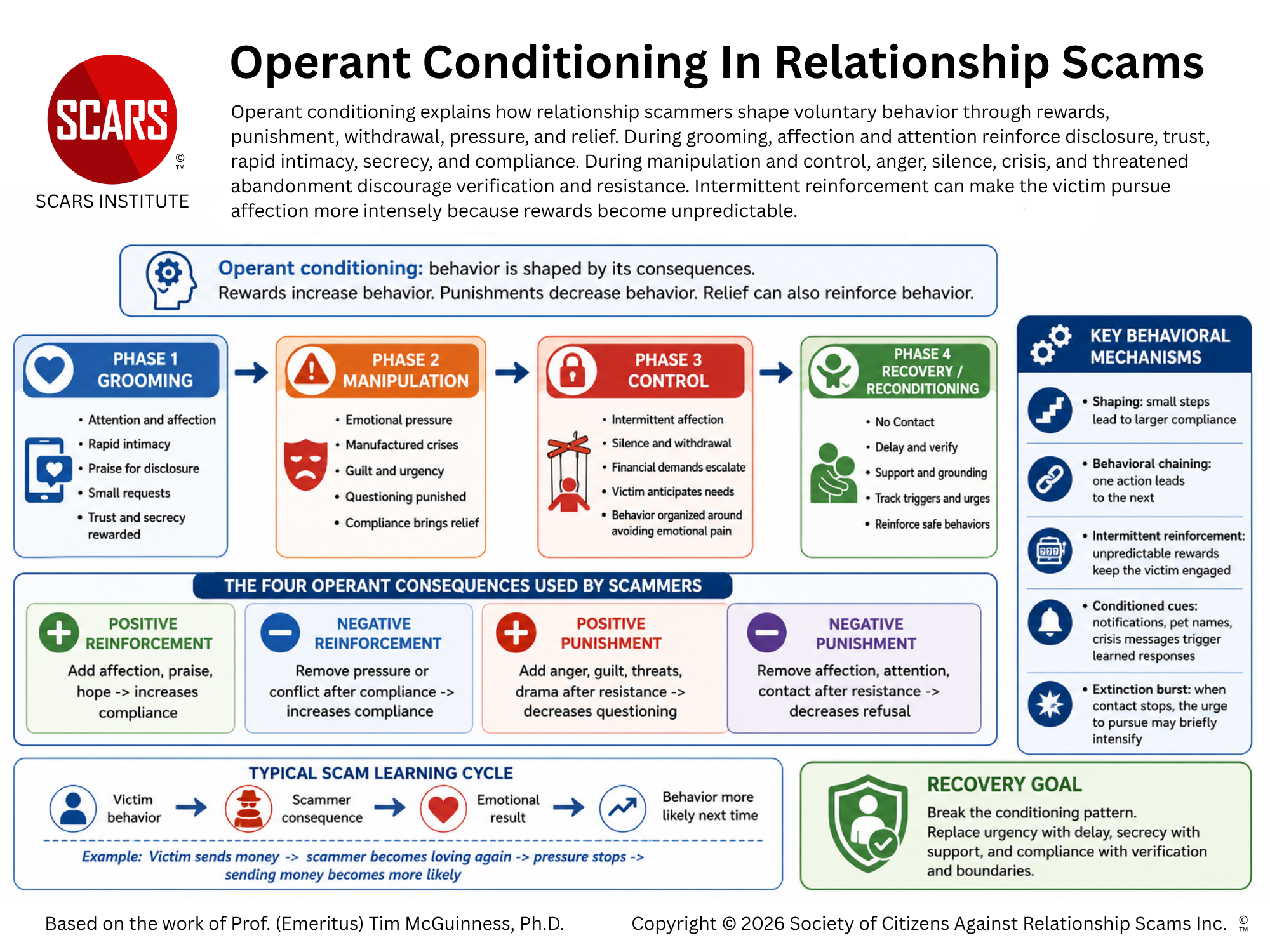
Operant conditioning explains how relationship scammers shape voluntary behavior through rewards, punishment, withdrawal, pressure, and relief. During grooming, affection and attention reinforce disclosure, trust, rapid intimacy, secrecy, and compliance. During manipulation and control, anger, silence, crisis, and threatened abandonment discourage verification and resistance. Intermittent reinforcement can make the victim pursue affection more intensely because rewards become unpredictable. Small requests can gradually lead to greater financial and behavioral demands through shaping and behavioral chaining. Recovery begins by interrupting the conditioning environment through No Contact, verification, support, and delayed decision-making. Survivors can also apply operant conditioning constructively by reinforcing healthy behaviors, reducing access to harmful rewards, tracking progress, using stable cues, and developing safer responses to triggers without relying on shame or self-punishment.
Note: This article is intended for informational purposes and does not replace professional medical advice. If you are experiencing distress, please consult a qualified mental health professional.
Keywords
Operant Conditioning, Relationship Scams, Behavioral Manipulation, Intermittent Reinforcement, Scam Grooming, Coercive Control, No Contact, Behavioral Shaping, Emotional Regulation, Recovery Reinforcement

Operant Conditioning Used by Scammers in Relationship Scams
A SCARS Institute Guide to Foundational Knowledge Every Scam Victim/Survivor Needs To Know
Author’s Note
In this article, I am going to explore Operant Conditioning, a type of manipulation you may never have thought about, much less ever heard discussed. It is actually a type of manipulation or conditioning that we all do and experience quite regularly. Parents do it to their children, spouses do it to each other, employers do it to their employees, society does it to specific groups, and unfortunately, scammers and fraudsters do it to their victims. It is perhaps the most common form of manipulation that you have never heard of. Looking back, you will be able to spot those moments when it was used, and fully understanding it will allow you to be more resistant to it.
Operant conditioning is one of the most important behavioral mechanisms for scam victims and survivors to understand because it explains how rewards, withdrawal, pressure, punishment, and relief can gradually shape voluntary behavior. Scammers do not need formal psychological training to discover which responses produce compliance. They observe what works and repeat it. Understanding these patterns can help survivors recognize that repeated actions occurred within an engineered system of consequences, not through a simple lack of intelligence or judgment. The same learning principles can later be redirected toward No Contact, verification, emotional regulation, support participation, and healthier recovery habits.
Prof. Emeritus Tim McGuinness, Ph.D.
July, 2026
What is Operant Conditioning
Operant conditioning is a fundamental theory of learning in psychology, pioneered by B.F. Skinner. It explains how behavior is controlled by its consequences.
The core principle is simple: behaviors that are followed by desirable outcomes are more likely to be repeated, while behaviors followed by undesirable outcomes are less likely to be repeated.
It’s a form of associative learning, but unlike classical conditioning (which pairs a stimulus with an involuntary response, like Pavlov’s dogs salivating to a bell), operant conditioning focuses on voluntary, goal-directed actions.
The key components of operant conditioning are reinforcement and punishment, which can each be either positive or negative. It’s crucial to understand that in this context, “positive” and “negative” do not mean “good” and “bad.” Instead, they refer to whether something is added or removed from the environment.
Parents and Operant Conditioning
Almost all parents use operant conditioning, usually without naming it or consciously designing a behavioral system. They praise a child for completing homework, provide privileges after responsible behavior, remove screen time after a rule violation, or end repeated reminders once the child completes a task.
These consequences teach the child which behaviors are likely to produce approval, freedom, relief, or restriction. In healthy parenting, operant conditioning is used consistently, proportionately, and with the child’s development and well-being in mind. The difference in a relationship scam is not the learning mechanism itself, but the offender’s purpose. The scammer uses rewards, withdrawal, pressure, and relief deceptively to exploit attachment, weaken resistance, and obtain compliance for the offender’s benefit.
The Four Quadrants of Consequences
1. Positive Reinforcement (Adding to Increase Behavior):
- What it is: A desirable stimulus is added after a behavior, which increases the likelihood of that behavior happening again.
- Example: A child cleans their room (behavior) and is given praise and a cookie (positive stimulus added). The child is more likely to clean their room in the future.
- In the workplace: An employee completes a project ahead of schedule (behavior) and receives a bonus (positive stimulus added).
2. Negative Reinforcement (Removing to Increase Behavior):
- What it is: An aversive or unpleasant stimulus is removed after a behavior, which increases the likelihood of that behavior happening again. The goal is to escape or avoid something unpleasant.
- Example: You put on sunscreen (behavior) to remove the unpleasant feeling of getting a sunburn (aversive stimulus removed). You are more likely to wear sunscreen in the future.
- Common confusion: This is often confused with punishment. The key difference is that negative reinforcement strengthens or increases a behavior, while punishment weakens or decreases it.
3. Positive Punishment (Adding to Decrease Behavior):
- What it is: An aversive or unpleasant stimulus is added after a behavior, which decreases the likelihood of that behavior happening again.
- Example: A teenager talks back to their parents (behavior) and is given extra chores (unpleasant stimulus added). The teenager is less likely to talk back in the future.
- In animal training: A dog barks excessively (behavior) and is sprayed with a bottle of water (unpleasant stimulus added).
4. Negative Punishment (Removing to Decrease Behavior):
- What it is: A desirable stimulus is removed after a behavior, which decreases the likelihood of that behavior happening again.
- Example: Two children are fighting over a toy (behavior), and the parent takes the toy away (desirable stimulus removed). The children are less likely to fight over that toy in the future.
- In social settings: A person is rude to their friends (behavior), and their friends start to ignore them (desirable stimulus of attention is removed).
Other Key Concepts
Extinction:
This occurs when a previously reinforced behavior is no longer followed by the reinforcing consequence, leading to a gradual decrease in that behavior. If a dog stops receiving treats for sitting, it will eventually stop sitting on command.
Schedules of Reinforcement:
Skinner discovered that the timing and frequency of reinforcement greatly affect how quickly a behavior is learned and how long it lasts. A continuous reinforcement schedule (reinforcing every single correct response) leads to fast learning but also fast extinction. A partial (or intermittent) reinforcement schedule (reinforcing the behavior only sometimes) leads to slower learning but much greater resistance to extinction. This is why gambling is so addictive; the reward is unpredictable, making the behavior incredibly persistent.
Operant conditioning is the powerful process by which our voluntary actions are shaped by their consequences, forming the basis of everything from how we raise children and train animals to how workplace incentives and even social habits are formed.
How Scammers Shape Behavior Through Reward, Withdrawal, Pressure, and Relief
Relationship scams do not usually begin with an immediate demand for money. They begin with scammers learning.
The scammer studies the victim’s emotional responses, routines, needs, fears, values, boundaries, and sources of hope. At the same time, the victim is gradually taught how to behave within the fraudulent relationship. Certain actions receive affection, reassurance, attention, approval, or relief. Other actions are followed by withdrawal, conflict, guilt, silence, urgency, disappointment, or threats of loss.
This pattern is closely related to operant conditioning, one of the central theories of behavioral learning.
Operant conditioning explains how voluntary behavior becomes more or less likely according to the consequences that follow it. A behavior followed by a rewarding consequence tends to be repeated. A behavior followed by an unpleasant consequence tends to weaken. A behavior that removes discomfort can also become stronger because it produces relief.
F. Skinner introduced the term operant conditioning to distinguish behavior shaped by consequences from the reflexive responses studied in classical conditioning. Modern behavioral science continues to describe operant behavior as behavior influenced and maintained by reinforcement schedules.
Within a relationship scam, operant conditioning does not require the victim to understand that learning is taking place. The person can believe they are responding freely to love, concern, conflict, or emergency while the offender is systematically shaping which responses become more frequent.
The scammer rewards compliance, discourages resistance, creates discomfort, and then teaches the victim how to make that discomfort stop. Over time, the relationship can become a behavioral control system.
Operant Conditioning Is Learning Through Consequences
Operant conditioning focuses on actions that affect the surrounding environment. A person performs a behavior, something happens afterward, and that consequence influences whether the behavior is likely to happen again.
The basic sequence is:
- A situation occurs.
- The person performs a behavior.
- A consequence follows.
- The probability of that behavior changes.
- The technical meaning of reinforcement is any consequence that increases the future probability of a behavior. Punishment refers to a consequence that decreases the future probability of a behavior.
- The words positive and negative do not mean good and bad within this framework.
- Positive means that something is added.
- Negative means that something is removed.
- Reinforcement increases behavior.
- Punishment decreases behavior.
These combinations produce the four commonly described consequences:
- Positive reinforcement adds something desirable to increase behavior.
- Negative reinforcement removes something unpleasant to increase behavior.
- Positive punishment adds something unpleasant to decrease behavior.
- Negative punishment removes something desirable to decrease behavior.
All four can appear during the grooming, manipulation, and control phases of a relationship scam.
Classical Conditioning and Operant Conditioning Work Together
- Classical conditioning links a stimulus with an automatic response. A particular notification sound, photograph, phrase, time of day, or message can become associated with affection, fear, anticipation, or relief.
- Operant conditioning shapes what the victim does in response.
For example, the sound of a message notification can trigger excitement because it has become associated with the scammer. Opening the message, responding immediately, providing reassurance, or sending money can then be reinforced by affection or by the removal of pressure.
- The emotional reaction is classically conditioned.
- The voluntary behavior is operantly conditioned.
Relationship scams often use both systems simultaneously. The victim develops conditioned emotional responses to the scammer’s presence while also learning which actions produce closeness, reduce conflict, or prevent abandonment.
The Grooming Phase Establishes the Reward System
During grooming, the scammer must make continued participation rewarding.
The offender often begins by providing abundant attention. Messages can arrive throughout the day. The victim receives compliments, affectionate language, admiration, concern, apparent vulnerability, and promises of a shared future.
These experiences function as potential reinforcers because they follow and strengthen particular behaviors.
- When the victim replies quickly, the scammer responds warmly.
- When the victim shares personal information, the scammer offers apparent intimacy.
- When the victim expresses trust, the scammer provides reassurance.
- When the victim prioritizes the relationship, the scammer describes the connection as rare or destined.
- When the victim accepts an explanation, the scammer rewards that acceptance with affection.
The result is not simply emotional pleasure. The victim begins learning which behaviors keep the relationship emotionally rewarding.
The reward can be social rather than material. Human attention, approval, affection, belonging, hope, and relief can become powerful conditioned reinforcers. Behavioral research recognizes that stimuli can acquire reinforcing value through learning and association even when they were not inherently rewarding at the beginning.
The scammer’s messages, photographs, pet names, promises, and declarations can therefore gain value because they repeatedly predict emotional reward.
Positive Reinforcement During Grooming
Positive reinforcement occurs when the scammer adds something desirable after the victim performs a behavior.
The most obvious reinforcer is affection.
A victim who discloses a painful personal experience can receive praise for being honest and trusting. A victim who responds immediately can receive increased attention. A victim who agrees with the scammer’s plans can receive descriptions of marriage, travel, financial security, or family life.
The sequence can look like this:
- The scammer asks the victim to share something private.
- The victim discloses personal information.
- The scammer responds with warmth, admiration, and apparent vulnerability.
- The victim becomes more likely to disclose again.
- Another sequence can involve exclusivity:
- The scammer expresses concern about the victim speaking with other potential partners.
- The victim agrees to stop using the dating platform.
- The scammer responds with intense affection and promises of commitment.
- The victim becomes more likely to accept additional restrictions.
The consequence strengthens the behavior even when the victim does not consciously connect the two.
- Positive reinforcement can shape:
- Immediate responses to messages.
- Increasing emotional disclosure.
- Acceptance of rapid intimacy.
- Reduced contact with other people.
- Defending the scammer.
- Ignoring inconsistencies.
- Participating in future fantasies.
- Sending small amounts of money.
- Accepting secrecy.
The reward teaches the victim that cooperation produces closeness.
How Small Requests Prepare the Victim for Larger Demands
Scammers frequently begin with actions that appear harmless.
The victim can be asked to move the conversation to a private platform, send a photograph, share a telephone number, confirm availability, provide an address for a gift, or perform a small favor.
When the victim complies, the scammer responds positively. This establishes a behavioral pattern before the high-risk demands begin. Each completed request can make the next request feel more familiar. The victim has already learned that compliance produces appreciation, intimacy, or progress in the relationship.
The sequence can gradually escalate:
- Respond to a message.
- Move to another platform.
- Share private information.
- Keep the relationship secret.
- Receive or transfer a package.
- Purchase a gift card.
- Pay a small emergency expense.
- Open a financial account.
- Move a larger amount of money.
The escalation can appear to involve separate decisions. Behaviorally, it can function as one developing chain in which each action becomes connected to the next. The victim is not suddenly transformed into someone willing to accept an extreme demand. The offender trains a sequence of increasingly consequential behaviors.
Negative Reinforcement and the Power of Relief
Negative reinforcement is one of the most important and commonly misunderstood mechanisms in relationship scams. It occurs when an unpleasant condition is removed after a behavior, causing that behavior to become more likely.
The victim experiences pressure, fear, guilt, conflict, anxiety, or the threat of losing the relationship. The victim then performs the behavior requested by the scammer. The discomfort stops. The relief reinforces the behavior.
For example:
- The scammer repeatedly warns that a medical emergency will become fatal without money.
- The victim initially refuses.
- The scammer becomes distressed, desperate, or accusatory.
- The victim sends the money.
- The crisis suddenly settles, and the scammer becomes affectionate again.
- The transfer has been reinforced because it removed intense emotional pressure.
- The victim is not only paying to solve the stated emergency. The victim is learning that compliance restores peace.
- This mechanism can become extremely powerful. A person can begin responding not to obtain a positive reward but to escape distress.
- The relationship changes from pursuit of pleasure to avoidance of punishment.
How Scammers Manufacture the Distress That Compliance Relieves
Negative reinforcement requires an unpleasant condition that can be removed. The scammer often creates that condition.
They can become cold, worried, disappointed, angry, frightened, or unavailable. They can describe an emergency, accuse the victim of mistrust, suggest that the relationship is failing, or imply that refusal will produce catastrophic consequences. The victim then becomes responsible for ending the distress.
The scammer can say:
- “If you trusted me, you would help.”
- “I cannot believe you would abandon me now.”
- “You are the only person who can save me.”
- “I knew everyone eventually leaves.”
- “I will lose everything because you refused.”
- “I cannot speak to you while you treat me like a criminal.”
The victim can experience guilt, fear, panic, or emotional pain. Once the requested action is completed, the scammer removes the unpleasant condition. Warmth returns. The supposed crisis improves. The accusations stop. The relationship feels safe again.
The victim learns:
- Sending money ends the panic.
- Apologizing ends the silence.
- Agreeing ends the argument.
- Providing proof ends the accusation.
- Keeping secrets prevents conflict.
- Obedience restores affection.
The relief can be more behaviorally powerful than the original romantic reward because the person is now acting to stop suffering.
Positive Punishment During Manipulation
Positive punishment occurs when an unpleasant consequence is added after a behavior, making that behavior less likely.
In a relationship scam, questioning the offender can be followed by anger, humiliation, accusations, emotional outbursts, threats, or dramatic crises.
- The victim asks why a photograph appears elsewhere online.
- The scammer responds with outrage and accuses the victim of betrayal.
- The victim asks to speak by video.
- The scammer claims to be deeply wounded by the lack of trust.
- The victim refuses a financial request.
- The scammer describes catastrophic consequences and blames the victim.
- The victim consults a family member.
- The scammer attacks the family member’s motives and creates a conflict.
The aversive response teaches the victim that questioning, verifying, refusing, or seeking outside advice leads to emotional punishment. The victim can begin avoiding those behaviors.
This is how reasonable skepticism becomes behaviorally suppressed. The victim is not persuaded that verification is intellectually wrong. The victim is conditioned to experience verification as emotionally costly.
Negative Punishment and the Withdrawal of Affection
Negative punishment occurs when something desirable is removed after a behavior, making that behavior less likely.
A scammer can withdraw attention, affection, reassurance, access, future promises, or communication after the victim resists.
- The victim asks too many questions.
- The scammer stops replying.
- The victim refuses to send money.
- The scammer withdraws declarations of love.
- The victim speaks with a bank employee.
- The scammer cancels a promised visit.
- The victim insists on verification.
- The scammer says the relationship can no longer continue.
- The desirable stimulus is removed because the victim performed an unwanted behavior.
- The victim can then learn that resistance risks abandonment.
This is particularly influential after attachment has formed. The scammer’s attention has become emotionally valuable. Its removal can produce distress similar to withdrawal from a meaningful relationship. The victim can begin apologizing for asking reasonable questions, concealing concerns, or reversing financial decisions to restore contact.
Hostile Withdrawal as Behavioral Control
The deliberate removal of emotional contact is recognized within research on psychological abuse as hostile withdrawal. It involves withholding connection in a manner intended to injure or control a partner.
In relationship scams, hostile withdrawal can include:
- Ignoring messages.
- Reading without replying.
- Disappearing after conflict.
- Turning off a telephone.
- Claiming to be too hurt to communicate.
- Refusing affection.
- Threatening to end the relationship.
- Blocking and later returning.
The silence is not always random. It can follow resistance, skepticism, or failure to provide money.
The victim can spend the silent period in heightened distress, reviewing the conflict and searching for a way to restore contact. When the scammer returns after the victim apologizes or complies, the restoration of communication reinforces the victim’s appeasement. The victim learns to prevent silence by avoiding resistance.
Intermittent Reinforcement
One of the most important mechanisms in persistent relationship scams is intermittent reinforcement. Under continuous reinforcement, every desired response receives a reward. Under intermittent reinforcement, only some responses receive reinforcement.
The timing is inconsistent. The victim does not know when affection, approval, contact, or relief will appear.
Research on reinforcement schedules has shown that the pattern and timing of reinforcement strongly influence behavior. Intermittently reinforced behavior can become persistent because the absence of a reward does not immediately signal that rewards have ended.
In a scam relationship, the offender can alternate between:
- Affection and silence.
- Praise and criticism.
- Availability and disappearance.
- Hope and crisis.
- Promises and delays.
- Reassurance and accusation.
The victim continues investing effort because the next response could restore the rewarding phase.
Why Unpredictability Strengthens Pursuit
Predictable rewards allow a person to understand the relationship between behavior and outcome. Unpredictable rewards create uncertainty.
The victim can think:
- “Perhaps the next message will be loving.”
- “Perhaps the visit will finally happen.”
- “Perhaps one more payment will solve the problem.”
- “Perhaps the person is only distant because of stress.”
- “Perhaps the relationship will return to how it was.”
The person continues responding because the reward has appeared before and can appear again. The absence of affection can increase pursuit rather than reduce it. The victim sends more messages, offers more reassurance, provides more help, or works harder to regain the earlier relationship.
This is one reason inconsistent affection can become more compelling than stable affection. The victim is not simply enjoying a reward. The victim is continually trying to recover it.
Research examining harmful relationships describes cycles in which mistreatment is followed by reconciliation, affection, apology, or promises of change. Intermittent rewards during the reconciliation period can strengthen emotional dependency and make disengagement more difficult.
The direct application of this literature to organized relationship scams remains an interpretive extension rather than proof that every scammer consciously follows a behavioral theory. However, the observable pattern is highly compatible with operant conditioning.
The Early Reward Becomes the Standard the Victim Tries to Recover
During grooming, the scammer often provides unusually intense and consistent attention. This establishes a baseline.
The victim remembers daily messages, affectionate rituals, long conversations, admiration, and apparent emotional openness. Later, when the offender becomes inconsistent, the victim compares the present relationship with that early period.
- The victim does not always interpret the withdrawal as evidence of manipulation.
- They can interpret it as a problem to solve.
- The person thinks that the loving relationship still exists underneath the conflict, distance, or emergency. The task becomes restoring what was present before.
- The scammer can exploit this expectation indefinitely.
- A small return of affection becomes powerful because it suggests that the original relationship can be recovered.
- The victim remains committed not only to the current interaction but to the memory of the reinforced beginning.
Shaping
Shaping is the process of reinforcing successive approximations toward a target behavior. The final behavior is not required at the beginning. Smaller steps are reinforced until the person moves progressively closer to the desired outcome. A scammer who immediately asks for a victim’s life savings will often fail.
Instead, the offender can reinforce smaller acts:
- Responding regularly.
- Sharing a private detail.
- Agreeing to exclusivity.
- Keeping a minor secret.
- Accepting an implausible explanation.
- Providing a small favor.
- Sending a modest amount.
- Lying to a family member.
- Ignoring a warning.
- Opening a new account.
- Transferring a larger sum.
Each action prepares the next.
The victim’s internal boundaries shift incrementally. A behavior that would have appeared unthinkable at the beginning can eventually feel like the logical continuation of prior commitments.
Shaping explains why outsiders often misunderstand the victim’s behavior. They see the final action without seeing the hundreds of smaller reinforced steps that preceded it.
Behavioral Chaining
Behavioral chaining links several actions into a sequence. Completion of one action creates the conditions for the next.
A relationship scam can create chains such as:
- Receive message.
- Respond immediately.
- Listen to the emergency.
- Provide reassurance.
- Accept responsibility.
- Find money.
- Complete the transfer.
- Report confirmation.
- Receive affection.
The reward at the end can strengthen the entire sequence.
Another chain can involve secrecy:
- The scammer raises a concern.
- The victim consults someone.
- The outsider questions the relationship.
- The scammer becomes distressed.
- The victim defends the scammer.
- The victim stops consulting outsiders.
- The scammer rewards loyalty.
The victim gradually learns a complete routine of secrecy and compliance. Once the chain becomes familiar, the victim can move through it with less deliberate evaluation.
Discriminative Stimuli
In operant conditioning, certain signals indicate that a behavior is likely to be reinforced or punished.
Within a scam, the offender creates recognizable cues:
- A pet name can signal that affection is available.
- A crying message can signal that money will be requested.
- A sudden silence can signal punishment.
- A photograph from a hospital can signal urgency.
- A phrase such as “I need you to trust me” can signal that questioning must stop.
- A specific time of day can signal expected contact.
The victim learns how to behave in the presence of these cues.
They can become anxious before the financial request is stated because the pattern has become familiar. They can begin preparing money when the scammer mentions a problem. They can apologize when the offender’s tone changes.
The conditioning can become anticipatory. The scammer no longer needs to state every consequence explicitly. The signal itself begins controlling behavior.
Conditioned Reinforcers
A stimulus can become reinforcing because it has been associated with another valued outcome.
- The scammer’s name, photograph, notification tone, or pet phrase can acquire emotional value because it predicts affection, hope, reassurance, or belonging.
- A message containing only a heart symbol can produce relief.
- A photograph can renew commitment.
- A promise of a future visit can motivate another payment.
- A fabricated investment balance can reinforce continued deposits because it symbolizes future security.
These stimuli do not need to provide a real outcome. Their learned meaning can be enough to sustain behavior.
This is especially important in online relationships because much of the reinforcement is symbolic. The victim does not receive physical companionship, shared residence, or verified financial gain. The offender uses words, images, account displays, and promises as conditioned reinforcers.
The Control Phase
During the control phase, the scammer no longer needs to provide continuous romance. The established behavioral system can do much of the work.
The victim knows which actions produce warmth and which produce distress. They can begin monitoring and correcting their own behavior before the scammer responds.
- This is a major transition.
- External control becomes self-regulation in service of the offender.
- The victim avoids asking questions because questions previously produced anger.
- The victim sends money quickly because delay previously produced panic.
- The victim conceals the relationship because disclosure previously threatened attachment.
- The victim anticipates the offender’s needs and acts before being asked.
- The victim can appear to be choosing freely while operating inside a learned system of rewards and punishments.
Research on coercive control describes repeated patterns of isolation, intimidation, surveillance, deprivation, exploitation, and microregulation that gradually reduce autonomy and create dependence. The cumulative pattern matters more than any single incident.
Relationship scams can reproduce many of these dynamics without physical proximity.
Technology-Facilitated Conditioning
Digital communication gives scammers unusual control over timing.
- They can decide exactly when to send affection, when to disappear, when to create urgency, and when to restore contact.
- They can observe whether messages have been read.
- They can demand immediate responses.
- They can contact the victim repeatedly across platforms.
- They can send photographs, voice messages, and videos at moments of emotional vulnerability.
- They can maintain contact across time zones and throughout the day.
The smartphone becomes the delivery system for reinforcement and punishment. A notification can bring relief.
- Silence can produce anxiety.
- A video call can function as a major reward.
- A blocked account can function as punishment.
Technology-facilitated control is recognized within broader coercive control research as part of patterns that can include monitoring, stalking, isolation, threats, and psychological manipulation.
The online scammer can therefore maintain a powerful behavioral environment while remaining physically distant.
Financial Compliance as Learned Behavior
Financial transfers often begin as extraordinary events. The first request can produce alarm, resistance, and extensive discussion. After repeated cycles, sending money can become more routine.
The victim learns that payment:
- Ends the emergency.
- Restores affection.
- Prevents abandonment.
- Proves loyalty.
- Moves the promised future closer.
- Protects the supposed partner.
- Prevents earlier payments from being lost.
The transfer becomes connected with multiple reinforcing consequences.
Eventually, the victim can begin looking for money before the scammer completes the demand. They can borrow, liquidate assets, conceal transactions, or override warnings because the behavior has been repeatedly shaped.
This does not mean the victim has lost intelligence. It means financial action has become embedded in an emotional learning system that rewards compliance and punishes delay.
Punishment of Independent Verification
Independent verification threatens the scammer’s control because it introduces consequences that the offender cannot manage. The offender therefore attempts to make verification costly.
- A victim who searches a photograph can be accused of betrayal.
- A victim who speaks with a bank can be told that the bank is interfering.
- A victim who contacts police can be warned that the supposed partner will be arrested.
- A victim who asks family members can be told that they are jealous, controlling, or prejudiced.
- A victim who requests documentation can receive a dramatic emergency instead.
These consequences reduce the likelihood of future verification. The scammer is not merely answering objections. The offender is conditioning the victim to avoid the process that could expose the deception.
Reinforcement of Secrecy
Secrecy can also be positively reinforced.
- The scammer can describe secrecy as proof of loyalty, intimacy, maturity, or protection.
- The victim is praised for keeping the relationship private.
- The offender says that outsiders cannot understand their special connection.
- The victim is told that confidentiality protects a military mission, legal matter, investment, inheritance, or business transaction.
- The private relationship begins to feel exclusive and privileged.
- At the same time, disclosure can be punished through conflict, withdrawal, or threats.
- The victim learns that secrecy receives approval and openness produces distress.
This removes corrective feedback from family, friends, financial professionals, and support providers. It also increases the offender’s ability to control which explanations the victim hears.
Extinction
Extinction occurs when a behavior that previously produced reinforcement stops producing it. If a victim repeatedly sends messages but receives no reply, the messaging behavior can eventually decrease. If payments no longer restore affection or resolve the supposed problem, financial compliance can weaken.
However, extinction is rarely immediate. A behavior can temporarily increase when expected reinforcement disappears. The person can try harder, respond more frequently, send more messages, or increase the size of the action in an attempt to recover the reward.
In scam victimization, this can appear as:
- Repeatedly calling after being blocked.
- Sending additional money after the scammer disappears.
- Searching for the offender across platforms.
- Contacting supposed friends or relatives of the scammer.
- Paying a recovery scammer to restore the loss.
- Trying to prove loyalty after rejection.
The behavior can intensify before it declines. This helps explain why abrupt scam discovery does not always produce immediate disengagement.
The Extinction Burst
An extinction burst is a temporary increase in behavior when reinforcement is withheld. The victim has learned that persistence sometimes restores contact. When the scammer disappears, the victim can increase efforts dramatically.
The person might send dozens of messages, attempt new contact methods, provide more money, or accept increasingly implausible explanations. The behavior is not evidence that the victim wants continued exploitation. It can reflect a learned response to the sudden loss of a powerful reinforcer. The offender can exploit the extinction burst by returning at the moment of greatest distress. The victim experiences enormous relief, which can reinforce renewed compliance even more strongly.
Spontaneous Recovery of Conditioned Behavior
A behavior that has weakened can return after time has passed, especially when the person encounters a familiar cue. A former victim can feel a sudden urge to respond after receiving a message, seeing a familiar photograph, hearing a voice, or reaching an anniversary connected with the relationship.
The urge does not prove that recovery has failed. It can reflect the reactivation of an established learning history.
The person can interrupt the behavior by recognizing the cue, delaying action, contacting support, and restoring verified reality. Recovery requires more than waiting for urges to disappear. It requires developing alternative responses to the same triggers.
Learned Helplessness and Reduced Agency
When consequences become unpredictable, and the victim repeatedly fails to regain stable affection, certainty, or safety, the person can begin to believe that personal action has little value. They can feel unable to make the correct choice.
- Questioning produces conflict.
- Compliance produces another demand.
- Paying resolves one emergency but creates another.
- Waiting produces panic.
- Seeking help threatens the relationship.
The victim experiences a narrowing of perceived options.
Coercive control research describes how repeated patterns of manipulation, intimidation, isolation, and deprivation can create fear, helplessness, entrapment, and loss of autonomy. The victim can stop evaluating what is best and instead focus on which action will produce the least immediate pain.
This is not meaningful consent. It is behavior constrained by a system of consequences.
Why the Victim Can Defend the Scammer
Defending the scammer can itself be reinforced.
- When the victim rejects criticism from outsiders, the scammer provides affection and praise. The victim is told they are loyal, intelligent, strong, or uniquely understanding.
- When the victim accepts warnings from others, the scammer becomes hurt or distant. The victim gradually learns that defending the relationship preserves emotional reward.
The defense also protects the victim from immediate grief. Accepting the scam would remove hope, attachment, identity, and the imagined future. Continued belief can therefore be reinforced both socially and emotionally. The victim receives approval from the scammer and temporary protection from devastating reality.
Operant Conditioning Does Not Remove Personal Agency
Operant conditioning helps explain behavior, but it should not be used to describe victims as mindless or mechanically controlled. Human beings interpret consequences, form beliefs, resist demands, seek evidence, and make complex choices. Their behavior is influenced by personal history, attachment, trauma, culture, financial pressure, loneliness, hope, and available support.
- Victims frequently resist.
- They question the scammer.
- They refuse requests.
- They seek advice.
- They test explanations.
- They attempt to leave.
The offender then adapts the reinforcement and punishment pattern.
Coercive control research emphasizes that victims continue resisting even when overt resistance becomes costly and must be expressed indirectly. Operant conditioning therefore describes one mechanism within a larger system of grooming and coercion. It does not provide a complete explanation of every decision.
The Scammer Does Not Need Formal Psychological Training
Many scammers have probably never studied Skinner, reinforcement schedules, or behavioral analysis. Formal knowledge is not required.
Offenders can discover effective consequences through trial and error.
- If affection produces compliance, they repeat affection.
- If silence produces pursuit, they use silence.
- If anger stops questioning, they use anger.
- If an emergency produces money, they create emergencies.
- If withdrawal produces apology, they withdraw.
Criminal groups can also share scripts and methods that preserve effective tactics across many victims.
The pattern can therefore become behaviorally sophisticated without being academically designed. The scammer conditions the victim while also being conditioned by the victim’s responses. Successful tactics are repeated because they produce the offender’s desired outcome.
How the Victim’s Behavior Trains the Scammer
Operant conditioning can work in both directions.
- When the scammer creates an emergency and receives money, the scammer’s behavior is reinforced.
- When the scammer withdraws and the victim apologizes, withdrawal is reinforced.
- When the scammer threatens abandonment and the victim complies, the threat is reinforced.
The offender learns which tactics work with that particular victim. This creates an increasingly personalized pattern.
The scammer discovers whether the victim responds most strongly to guilt, fear, affection, responsibility, jealousy, financial hope, religious belief, family concern, or threats of loss. The victim is being shaped, but the offender is also refining the manipulation through feedback.
Recovery Requires Changing the Consequences
Ending contact removes the scammer’s ability to deliver many of the established rewards and punishments.
No Contact is therefore more than a communication boundary. It interrupts the conditioning environment.
The scammer can no longer provide affection after payment, silence after resistance, relief after compliance, or crisis after hesitation. However, removing the scammer does not immediately remove the learned responses.
The victim can still experience urges, anticipation, guilt, fear, and longing. The nervous system continues expecting the old sequence. Recovery requires allowing those responses to weaken while building new consequences around safer behavior.
Reinforcing Recovery Behaviors
Recovery becomes stronger when healthy actions produce meaningful consequences. A survivor asks for help and receives support rather than judgment.
- The survivor verifies a message and experiences relief from uncertainty.
- The survivor refuses a suspicious request and recognizes increased safety.
- The survivor attends a support meeting and feels less isolated.
- The survivor writes about the manipulation and gains clarity.
- The survivor maintains No Contact and notices that emotional activation gradually decreases.
These outcomes reinforce recovery participation.
At first, healthy actions can feel less emotionally rewarding than the scam relationship. Verification does not provide the same intensity as romantic attention. Support meetings do not immediately replace attachment. Financial boundaries do not remove grief.
The new reinforcement system must develop over time. Consistency matters more than intensity.
Replacing Immediate Relief With Long-Term Safety
The scammer trained the victim to seek immediate relief.
- Send money now.
- Reply now.
- Apologize now.
- Restore the relationship now.
Recovery asks the survivor to tolerate temporary discomfort for a safer outcome.
- Do not respond.
- Wait before deciding.
- Allow the anxiety to rise and fall.
- Consult someone independent.
- Accept that the relationship cannot be restored.
This reversal can feel extremely difficult because the recovery behavior does not immediately remove all discomfort.
The survivor must learn that distress can be tolerated without performing the old response. Every successful delay weakens the connection between discomfort and compliance.
Recognizing the Conditioning Pattern
A survivor can begin by identifying the sequence.
- What happened immediately before the behavior?
- What did the scammer request?
- What emotion did the request produce?
- What action did the victim perform?
- What consequence followed?
- Did affection return?
- Did pressure stop?
- Did silence end?
- Did the crisis temporarily improve?
- Did the scammer praise loyalty?
- Did questioning produce punishment?
- Did disclosure to outsiders produce conflict?
This analysis helps separate the behavior from moral judgment. Instead of asking, “Why did the victim keep doing this?” the more useful question becomes, “What consequence repeatedly followed the behavior?”
Questions That Help Expose Operant Control
A survivor can examine the relationship by asking:
- Which behaviors received affection or approval?
- Which behaviors caused the scammer to withdraw?
- What happened after the victim questioned a story?
- What happened after the victim sent money?
- Did each payment genuinely solve the problem?
- Did relief become dependent on compliance?
- Was affection predictable or intermittent?
- Did silence make the victim work harder for contact?
- Did the scammer reward secrecy?
- Did consultation with outsiders produce conflict?
- Did the victim begin anticipating demands before they were stated?
- Did ordinary boundaries begin to feel like betrayal?
The answers can reveal a systematic pattern rather than a series of unrelated crises.
Rebuilding Choice
Recovery does not require eliminating every conditioned emotion. The survivor can still feel longing without making contact.
- They can feel guilt without sending money.
- They can feel fear without accepting the scammer’s explanation.
- They can feel urgency without acting immediately.
- They can remember affection without treating it as evidence.
The central recovery skill is separating internal activation from external behavior. A conditioned response can arise automatically.
The next action remains open to change. Over time, repeated safer choices create a new learning history.
The Central Insight
Relationship scams are not maintained only through lies. They are maintained through consequences.
- Affection rewards compliance.
- Relief rewards payment.
- Silence punishes resistance.
- Conflict discourages verification.
- Intermittent warmth sustains pursuit.
- Small rewards shape larger actions.
Repeated cycles transform extraordinary demands into familiar routines. The victim’s behavior becomes increasingly organized around preserving connection and avoiding emotional pain.
Operant conditioning does not explain every aspect of relationship scam victimization, and the available research does not establish that every offender consciously applies Skinnerian principles. It does provide a powerful framework for understanding how voluntary behavior can be shaped inside a deceptive relationship.
The victim did not simply make the same mistake repeatedly. The person was exposed to a changing system of reward, withdrawal, pressure, punishment, and relief.
Recovery begins by dismantling that system. The survivor removes the offender’s access, identifies the behavioral patterns, tolerates the temporary absence of familiar rewards, and begins reinforcing choices that restore safety, autonomy, reality, and self-respect.
The conditioning was learned. With time, support, and repeated action, a different way of responding can also be learned.
Using Operant Conditioning to Support Recovery
A traumatized scam victim can also use operant conditioning deliberately as a self-behavioral modification technique. The same learning principles that helped the scammer shape compliance can be redirected toward safety, emotional regulation, recovery participation, and restored autonomy. The objective is not to punish the survivor for symptoms or mistakes. The objective is to make healthy behaviors easier to repeat, more immediately rewarding, and increasingly connected with relief, confidence, and personal progress.
Recovery behaviors often provide delayed benefits. Reading psychoeducational material, attending support meetings, maintaining No Contact, journaling, completing therapy exercises, and tolerating grief can feel difficult before their value becomes visible. Avoidance offers faster relief. A victim can therefore understand what needs to be done while still repeatedly choosing withdrawal, distraction, contact with the scammer, or postponement.
Self-directed operant conditioning helps correct this imbalance by attaching immediate, predictable consequences to recovery choices.
Begin With Clearly Defined Behaviors
A recovery goal must be translated into an observable action. A broad intention such as “I will recover” is too vague to reinforce effectively. The survivor needs to identify what recovery behavior will occur, when it will occur, and how completion will be recognized.
Examples include:
- Reading one recovery article for fifteen to 30 minutes.
- Writing a meaningful comment after reading.
- Attending one support meeting each week.
- Completing a five-minute grounding exercise each morning plus saying the required affirmations.
- Contacting a trusted person before making an unusual financial decision.
- Waiting twenty-four hours before responding to an unexpected request.
- Writing one journal entry after a trigger.
- Avoiding all searches for the scammer’s identity or location.
- Keeping No Contact for the entire day, the entire week, the entire month, then forever.
The behavior should begin small enough that it can be completed even when motivation is low. Early success is important because repeated failure can strengthen avoidance and hopelessness.
Use Positive Reinforcement
Positive reinforcement adds a desirable consequence after a recovery behavior, increasing the likelihood that the behavior will be repeated.
A survivor can reward completion of a difficult recovery task with something modest and healthy. The reward can include listening to favorite music, watching an enjoyable program, spending time outdoors, calling a supportive friend, preparing a preferred meal, or setting aside time for a relaxing activity.
The reward should follow the behavior as soon as reasonably possible.
For example:
- The survivor reads and reflects on a recovery article, writes a comment about it, then takes a pleasant walk as a reward.
- The survivor attends a Zoom support call, then watches a favorite program or movie.
- The survivor completes a therapy exercise, then enjoys coffee in a comfortable setting.
- The survivor maintains No Contact for one week, then chooses a meaningful but affordable personal reward.
The reward should recognize effort and participation rather than emotional perfection. A survivor does not need to feel calm, hopeful, or fully convinced before earning reinforcement. Completing the healthy action is the behavior being strengthened.
Positive reinforcement can also be social. A survivor can share progress with a trusted person who responds with encouragement, recognition, and accountability. Supportive acknowledgment can make recovery participation feel visible and worthwhile.
Use Negative Reinforcement Carefully
Negative reinforcement strengthens a behavior because the behavior removes or reduces something unpleasant. A recovery practice can produce relief when used appropriately. Grounding can reduce physiological activation. Verification can reduce uncertainty. Asking for help can reduce isolation. Completing a necessary financial task can reduce ongoing anxiety.
The survivor can consciously notice this relationship:
- “When I verify before acting, uncertainty decreases.”
- “When I attend support, I feel less alone.”
- “When I write down the facts, mental confusion decreases.”
- “When I maintain No Contact, I avoid another cycle of manipulation.”
- “When I complete the difficult task, I no longer have to carry the stress of postponing it.”
This form of reinforcement becomes healthier when relief follows constructive action rather than avoidance. The person learns that discomfort can be reduced through grounding, support, boundaries, and responsible completion instead of escape or renewed contact.
Avoid Self-Punishment
Traumatized scam victims often attempt behavior change through harsh self-criticism. They insult themselves after a setback, deny themselves ordinary comfort, repeatedly review mistakes, or use shame as motivation. This approach can be psychologically harmful.
Punishment can suppress a behavior temporarily, but it does not necessarily teach a safe replacement. Excessive punishment can also increase fear, concealment, avoidance, resentment, and hopelessness. These effects resemble the control methods already used by the scammer.
A survivor should not recreate the offender’s system internally.
A missed meeting, delayed exercise, emotional setback, or moment of rumination should lead to review and correction rather than humiliation. The useful questions are:
- What happened before the behavior?
- What emotion or trigger was present?
- What immediate consequence made the unhelpful behavior attractive?
- What smaller recovery action could be used next time?
- What support or environmental change would make the safer behavior easier?
Accountability identifies the pattern and changes it. Shame attacks the person without teaching a replacement.
Remove Rewards From Harmful Behaviors
Some unhelpful behaviors continue because they still produce immediate emotional rewards.
- Searching for the scammer can create a temporary sense of connection or control.
- Reviewing old messages can briefly restore emotional closeness.
- Imagining revenge can produce a short-lived feeling of power.
- Avoiding support can remove the discomfort of vulnerability.
- Postponing therapy homework can provide immediate relief.
The survivor can weaken these patterns by reducing their reinforcing consequences.
Old messages can be archived outside immediate reach. Photographs can be removed from the phone. Search access can be restricted. Financial apps can require additional verification. A trusted person can hold important account controls temporarily. Recovery materials can be placed where they are easier to access than scam-related material.
The environment should make the harmful behavior less convenient and the recovery behavior more convenient. This is not punishment. It is stimulus control. The survivor changes the conditions that previously made an unsafe response easy and rewarding.
Reinforce Successive Approximations
A survivor does not need to perform the final recovery behavior perfectly from the beginning. Shaping can be used to reinforce gradual movement toward the goal.
- A person who cannot tolerate a full support meeting can attend for ten minutes.
- A person who cannot write a complete journal entry can write three sentences.
- A person overwhelmed by a long article can read one section.
- A person who checks old messages repeatedly can first delay checking for fifteen minutes, then thirty minutes, then several hours.
- A person afraid of making decisions can begin with one low-risk choice using a written verification process.
Each successful step should be recognized before the next level is attempted. Shaping prevents the survivor from treating incomplete progress as failure. It builds competence through a series of achievable behaviors.
Use Continuous Reinforcement at First
New recovery habits often benefit from continuous reinforcement. This means recognizing or rewarding the behavior every time it occurs during the early learning period.
We recommend using our Recovery Tracking System.
- Each completed grounding exercise is recorded.
- Each attended meeting receives acknowledgment.
- Each verified decision is marked as a success.
- Each day of No Contact is added to a visible record.
- Each completed article or exercise receives a checkmark.
Continuous reinforcement helps establish the connection between the recovery behavior and a positive consequence. Once the behavior becomes more stable, the survivor can shift toward less frequent reinforcement.
The eventual goal is for the behavior’s natural consequences to become rewarding. Improved stability, reduced confusion, stronger boundaries, and restored self-respect gradually replace the need for an external reward after every action.
Build a Recovery Tracking System
A simple tracking system can make improvement visible. We recommend using our Recovery Tracking System.
The survivor can record:
- The target behavior.
- The time or situation in which it occurred.
- The emotional state before the behavior.
- Whether the behavior was completed.
- The immediate consequence.
- The longer-term result.
This record reveals patterns that memory can overlook. Trauma and negativity bias can cause a person to remember setbacks more readily than progress. Written tracking provides evidence that healthy actions are accumulating. The record should remain simple. An elaborate system can become another form of avoidance if the survivor spends more time designing it than performing the target behaviors.
Pair Recovery With Stable Cues
A behavior becomes easier when it is connected with a predictable cue. The survivor can read recovery material after breakfast, practice grounding before opening email, journal before bedtime, or attend support at the same time each week.
A cue can include:
- A specific time.
- A particular location.
- An alarm or calendar reminder.
- The completion of another routine.
- A visible recovery card.
- A supportive person’s scheduled message.
Stable cues reduce dependence on motivation. The person does not need to decide repeatedly whether to perform the behavior. The surrounding routine begins prompting it automatically.
Reinforce Identity as Well as Action
Recovery behavior can also strengthen a new sense of identity. After completing a healthy action, the survivor can name what the behavior represents:
- “I asked for help instead of isolating.”
- “I verified instead of reacting.”
- “I tolerated the urge without making contact.”
- “I completed what I said I would do.”
- “I acted according to safety rather than panic.”
These statements connect behavior with agency, reliability, and self-respect. The person begins accumulating evidence that they can make responsible choices even while experiencing distress.
The identity is built from repeated actions rather than positive affirmations alone.
Expect Extinction Bursts
When a survivor stops reinforcing an old behavior, the urge to perform it can temporarily intensify.
No Contact can initially increase longing, anxiety, or the desire to check for messages. Refusing to search for the scammer can increase intrusive curiosity. Beginning structured recovery can make avoidance feel more attractive. This temporary increase resembles an extinction burst. The old behavior has stopped producing its expected reward, so the nervous system tries harder to recover it.
The survivor should prepare for this increase rather than interpreting it as failure.
A written response plan can include contacting a support person, leaving the triggering environment, using grounding, reviewing verified facts, or delaying action until the urge decreases. Every time the urge passes without the old behavior, the learned connection weakens.
A Practical Self-Conditioning Sequence
A survivor can apply the process through the following sequence:
- Identify one specific recovery behavior.
- Choose a predictable cue for performing it.
- Reduce obstacles that make completion difficult.
- Complete the behavior at a manageable level.
- Provide an immediate healthy reward or acknowledgment.
- Record completion.
- Review what helped or interfered.
- Repeat the behavior consistently.
- Increase the difficulty gradually.
Allow the natural benefits of recovery to become the primary reinforcement.
The approach should remain compassionate, flexible, and realistic. The survivor is not training a machine. They are helping a traumatized nervous system learn that safety, support, verification, and responsible participation produce better consequences than secrecy, avoidance, impulsive action, or renewed contact.
Reconditioning Recovery
The scammer used consequences to make compliance easier and resistance more painful. Recovery can reverse that structure.
- Healthy behavior can become easier.
- Unsafe behavior can become less accessible.
- Support can follow honest disclosure.
- Relief can follow verification.
- Confidence can follow responsible action.
- Self-respect can follow maintained boundaries.
Operant conditioning cannot replace trauma-informed therapy, social support, psychoeducation, or medical care when these are needed. It can provide a practical method for turning recovery knowledge into repeated behavior.
The survivor does not have to wait until motivation appears. They can shape motivation by repeatedly connecting recovery actions with meaningful consequences. Over time, the behaviors that once required conscious effort can become familiar routines that support safety, autonomy, and a renewed direction in life.
Conclusion
Operant conditioning provides a practical framework for understanding how relationship scammers gradually shape behavior throughout grooming, manipulation, financial exploitation, and control. Affection can reward compliance. Silence can discourage questioning. Emotional pressure can make payment feel like the fastest way to restore peace. Intermittent attention can keep a victim pursuing the rewarding relationship that appeared during the earliest stages of grooming.
These patterns do not mean that victims lose intelligence, personal values, or all capacity for choice. They show how repeated consequences can influence behavior inside a deceptive relationship where the offender controls information, timing, emotional rewards, and manufactured crises. Small requests can prepare the victim for greater demands, while punishment and withdrawal can make verification, refusal, and outside consultation feel emotionally dangerous.
Recovery requires changing that system. No Contact removes the scammer’s ability to continue delivering rewards and punishments, although conditioned urges can remain for some time. Survivors can learn to delay action, tolerate temporary discomfort, verify information, seek support, and separate emotional activation from behavior.
Operant conditioning can also support recovery when it is applied compassionately. Healthy actions can be reinforced through acknowledgment, visible tracking, stable routines, appropriate rewards, and recognition of gradual progress. The goal is not to punish symptoms or mistakes. The goal is to make safe behavior easier to repeat.
Conditioning helped establish patterns of compliance, secrecy, urgency, and emotional dependence. Repeated recovery actions can establish new patterns based on safety, reality, autonomy, connection, and self-respect.

Glossary
- Affection Withdrawal — Affection withdrawal occurs when a scammer removes warmth, reassurance, attention, or declarations of love after a victim questions, refuses, or delays. The sudden loss of connection creates emotional distress and teaches the victim that resistance threatens the relationship. Repeated withdrawal can condition the victim to apologize, comply, or conceal concerns to restore contact. — Emotional Manipulation
- Anticipatory Compliance — Anticipatory compliance develops when a victim begins responding to the scammer’s expected demands before a direct request is made. Familiar changes in tone, silence, crisis language, or emotional pressure can signal what the offender will want next. The victim can begin preparing money, explanations, apologies, or reassurance because the behavioral pattern has become predictable. — Coercive Control
- Associative Learning — Associative learning occurs when a person connects one event, action, or stimulus with another through repeated experience. Operant conditioning links voluntary behavior with the consequences that follow it, while classical conditioning links stimuli with automatic responses. Relationship scammers exploit both processes by connecting communication, affection, fear, relief, and compliance. — Behavioral Learning
- Behavioral Chaining — Behavioral chaining links several actions into a sequence in which one completed behavior leads naturally to the next. A scammer can move a victim from replying to messages, sharing information, keeping secrets, transferring small amounts, and eventually completing larger transactions. The reward at the end of the sequence can strengthen the entire chain and make it feel increasingly routine. — Scam Tactics
- Behavioral Control System — A behavioral control system is an organized pattern of rewards, punishments, withdrawal, pressure, and relief that shapes how a victim responds. The scammer learns which consequences increase compliance and which consequences reduce questioning or resistance. Over time, the victim’s choices can become increasingly organized around preserving connection and avoiding emotional pain. — Coercive Control
- Behavioral Suppression — Behavioral suppression occurs when a victim reduces questioning, verification, refusal, or outside consultation because these actions repeatedly produce unpleasant consequences. Anger, accusations, silence, humiliation, or threatened abandonment can make protective behavior feel emotionally dangerous. The victim can stop using reasonable safeguards even without accepting the scammer’s explanations as logically sound. — Victim Safety
- Classical Conditioning — Classical conditioning connects a stimulus with an automatic emotional or physical response. A notification sound, photograph, pet name, or time of day can become associated with excitement, affection, anxiety, or relief. These conditioned reactions can activate before the victim consciously evaluates what the message or cue actually means. — Neurological Process
- Coercive Consequence System — A coercive consequence system uses emotionally painful or rewarding outcomes to restrict another person’s practical freedom. The victim can learn that compliance restores peace, while refusal produces conflict, guilt, silence, or fear. This system can make behavior appear voluntary even when the available choices have been narrowed through manipulation. — Coercive Control
- Conditioned Emotional Response — A conditioned emotional response is an automatic feeling that develops after a stimulus has repeatedly been associated with a meaningful experience. The scammer’s name, image, voice, or message can trigger anticipation, longing, fear, or relief. The emotion can return during recovery even after the victim understands that the relationship was fraudulent. — Trauma Activation
- Conditioned Reinforcer — A conditioned reinforcer is a stimulus that becomes rewarding because it has been repeatedly associated with another valued outcome. A heart symbol, affectionate phrase, photograph, promised visit, or fabricated account balance can gain emotional power through association. The stimulus can continue motivating behavior even when it provides no real companionship, safety, or financial benefit. — Behavioral Learning
- Continuous Reinforcement — Continuous reinforcement occurs when a desired behavior receives a rewarding consequence every time it is performed. A scammer can use frequent praise, rapid replies, and constant affection during grooming to establish trust and participation quickly. The predictable reward helps the victim learn which behaviors produce closeness and approval. — Scam Tactics
- Control Phase — The control phase begins when the scammer no longer needs to provide continuous romance because the established consequence system already influences behavior. The victim can begin avoiding questions, concealing the relationship, sending money quickly, and anticipating the offender’s needs. External manipulation gradually becomes self-monitoring that serves the scammer’s objectives. — Coercive Control
- Corrective Feedback Isolation — Corrective feedback isolation occurs when the victim becomes separated from people and institutions that could challenge the scammer’s claims. Secrecy, conflict, accusations, and attacks on family members, banks, police, or support providers can discourage outside consultation. The absence of independent feedback allows the offender’s explanations to dominate the victim’s understanding. — Social Pressure
- Discriminative Stimulus — A discriminative stimulus is a cue that signals whether a particular behavior is likely to receive a reward or punishment. Crying messages can signal an approaching financial demand, while silence can signal displeasure or threatened abandonment. The victim learns how to respond to these signals before the scammer states the expected behavior directly. — Behavioral Learning
- Emotional Compliance — Emotional compliance occurs when a victim follows a demand primarily to reduce guilt, fear, anxiety, conflict, or threatened loss. The behavior can appear voluntary, but the immediate objective becomes ending emotional suffering rather than making a freely considered decision. Repeated relief after compliance can make the response increasingly automatic. — Emotional Manipulation
- Emotional Reward Baseline — An emotional reward baseline is the early level of attention, affection, intimacy, and reassurance that the scammer establishes during grooming. The victim later compares periods of withdrawal or conflict with this intensely rewarding beginning. Small returns of warmth can become powerful because they appear to promise restoration of the original relationship. — Attachment Pattern
- Extinction — Extinction occurs when a behavior that previously produced reinforcement no longer receives the expected consequence. Repeated messages can gradually decrease when they no longer restore contact, affection, or relief. Extinction usually takes time because the victim has learned that persistence sometimes produces another reward. — Behavioral Learning
- Extinction Burst — An extinction burst is a temporary increase in a previously reinforced behavior after the expected reward disappears. A victim can send more messages, search more intensely, offer additional money, or try new contact methods after the scammer withdraws. The increase reflects a learned attempt to recover the missing reinforcement rather than a desire for continued exploitation. — Trauma Response
- Financial Compliance Conditioning — Financial compliance conditioning occurs when repeated consequences make sending money feel increasingly familiar, necessary, or emotionally relieving. Payment can end a crisis, restore affection, prevent abandonment, or appear to protect earlier financial commitments. The transfer becomes embedded in an emotional learning system rather than remaining an isolated financial decision. — Financial Harm
- Grooming Reward System — A grooming reward system uses attention, admiration, apparent vulnerability, future promises, and affection to reinforce participation in a fraudulent relationship. The scammer rewards quick replies, personal disclosure, exclusivity, trust, and acceptance of explanations. These consequences teach the victim which behaviors keep the relationship emotionally rewarding. — Scam Tactics
- Hostile Withdrawal — Hostile withdrawal is the deliberate removal of communication or emotional connection to injure, pressure, or control another person. A scammer can ignore messages, disappear after conflict, block the victim, refuse affection, or threaten to end the relationship. Contact often returns after apology or compliance, reinforcing the victim’s effort to prevent future silence. — Emotional Manipulation
- Immediate Relief Conditioning — Immediate relief conditioning develops when a behavior repeatedly ends an unpleasant emotional state. Sending money, apologizing, agreeing, or providing proof can stop pressure, accusations, panic, or silence. The relief strengthens the behavior even when the action creates greater danger or loss later. — Behavioral Learning
- Intermittent Reinforcement — Intermittent reinforcement occurs when a behavior receives a reward only some of the time and on an unpredictable schedule. The scammer can alternate affection with silence, reassurance with accusation, and promises with delays. Uncertainty can make the victim continue trying because the next response might restore the rewarding phase. — Emotional Manipulation
- Learned Helplessness — Learned helplessness can develop when repeated efforts fail to produce stable safety, affection, certainty, or control. The victim can begin believing that no available choice will lead to a reliable outcome. This narrowing of perceived options can shift attention away from long-term safety and toward whichever action reduces immediate pain. — Psychological Vulnerability
- Manipulated Relief — Manipulated relief occurs when the scammer creates distress and then removes it after the victim complies. The offender can manufacture fear, urgency, guilt, conflict, or threatened abandonment before requesting money or obedience. The return of affection or calm teaches the victim that compliance is the path to emotional safety. — Emotional Manipulation
- Negative Punishment — Negative punishment removes something desirable after an unwanted behavior to make that behavior less likely. A scammer can withdraw affection, communication, reassurance, access, or future promises after the victim questions or refuses. The victim can learn that protective behavior risks losing the relationship. — Behavioral Learning
- Negative Reinforcement — Negative reinforcement strengthens a behavior because the behavior removes or reduces something unpleasant. A victim can send money to stop pressure, apologize to end silence, or agree to prevent conflict. The behavior becomes more likely because it produces relief, not because the consequence is healthy or beneficial. — Behavioral Learning
- Operant Conditioning — Operant conditioning is the process through which voluntary behavior becomes more or less likely according to its consequences. Reinforcement increases behavior, while punishment decreases it. Relationship scammers use these principles to shape compliance, discourage resistance, and create routines of secrecy, payment, and emotional dependence. — Behavioral Learning
- Operant Control — Operant control occurs when a person’s behavior is shaped through repeated consequences rather than direct physical force. The scammer rewards actions that support exploitation and makes resistance emotionally costly. The victim can believe that each decision is independent while responding within an established pattern of consequences. — Coercive Control
- Partial Reinforcement Schedule — A partial reinforcement schedule provides rewards only after some responses rather than after every response. The unpredictability slows learning but can make the learned behavior highly resistant to extinction. In relationship scams, inconsistent affection and contact can keep the victim pursuing a reward that appears possible but uncertain. — Behavioral Learning
- Personalized Manipulation Pattern — A personalized manipulation pattern develops when the scammer learns which emotional tactics are most effective with a particular victim. The offender can test guilt, affection, responsibility, jealousy, fear, financial hope, or threatened loss. Successful tactics are repeated and refined until the manipulation becomes closely matched to the victim’s vulnerabilities and responses. — Scam Tactics
- Positive Punishment — Positive punishment adds an unpleasant consequence after a behavior to reduce the likelihood that the behavior will happen again. A scammer can respond to questioning with anger, humiliation, accusations, threats, or dramatic crises. These consequences can teach the victim to avoid verification, refusal, or outside advice. — Behavioral Learning
- Positive Reinforcement — Positive reinforcement adds a desirable consequence after a behavior to make that behavior more likely. A scammer can respond to disclosure, trust, secrecy, or financial cooperation with affection, praise, attention, or future promises. The reward strengthens compliance even when the victim does not consciously recognize the connection. — Behavioral Learning
- Punishment — Punishment is any consequence that reduces the future likelihood of a behavior. Within a relationship scam, punishment can involve added distress or the removal of affection, attention, reassurance, and access. The offender uses punishment to suppress questioning, boundaries, verification, refusal, and disclosure to outsiders. — Coercive Control
- Reconditioning — Reconditioning is the process of replacing previously learned responses with safer and more adaptive behavioral patterns. A survivor can learn to connect verification with relief, boundaries with self-respect, support with connection, and delayed action with safety. Repeated practice gradually weakens the scammer’s consequence system and strengthens recovery-oriented behavior. — Recovery Process
- Reinforcement — Reinforcement is any consequence that increases the likelihood that a behavior will be repeated. The consequence can add something desirable or remove something unpleasant. Scammers use reinforcement to strengthen disclosure, compliance, secrecy, payment, and efforts to restore emotional contact. — Behavioral Learning
- Reinforcement Schedule — A reinforcement schedule determines when and how often a behavior receives a rewarding consequence. Continuous schedules reward every response, while intermittent schedules reward only some responses. The schedule affects how quickly behavior develops and how strongly it persists after rewards become inconsistent or disappear. — Behavioral Learning
- Resistance Suppression — Resistance suppression occurs when questioning, refusal, verification, or help-seeking decreases because those actions repeatedly produce emotional pain. The scammer can use outrage, guilt, withdrawal, crisis, or threatened abandonment to punish protective behavior. The victim gradually learns that resistance carries an immediate emotional cost. — Coercive Control
- Reward Prediction — Reward prediction is the expectation that a specific action or cue will produce affection, contact, relief, approval, or another desirable result. The victim can respond rapidly because earlier experiences taught that compliance restored emotional security. When rewards become inconsistent, prediction can keep the person trying despite repeated disappointment. — Future Orientation
- Secrecy Reinforcement — Secrecy reinforcement occurs when privacy and concealment receive affection, praise, exclusivity, or claims of special trust. The scammer can describe secrecy as loyalty, maturity, protection, or proof of commitment. This reward pattern removes outside correction and increases the offender’s control over the victim’s information environment. — Scam Tactics
- Self-Conditioning Sequence — A self-conditioning sequence is a structured recovery process that connects a specific behavior with a stable cue, manageable action, immediate acknowledgment, and repeated practice. The survivor identifies one behavior, reduces obstacles, completes the action, records the result, and gradually increases the challenge. This method can turn recovery knowledge into more reliable habits. — Behavioral Modification
- Shaping — Shaping reinforces small steps that move progressively toward a larger target behavior. A scammer can begin with harmless requests before advancing toward secrecy, account access, borrowing, or major transfers. Recovery can reverse this process by reinforcing manageable steps toward support, No Contact, verification, and emotional regulation. — Behavioral Learning
- Social Reinforcer — A social reinforcer is attention, approval, praise, affection, belonging, or recognition that increases a behavior. Relationship scammers use social rewards because they can be delivered repeatedly without providing a real relationship or material benefit. Survivors can later use healthy social reinforcement through support, acknowledgment, and responsible accountability. — Support Relationship
- Spontaneous Recovery — Spontaneous recovery occurs when a conditioned behavior or urge returns after it appeared to have weakened. A familiar photograph, voice, anniversary, message, or emotional state can reactivate the earlier learning pattern. The return does not prove that recovery has failed, but it signals a need for grounding, support, delay, and verified reality. — Trauma Activation
- Stimulus Control — Stimulus control involves changing the environment so that safer behaviors become easier and harmful behaviors become less accessible. A survivor can archive messages, remove photographs, restrict searches, add financial verification, and place recovery materials within easy reach. These changes reduce exposure to cues and rewards that previously supported unsafe actions. — Victim Safety
- Successive Approximation — Successive approximation is a gradual step that moves a person closer to a larger behavioral goal. A survivor can attend part of a meeting, write three sentences, delay checking messages, or complete one verification task. Recognizing each completed step builds competence without requiring immediate perfection. — Recovery Momentum
- Symbolic Reinforcement — Symbolic reinforcement uses words, images, promises, account displays, or digital signals that represent a desired outcome without delivering it. A photograph can represent companionship, while a fabricated balance can represent future security. The learned meaning of the symbol can motivate continued emotional or financial investment. — Emotional Manipulation
- Technology-Facilitated Conditioning — Technology-facilitated conditioning uses digital communication to control the timing and delivery of rewards, pressure, silence, and emotional cues. Smartphones allow scammers to monitor replies, demand immediate responses, disappear strategically, and restore contact at moments of vulnerability. Physical distance does not prevent the creation of a powerful behavioral environment. — Technology-Facilitated Abuse
- Variable Reward Pattern — A variable reward pattern provides affection, reassurance, contact, or relief at inconsistent and unpredictable times. The victim cannot determine which effort will restore the rewarding relationship and can therefore increase pursuit. This pattern helps explain why inconsistent attention can become more compelling than stable affection. — Emotional Manipulation
- Voluntary Behavior — Voluntary behavior consists of goal-directed actions that are influenced by decisions and consequences rather than automatic reflexes alone. Replying, disclosing information, transferring money, verifying claims, and seeking support are examples of voluntary actions. Operant conditioning explains how the consequences following these actions can change their future likelihood. — Behavioral Learning
- Withdrawal-Based Control — Withdrawal-based control uses silence, disappearance, blocking, reduced affection, or threatened separation to shape another person’s behavior. The victim can learn that questioning and refusal lead to emotional loss, while apology and compliance restore contact. Repeated cycles can make abandonment fear more influential than evidence or personal boundaries. — Coercive Control
Sources and References
- Human Sensitivity to Reinforcement in Operant Choice: How Much Do Consequences Matter? — Scott H. Kollins, M. Christopher Newland, Thomas S. Critchfield — https://doi.org/10.3758/BF03209395
- Effects of Instructions and Reinforcement-Feedback on Human Operant Behavior Maintained by Fixed-Interval Reinforcement — Alan Baron, Arnold Kaufman, Kathleen A. Stauber — https://doi.org/10.1901/jeab.1969.12-701
- The Sleeping Giant: Reinforcement Schedules — Michael D. Zeiler — https://doi.org/10.1901/jeab.1984.42-485
- Can Reinforcement Induce Children to Falsely Incriminate Themselves? — F. James Billings, Tanya Taylor, James Burns, Deb L. Corey, Sena Garven, James M. Wood — https://doi.org/10.1007/s10979-006-9049-5
- Online Romance Scams: Relational Dynamics and Psychological Characteristics of the Victims and Scammers. A Scoping Review — Anna Coluccia, Andrea Pozza, Fabio Ferretti, Fulvio Carabellese, Alessandra Masti, Giacomo Gualtieri — https://doi.org/10.2174/1745017902016010024
- Do You Love Me? Psychological Characteristics of Romance Scam Victims — Monica T. Whitty — https://doi.org/10.1089/cyber.2016.0729
- Pretending to Be Better Than They Are? Emotional Manipulation in Imprisoned Fraudsters — Qianglong Wang, Zhenbiao Liu, Edward M. Bernat, Anthony A. Vivino, Zilu Liang, Shuliang Bai, Chao Liu, Bo Yang, Zhuo Zhang — https://doi.org/10.3389/fpsyg.2021.562269
- When Lying Feels the Right Thing to Do — Sophie Van Der Zee, Ross Anderson, Ronald Poppe — https://doi.org/10.3389/fpsyg.2016.00734
- Please Be Honest and Provide Evidence: Deterrents of Deception in an Online Insurance Fraud Context — Sharon Leal, Aldert Vrij, Galit Nahari, Samantha Mann — https://doi.org/10.1002/acp.3252
- Elder Fraud and Financial Exploitation: Application of Routine Activity Theory — Marguerite DeLiema — https://doi.org/10.1093/geront/gnw258
Author Biographies
Author Biography
Prof. (Emeritus) Tim McGuinness, Ph.D. DFin is a co-founder, Managing Director, and Chairman of the SCARS Institute (Society of Citizens Against Relationship Scams Inc.), where he serves as an unsalaried volunteer officer dedicated to supporting scam victims and survivors around the world. With over 34 years of experience in scam education and awareness, he is perhaps the longest-serving advocate in the field.
Dr. McGuinness has an extensive background as a business pioneer, having co-founded several technology-driven enterprises, including the former e-commerce giant TigerDirect.com. Beyond his corporate achievements, he is actively engaged with multiple global think tanks where he helps develop forward-looking policy strategies that address the intersection of technology, ethics, and societal well-being. He is also a computer industry pioneer (he was an Assistant Director of Corporate Research Engineering at Atari Inc. in the early 1980s) and invented core technologies still in use today.
His professional identity spans a wide range of disciplines. He is a scientist, strategic analyst, solution architect, advisor, public speaker, published author, roboticist, Navy veteran, and recognized polymath. He holds numerous certifications, including those in cybersecurity from the United States Department of Defense under DITSCAP & DIACAP, continuous process improvement and engineering and quality assurance, trauma-informed care, grief counseling, crisis intervention, and related disciplines that support his work with crime victims.
Dr. McGuinness was instrumental in developing U.S. regulatory standards for medical data privacy called HIPAA and financial industry cybersecurity called GLBA. His professional contributions include authoring more than 1,000 papers and publications in fields ranging from scam victim psychology and neuroscience to cybercrime prevention and behavioral science.
“I have dedicated my career to advancing and communicating the impact of emerging technologies, with a strong focus on both their transformative potential and the risks they create for individuals, businesses, and society. My background combines global experience in business process innovation, strategic technology development, and operational efficiency across diverse industries.”
“Throughout my work, I have engaged with enterprise leaders, governments, and think tanks to address the intersection of technology, business, and global risk. I have served as an advisor and board member for numerous organizations shaping strategy in digital transformation and responsible innovation at scale.”
“In addition to my corporate and advisory roles, I remain deeply committed to addressing the rising human cost of cybercrime. As a global advocate for victim support and scam awareness, I have helped educate millions of individuals, protect vulnerable populations, and guide international collaborations aimed at reducing online fraud and digital exploitation.”
“With a unique combination of technical insight, business acumen, and humanitarian drive, I continue to focus on solutions that not only fuel innovation but also safeguard the people and communities impacted by today’s evolving digital landscape.”
Dr. McGuinness brings a rare depth of knowledge, compassion, and leadership to scam victim advocacy. His ongoing mission is to help victims not only survive their experiences but transform through recovery, education, and empowerment.
-/ 30 /-
What do you think about this?
Please share your thoughts in a comment below!
GLOSSARY SEARCH
TOPIC SEARCH
TABLE OF CONTENTS








CATEGORIES

More ScamsNOW.com Articles