




The SCARS Institute Recovery Tracking System – 2026

The SCARS Institute Magazine about Scam Victims-Survivors, Scams, Fraud & Cybercrime

- Published: 7/26/26
- Modified: 7/26/26
- Comments: 2
- Read Status:

The SCARS Institute Recovery Tracking System
A Practical Method for Turning Recovery Into Visible, Repeatable Progress
Primary Category: Scam Victims Recovery / Psychology / Recoverology
Authors:
• Tim McGuinness, Ph.D., DFin, MCPO, MAnth – Anthropologist, Scientist, Polymath, Managing Director of the Society of Citizens Against Relationship Scams Inc.
Author Biographies Below
About This Article
A Recovery Tracking System helps traumatized scam victims record triggers, emotional and physical responses, actions, immediate results, and later outcomes. The process makes behavioral progress visible even when grief, anxiety, shame, or longing remain present. It can support No Contact, emotional regulation, financial safety, therapy participation, psychoeducation, social connection, sleep awareness, and resistance to impulsive behavior. Paper journals, electronic journals, note-taking applications, checklists, and spreadsheets can all provide suitable formats. Entries should remain brief, private, manageable, and focused on learning rather than self-judgment. Regular review can reveal recurring triggers, successful coping strategies, avoidance patterns, and areas requiring additional support. Repeated tracking strengthens safer behaviors by connecting recovery participation with evidence of progress, improved decision-making, greater self-awareness, and restored personal agency.
Note: This article is intended for informational purposes and does not replace professional medical advice. If you are experiencing distress, please consult a qualified mental health professional.
Keywords
Recovery Tracking System, Scam Victim Recovery, Recovery Journal, Behavioral Awareness, No Contact, Emotional Regulation, Trauma Triggers, Financial Safety, Recovery Participation, Personal Agency

The Recovery Tracking System
A Practical Method for Turning Recovery Into Visible, Repeatable Progress
Recovery after a relationship scam can feel confusing because emotional improvement rarely happens in a straight line. One day can feel stable, while the next can bring grief, anger, shame, intrusive thoughts, or the urge to reconnect with the scammer. A difficult day can make it seem as though no progress has been made, even after weeks of effort.
This is one reason a Recovery Tracking System can be so useful.
A Recovery Tracking System is a simple and structured way to record what happens during recovery. It helps you identify triggers, observe emotional and physical reactions, document the actions you take, and notice what happens afterward. Over time, the record begins to show patterns that can be difficult to see while you are living through them.
The purpose is not to monitor every thought or judge every mistake. It is not a test of whether you are recovering correctly. It is a practical tool for increasing awareness, strengthening useful behaviors, reducing harmful reactions, and making progress visible.
Trauma can distort perception. It can make one setback feel more important than many days of improvement. It can cause you to forget how many times you resisted an urge, asked for help, attended support, verified information, or chose not to contact the scammer.
A written record gives you evidence. It shows what happened, what you felt, what you did, and what you learned.
Why Recovery Can Be Difficult to Measure
Many people expect recovery to feel like a steady reduction in pain. They assume that if they are improving, they should feel better every day.
That is rarely how trauma recovery works.
You can make significant progress while still experiencing difficult emotions. You can understand the scam more clearly and still miss the person you believed the scammer to be. You can maintain No Contact and still feel an urge to check for messages. You can feel stronger and still have moments of shame.
Recovery often becomes visible first through behavior rather than emotion.
- You pause before reacting.
- You verify instead of assuming.
- You ask someone for help.
- You attend a support meeting even when you want to isolate.
- You complete a therapy exercise.
- You stop blaming yourself for the offender’s crime.
- You tolerate an emotional trigger without contacting the scammer.
- You recognize manipulation more quickly.
These changes can happen before you feel completely different inside.
A Recovery Tracking System helps you notice them.
What a Recovery Tracking System Records
The system can be as simple or detailed as you need. A useful entry usually records several basic elements.
- You can begin with:
- The date and time.
- The trigger or situation.
- Your emotional and physical response.
- The action you took.
- The immediate result.
- The later outcome.
- What you learned.
- What you plan to do next time.
For example, you might receive a message from an unknown account that reminds you of the scammer. You feel anxious, curious, and physically tense. Instead of responding, you take several slow breaths, save a screenshot, block the account, and contact a trusted person.
- The immediate result might be that your anxiety remains high for several minutes.
- The later outcome might be that the anxiety decreases, no further contact occurs, and you feel relieved that you protected yourself.
- The lesson might be that delaying action and asking for support helped you avoid an impulsive response.
- That one entry provides more useful information than simply writing, “I had a bad day.”
The System Is Designed to Track Behavior
The most important part of a Recovery Tracking System is the behavior you choose. You cannot always control when grief, fear, anger, longing, or shame appears. You can learn to influence what you do next. However, the system can help you track behaviors such as:
- Maintaining No Contact.
- Avoiding searches for the scammer.
- Blocking suspicious accounts.
- Verifying unexpected messages.
- Waiting before making financial decisions.
- Attending support meetings.
- Participating in therapy.
- Reading recovery education.
- Writing comments or reflections after learning.
- Using grounding exercises.
- Practicing emotional regulation.
- Getting adequate sleep.
- Eating regularly.
- Exercising or walking.
- Reconnecting with safe people.
- Completing financial recovery tasks.
- Reporting suspicious communication.
- Reviewing safety plans.
- Setting boundaries.
- Asking for help before acting.
These behaviors create the foundation of recovery.
Tracking No Contact
No Contact is one of the most important behaviors to track because it interrupts the scammer’s ability to continue delivering emotional rewards, pressure, guilt, fear, and manipulation.
You can record each day that you maintain No Contact. You can also record the moments when contact felt most tempting. A No Contact entry might include:
- What triggered the urge.
- How strong the urge felt.
- What thoughts appeared.
- What action you took instead.
- How long the urge lasted.
- What helped it decrease.
This helps you learn that urges are temporary. They can feel intense, but they do not remain at maximum strength forever.
You can also begin to identify recurring triggers. The urge might become stronger in the evening, on weekends, after conflict with family, during loneliness, or after seeing romantic content online.
Once you recognize the pattern, you can prepare for it.
Tracking the Urge to Search
Searching for the scammer can feel like an attempt to regain control. You might want proof, answers, justice, or evidence that the relationship meant something.
The search can also function as a form of continued contact. It keeps the scammer mentally present. It can renew emotional activation, expose you to false profiles, and create opportunities for recovery scammers or recontact attempts.
A tracking entry can help you distinguish the urge from the action. You can write:
- “I felt the urge to search.”
- “I waited thirty minutes.”
- “I contacted a support person.”
- “I reviewed the evidence I already have.”
- “The urge decreased.”
This is important because the success is not that the urge never appeared. The success is that you responded differently.
Tracking Emotional Triggers
Triggers can include photographs, songs, dates, locations, words, notifications, financial statements, social media posts, or conversations about relationships.
Your system can help you record:
- What triggered the reaction.
- What emotion appeared first.
- What happened in your body.
- What thoughts followed.
- How long the reaction lasted.
- What helped you regulate.
This can help you separate the trigger from the meaning you automatically assign to it.
- A song can trigger grief. That does not mean you should contact the scammer.
- A notification can trigger anticipation. That does not mean the message is important.
- A photograph can trigger longing. That does not prove the relationship was real.
The record helps you observe the sequence.
Tracking Shame, Blame, and Guilt
Shame often appears as a global judgment.
- “I am stupid.”
- “I ruined everything.”
- “I should have known.”
- “No one will respect me.”
A Recovery Tracking System can help you replace global judgment with specific observation. You can record:
- What happened before the shame appeared.
- What exact thought you had.
- Whether the thought was factual or distorted.
- What you would say to another victim in the same situation.
What more accurate statement you can use. For example:
- Trigger: I reviewed the bank statement.
- Automatic thought: I destroyed my future.
- More accurate statement: I suffered a serious financial loss because a criminal manipulated me. I am now taking steps to protect what remains and rebuild.
This process does not deny responsibility for present choices. It prevents responsibility from being distorted into self-condemnation.
Tracking Avoidance
Avoidance often provides immediate relief, which is why it becomes easy to repeat.
You avoid opening a bank statement, attending a support meeting, calling a therapist, reading educational material, or telling someone what happened. The immediate result is relief.
The longer-term result is usually increased anxiety, isolation, confusion, or delay. A tracking system helps you compare the immediate reward with the later cost.
You can record:
- What task you avoided.
- What discomfort you expected.
- What you did instead.
- How you felt immediately.
- How the delay affected you later.
This helps reveal why avoidance continues and why it does not solve the underlying problem.
You can then create a smaller version of the task.
- Instead of completing an entire financial review, you can open one statement.
- Instead of attending a full meeting, you can join for fifteen minutes.
- Instead of writing a long journal entry, you can write three sentences.
Tracking Recovery Participation
Recovery requires repeated participation. You can track:
- Support meetings attended.
- Therapy sessions completed.
- Articles read.
- Questions asked.
- Comments written.
- Exercises practiced.
- Safety actions completed.
- Conversations with trusted people.
This can be especially useful when motivation is low.
You do not need to feel inspired before participating. The record can show that participation itself often changes how you feel afterward.
You might write:
- Before the meeting: anxious, tired, wanted to avoid.
- Action: attended anyway.
- Immediate result: uncomfortable at first.
- Later result: felt less alone and learned something useful.
The next time you want to avoid the meeting, you have evidence that attendance helped.
Tracking Financial Safety Behaviors
A Recovery Tracking System can support safer financial habits.
You can record:
- Unexpected requests for money.
- Pressure to act quickly.
- Contact from unknown financial services.
- Requests for account access.
- Cryptocurrency or investment offers.
- Messages claiming to recover lost funds.
- Decisions that were delayed for verification.
- People consulted before acting.
The system can include a rule such as: “No unusual financial decision will be made on the same day it is presented.”
You can track whether you followed the rule and what happened. This helps rebuild confidence in decision-making through a structured process rather than relying only on intuition.
Tracking Sleep and Physical Regulation
Trauma affects the body as well as the mind. Poor sleep, irregular meals, inactivity, alcohol use, dehydration, and chronic stress can increase emotional reactivity.
You can track simple physical factors such as:
- Hours of sleep.
- Meals eaten.
- Movement or exercise.
- Medication taken as prescribed.
- Alcohol or substance use.
- Panic symptoms.
- Headaches.
- Muscle tension.
- Energy level.
The goal is not to create a perfect health record. It is to notice connections.
You might discover that urges to contact the scammer become stronger when you are exhausted. You might notice that anxiety is more difficult to regulate after several nights of poor sleep. This information helps you understand that some emotional crises are intensified by physical depletion.
Tracking Social Connection
Isolation can increase rumination, shame, and emotional dependence on the memory of the scammer.
You can track safe social behavior such as:
- Speaking with a family member.
- Calling a friend.
- Participating in the SCARS community.
- Commenting on another member’s post.
- Attending a group meeting.
- Spending time in a public place.
- Asking for practical help.
You can also record how you felt before and after.
Social contact can feel difficult at first. You might feel exposed, embarrassed, or emotionally tired. The later outcome can still be positive.
The system helps you see whether connection reduces isolation even when the first moments feel uncomfortable.
Tracking Progress Without Demanding Perfection
The Recovery Tracking System should never become another standard you use to attack yourself.
- You do not need to complete it perfectly.
- You do not need to record every event.
- You do not need to write every day.
- You do not need to produce long entries.
The system exists to support recovery, not to create another source of guilt.
A useful entry can be three lines.
- Trigger: I wanted to check the scammer’s profile.
- Action: I called a friend and waited.
- Outcome: The urge passed after twenty minutes.
That is enough.
Why You Might Resist Using It
Resistance is normal.
- You might think the system is too much work.
- You might not want to revisit difficult emotions.
- You might fear seeing how often certain urges occur.
- You might feel that writing will make the experience more real.
- You might believe you already understand what is happening.
- You might begin enthusiastically and then stop.
- You might feel embarrassed by what you would need to record.
Resistance often appears because the system asks you to observe behaviors that were previously automatic. Awareness can feel uncomfortable before it becomes empowering.
Overcoming the Belief That It Is Too Much Work
The system should be reduced until it becomes manageable. Begin with one behavior.
- You can track only No Contact.
- You can track only support attendance.
- You can track only the urge to search.
- You can use one sentence per entry.
- You can record only the most important event of the day.
A system that takes two minutes and is used consistently is more valuable than an elaborate system that is abandoned after three days. Start with the smallest version you can actually maintain.
Overcoming Emotional Avoidance
- You do not have to write the full story of the scam each time.
- The purpose is not to relive the event.
- You are recording a pattern.
- Use neutral language.
Instead of writing, “Everything came back and I fell apart,” you can write:
- Trigger: received a message from an unknown number.
- Response: fear, rapid heartbeat, urge to reply.
- Action: blocked the number and contacted support.
- Outcome: anxiety decreased after thirty minutes.
This keeps the focus on observation and action.
Overcoming Shame About What You Record
Your journal is not evidence against you. It is evidence that you are learning.
- An entry showing that you almost contacted the scammer is not a failure. It is a record of a trigger and a chance to develop a safer response.
- An entry showing that you did contact the scammer can still be useful.
You can identify:
- What happened beforehand.
- What consequence you expected.
- What actually happened.
- What boundary needs to change.
- What support you need next time.
Honest tracking is more useful than a record designed to make you look successful.
Overcoming Inconsistency
You can connect the tracking system with an existing routine.
- Complete it after breakfast.
- Write before bed.
- Record an entry after a support meeting.
- Use it immediately after a trigger.
- Set a daily reminder.
- Keep the journal visible.
- Use the same simple questions each time.
Consistency becomes easier when the system has a clear cue. If you miss several days, do not attempt to reconstruct everything. Begin again with the current day.
Recovery does not require perfect continuity. It requires returning.
Overcoming the Fear of Seeing Slow Progress
- You might worry that the record will prove you are not improving. The opposite is often true. Progress can be hidden when you rely only on emotion.
- You might still feel grief, but the record can show that you no longer contact the scammer.
- You might still feel anxious, but you now verify messages.
- You might still feel shame, but you attend support instead of isolating.
- You might still experience triggers, but they last twenty minutes instead of several hours.
These are meaningful changes. The system helps you recognize progress that feelings alone can conceal.
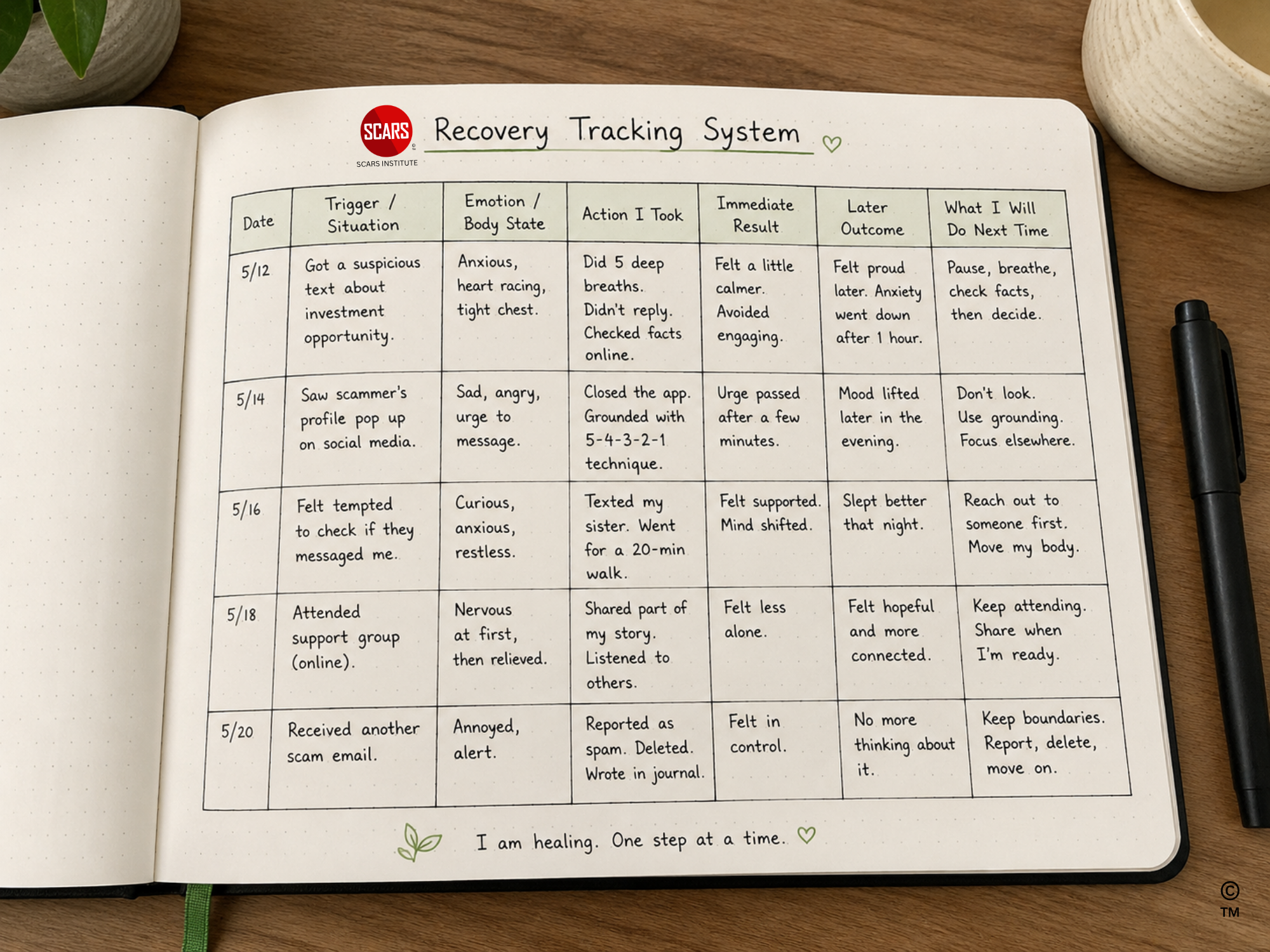
Creating a Paper Journal Table
A paper journal can use a simple table with columns such as:
Template Suggestion
Date:
Trigger or situation:
Emotion or body response:
Action taken:
Immediate result:
Later outcome:
What to do next time:
- You do not need to draw a perfect table.
- You can divide the page with lines.
- You can write the headings across the top.
- You can use one page per event.
- You can write the categories vertically instead of horizontally.
The format matters less than the information.
Using an Electronic Journal
- You can use the free electronic journal provided within the SCARS Institute community or another journaling application.
- You do not need to create a formal table.
- You can create a reusable template and paste it into each new entry.
For example:
Date and time:
Trigger or situation:
Emotion and body response:
Action I took:
Immediate result:
Later outcome:
What I learned:
What I will do next time:
You can save this as a template in the application, keep it in a note, or copy it from a previous entry. Each new journal entry can use the same structure. This creates the functional equivalent of a table without requiring spreadsheet tools.
See more about Phone Apps below.
Using Tags and Titles in an Electronic Journal
Electronic journals can make patterns easier to find.
You can use titles such as:
- No Contact Urge.
- Financial Trigger.
- Unknown Message.
- Support Meeting.
- Shame Response.
- Therapy Exercise.
- Sleep and Anxiety.
You can also use tags if the application supports them.
Useful tags can include:
- No Contact.
- Trigger.
- Progress.
- Financial Safety.
- Support.
- Therapy.
- Grounding.
- Shame.
- Grief.
- Anxiety.
- Boundary.
- Verification.
Later, you can search for one tag and review similar entries. This helps you identify repeated patterns.
Using Voice-to-Text
Please note: we do not recommend using voice or speech to text. The reason is that writing has a neutral effect and speaking can evoke emotions more strongly.
- Writing can feel difficult when you are distressed.
- You can use voice-to-text in an electronic journal.
- Speak slowly and answer each prompt.
You can say:
- “The trigger was an unknown message.”
- “I felt anxious and curious.”
- “I wanted to respond.”
- “I waited and contacted support.”
- “The urge decreased.”
Voice-to-text can reduce the effort required to record the event. You do not need to edit the entry for grammar or style. The journal is a recovery tool, not a publication.
Using Checklists
Some people prefer checklists. An electronic journal entry can include:
- Maintained No Contact: Yes or No.
- Used grounding: Yes or No.
- Contacted support: Yes or No.
- Verified before acting: Yes or No.
- Read recovery material: Yes or No.
- Attended support: Yes or No.
- Sleep adequate: Yes or No.
One short reflection can follow the checklist. This format is useful when concentration is limited.
Using a Spreadsheet
A spreadsheet can reproduce the paper table.
Each row can represent one event. Each column can contain:
Date.
Trigger.
Emotion.
Action.
Immediate result.
Later result.
Next step.
You can also include a rating from zero to ten for anxiety, urge strength, or emotional intensity. The rating is not a clinical measurement. It is a personal comparison.
You can observe whether the same trigger becomes less intense over time.
The spreadsheet should remain simple. Too many columns can make the system difficult to maintain.
Protecting Privacy
Recovery journals can contain sensitive information.
- Use password protection when possible.
- Lock the device.
- Avoid storing unnecessary account numbers, passwords, identification documents, or complete financial information.
- Do not include information that would create additional risk if someone accessed the journal.
- You can describe an account as “savings account” rather than recording the full account number.
- You can identify the scammer as “the offender” rather than storing every profile name.
- The purpose is behavioral awareness, not evidence storage.
- Evidence should be preserved separately and securely.
Reviewing the Record
Tracking becomes most useful when you review it. A weekly review can take ten minutes.
Ask:
- What triggered me most often?
- Which behavior helped most?
- When was I most vulnerable?
- What did I avoid?
- What progress did I overlook?
- Which recovery action should I continue?
- What needs more support?
You do not need to analyze every entry. Look for patterns.
You might discover that late-night isolation increases the urge to search. You might see that support meetings consistently reduce distress. You might notice that verifying information lowers anxiety more effectively than repeated reassurance-seeking.
The review turns individual entries into learning.
Sharing Selected Patterns With Support or Therapy Providers
- You do not need to share the entire journal.
- You can bring selected patterns to a therapist, support provider, or trusted person.
You might say:
- “I noticed that I want to contact the scammer after conflict with my family.”
- “My anxiety increases when I receive financial emails.”
- “I avoid support when I feel ashamed.”
- “Grounding works better when I use it before the urge becomes intense.”
This gives the support provider specific information. It also makes therapy and support more practical.
Reinforcing Recovery Through the System
The Recovery Tracking System is itself a form of behavioral reinforcement.
- When you record a healthy action, you acknowledge it.
- When you review progress, you create evidence of competence.
- When you identify a pattern, you gain greater control.
- When you choose a safer response, you strengthen that behavior.
You can also add a modest reward after completing important recovery actions. The reward can include rest, music, a walk, a favorite meal, time with a friend, or another healthy activity. The purpose is not to bribe yourself. It is to use a reinforcement technique called Operant Conditioning. It is to help the nervous system associate recovery behavior with recognition, relief, and progress.
The System Must Remain Compassionate
A Recovery Tracking System should help you become more honest without becoming more cruel.
- You are not recording evidence of personal failure.
- You are observing a traumatized person learning new responses.
- Some entries will show progress.
- Some will show avoidance.
- Some will show repeated mistakes.
- Some will show courage that you did not recognize at the time.
- All of them can provide information.
The system works when it helps you make the next decision more safely.
Recovery Becomes Visible Through Repetition
Recovery is not one dramatic moment of understanding. It develops through repeated actions.
- You maintain No Contact again.
- You verify again.
- You attend again.
- You ask for help again.
- You tolerate the trigger again.
- You choose not to act impulsively again.
These decisions can feel small when viewed separately. The Recovery Tracking System places them together. Over time, the record begins to show something important.
- You are no longer only reacting to what happened.
- You are learning how to direct what happens next.
The scammer once shaped behavior through affection, pressure, withdrawal, urgency, and relief. Recovery allows you to build a different behavioral system.
- Safety can follow verification.
- Relief can follow grounding.
- Connection can follow honest participation.
- Confidence can follow responsible action.
- Self-respect can follow maintained boundaries.
The system does not recover for you. It helps you see the work you are already doing, recognize what helps, correct what does not, and continue with greater awareness.
Recovery can feel uncertain from inside the experience. A written record gives it shape. It shows where you began, what you faced, how you responded, and how your choices gradually changed.
That is the purpose of a Recovery Tracking System. It makes recovery visible enough to continue.
Conclusion
A Recovery Tracking System gives traumatized scam victims a practical way to observe recovery as it happens. Emotional improvement can remain difficult to recognize because grief, shame, anxiety, anger, and longing can return even after meaningful progress has been made. A written record shows that recovery is also reflected through safer decisions, improved boundaries, greater participation, and more deliberate responses to triggers.
The system helps transform vague distress into useful information. It allows you to identify what happened, how your body and emotions responded, what action you took, and what followed. Over time, repeated entries can reveal when you are most vulnerable, which behaviors reduce distress, what situations increase the urge to reconnect, and which forms of support help you remain grounded.
Tracking should remain simple, private, and compassionate. It should never become another source of pressure, perfectionism, or self-judgment. A brief entry can be enough to preserve an important lesson. Missed days do not erase progress, and a setback does not make the system unsuccessful. The value comes from returning, observing honestly, and using what you learn to make the next decision more safely.
Recovery develops through repetition. Each time you maintain No Contact, verify information, attend support, complete therapy work, regulate an emotional response, or ask for help, you strengthen a healthier behavioral pattern. The Recovery Tracking System places these actions into a visible record, helping you recognize that recovery is not only something you hope for. It is something you are actively practicing.

Glossary
- Action Record — An action record documents what a scam victim did after a trigger, emotional reaction, or urge appeared. It helps separate the automatic response from the deliberate behavior that followed. Recording the action allows the survivor to compare impulsive reactions with safer choices and identify which responses support recovery. — Behavioral Modification
- Behavioral Evidence — Behavioral evidence is the written proof that a scam victim is making safer and more deliberate choices during recovery. It can include maintaining No Contact, attending support, verifying messages, completing therapy work, or asking for help. This evidence can reveal progress even when difficult emotions remain present. — Recovery Insight
- Behavioral Reinforcement — Behavioral reinforcement occurs when a recovery action becomes more likely because it is followed by recognition, relief, satisfaction, or another healthy consequence. A survivor can strengthen useful habits by acknowledging completed tasks or pairing them with modest rewards. The purpose is to make recovery behaviors easier to repeat over time. — Behavioral Modification
- Behavioral Tracking — Behavioral tracking is the practice of recording specific recovery actions rather than relying only on changing emotions as evidence of improvement. It can document verification, grounding, participation, financial caution, boundary maintenance, and resistance to impulsive contact. This approach helps survivors recognize that recovery often becomes visible through behavior before emotional relief becomes consistent. — Recovery Process
- Brief Entry Method — The brief entry method allows a scam victim to record a trigger, action, and outcome in only a few lines. It reduces the burden of journaling when concentration, motivation, or emotional energy is limited. A short entry used consistently can provide more useful information than an elaborate system that is quickly abandoned. — Recovery Participation
- Checklist Tracking — Checklist tracking uses simple yes or no responses to record whether important recovery behaviors occurred. It can include No Contact, grounding, verification, support participation, adequate sleep, or completion of psychoeducation. This method is practical for survivors who find open-ended writing difficult or overwhelming. — Recovery Practice
- Compassionate Accountability — Compassionate accountability combines honest behavioral review with respect for the survivor’s trauma, limitations, and continuing capacity to learn. It does not excuse unsafe actions, but it avoids using shame, insults, or self-punishment as motivation. The survivor examines what happened and identifies a safer response without treating the setback as proof of personal failure. — Accountability Practice
- Contact Urge — A contact urge is the impulse to message, call, search for, or otherwise reconnect with the scammer. The urge can be triggered by loneliness, memories, conflict, familiar dates, notifications, or emotional distress. Tracking its intensity, duration, and outcome helps the survivor learn that an urge can pass without being acted upon. — Trauma Activation
- Daily Recovery Cue — A daily recovery cue is a predictable signal that prompts a survivor to complete a tracking entry or another recovery behavior. The cue can be breakfast, bedtime, a calendar reminder, a support meeting, or the completion of another routine. Consistent cues reduce dependence on motivation and help recovery practices become more automatic. — Recovery Practice
- Delayed Decision Rule — A delayed decision rule requires a scam victim to wait before responding to an unusual financial request, investment offer, recovery claim, or urgent demand. The waiting period creates time for verification, consultation, and emotional regulation. This rule protects the survivor from decisions made under pressure, fear, excitement, or manufactured urgency. — Victim Safety
- Digital Journal Template — A digital journal template is a reusable set of prompts placed inside an electronic journal or note-taking application. It can include the date, trigger, emotional response, action, immediate result, later outcome, lesson, and next step. The template provides the structure of a table without requiring the survivor to create one manually. — Digital Recovery Practice
- Electronic Recovery Journal — An electronic recovery journal is a private digital space used to record recovery behaviors, triggers, responses, and outcomes. It can be provided through a support community or created through a journaling or note-taking application. Electronic journals can make entries searchable and allow survivors to use templates, titles, tags, reminders, and checklists. — Digital Recovery Practice
- Emotional Avoidance — Emotional avoidance occurs when a scam victim postpones or escapes a recovery task because it is expected to produce discomfort. Avoiding a bank statement, support meeting, therapy call, or difficult reflection can provide immediate relief. Tracking the later consequences helps reveal how avoidance can increase anxiety, isolation, confusion, and delay. — Withdrawal Pattern
- Emotional Response Record — An emotional response record identifies the feelings that appeared after a trigger or difficult situation. It can document fear, anger, shame, grief, longing, curiosity, or anxiety without treating those emotions as instructions. Recording the emotional response helps the survivor distinguish what was felt from what was done. — Emotional Regulation
- Emotional Trigger Log — An emotional trigger log records the events, images, words, dates, sounds, messages, or situations that activate distress. It also documents the thoughts, body sensations, and behaviors that follow. Repeated entries can reveal recurring conditions that require preparation, support, or stronger boundaries. — Trauma Activation
- Evidence Separation — Evidence separation is the practice of keeping behavioral recovery notes apart from formal records of the crime. A recovery journal focuses on triggers, responses, learning, and behavior, while screenshots, transaction records, identification documents, and communications should be stored securely elsewhere. This separation protects privacy and prevents the journal from becoming an unsafe evidence archive. — Victim Safety
- Financial Safety Tracking — Financial safety tracking records situations that could expose a scam victim to renewed fraud or impulsive financial behavior. It can include unexpected requests, cryptocurrency offers, account-access demands, recovery scams, and decisions delayed for verification. The record helps rebuild financial confidence through a repeatable safety process rather than intuition alone. — Financial Harm
- Grounding Record — A grounding record documents when a scam victim used a technique to reduce emotional or physiological activation. It can include breathing, sensory orientation, movement, reality statements, or contact with a trusted person. Comparing the level of distress before and after grounding helps the survivor identify which methods are most effective. — Emotional Regulation
- Habit Cue — A habit cue is a consistent event, place, time, or reminder connected with a recovery behavior. It can prompt journaling, grounding, reading, verification, or participation before avoidance takes control. Linking a behavior to a stable cue makes the action easier to repeat and reduces the need for daily decision-making. — Behavioral Modification
- Immediate Result — The immediate result is what happens directly after a survivor takes a recovery action or avoids one. It can include temporary relief, continuing anxiety, reduced urgency, discomfort, support, or increased control. Recording this result helps distinguish short-term emotional consequences from the longer-term effects of the behavior. — Recovery Insight
- Inconsistency Recovery — Inconsistency recovery is the process of returning to a tracking practice after missed entries, avoidance, fatigue, or disruption. The survivor does not need to reconstruct every missed day or punish themselves for stopping. Beginning again with the current experience preserves momentum and prevents perfectionism from ending the practice. — Recovery Momentum
- Journal Privacy — Journal privacy involves protecting recovery entries from unnecessary access, exposure, or misuse. A survivor can use device locks, passwords, application security, and careful wording while avoiding full account numbers, passwords, or identity documents. Privacy protections allow honest reflection without creating additional safety risks. — Privacy Protection
- Later Outcome — The later outcome is the effect that becomes visible after time has passed following a recovery choice. A behavior that feels uncomfortable immediately can later reduce anxiety, increase confidence, prevent contact, or strengthen safety. Recording later outcomes helps survivors avoid judging a decision only by its first emotional effect. — Recovery Insight
- No Contact Tracking — No Contact tracking records the days, situations, and difficult moments in which a scam victim does not communicate with the offender. It also documents urges, triggers, alternative actions, and the length of time required for distress to decrease. This record helps the survivor recognize that maintaining the boundary is an active recovery behavior. — Boundary Practice
- Neutral Language Recording — Neutral language recording describes an event without exaggerated judgment, self-attack, or emotionally loaded conclusions. A survivor can write that an unknown message caused fear and an urge to respond instead of saying that everything collapsed. This approach keeps the entry focused on observable patterns and practical next steps. — Reality Testing
- Operant Recovery Reinforcement — Operant recovery reinforcement applies the principles of learning through consequences to healthy recovery behavior. The survivor connects useful actions with recognition, relief, healthy rewards, or evidence of progress. Repeated reinforcement can strengthen grounding, verification, participation, No Contact, and other protective habits. — Behavioral Modification
- Pattern Recognition — Pattern recognition is the process of identifying repeated connections among triggers, emotions, body states, behaviors, and outcomes. A survivor might discover that loneliness increases contact urges or that exhaustion makes financial anxiety harder to regulate. Recognizing these patterns allows the person to prepare earlier and choose more effective responses. — Recovery Insight
- Physical Regulation Tracking — Physical regulation tracking records bodily conditions that can influence emotional stability and decision-making. It can include sleep, meals, hydration, movement, headaches, panic symptoms, muscle tension, energy, medication adherence, or substance use. The record helps reveal when physical depletion is increasing vulnerability to distress or impulsive behavior. — Physiological Response
- Progress Visibility — Progress visibility occurs when a written record makes small recovery changes easier to recognize. The survivor can see that urges are becoming shorter, verification is becoming more consistent, or participation is replacing isolation. Visible evidence can correct the trauma-related tendency to treat one setback as more important than many successful actions. — Recovery Momentum
- Recovery Behavior — A recovery behavior is a specific action that supports safety, stability, learning, connection, or emotional regulation. Examples include maintaining No Contact, attending support, completing therapy exercises, verifying suspicious messages, and asking for help before acting. Defining recovery through observable behavior makes progress easier to practice and measure. — Recovery Process
- Recovery Checklist — A recovery checklist is a brief list of protective or restorative actions that a scam victim reviews regularly. It can include grounding, No Contact, support participation, reading, sleep, verification, and financial caution. The checklist provides structure during periods when trauma, fatigue, or poor concentration makes detailed journaling difficult. — Recovery Practice
- Recovery Participation Log — A recovery participation log records attendance, learning, questions, comments, exercises, support interactions, and therapy involvement. It helps the survivor compare feelings before participation with the effects experienced afterward. The record can demonstrate that useful participation often improves connection and understanding even when motivation was initially absent. — Recovery Participation
- Recovery Resistance — Recovery resistance is the reluctance to begin or continue a tracking practice because it feels burdensome, exposing, repetitive, or emotionally uncomfortable. It can also appear when a survivor believes the patterns are already understood or fears that the record will reveal slow progress. Reducing the system to one behavior or one brief entry can make participation more manageable. — Psychological Vulnerability
- Recovery Review — A recovery review is a scheduled examination of recent tracking entries to identify patterns, progress, vulnerabilities, and unmet support needs. It can focus on common triggers, helpful behaviors, avoidance, overlooked improvement, and actions that should continue. The review converts separate entries into practical learning that can guide future decisions. — Recovery Insight
- Recovery Tracking System — A Recovery Tracking System is a structured method for documenting triggers, emotional and physical reactions, actions, immediate results, later outcomes, and lessons. It helps scam victims recognize behavioral progress that can remain hidden when recovery is judged only by emotion. The system supports safer decisions, greater self-awareness, compassionate accountability, and repeated recovery participation. — Recovery Process
- Repeated Action — Repeated action is the consistent performance of a recovery behavior until it becomes more familiar and reliable. Maintaining No Contact, verifying messages, attending support, and practicing grounding gain strength through repetition. Small actions can produce meaningful change when they are continued across difficult emotional periods. — Recovery Momentum
- Response Delay — Response delay is the intentional pause between a trigger or request and the survivor’s next action. The pause creates time for emotional activation to decrease and for verification or consultation to occur. Delaying a response weakens impulsive patterns and supports decisions based on safety rather than urgency. — Decision-Making Pattern
- Safe Social Connection — Safe social connection is contact with trusted people, support groups, community members, therapists, or family members who reduce isolation and encourage grounded recovery behavior. The survivor can track how they felt before and after social participation. This comparison helps reveal whether connection produces longer-term relief even when initial participation feels uncomfortable. — Support Systems
- Self-Judgment Prevention — Self-judgment prevention is the deliberate refusal to use a recovery record as proof of stupidity, weakness, or personal failure. The survivor treats each entry as information about a behavior, trigger, or unmet need. This approach protects the tracking system from becoming another source of shame and avoidance. — Self-Compassion Practice
- Shame Thought Record — A shame thought record documents the harsh belief that appears after a trigger, loss reminder, or perceived setback. It then compares the judgment with known facts and develops a more accurate statement. This process helps prevent responsibility for present choices from becoming global self-condemnation. — Belief Distortion
- Small-Step Tracking — Small-step tracking records manageable versions of difficult recovery tasks. A survivor can open one bank statement, attend part of a support meeting, or write three sentences instead of attempting the complete task at once. Recognizing these smaller actions supports gradual progress and reduces avoidance caused by feeling overwhelmed. — Recovery Momentum
- Spreadsheet Tracking — Spreadsheet tracking uses rows and columns to organize recovery events, triggers, emotions, actions, outcomes, and next steps. It can also include personal ratings for anxiety, urge strength, or emotional intensity. The format helps survivors compare similar events over time while keeping the system simple enough to maintain. — Digital Recovery Practice
- Support Pattern — A support pattern is a repeated connection between seeking help and experiencing a useful recovery outcome. A survivor might notice that contacting a trusted person reduces the urge to reconnect or that support meetings lessen isolation. Recording this pattern strengthens confidence in reaching out before distress becomes overwhelming. — Support Relationship
- Tag-Based Organization — Tag-based organization uses searchable labels to group electronic journal entries by subject. Tags can identify No Contact, grief, financial safety, grounding, therapy, anxiety, verification, or support. Reviewing entries under one tag can reveal recurring patterns that would remain difficult to see in a chronological journal alone. — Digital Recovery Practice
- Therapy Participation Record — A therapy participation record documents attendance, completed exercises, emotional responses, and practical lessons connected with trauma-informed mental healthcare. It can help the survivor remember what was practiced and identify subjects that need further discussion. Selected patterns can be shared with the therapist without exposing the entire private journal. — Health Impact
- Trigger Identification — Trigger identification is the process of naming the event or cue that appeared before emotional or behavioral activation. A trigger can include a photograph, song, date, notification, financial statement, social media post, or unfamiliar message. Accurate identification allows the survivor to prepare for recurring situations and separate the cue from the action that follows. — Trauma Activation
- Urge Intensity Rating — An urge intensity rating is a personal numerical estimate of how strongly a survivor feels compelled to perform a behavior. It can be used for contact urges, searching, impulsive spending, avoidance, or reassurance-seeking. Comparing ratings over time can show whether the same trigger is becoming easier to tolerate, although the number is not a clinical measurement. — Emotional Regulation
- Verification Record — A verification record documents situations in which a scam victim paused and checked information before acting. It can include suspicious messages, financial offers, unfamiliar accounts, recovery claims, or requests for personal information. The record helps rebuild confidence by showing that safer decisions can follow a repeatable verification process. — Verification Practice
- Voice-to-Text Caution — Voice-to-text caution recognizes that speaking about a traumatic experience can sometimes evoke stronger emotions than writing. A survivor who uses speech entry should notice whether verbalizing the event increases distress or makes regulation more difficult. Written entry can remain the safer option when speaking activates the experience too intensely. — Trauma-Informed Practice
- Weekly Review — A weekly review is a brief scheduled examination of recovery entries from the preceding days. It helps identify common triggers, helpful actions, neglected tasks, vulnerable periods, and progress that was not recognized at the time. A regular review allows the survivor to adjust the tracking system and prepare more effectively for future challenges. — Recovery Practice
- Written Evidence — Written evidence is the accumulated record of a scam victim’s recovery actions, responses, lessons, and changing patterns. It can show that the survivor maintained boundaries, tolerated urges, participated in support, and made safer decisions despite continuing distress. This evidence provides a more reliable view of progress than memory or mood alone. — Recovery Insight
Author Biographies
Author Biography
Prof. (Emeritus) Tim McGuinness, Ph.D. DFin is a co-founder, Managing Director, and Chairman of the SCARS Institute (Society of Citizens Against Relationship Scams Inc.), where he serves as an unsalaried volunteer officer dedicated to supporting scam victims and survivors around the world. With over 34 years of experience in scam education and awareness, he is perhaps the longest-serving advocate in the field.
Dr. McGuinness has an extensive background as a business pioneer, having co-founded several technology-driven enterprises, including the former e-commerce giant TigerDirect.com. Beyond his corporate achievements, he is actively engaged with multiple global think tanks where he helps develop forward-looking policy strategies that address the intersection of technology, ethics, and societal well-being. He is also a computer industry pioneer (he was an Assistant Director of Corporate Research Engineering at Atari Inc. in the early 1980s) and invented core technologies still in use today.
His professional identity spans a wide range of disciplines. He is a scientist, strategic analyst, solution architect, advisor, public speaker, published author, roboticist, Navy veteran, and recognized polymath. He holds numerous certifications, including those in cybersecurity from the United States Department of Defense under DITSCAP & DIACAP, continuous process improvement and engineering and quality assurance, trauma-informed care, grief counseling, crisis intervention, and related disciplines that support his work with crime victims.
Dr. McGuinness was instrumental in developing U.S. regulatory standards for medical data privacy called HIPAA and financial industry cybersecurity called GLBA. His professional contributions include authoring more than 1,000 papers and publications in fields ranging from scam victim psychology and neuroscience to cybercrime prevention and behavioral science.
“I have dedicated my career to advancing and communicating the impact of emerging technologies, with a strong focus on both their transformative potential and the risks they create for individuals, businesses, and society. My background combines global experience in business process innovation, strategic technology development, and operational efficiency across diverse industries.”
“Throughout my work, I have engaged with enterprise leaders, governments, and think tanks to address the intersection of technology, business, and global risk. I have served as an advisor and board member for numerous organizations shaping strategy in digital transformation and responsible innovation at scale.”
“In addition to my corporate and advisory roles, I remain deeply committed to addressing the rising human cost of cybercrime. As a global advocate for victim support and scam awareness, I have helped educate millions of individuals, protect vulnerable populations, and guide international collaborations aimed at reducing online fraud and digital exploitation.”
“With a unique combination of technical insight, business acumen, and humanitarian drive, I continue to focus on solutions that not only fuel innovation but also safeguard the people and communities impacted by today’s evolving digital landscape.”
Dr. McGuinness brings a rare depth of knowledge, compassion, and leadership to scam victim advocacy. His ongoing mission is to help victims not only survive their experiences but transform through recovery, education, and empowerment.
Vianey Gonzalez is a licensed psychologist in Mexico and a survivor of a romance scam that ended eight years ago. Through her recovery and the support she received, she was able to refocus on her future, eventually attending a prestigious university in Mexico City to become a licensed psychologist with a specialization in crime victims and their unique trauma. She was a Board Member and now serves as an Advisor to the SCARS Institute (Society of Citizens Against Relationship Scams Inc.) and holds the position of Chief Psychology Officer. She also manages our Mexican office, providing support to Spanish-speaking victims around the world. Vianey has been instrumental in helping thousands of victims and remains an active contributor to the work we publish on this and other SCARS Institute websites.
La Lic. Vianey Gonzalez es profesional licenciada en psicología en México y sobreviviente de una estafa romántica que terminó hace ocho años. Gracias a su recuperación y al apoyo recibido, pudo reenfocarse en su futuro y, finalmente, cursó sus estudios en una prestigiosa universidad en la Ciudad de México para obtener su licencia como psicóloga con especialización en víctimas de crimen y sus traumas particulares. Actualmente, es miembro de la junta directiva del Instituto SCARS (Sociedad de Ciudadanos Contra las Estafas en las Relaciones) y ocupa el cargo de Directora de Psicología. También dirige nuestra oficina en México, brindando apoyo a víctimas en español en todo el mundo. Vianey ha sido fundamental para ayudar a miles de víctimas y continúa contribuyendo activamente las obras que publicamos en este y otros sitios web del Instituto SCARS.
Debby Montgomery Johnson is a resilient advocate, author, and speaker dedicated to empowering others through her experiences of triumph over adversity. With a diverse background spanning military service, finance, and community leadership, Debby served as a U.S. Air Force Intelligence Officer, earning accolades like the USAF Meritorious Service Medal and Joint Service Commendation Medal. Transitioning to banking, she excelled as Senior Branch Manager at World Savings Bank, was named Manager of the Year in Florida in 2005, and achieved top customer service honors in 2006.
Her personal journey took a dramatic turn after becoming a victim of a million-dollar online romance scam, inspiring her bestselling book, “The Woman Behind the Smile: Triumph Over the Ultimate Online Dating Betrayal.” This memoir, along with “Snapshots from Positive Tribe Stories” and contributions to “A Gift Called Fearless,” shares her path to healing and resilience. As the former Chair of the Board of Directors, she now serves as an Advisor to the Society of Citizens Against Relationship Scams Inc. (SCARS Institute), Debby educates and supports scam victims/survivors worldwide.
As a businesswoman, she is the CEO of BenfoComplete.com, an exceptional vitamin supplement products company developing innovative products for those who suffer from neuropathy.
A passionate volunteer with her church since 2013, she aids over 500 women in temporal and spiritual growth. Involved in organizations like: Women’s Prosperity Network, Holistic Chamber of Commerce, and The Rosie Network, Debby promotes holistic health and military family businesses. Honored as the 2017 California Women’s Conference SPEAK OFF winner, she continues inspiring audiences to embrace their true selves and live fearlessly.
Janina Morcinek is a dedicated and accomplished educator, holding certifications and credentials that underscore her commitment to teaching. With a robust academic background, she graduated from both the Krakow University of Technology and the Catholic University of Lublin, equipping her with a diverse skill set and a deep understanding of various educational methodologies. Currently, she serves as a teacher in a secondary school, where she inspires and guides young minds, and also at a University of the Third Age (UTW), where she fosters lifelong learning and intellectual growth among her mature students.
Despite her professional success, Janina’s life took an unexpected turn six years ago when she fell victim to romance fraud. This traumatic experience left her feeling vulnerable and betrayed, but it also sparked a journey of resilience and recovery. Thanks to the support and guidance provided by SCARS, a nonprofit organization dedicated to educating and assisting victims of romance scams, Janina was able to navigate the complex emotions and challenges that followed. Through their comprehensive resources and compassionate approach, she found the strength to heal and reclaim her life.
Today, Janina is a beacon of hope and a source of inspiration for others who have experienced similar traumas. As a former Director, and now volunteer Advisor to the SCARS Institute, she has taken on the role of supporting and helping fellow scam victims/survivors, both within her country and internationally. Her story serves as a powerful testament to the transformative power of support and community. By sharing her experiences and the valuable knowledge she continues to acquire, Janina not only aids others in their recovery but also contributes to the broader mission of raising awareness about the perils of romance scams and fraud. Her dedication to this cause is a reflection of her unwavering commitment to making a positive impact and ensuring that no one has to suffer alone.
-/ 30 /-
What do you think about this?
Please share your thoughts in a comment below!
GLOSSARY SEARCH
TOPIC SEARCH
TABLE OF CONTENTS








CATEGORIES
The SCARS Institute Recovery Tracking System – 2026
Please Leave a Comment
Please Tell Us What You Learned From This?
Commenting Is An Essential Part Of Healing
Read • Think • Write
2 Comments
Leave A Comment Cancel reply
More ScamsNOW.com Articles









This was loaded with information. I want to make use of the Recovery tracking System for my triggers. Nights are hard for me. I get lonely n it is then that I’m triggered the most to find the scammer but I always pick up an article to read or watch Netflix or journal.
Very good, keep moving forward.