


Lazarus and the Resurrection – An Allegory for Scam Victim Recovery – 2026

The SCARS Institute Magazine about Scam Victims-Survivors, Scams, Fraud & Cybercrime
- Published: 4/15/26
- Modified: 4/15/26
- Comments: 1
- Read Status:


Lazarus and the Resurrection – An Allegory for Scam Victim Recovery
What We Can Learn from the Story of Lazarus and His Resurrection – For Scam Victim Recovery
Primary Category: Scam Victim Recovery Philosophy / Recoverology
Authors:
• Tim McGuinness, Ph.D., DFin, MCPO, MAnth – Anthropologist, Scientist, Polymath, Managing Director of the Society of Citizens Against Relationship Scams Inc.
Author Biographies Below
About This Article
The story of Lazarus is presented as a detailed allegory for scam victim recovery, where emotional devastation following fraud is compared to illness, death, and entombment. The progression from early doubt to sudden discovery mirrors the collapse of trust and identity, followed by a period of shock and the eventual realization that losses cannot be reversed. The four days in the tomb symbolize the point at which hope gives way to finality, leaving individuals confined by shame, guilt, and regret. Recovery begins with compassionate acknowledgment of suffering, modeled through shared grief, and continues through an active decision to emerge from isolation. Support from others is necessary to address the lasting effects of trauma, enabling individuals to move forward and rebuild a life defined by resilience rather than loss.
Note: This article is intended for informational purposes and does not replace professional medical advice. If you are experiencing distress, please consult a qualified mental health professional. Also see our religious disclaimer below.
What We Can Learn from the Story of Lazarus and His Resurrection – For Scam Victim Recovery
The Story of Lazarus
The story of Lazarus, as recounted in the Gospel of John, stands as one of the most dramatic and emotionally resonant narratives in the New Testament. It is a tale of friendship, profound grief, and the ultimate triumph over the finality of death. While its theological significance within Christianity is immense, a powerful and often overlooked dimension of this ancient story emerges when viewed through the lens of modern trauma, specifically the profound and life-altering experience of being scammed. For a victim of a sophisticated scam, the aftermath is not merely a financial loss; it is an emotional and psychological devastation that can feel like a form of death. In this context, the narrative of Lazarus transforms from a solely religious miracle into a potent allegory for recovery, a metaphor for resurrection from an emotional tomb, and a profound example of hope for those who feel buried alive by their trauma.
For more on the story, see the References below.
The Allegory of Lazarus
To understand the allegory, one must first grasp the nature of the trauma experienced by scam victims. A scam, particularly one involving a deep emotional connection like a romance scam or a complex investment fraud, is a violation on multiple levels. It is an attack on one’s finances, certainly, but more insidiously, it is an attack on one’s judgment, trust, and sense of reality. The victim is not just tricked; they are emotionally hollowed out. The person they believed they were connecting with, the future they were investing in, the security they thought they were building, all of it is revealed to be a meticulously constructed illusion. The collapse of this illusion leaves a void. The grief is not for a person who has died, but for a person who never existed. The betrayal is not just by a stranger, but by one’s own mind, which failed to see the warning signs.
This is where the parallel with Lazarus becomes striking. Before his physical death, Lazarus was ill. His condition deteriorated, and despite the hope of a cure, he succumbed. Similarly, a scam victim often experiences a period of “illness.” There may be subtle signs, moments of doubt, or cognitive dissonance, but the manipulated hope and trust placed in the scammer, or in the perceived opportunity, override these instincts. They are, in a sense, emotionally unwell, blinded by the carefully administered poison of the scammer’s manipulation. Then comes the moment of discovery, the “death.” It is the moment the bank transfer is reversed, the fake profile disappears, and the investment platform goes offline. In that instant, the victim’s world collapses. The person they were before, the manipulated, trusting, hopeful, and emotionally engaged individual, ceases to exist. They are plunged into a state of shock and numbness, a tomb of their mind’s making.
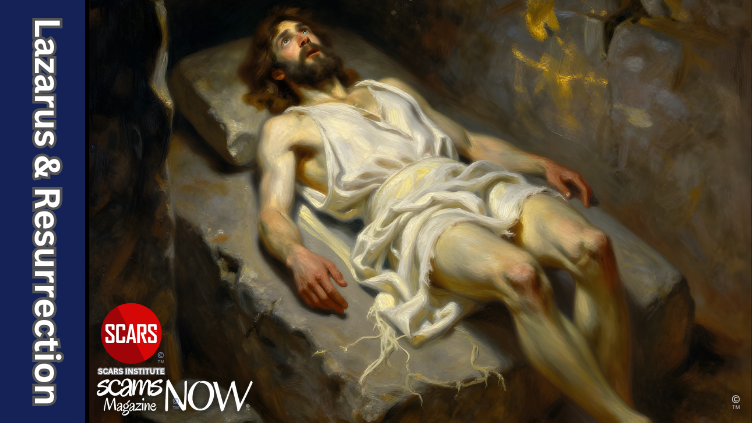
The Gospel of John emphasizes an important detail: Lazarus had been in the tomb for four days. This was not an arbitrary number. In the Jewish tradition of the time, it was believed that the soul lingered near the body for three days before departing. By the fourth day, death was absolute, irreversible. There was no hope. This detail deeply resonates with the scam victim’s experience. In the immediate aftermath of the scam, there is often a frantic energy, a desperate attempt to negotiate with reality, reverse the transaction, contact law enforcement, and find some way to undo the reality of what has happened. But as days turn into weeks, this frantic hope gives way to the crushing finality of the situation. The money is gone. The person is gone. The dream is gone. This is the fourth day in the tomb. The victim is entombed not by a stone, but by shame, guilt, and the suffocating weight of regret. They are wrapped in the “grave clothes” of self-blame, their hands and feet bound by the “what ifs” and “if onlys” that paralyze them. They are, for all intents and purposes, emotionally dead.
The Finality
The role of Jesus in the story becomes a powerful metaphor for the external elements of recovery. When Jesus arrives, he does not immediately perform a miracle. First, he engages with the pain. He meets Martha, who expresses both her faith and her frustration: “Lord, if you had been here, my brother would not have died.” This is the cry of the scam victim. “If only I had been smarter,” “If only someone had warned me,” “If only the bank had stopped the transfer.” It is a cry of anguish directed at a perceived power that could have intervened. Jesus’s response is not to chastise Martha for her lack of faith, but to meet her in her grief and offer a new perspective: “I am the resurrection and the life.” He does not deny the reality of death; he transcends it. In this way, scam victims transcend the crime through their recovery.
The most humanizing moment in the story follows: “Jesus wept.” He stands before the tomb of his friend and is moved to tears by the grief of Mary and Martha, and by the reality of death itself. This is a profound lesson for anyone seeking to help a scam victim. The first and most critical step is not to offer quick solutions or platitudes. It is not to say, “You should have known better,” or “Just move on.” It is to weep with them. It is to validate their pain, to sit with them in the darkness of their tomb and acknowledge the horror of their loss without judgment. This shared grief is the stone beginning to roll away. It is the first crack of light that lets the victim know they are not alone in their suffering, that their pain is real and justified.
The Resurrection
When Jesus commands the stone to be rolled away, Martha objects, “Lord, by this time there is a bad odor, for he has been there four days.” This is the voice of shame. The victim, buried in their trauma, fears what will be revealed if they begin to “unbury” themselves. They fear the “bad odor” of their own foolishness, the judgment of others, the stench of their own perceived failure. Recovery requires a force that is greater than this shame, a voice that says, “Did I not tell you that if you believe, you will see the glory of God?” It is the encouragement of a therapist, a support provider, or a loved one who insists that the potential for healing is worth the risk of exposure.
The command, “Lazarus, come out!” is the call to action. It is the moment the victim must decide to commit and to participate in their own resurrection. It is not a passive process. Recovery from trauma is an active choice to step out of the darkness of isolation. It is the decision to stop hiding, to stop blaming oneself, and to step into the light, even if that light feels blinding, overwhelming, and painful at first. It is the choice to speak the truth of what happened, to report the crime, to share one’s story with others who understand.
The final act is deeply symbolic. Lazarus emerges, but he is still bound by his grave clothes. Jesus instructs the bystanders, “Take off the grave clothes and let him go.” Resurrection is not a single, magical event that instantly restores everything. It is the beginning of a process. The victim has made the decision to live again, but they are still bound by the trappings of their trauma. The “grave clothes” are the lingering habits of thought, the hypervigilance, the inability to trust, the crushing self-doubt. These cannot be shed alone. The community, the family, and supporters have a role to play. This is the function of support groups like the SCARS Institute’s Scam Survivors’ Community (www.SCARScommunity.org), or other real online communities of fellow survivors. They are the ones who help gently unwrap the linens of shame, who offer practical advice, who share their own stories of shedding those bindings. They help the newly resurrected victim learn to walk freely again, unencumbered by the past.
The allegory extends further when considering the aftermath of the miracle. The Gospel notes that this event was the catalyst for the Sanhedrin to plot Jesus’s death. In other words, the resurrection of Lazarus led to a new crisis. This is a realistic and critical part of the recovery metaphor. A victim’s decision to “come out” of their tomb, to speak up, to seek justice, to reclaim their life, may not be universally celebrated. Family members who do not understand the depth of the trauma may grow impatient. Friends may grow tired of the struggle. Law enforcement may be unable to recover the funds, adding a layer of bureaucratic frustration. The act of resurrection itself can create new challenges. But just as Jesus’s path led toward a greater, albeit painful, purpose, the victim’s path to recovery, though fraught with difficulty, leads toward a stronger, more resilient self. This is what we call the “Yellow Brick Road.”
Conclusion
Ultimately, the story of Lazarus offers scam survivors a blueprint for hope that is both based on faith and deeply practical. It reframes their experience from one of finality to one of transition, to transcendence. They are not a ruined or broken person; they are a person in a tomb, waiting for the stone to be rolled away. It validates their four-day despair, acknowledging that death feels absolute and hope seems impossible. It provides a model for helpers to weep with the grieving before attempting to help them heal. It emphasizes the necessity of community in the unwrapping process, reminding survivors that they cannot and should not shed their grave clothes alone in isolation.
Most importantly, it offers the promise of a future. Lazarus, after his resurrection, does not simply fade into the background. He lives. He is a testament to the power that overcomes the darkness. For the scam survivor, their “resurrection” is the chance to live again, not as the person they were before, but as someone new. They carry the scars of their experience, but those scars become a testament to their survival. Their story, like Lazarus’s, becomes one of hope for others who are still in the tomb. They can look back at the person who was wrapped in shame and grief and see the journey they have taken. The life that was “sabotaged from the beginning” by the scammer’s deceit is not over. It has, in fact, just begun its most meaningful chapter. The emotional death was not an end, but a painful, dark gestation preceding a profound and hard-won rebirth.

Glossary
- Allegorical Illness — This term describes the early phase of scam involvement where subtle doubts, inconsistencies, or internal conflict appear but are overridden by manipulated trust and emotional investment. It reflects a gradual weakening of judgment and perception rather than a sudden failure. The concept helps explain that vulnerability develops progressively under influence rather than from a single mistake.
- Cognitive Dissonance Phase — This refers to the internal conflict experienced when emerging warning signs contradict the emotional narrative created by the scammer. Individuals may notice inconsistencies but suppress them to preserve the perceived relationship or opportunity. Understanding this phase supports recognition that confusion and contradiction are expected responses during manipulation.
- Community-Assisted Reintegration — This describes the process of re-entering normal social and emotional functioning with the help of supportive groups. Community provides guidance, shared experience, and practical strategies for rebuilding stability. This concept emphasizes that recovery is strengthened through collective support rather than isolation.
- Constructed Illusion — This term describes the fabricated reality created by scammers, including false identities, relationships, and financial opportunities. Individuals invest emotionally and cognitively in this illusion as though it were real. Recognizing this concept helps separate the false narrative from reality during recovery.
- Emotional Exposure Threshold — This refers to the point at which an individual becomes willing to confront and share their experience despite discomfort and fear. Crossing this threshold allows access to support and validation. Understanding this helps individuals prepare for the difficulty of disclosure.
- Emotional Gestation Period — This term represents the time between psychological collapse and visible recovery, where internal processing occurs. Individuals may feel uncertain, stalled, or overwhelmed during this period. Recognizing this stage supports patience and reduces pressure for immediate improvement.
- Emotional Hollowing — This describes the internal depletion that occurs when trust, hope, and belief are exploited over time. The individual may feel emptied of emotional stability and confidence. This concept explains why recovery requires rebuilding internal resources, not just addressing financial loss.
- Emotional Reanimation — This describes the gradual return of emotional engagement and responsiveness after a period of numbness or withdrawal. Individuals begin to reconnect with feelings and external experiences. Recognizing this shift helps identify meaningful progress in recovery.
- Emotional Tomb — This term represents the psychological state following discovery of the scam, where shock, numbness, and withdrawal dominate. Individuals may feel isolated, trapped, and unable to act. Understanding this state normalizes the paralysis that often follows traumatic realization.
- Experiential Transformation — This describes the change in identity and perspective that occurs through processing the scam experience. Individuals integrate the event into a new understanding of themselves and their decisions. This concept frames growth as a result of confronting and working through trauma.
- External Compassion Catalyst — This describes the role of empathetic responses from others in initiating movement toward recovery. Compassion reduces isolation and creates conditions where healing can begin. Recognizing this highlights the importance of supportive interactions early in recovery.
- False Relationship Grief — This refers to grief experienced for a person or relationship that never truly existed. The emotional attachment was real, even though the other party was not. Recognizing this form of grief validates the depth of loss without requiring a physical death.
- Finality Acceptance — This describes the transition from attempting to reverse the scam to accepting that losses cannot be undone. It often follows a period of intense effort and hope. Understanding this stage helps individuals recognize a key turning point in recovery.
- Fourth-Day Finality — This concept reflects the point at which hope of reversal fully collapses, and the permanence of loss becomes undeniable. Individuals may feel emotionally exhausted and resigned to reality. This stage marks the beginning of deeper psychological processing.
- Frantic Recovery Attempt — This term describes the immediate actions taken after discovery, including contacting banks, authorities, and others in an attempt to reverse the damage. These efforts are driven by urgency and disbelief. Recognizing this phase helps normalize early reactions.
- Grave Clothes — This refers to the lingering psychological effects of the scam, including shame, guilt, distrust, and self-blame. These factors continue to restrict emotional and behavioral movement even after initial recovery begins. Understanding this concept highlights the need for ongoing support.
- Illusion Collapse — This term describes the moment when the constructed reality created by the scammer is exposed as false. The sudden loss of perceived truth can destabilize identity and emotional grounding. Recognizing this collapse helps explain the intensity of the reaction.
- Isolation Entrapment — This describes the tendency to withdraw from others due to shame, embarrassment, or fear of judgment. Isolation reinforces negative thought patterns and delays recovery. Awareness of this pattern supports re-engagement with supportive networks.
- Judgment Paralysis — This term refers to the inability to make decisions or take action following the shock of discovery. Cognitive overload and emotional distress contribute to this state. Understanding this helps reduce self-blame for perceived inaction.
- Loss of Future Narrative — This describes the collapse of imagined plans, relationships, or financial security tied to the scam. Individuals lose not only what existed, but what they believed would exist. Recognizing this loss explains the depth of grief experienced.
- Manipulated Trust State — This term describes the condition in which trust has been intentionally shaped and controlled by the scammer. Natural trust mechanisms are redirected toward false targets. Understanding this reframes vulnerability as a result of manipulation rather than personal failure.
- Narrative Investment — This refers to the emotional and cognitive commitment placed into the scammer’s story or identity. Individuals actively participate in sustaining the illusion through belief and engagement. Recognizing this helps explain why disengagement can feel difficult.
- Perceived Self-Betrayal — This describes the feeling that one’s own judgment or instincts failed to prevent harm. Individuals may blame themselves for not recognizing warning signs. Understanding this concept helps reframe responsibility away from the victim.
- Post-Resurrection Challenges — This refers to difficulties that arise after initial recovery steps, including a lack of understanding from others or institutional barriers. These challenges can complicate continued progress. Recognizing this prepares individuals for ongoing effort.
- Psychological Burial — This term represents deep immersion into shame, regret, and emotional withdrawal following the scam. Individuals may feel disconnected from normal functioning. Awareness of this state supports gradual re-engagement with life.
- Reality Reintegration — This term refers to the process of reconnecting with factual understanding and stable perception after illusion collapse. Individuals rebuild a grounded view of events and themselves. This supports long-term recovery and decision-making.
- Recovery Activation — This refers to the moment when an individual begins to actively engage in healing efforts. It includes seeking support, acknowledging reality, and taking initial steps forward. Recognizing this stage encourages intentional participation in recovery.
- Recovery Momentum Development — This term describes the gradual building of forward movement through repeated actions and consistent engagement with recovery practices. Progress may begin slowly but strengthens over time. Understanding this encourages persistence and structure.
- Recovery Participation Choice — This term emphasizes that recovery requires active involvement rather than passive waiting. Individuals must choose to engage with support systems and confront their experience. This reinforces personal agency in healing.
- Recovery Resistance — This term describes hesitation or avoidance of engaging in recovery due to fear, shame, or overwhelm. It can delay healing and prolong distress. Awareness of this resistance helps individuals move past it.
- Shame Barrier — This refers to the internal resistance to discussing or confronting the scam due to embarrassment or fear of judgment. It prevents individuals from seeking help or sharing their experience. Recognizing this barrier supports efforts to overcome it.
- Shame Exposure Risk — This refers to the fear associated with revealing one’s experience and perceived mistakes to others. This fear often prevents help-seeking behavior and prolongs isolation. Understanding this risk supports gradual and controlled disclosure.
- Social Unwrapping Process — This term describes the role of others in helping individuals address and release lingering psychological effects. Support systems assist in reframing thoughts and rebuilding trust. This emphasizes recovery as a shared process.
- Sudden Identity Collapse — This describes the loss of a previous sense of self following the scam. Individuals may no longer recognize who they were during the experience. Understanding this helps frame identity reconstruction as part of recovery.
- Supportive Witnessing — This refers to the act of others being present with an individual’s pain without judgment or immediate solutions. It involves listening and acknowledging suffering. This concept reinforces the importance of empathy in recovery.
- Symbolic Resurrection — This term represents the process of re-engaging with life after emotional collapse. It is not a return to a previous state but the beginning of a new phase. Understanding this helps set realistic expectations for recovery.
- Trauma-Induced Numbness — This describes the emotional shutdown that often follows the realization of the scam. Individuals may feel disconnected or unable to process events. Recognizing this normalizes the experience.
- Trust System Disruption — This refers to the breakdown of internal mechanisms used to evaluate safety and reliability in others. It affects future relationships and decisions. Awareness of this supports the gradual rebuilding of trust.
- Unburial Process — This term describes the gradual confrontation of suppressed emotions and experiences related to the scam. It involves facing discomfort in order to heal. Understanding this helps prepare individuals for the challenges of recovery.
- Validation Before Intervention — This concept emphasizes that acknowledgment of pain must occur before offering solutions or advice. It prioritizes emotional understanding. This approach improves the effectiveness of support.
- Void Formation — This describes the emptiness left after the collapse of the scam’s illusion and associated expectations. Individuals may feel a lack of purpose or direction. Recognizing this helps guide rebuilding efforts.
- What-If Looping — This refers to repetitive thoughts focused on alternative outcomes and missed warning signs. These cycles reinforce regret and self-blame. Understanding this pattern supports cognitive restructuring.
- Yellow Brick Road Path — This term represents the ongoing journey of recovery marked by difficulty, growth, and progression toward a stronger identity. It acknowledges that challenges continue even after initial recovery begins. This concept frames recovery as a sustained process.
Reference
Who Was Lazarus?
Lazarus is a figure primarily known from the New Testament of the Christian Bible, specifically in the Gospel of John. He is most famous for being a man whom Jesus Christ resurrected from the dead, an event that stands as one of the most significant miracles performed by Jesus in the Gospels.
According to the biblical account in John 11, Lazarus was a resident of Bethany and the brother of two women, Mary and Martha. He was described as someone Jesus loved, suggesting a close friendship. The story begins when Lazarus falls ill. His sisters send word to Jesus, who is preaching elsewhere, asking him to come and heal their brother. In a puzzling move, Jesus deliberately waits two days before departing for Bethany, explaining to his disciples that Lazarus’s sickness will not end in death but is for “God’s glory, so that God’s Son may be glorified through it.”
By the time Jesus arrives in Bethany, Lazarus has been dead and buried in a tomb for four days. This detail is significant, as Jewish belief of the time held that the soul lingered near the body for three days, making four days a point of no return. Martha meets Jesus and expresses her faith that if he had been there, her brother would not have died. Jesus engages her in a profound theological conversation, declaring, “I am the resurrection and the life. The one who believes in me will live, even though they die.”
Jesus then goes to the tomb, a cave with a stone laid across the entrance. Overcome with emotion, the Gospel records that “Jesus wept.” This shortest and perhaps most poignant verse in the Bible, demonstrating his deep humanity and compassion for his friends and the suffering caused by death. He commands the stone to be rolled away, despite Martha’s protest about the smell of decay. Jesus then looks to heaven and prays aloud before calling out in a loud voice, “Lazarus, come out!”
The dead man emerges from the tomb, his hands and feet still wrapped with strips of linen and a cloth around his face. Jesus instructs the onlookers to “Take off the grave clothes and let him go.”
This miracle had a profound and dual impact. For Lazarus and his family, it was a moment of immense joy and the restoration of their brother. For the wider public, it was a sign that solidified Jesus’s identity for many, leading them to believe in him. However, it also had a dark consequence. The Sanhedrin, the Jewish council, saw this miracle as the final straw. Fearing that Jesus’s growing popularity would provoke a violent crackdown from the Roman authorities, they plotted from that day to kill him. Lazarus himself became a target; the chief priests also made plans to put him to death, as it was because of him that many Jews were believing in Jesus.
Beyond the Gospel of John, some traditions have attempted to identify this Lazarus with other figures. For instance, some have speculated that he might be the same person as the beggar Lazarus in the parable told by Jesus in the Gospel of Luke. However, most biblical scholars reject this, viewing them as distinct characters, one a real historical figure in a narrative, the other a fictional character in a teaching story.
In summary, Lazarus of Bethany is remembered as the beloved friend of Jesus who became the central figure in one of the most dramatic miracles of the New Testament, serving as a powerful testament to Jesus’s power over death and a pivotal event that led directly to his own crucifixion.
The SCARS Institute and Religion
A Disclaimer
The SCARS Institute is a secular, nonprofit organization dedicated to supporting individuals recovering from betrayal trauma caused by scams. Services, programs, and resources are provided without regard to religion, belief system, or personal worldview. Individuals of all faiths, as well as those who do not identify with any faith, are equally welcomed and supported.
From time to time, materials may include references to stories drawn from various religious or cultural traditions. These references are used as illustrative tools, metaphors, or allegorical frameworks to help individuals better understand the emotional and psychological challenges involved in recovery. Such stories can provide familiar structures that make complex internal experiences easier to recognize and process.
These references do not reflect endorsement of any religion, doctrine, or belief system. The SCARS Institute does not promote religious affiliation, does not engage in evangelizing, and does not encourage adoption of any specific faith perspective. The use of these narratives is solely educational and supportive in purpose.
The organization remains open to respectful discussion of religious or philosophical topics when they arise in the context of recovery. At the same time, it maintains a clear boundary in its writing and community spaces by avoiding religious profession and minimizing faith-based advocacy. This approach helps ensure that all individuals can participate without pressure, exclusion, or discomfort related to personal beliefs.
The focus remains on recovery, stability, and understanding. Story-based examples are used to help individuals recognize the nature of hardship, endurance, and personal change that often occur during recovery. The goal is to provide accessible ways to understand difficult experiences, not to influence personal beliefs.
This has been our practice since the beginning.
SCARS Institute Management
April 2026
Author Biographies
Author Biography
Prof. (Emeritus) Tim McGuinness, Ph.D. DFin is a co-founder, Managing Director, and Chairman of the SCARS Institute (Society of Citizens Against Relationship Scams Inc.), where he serves as an unsalaried volunteer officer dedicated to supporting scam victims and survivors around the world. With over 34 years of experience in scam education and awareness, he is perhaps the longest-serving advocate in the field.
Dr. McGuinness has an extensive background as a business pioneer, having co-founded several technology-driven enterprises, including the former e-commerce giant TigerDirect.com. Beyond his corporate achievements, he is actively engaged with multiple global think tanks where he helps develop forward-looking policy strategies that address the intersection of technology, ethics, and societal well-being. He is also a computer industry pioneer (he was an Assistant Director of Corporate Research Engineering at Atari Inc. in the early 1980s) and invented core technologies still in use today.
His professional identity spans a wide range of disciplines. He is a scientist, strategic analyst, solution architect, advisor, public speaker, published author, roboticist, Navy veteran, and recognized polymath. He holds numerous certifications, including those in cybersecurity from the United States Department of Defense under DITSCAP & DIACAP, continuous process improvement and engineering and quality assurance, trauma-informed care, grief counseling, crisis intervention, and related disciplines that support his work with crime victims.
Dr. McGuinness was instrumental in developing U.S. regulatory standards for medical data privacy called HIPAA and financial industry cybersecurity called GLBA. His professional contributions include authoring more than 1,000 papers and publications in fields ranging from scam victim psychology and neuroscience to cybercrime prevention and behavioral science.
“I have dedicated my career to advancing and communicating the impact of emerging technologies, with a strong focus on both their transformative potential and the risks they create for individuals, businesses, and society. My background combines global experience in business process innovation, strategic technology development, and operational efficiency across diverse industries.”
“Throughout my work, I have engaged with enterprise leaders, governments, and think tanks to address the intersection of technology, business, and global risk. I have served as an advisor and board member for numerous organizations shaping strategy in digital transformation and responsible innovation at scale.”
“In addition to my corporate and advisory roles, I remain deeply committed to addressing the rising human cost of cybercrime. As a global advocate for victim support and scam awareness, I have helped educate millions of individuals, protect vulnerable populations, and guide international collaborations aimed at reducing online fraud and digital exploitation.”
“With a unique combination of technical insight, business acumen, and humanitarian drive, I continue to focus on solutions that not only fuel innovation but also safeguard the people and communities impacted by today’s evolving digital landscape.”
Dr. McGuinness brings a rare depth of knowledge, compassion, and leadership to scam victim advocacy. His ongoing mission is to help victims not only survive their experiences but transform through recovery, education, and empowerment.
-/ 30 /-
What do you think about this?
Please share your thoughts in a comment below!
GLOSSARY SEARCH
TOPIC SEARCH
TABLE OF CONTENTS








CATEGORIES
Lazarus and the Resurrection – An Allegory for Scam Victim Recovery – 2026
Please Leave a Comment
Please Tell Us What You Learned From This?
Commenting Is An Essential Part Of Healing
Read • Think • Write
One Comment
Leave A Comment Cancel reply
More ScamsNOW.com Articles









Reading this provided a profound shift in my perspective. For over three years, I existed in a state of ‘Emotional Tombing,’ where a ‘Constructed Illusion’ slowly stripped away my sense of self. I lived in the heavy silence of the ‘Fourth Day,’ believing the loss of my dreams, my security, and my identity was absolute and irreversible.
I realize now that my questions to God—the ‘Why didn’t you protect me?’—are the natural cries of ‘False Relationship Grief.’ However, the allegory of Lazarus offers a powerful truth: resurrection is not a return to the past, but a hard-won rebirth. I recognize that I cannot shed these ‘Grave Clothes’ of debt, shame, and hypervigilance in isolation. I am ready to step into the light of ‘Community-Assisted Reintegration,’ trusting that with the support of family and fellow survivors, I can move past the ‘Shame Barrier’ and begin the process of living and breathing again.