



Scam Victim Recovery Based on Factorials – A Mathematical Model – 2026

The SCARS Institute Magazine about Scam Victims-Survivors, Scams, Fraud & Cybercrime

- Published: 5/30/26
- Modified: 5/30/26
- Comments: 0
- Read Status:

Scam Victim Recovery Based on Factorials
A Mathematical Model
The Factorial Decision Path of Scam Victim Recovery
Primary Category: Scam Victim Recovery Philosophy / Recoverology
Authors:
• Tim McGuinness, Ph.D., DFin, MCPO, MAnth – Anthropologist, Scientist, Polymath, Managing Director of the Society of Citizens Against Relationship Scams Inc.
Author Biographies Below
About This Article
The factorial model can help explain scam victim recovery by showing how each decision changes the next set of choices available. At the beginning, a victim may face many possible responses, including disclosure, secrecy, reporting, denial, support, or continued contact with the criminals. Each choice influences later choices and can either narrow or expand the recovery path. This model must never be used to blame victims for the crime. The criminals remain responsible for the crime. The victim’s choices matter because they shape recovery, not guilt. When used carefully, the factorial metaphor can help victims, families, and professionals understand how small stabilizing choices can reopen the path toward truth, support, safety, and healing.
Note: This article is intended for informational purposes and does not replace professional medical advice. If you are experiencing distress, please consult a qualified mental health professional.
Keywords
Factorial Model, Betrayal Trauma, Scam Victim Recovery, Recovery Decisions, Self-Blame, Denial, Emotional Healing, Trauma Stabilization, Victim Support, Recovery Pathways

The Factorial Decision Path of Scam Victim Recovery
Author’s Note
Not all scam victims/survivors respond to the same learning approach. We often use metaphors, fables, and allegories to help traumatized people better understand what happened to them and how to recover from it. Sometimes we look at historical or spiritual figures, sometimes we look to Asian philosophical wisdom, and sometimes we look at quite odd perspectives that we think will be useful, and perhaps spawn a bit of curiosity in the process. This is such a case. We are going to explore a tool of mathematics to equate it to the decision process during recovery. Just as in math, errors or decisions can have profound cascading effects on the answer that results.
How Early Choices Shape Later Choices After Betrayal Trauma
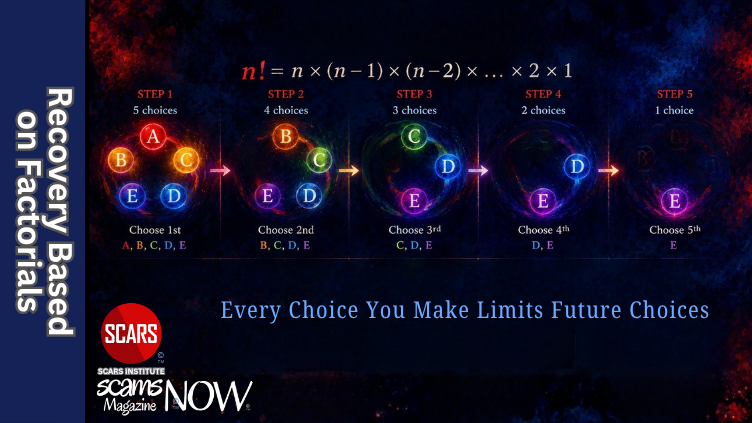
Recovery after a scam does not unfold as one single decision. It unfolds as a sequence of decisions. Each decision changes the next set of choices available. Some choices open healthier paths. Some choices narrow the path. Some choices delay recovery without ending it. Some choices end recovery or eliminate it completely. This is where the mathematical idea of a factorial can help explain the recovery process.
In mathematics, a factorial is written as n! (‘n‘ and an exclamation point). It means that a number of possible items can be arranged in many different orders.
For example:
5! means 5 × 4 × 3 × 2 × 1
The total number of possible arrangements becomes much larger than the number itself.
This idea can be used as a metaphor or a guide for scam victim recovery. At the beginning, each victim/survivor faces many possible choices. That beginning set of choices can be thought of as n. Once the first choice is made, the next set of choices changes. The first decision does not control everything, but it influences what comes next. Then the second decision influences the third. The third influences the fourth. Over time, the recovery path becomes a chain of decisions.
This does not mean recovery is mechanical exactly, though there is a defined process. Human recovery is not exactly a formula. Betrayal trauma affects memory, attention, emotion, trust, judgment, shame, and identity. A victim is not a machine moving through fixed steps. The factorial model is useful because it helps show the idea of how early decisions can multiply in impact.
The Beginning: Too Many Choices at Once
After discovery, the victim often faces an overwhelming number of decisions. Here are just some of them:
- Should the victim report the crime?
- Should the victim tell family?
- Should the victim save evidence?
- Should the victim block the criminals?
- Should the victim contact the bank?
- Should the victim enter support?
- Should the victim hide the truth?
- Should the victim keep searching for the criminals?
- Should the victim believe part of the story was real?
- Should the victim blame themselves?
- Should the victim return to normal life immediately?
This is the first stage of n. There are many choices, but the victim’s nervous system is often least prepared to make them. Shock, fear, shame, grief, and confusion reduce clarity. Each victim feels pressure to act quickly while the mind is still trying to understand what happened. But this is absolutely the wrong thing to do.
The danger is that early choices can become organizing principles or choices. They begin shaping the rest of the recovery.
- A victim who chooses secrecy then faces a narrower set of choices. Secrecy can make it harder to ask for support, harder to report, harder to explain financial loss, and harder to process shame. The first decision does not destroy recovery, but it changes the next available decisions.
- A victim who chooses disclosure also faces difficult choices. The victim needs to manage family reactions, explain the crime, answer painful questions, and tolerate embarrassment. Yet disclosure also opens access to support, accountability, protection, and reality testing.
Each path creates a different next path. This is the factorial structure of recovery. This is also known as causality.
The First Choice Changes the Second Choice …
A factorial begins with the first number, then moves downward. In recovery, the first meaningful decision often reduces or rearranges the next decision set.
- If the first decision is to protect the criminals emotionally, the next decisions move toward denial. The victim rereads messages, defends the criminals, avoids evidence, and resists support.
- If the first decision is to protect the self, the next decisions move toward safety. The victim blocks contact, preserves evidence, notifies financial institutions, and seeks help.
Both paths begin with one choice, but each choice changes the following choices.
This is why early intervention matters. It is not because victims must do everything perfectly. They cannot. The first days and weeks after discovery are often chaotic. Early intervention matters because a few stabilizing choices can help prevent a cascade of harmful choices.
- Blocking the criminals changes the path.
- Saving evidence changes the path.
- Reporting the crime changes the path.
- Entering support changes the path.
- Receiving therapy changes the path.
- Speaking the truth changes the path.
- Resting before making major decisions changes the path.
Each one of these choices reduces exposure to harmful choices and increases access to healthier ones.
The Multiplication of Recovery Consequences
The factorial metaphor is especially useful because it shows how quickly consequences multiply.
One choice rarely stays alone.
- If a victim keeps communicating with the criminals, that choice leads to renewed persuasion, renewed hope, renewed financial requests, renewed emotional confusion, and renewed exposure to manipulation.
- If a victim blocks the criminals, that choice leads to withdrawal symptoms, grief, silence, and distress. Yet it also led to reduced manipulation, improved clarity, and safer recovery.
Neither choice feels easy. Recovery choices are not divided into painless and painful. Many healthy choices hurt at first. Many harmful choices feel comforting at first. This is one reason victims struggle.
The factorial model helps explain this. The value of a decision is not visible immediately. The first result be pain, but the later results are freedom and peace. Another decision gives immediate relief, but later produces deeper harm and trauma.
- A victim who contacts the criminal feels temporary comfort. That comfort then leads to renewed attachment. Renewed attachment leads to more secrecy. More secrecy leads to more financial loss. More loss leads to deeper shame. The original choice multiplies.
- A victim who refuses contact feels severe distress. That distress leads to support. Support leads to reality testing. Reality testing reduces fantasy. Reduced fantasy increases stability. Stability supports recovery. The original choice also multiplies.
This is why recovery must be measured by direction, not by immediate comfort.
Choice Order Matters
In factorials, order matters. The same items arranged in a different order create a different outcome. Recovery also depends on order.
- Some victims try to study every scam tactic before they stabilize emotionally. This seems responsible, but it can increase fear, obsession, and hypervigilance. Learning is useful, but timing matters.
- Some victims try to forgive before they accept what happened. This can become avoidance. Forgiveness language covers pain that has not yet been processed.
- Some victims try to educate others before they have stabilized themselves. This can become overexposure. The victim stays psychologically close to the crime before the nervous system has had time to recover.
- Some victims try to prevent all future scams before they can fully admit the current crime happened. This can create false confidence. The victim believes they are now protected, while still emotionally attached to the last deception.
In recovery, the same actions can have different effects depending on when they occur.
- Education can help after stabilization.
- Advocacy can help after grounding.
- Forgiveness has meaning after truth.
- Prevention training helps make the nervous system safer.
The order matters because recovery is not just about what is chosen. It is also about when it is chosen.
The Narrowing Path of Denial
Denial often functions like a choice that narrows all later choices.
- When a victim denies the crime, the victim delays reporting, if they report at all.
- When reporting is delayed, evidence becomes harder to preserve.
- When evidence is lost, the victim feels more helpless.
- When helplessness grows, shame deepens.
- When shame deepens, secrecy increases.
- When secrecy increases, isolation becomes more likely.
These things cascade. This is not because the victim is weak. It is because one defensive choice can rearrange the next set of choices.
Denial is often an attempt to survive emotional shock. The mind softens reality because the full truth feels unbearable. Yet denial becomes dangerous when it turns into a long-term recovery pattern.
The factorial path of denial can look like this:
- Avoid the truth.
- Avoid the evidence.
- Avoid the report.
- Avoid the conversation.
- Avoid the support group.
- Avoid the grief.
- Avoid the recovery process.
At each point, the path narrows. The victim still has choices, but fewer of them feel accessible. Recovery begins to feel impossible, not because it is impossible, but because many earlier choices have made the next healthy choice feel harder.
The Expanding Path Of Truth
Truth works differently. Truth hurts at first, but it tends to expand later choices.
- When the victim accepts that the event was a crime, reporting becomes more possible.
- When reporting becomes possible, evidence preservation becomes more meaningful.
- When evidence is preserved, the victim feels more grounded and more in control.
- When the victim feels more grounded, support becomes easier to enter.
- When support begins, shame begins to weaken. When shame weakens, recovery becomes more stable.
Can you see how this works? Truth does not remove pain. Truth organizes pain.
This matters because disorganized pain can feel endless. Organized pain can begin to move.
- The victim can name the crime.
- The victim can name the manipulation.
- The victim can name the losses.
- The victim can name the emotional injury.
Naming creates structure. Structure creates choices.
The factorial path of truth can look like this:
- Accept the crime.
- Accept it was the criminal’s fault/
- Preserve evidence.
- Block the criminals.
- Report what happened.
- Tell one safe person.
- Enter support.
- Enter therapy.
- Stabilize the nervous system.
- Begin recovery.
Each choice makes the next healthier choice more reachable. This is the Factorial method.
The Role Of Self-Blame In The Factorial Path
Self-blame is one of the most powerful decision-shaping forces in recovery.
- When a victim believes, “This was my fault,” later choices often become distorted.
- The victim avoids reporting because they feel ashamed.
- The victim avoids support because they expect judgment.
- The victim rejects compassion because they believe punishment is deserved.
- The victim remains vulnerable because shame reduces clear thinking.
Self-blame does not stay inside a single thought. It spreads across the recovery path.
- It affects language.
- It affects reporting.
- It affects help-seeking.
- It affects risk.
- It affects identity.
- It affects recovery.
The factorial model helps show why self-blame must be challenged early. If the victim accepts self-blame as the first organizing belief, many later choices are made under the control of shame.
A more accurate first belief changes the path.
- “This was a crime.”
- “I was manipulated.”
- “My emotions were exploited.”
- “It was not my fault.”
- “I am a survivor.”
- “I need support.”
- “I can learn without blaming myself.”
These statements create different choices. They do not erase responsibility for recovery. They place responsibility for the crime where it belongs, with the criminals, while placing responsibility for healing where it can be used, with the survivor.
Recovery Is Not Unlimited Freedom
The factorial model also corrects a common misunderstanding. Victims believe they can make any recovery choice at any time. In reality, earlier choices can make later choices easier or harder.
- A victim who stays in contact with the criminals does not feel fully free to heal.
- A victim who hides the crime does not feel fully free to receive support.
- A victim who refuses to report feels trapped in secrecy.
- A victim who keeps rereading messages does not feel free from attachment.
- A victim who studies fraud obsessively does not feel free from fear.
These patterns do not mean the victim is doomed. They mean the path has narrowed. Recovery requires stepping backward to make a different foundational choice.
- The victim needs to block contact before healing can deepen.
- The victim needs to tell the truth before shame can lessen.
- The victim needs to stop studying criminals before the nervous system can calm.
- The victim needs to enter support before judgment can soften.
Recovery often requires returning to earlier choice points and choosing again.
Factorials, Revictimization, Retraumatization, and Vulnerability
The factorial model is especially useful in understanding re-scamming.
After a scam, the victim is often more vulnerable than before. The nervous system is injured. Trust in the self is damaged. The mind craves comfort, answers, certainty, or emotional rescue. The victim is also desperate to prove they are not vulnerable anymore.
That combination can be dangerous.
If the first post-scam choice is to seek immediate emotional relief, the next choice involves unsafe contact. If the next choice involves unsafe contact, the victim becomes exposed to another manipulator. If shame prevents disclosure, the new manipulation remains hidden. If it remains hidden, the risk multiplies.
Re-scamming or revictimization often does not happen because the victim learned nothing. It can happen because the victim is still inside the factorial chain of the first crime.
- The victim cannot let go of what happened.
- The victim cannot fully believe what happened.
- The victim wants comfort.
- The victim wants certainty.
- The victim wants a different ending.
This is why recovery must focus first on stabilization. Prevention matters, but prevention is not the first task when the nervous system is still flooded. A person in acute distress is not in the best condition to judge risk clearly. Healing must come before advanced prevention.
The Practical Use Of The Factorial Model
This model can help victims, families, peer supporters, and professionals ask better questions.
- Instead of asking only, “What should the victim do now?” they can ask, “What earlier choice is shaping the current difficulty?”
- Instead of asking, “Why will the victim not move forward?” they can ask, “Which decision point narrowed the path?”
- Instead of asking, “Why is the victim still attached?” they can ask, “What choices continue feeding the attachment?”
- Instead of asking, “Why is recovery stuck?” they can ask, “Which next choice would open the path again?”
These questions reduce blame. They also increase practical clarity.
Recovery can become overwhelming when viewed as one giant process. The factorial model breaks it into choice or decision points. The victim does not have to solve everything at once. The victim must identify the next choice that opens the healthiest next path.
That next choice is simple.
- Stop contact.
- Save evidence.
- Tell one trusted person.
- Attend one support meeting.
- Stop rereading messages.
- Sleep.
- Eat.
- Call the bank.
- File the report.
- Write down the truth.
- Ask for help.
Small choices matter because small choices change the next set of choices.
The Moral Meaning Of Choice
This model must never be used to blame victims. The existence of choices does not mean the victim caused the crime. Criminals caused the crime. The victim’s choices are about recovery, not guilt. They are the consequences of choices made after the scam.
This distinction is essential.
- A victim can make harmful recovery choices without being responsible for the crime.
- A victim can delay reporting without being responsible for the crime.
- A victim can remain attached without being responsible for the crime.
- A victim can feel denial without being responsible for the crime.
The purpose of examining choices or decisions is not to create blame. The purpose is to restore agency.
- Agency means the victim can influence what happens next.
- Agency is not the same as fault.
- Fault belongs to the criminals.
- Agency belongs to recovery.
The Factorial Path Can Be Changed
The most hopeful part of the factorial metaphor is that the path can change. Yes, you can change the past!
Even if early choices narrowed recovery, later choices can reopen it. A victim who stayed silent can still speak. A victim who delayed reporting can still report. A victim who keeps contact can still block. A victim who blames themselves can still learn accurate language. A victim who avoided support can still enter support.
- The chain is powerful, but it is not permanent.
- Recovery is full of new decision points.
- Each new decision can rearrange what comes next.
This means the victim is not trapped forever inside the first choices made after discovery. The path is harder, but it remains changeable.
Review
The factorial model offers a useful way to understand scam victim recovery because it shows how choices multiply and cascade. At the beginning, the victim faces many possible decisions while the mind is often least prepared to make them. Each early decision changes the next set of decisions. Over time, these choices create a path.
Some paths narrow recovery through secrecy, denial, self-blame, continued contact, and avoidance. Other paths expand recovery through truth, support, evidence preservation, reporting, stabilization, and self-compassion. The model does not blame victims. It explains how recovery becomes easier or harder depending on the sequence of choices made after the crime.
This idea also helps families and professionals respond with more patience. A victim who appears stuck not be refusing recovery. They are living inside a narrowed path created by earlier decisions made under shock, shame, fear, or grief. The solution is not judgment. The solution is helping the victim identify the next choice that opens the path again.
- Recovery is not one choice.
- Recovery is a chain of choices.
Each choice matters because each choice changes what becomes possible next.
Conclusion
The factorial model provides a valuable perspective on recovery because it highlights a reality that many victims struggle to recognize during the early stages of healing: recovery is rarely determined by a single decision. Instead, it is shaped by a sequence of interconnected choices, each influencing the choices that follow. What appears to be a small decision today may create consequences that expand or narrow opportunities for recovery weeks, months, or even years later.
Understanding this process helps explain why recovery sometimes feels difficult to restart once it has stalled. A victim who remains connected to the criminals, avoids support, delays reporting, or continues to struggle with self-blame is not necessarily refusing to recover. More often, those earlier choices have narrowed the available paths forward, making healthy decisions feel increasingly difficult to access. The resulting frustration can create the false impression that recovery is impossible when, in reality, the next productive choice has simply become harder to see.
The factorial model also offers an important message of hope. Just as harmful choices can create cascading difficulties, healthy choices can create cascading opportunities for healing. A single decision to tell the truth, preserve evidence, attend a support meeting, enter therapy, block the criminals, or seek professional help can begin opening pathways that previously seemed unavailable. Recovery is not permanently determined by early mistakes, poor decisions, denial, or emotional confusion. Every day presents new decision points capable of changing the direction of the recovery process.
Most importantly, the factorial model separates responsibility for the crime from responsibility for healing. The criminals remain responsible for the deception, manipulation, and exploitation. The survivor remains responsible only for the choices that support recovery moving forward. Understanding this distinction restores agency without creating blame. Recovery becomes less about judging past decisions and more about recognizing that each healthy choice creates new possibilities for the future. In that sense, healing is not a single destination but an ongoing process of choosing the next path that leads toward truth, stability, resilience, and recovery.

Glossary
- Accountability — Accountability refers to the willingness to acknowledge actions, responsibilities, and consequences accurately. Within the recovery process, accountability helps distinguish responsibility for healing from responsibility for the crime itself. Accountability belongs to recovery decisions while fault for the crime remains with the criminals. — Recovery Process
- Advocacy Timing — Advocacy timing refers to the point in recovery when a survivor begins helping others or educating the public about scams. Advocacy undertaken before emotional stabilization can increase overexposure and keep attention focused on the crime. Appropriate timing allows advocacy to support healing rather than interfere with it. — Recovery Process
- Agency — Agency refers to a survivor’s ability to influence future outcomes through present decisions. Agency is not the same as fault and should never be confused with responsibility for the crime. Restoring agency helps survivors regain confidence and direction during recovery. — Identity Recovery
- Avoidance Pattern — Avoidance pattern refers to repeated efforts to evade painful emotions, evidence, conversations, or recovery activities. Avoidance is a process that narrows future choices and limits opportunities for healing. Persistent avoidance often increases isolation, confusion, and emotional distress over time. — Trauma Response
- Causality — Causality refers to the relationship between one event and the events that follow it. The factorial model uses causality to explain how one recovery decision influences later decisions and outcomes. Understanding causality helps survivors recognize how choices create expanding or narrowing pathways. — Cognitive Processing
- Choice Cascade — Choice cascade describes the process through which one decision creates a series of additional consequences and decisions. Recovery rarely depends upon a single action. Cascading effects can either support healing or reinforce emotional difficulties. — Recovery Process
- Choice Chain — Choice chain refers to the sequence of interconnected decisions that shape a survivor’s recovery experience. Each decision influences the next available options and helps determine the direction of healing. — Recovery Process
- Choice Order — Choice order refers to the sequence in which recovery actions occur. The article explains that actions such as education, advocacy, forgiveness, and prevention have different effects depending on when they are undertaken. Proper sequencing helps create greater stability and effectiveness in recovery. — Cognitive Processing
- Choice Point — Choice point refers to a specific moment when a survivor must make a decision that influences future recovery options. Recovery is a series of such decision points rather than a fixed path. Identifying choice points helps simplify an otherwise overwhelming process. — Recovery Process
- Comfort-Seeking Decision — Comfort-seeking decision refers to a choice made primarily to reduce immediate emotional distress. Comforting decisions can create long-term difficulties despite providing temporary relief. Distinguishing comfort from recovery is an important part of healing. — Emotional Regulation
- Consequence Multiplication — Consequence multiplication describes how the effects of one decision expand over time and influence many later outcomes. The factorial metaphor demonstrates that choices rarely remain isolated events. Small decisions can eventually produce significant emotional, practical, and psychological consequences. — Cognitive Processing
- Criminal Contact Continuation — Criminal contact continuation refers to ongoing communication with the criminals after the crime has been discovered. Behavior is a factor that often increases attachment, confusion, manipulation, and vulnerability. Continued contact typically narrows recovery options and delays healing. — Scam Manipulation
- Decision Arrangement — Decision arrangement refers to the way recovery choices can be organized in different sequences, producing different outcomes. Different arrangements of similar choices can lead survivors toward very different recovery experiences. — Cognitive Processing
- Decision Distortion — Decision distortion refers to the alteration of healthy decision-making by factors such as shame, fear, denial, or emotional attachment. The article explains that distorted decisions often arise when survivors attempt to cope with overwhelming emotional pain. These distortions can influence recovery for extended periods. — Trauma Response
- Decision Point Analysis — Decision point analysis refers to examining previous choices to understand current recovery challenges. The article suggests that identifying earlier decisions can help explain present difficulties without creating blame. This approach encourages practical problem-solving and self-awareness. — Cognitive Processing
- Decision Sequence — Decision sequence refers to the order in which recovery-related decisions are made. The article emphasizes that the sequence often matters as much as the decisions themselves. Different sequences can either support stabilization or contribute to ongoing difficulties. — Recovery Process
- Defensive Choice — Defensive choice refers to a decision made primarily to reduce emotional pain or protect against distress. Denial, secrecy, and avoidance are examples of defensive choices. While protective in the short term, these choices can create long-term obstacles to recovery. — Trauma Response
- Denial Cascade — Denial cascade refers to the progressive chain of consequences that emerge when a survivor avoids accepting the reality of the crime. Denial can lead to delayed reporting, evidence loss, increased shame, secrecy, and isolation. Each consequence contributes to further narrowing of recovery options. — Trauma Response
- Denial Pathway — Denial pathway refers to a recovery route characterized by avoidance of truth, evidence, reporting, support, and grief processing. Continued movement along this pathway often increases emotional and practical difficulties. — Trauma Response
- Disclosure Choice — Disclosure choice refers to the decision to tell others about the crime and its effects. Disclosure can be difficult because it involves embarrassment, vulnerability, and uncomfortable conversations. At the same time, disclosure often opens opportunities for support, accountability, and reality testing. — Social Support
- Disclosure Expansion — Disclosure expansion refers to the increased opportunities that emerge after a survivor chooses openness rather than secrecy. Disclosure can create access to support networks, professional assistance, and emotional validation. These opportunities often broaden recovery pathways. — Social Support
- Emotional Attachment Renewal — Emotional attachment renewal refers to the strengthening of attachment feelings through continued interaction with the criminals. Renewed contact often reinforces hope, fantasy, and emotional dependence. This process can significantly delay recovery progress. — Victim Psychology
- Emotional Confusion Loop — Emotional confusion loop refers to a recurring cycle in which continued contact or unresolved attachment increases uncertainty and distress. Confusion often reinforces additional poor decisions. Breaking this loop typically requires truth, support, and separation from the criminals. — Trauma Response
- Evidence Preservation — Evidence preservation refers to the deliberate retention of documents, communications, financial records, and other materials related to the crime. Evidence preservation is an early recovery choice that expands future options. Preserved evidence supports reporting, validation, and practical action. — Criminal Exploitation
- Factorial Metaphor — Factorial metaphor refers to the use of mathematical factorial principles to explain how recovery choices multiply and interact. This metaphor can demonstrate that decisions influence future possibilities. The concept helps survivors visualize recovery as a structured sequence rather than a random process. — Cognitive Processing
- Factorial Method — Factorial method refers to the practical application of factorial thinking to scam victim recovery. It emphasizes how each decision affects the next set of available decisions. The method provides a framework for understanding recovery pathways and consequences. — Recovery Process
- Factorial Path — Factorial path refers to the evolving sequence of choices that shape a survivor’s recovery journey. Each decision rearranges future opportunities and challenges. Different paths can narrow or expand the possibilities available to the survivor. — Recovery Process
- Fantasy Reduction — Fantasy reduction refers to the gradual weakening of unrealistic beliefs, hopes, or interpretations about the criminals and the crime. Reality testing and support often contribute to this process. Reduced fantasy supports greater emotional stability and clarity. — Cognitive Processing
- Financial Loss Amplification — Financial loss amplification refers to the process through which continued involvement with criminals creates additional financial harm. Repeated contact often increases exposure to new requests and further exploitation. This amplification demonstrates the multiplying nature of recovery choices. — Criminal Exploitation
- First Organizing Choice — First organizing choice refers to an early decision that begins shaping the overall direction of recovery. Initial choices often influence many later decisions and opportunities. These choices can either support healing or contribute to ongoing difficulties. — Recovery Process
- Grounded Stability — Grounded stability refers to a state in which a survivor feels emotionally and psychologically anchored in reality. Truth, support, and evidence preservation often contribute to this condition. Greater stability improves judgment and recovery outcomes. — Emotional Regulation
- Healthy Path Expansion — Healthy path expansion refers to the process through which constructive decisions increase future recovery opportunities. Truth, support, therapy, and stabilization can create additional options. Expanded pathways improve flexibility and resilience during recovery. — Recovery Process
- Immediate Relief Decision — Immediate relief decision refers to a choice aimed at reducing emotional discomfort quickly rather than supporting long-term recovery. Such decisions can sometimes lead to renewed attachment or vulnerability. Immediate relief is not always aligned with healing. — Emotional Regulation
- Intervention Timing — Intervention timing refers to the point at which supportive actions, therapies, or recovery measures are introduced. Timing affects outcomes significantly. Early stabilization often creates better conditions for later recovery activities. — Recovery Process
- Isolation Progression — Isolation progression refers to the gradual movement toward social withdrawal that can result from shame, secrecy, and denial. Isolation is part of a narrowing recovery pathway. Increased isolation often reduces access to support and reality testing. — Social Support
- Long-Term Recovery Pattern — Long-term recovery pattern refers to the enduring direction created by repeated choices over time. Patterns emerge from accumulated decisions rather than isolated actions. Understanding patterns helps identify opportunities for positive change. — Recovery Process
- Meaningful Decision Point — A meaningful decision point refers to a choice that significantly influences future recovery opportunities. Such moments as critical because they shape later consequences. Recognizing these points can improve decision-making and recovery planning. — Recovery Process
- Multiplication Effect — Multiplication effect refers to the tendency for recovery consequences to expand beyond the original decision. The factorial model demonstrates how one action can influence many later outcomes. This effect explains why small choices often carry significant importance. — Cognitive Processing
- Narrowed Recovery Path — Narrowed recovery path refers to a recovery trajectory in which available options become increasingly limited. It associates this pattern with secrecy, denial, avoidance, and continued attachment. Narrowing does not eliminate recovery but makes healthy choices harder to access. — Recovery Process
- Organizing Belief — Organizing belief refers to a central assumption that influences multiple recovery decisions. Self-blame is an example of an organizing belief that shapes behavior and perception. Changing an organizing belief can significantly alter recovery direction. — Identity Recovery
- Overexposure Pattern — Overexposure pattern refers to excessive engagement with crime-related information, advocacy, or educational activities before adequate stabilization occurs. Overexposure can keep survivors psychologically connected to the crime. This connection may delay emotional recovery. — Trauma Response
- Reality Testing — Reality testing refers to the process of evaluating beliefs, assumptions, and interpretations against objective evidence and external feedback. Reality testing as a key component of reducing fantasy and strengthening recovery. It supports greater clarity and emotional balance. — Cognitive Processing
- Recovery Direction — Recovery direction refers to the overall movement of healing choices over time. Recovery should be measured by direction rather than immediate comfort. Positive direction often leads to long-term gains despite short-term discomfort. — Recovery Process
- Recovery Sequence — Recovery sequence refers to the ordered progression of actions and decisions that support healing after betrayal trauma. Sequence influences effectiveness because some actions are most helpful after stabilization occurs. Appropriate sequencing strengthens recovery outcomes. — Recovery Process
- Revictimization Vulnerability — Revictimization vulnerability refers to increased susceptibility to future scams or exploitation following an initial scam experience. Emotional injury, unresolved attachment, and a desire for comfort can increase this risk. Stabilization helps reduce vulnerability. — Vulnerability Awareness
- Self-Protective Choice — Self-protective choice refers to a decision made to enhance safety, stability, and recovery. Examples include blocking criminals, preserving evidence, entering support, and seeking therapy. Such choices often expand future recovery opportunities. — Recovery Process
- Stabilization Priority — Stabilization priority refers to the principle that emotional and nervous system stabilization should occur before advanced prevention efforts or extensive scam education. Stabilization is a foundation for effective recovery. Without stabilization, judgment and decision-making may remain impaired. — Trauma Response
- Structure Creation — Structure creation refers to the process of organizing confusing experiences into understandable categories and narratives. Naming the crime, manipulation, and losses helps create structure. Greater structure supports clearer choices and emotional processing. — Cognitive Processing
- Truth Expansion Path — Truth expansion path refers to the sequence of opportunities that emerge when a survivor accepts reality and engages with recovery honestly. Truth can increase support, reduce shame, and strengthen stability. This pathway expands future possibilities. — Recovery Process
- Withdrawal Distress Response — Withdrawal distress response refers to the emotional discomfort that occurs after ending contact with the criminals. Distress can include grief, silence, confusion, and emotional pain. Although difficult, it often precedes greater clarity and recovery. — Trauma Response
Author Biographies
Author Biography
Prof. (Emeritus) Tim McGuinness, Ph.D. DFin is a co-founder, Managing Director, and Chairman of the SCARS Institute (Society of Citizens Against Relationship Scams Inc.), where he serves as an unsalaried volunteer officer dedicated to supporting scam victims and survivors around the world. With over 34 years of experience in scam education and awareness, he is perhaps the longest-serving advocate in the field.
Dr. McGuinness has an extensive background as a business pioneer, having co-founded several technology-driven enterprises, including the former e-commerce giant TigerDirect.com. Beyond his corporate achievements, he is actively engaged with multiple global think tanks where he helps develop forward-looking policy strategies that address the intersection of technology, ethics, and societal well-being. He is also a computer industry pioneer (he was an Assistant Director of Corporate Research Engineering at Atari Inc. in the early 1980s) and invented core technologies still in use today.
His professional identity spans a wide range of disciplines. He is a scientist, strategic analyst, solution architect, advisor, public speaker, published author, roboticist, Navy veteran, and recognized polymath. He holds numerous certifications, including those in cybersecurity from the United States Department of Defense under DITSCAP & DIACAP, continuous process improvement and engineering and quality assurance, trauma-informed care, grief counseling, crisis intervention, and related disciplines that support his work with crime victims.
Dr. McGuinness was instrumental in developing U.S. regulatory standards for medical data privacy called HIPAA and financial industry cybersecurity called GLBA. His professional contributions include authoring more than 1,000 papers and publications in fields ranging from scam victim psychology and neuroscience to cybercrime prevention and behavioral science.
“I have dedicated my career to advancing and communicating the impact of emerging technologies, with a strong focus on both their transformative potential and the risks they create for individuals, businesses, and society. My background combines global experience in business process innovation, strategic technology development, and operational efficiency across diverse industries.”
“Throughout my work, I have engaged with enterprise leaders, governments, and think tanks to address the intersection of technology, business, and global risk. I have served as an advisor and board member for numerous organizations shaping strategy in digital transformation and responsible innovation at scale.”
“In addition to my corporate and advisory roles, I remain deeply committed to addressing the rising human cost of cybercrime. As a global advocate for victim support and scam awareness, I have helped educate millions of individuals, protect vulnerable populations, and guide international collaborations aimed at reducing online fraud and digital exploitation.”
“With a unique combination of technical insight, business acumen, and humanitarian drive, I continue to focus on solutions that not only fuel innovation but also safeguard the people and communities impacted by today’s evolving digital landscape.”
Dr. McGuinness brings a rare depth of knowledge, compassion, and leadership to scam victim advocacy. His ongoing mission is to help victims not only survive their experiences but transform through recovery, education, and empowerment.
-/ 30 /-
What do you think about this?
Please share your thoughts in a comment below!
GLOSSARY SEARCH
TOPIC SEARCH
TABLE OF CONTENTS








CATEGORIES
More ScamsNOW.com Articles