



The Horror – That a Relationship Scam Can Create – 2026

The SCARS Institute Magazine about Scam Victims-Survivors, Scams, Fraud & Cybercrime

- Published: 8/18/26
- Modified: 8/18/26
- Comments: 0
- Read Status:

The Horror – That a Relationship Scam Can Create
Horror is an Emotional State When Reality Becomes Unacceptable or Unrecognizable
Dissonance, Schema Violation, and the Psychological Foundation of Horror
Primary Category: Psychology / Neurology / Recoverology
Authors:
• Tim McGuinness, Ph.D., DFin, MCPO, MAnth – Anthropologist, Scientist, Polymath, Managing Director of the Society of Citizens Against Relationship Scams Inc.
Author Biographies Below
About This Article
Profound horror differs from ordinary fear because it involves a severe conflict between experienced reality and the mental schemas used to understand what should be possible, safe, human, moral, or real. Extreme schema incongruence can produce disbelief, cognitive destabilization, freezing, and difficulty assimilating new information into an existing worldview. Betrayal can intensify this process because a trusted person becomes simultaneously associated with safety and danger. Relationship scams create a particularly powerful form of relational horror when genuine attachment becomes connected to an impersonated or deliberately manufactured identity. Recovery requires more than recognizing the deception. Victims must gradually accommodate the experience by developing more accurate models of trust, attachment, manipulation, personal judgment, human behavior, and risk while preserving the possibility of future safety, meaning, and connection.
Note: This article is intended for informational purposes and does not replace professional medical advice. If you are experiencing distress, please consult a qualified mental health professional.
Keywords
Psychological Dissonance, Schema Incongruence, Profound Horror, Betrayal Trauma, Relationship Scams, Relational Horror, Freeze Response, Shattered Assumptions, Trust Reconstruction, Trauma Recovery

Horror is an Emotional State When Reality Becomes Unacceptable or Unrecognizable
Dissonance, Schema Violation, and the Psychological Foundation of Horror
“True horror is the collapse of safety itself: the moment when what you trusted: your senses, another person, reality’s rules, betrays you. It is dread fused with helplessness, an understanding that something is deeply wrong and cannot be undone. Not fear of danger, but recognition that the ground is gone.”
– Tim McGuinness, Ph.D.
Author’s Note
Profound horror is often treated as little more than intensified fear, but that explanation overlooks the cognitive disruption that occurs when an experience violates deeply held assumptions about reality, humanity, identity, safety, morality, or trust. The relationship between horror, psychological dissonance, schema incongruence, and trauma becomes especially important in relationship scams because victims can discover that a person they experienced as loving and trustworthy was deliberately constructed or impersonated for exploitation. The resulting psychological struggle involves more than accepting the facts of the crime. It requires rebuilding a coherent understanding of relationships, human behavior, personal judgment, and reality that can contain what happened without allowing the betrayal to define everything that follows.
Prof. Emeritus Tim McGuinness, Ph.D.
August, 2026
Introduction
Horror is commonly treated as an extreme form of fear, but fear alone does not adequately explain the experience of profound horror. A person can be terrified by an approaching predator, an armed attacker, a dangerous storm, or a medical emergency while still understanding exactly what is happening. The danger fits within an existing model of reality. The person knows what the threat is, understands why it is dangerous, and can imagine what might happen next.
Profound horror operates differently. It appears when an experience does more than threaten safety. It violates something fundamental in the person’s understanding of reality. The mind encounters an event, object, behavior, or revelation that contradicts what it believes should be possible, human, natural, moral, safe, or real. The resulting emotional experience contains fear or disgust in many cases, but it also contains something deeper: cognitive destabilization.
The person confronts two incompatible realities. Existing knowledge says that something cannot be true, while perception or evidence establishes that it is true. The mind attempts to reconcile the contradiction but cannot readily incorporate the new information without substantially revising the assumptions through which the world has previously made sense.
This places dissonance near the psychological center of profound horror, although ordinary cognitive dissonance is not sufficient to explain it. The more precise concept is profound schema incongruence. A schema is an organized mental framework that helps a person understand people, relationships, morality, bodies, safety, identity, causality, and the surrounding world. Horror emerges when an extreme experience radically violates one of these fundamental schemas and the mind cannot easily assimilate what has occurred.
Psychological research supports this distinction. Pamela Taylor and Yukiko Uchida examined the relationship between horror, awe, and schema incongruence and found that both emotions can emerge from experiences that challenge existing concepts of the world. Horrifying experiences, however, were associated with greater uncertainty and greater difficulty assimilating the experience into existing schemas. Horror was particularly associated with extremity, while awe was more strongly associated with vastness.
The psychological foundation of profound horror can therefore be understood as a collision between reality and the mental structures used to comprehend it. Fear says that something dangerous exists. Horror adds another proposition: what exists should not be possible according to the person’s previous understanding of reality.
Psychological Dissonance Is the Beginning, Not the Whole Process
Cognitive dissonance describes the psychological discomfort produced when beliefs, attitudes, actions, or other cognitions conflict. Leon Festinger’s original theory established that people are strongly motivated to reduce inconsistency because internal contradiction creates psychological tension. People change beliefs, reinterpret information, justify behavior, or modify actions in order to restore greater coherence.
Ordinary life produces cognitive dissonance constantly. A person values health but continues smoking. Someone considers honesty important but tells a lie. An individual believes a friend is reliable but discovers that the friend broke an important promise. These contradictions can create discomfort, disappointment, guilt, embarrassment, anger, or rationalization, but they do not ordinarily create horror.
Profound horror requires dissonance at a more fundamental level. The contradiction does not merely challenge an opinion or expectation. It threatens the framework through which the person interprets what kind of world exists and what kinds of things can happen within it.
The severity of that distinction becomes clearer when contradictions are considered at progressively deeper levels. If a colleague arrives an hour late, an expectation has been violated, but little else requires revision. If a trusted friend tells a serious lie, the person’s understanding of that relationship requires modification. If a respected individual commits an act the observer considered morally unimaginable, the contradiction reaches into assumptions about character and human behavior. If an event demonstrates that reality permits something the observer believed fundamentally impossible, the organizing schema itself becomes unstable.
At that deepest level, the mind cannot restore coherence by changing one expectation. A much larger model has to be reconsidered.
This is where dissonance begins to become horror.
Psychological Dissonance
“Psychological dissonance is the internal tension that arises when a person’s beliefs, expectations, emotions, perceptions, or behaviors conflict with one another. The mind generally seeks coherence, so contradiction creates discomfort and motivates some form of resolution. A person can reduce dissonance by changing a belief, reinterpreting events, justifying behavior, seeking additional information, or rejecting evidence that threatens an established understanding. Mild dissonance is common in everyday life. Severe psychological dissonance can become destabilizing when new information conflicts with deeply held assumptions about identity, relationships, morality, safety, or reality, especially when the contradiction cannot be easily explained or integrated.”
– Tim McGuinness, Ph.D.
The Mind Depends on Models of Reality
Human beings cannot process every experience as entirely new information. The mind depends upon categories, schemas, expectations, prior learning, memories, and assumptions to interpret incoming information quickly. These structures allow a person to understand an enormous amount of experience without consciously reconstructing reality from the beginning every moment.
“When you have eliminated the impossible, whatever remains, however improbable, must be the truth.”
– Arthur Conan Doyle, Sherlock Holmes – The Sign of the Four.
A familiar object is immediately recognized. Facial expressions are rapidly interpreted. A person entering a bank expects one form of behavior, while someone entering a funeral expects another. A child develops expectations about parents. Friends develop assumptions about loyalty. Intimate partners build expectations around affection, reciprocity, vulnerability, honesty, and trust.
These expectations are not superficial conveniences. They form part of the predictive structure through which human beings navigate the world.
Contemporary predictive-processing approaches describe the brain as continuously generating expectations about incoming information and comparing those predictions with actual sensory input. When reality differs from expectation, prediction error helps drive learning. The internal model is adjusted so that future predictions become more accurate.
Most prediction errors create little difficulty because the necessary correction is small. A person expects a coffee cup to be full and discovers that it is empty. Someone expects rain and finds sunshine instead. A familiar store has changed its layout. The model is updated, and normal cognition continues.
Profound horror involves something much larger. The prediction error reaches into assumptions that organize whole areas of reality. Instead of correcting one detail, the mind faces information capable of invalidating the framework that produced the prediction in the first place.
The psychological conflict then becomes substantial. The person’s existing model says that reality operates one way, while experience demonstrates that reality operates another way. The old model cannot explain what has occurred, yet the mind does not immediately possess a replacement model capable of containing the new information.
Horror develops in that gap between the collapse of the old explanation and the construction of a new one.
Schema Incongruence
“Schema incongruence occurs when new information, an experience, or an event conflicts sharply with an existing mental framework used to understand reality. A schema contains expectations about people, relationships, safety, morality, identity, cause and effect, and how the world normally works. When experience contradicts those expectations, the mind attempts to interpret or assimilate the new information. Mild incongruence can be resolved by adjusting expectations. Severe schema incongruence can produce confusion, disbelief, distress, or cognitive destabilization because accepting the new information requires changing deeply held assumptions. In trauma, profound schema incongruence can contribute to disrupted trust, meaning, identity, and worldview.”
– Tim McGuinness, Ph.D.
Horror Is Different From Fear
Fear and horror overlap, but they are not interchangeable emotional experiences. Fear is primarily organized around danger and anticipated harm. A person facing a dangerous animal can experience intense terror without encountering any contradiction in reality. The animal is understood, its danger is understood, and the possible consequences are understood. Nothing about the situation requires a fundamental reorganization of the person’s worldview.
“The oldest and strongest emotion of mankind is fear, and the oldest and strongest kind of fear is fear of the unknown.”
– H. P. Lovecraft
Research comparing horror, fear, and moral disgust reinforces this distinction. Taylor and Uchida found that fear responded particularly strongly to the personal relevance of a threat, while moral disgust was influenced strongly by the presence of a blameworthy agent. Horror was associated especially with extreme or abnormal harm that had actually occurred. Participants experiencing horror also reported greater disbelief, cognitive disruption, and schema incongruence.
Fear therefore communicates that danger exists and demands attention. Disgust communicates that something is physically repellent, contaminating, degrading, or morally offensive. Horror contains another element. It communicates that something has occurred that violates the person’s understanding of what should be possible.
These emotional systems can operate together. A horrifying event can also be frightening and disgusting. The distinction lies in the additional cognitive rupture that accompanies horror.
Research mapping human emotional experience has likewise identified horror as distinguishable from fear and disgust rather than simply treating all three as different intensities of the same emotion. The boundaries among emotions are not rigid, but horror occupies its own recognizable psychological territory.
The defining feature is not simply stronger fear. It is fear, disgust, shock, or distress accompanied by profound incomprehensibility.
Failed Assimilation Turns Incongruence Into Horror
Human cognition constantly assimilates new information. Someone learns that a quiet acquaintance has completed an ultramarathon and revises an assumption about that person’s athletic ability. A traveler encounters an unfamiliar cultural practice and expands an existing understanding of human behavior. A scientist learns of an unusual natural phenomenon and incorporates it into a broader model of the physical world.
Unexpected information does not ordinarily become horrifying because the mind can accommodate it.
Profound horror appears when assimilation fails.
“He who fights with monsters should see to it that he himself does not become a monster. And if you gaze long into an abyss, the abyss also gazes into you.”
– Nietzsche, Beyond Good and Evil
Taylor and Uchida’s comparison of horror and awe is particularly revealing because both emotional experiences involve schema incongruence. Awe can challenge ordinary understanding dramatically. A person can encounter the scale of the universe, the power of nature, an extraordinary human accomplishment, or a vast landscape and feel cognitively overwhelmed. Yet awe generally allows the person’s worldview to expand around the experience.
Horror presents a more destructive form of incongruence. Instead of enlarging the existing model, the experience threatens to invalidate it. The person cannot simply add the new information to what was already believed because the new information contradicts assumptions upon which the old model depends.
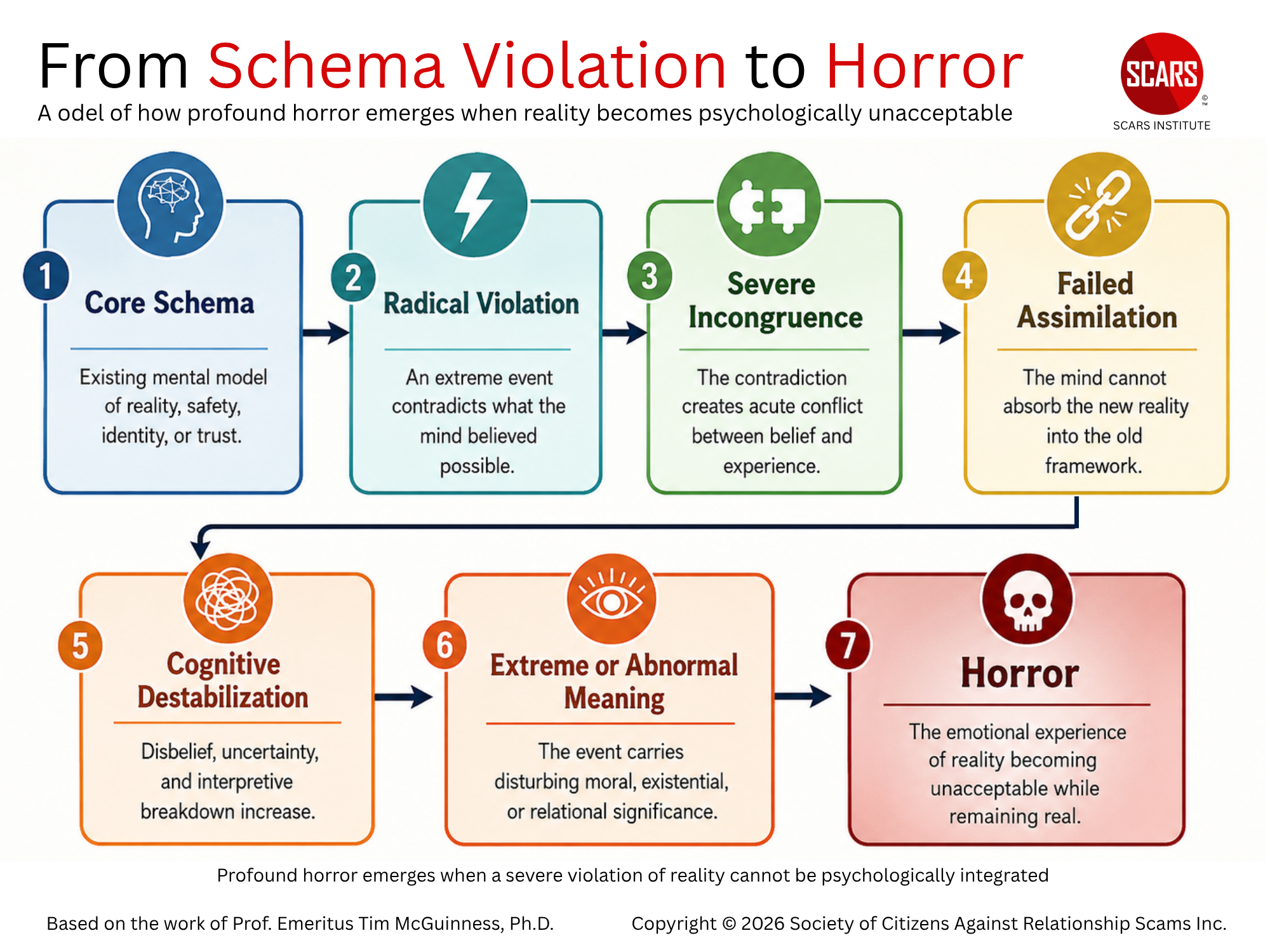
The central process therefore follows a recognizable psychological progression. A core schema establishes expectations about reality. An extreme event radically contradicts those expectations. Severe incongruence develops. The mind attempts to assimilate the new information but cannot do so without revising fundamental assumptions. Uncertainty increases while the old model becomes unstable. When the contradiction also carries extreme harm, abnormality, moral significance, or existential threat, horror emerges.
The mind is no longer merely trying to understand what happened. It is trying to understand what kind of world permits what happened.
Why the Mind Responds With “That Cannot Be True”
Language used during shocking experiences reveals the depth of this cognitive conflict. People confronted with profoundly disturbing information frequently say that something cannot be true, cannot be happening, or could not have been done by another human being. These statements are often treated simply as expressions of surprise, but they can reflect an active collision between evidence and schema.
“Because he knows a frightful fiend / Doth close behind him tread.”
– Coleridge, The Rime of the Ancient Mariner
When a person says that no human being could commit a particular act, the statement is literally contradicted by the fact that a human being has already committed it. Psychologically, however, the statement identifies the actual problem. The behavior lies outside the observer’s established model of humanity.
Accepting the evidence therefore requires more than accepting one unpleasant fact. The observer must alter an assumption about what human beings are capable of doing.
The same mechanism appears when a person insists that a trusted individual could not have committed a betrayal despite overwhelming evidence. The mind is not always rejecting information because it has failed to understand the evidence. It can be resisting the larger consequences of accepting that evidence. If the betrayal is true, then a relationship, a person, and perhaps a whole understanding of trust must be reconstructed.
This helps explain the unusual stillness that can accompany horror. People do not always respond immediately with flight or visible panic. Some stare, freeze, repeat questions, deny what they are seeing, or search desperately for another explanation. The mind is attempting to restore coherence before it possesses a workable interpretation of the situation.
The cognitive refusal contains an important message. Reality has arrived faster than the person’s model of reality can change.
The Uncanny Exploits Category Instability
The uncanny demonstrates a related mechanism on a smaller scale. Something appears familiar while simultaneously behaving in a way that violates the category to which it seems to belong. A face appears almost human but contains subtle abnormalities. A voice resembles natural human speech but does not sound completely alive. A familiar room contains something that does not belong. A person expresses apparently normal emotion while something about the response feels fundamentally wrong.
“The uncanny is that class of the frightening which leads back to what is known of old and long familiar.”
– Sigmund Freud, The Uncanny (1919).
The disturbing effect comes from competing classification signals. The object appears to belong within a familiar category, yet important features contradict the category’s expected properties.
The mind cannot settle comfortably on one interpretation.
- Human or nonhuman.
- Alive or dead.
- Person or imitation.
- Natural or artificial.
- Safe or dangerous.
- Normal or abnormal.
Research concerning the uncanny valley has examined how inconsistencies in human realism can intensify negative responses to artificial figures. No single mechanism explains every uncanny response, but category conflict and inconsistent realism clearly contribute to the phenomenon.
This principle helps explain why ambiguity is so powerful in horror. An unexplained anomaly forces cognition to remain active. The mind repeatedly attempts to classify what it is seeing but cannot obtain a stable resolution.
Explanation often reduces horror because explanation repairs the model. Once the strange figure is clearly identified as a mechanical device, an illness, a hallucination, an animal, or another understandable phenomenon, uncertainty contracts. The object can remain dangerous or repulsive, but part of the horror disappears because cognition finally knows where to place it.
The unexplained preserves the dissonance.
Body Horror Violates the Expected Structure of the Self
Body horror uses the same psychological mechanism by attacking assumptions about bodily order. Its disturbing quality is not explained solely by pain, injury, blood, or death. Conventional injury can produce tremendous fear, grief, empathy, or disgust while still remaining understandable.
“The most merciful thing in the world … is the inability of the human mind to correlate all its contents.”
– H. P. Lovecraft, The Call of Cthulhu.
Body horror violates the categories that define what a body is supposed to be.
Human bodies have recognizable boundaries. Anatomy follows expected patterns. Internal organs remain inside the body. One organism does not normally transform into another. Personal identity is experienced as connected to bodily continuity. The body is experienced as belonging to the self.
Body horror destabilizes these assumptions. A human form changes into something that cannot be classified. Human and nonhuman characteristics merge. Boundaries between inside and outside collapse. The relationship between body and identity becomes uncertain. Biological structures behave in ways that ordinary experience declares impossible.
The observer is therefore confronting more than physical damage. The observer is being shown a body that violates the schema of what a human body is.
This explains why transformation can create a deeper form of horror than destruction. Death is frightening and irreversible, but death remains part of the known biological order. A transformation that makes the observer unable to determine what the person has become attacks the biological model itself.
The horror comes from seeing the impossible presented as real.
Cosmic Horror Violates the Structure of Existence
Cosmic horror extends the same mechanism beyond the human body and directs it toward reality itself. An ordinary monster exists within a recognizable universe. It can attack, kill, destroy, or terrorize people without necessarily changing the observer’s understanding of existence.
Cosmic horror presents a different threat. Its most disturbing revelation is not that a dangerous creature exists but that reality itself is radically different from what humanity believed.
Human beings are not situated within existence as expected. Time does not operate according to familiar assumptions. Consciousness has boundaries that are different from those previously understood. Space contains dimensions or forces that invalidate ordinary perception. Human importance disappears within an incomprehensibly larger order.
The resulting horror is ontological because it destabilizes assumptions about being and reality.
The monster in cosmic horror is therefore often frightening because of what its existence proves. If the entity exists, then the universe cannot be organized the way human beings thought it was. The creature becomes evidence against reality as previously understood.
That produces a deeper cognitive crisis than ordinary danger. An attacker can be escaped or defeated while the worldview remains intact. An ontological contradiction threatens the framework within which ideas such as safety, identity, meaning, and human significance were previously organized.
The person is not merely endangered by something in the universe. The person discovers that the universe itself is no longer understandable according to familiar assumptions.
The Scammer as a Pod-People Monster
In a relationship scam, the offender often does more than invent a fictional identity. The scammer can impersonate a real person by stealing photographs, professional details, family information, social media content, or other pieces of an authentic life. Psychologically, this resembles the pod-person motif found in classic cosmic horror: the familiar human form remains visible, but the person behind it has been replaced by something fundamentally different.
“The boundaries which divide Life from Death are at best shadowy and vague.”
– Edgar Allan Poe, The Premature Burial.
The horror comes from the collapse of identity certainty. The victim believes they are interacting with a recognizable human being who possesses a history, personality, emotions, and intentions consistent with the presented identity. Later, the victim discovers that the visible person was only a shell used by someone else. The face was real, but the relationship attached to it was not.
This creates profound schema incongruence. Familiarity and fraud occupy the same image. Human intimacy becomes detached from authentic identity. The victim is forced to confront the disturbing possibility that a face, voice, biography, and apparent emotional life can all be present while the actual person behind the interaction is entirely different.
Moral Horror Violates the Model of Humanity
Some of the deepest forms of horror contain nothing supernatural. Human behavior alone can produce profound schema violation when it exceeds the observer’s existing model of cruelty, indifference, betrayal, or intentional harm.
“Nothing is so painful to the human mind as a great and sudden change.”
– Mary Shelley, Frankenstein.
People ordinarily understand that human beings can lie, exploit, steal, injure, and kill. These possibilities already exist within most adult models of humanity. Knowledge of wrongdoing alone therefore does not automatically create horror.
Moral horror emerges when actual behavior exceeds the person’s functional understanding of what another human being can deliberately do.
A corrupt official accepting money can provoke anger and disgust because the conduct fits an established schema of corruption. A person deliberately inflicting extreme suffering on someone who trusts and depends upon them reaches into a different psychological territory. The behavior contradicts assumptions about empathy, attachment, restraint, reciprocity, and the limits of human conduct.
Taylor and Uchida’s findings concerning abnormal and extreme harm are particularly relevant to this distinction. Horror was associated not merely with blameworthiness but with the extremity and abnormality of the harm and with the cognitive disruption produced by trying to understand it.
The resulting realization can alter more than an opinion about the offender. The observer has learned something disturbing about humanity itself. Human beings are capable of this.
Once incorporated, that knowledge changes the observer’s model of the species. The horror comes partly from the act and partly from what the act forces the observer to know.
Psychological Trauma Can Contain the Same Cognitive Rupture
The relationship between horror and trauma becomes especially important because many traumatic experiences involve more than fear conditioning or memories of danger. They also violate fundamental assumptions through which people organize their lives.
“I am not what I am.”
– William Shakespeare, Othello.
Shattered Assumptions Theory describes trauma partly as a challenge to deeply held beliefs about personal invulnerability, the meaningfulness of the world, the trustworthiness of others, and the value of the self. Research in this area demonstrates that traumatic events can alter basic assumptions about safety, predictability, fairness, and human behavior.
This helps explain why trauma survivors often ask questions that appear philosophical rather than merely practical. They can repeatedly ask how the event was possible, how another person could have behaved that way, why warning signs were not recognized, whether anyone can be trusted, whether the world is fundamentally unsafe, or whether personal judgment can ever be relied upon again.
These are not simply requests for factual information. They are attempts to rebuild damaged schemas.
The traumatic event has produced information that the previous worldview cannot adequately contain. The mind continues revisiting the experience because the cognitive problem remains unresolved. Memories, emotional reactions, and interpretations repeatedly return to the same contradiction as the person searches for a coherent explanation.
Trauma and horror are not identical. Trauma includes many psychological processes that do not depend upon profound schema violation, and many frightening experiences can produce trauma without generating the specific emotional quality of horror. The connection lies in the shared experience of encountering a reality that overwhelms the person’s previous assumptions about how the world is supposed to work.
When trauma contains that kind of radical incongruence, recovery requires more than learning that immediate danger has ended. The person also has to reconstruct meaning.
Betrayal Produces an Especially Powerful Form of Dissonance
Betrayal creates one of the strongest forms of schema conflict because the same person becomes associated with safety and danger, affection and injury, trust and exploitation. The contradiction strikes directly at relational structures that normally organize attachment and interpersonal security.
“Betrayal is a fundamental dimension of trauma.”
– Melissa G. Platt & Jennifer J. Freyd, Betray My Trust, Shame on Me (2015)
Psychological research on betrayal documents reactions that include shock, grief, anger, self-doubt, preoccupation, damaged self-esteem, and difficulties with trust. Betrayal Trauma Theory further examines the consequences of harm perpetrated by trusted or important others and the ways that attachment relationships can complicate recognition and processing of betrayal.
The cognitive structure of betrayal contains a profound contradiction. A person who represented safety becomes the source of danger. Someone whose affection created emotional security becomes the person responsible for injury. Trust, which normally organizes closeness and cooperation, becomes the mechanism through which harm was made possible.
The victim therefore has to reconcile two representations of the same individual. One representation contains affection, memories, vulnerability, promises, intimacy, and trust. The other contains deception, manipulation, exploitation, concealment, and intentional harm.
The problem cannot always be solved by simply replacing one representation with the other. The earlier emotional experiences occurred and remain encoded in memory. The betrayal also occurred and must be incorporated into the person’s understanding of the relationship.
Recovery requires construction of a model capable of holding both realities without allowing either one to falsify the other.
That process is psychologically demanding because the betrayal does not simply change what the victim thinks about another person. It can alter beliefs about attachment, trust, judgment, intimacy, personal vulnerability, morality, and the reliability of social perception.
Relationship Scams Can Produce Relational Horror
Relationship scams create an unusually severe form of this dissonance because the victim can discover that the relationship was psychologically real for one person while being deliberately manufactured or strategically manipulated by another. The victim’s conversations occurred, emotional responses were genuine, attachment developed through real psychological processes, and expectations for the future became meaningful. The fraudulent nature of the offender’s identity or intentions does not erase those experiences from the victim’s memory.
“False face must hide what the false heart doth know.”
– William Shakespeare, Macbeth.
This produces a difficult cognitive conflict. The relationship felt real because the victim’s emotional experience was real, while the relationship was simultaneously constructed or exploited for criminal purposes. Treating the entire experience as emotionally unreal does not accurately describe what happened inside the victim. Treating the victim’s genuine attachment as evidence that the offender’s intentions were genuine is equally inaccurate.
Recovery therefore requires a model capable of containing both truths. The victim experienced a real attachment to a representation that was manipulated, fabricated, or strategically presented by the offender.
That distinction reaches far beyond ordinary heartbreak. In a conventional relationship ending, both people existed within a broadly shared reality even when one partner lied, cheated, withdrew, or behaved destructively. In a relationship scam, the victim can discover that central elements of the other person’s identity, circumstances, history, intentions, and emotional presentation were intentionally constructed.
The psychological consequences can involve much more than grief over the apparent relationship. The discovery can destabilize confidence in memory, judgment, intimacy, digital communication, personal identity, social trust, and the ability to distinguish sincerity from manipulation.
The horror arises because the victim must confront what the deception demonstrates. Human expressions of affection can be simulated deliberately. Intimacy can be engineered as an instrument of exploitation. Vulnerability can be studied and strategically used. A person can maintain an elaborate emotional performance over months or years while pursuing objectives fundamentally different from those represented to the victim.
These realizations challenge assumptions that ordinarily make relationships psychologically manageable. The victim must eventually develop a more accurate model of how trust works without replacing earlier openness with the equally distorted conclusion that no human relationship can ever be trusted.
Denial Can Function as an Attempt to Preserve Coherence
Scam victims sometimes continue searching for explanations that preserve some portion of the original relationship. The victim can wonder whether the offender genuinely cared despite the deception, whether someone else controlled the offender, whether only part of the identity was false, or whether there is some missing explanation capable of reconciling the loving persona with the criminal behavior.
“Trauma disintegrates individuals’ core assumptions that the world is safe and meaningful, and that the self is worthy.”
– Michelle M. Lilly, Kathryn H. Howell & Sandra Graham-Bermann, describing Shattered World Assumptions Theory.
These responses are commonly described as denial, but denial alone does not explain their psychological function. They also represent attempts to preserve coherence.
Fully accepting the betrayal can require simultaneous revisions to several interconnected schemas. The person once understood the offender as trustworthy, the relationship as reciprocal, the future as shared, personal judgment as reliable, intimate disclosure as safe, and emotional communication as evidence of genuine attachment. Accepting that the relationship was deliberately exploited destabilizes all of these assumptions at once.
Alternative explanations reduce that cognitive burden because they preserve parts of the original model. If the offender really cared, then the entire attachment does not have to be reconstructed. If someone forced the offender to participate, then the loving persona can remain psychologically separate from the criminal behavior. If only part of the story was false, then the mind can preserve a meaningful portion of the relationship.
These explanations can persist even after the available evidence makes them increasingly difficult to sustain because the mind is protecting a larger structure than one belief about the offender.
Understanding this function does not require validating inaccurate explanations. Recovery ultimately depends upon integrating the available evidence into a coherent model. The important distinction is that the victim’s resistance to that integration reflects a struggle to reorganize reality rather than a simple failure to understand obvious facts.
Horror and the Freeze Response
Profound horror can be closely associated with the freeze response because both involve a moment in which ordinary action becomes interrupted. When a threatening or incomprehensible event appears, the nervous system does not always move immediately into fight or flight. Human defensive responses include forms of immobility in which movement is reduced while attention becomes intensely focused on the threat. Researchers distinguish this attentive freezing from tonic immobility, a more extreme involuntary response associated with overwhelming threat and perceived inability to escape.
“The beauty of the dream vanished, and breathless horror and disgust filled my heart.”
– Mary Shelley, Frankenstein.
The connection to horror becomes particularly important when horror is understood as profound schema incongruence. A person confronted with something frightening but comprehensible can often identify the threat and select an action. Profound horror can temporarily interfere with that process because the mind is confronting information that does not fit its existing model of reality. Before deciding what to do, cognition is attempting to determine what is happening, whether it is real, and what the event means. The familiar defensive sequence is therefore complicated by a crisis of interpretation.
This helps explain why people confronted with horrifying discoveries sometimes become motionless, stare, stop speaking, or repeatedly express disbelief rather than immediately taking action. The freeze response can serve an adaptive defensive function by suppressing unnecessary movement while attention and sensory processing become concentrated on the threat. In experimental and clinical research, attentive immobility has been associated with reduced body movement and physiological changes consistent with heightened threat monitoring.
When threat becomes overwhelming and escape appears impossible, the response can progress beyond ordinary freezing toward tonic immobility. Tonic immobility involves involuntary motor inhibition and can include an inability to move or speak despite intense internal activation. A 2023 systematic review and meta-analysis found that peritraumatic tonic immobility was significantly associated with greater PTSD symptom severity and occurred more often in traumatic situations involving interpersonal violence.
The relationship between horror and freezing therefore involves both defensive biology and cognition. Horror can confront the person with extreme threat while simultaneously disrupting the mental framework needed to interpret that threat. The body becomes prepared for survival while the mind struggles to construct an explanation. In profound betrayal, this combination can become especially powerful because the source of perceived safety and the source of danger are suddenly revealed to be the same person.
The person can momentarily become psychologically and physically suspended between incompatible realities. The freeze is not indecision in the ordinary sense. It can represent a defensive system holding action while the mind attempts to comprehend a reality it was not prepared to encounter.
Horror Can Continue After Immediate Danger Ends
Fear frequently decreases when a recognizable threat disappears. Horror can continue after immediate safety has been restored because the cognitive contradiction remains unresolved.
“That one may smile, and smile, and be a villain.”
– William Shakespeare, Hamlet.
A scam victim can block the offender, secure financial accounts, report the crime, change contact information, and understand intellectually that the active scam has ended. The person can nevertheless remain deeply disturbed by what the experience revealed about another human being, about manipulation, about personal vulnerability, and about the nature of trust.
Questions that persist after the practical crisis often reveal the continuing reconstruction process. The victim can struggle to understand how someone could imitate affection convincingly, how intimate conversations could be used strategically, how genuine emotional needs became instruments of exploitation, why the manipulation remained persuasive, and how future relationships can be approached without repeating the experience.
These are meaning questions rather than immediate safety questions.
The mind continues returning to them because the new model remains incomplete. Until the betrayal becomes psychologically comprehensible, reminders of the scam can reactivate not only grief and fear but the original incompatibility between what the victim believed and what the evidence ultimately revealed.
The continuing horror therefore does not necessarily mean that the person still believes the scam is active. It can mean that the meaning of the experience has not yet been integrated into a stable understanding of reality.
Recovery Requires Accommodation Rather Than Erasure
When an extreme experience disproves part of a person’s worldview, recovery cannot consist of restoring every assumption exactly as it existed before the event. Some assumptions were contradicted by reality and require revision.
“What manner of man is this, or what manner of creature is it in the semblance of man?”
– Bram Stoker, Dracula.
The appropriate psychological task is accommodation. The person develops a new framework capable of incorporating the experience without allowing one traumatic event to become the organizing principle for every future expectation.
A victim who once believed that expressions of love reliably indicated trustworthy intentions can develop a more sophisticated understanding that emotional expression requires corroboration through consistency, behavior, verification, time, and evidence. A victim who moves from openness to the conclusion that nobody can be trusted has replaced one overly broad schema with another. Recovery requires a more accurate middle position in which trust is possible but develops progressively.
The same process applies to personal judgment. A scam victim can move from assuming that intuition will always identify deception to believing that personal judgment is completely worthless. Neither position supports healthy functioning. A more adaptive model recognizes that human judgment is fallible, that sophisticated manipulation can defeat normal social perception, and that judgment improves when intuition is combined with verification, external information, deliberate decision-making, and appropriate safeguards.
The worldview after recovery can therefore become more complex than the worldview that existed before victimization. Human beings are capable of genuine compassion and deliberate exploitation. Trust creates necessary human connection while also carrying risk. Emotional attachment can be authentic within the victim even when another person’s presentation is fraudulent. Safety can never be absolute, but risk can be reduced through knowledge and behavior.
This new model contains the betrayal without allowing the betrayal to define all human relationships. That is the difference between integration and permanent distrust.
Why Understanding This Process Matters for Trauma Support
Understanding profound horror as schema disruption changes how certain post-traumatic reactions can be interpreted. A victim who repeatedly says that the experience remains unbelievable can fully understand the factual evidence while still struggling to integrate its meaning. Someone who asks the same questions repeatedly can be testing different explanations against a damaged worldview rather than simply failing to retain information.
“This is horror; but it is not fear.”
– Edward Bulwer-Lytton, The Haunted and the Haunters;
A victim who alternates between accepting the scam and imagining that some part of the relationship was genuine can be moving between competing models of reality. One model contains the relationship as it was experienced. The other contains the relationship as the evidence now reveals it. The psychological task is not merely choosing one and erasing the other. It is constructing an accurate understanding capable of explaining why both representations exist in memory.
Support therefore requires more than repeating the facts of the crime. Facts establish what happened, but recovery also requires an explanation of how it became possible and what it means.
Victims benefit from understanding how grooming operates, how attachment forms, how trust can be manipulated, why deception can remain convincing, how cognitive biases affect everyone, why emotional investment changes decision-making, and why normal human psychological processes can be exploited by skilled offenders. This knowledge helps replace the incomprehensible event with a coherent model of manipulation.
That transition matters because comprehensibility reduces dissonance.
Comprehensibility does not excuse the offender, minimize the crime, erase grief, or make the betrayal acceptable. It gives the mind an accurate framework in which the event can exist.
The experience becomes something terrible that happened within an understandable reality rather than something so incomprehensible that it continually threatens the structure of reality itself.
A Psychological Model of Profound Horror
The relationship between dissonance and horror can be stated with greater precision. Profound horror emerges when an extreme experience radically violates an important schema concerning reality, humanity, morality, identity, bodily order, safety, or attachment. The contradiction produces severe cognitive incongruence. The mind attempts to assimilate the information but cannot do so without revising fundamental assumptions. Uncertainty and cognitive destabilization increase while the experience simultaneously carries extreme harm, abnormality, threat, or existential significance.
“Man is not truly one, but truly two.”
– Robert Louis Stevenson, The Strange Case of Dr. Jekyll and Mr. Hyde.
The process can be represented conceptually as:
Core Schema → Radical Violation → Severe Incongruence → Failed Assimilation → Cognitive Destabilization → Extreme or Abnormal Meaning → Horror
This model explains why dissonance alone does not create horror. Ordinary contradictions lack the magnitude and significance required to destabilize fundamental schemas. It also explains why fear alone is insufficient. A danger can produce extreme fear while remaining completely understandable.
Profound horror requires the additional experience of confronting something that falls outside the boundaries of what the mind previously believed reality could contain.
This model also explains why understanding can gradually reduce horror even when the underlying event remains terrible. Once the mind develops a framework capable of containing what occurred, the event no longer has to rupture the person’s understanding of reality every time it is remembered. Moral judgment can remain intact, grief can continue, anger can remain justified, and consequences can remain permanent while the event becomes psychologically comprehensible.
The mind no longer has to choose between denying reality and abandoning its entire understanding of the world.
It develops a larger model capable of containing both the old reality and the new knowledge produced by the experience.
Conclusion
Dissonance stands near the psychological center of profound horror, but the relevant form is far deeper than ordinary inconsistency between beliefs or actions. Horror develops through radical schema incongruence, especially when an extreme or abnormal experience contradicts a fundamental model of reality and cannot be readily assimilated into existing understanding.
“The mind of man is capable of anything, because everything is in it, all the past as well as all the future.”
– Joseph Conrad, Heart of Darkness.
Fear is principally organized around danger. Disgust is organized around physical, social, or moral repulsion. Horror reaches into comprehension itself because it presents the mind with a reality that contradicts what the person previously believed should be possible.
This framework explains why horror appears across experiences that otherwise seem unrelated. The uncanny destabilizes categories. Body horror violates assumptions about bodily integrity and identity. Cosmic horror attacks assumptions about existence. Moral horror reveals forms of human behavior that exceed the observer’s previous understanding of humanity. Betrayal violates the relational structures that normally connect trust with safety.
Traumatic experiences can contain the same underlying conflict when they overturn assumptions about safety, predictability, morality, relationships, or the self. Relationship scams create an especially powerful example because the victim must reconcile genuine emotional attachment with deliberate deception and exploitation. The memories and emotional responses remain authentic even when the identity or intentions that produced them were fraudulent. Recovery requires a framework capable of incorporating both realities.
The psychological task is therefore larger than accepting that a crime occurred. The victim must gradually reconstruct an understanding of trust, attachment, manipulation, personal judgment, human behavior, and risk that can contain what happened without allowing the betrayal to become the explanation for everything that follows.
Profound horror can be understood as the emotional response produced when reality becomes psychologically unacceptable while remaining undeniably real. The mind cannot continue indefinitely with that contradiction unresolved. It searches for a new structure capable of explaining what has been learned.
Successful recovery does not make the horrifying reality acceptable, excuse what happened, or restore every belief that existed before the experience. It allows the mind to understand the event without being continually destabilized by it. The experience becomes integrated into a larger and more accurate model of reality, one that acknowledges what human beings are capable of while preserving the possibility of safety, trust, meaning, and connection.
The horror loses some of its power when the mind finally has somewhere to put it.

Glossary
- Accommodation — Accommodation is the process of changing an existing mental framework so that new and contradictory information can be incorporated accurately. In trauma recovery, accommodation becomes necessary when an experience has demonstrated that an earlier assumption about safety, trust, relationships, or human behavior was incomplete. Healthy accommodation creates a more complex understanding without allowing one traumatic event to define every future expectation. — Recovery Process
- Alternative Explanations — Alternative explanations are interpretations that preserve part of an earlier understanding when new evidence threatens to overturn it. Scam victims can search for explanations that allow the offender to remain caring, coerced, partially truthful, or different from the criminal revealed by the evidence. These explanations can temporarily reduce psychological conflict because they delay the need to reconstruct several interconnected beliefs at once. — Belief Distortion
- Assimilation — Assimilation is the mental process of incorporating new information into an existing understanding without substantially changing the underlying framework. Ordinary unexpected experiences are often assimilated easily because they require only minor adjustments to expectations. Profoundly horrifying or traumatic information becomes more disruptive when existing schemas cannot absorb it without major revision. — Cognitive Process
- Assimilation Failure — Assimilation failure occurs when new information cannot be incorporated into an existing worldview without contradicting assumptions that support that worldview. The mind can repeatedly revisit the event because no available explanation adequately reconciles what was believed with what actually occurred. In profound horror and betrayal, this unresolved conflict contributes to disbelief, uncertainty, and continuing cognitive disruption. — Cognitive Process
- Attentive Freezing — Attentive freezing is a defensive state in which movement decreases while attention becomes intensely focused on a possible threat. The nervous system can temporarily suppress ordinary action while sensory processing and threat assessment become more concentrated. During horrifying discoveries, attentive freezing can occur while the person attempts to understand an event that does not fit an existing model of reality. — Trauma Response
- Betrayal Based Dissonance — Betrayal based dissonance develops when a trusted person becomes associated simultaneously with safety and harm, affection and exploitation, or intimacy and deception. These conflicting representations are difficult to reconcile because both are connected to genuine memories and emotional experiences. Relationship scams can intensify this conflict when the trusted identity itself was intentionally manufactured or manipulated. — Betrayal Trauma
- Bodily Order — Bodily order refers to the expected organization, boundaries, continuity, and recognizable form of the human body. Body horror becomes disturbing when these expectations are violated through impossible transformation, altered anatomy, or loss of recognizable bodily identity. The reaction demonstrates how strongly human cognition depends upon stable assumptions about what a body is supposed to be. — Human Perception
- Category Conflict — Category conflict occurs when an object, person, or experience displays characteristics belonging to incompatible mental categories. Something can appear human while simultaneously behaving in ways that make the human classification uncertain. Horror frequently exploits this conflict because unresolved categorization prevents the mind from reaching a stable interpretation of what it is encountering. — Cognitive Process
- Category Instability — Category instability occurs when the mind cannot confidently determine which conceptual category contains an experience. The uncertainty can involve distinctions such as human or nonhuman, alive or dead, authentic or artificial, safe or dangerous, and normal or abnormal. Persistent category instability can contribute to the unsettling psychological experience associated with the uncanny and other forms of horror. — Perceptual Process
- Cognitive Destabilization — Cognitive destabilization occurs when new information disrupts the mental structures that ordinarily provide coherence, predictability, and meaning. The person can understand individual facts while struggling to integrate what those facts imply about relationships, morality, identity, safety, or reality. Profound horror involves this deeper disruption rather than merely an increase in ordinary fear. — Cognitive Process
- Cognitive Refusal — Cognitive refusal is the immediate mental resistance expressed when evidence contradicts something the person considers fundamentally impossible or unacceptable. Statements such as believing that something cannot be true can reflect more than surprise because accepting the evidence can require major changes to existing assumptions. In betrayal, this response can temporarily protect an established understanding of another person or relationship from collapse. — Trauma Response
- Coherence — Coherence is the condition in which beliefs, memories, expectations, perceptions, and explanations fit together sufficiently to create an understandable model of reality. Human cognition is strongly motivated to maintain this internal consistency because unresolved contradiction produces psychological tension. Recovery after profound betrayal often requires rebuilding coherence around an explanation that can contain both the original experience and the later evidence. — Recovery Process
- Coherence Restoration — Coherence restoration is the psychological effort to reduce contradiction by developing an explanation that makes conflicting information understandable together. A person can change beliefs, reinterpret events, seek additional information, or revise assumptions in order to restore a stable account of what happened. In recovery, lasting coherence depends upon incorporating the evidence rather than preserving explanations that require continued denial. — Recovery Process
- Competing Models of Reality — Competing models of reality are incompatible explanations that remain active in the mind at the same time. A scam victim can retain one model containing the relationship as it was emotionally experienced and another containing the deception revealed by later evidence. Recovery requires an understanding capable of explaining why both representations exist without treating either the genuine attachment or the criminal deception as unreal. — Reality Testing
- Comprehensibility — Comprehensibility is the degree to which an experience can be understood within an organized and coherent explanation. Increasing comprehensibility does not make betrayal acceptable, excuse the offender, or eliminate grief. It reduces psychological dissonance by giving the mind an accurate framework in which the previously incomprehensible event can exist. — Recovery Insight
- Core Schema — A core schema is a fundamental mental framework that organizes expectations about areas such as relationships, morality, safety, identity, causality, trust, and reality. Core schemas help people interpret experience rapidly and predict what should normally happen. Profound horror can develop when an extreme event contradicts one of these frameworks so severely that ordinary adjustment is no longer sufficient. — Cognitive Framework
- Crisis of Interpretation — A crisis of interpretation occurs when a person cannot immediately determine what a threatening or disturbing experience means. Existing knowledge fails to explain the event, while action is complicated by uncertainty about what is actually happening. During profound horror, the nervous system can be preparing for survival at the same time that cognition is struggling to construct a workable explanation. — Trauma Response
- Dissonance Reduction — Dissonance reduction is the effort to decrease psychological tension created by conflicting beliefs, perceptions, emotions, expectations, or evidence. People can reduce dissonance by revising beliefs, changing behavior, seeking explanations, rationalizing inconsistencies, or rejecting threatening information. In recovery, adaptive dissonance reduction depends upon increasing accuracy rather than preserving a preferred interpretation that conflicts with established evidence. — Cognitive Process
- Existential Significance — Existential significance refers to the degree to which an experience challenges beliefs about existence, meaning, identity, humanity, mortality, or the structure of reality. Events carrying strong existential significance can disrupt far more than immediate expectations because they affect the framework through which life itself is understood. Profound horror frequently contains this dimension when a disturbing discovery changes what the person believes reality permits. — Meaning Reconstruction
- Failed World Model — A failed world model is an internal understanding of reality that can no longer adequately explain important new evidence. The person previously relied upon assumptions about how people, relationships, safety, morality, or reality operate, but an extreme experience contradicts those assumptions. Recovery requires revising the model rather than repeatedly forcing the new information into a framework that no longer fits. — Cognitive Framework
- Fear of the Unknown — Fear of the unknown is distress produced by uncertainty about something whose nature, intentions, consequences, or boundaries cannot be adequately predicted. Horror can intensify this fear when the unknown also contradicts familiar categories or expectations. The inability to classify or explain the experience leaves the mind without the predictive certainty normally used to guide behavior. — Threat Response
- Freeze Response — The freeze response is a defensive reaction in which ordinary movement and action become temporarily inhibited while attention concentrates on a threat. It can occur when the nervous system detects danger before the person has determined the most appropriate response. During profound horror, freezing can coincide with schema disruption because the body is responding defensively while the mind struggles to understand what it is confronting. — Trauma Response
- Genuine Attachment to a Fraudulent Representation — Genuine attachment to a fraudulent representation occurs when a victim develops authentic emotional attachment to an identity, persona, or relationship deliberately constructed or manipulated by an offender. The victim’s attachment remains psychologically real even when the offender’s identity or intentions were fraudulent. Recovery requires understanding this distinction so genuine emotional experience is not incorrectly treated as evidence that the offender’s relationship was genuine. — Attachment Trauma
- Global Model Failure — Global model failure occurs when contradictory information threatens a broad mental framework rather than correcting one limited expectation. The new information can force revisions across trust, identity, morality, safety, relationships, and assumptions about human behavior simultaneously. This scale of disruption helps distinguish profound horror from ordinary surprise or everyday cognitive inconsistency. — Cognitive Process
- Horror — Horror is an emotional state associated with extreme or abnormal experiences that violate fundamental expectations about what should be possible, human, moral, natural, safe, or real. It commonly includes fear, disgust, shock, disbelief, and cognitive disruption, but it is not simply stronger fear. Profound horror develops when the mind cannot readily assimilate the disturbing reality into its existing understanding of the world. — Emotional Response
- Identity Certainty — Identity certainty is confidence that the person being perceived or communicated with is genuinely the individual represented by the available face, voice, biography, history, and behavior. Relationship scams can destroy this certainty when a victim discovers that authentic photographs or personal details belonged to someone other than the person conducting the relationship. The discovery can destabilize broader assumptions about how identity is recognized and verified. — Reality Testing
- Incompatible Realities — Incompatible realities are two apparently contradictory understandings that both contain psychologically important information. A relationship scam victim can know that the emotional attachment was genuine while also knowing that the offender’s identity or intentions were fraudulent. Recovery requires integrating these realities into a larger explanation rather than trying to make one truth erase the other. — Meaning Reconstruction
- Inconsistent Realism — Inconsistent realism occurs when something appears convincingly familiar in some respects while other characteristics violate what would normally be expected from that category. Research concerning the uncanny valley has examined how this inconsistency contributes to discomfort toward highly humanlike artificial figures. Similar perceptual conflict helps explain why something that is almost normal can sometimes feel more disturbing than something clearly unfamiliar. — Perceptual Process
- Meaning Questions — Meaning questions are attempts to understand the broader significance of a traumatic or horrifying experience rather than simply establishing the factual sequence of events. A victim can ask how another person could behave that way, how manipulation remained convincing, or what trust should mean afterward. These questions indicate that the mind is trying to reconstruct an explanatory framework after earlier assumptions have been disrupted. — Meaning Reconstruction
- Model Reconstruction — Model reconstruction is the process of developing a revised understanding of reality after an important existing framework has been contradicted by experience. The new model must account for what happened without turning the traumatic event into a universal prediction about everything that can happen in the future. In scam recovery, reconstruction can involve new understandings of trust, attachment, manipulation, judgment, risk, and human behavior. — Recovery Process
- Moral Horror — Moral horror is the emotional response produced when human behavior exceeds the observer’s existing understanding of cruelty, betrayal, indifference, or deliberate harm. The disturbing act does more than violate a moral rule because it forces the observer to revise beliefs about what human beings are capable of doing. Moral horror therefore combines ethical violation with profound schema disruption. — Moral Emotion
- Ontological Contradiction — Ontological contradiction occurs when an experience appears incompatible with established assumptions about the nature or structure of reality. Cosmic horror uses this mechanism by presenting beings, forces, dimensions, or conditions that invalidate the observer’s previous understanding of existence. The resulting distress reaches beyond physical danger because the framework used to define reality itself becomes unstable. — Existential Psychology
- Ontological Horror — Ontological horror is horror produced by a perceived breakdown in assumptions about existence, reality, consciousness, time, identity, or the structure of the universe. The threatening element becomes disturbing partly because its existence demonstrates that reality is fundamentally different from what the observer believed. This form of horror therefore attacks the framework within which ordinary concepts of safety and meaning were previously organized. — Existential Emotion
- Pod Person Analogy — The pod person analogy compares relationship scam impersonation with classic horror stories in which a familiar human appearance conceals a fundamentally different being. A scammer can use a real person’s photographs, biography, professional details, or social presence while presenting emotions and intentions belonging to the offender. The resulting discovery can create horror because familiarity and fraud occupy the same identity representation. — Recovery Insight
- Prediction Error — Prediction error is the difference between what the mind expects to encounter and what incoming information actually reveals. Small prediction errors are usually resolved by updating a limited expectation. Profound horror can involve prediction errors so significant that they challenge the larger framework responsible for generating the original expectation. — Neurological Process
- Predictive Structure — Predictive structure refers to the system of expectations, prior learning, categories, memories, and assumptions through which people anticipate what is likely to happen. Human beings use this structure to navigate ordinary situations without consciously analyzing every possibility. Severe betrayal can disrupt predictive structure by demonstrating that familiar signs of affection, identity, trust, or safety can be deliberately manipulated. — Cognitive Framework
- Profound Horror — Profound horror is a form of horror in which an extreme experience destabilizes fundamental assumptions about reality, humanity, identity, morality, safety, attachment, or bodily order. The experience cannot be understood simply as a recognizable danger because it also appears incompatible with what the person believed should be possible. The resulting state combines emotional distress with severe cognitive incongruence and difficulty assimilating the new reality. — Emotional Response
- Psychological Dissonance — Psychological dissonance is the internal tension produced when beliefs, expectations, emotions, perceptions, or behaviors conflict with one another. The mind seeks coherence, so contradiction encourages attempts to reinterpret information, change beliefs, justify behavior, seek additional evidence, or reject threatening conclusions. Severe psychological dissonance can become destabilizing when the conflict reaches deeply held assumptions about identity, morality, relationships, safety, or reality. — Cognitive Process
- Radical Contradiction — Radical contradiction occurs when new evidence conflicts not merely with an expectation but with a fundamental assumption used to organize reality. The resulting conflict can require broad changes to beliefs about human behavior, morality, safety, trust, identity, or relationships. Radical contradiction forms an important stage in the psychological progression from schema violation toward profound horror. — Cognitive Process
- Relational Horror — Relational horror is profound horror arising from discoveries that destabilize fundamental assumptions about intimacy, trust, authenticity, attachment, and another person’s identity or intentions. Relationship scams can create this experience when genuine attachment becomes connected to deliberate impersonation, manipulation, and exploitation. The victim must reconstruct a relational reality in which emotionally meaningful experiences and criminal deception can both be acknowledged accurately. — Betrayal Trauma
- Reality Reconstruction — Reality reconstruction is the recovery process through which a person develops an updated and coherent understanding after an experience has invalidated important assumptions. It involves incorporating established facts, understanding how the event became possible, and revising expectations without adopting equally inaccurate global conclusions. For scam victims, this can include rebuilding concepts of trust, identity, judgment, relationships, risk, and human motivation. — Recovery Process
- Reality Violation — Reality violation occurs when an event appears to contradict a person’s established understanding of what reality permits. The experience can involve human behavior, bodily form, identity, morality, attachment, or the structure of existence itself. When the violation is extreme and cannot be readily assimilated, the resulting cognitive disruption can contribute to profound horror. — Cognitive Process
- Relational Schema — A relational schema is a mental framework containing expectations about how relationships normally function, including trust, reciprocity, honesty, affection, vulnerability, loyalty, and safety. These schemas guide interpretation of another person’s behavior and help determine whether interactions appear normal or concerning. Betrayal can destabilize the schema when the same behaviors previously interpreted as evidence of care are revealed to have been instruments of exploitation. — Attachment Process
- Schema — A schema is an organized mental framework used to interpret people, experiences, relationships, categories, and events. Schemas allow the mind to process information efficiently by connecting new experiences with established expectations about how the world normally works. Trauma can force significant schema revision when an experience contradicts assumptions that previously provided stability and predictability. — Cognitive Framework
- Schema Disruption — Schema disruption occurs when an experience damages or destabilizes a mental framework that previously organized expectations about reality. The person can continue understanding individual facts while losing confidence in the larger assumptions connecting those facts together. Trauma support can address this disruption by helping the victim build a more accurate and sustainable framework for understanding what happened. — Trauma Response
- Schema Incongruence — Schema incongruence occurs when an experience or new information conflicts sharply with an existing mental framework used to understand reality. Mild incongruence can be resolved through ordinary learning, while severe incongruence requires modification of deeper assumptions. In trauma and profound horror, intense schema incongruence can disrupt trust, meaning, identity, safety, and the person’s broader worldview. — Cognitive Process
- Schema Preservation — Schema preservation is the effort to maintain an existing mental framework when new evidence threatens to overturn it. A scam victim can preserve parts of the earlier relationship model by imagining explanations that separate the caring persona from the offender’s criminal behavior. This response reduces immediate cognitive disruption but can interfere with integration when preservation depends upon explanations contradicted by established evidence. — Belief Distortion
- Shattered Assumptions Theory — Shattered Assumptions Theory describes how traumatic experiences can disrupt deeply held beliefs about safety, meaningfulness, fairness, personal worth, and the trustworthiness of other people. The framework helps explain why some trauma survivors struggle with questions extending far beyond the immediate event. Recovery requires rebuilding assumptions that incorporate what happened without making the traumatic experience the governing rule for all future expectations. — Trauma Theory
- Threat Monitoring — Threat monitoring is the heightened attention directed toward detecting, identifying, and interpreting possible danger. During freezing, unnecessary movement can decrease while perception becomes more concentrated on the threatening situation. Following betrayal, persistent threat monitoring can also influence how future social interactions, communications, identities, and expressions of trust are interpreted. — Trauma Response
- Tonic Immobility — Tonic immobility is an involuntary defensive state involving profound motor inhibition during overwhelming threat, particularly when escape appears impossible. A person can experience intense internal activation while being unable to move or speak normally. It differs from ordinary attentive freezing and has been associated in trauma research with greater posttraumatic symptom severity. — Physiological Response
- Uncanny — The uncanny is an unsettling experience created when something familiar simultaneously contains qualities that make it feel unfamiliar, unnatural, or wrong. The mind recognizes enough familiar characteristics to activate an established category but encounters conflicting information that prevents stable classification. This tension helps explain why almost human appearances or apparently normal behavior containing subtle abnormalities can become deeply disturbing. — Perceptual Process
- Unresolved Contradiction — Unresolved contradiction occurs when incompatible information remains psychologically active because the mind has not yet developed an explanation capable of integrating it. Repeated questioning, disbelief, rumination, or movement between different interpretations can follow while the contradiction remains unsettled. Scam recovery often requires resolving contradictions between genuine attachment and fraudulent identity without denying either the victim’s experience or the offender’s deception. — Recovery Process
- Worldview Reconstruction — Worldview reconstruction is the process of revising broad assumptions about people, relationships, safety, morality, trust, identity, and reality after those assumptions have been disrupted by trauma. Effective reconstruction does not require returning to the exact beliefs held before victimization. It produces a more accurate worldview capable of acknowledging genuine danger and human exploitation while preserving realistic possibilities for trust, meaning, connection, and safety. — Recovery Process
Reference & Sources
- Taylor, Pamela Marie, and Yukiko Uchida. “Awe or Horror: Differentiating Two Emotional Responses to Schema Incongruence.” Cognition and Emotion, 2019.
Supports the central argument that horror can arise from schema incongruence and is associated with greater uncertainty and difficulty assimilating extreme experiences.
https://doi.org/10.1080/02699931.2019.1578194
https://pubmed.ncbi.nlm.nih.gov/30727825/ - Taylor, Pamela Marie, and Yukiko Uchida. “Horror, Fear, and Moral Disgust Are Differentially Elicited by Different Types of Harm.” Emotion, 2022.
Supports the distinction between horror, fear, and moral disgust, including the association of horror with extreme or abnormal harm, disbelief, cognitive disruption, and schema incongruence.
https://pubmed.ncbi.nlm.nih.gov/35073109/ - Cowen, Alan S., and Dacher Keltner. “Self-Report Captures 27 Distinct Categories of Emotion Bridged by Continuous Gradients.” Proceedings of the National Academy of Sciences, 2017.
Supports treating horror as a distinguishable emotional experience rather than merely another name for fear or disgust.
https://doi.org/10.1073/pnas.1702247114
https://pubmed.ncbi.nlm.nih.gov/28874542/ - Festinger, Leon, and James M. Carlsmith. “Cognitive Consequences of Forced Compliance.” Journal of Abnormal and Social Psychology, 1959.
Provides foundational experimental evidence for cognitive dissonance and the human tendency to reduce inconsistencies among beliefs, attitudes, and behavior.
https://doi.org/10.1037/h0041593
https://pubmed.ncbi.nlm.nih.gov/13640824/ - Jordan, Richard. “The Locus Coeruleus as a Global Model Failure System.” Trends in Neurosciences, 2024.
Supports the discussion of predictive processing, prediction error, and situations in which strongly violated expectations can constitute broader failures of an internal model rather than minor prediction errors.
https://doi.org/10.1016/j.tins.2023.11.006
https://pubmed.ncbi.nlm.nih.gov/38102059/ - Park, Crystal L., Mary Alice Mills, and Donald Edmondson. “PTSD as Meaning Violation: Testing a Cognitive Worldview Perspective.” Psychological Trauma: Theory, Research, Practice, and Policy, 2012.
Supports the argument that traumatic experiences can conflict with global beliefs and goals and that violations of meaning are associated with posttraumatic symptoms.
https://doi.org/10.1037/a0018792
https://pubmed.ncbi.nlm.nih.gov/24860641/
https://pmc.ncbi.nlm.nih.gov/articles/PMC4029350/ - Edmondson, Donald, Stephenie R. Chaudoir, Mary Alice Mills, Crystal L. Park, Julie Holub, and Jennifer M. Bartkowiak. “From Shattered Assumptions to Weakened Worldviews: Trauma Symptoms Signal Anxiety Buffer Disruption.” Journal of Loss and Trauma, 2011.
Supports worldview-based models in which traumatic experiences become psychologically disruptive when they cannot be readily assimilated into previously held understandings of the world.
https://pubmed.ncbi.nlm.nih.gov/24077677/ - Schuler, Eric R., and Adriel Boals. “Shattering World Assumptions: A Prospective View of the Impact of Adverse Events on World Assumptions.” Psychological Trauma: Theory, Research, Practice, and Policy, 2016.
Provides prospective evidence that adverse events can alter fundamental assumptions about the world, supporting the discussion of trauma-related schema and worldview disruption.
https://doi.org/10.1037/tra0000073
https://pubmed.ncbi.nlm.nih.gov/26214070/ - Platt, Melissa G., and Jennifer J. Freyd. “Betray My Trust, Shame on Me: Shame, Dissociation, Fear, and Betrayal Trauma.” Psychological Trauma: Theory, Research, Practice, and Policy, 2015.
Supports the treatment of betrayal as an important dimension of trauma and demonstrates relationships among high-betrayal trauma, shame, dissociation, and responses to interpersonal threat.
https://doi.org/10.1037/tra0000022
https://pubmed.ncbi.nlm.nih.gov/25793317/ - Gagnon, Kerry L., Michelle Seulki Lee, and Anne P. DePrince. “Victim-Perpetrator Dynamics Through the Lens of Betrayal Trauma Theory.” Journal of Trauma & Dissociation, 2017.
Supports the relationship among interpersonal betrayal, post-trauma appraisals, shame, expectations of future harm, cognitive effects, and difficulties arising when trauma is perpetrated by someone close to the victim.
https://doi.org/10.1080/15299732.2017.1295421
https://pubmed.ncbi.nlm.nih.gov/28300483/ - Hagenaars, Muriel A., Karin Roelofs, and John F. Stins. “Human Freezing in Response to Affective Films.” Anxiety, Stress & Coping, 2014.
Provides experimental evidence that emotionally threatening stimuli can produce measurable freezing responses in humans, supporting the discussion of reduced movement during intense emotional threat.
https://doi.org/10.1080/10615806.2013.809420
https://pubmed.ncbi.nlm.nih.gov/23805855/ - Hagenaars, Muriel A., Melly Oitzl, and Karin Roelofs. “Updating Freeze: Aligning Animal and Human Research.” Neuroscience & Biobehavioral Reviews, 2014.
Reviews freezing as part of the defensive response system and helps distinguish attentive freezing from other defensive reactions.
https://doi.org/10.1016/j.neubiorev.2014.07.021
https://pubmed.ncbi.nlm.nih.gov/25108035/ - Coimbra, Bruno Messina, Chris Maria Hoeboer, Mirjam van Zuiden, et al. “The Relationship Between Tonic Immobility and the Development, Severity, and Course of Posttraumatic Stress Disorder: Systematic and Meta-Analytic Literature Review.” Journal of Anxiety Disorders, 2023.
Supports the distinction between ordinary freezing and tonic immobility. The meta-analysis found a significant association between peritraumatic tonic immobility and PTSD symptom severity and found stronger associations with interpersonal violence.
https://doi.org/10.1016/j.janxdis.2023.102730
https://pubmed.ncbi.nlm.nih.gov/37229971/ - Coluccia, Anna, Andrea Pozza, Fabio Ferretti, Fulvio Carabellese, Alessandra Masti, and Giacomo Gualtieri. “Online Romance Scams: Relational Dynamics and Psychological Characteristics of the Victims and Scammers. A Scoping Review.” Clinical Practice & Epidemiology in Mental Health, 2020.
Supports the relationship-scam discussion, including the development of deep emotional bonds through fictitious identities and the combined emotional impact of losing both money and a psychologically meaningful relationship.
https://doi.org/10.2174/1745017902016010024
https://pubmed.ncbi.nlm.nih.gov/32508967/
https://pmc.ncbi.nlm.nih.gov/articles/PMC7254823/ - Bai, Jie, Mei-Hsin Ho, Hsiang-Te Sung, Chuan-Sheng Hung, and Jui-Hsiu Tsai. “Mental Health and Psychosocial Sequelae of Fraud Victimization: A Systematic Review.” Frontiers in Psychology, 2026.
Provides the strongest current broad review supporting the psychological consequences of fraud victimization. It identifies anxiety, depression, distress, shame, self-blame, deterioration of trust, and reduced quality of life, and reports that psychological harm can persist after financial losses are resolved and can be strongly associated with emotional manipulation and perceived betrayal.
https://doi.org/10.3389/fpsyg.2026.1805536
https://pubmed.ncbi.nlm.nih.gov/42137076/
Author Biographies
Author Biography
Prof. (Emeritus) Tim McGuinness, Ph.D. DFin is a co-founder, Managing Director, and Chairman of the SCARS Institute (Society of Citizens Against Relationship Scams Inc.), where he serves as an unsalaried volunteer officer dedicated to supporting scam victims and survivors around the world. With over 34 years of experience in scam education and awareness, he is perhaps the longest-serving advocate in the field.
Dr. McGuinness has an extensive background as a business pioneer, having co-founded several technology-driven enterprises, including the former e-commerce giant TigerDirect.com. Beyond his corporate achievements, he is actively engaged with multiple global think tanks where he helps develop forward-looking policy strategies that address the intersection of technology, ethics, and societal well-being. He is also a computer industry pioneer (he was an Assistant Director of Corporate Research Engineering at Atari Inc. in the early 1980s) and invented core technologies still in use today.
His professional identity spans a wide range of disciplines. He is a scientist, strategic analyst, solution architect, advisor, public speaker, published author, roboticist, Navy veteran, and recognized polymath. He holds numerous certifications, including those in cybersecurity from the United States Department of Defense under DITSCAP & DIACAP, continuous process improvement and engineering and quality assurance, trauma-informed care, grief counseling, crisis intervention, and related disciplines that support his work with crime victims.
Dr. McGuinness was instrumental in developing U.S. regulatory standards for medical data privacy called HIPAA and financial industry cybersecurity called GLBA. His professional contributions include authoring more than 1,000 papers and publications in fields ranging from scam victim psychology and neuroscience to cybercrime prevention and behavioral science.
“I have dedicated my career to advancing and communicating the impact of emerging technologies, with a strong focus on both their transformative potential and the risks they create for individuals, businesses, and society. My background combines global experience in business process innovation, strategic technology development, and operational efficiency across diverse industries.”
“Throughout my work, I have engaged with enterprise leaders, governments, and think tanks to address the intersection of technology, business, and global risk. I have served as an advisor and board member for numerous organizations shaping strategy in digital transformation and responsible innovation at scale.”
“In addition to my corporate and advisory roles, I remain deeply committed to addressing the rising human cost of cybercrime. As a global advocate for victim support and scam awareness, I have helped educate millions of individuals, protect vulnerable populations, and guide international collaborations aimed at reducing online fraud and digital exploitation.”
“With a unique combination of technical insight, business acumen, and humanitarian drive, I continue to focus on solutions that not only fuel innovation but also safeguard the people and communities impacted by today’s evolving digital landscape.”
Dr. McGuinness brings a rare depth of knowledge, compassion, and leadership to scam victim advocacy. His ongoing mission is to help victims not only survive their experiences but transform through recovery, education, and empowerment.
-/ 30 /-
What do you think about this?
Please share your thoughts in a comment below!
GLOSSARY SEARCH
TOPIC SEARCH
TABLE OF CONTENTS








CATEGORIES
More ScamsNOW.com Articles