



You Are Just A Story Your Brain Cells Keep Making Up – 2026

The SCARS Institute Magazine about Scam Victims-Survivors, Scams, Fraud & Cybercrime

- Published: 8/16/26
- Modified: 8/16/26
- Comments: 0
- Read Status:

You Are Just A Story Your Brain Cells Keep Making Up
Is There Really A You There After All?
Primary Category: Neurology / Psychology / Philosophy / Recoverology
Authors:
• Tim McGuinness, Ph.D., DFin, MCPO, MAnth – Anthropologist, Scientist, Polymath, Managing Director of the Society of Citizens Against Relationship Scams Inc.
Author Biographies Below
About This Article
Human identity emerges from the coordinated activity of trillions of cells, billions of neurons, bodily signals, memories, emotions, and continuously changing biological systems. No individual cell contains the complete self, and consciousness appears to arise through distributed neural and bodily processes rather than from a single internal location. Trauma can alter many of the systems involved in constructing the sense of self, including memory, attention, threat detection, autonomic regulation, and emotional processing. This can leave survivors feeling unfamiliar to themselves after victimization. Recovery depends on neuroplasticity, repeated experience, new learning, safer relationships, restored routines, and gradual changes in prediction and behavior. The goal is not to recreate a previous identity, but to help the biological and psychological system build a larger life beyond trauma.
Note: This article is intended for informational purposes and does not replace professional medical advice. If you are experiencing distress, please consult a qualified mental health professional.
Keywords
Consciousness, Emergence, Neuroplasticity, Trauma Recovery, Nervous System, Interoception, Identity, Memory, Biological Adaptation, Sense Of Self

You Are the Rumor Your Cells Keep Telling – Is There Really A You There After All?
Author’s Note
Human consciousness remains one of the great unresolved questions of biology and neuroscience, yet enough is understood to challenge the familiar idea that a fixed self simply resides somewhere inside the brain. Identity depends on ongoing relationships among neural activity, bodily regulation, memory, perception, emotion, experience, and the surrounding social world. That perspective becomes especially important in trauma recovery. When survivors say that they no longer feel like themselves, they are often describing genuine changes in how their biological and psychological systems are functioning. Understanding the self as adaptive rather than fixed creates a different way to understand recovery. The person does not need to return to an untouched earlier version of life. The task is to continue learning, adapting, integrating, and living until the trauma becomes one part of a much larger human experience.
Prof. Emeritus Tim McGuinness, Ph.D.
August, 2026
The Strange Biology of Being You
You think you live inside your body because almost everything about ordinary experience encourages that conclusion. You look through your eyes, speak through your mouth, move your hands, remember your history, and experience a continuous private voice that seems to occupy some invisible command center behind your face. Somewhere inside all of this flesh, you intuitively assume, there must be a definite thing called you.
Biology presents a considerably stranger possibility.
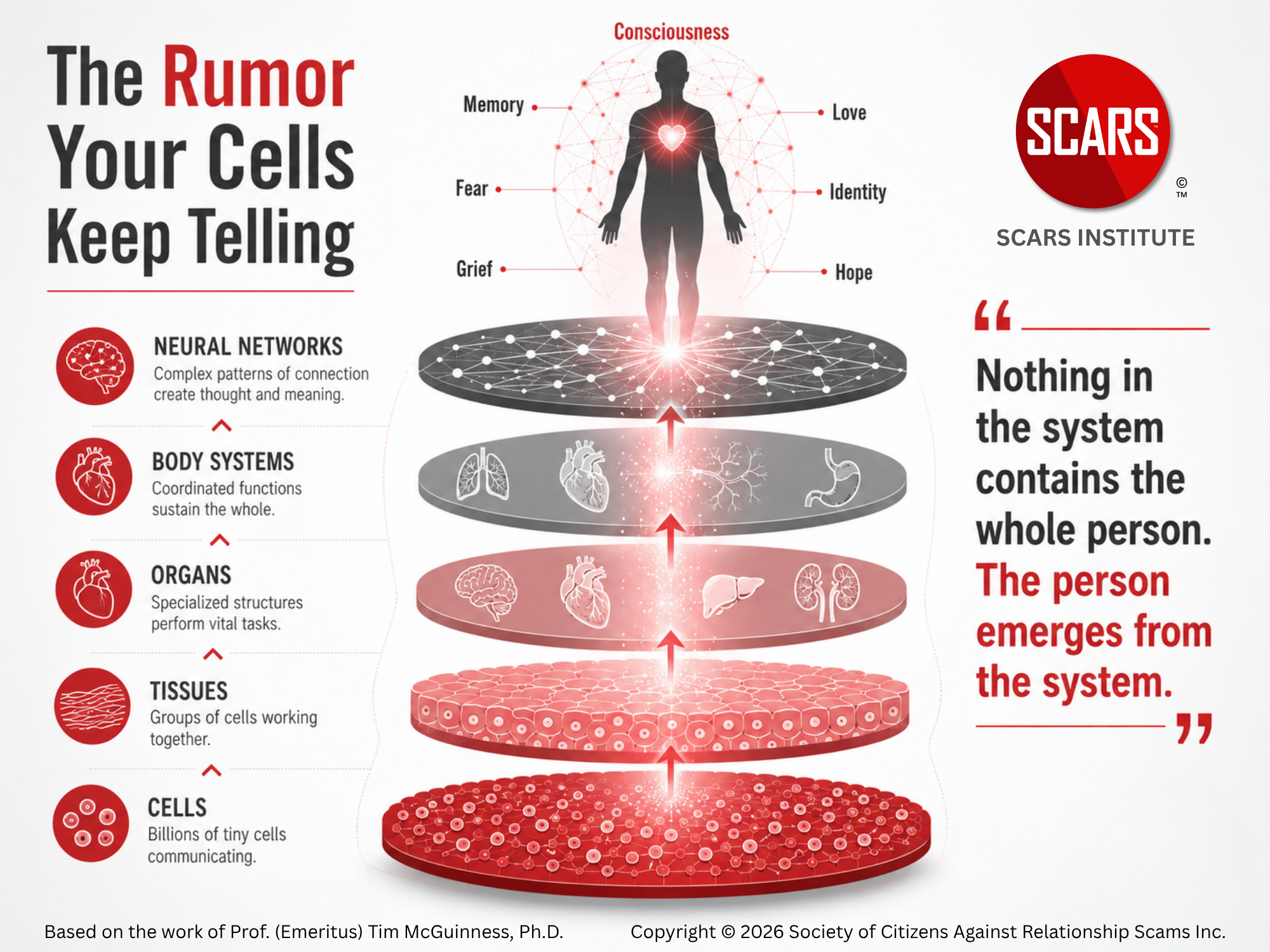
Your body contains roughly 30 trillion human cells in a reference adult, although the actual number varies substantially with body size, sex, age, and physiology. The often repeated figure of 34 trillion works well as an approximation, but nature does not issue everyone exactly the same cellular inventory at birth. Most of those cells have extraordinarily limited jobs. Red blood cells transport oxygen. Hepatocytes conduct the biochemical work of the liver. Muscle cells contract. Keratinocytes help construct skin. Immune cells identify and respond to biological threats. None possesses anything remotely resembling your biography.
No skin cell knows your name. No liver cell knows whether you are married. No immune cell remembers your childhood. No heart muscle cell understands whom you love. Your cells participate in keeping you alive without possessing the slightest apparent understanding of the life they are keeping alive.
Yet somehow, collectively, there you are.
That might be one of the strangest facts about human existence. You are made entirely from components that do not individually appear to know you exist.
Thirty Trillion Participants and No One in Charge
Your body is not really organized like a conventional machine. A machine usually has components designed by an external engineer for a predetermined purpose. Your body emerged through billions of years of evolutionary selection, development, cellular differentiation, chemical signaling, reproduction, mutation, survival, and death. There was no architectural meeting at which your cells approved the final plan.
Instead, an extraordinary amount of biological coordination occurs through communication.
Cells release chemical signals. Hormones travel through blood. Neurotransmitters cross microscopic synaptic spaces. Cytokines carry immune information. Local signaling molecules alter neighboring cells. Gap junctions allow certain cells to exchange ions and small molecules directly. Electrical gradients change across membranes. Genetic activity rises and falls according to signals arriving from inside and outside the cell. Nervous, endocrine, metabolic, cardiovascular, and immune processes continually interact rather than behaving as independent departments.
You experience the result as one organism.
There is some irony in that arrangement. You can spend an afternoon worrying about whether your life is sufficiently organized while trillions of cells conduct an incomprehensibly complicated biochemical civilization without consulting your calendar.
You do not consciously regulate your blood pH. You do not instruct your pancreas when to release insulin. You do not personally order bone marrow to manufacture blood cells. You do not consciously coordinate inflammatory signaling after an injury. You can take deliberate actions that influence these processes, but most of the machinery responsible for keeping you alive operates outside awareness.
The conscious person who feels like the owner of the body receives surprisingly limited administrative privileges.
Then There Is Your Brain
Surely the brain must be different. If there is somewhere inside you where the real you resides, the obvious candidate appears to be the organ enclosed by your skull.
The human brain has commonly been estimated to contain about 86 billion neurons and a comparable number of non-neuronal cells, although newer analyses emphasize that the exact number remains uncertain. What matters for the present question is not whether the final count is 80 billion, 86 billion, or something somewhat higher or lower. The staggering fact is that every thought you have ever experienced depends upon coordinated biological activity among enormous populations of cells.
A neuron is an astonishing biological structure. It maintains electrical gradients across its membrane, receives signals through dendrites, integrates incoming activity, generates electrical impulses, releases neurotransmitters, and modifies its connections through forms of plasticity. Individual neurons perform complex biological information processing.
But a neuron does not appear to possess your thoughts.
A neuron in your visual system can participate in processing information produced by light striking your retina without itself seeing the sunset. A neuron involved in auditory processing can respond to features of a familiar voice without hearing your mother’s voice as you hear it. A hippocampal neuron can become part of a cellular ensemble associated with a memory without sitting quietly inside your skull remembering your eighth birthday.
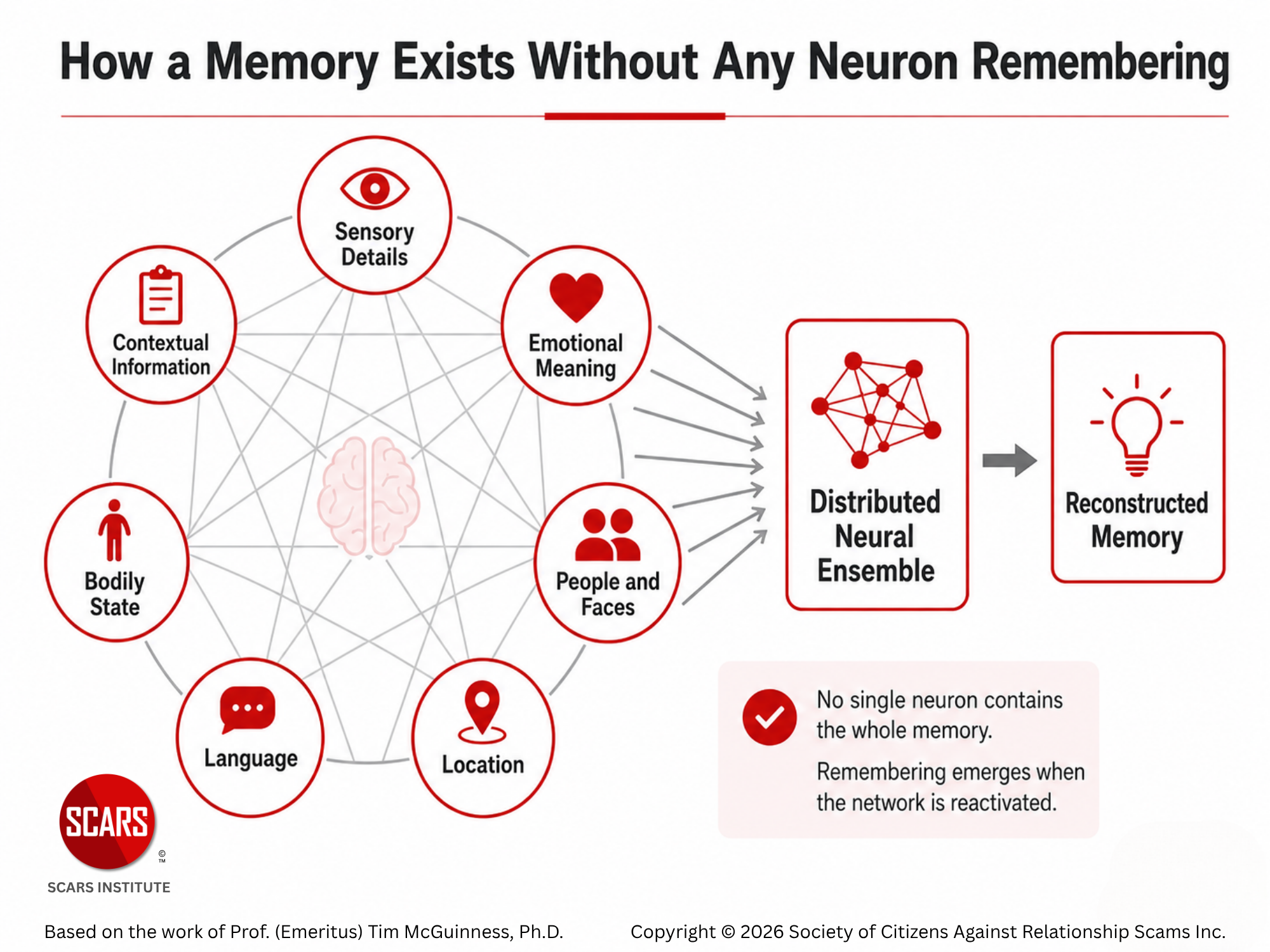
Modern memory research increasingly describes memories as involving distributed ensembles of neurons, sometimes called engrams. No single cell contains the complete memory in the ordinary sense of remembering. A memory becomes accessible when patterns distributed across neural systems are reactivated and reconstructed.
Your memories therefore do not appear to exist as little recordings hidden inside individual neurons. They depend upon relationships among cells, synapses, circuits, patterns of activation, molecular changes, and larger interacting brain systems.
The memory is in the organization. So, apparently, are you.
The Brain That Produces Thought Does Not Contain a Little Thinker
This is where ordinary intuition begins to fail.
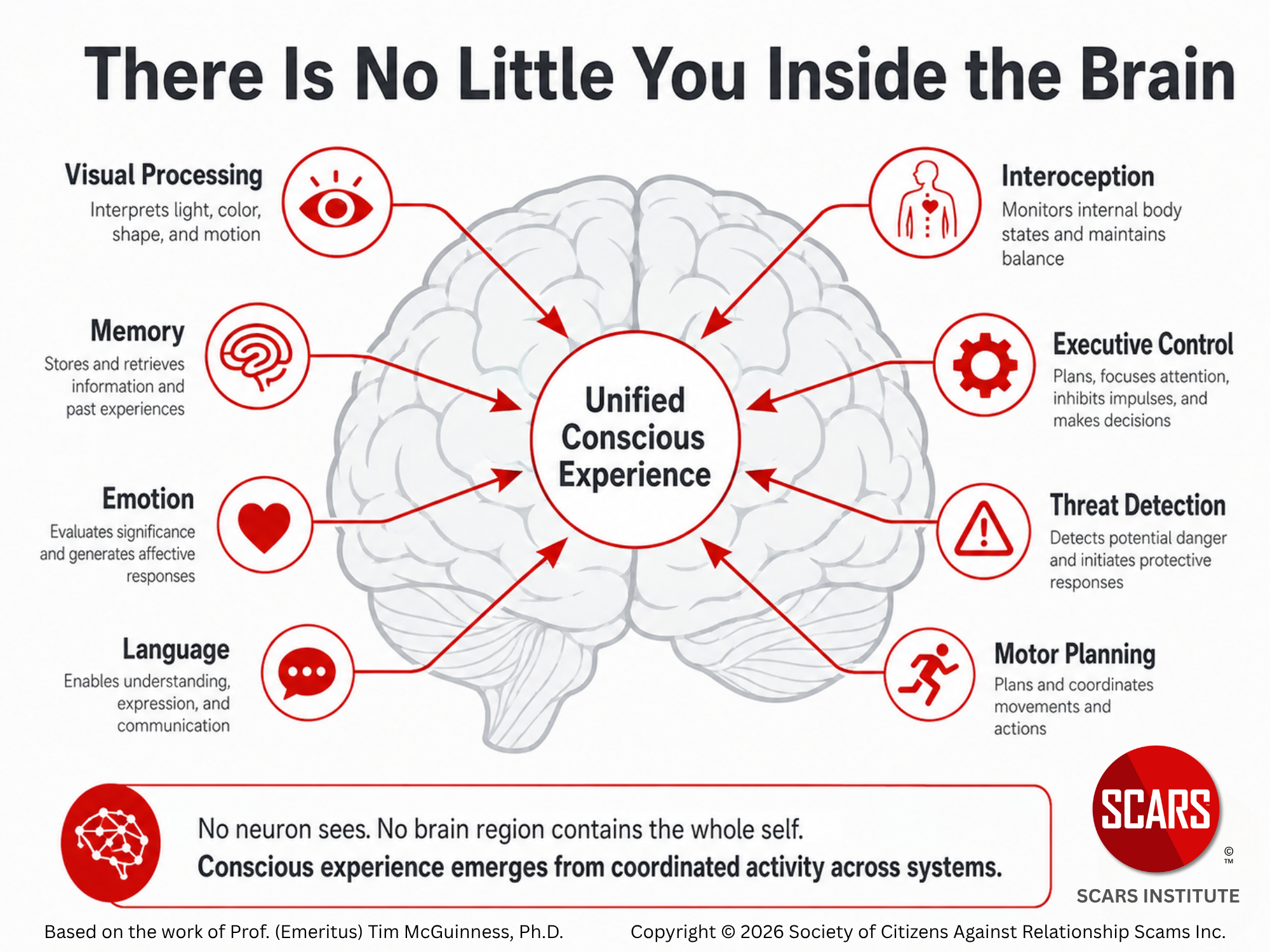
You experience a thought as a unified event. You think, “I should call someone.” The experience arrives as one thought belonging to one person. You do not experience the visual system contributing imagery, language networks organizing words, memory systems retrieving associations, emotional circuits assigning significance, motor planning systems considering action, and executive networks coordinating competing possibilities.
You receive the finished experience.
This creates what philosophers and neuroscientists have repeatedly confronted as a profound problem. The brain contains specialized systems, yet conscious experience feels integrated. Color, sound, memory, emotion, bodily sensation, intention, and identity arrive together as one moment occurring to one person.
One influential scientific framework, Global Neuronal Workspace theory, proposes that some information becomes consciously accessible when neural activity is sufficiently amplified and distributed across large interconnected networks, making that information available to multiple specialized systems. Other theories propose different mechanisms, including recurrent processing and integrated information. There is vigorous scientific disagreement about which mechanisms are necessary or sufficient for consciousness.
What neuroscience has not discovered is a miniature observer sitting inside the brain watching everything happen. There is no known neurological throne room.
There is no anatomical location where a microscopic version of you receives the video feed from the eyes, audio from the ears, emotional report from the limbic system, and daily briefing from memory.
If such an internal observer existed, another problem would immediately appear. Something would then have to be inside that observer experiencing what the observer experiences. The explanation would merely move the mystery one level deeper.
Instead, the evidence increasingly points toward distributed interaction. Consciousness depends upon coordinated activity involving cortical and subcortical systems, including important interactions between the cortex and thalamus. Damage, anesthesia, sleep, seizures, or disruptions in connectivity can profoundly alter whether information becomes consciously available at all.
- You do not appear to have a consciousness-producing cell.
- You have consciousness-producing relationships among cells.
Your Brain Is Not Working Alone
The mystery becomes even more interesting when the rest of your body reenters the discussion.
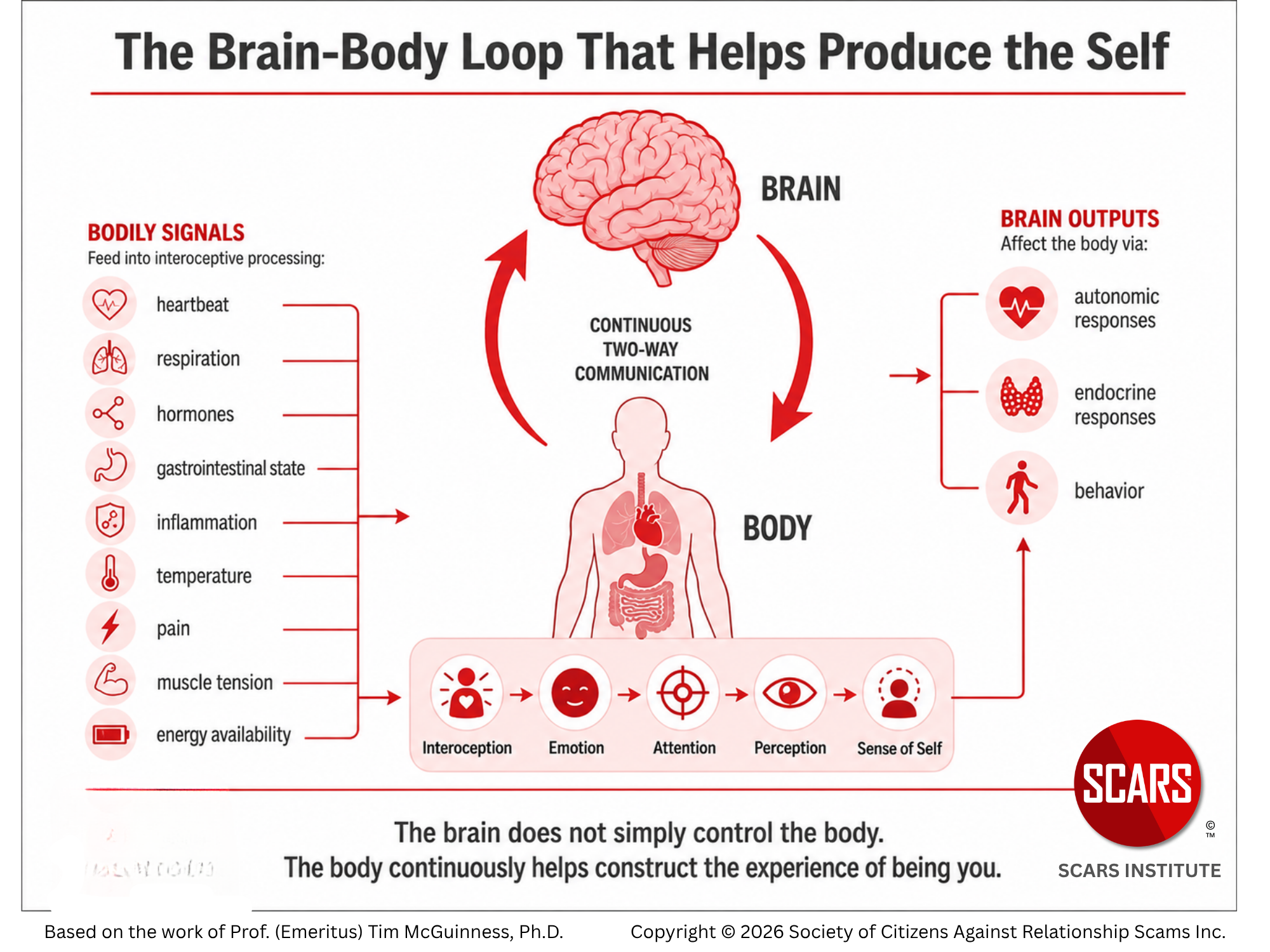
The feeling of being a self does not arise solely from abstract thought. Your brain continuously receives information about what is happening inside your body. Heartbeat, respiration, blood pressure, gastrointestinal activity, temperature, pain, hormonal state, inflammation, muscle tension, energy availability, and countless other physiological signals contribute to the nervous system’s representation of your condition.
This process is called interoception.
Interoceptive pathways continually inform the brain about internal bodily states, and regions including the insular cortex participate in integrating this information with emotion, cognition, and awareness. Research increasingly connects interoception with basic aspects of selfhood because your sense of being someone is partly grounded in the continuing perception that there is a particular living body from which experience is occurring.
- Your “self” therefore does not simply command your body.
- Your body helps construct your self.
Consider what happens when you are exhausted, hungry, ill, intoxicated, feverish, hormonally altered, frightened, or sleep-deprived. The person you experience yourself to be can change dramatically. Your patience changes. Judgment changes. Emotional intensity changes. Attention changes. Memory access changes. Threat perception changes. Even your interpretation of other people can change.
You can tell yourself that you are purely rational if it improves your morning, but your hypothalamus has not signed that agreement. The mind is embodied because the nervous system is embedded within a living organism whose internal conditions continually influence neural processing.
The Self Is Continually Being Reconstructed
You also experience yourself as continuous through time. You were present yesterday, you are present today, and you expect to remain present tomorrow. That continuity feels so natural that it can seem almost physical, as though the same permanent object called “you” simply travels through time.
Your biology is less tidy.
Cells die and are replaced at radically different rates. Blood cells turn over. Skin renews itself. The intestinal lining changes rapidly. Many neurons, however, can survive for decades. The popular claim that the entire human body replaces itself every seven years is false because tissues have dramatically different turnover patterns.
Yet even the cells that remain are not static. Proteins are replaced. Synapses change. Gene expression changes. Connections strengthen and weaken. Memories are retrieved and modified. New experiences become incorporated into existing networks. You remain recognizable despite continuous biological change.
This suggests that personal continuity depends less upon preserving exactly the same physical components than upon preserving enough organization, memory, relationship, and ongoing biological process for continuity to emerge.
A whirlpool provides a useful analogy. The water entering it is constantly changing, yet the whirlpool retains a recognizable form because the organization persists through changing material.
You are vastly more complicated than a whirlpool, of course, and considerably more likely to complain about taxes, but the principle is useful. Your continuity resides partly in pattern.
You Are an Emergent Event
The scientific term that begins to approach this strange relationship is emergence.
Emergence occurs when interactions among simpler components produce properties that are not meaningfully attributed to the individual components in isolation. Individual water molecules are not wet in the ordinary macroscopic sense, yet collections of water molecules produce the property humans describe as wetness. Individual cardiac muscle cells participate in electrical and mechanical activity, while coordinated cardiac tissue produces an organized heartbeat.
The comparison cannot solve consciousness. Consciousness remains a major unsolved scientific problem. Saying that consciousness is emergent identifies a relationship between levels of organization, but it does not explain why coordinated neural processing should produce subjective experience rather than sophisticated biological activity occurring completely in the dark.
That unresolved question matters.
Science can increasingly describe what neurons do when you recognize a face, retrieve a memory, experience pain, make a decision, lose consciousness under anesthesia, or become aware of a stimulus. It can identify circuits, electrical rhythms, neurotransmitters, connectivity patterns, and changes associated with conscious access. Science still cannot point to an equation and demonstrate why any of this should feel like something from the inside. Yet it does.
- You wake up.
- You see red.
- You hear music.
- You miss someone.
- You become frightened.
- You experience grief.
- You know that you exist.
Billions of cells participate, and not one of them appears to possess the whole experience.
Trauma Reveals How Constructed the Self Really Is
Trauma can make this biological reality painfully visible.
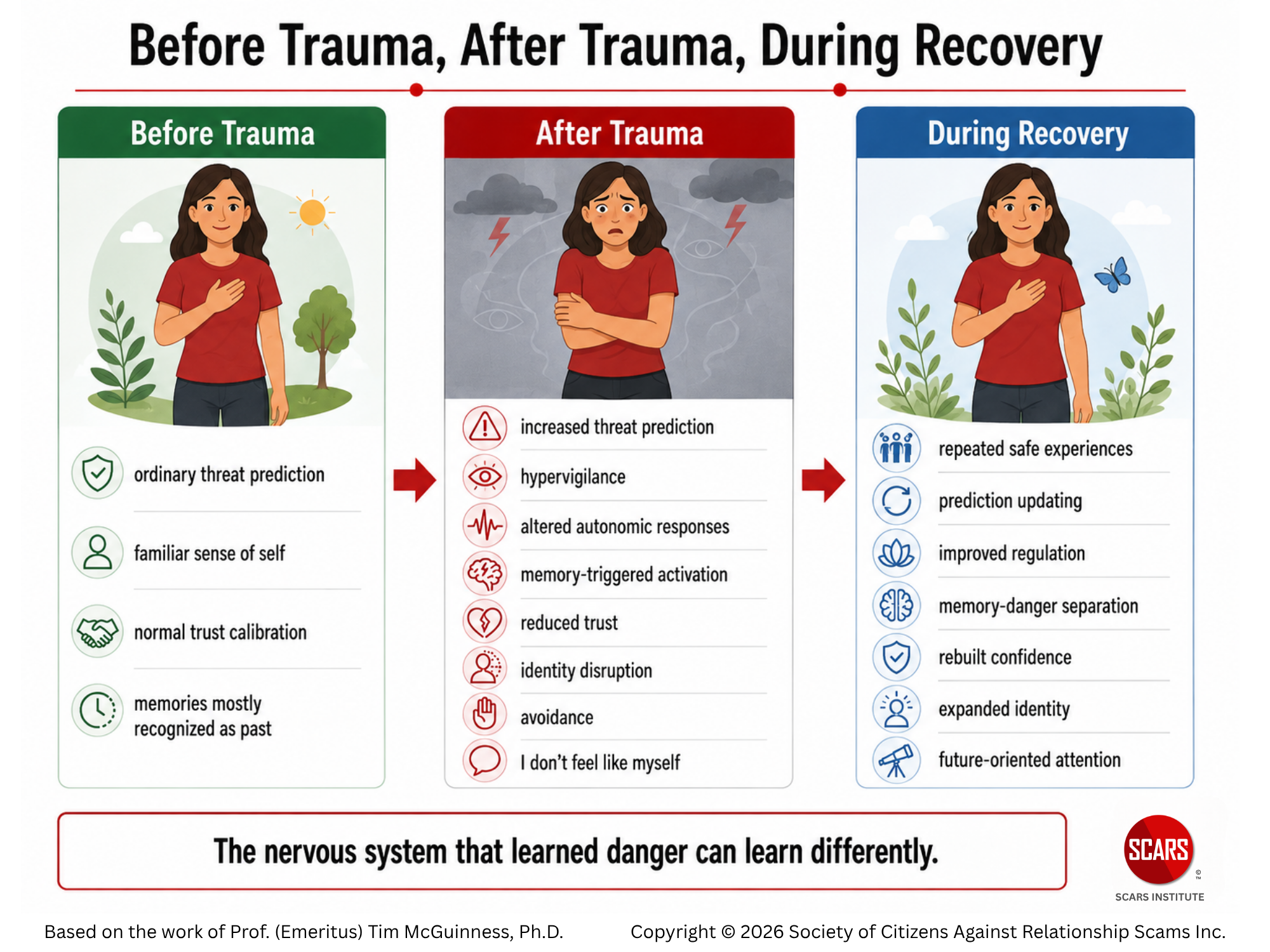
After a traumatic experience, you can say, “I don’t feel like myself anymore.” That statement is often treated metaphorically, but it reflects something neurologically important. Trauma can alter attention, threat detection, memory retrieval, autonomic regulation, emotional processing, bodily awareness, expectations, sleep, and interpretation of social information.
The biological systems participating in the construction of your moment-to-moment self begin operating differently.
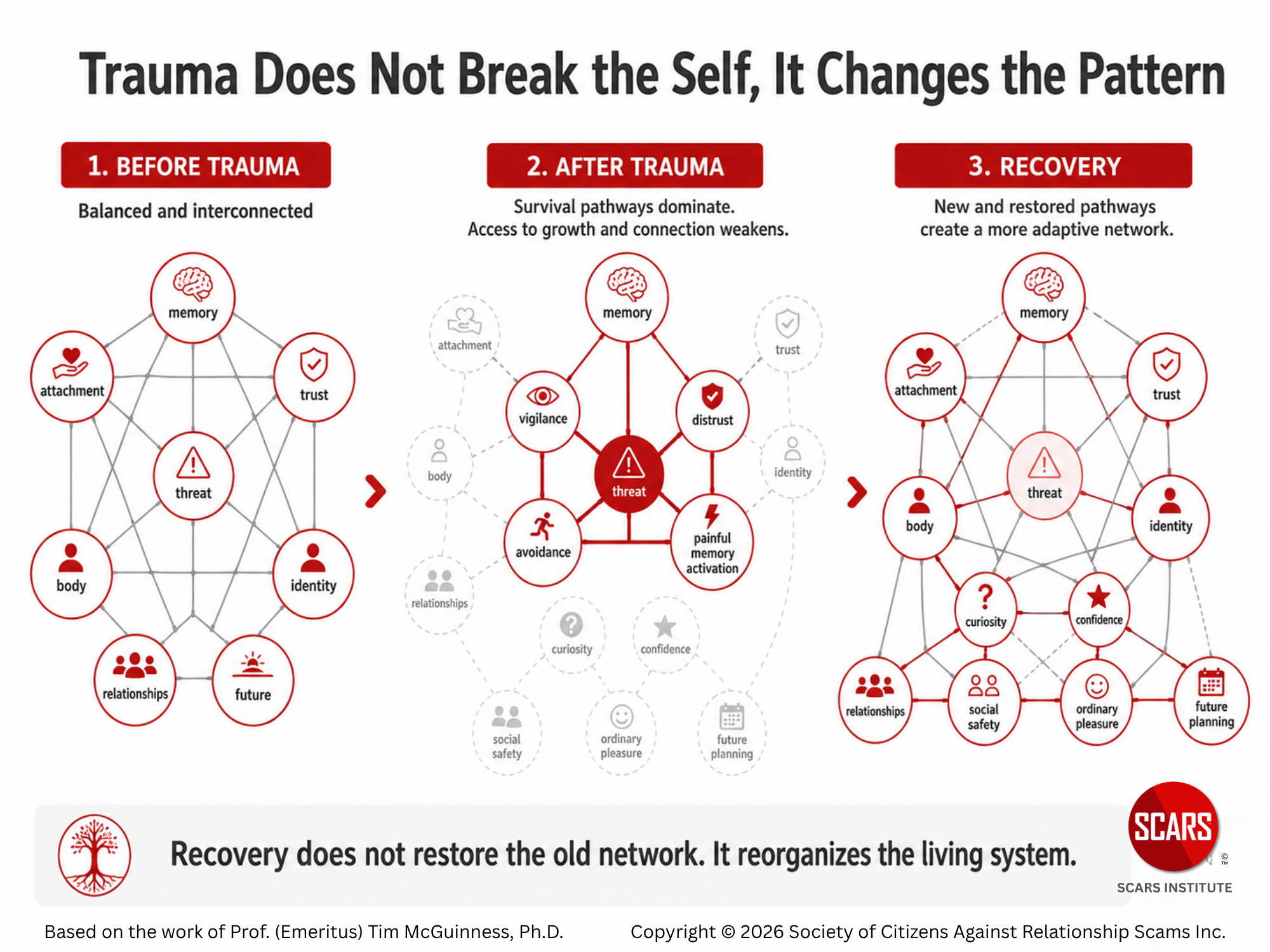
You are still physically present, yet the pattern producing your familiar experience of yourself has changed. That helps explain why trauma recovery cannot consist simply of deciding to return to normal. There is no master switch labeled SELF that can be returned to its previous position. Recovery involves repeated experiences through which nervous-system predictions, behavioral responses, memories, interpretations, emotional associations, bodily regulation, and social expectations gradually change.
The self you experience is dynamic enough to be injured partly because it was dynamic in the first place. That same fact creates the possibility of recovery.
If identity were one permanent neurological object stored somewhere inside the brain, serious disruption might simply break it. Instead, much of what you experience as yourself depends upon adaptive systems capable of learning, reorganizing, updating, and forming new connections.
- The machinery that learned fear can learn safety.
- The networks that connected reminders with danger can acquire different associations.
- The beliefs reorganized by betrayal can be examined and reconstructed.
- The autobiographical story damaged by victimization can incorporate what happened without allowing the event to become the definition of everything that follows.
You are not returning to an untouched version of yourself preserved somewhere inside the brain. You are continuing the biological and psychological process through which a self has always been constructed.
Perhaps You Never Owned the Body in the First Place
The statement that you do not “own” your body is philosophical rather than strictly biological, but biology gives the metaphor considerable force.
Ownership suggests separation between an owner and something owned. Your relationship with your body does not work that way. Remove the body and there is no scientifically demonstrated independent biological owner remaining behind.
The body is not merely the vehicle carrying you. The functioning organism appears to be part of what produces you.
Your brain is not a container holding the self. Your brain, body, memories, sensations, relationships, and continuing biological activity participate in generating the experience of being a self.
You therefore occupy an unusual position. You are simultaneously the organism and an experience generated by the organism. You are capable of observing your own thoughts even though those observations arise from the same biological system producing the thoughts. You can question your identity using the brain processes responsible for producing the identity being questioned.
Evolution somehow produced matter capable of wondering what matter is doing. There is the irony.
Something Wakes Up
Approximately 30 trillion human cells cooperate to maintain the organism you casually call “me.” Tens of billions of neurons participate in the brain that remembers your history, anticipates your future, recognizes your loved ones, fears threats, creates language, and produces the continuous impression that someone is present behind your eyes. None of those cells appears individually to know the story.
- Your heart does not know why it accelerates when you see someone you love.
- Your hippocampal neurons do not sit together reminiscing.
- Your visual cortex never watches the world.
- Your insula does not privately experience your body.
- Your neurons exchange electrochemical signals
- Your glial cells maintain and modify the environment in which neural processing occurs
- Your endocrine system distributes chemical instructions
- Your immune system exchanges information with the nervous system, and
- Your organs continually signal their condition.
Then, somehow, you experience being here.
The profound lesson is not that you are unreal. Quite the opposite. You are real in a more extraordinary way than the simple idea of a little self living inside a biological machine.
- You are not one cell.
- You are not one brain region.
- You are not one memory.
- You are not even exactly the same physical collection of matter from one period of life to another.
- You are an organized, living continuity produced through relationships among parts that possess none of your identity individually.
In that sense, you really are something like a rumor your cells keep telling one another. The rumor changes as experience changes. Trauma can disturb it. Memory can revise it. Age can alter it. Relationships can enrich it. Learning can reorganize it. Recovery can help restore coherence when suffering has fractured the story.
Yet the telling continues. Trillions of biological strangers exchange signals without knowing your name, and from their astonishing coordination emerges someone who has a name, remembers a childhood, loves particular people, fears particular losses, carries wounds, imagines tomorrow, and can sit quietly contemplating the impossible fact of being conscious.
Nothing inside you appears to understand the whole. Together, somehow, something wakes up.
And that something is you.
When Trauma Changes the Rumor Your Body Is Telling
For a traumatized person, the idea that the self emerges from constantly interacting biological systems carries an important implication: recovery does not depend on finding some untouched version of yourself hidden beneath the trauma. There is no sealed internal chamber containing the person you were before the crime, waiting to be released if you can only think correctly enough. Your sense of self is produced continuously through memory, perception, bodily regulation, expectation, emotion, attention, relationships, and the activity of your nervous system. Trauma changes some of those processes, and because those processes participate in creating your experience of being you, trauma can make you feel profoundly unfamiliar to yourself.
You can wake up after victimization and feel that you are no longer the person you were. You can distrust decisions that once felt effortless. You can become afraid of situations that previously felt ordinary. Your concentration can weaken, your sleep can change, your body can remain tense, and your emotional responses can seem disproportionate or unpredictable. You can hear yourself reacting and wonder where the reaction came from. You can know intellectually that you are safe while your body continues behaving as though danger remains nearby.
That does not mean that some essential part of you has been destroyed. It means that the biological systems participating in your sense of self have learned from what happened.
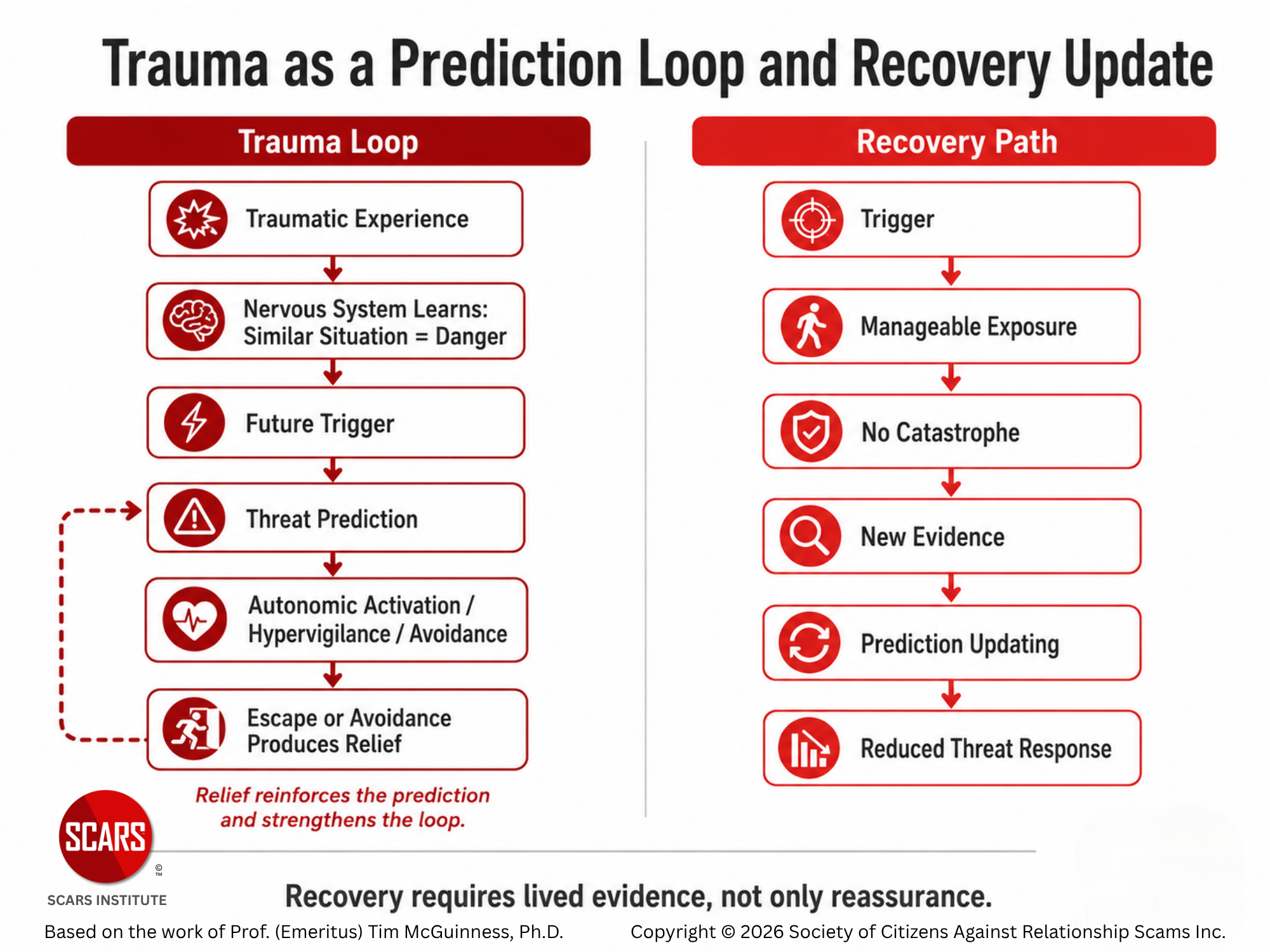
Trauma is, among other things, a powerful learning event. Your nervous system does not wait for philosophical interpretation before responding. It detects threat, mobilizes defensive systems, strengthens certain associations, alters attention, prioritizes particular memories, and changes predictions about what can happen next. When betrayal is involved, those predictions can extend beyond physical danger. Your brain can begin treating trust, affection, uncertainty, financial decisions, social contact, intimacy, or even your own judgment as possible sources of danger.
Your brain is doing what biological systems do. It is adapting.
The difficulty is that an adaptation that helped you survive an overwhelming experience can become poorly suited to ordinary life afterward. Hypervigilance can remain after the immediate threat is gone. Suspicion can persist after the offender is removed. Shame can become attached to memories that originally involved trust and affection. Avoidance can keep you away from experiences that could help restore confidence. The nervous system can continue applying lessons learned during the crime to situations that are no longer the crime.
This is one reason recovery takes repetition.
You rarely change a trauma response through one insight because the response was not created by one idea. It exists across interconnected systems involving memory, autonomic regulation, emotion, attention, learned association, expectation, and behavior. Understanding what happened matters enormously, but understanding is only one part of biological learning. Your nervous system also has to experience evidence that the world is not permanently organized according to the rules of the trauma.
That evidence accumulates gradually.
Every time you make a decision and discover that you can evaluate the outcome, you provide new information about your competence. Every time you encounter uncertainty without catastrophe, your nervous system receives evidence that uncertainty does not always mean danger. Every time you participate in a healthy relationship without exploitation, earlier predictions about trust encounter contradictory experience. Every time you remember what happened without becoming completely overwhelmed, the memory exists within a different physiological context.
This is how recovery becomes biological as well as psychological.
Neuroplasticity allows neural connections and functional patterns to change in response to experience. Memory is not a completely fixed recording. Emotional associations can change. Threat predictions can be updated. Attention can become less dominated by danger. New habits can become more automatic. Your brain remains capable of learning because the same adaptability that allowed trauma to alter you also allows recovery to alter you.
There is an uncomfortable irony in this. Many survivors become angry with themselves because they cannot simply command the trauma to stop affecting them. Yet the conscious voice issuing the command is only one participant in the larger biological system. You can tell yourself that there is nothing to fear while your autonomic nervous system is already increasing your heart rate. You can decide that you trust someone while another part of your nervous system remains attentive to every possible inconsistency. You can insist that you should be finished grieving while attachment and memory systems continue responding to reminders of what was lost.
The executive office has issued a directive. Several trillion employees apparently did not receive the memo.
Recovery therefore requires more than instruction. It requires experience. You teach your nervous system differently by repeatedly living differently.
This is why healthy routines matter after trauma even when they can appear almost insultingly ordinary compared with the magnitude of what happened. Sleep, nutrition, physical activity, social interaction, learning, structured responsibilities, reflection, participation in support, and gradual reengagement with everyday life all provide biological information. They help restore rhythms, expectations, and patterns that trauma disrupted.
The same principle explains why avoidance can become dangerous when it expands too far. Avoidance provides immediate relief because the triggering situation disappears. The nervous system can then learn exactly the wrong lesson: escape prevented danger. The avoided situation remains coded as threatening because the person never remains present long enough to discover that the predicted catastrophe does not occur.
Recovery reverses that process carefully and progressively.
You do not need to throw yourself into overwhelming situations to prove that you are strong. You need enough manageable experiences to allow your nervous system to update its predictions. Confidence returns through evidence. Trust becomes possible through evidence. Tolerance for uncertainty grows through evidence. Your sense of agency becomes stronger because you repeatedly experience yourself acting, evaluating, adapting, and continuing.
That process also changes identity.
Trauma can temporarily organize identity around what happened. You become the person who was deceived, assaulted, robbed, betrayed, manipulated, abandoned, threatened, or harmed. The event occupies so much psychological space that it begins influencing how you interpret the past, present, and future. The rumor your cells keep telling becomes dominated by one terrible chapter.
Recovery does not require deleting that chapter. It requires making the story larger again.
You accumulate experiences that are not the trauma. You develop knowledge you did not possess before. You practice judgment. You establish boundaries. You rebuild relationships. You learn what manipulation looks like. You discover where your vulnerabilities were exploited without confusing vulnerability with weakness. You regain the ability to make mistakes without interpreting every mistake as evidence that your judgment is permanently damaged.
Gradually, the biological and psychological system produces a different experience of self.
You stop feeling like someone whose life ended at the moment of victimization and begin experiencing yourself as someone whose life contains victimization but continues beyond it. The distinction can seem small in language, yet it is enormous in identity.
Your memories still exist. Your nervous system can still react sometimes. Certain dates, places, words, photographs, financial circumstances, or relationship experiences can still activate old responses. Recovery does not require absolute silence from the past. A healed nervous system does not become a nervous system that has forgotten what happened.
It becomes one that has learned that what happened is not happening now. That is one of the most important biological achievements of trauma recovery.
The brain gradually becomes better able to distinguish memory from immediate danger. The body becomes less compelled to mobilize every time something resembles the past. Emotional reactions become easier to regulate. Attention becomes available for things other than threat. The future begins to occupy more psychological territory than the offender, the crime, or the loss.
The person who emerges from that process is not necessarily the person who existed before the trauma.
There is no biological requirement that recovery restore an earlier version of you.
You can become different. You can become more knowledgeable, more deliberate, more discerning, more aware of your limits, more capable of recognizing manipulation, and more willing to protect your own interests. You can also become playful again, curious again, trusting where trust is earned, and interested in a future that does not revolve around preventing the past from happening again.
The purpose of recovery is not to reconstruct a perfect copy of who you were. It is to help your continually adapting biological system learn that life contains more than the trauma.
Your cells will keep communicating. Your nervous system will keep predicting. Your memories will keep changing as they are incorporated into new experience. Your brain will keep reorganizing itself around what you repeatedly think, feel, practice, avoid, confront, learn, and live.
The rumor continues.
Recovery is what happens when the story being passed through that living system stops being only, “Something terrible happened to me.”
- Over time, it becomes something larger.
- Something terrible happened.
- You survived it.
- You learned from it.
- You changed because of it.
And the organism that once learned danger can continue learning how to live.
How Parts Theory Fits Into the Biological Self
Psychological Internal Family Systems or Parts Theory provides another useful way to understand why the self can feel unified while containing very different emotions, motivations, memories, and behavioral responses. Approaches such as Internal Family Systems and trauma-related models of structural dissociation describe the personality as containing different functional states or “parts” that can become active under different conditions. These parts should not be understood as tiny separate people living inside the brain, nor do they correspond to individual brain regions. They are psychological ways of describing organized patterns of memory, emotion, expectation, bodily response, motivation, and behavior that can become dominant at different moments.
This fits remarkably well with the biological view of the self as an emergent process. Your brain already contains multiple systems performing different tasks at the same time. Networks associated with threat detection can signal danger while other networks recognize that the present environment is safe. Attachment systems can pull you toward another person while defensive systems push you away. One system can retrieve memories of affection while another produces anger about betrayal. Conscious experience receives the results of these competing processes and experiences them as different internal positions.
Trauma can intensify these divisions. Research on structural dissociation describes trauma-related problems as failures of integration among psychobiological systems involved in ordinary life, defense, attachment, and traumatic memory. Different states can therefore become organized around different action tendencies and emotional priorities. This does not mean that every traumatized person develops a dissociative disorder. It means that trauma can make normal differences among internal states more rigid, more emotionally intense, and more difficult to integrate.
A scam victim provides an especially clear example.
- One part of the person can understand that the relationship was fraudulent.
- Another can still miss the person they believed existed.
- Another can feel furious about the exploitation.
- Another can feel ashamed. Another can want justice.
- Another can simply want the pain to stop.
These experiences can appear contradictory only if the self is imagined as one single mental voice that should always produce one consistent response.
The biological model suggests something different. The person is already a coordinated system composed of many interacting processes. Parts Theory provides psychological language for describing some of those organized patterns when they become noticeable in conscious experience.
Recovery therefore does not require destroying the frightened part, silencing the angry part, or forcing the attached part to disappear. It requires greater integration. The survivor learns why each response developed, what conditions activate it, what protective function it once served, and whether that response still fits present reality. Trauma treatment models based on structural dissociation similarly emphasize stabilization, greater communication and integration among psychological states, processing of traumatic memories, and eventual engagement with ordinary life.
This connects directly with the larger biological principle of recovery. The nervous system does not heal by eliminating every system that learned something from the trauma. It heals by reorganizing relationships among those systems so that fear, attachment, memory, judgment, and emotion can operate within a more coherent whole.
The “rumor” your cells keep telling is therefore not always spoken with one voice. Sometimes different biological and psychological systems are telling different versions of what is happening, what happened before, and what must happen next. Trauma can make those voices compete more aggressively. Recovery helps them become part of the same story again.
- You do not recover by becoming a person without parts.
- You recover as those parts become increasingly capable of functioning as one person.
Conclusion
You are not a fixed object hidden somewhere inside your body. You are an ongoing biological process emerging from the coordinated activity of trillions of cells, billions of neurons, shifting memories, bodily signals, learned expectations, emotional responses, and continuously changing patterns of communication. Your sense of self feels stable because the organism maintains enough continuity for you to experience one life unfolding through time, even while the biological machinery supporting that experience is constantly changing.
Trauma demonstrates just how dynamic that system really is. A traumatic experience can alter memory, attention, threat detection, autonomic regulation, sleep, emotional responses, bodily awareness, social interpretation, and expectations about what will happen next. When those systems change, the person you experience yourself to be can also feel changed. That experience can be deeply unsettling, but it also reveals one of the most important facts about recovery: the system capable of learning danger is also capable of learning something new.
Recovery therefore does not require locating and restoring some untouched version of yourself from before the trauma. It requires continuing the same biological process through which a sense of self has always been constructed. New experiences can modify old predictions. Repetition can strengthen different responses. Safe relationships can challenge expectations formed through betrayal. Decisions can rebuild confidence. Memory can become less tightly connected with immediate danger. The nervous system can gradually learn that what happened before is not necessarily happening now.
You are not trying to erase what happened or rebuild an exact copy of who you once were. You are allowing your living system to incorporate the trauma into a larger history that also contains learning, relationships, judgment, curiosity, purpose, and a future. The rumor your cells keep telling does not stop after trauma. It changes as you change. Recovery is the process through which that story becomes larger than the worst thing that happened to you.

Glossary
- Adaptive Biological Self — The adaptive biological self describes a person as an ongoing product of interacting neural, bodily, emotional, perceptual, and memory systems rather than as a permanently fixed internal object. Those systems continually respond to experience and change their patterns while preserving enough continuity for the person to remain recognizably themselves. This perspective helps explain why trauma can change the experience of identity without destroying the person who experiences that change. — Identity Process
- Adaptive Threat Carryover — Adaptive threat carryover occurs when biological responses that were useful during danger remain active after the original danger has ended. Heightened vigilance, suspicion, bodily tension, and defensive attention can persist because the nervous system learned that these responses were protective during the traumatic experience. Recovery gradually provides new experiences that allow those protective responses to become better matched to present conditions. — Trauma Response
- Autobiographical Story Expansion — Autobiographical story expansion occurs when the survivor’s understanding of personal identity grows beyond the traumatic event and begins incorporating new experiences, relationships, knowledge, accomplishments, choices, and future possibilities. Trauma can temporarily dominate the personal story because the event occupies exceptional emotional and neurological importance. Recovery enlarges the story until victimization remains part of personal history without functioning as the central definition of the person. — Identity Process
- Autonomic Danger Persistence — Autonomic danger persistence describes continued bodily mobilization after conscious reasoning has recognized that an immediate threat is no longer present. Heart rate, muscle tension, vigilance, respiration, and other autonomic responses can remain influenced by previously learned danger associations. This helps explain why intellectual knowledge of safety does not always immediately produce a corresponding physical sense of safety. — Physiological Response
- Biochemical Coordination — Biochemical coordination is the continuous exchange of chemical information that allows cells, organs, and biological systems to function as one living organism. Hormones, neurotransmitters, cytokines, local signaling molecules, and other chemical messengers help regulate activity throughout the body without requiring conscious direction. The resulting coordination contributes to the biological conditions from which perception, emotion, behavior, and the experience of self emerge. — Biological Process
- Biological Continuity — Biological continuity refers to the persistence of a recognizable person despite continuous physical and functional change within the body. Cells turn over at different rates, proteins are replaced, synapses change, memories are modified, and new experiences alter neural organization throughout life. Personal continuity therefore depends partly on maintaining organized patterns across change rather than preserving an identical collection of biological material. — Biological Process
- Biological Learning Through Trauma — Biological learning through trauma describes the process through which traumatic experience changes threat expectations, associations, attention, bodily responses, memory priorities, and behavioral tendencies. The nervous system learns from overwhelming events because survival depends on using previous experience to anticipate future danger. Problems develop when lessons formed under extraordinary conditions continue being applied to ordinary situations after the original threat has disappeared. — Trauma Response
- Biological Self-Construction — Biological self-construction describes the continuing production of the experienced self through interactions among the brain, body, memory, sensation, emotion, attention, expectations, and relationships. No individual cell or single brain region contains the complete person, yet coordinated biological activity produces a unified experience of identity. Trauma and recovery both influence this process because the biological systems involved remain capable of learning and reorganization. — Identity Process
- Bodily State Signaling — Bodily state signaling is the continual transmission of information about internal conditions such as heartbeat, respiration, blood pressure, gastrointestinal activity, temperature, pain, inflammation, hormonal activity, and energy availability. The nervous system uses this information when regulating behavior, emotion, attention, and physiological priorities. Changes in these signals can influence how a person experiences safety, distress, exhaustion, emotional intensity, and even personal identity. — Physiological Process
- Brain-Body Integration — Brain-body integration refers to the continuous interaction between neural processing and the physiological condition of the rest of the organism. The brain receives information from organs, hormones, immune activity, cardiovascular systems, muscles, and other bodily processes while also influencing those systems in return. The experienced self therefore develops from an embodied biological system rather than from a brain operating independently inside the skull. — Neurological Process
- Cellular Communication Network — A cellular communication network is the vast system through which cells exchange chemical, electrical, hormonal, immune, and molecular information throughout the body. Individual cells perform specialized functions without understanding the organism as a whole, yet their coordinated communication allows complex biological regulation to occur. The person’s unified experience emerges from organization created across countless interactions rather than from conscious control over individual cellular activity. — Cellular Process
- Cellular Turnover Diversity — Cellular turnover diversity refers to the fact that different tissues replace their cells at dramatically different rates throughout life. Some cells are replaced quickly, while many neurons can remain for decades even though their proteins, connections, and molecular activity continue changing. This diversity demonstrates why the popular idea that the entire body becomes completely new after a fixed number of years does not accurately describe human biology. — Cellular Process
- Conscious Access — Conscious access occurs when information processed within the nervous system becomes available to broader systems involved in awareness, reporting, decision-making, memory, and deliberate action. Vast amounts of neural processing occur without entering conscious experience, while only some information becomes part of what the person knowingly experiences. The distinction helps explain why consciousness represents a selected and integrated outcome of neural activity rather than a complete view of everything happening inside the brain. — Consciousness Science
- Conscious Owner Illusion — The conscious owner illusion describes the intuitive impression that a separate internal self controls the body as an owner operates a machine. Most biological regulation occurs without conscious instruction, including metabolic control, immune activity, hormonal regulation, tissue maintenance, and many autonomic functions. Conscious decision-making influences the organism, but the person does not supervise most of the biological processes required for continued existence. — Consciousness Science
- Consciousness-Producing Relationships — Consciousness-producing relationships describe the coordinated interactions among neurons, neural circuits, cortical regions, subcortical structures, and other biological systems associated with conscious experience. No known individual neuron contains a complete thought, memory, or self, while large-scale patterns of coordinated activity contribute to unified awareness. The important biological property therefore appears to exist in organized relationships among components rather than inside one privileged cell. — Neural Integration
- Cortical-Subcortical Coordination — Cortical-subcortical coordination refers to communication between the cerebral cortex and deeper brain structures involved in arousal, memory, emotion, sensory processing, motivation, and physiological regulation. Consciousness depends on interactions across multiple systems rather than on cortical activity operating alone. Disruption through anesthesia, seizures, brain injury, sleep, or impaired connectivity demonstrates how strongly conscious experience depends upon organized communication across these neural levels. — Neural Integration
- Distributed Memory Ensemble — A distributed memory ensemble is a population of neurons whose coordinated activity participates in storing, retrieving, and reconstructing aspects of an experience. No single neuron ordinarily contains an entire autobiographical memory in the way a digital file contains a complete recording. Remembering depends on reactivating patterns distributed across interconnected neural systems that contribute sensation, emotion, context, meaning, and other components of the remembered event. — Memory Process
- Distributed Neural Processing — Distributed neural processing describes the way perception, memory, language, emotion, decision-making, bodily awareness, and other functions depend on coordinated activity across multiple brain systems. The person experiences a unified result even though specialized neural networks contribute different forms of information. This organization explains why the brain does not require one central location where every component of experience is assembled for a separate internal observer. — Neurological Process
- Embodied Selfhood — Embodied selfhood describes the idea that the experience of being a person depends partly on the brain’s continuing representation of the body’s internal condition. Hunger, illness, exhaustion, hormonal changes, pain, fear, intoxication, and sleep deprivation can change judgment, attention, mood, perception, and behavior because bodily conditions influence neural processing. The self therefore develops through a living brain-body system rather than through thought alone. — Embodied Cognition
- Emergent Consciousness — Emergent consciousness refers to conscious experience arising from organized interactions among biological components that do not individually possess the complete property of consciousness. Neurons exchange electrochemical signals and participate in complex information processing, yet no isolated neuron appears to contain a person’s unified subjective experience. Emergence describes this relationship between organization and higher-level experience without solving the deeper question of why neural processing produces subjective awareness. — Consciousness Science
- Emergent Self — The emergent self is the experienced identity that develops from coordinated biological, neurological, psychological, and social processes rather than from a single fixed structure inside the body. Memory, perception, bodily sensation, relationships, expectations, emotion, and attention all contribute to the ongoing experience of being one person. Because these contributing systems change, the self can remain continuous while also developing substantially across life. — Identity Process
- Engram Reactivation — Engram reactivation occurs when neural ensembles associated with a previous experience become active again during remembering. The resulting memory is reconstructed through distributed patterns rather than retrieved as a complete recording stored inside one cell or location. Trauma can give certain memory networks exceptional emotional importance, which helps explain why reminders can reactivate powerful responses even when the original event is no longer occurring. — Memory Process
- Experience-Based Safety Learning — Experience-based safety learning occurs when repeated encounters with manageable, non-dangerous situations provide the nervous system with evidence that previous threat expectations do not always apply. Intellectual reassurance can contribute to understanding, but biological learning becomes stronger when predictions are repeatedly contradicted by lived experience. Safe decisions, relationships, routines, and tolerable encounters with uncertainty can therefore become important sources of new learning during recovery. — Recovery Process
- Experience-Driven Neural Updating — Experience-driven neural updating describes the capacity of neural systems to change functional patterns as new information is repeatedly encountered. Connections can strengthen or weaken, emotional associations can change, and predictions can be revised when experience repeatedly contradicts older expectations. This capacity allows the same nervous system that adapted to traumatic conditions to continue adapting during recovery. — Neurological Process
- Finished Experience Effect — The finished experience effect describes the way conscious thought appears unified even though many separate neural systems contribute to producing it. A person experiences the thought, decision, memory, or perception after numerous specialized processes have already supplied language, emotion, sensory information, remembered associations, and possible actions. Consciousness therefore presents an integrated result without revealing most of the underlying biological work that produced it. — Consciousness Science
- Future-Oriented Attention Return — Future-oriented attention return occurs when psychological resources that were dominated by threat, victimization, loss, or the offender gradually become available for future plans, relationships, interests, learning, and ordinary life. Trauma can concentrate attention on preventing recurrence or interpreting what happened. Recovery expands attention so that future possibilities increasingly occupy more psychological territory than the traumatic event. — Recovery Process
- Global Neuronal Workspace — Global Neuronal Workspace is a scientific framework proposing that information becomes consciously accessible when neural activity is amplified and distributed broadly enough to become available to multiple specialized brain systems. The theory attempts to explain why some neural information reaches awareness while enormous amounts of other processing remain unconscious. It represents one influential explanation of conscious access rather than a final scientific solution to consciousness. — Consciousness Science
- Interoceptive Self-Mapping — Interoceptive self-mapping is the nervous system’s continuing representation of internal bodily conditions through signals involving heartbeat, respiration, temperature, pain, gastrointestinal activity, hormonal state, inflammation, and other physiological processes. Brain regions including the insular cortex participate in integrating this information with cognition and emotion. The process contributes to the basic sense that conscious experience is occurring from within a particular living body. — Embodied Cognition
- Learned Danger Prediction — Learned danger prediction occurs when the nervous system uses previous traumatic experience to anticipate that similar circumstances can produce harm again. The prediction can influence attention, emotion, bodily activation, interpretation, and behavior before deliberate reasoning fully evaluates the present situation. Recovery involves accumulating enough new evidence for those predictions to become increasingly accurate and less dominated by the conditions of the trauma. — Trauma Response
- Living Pattern Continuity — Living pattern continuity describes the persistence of personal identity through ongoing biological change because organization remains sufficiently stable across time. The physical materials involved in the body change, neural connections are modified, memories are updated, and new experiences become incorporated into existing systems. A recognizable person continues because continuity depends partly on maintained relationships and patterns rather than on perfectly unchanged biological components. — Identity Process
- Memory-Danger Separation — Memory-danger separation occurs when the nervous system becomes increasingly able to distinguish a reminder of past harm from evidence of immediate present danger. Early trauma responses can make memories, places, words, photographs, financial situations, or relationship experiences trigger defensive activation as though the original event were recurring. Recovery strengthens the distinction between remembering what happened and biologically preparing for it to happen again. — Recovery Process
- Memory Reconstruction — Memory reconstruction describes the process through which remembered experience is reassembled from distributed neural information rather than replayed as an unchanged recording. Retrieval can reactivate sensory details, emotional associations, contextual information, beliefs, and later knowledge that contribute to the current experience of remembering. This helps explain how traumatic memories can remain recognizable while their emotional meaning and relationship to present danger change over time. — Memory Process
- Neural Pattern Reorganization — Neural pattern reorganization describes changes in functional connections and activity patterns that occur as the brain continues learning from experience. Repeated thoughts, behaviors, relationships, emotional experiences, and environmental conditions can influence which neural pathways become more readily activated. Trauma can reorganize these patterns around danger, while recovery experiences can progressively support different patterns of interpretation and response. — Neurological Process
- Neurological Throne Room Fallacy — The neurological throne room fallacy is the mistaken expectation that a single place inside the brain contains the complete observer, thinker, or self who receives all incoming information. Neuroscience has not identified such an internal command chamber or miniature observer. Conscious experience instead depends on distributed and coordinated activity across many interacting neural systems. — Consciousness Science
- Nonconscious Biological Administration — Nonconscious biological administration describes the enormous amount of physiological regulation that occurs without deliberate awareness or instruction. Blood chemistry, immune responses, hormone release, tissue repair, metabolism, cardiovascular regulation, and countless cellular processes continue whether or not the conscious person understands them. The concept highlights how limited conscious control is compared with the biological activity required to maintain the organism. — Biological Process
- Organism-Level Identity — Organism-level identity describes the person as a property of the coordinated living organism rather than as something contained within a single cell, organ, memory, or neural circuit. Individual components contribute specialized functions while larger patterns create continuity, behavior, perception, emotion, and conscious experience. This perspective allows trauma-related changes to be understood as alterations in interacting systems rather than as evidence that an essential inner person has disappeared. — Identity Process
- Pattern-Based Personal Continuity — Pattern-based personal continuity describes how recognizable identity can persist even while the underlying biological materials and neural relationships continue changing. Memories, relationships, bodily regulation, habits, expectations, and neural organization preserve enough structured continuity for the person to experience a connected life across time. The concept explains why meaningful change can occur without requiring the person to become completely disconnected from who they were previously. — Identity Process
- Physiological Context of Remembering — Physiological context of remembering refers to the bodily and emotional state present when a memory is retrieved. A traumatic memory recalled during intense autonomic activation can be experienced differently from the same memory recalled while the person is regulated and aware of present safety. Repeatedly encountering memories within safer physiological conditions can change how strongly remembering is associated with immediate threat. — Memory Process
- Prediction Updating Through Safety — Prediction updating through safety occurs when experiences of manageable uncertainty, successful decision-making, trustworthy relationships, and non-catastrophic outcomes challenge expectations formed during trauma. The nervous system compares what it anticipated with what actually happened and can gradually modify future responses. Recovery therefore depends partly on lived evidence that previously learned rules of danger do not govern every present situation. — Learning Process
- Recovery Through Repeated Experience — Recovery through repeated experience describes the accumulation of ordinary and corrective experiences that gradually influence memory, expectation, physiological response, behavior, and identity after trauma. One intellectual insight rarely changes every system involved because traumatic learning extends beyond conscious belief. Repetition gives the nervous system enough evidence to develop different patterns of responding across time. — Recovery Process
- Self as an Ongoing Process — Self as an ongoing process describes identity as something continuously produced through biological activity, memory, perception, emotion, bodily sensation, relationships, and learning. The person experiences continuity, but the systems creating that continuity remain active and changeable rather than permanently fixed. This understanding supports recovery because trauma-related changes do not have to represent a permanent final version of the person. — Identity Process
- Self-Continuity Through Change — Self-continuity through change is the persistence of recognizable identity despite changes in cells, neural connections, memories, relationships, beliefs, behavior, and bodily condition. A person does not require biological immobility to remain the same individual across time. Recovery can therefore involve substantial neurological and psychological change while preserving a meaningful connection with personal history. — Identity Process
- Selfhood Through Organization — Selfhood through organization describes the idea that identity depends on coordinated relationships among biological and psychological systems rather than on one component possessing the complete person. Cells, neural circuits, memories, bodily states, and social experiences contribute different information to the larger living pattern. The experience of being a unified self emerges from that organization even though none of the participating components individually contains the whole identity. — Consciousness Science
- Signal-Driven Coordination — Signal-driven coordination is the organization of biological activity through electrical impulses, neurotransmitters, hormones, cytokines, molecular messengers, membrane gradients, and other forms of cellular communication. These signals allow specialized cells and organs to coordinate activity without any single component understanding the entire organism. The resulting system demonstrates how complex organization can emerge from countless local interactions. — Systems Biology
- Survival Adaptation Carryover — Survival adaptation carryover occurs when patterns learned during threatening conditions continue influencing behavior and physiology after those conditions have ended. Hypervigilance, avoidance, suspicion, emotional activation, and increased attention to possible danger can persist because the nervous system previously treated them as useful protective responses. Recovery helps the organism distinguish what was adaptive during the traumatic event from what is useful in present life. — Trauma Response
- Threat Generalization Into Trust — Threat generalization into trust occurs when lessons learned from betrayal begin influencing relationships and situations beyond the original offender or event. The nervous system can start treating intimacy, affection, financial decisions, uncertainty, social contact, or personal judgment as potential sources of danger. Recovery gradually narrows these generalized predictions by providing experiences in which trust and uncertainty do not reproduce the original harm. — Betrayal Trauma
- Trauma-Altered Self Experience — Trauma-altered self experience describes the feeling that the person is no longer familiar to themselves after victimization because attention, memory, bodily regulation, emotional reactions, expectations, sleep, and threat perception are functioning differently. The resulting identity disruption can feel profound even though no essential inner self has vanished. The experience reflects changes in systems that continually participate in producing the person’s sense of self. — Trauma Response
- Trauma-Organized Identity — Trauma-organized identity develops when victimization occupies so much psychological importance that the event begins shaping how the person interprets the past, present, future, relationships, judgment, and personal worth. The survivor can begin experiencing themselves primarily as the person who was deceived, betrayed, harmed, or exploited. Recovery expands identity by accumulating experiences and roles that are not organized around the traumatic event. — Identity Process
- Trauma Prediction Persistence — Trauma prediction persistence occurs when expectations formed during victimization continue operating even after circumstances have changed. The person can consciously understand that the offender is gone while the nervous system continues anticipating deception, danger, humiliation, abandonment, or loss. Repeated corrective experiences are necessary because persistent predictions change through accumulated evidence rather than through factual instruction alone. — Trauma Response
- Unconscious Neural Contribution — Unconscious neural contribution refers to the enormous amount of information processing that occurs before or without conscious awareness. Sensory interpretation, emotional evaluation, memory association, motor preparation, bodily regulation, and threat detection can influence experience before the person becomes consciously aware of the processes involved. Conscious thought therefore represents only one visible portion of a much larger neurological system. — Neurological Process
- Whole-Organism Experience — Whole-organism experience describes conscious life as arising from the integrated functioning of the brain, body, memory, perception, emotion, physiology, and continuing interaction with the surrounding world. The person does not experience each biological system separately even though those systems contribute different forms of information. This integrated perspective helps explain why physical condition, psychological trauma, relationships, learning, and bodily regulation can all influence the experience of being oneself. — Embodied Cognition
- Wider-Life Reintegration — Wider-life reintegration occurs when the survivor’s attention, identity, relationships, interests, judgment, and future direction progressively extend beyond the boundaries created by the traumatic experience. Recovery does not require deleting the event from memory or restoring an exact earlier version of the person. It allows the trauma to become one part of a larger continuing life rather than the organizing center of that life. — Recovery Process
Research References
Human Cells, Cellular Organization, and Biological Continuity
- Sender, R., Fuchs, S., & Milo, R. (2016). Revised estimates for the number of human and bacteria cells in the body. PLOS Biology, 14(8), e1002533.
https://doi.org/10.1371/journal.pbio.1002533 - Hatton, I. A., Galbraith, E. D., Merleau, N. S. C., Miettinen, T. P., Smith, B. M., & Shander, J. A. (2023). The human cell count and size distribution. Proceedings of the National Academy of Sciences, 120(39), e2303077120.
https://doi.org/10.1073/pnas.2303077120 - Spalding, K. L., Bhardwaj, R. D., Buchholz, B. A., Druid, H., & Frisén, J. (2005). Retrospective birth dating of cells in humans. Cell, 122(1), 133–143.
https://doi.org/10.1016/j.cell.2005.04.028 - Bergmann, O., Bhardwaj, R. D., Bernard, S., Zdunek, S., Barnabé-Heider, F., Walsh, S., Zupicich, J., Alkass, K., Buchholz, B. A., Druid, H., Jovinge, S., & Frisén, J. (2009). Evidence for cardiomyocyte renewal in humans. Science, 324(5923), 98–102.
https://doi.org/10.1126/science.1164680 - Bergmann, O., Zdunek, S., Felker, A., et al. (2015). Dynamics of cell generation and turnover in the human heart. Cell, 161(7), 1566–1575.
https://doi.org/10.1016/j.cell.2015.05.026 - Lynnerup, N., Kjeldsen, H., Heegaard, S., Jacobsen, C., & Heinemeier, J. (2008). Radiocarbon dating of the human eye lens crystallines reveal proteins without carbon turnover throughout life. PLOS ONE, 3(1), e1529.
https://doi.org/10.1371/journal.pone.0001529
Neurons, Memory, and Distributed Neural Organization
- Azevedo, F. A. C., Carvalho, L. R. B., Grinberg, L. T., et al. (2009). Equal numbers of neuronal and nonneuronal cells make the human brain an isometrically scaled-up primate brain. Journal of Comparative Neurology, 513(5), 532–541.
https://doi.org/10.1002/cne.21974 - Liu, X., Ramirez, S., Pang, P. T., Puryear, C. B., Govindarajan, A., Deisseroth, K., & Tonegawa, S. (2012). Optogenetic stimulation of a hippocampal engram activates fear memory recall. Nature, 484, 381–385.
https://doi.org/10.1038/nature11028 - Han, J. H., Kushner, S. A., Yiu, A. P., et al. (2009). Selective erasure of a fear memory. Science, 323(5920), 1492–1496.
https://doi.org/10.1126/science.1164139 - Spalding, K. L., Bergmann, O., Alkass, K., et al. (2013). Dynamics of hippocampal neurogenesis in adult humans. Cell, 153(6), 1219–1227.
https://doi.org/10.1016/j.cell.2013.05.002
Consciousness and Large-Scale Neural Integration
- Dehaene, S., Naccache, L., Cohen, L., Le Bihan, D., Mangin, J. F., Poline, J. B., & Rivière, D. (2001). Cerebral mechanisms of word masking and unconscious repetition priming. Nature Neuroscience, 4, 752–758.
https://doi.org/10.1038/89551 - Del Cul, A., Baillet, S., & Dehaene, S. (2007). Brain dynamics underlying the nonlinear threshold for access to consciousness. PLOS Biology, 5(10), e260.
https://doi.org/10.1371/journal.pbio.0050260 - Ferrarelli, F., Massimini, M., Sarasso, S., et al. (2010). Breakdown in cortical effective connectivity during midazolam-induced loss of consciousness. Proceedings of the National Academy of Sciences, 107(6), 2681–2686.
https://doi.org/10.1073/pnas.0913008107 - Massimini, M., Ferrarelli, F., Huber, R., Esser, S. K., Singh, H., & Tononi, G. (2005). Breakdown of cortical effective connectivity during sleep. Science, 309(5744), 2228–2232.
https://doi.org/10.1126/science.1117256
Interoception, Embodiment, and the Biological Sense of Self
- Critchley, H. D., Wiens, S., Rotshtein, P., Öhman, A., & Dolan, R. J. (2004). Neural systems supporting interoceptive awareness. Nature Neuroscience, 7, 189–195.
https://doi.org/10.1038/nn1176 - Park, H. D., Correia, S., Ducorps, A., & Tallon-Baudry, C. (2014). Spontaneous fluctuations in neural responses to heartbeats predict visual detection. Nature Neuroscience, 17, 612–618.
https://doi.org/10.1038/nn.3671 - Park, H. D., Bernasconi, F., Salomon, R., et al. (2018). Neural sources and underlying mechanisms of neural responses to heartbeats, and their role in bodily self-consciousness: An intracranial EEG study. Cerebral Cortex, 28(7), 2351–2364.
https://doi.org/10.1093/cercor/bhx136 - Tsakiris, M., Hesse, M. D., Boy, C., Haggard, P., & Fink, G. R. (2007). Neural signatures of body ownership: A sensory network for bodily self-consciousness. Cerebral Cortex, 17(10), 2235–2244.
https://doi.org/10.1093/cercor/bhl131 - Rohde, M., Di Luca, M., & Ernst, M. O. (2011). The rubber hand illusion: Feeling of ownership and proprioceptive drift do not go hand in hand. PLOS ONE, 6(6), e21659.
https://doi.org/10.1371/journal.pone.0021659
Trauma, Threat Processing, Attention, and Autonomic Responses
- Milad, M. R., Pitman, R. K., Ellis, C. B., et al. (2009). Neurobiological basis of failure to recall extinction memory in posttraumatic stress disorder. Biological Psychiatry, 66(12), 1075–1082.
https://doi.org/10.1016/j.biopsych.2009.06.026 - Bryant, R. A., & Harvey, A. G. (1995). Processing threatening information in posttraumatic stress disorder. Journal of Abnormal Psychology, 104(3), 537–541.
https://doi.org/10.1037/0021-843X.104.3.537 - Bryant, R. A., & Harvey, A. G. (1997). Attentional bias in posttraumatic stress disorder. Journal of Traumatic Stress, 10(4), 635–644.
https://doi.org/10.1002/jts.2490100409 - Khanna, M. M., Badura-Brack, A. S., McDermott, T. J., et al. (2017). Veterans with post-traumatic stress disorder exhibit altered emotional processing and attentional control during an emotional Stroop task. Psychological Medicine, 47(11), 2017–2027.
https://doi.org/10.1017/S0033291717000460 - Orr, S. P., Pitman, R. K., Lasko, N. B., & Herz, L. R. (1993). Psychophysiological assessment of posttraumatic stress disorder imagery in World War II and Korean combat veterans. Journal of Abnormal Psychology, 102(1), 152–159.
https://doi.org/10.1037/0021-843X.102.1.152 - Shalev, A. Y., Peri, T., Gelpin, E., Orr, S. P., & Pitman, R. K. (1997). Psychophysiologic assessment of mental imagery of stressful events in Israeli civilian posttraumatic stress disorder patients. Comprehensive Psychiatry, 38(5), 269–273.
https://doi.org/10.1016/S0010-440X(97)90059-6
Fear Learning, Safety Learning, Memory Updating, and Recovery
- Phelps, E. A., Delgado, M. R., Nearing, K. I., & LeDoux, J. E. (2004). Extinction learning in humans: Role of the amygdala and vmPFC. Neuron, 43(6), 897–905.
https://doi.org/10.1016/j.neuron.2004.08.042 - Schiller, D., Monfils, M. H., Raio, C. M., Johnson, D. C., LeDoux, J. E., & Phelps, E. A. (2010). Preventing the return of fear in humans using reconsolidation update mechanisms. Nature, 463, 49–53.
https://doi.org/10.1038/nature08637 - Nature subsequently published an addendum providing additional methodological detail about participant exclusion criteria: https://doi.org/10.1038/s41586-018-0405-7
- Ågren, T., Engman, J., Frick, A., Björkstrand, J., Larsson, E. M., Furmark, T., & Fredrikson, M. (2012). Disruption of reconsolidation erases a fear memory trace in the human amygdala. Science, 337(6101), 1550–1552.
https://doi.org/10.1126/science.1223006 - Björkstrand, J., Ågren, T., Frick, A., Engman, J., Larsson, E. M., Furmark, T., & Fredrikson, M. (2015). Disruption of memory reconsolidation erases a fear memory trace in the human amygdala: An 18-month follow-up. PLOS ONE, 10(7), e0129393.
https://doi.org/10.1371/journal.pone.0129393 - Zhu, X., Suarez-Jimenez, B., Lazarov, A., Helpman, L., Papini, S., Lowell, A., Durosky, A., Lindquist, M. A., Markowitz, J. C., Schneier, F., Wager, T. D., & Neria, Y. (2018). Exposure-based therapy changes amygdala and hippocampus resting-state functional connectivity in patients with posttraumatic stress disorder. Depression and Anxiety, 35(10), 974–984.
https://doi.org/10.1002/da.22816
Author Biographies
Author Biography
Prof. (Emeritus) Tim McGuinness, Ph.D. DFin is a co-founder, Managing Director, and Chairman of the SCARS Institute (Society of Citizens Against Relationship Scams Inc.), where he serves as an unsalaried volunteer officer dedicated to supporting scam victims and survivors around the world. With over 34 years of experience in scam education and awareness, he is perhaps the longest-serving advocate in the field.
Dr. McGuinness has an extensive background as a business pioneer, having co-founded several technology-driven enterprises, including the former e-commerce giant TigerDirect.com. Beyond his corporate achievements, he is actively engaged with multiple global think tanks where he helps develop forward-looking policy strategies that address the intersection of technology, ethics, and societal well-being. He is also a computer industry pioneer (he was an Assistant Director of Corporate Research Engineering at Atari Inc. in the early 1980s) and invented core technologies still in use today.
His professional identity spans a wide range of disciplines. He is a scientist, strategic analyst, solution architect, advisor, public speaker, published author, roboticist, Navy veteran, and recognized polymath. He holds numerous certifications, including those in cybersecurity from the United States Department of Defense under DITSCAP & DIACAP, continuous process improvement and engineering and quality assurance, trauma-informed care, grief counseling, crisis intervention, and related disciplines that support his work with crime victims.
Dr. McGuinness was instrumental in developing U.S. regulatory standards for medical data privacy called HIPAA and financial industry cybersecurity called GLBA. His professional contributions include authoring more than 1,000 papers and publications in fields ranging from scam victim psychology and neuroscience to cybercrime prevention and behavioral science.
“I have dedicated my career to advancing and communicating the impact of emerging technologies, with a strong focus on both their transformative potential and the risks they create for individuals, businesses, and society. My background combines global experience in business process innovation, strategic technology development, and operational efficiency across diverse industries.”
“Throughout my work, I have engaged with enterprise leaders, governments, and think tanks to address the intersection of technology, business, and global risk. I have served as an advisor and board member for numerous organizations shaping strategy in digital transformation and responsible innovation at scale.”
“In addition to my corporate and advisory roles, I remain deeply committed to addressing the rising human cost of cybercrime. As a global advocate for victim support and scam awareness, I have helped educate millions of individuals, protect vulnerable populations, and guide international collaborations aimed at reducing online fraud and digital exploitation.”
“With a unique combination of technical insight, business acumen, and humanitarian drive, I continue to focus on solutions that not only fuel innovation but also safeguard the people and communities impacted by today’s evolving digital landscape.”
Dr. McGuinness brings a rare depth of knowledge, compassion, and leadership to scam victim advocacy. His ongoing mission is to help victims not only survive their experiences but transform through recovery, education, and empowerment.
-/ 30 /-
What do you think about this?
Please share your thoughts in a comment below!
GLOSSARY SEARCH
TOPIC SEARCH
TABLE OF CONTENTS








CATEGORIES
More ScamsNOW.com Articles