



ScamsNOW!
The SCARS Institute Magazine about Scam Victims-Survivors, Scams, Fraud & Cybercrime


A Cure for Melancholia
A Short Story
Author:
• Tim McGuinness, Ph.D., DFin, MCPO, MAnth – Anthropologist, Scientist, Polymath, Managing Director of the Society of Citizens Against Relationship Scams Inc.
Author Biographies Below
A Cure for Melancholia
A Scam Short Story
Author’s Note
The following is a work of fiction, intended to remind every survivor about the importance of recovery. That there are no quick fixes, no shortcuts. Just the hard work of pulling yourself back from the abyss.
It is easy to want a pill that can solve everything, but that path often leads to disaster. Our experience is that those who do the work, as hard as it is, will come out the other side a better person. We can only hope that you are someone who does, and not someone who does not.
Prof. Emeritus Tim McGuinness, Ph.D.
August, 2026
Welcome to the Recovery Zone
You’re traveling through another dimension, a dimension not only of memory and emotion but of the mind. A journey into a strange and uncertain place whose boundaries lie somewhere between what happened and what comes next. You unlock the door with the key of understanding. Beyond it lies a land of memory, a land of emotion, a land of mind. You’re moving into a world of both pain and possibility, of memories and meanings, of wounds and choices. There’s a signpost up ahead. You’ve just crossed over into… The Recovery Zone.
Opening
Eleanor Whitcomb, thirty-eight years old, unmarried, employed as a bookkeeper, resident of Boston, Massachusetts. A quiet woman with modest ambitions, careful habits, and a savings account accumulated one paycheck at a time. Until three months ago, Miss Whitcomb possessed something considerably more valuable than money. She possessed certainty. Certainty about herself, about other people, and about the simple proposition that a human voice speaking tenderly across a telephone wire belonged to the person it claimed to be.
Then came a wrong number, a man’s voice, several letters, three photographs, promises of marriage, and a sequence of bank transfers that left Eleanor with an empty account and a considerably emptier understanding of the world. The man she loved had no face she could identify, no address she could find, and perhaps not even the name by which she knew him. He had taken her savings, her trust, and very nearly her desire to continue living.
Tonight, Eleanor Whitcomb will walk into a small bookstore on a Boston street and ask an impossible question: whether there is a cure for sorrow. She will receive an answer, neatly bound in faded green cloth and priced at one dollar. What Eleanor does not yet understand is that suffering can sometimes be removed without being healed, that grief can be hidden without being gone, and that every miracle carries instructions for a reason.
Eleanor Whitcomb is about to purchase twelve pages of hope, one ancient prescription, and a lesson concerning the difference between escaping pain and surviving it.
Her destination lies just beyond the familiar boundaries of reason, somewhere between memory and forgetting, in a quiet corner of the Recovery Zone.
It Begins
— A Cure for Melancholia —
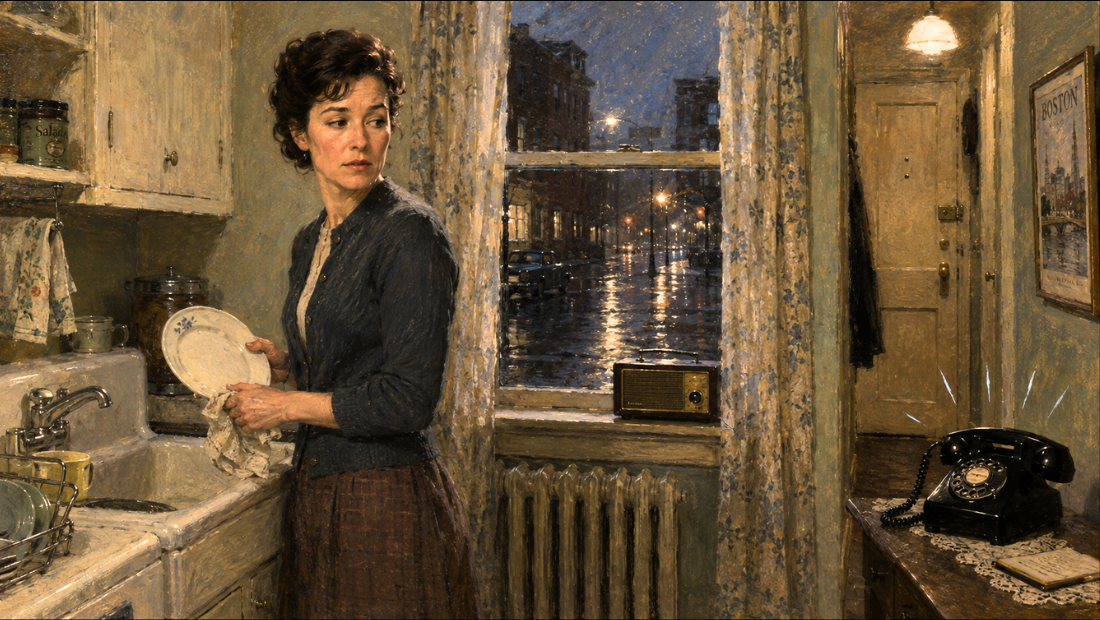
The telephone rang at seven minutes past eight on a rainy Tuesday evening in March of 1963.
Eleanor Whitcomb was standing at the kitchen sink of her small Boston apartment, rinsing the remains of supper from a white china plate. The radio on the windowsill murmured through static about rain continuing through Wednesday, perhaps clearing by Thursday. Outside, automobile tires whispered along the wet street below.
The telephone rang again.
It was a black Western Electric set on a narrow table beside the hallway, heavy enough to serve as a weapon and expensive enough that Eleanor still noticed the monthly bill.
She dried her hands and answered.
“Hello?”
A man’s voice came through the line.
“Mr. Carlson?”
Elenor said.
“I’m afraid you have the wrong number.”
There was a brief silence.
“Oh. I’m terribly sorry.”
His voice was pleasant. Low and educated without sounding affected. He seemed genuinely embarrassed.
“No harm done,” Eleanor said.
“I hope I haven’t interrupted anything important.”
“Only the dishes.”
The man laughed softly.
“Then perhaps Mr. Carlson has inadvertently done you a favor.”
Eleanor smiled despite herself.
“He has.”
“Well, I’ll let you return to them. Good evening, Miss…”
“Whitcomb.”
Another small pause followed.
“Miss Whitcomb.”
“Eleanor.”
“Good evening, Eleanor.”
She hung up and stood beside the telephone for several seconds.
Then she returned to the dishes.
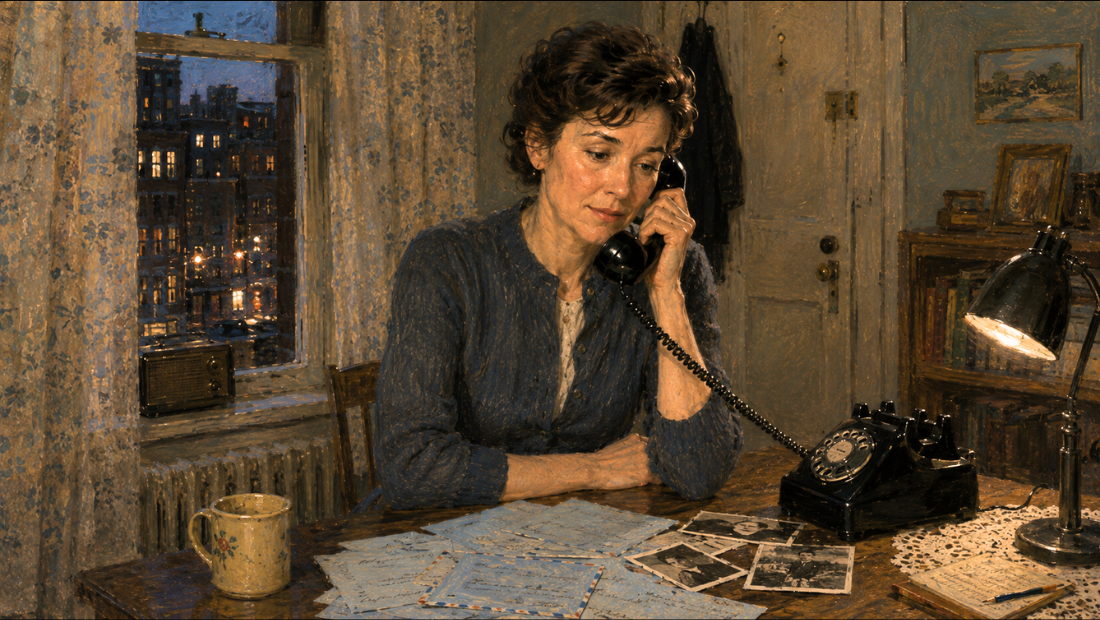
The next evening, at almost exactly the same time, the telephone rang again.
“Mr. Carlson?”
Eleanor laughed.
“You are either extremely unlucky with telephone numbers or exceptionally determined.”
The man laughed too.
“I copied the number incorrectly yesterday, then apparently copied my own mistake. It seems I have a gift for consistency.”
This time they talked for eleven minutes.
His name was Richard Harlan. He was forty-two years old, an engineer living in New York City, though his work took him around the country. He had been widowed four years earlier. His mother lived in Philadelphia. He liked Gershwin, detective novels, strong coffee, baseball when the Yankees were losing, and rainy evenings when he did not have to be outside in them.
The following Friday he telephoned again.
There was no mention of Mr. Carlson.
“I decided honesty would save time,” he said.
Eleanor sat on the chair beside the telephone.
They talked until nearly eleven.
After that, Richard became part of the architecture of her evenings.
The telephone rang from New York, Albany, Pittsburgh, Hartford, and once from Chicago, so the operator said, where he complained that the wind had been invented specifically to punish human beings. Long-distance calls were expensive in those days. Every minute carried a price, which gave conversation a peculiar seriousness. Eleanor began confusing the expense of the calls with evidence of sincerity.
They spoke about childhood.
Richard told her about a stern father and a mother who played piano badly but enthusiastically. Eleanor told him how her own mother had died when Eleanor was nineteen and how, even after all these years, she sometimes found herself thinking of something she wanted to tell her.
“What did you want when you were a girl?” Richard asked one evening.
“A house near the water.”
“What kind?”
“Nothing grand. White, perhaps. A porch. A little garden.”
“What would you grow?”
“Roses.”
“What color?”
“Yellow.”
“Yellow roses it is.”
“For what?”
“Our house.”
The line became quiet.
“Too soon?” he asked.
“Yes.”
“I’m sorry.”
Eleanor held the receiver against her ear.
“No,” she said. “Not too soon.”
Letters began arriving.
They came on pale blue airmail stationery in envelopes bearing postmarks from different cities. Richard’s handwriting was confident and slightly slanted. Sometimes the letters ran two pages, sometimes three.
Then came the photographs.
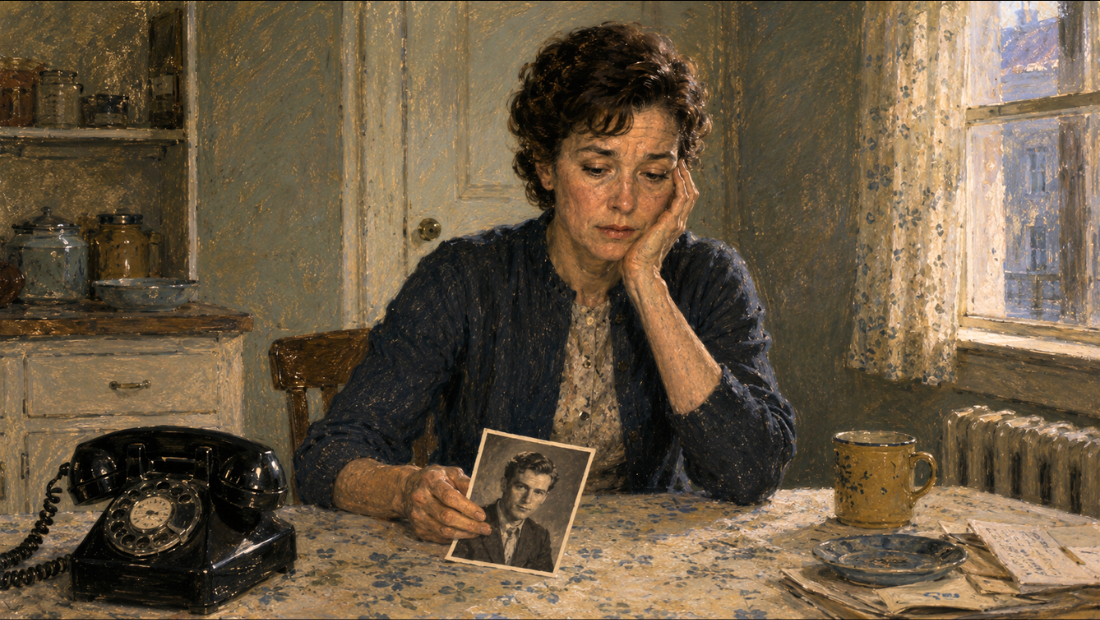
The first showed a tall, fair-haired man beside a lake, sleeves rolled above his elbows, sunlight touching one side of his face. The second showed the same man in a dark suit outside a large stone building. The third was smaller, almost intimate, a head-and-shoulders portrait in which he seemed to be looking directly at Eleanor.
She placed that photograph beside her bed.
When Richard called, she sometimes held it while they spoke.
The technology of 1963 could carry a voice hundreds of miles through copper wire.
Eleanor supplied everything else.
She supplied the gestures she imagined accompanying his words. She supplied the warmth of his hand, the scent of his shaving lotion, the expression on his face when he laughed. She supplied Sunday mornings, dinners, Christmases, arguments, reconciliations, and the white house beside the water.
She supplied the yellow roses.
By May, Richard was talking about marriage.
Then came the first difficulty.
A contract payment had been delayed, he explained. His company was involved in a dispute with a supplier. His own funds had become temporarily entangled in the problem.
He sounded humiliated when he mentioned it.
“Forget I said anything.”
“How much do you need?”
“No, Eleanor.”
“Richard.”
“I shouldn’t have told you.”
“How much?”
Six hundred dollars.
Eleanor went to the bank during her lunch hour and completed a wire transfer.
Richard promised to repay it within ten days.
Ten days later, another problem appeared.
There was a bond that had to be posted.
Then legal expenses.
Then travel costs.
Then money required to release funds that would supposedly repay everything.
Each request arrived wrapped in embarrassment.
Richard never demanded.
He hesitated.
He apologized.
He resisted.
When Eleanor herself hesitated, he became quiet rather than angry.
“I suppose I thought we were building something together.”
They were.
Eleanor simply misunderstood what was being built.
By late June, her savings were gone.
By July, she had withdrawn money her father had left her. She sold a small group of bonds and emptied an investment account she had carefully maintained for more than a decade.
Richard was coming to Boston.
Friday.
Then Monday.
Then the following weekend.
Each journey was postponed by another unavoidable complication.
Finally, on a hot July afternoon, Eleanor telephoned the engineering company whose name Richard had mentioned repeatedly.
The receptionist had never heard of him.
Eleanor tried another number.
Then another.
She checked the address he had used in New York.
No Richard Harlan lived there.
The discovery of the photographs came almost accidentally. A faint studio mark appeared on the back of one print. Eleanor telephoned the photographer.
The man in the photograph was a commercial model from Connecticut.
His name was not Richard Harlan.
He was not an engineer.
He had never lived at Richard’s address.
He had never written Eleanor Whitcomb.
He had never spoken to her.
The photographs had been purchased months earlier by someone using another name.
Eleanor sat at her kitchen table with the portrait lying in front of her.
She stared into the stranger’s face for almost an hour.
Then she telephoned Richard.
The number had been disconnected.
She called again.
Disconnected.
A third time.
Disconnected.
For the next two weeks, Eleanor moved through her apartment as though something enormous had exploded without disturbing a single piece of furniture.
Everything was still there.
Nothing was where it belonged.
The telephone became unbearable. She hated its shape, its ringing, the small circular holes in the dial.
Yet she watched it constantly.
She reread the letters.
She examined dates, postmarks, handwriting, phrases. She searched for evidence that some portion of the relationship had been genuine.
She replayed conversations in her mind.
She remembered the yellow roses.
She hated him.
Then she missed him.
Then she hated herself for missing someone who had never existed.
The bank began sending notices.
A problem involving tax documents and transfers brought correspondence from the Internal Revenue Service. The government had questions Eleanor barely understood about transactions she had made for reasons she could no longer explain without feeling ashamed.
She stopped sleeping properly.
Food lost its taste.
Friends telephoned, but she invented headaches and colds.
One afternoon she found herself standing on a bridge over the Charles River.
She looked down at the water for a very long time.
The idea of dying had begun appearing in her mind without drama. It seemed less like violence than like an administrative solution. A closing of accounts. A room where telephones could not ring and strangers could not lie.
She eventually walked home.
Two days later she was wandering through Beacon Hill without destination when she noticed a bookstore.
It occupied a narrow space between an old tailor’s shop and a boarded building.
The wooden sign above the entrance read:
HOLLIS & SON
BOOKSELLERS
EST. 1881
Eleanor had walked that street before, though she could not remember seeing the shop.
She entered.
A brass bell sounded above the door.
The store smelled of dust, old leather, paper, and something faintly medicinal. Books climbed from floor to ceiling. They lay in untidy stacks on tables and leaned against one another on shelves.
Behind the counter sat an elderly man in a gray cardigan.
He looked up.
“Something particular?”
Eleanor almost said no.
Instead, perhaps because despair had removed her concern about sounding foolish, she asked the truth.
“Do you have a book that can cure sorrow?”
The old man studied her face.
Not sympathetically.
Not suspiciously.
Simply carefully.
“Yes,” he said.
Eleanor gave a small laugh.
“You do?”
“I believe so.”
He rose and disappeared between the shelves.
Several minutes passed.
When he returned, he carried a tiny volume covered in faded green cloth. Dust had settled deeply into the edges.
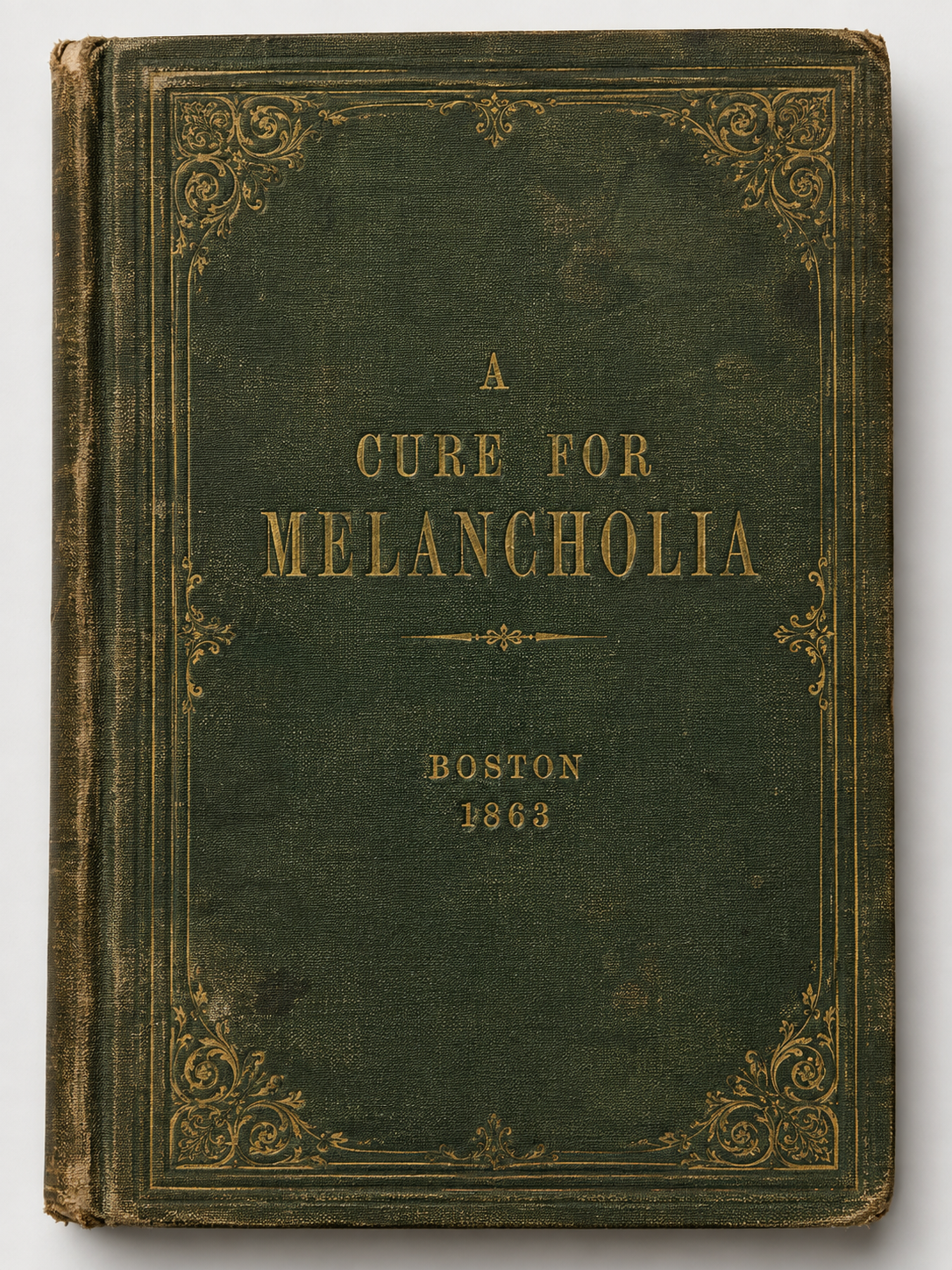
Stamped across the front in tarnished gold letters were the words:
A CURE FOR MELANCHOLIA
Beneath them:
BOSTON
1863
There was no author’s name.
But inside, the author was listed as “A. Azaziel.”
Eleanor turned it over.
“How much?”
“One dollar.”
“Does it work?”
The bookseller looked toward the window.
“They usually do.”
“Usually?”
“Books are rather like medicines. The difficulty is not always whether the prescription works.”
“What is the difficulty?”
“Whether the patient follows it.”
Eleanor paid him.
She placed the little book in her handbag and walked home.
By the time she reached her apartment, she had forgotten it was there.
That night the despair became almost unbearable.
She sat at the kitchen table with Richard’s letters scattered around her. Midnight passed. Then one o’clock.
She cried until her body seemed incapable of producing another tear.
When she stood, she struck the table with her hip. Her handbag slipped from the chair and fell open.
Coins scattered across the floor. Her lipstick rolled beneath the table.
The green book landed beside her shoe.
Eleanor stared at it.
Then remembered.
She carried it to the sofa.
The book contained only twelve pages.
Most were filled with strange nineteenth-century observations about melancholia, written in formal language that treated grief almost as a physical substance.
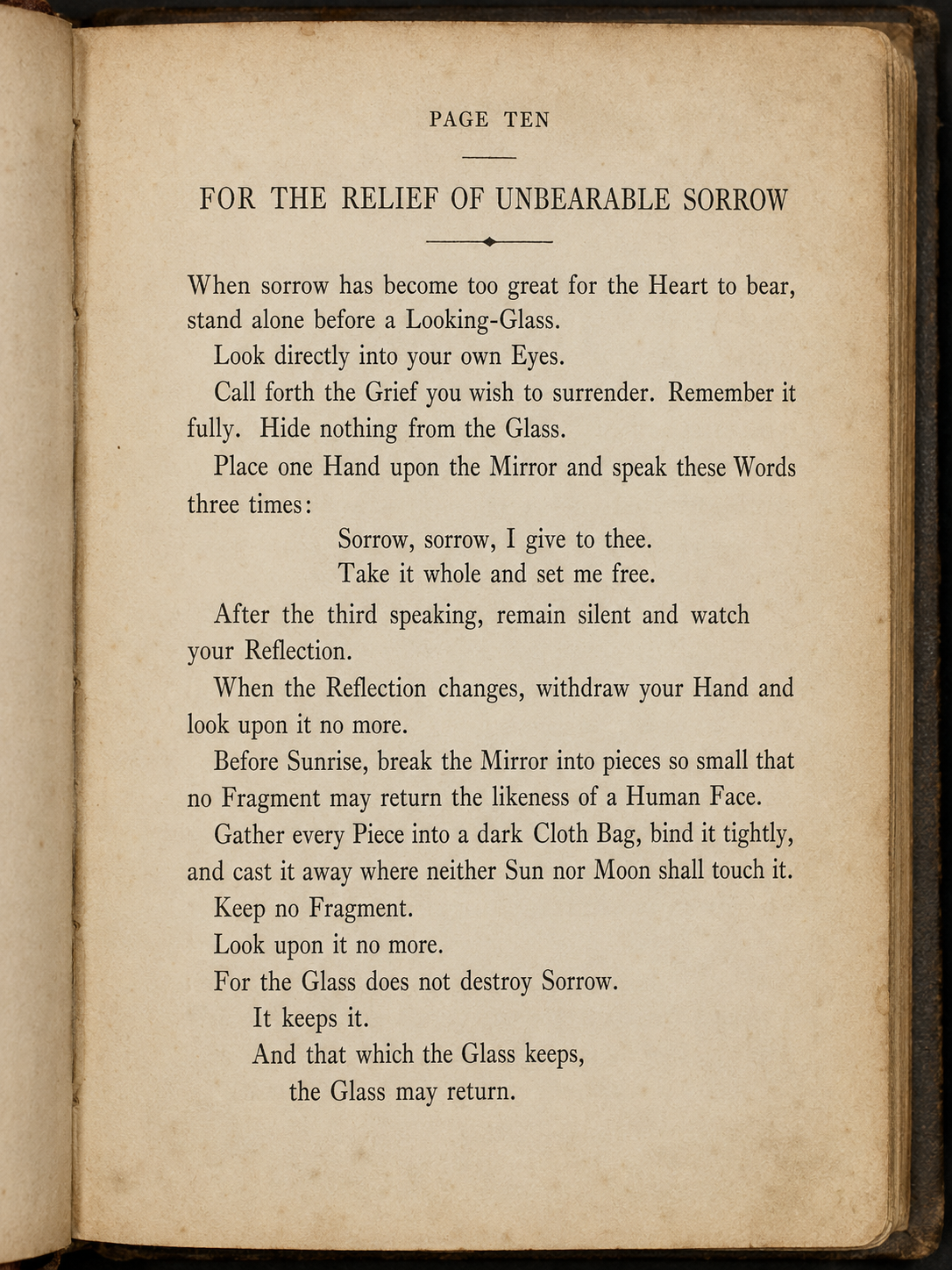
On the tenth page appeared a heading.
FOR THE RELIEF OF UNBEARABLE SORROW
The instructions were simple.
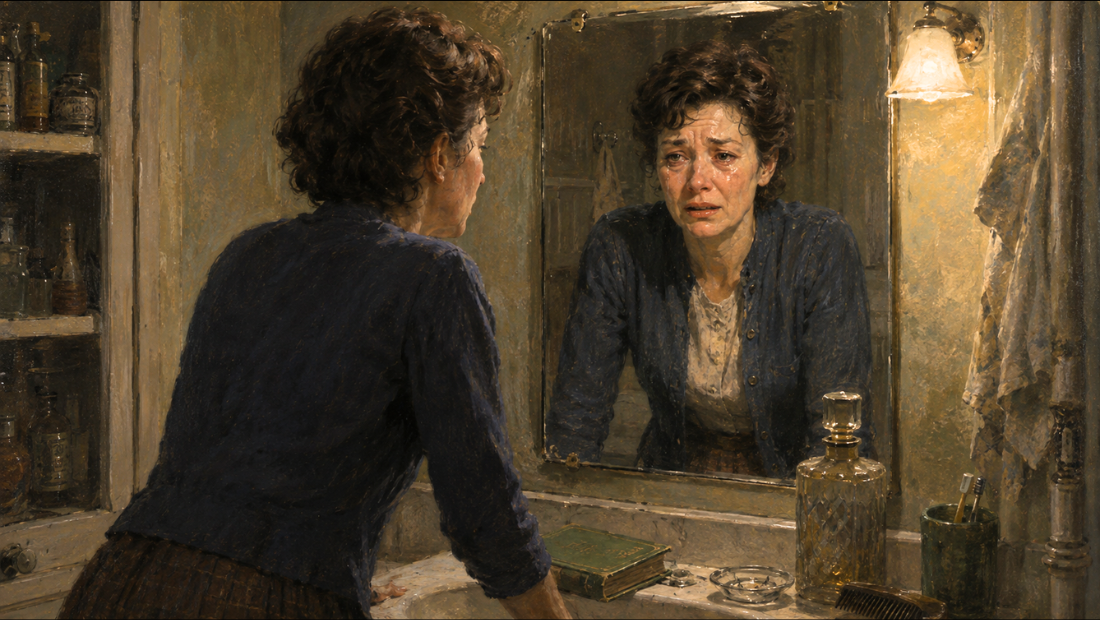
The afflicted person was to stand before a mirror and look directly into the eyes of the reflection. Every grief was to be remembered completely, without resistance or distraction.
Then the sufferer was to say:
“Sorrow, sorrow, I give to thee.
Take it whole and set me free.”
The person was to remain before the glass until the reflection changed.
Afterward, the mirror had to be broken.
Every fragment was to be broken again until no piece remained large enough to reflect a recognizable human face.
The pieces were then to be sealed inside a dark cloth bag and discarded where neither sunlight nor moonlight could touch them.
Eleanor read the instructions twice.
Then she entered the bathroom.
The woman in the mirror scarcely resembled the person Eleanor remembered.
Her hair was untidy. Her eyes were swollen. Her face looked older.
She stared into those eyes.
At first she felt ridiculous.
Then she thought about Richard.
The first wrong number.
Mr. Carlson.
The letters.
The photographs.
The voice.
The money.
The disconnected telephone.
The stranger in the photograph.
The white house.
The yellow roses.
She felt everything rise inside her.
Her breathing became shallow.
Tears ran down her face.
“Sorrow, sorrow, I give to thee,” she whispered.
She swallowed and tried again.
“Sorrow, sorrow, I give to thee. Take it whole and set me free.”
Nothing happened.
She said it two more times.
Then the bathroom light flickered.
Eleanor froze.
Something in the mirror had changed.
Not the face.
The eyes.
For one impossible instant, the woman inside the glass appeared to be crying harder than Eleanor was.
Eleanor stepped backward.
The instructions said to break the mirror.
She reached for a heavy perfume bottle.
Then stopped.
Her mother had helped her choose that mirror when Eleanor first moved into the apartment.
She could not destroy it.
Instead, she found an old white bedsheet and carefully draped it over the glass.
She fastened the cloth at the top.
Then she went to bed.
The following morning the sun was shining.
There was not a cloud over Boston.
Eleanor opened her eyes at seven-fifteen and remained quietly beneath the blankets.
Something was different.
She felt light.
Not happy exactly.
Free.
She stretched.
Then she smiled.
She made coffee and opened the windows.
The city seemed to have been washed during the night. The air was cool. Sunlight fell across the kitchen floor.
Eleanor began humming while she dressed.
Something unpleasant had happened to her recently. She knew that.
There had been a man.
Richard.
Money.
Some sort of terrible mistake.
But whenever she tried to approach the memory, it seemed to recede from her.
The facts remained.
Their weight had vanished.
There was no grief.
No shame.
No longing.
No fear.
No despair.
Eleanor Whitcomb had found her cure.
A week later, she threw away the little green book while cleaning.
She scarcely noticed it.
Months passed.
The financial problems were slowly resolved. The tax correspondence ended. Eleanor found a better position at another company.
She joined a local music society.
She went dancing.
She bought new clothes.
Friends told her she looked younger.
“You’re like a different woman,” one of them said.
Perhaps she was.
The bathroom mirror remained covered.
At first Eleanor remembered why.
Eventually she forgot.
Nearly a year passed.
Then came a Saturday evening in September.
Eleanor had been invited to a party in Cambridge. She had bought a navy blue dress for the occasion and a cream-colored blouse with small pearl buttons.
She arranged her hair carefully.
She applied lipstick using a small compact mirror.
The light was poor.
She frowned and looked toward the bathroom sink.
The old sheet still covered the wall mirror.
Eleanor stared at it.
For a moment she could not remember why it was there.
Then she laughed at herself.
“What nonsense.”
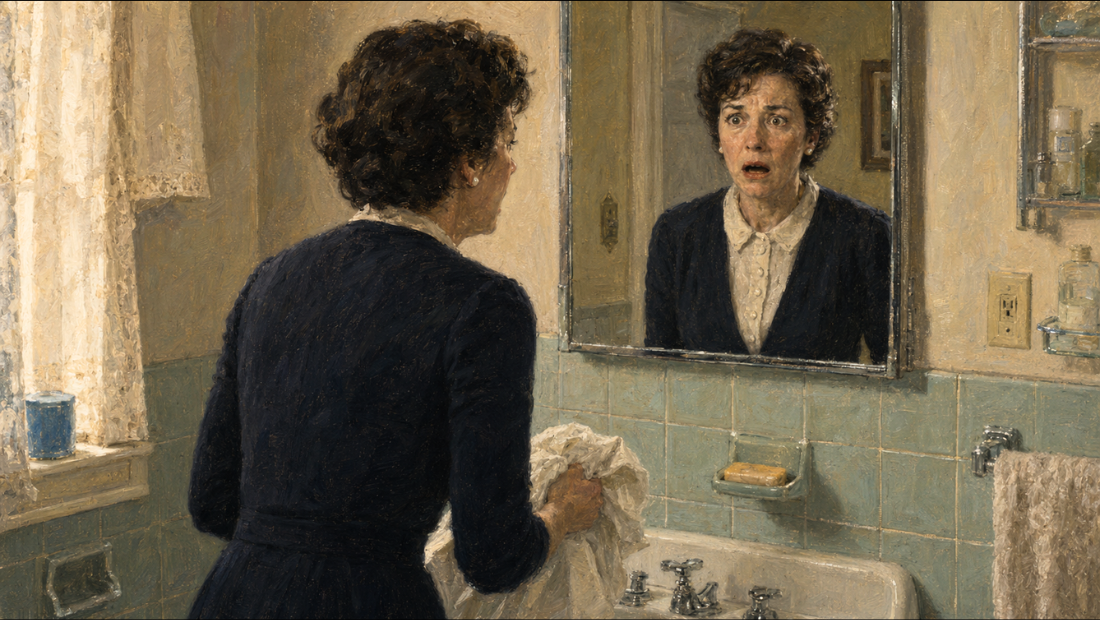
She reached up and pulled down the cloth.
Her reflection appeared.
For one second, nothing happened.
Then the year disappeared.
Richard’s voice filled her mind.
Mr. Carlson?
The laughter.
The letters.
The photographs.
The yellow roses.
The bank.
The money.
The lies.
The disconnected number.
The stranger’s face.
The bridge over the Charles.
The shame.
The fear.
The loneliness.
Every ounce of sorrow she had surrendered returned at once.
Not faded.
Not softened.
Preserved.
The mirror had not destroyed anything.
It had kept everything.
Eleanor screamed.
She collapsed onto the bathroom floor.
Hours later, she crawled into the living room and began tearing through drawers and cabinets.
The book.
She needed the book.
She emptied shelves.
Opened boxes.
Dumped handbags onto the floor.
Then she remembered.
She had thrown it away almost a year earlier.
She tried to remember the words.
“Sorrow… sorrow…”
Something about giving.
Something about freedom.
She stood before the mirror.
“Sorrow, I give you…”
Nothing.
“Take my sorrow and set me…”
Nothing.
She covered the glass again.
The pain remained.
The rules had been quite specific.
The mirror should have been destroyed.
Instead, she had preserved it.
And apparently it had preserved her sorrow with equal care.
The next morning Eleanor hurried back to Beacon Hill.
She found the tailor.
She found the boarded building.
Between them was a vacant lot.
She stopped on the sidewalk.
A man was sweeping outside the tailor shop.
“The bookstore,” Eleanor said.
He looked at her.
“What bookstore?”
“Hollis and Son.”
The man frowned.
“There isn’t any bookstore.”
“There was. Right here.”
He shook his head.
“No, ma’am.”
“An old man worked there. Gray sweater. Books everywhere.”
The man leaned on his broom.
“Lady, I’ve worked here seventeen years.”
Eleanor pointed toward the empty lot.
“There was a building there.”
“Oh, there was a building.”
“When did the bookstore close?”
The man looked at her strangely.
“That building burned down before I was born.”
“When?”
“Before the war.”
Eleanor stared at him.
“Which war?”
“The first one.”
She returned home.
She did not attend the party.
Another invitation arrived the following week.
She declined.
Then another.
Eventually invitations stopped coming.
Eleanor stopped answering the telephone.
She stopped opening the curtains.
Neighbors saw her occasionally carrying groceries upstairs.
Then they saw her less often.
The years passed quietly.
Dust gathered in the apartment. Wallpaper curled away from the walls. Paint yellowed.
The bathroom mirror remained uncovered.
Eleanor sat before it for hours.
No one knew what she saw.
Perhaps she saw Richard.
Perhaps she saw herself.
Perhaps she saw only the accumulated suffering of one human life reflected back without mercy.
Epilogue
In November of 1969, neighbors complained about an odor in the hallway.
Police entered the apartment.
They found Eleanor on the bathroom floor.
She had been dead for several days.
The coroner found nothing remarkable.
There was an undernourished woman of forty-four, an apartment neglected for years, and an ordinary bathroom mirror hanging above an ordinary porcelain sink.
There was nothing written on the glass.
No crack.
No mysterious symbol.
Nothing a policeman could photograph that would make sense of the room.
Only fingerprints.
Both of Eleanor’s hands had apparently been pressed against the mirror shortly before she died.
It looked almost as though she had been trying to push something back inside.
Or perhaps retrieve something from the other side.
The official record eventually reduced Eleanor Whitcomb’s death to a collection of acceptable words.
Natural causes.
Neglect.
Isolation.
Government forms, however, contain no convenient line for unbearable sorrow.
Eleanor’s mistake had been a simple one.
She had discovered something capable of removing pain and believed she had discovered healing.
For one year the mirror gave her exactly what she requested. It removed the grief, the terror, the humiliation, and the despair.
What it did not give her was understanding.
It did not teach her how deception had worked.
It did not help her reconcile love with betrayal.
It did not rebuild confidence in her judgment.
It did not allow grief to change slowly into memory.
It did not help her construct a life that could contain what had happened without being ruled by it.
The mirror merely stored the suffering.
And stored suffering is not healed suffering.
There are no incantations that remove trauma.
There are no mirrors capable of swallowing grief forever.
There are no twelve-page books containing painless roads out of human anguish.
Sorrow refused is still sorrow.
Pain hidden from sight remains pain.
Eleanor had spent her final years searching for a doorway around suffering when what she needed was a path through it.
Such a path is slower.
It asks more of the traveler.
Truth. Understanding. Support. Time. Repetition. Grief. Learning. Acceptance. The rebuilding of trust and identity. The gradual reclamation of a life larger than what happened.
No magic.
No shortcuts.
Only recovery.
And if Eleanor Whitcomb had somehow found that road instead of the little bookstore on Beacon Hill, she might have discovered the one place where sorrow can be carried without being allowed to become the whole of a human life.
A place just beyond despair.
Somewhere in the Recovery Zone.
—————————————-
By Tim McGuinness Ph.D.
August 2026
© 2026




Afterthought
This story is an original work of fiction created by the author to speak to a very real experience shared by many victims and survivors: the desperate wish to make overwhelming sorrow, grief, and trauma simply disappear. When suffering becomes intense, it is natural to want a quick solution, but recovery does not come from magic, pills, shortcuts, or easy answers. Recovery is a difficult process that requires commitment, participation, patience, learning, and personal responsibility.
The Yellow Brick Road is not always easy to walk. There can be setbacks, painful discoveries, and moments when continuing feels difficult if not impossible. But those who remain committed to their recovery, accept responsibility for doing the work, and continue moving forward can rebuild their lives. You are not alone. Thousands have gone before you and reached recovery.
At the SCARS Institute, we have seen thousands of victims and survivors make that journey successfully. We hope this story helps you see that taking shortcuts backfires, that recovery is possible for you as well if you follow the right path
It was not your fault.
You are a survivor.
You are not alone.
You are worthy – Axios.
You are stronger than you know.
You are responsible.
We wish you all the best!

Author Biographies
-/ 30 /-
What do you think about this?
Please share your thoughts in a comment below!
This work is copyright © 2026 by Tim McGuinness, Ph.D.
Recovery Zone™ is a trademark of the SCARS Institute – Society of Citizens Against Relationship Scams Inc.
All Rights Reserved Worldwide
Please Tell Us What You Took From This?
Please Leave A Comment!
Commenting Is An Essential Part Of Healing
Read • Think • Write
One Comment
Leave A Comment
TABLE OF CONTENTS







CATEGORIES

ARTICLE META
Important Information for New Scam Victims
- Please visit www.ScamVictimsSupport.org – a SCARS Website for New Scam Victims & Sextortion Victims.
- SCARS Institute now offers its free, safe, and private Scam Survivor’s Support Community at www.SCARScommunity.org – this is not on a social media platform, it is our own safe & secure platform created by the SCARS Institute especially for scam victims & survivors.
- SCARS Institute now offers a free recovery learning program at www.SCARSeducation.org.
- Please visit www.ScamPsychology.org – to more fully understand the psychological concepts involved in scams and scam victim recovery.
If you are looking for local trauma counselors, please visit counseling.AgainstScams.org
If you need to speak with someone now, you can dial 988 or find phone numbers for crisis hotlines all around the world here: www.opencounseling.com/suicide-hotlines
Statement About Victim Blaming
Some of our articles discuss various aspects of victims. This is both about better understanding victims (the science of victimology) and their behaviors and psychology. This helps us to educate victims/survivors about why these crimes happened and not to blame themselves, better develop recovery programs, and help victims avoid scams in the future. At times, this may sound like blaming the victim, but it does not blame scam victims; we are simply explaining the hows and whys of the experience victims have.
These articles, about the Psychology of Scams or Victim Psychology – meaning that all humans have psychological or cognitive characteristics in common that can either be exploited or work against us – help us all to understand the unique challenges victims face before, during, and after scams, fraud, or cybercrimes. These sometimes talk about some of the vulnerabilities the scammers exploit. Victims rarely have control of them or are even aware of them, until something like a scam happens, and then they can learn how their mind works and how to overcome these mechanisms.
Articles like these help victims and others understand these processes and how to help prevent them from being exploited again or to help them recover more easily by understanding their post-scam behaviors. Learn more about the Psychology of Scams at www.ScamPsychology.org
SCARS INSTITUTE RESOURCES:
If You Have Been Victimized By A Scam Or Cybercrime
♦ If you are a victim of scams, go to www.ScamVictimsSupport.org for real knowledge and help
♦ Enroll in SCARS Scam Survivor’s School now at www.SCARSeducation.org
♦ To report criminals, visit https://reporting.AgainstScams.org – we will NEVER give your data to money recovery companies like some do!
♦ Follow us and find our podcasts, webinars, and helpful videos on YouTube: https://www.youtube.com/@RomancescamsNowcom
♦ Learn about the Psychology of Scams at www.ScamPsychology.org
♦ Dig deeper into the reality of scams, fraud, and cybercrime at www.ScamsNOW.com and www.RomanceScamsNOW.com
♦ Scam Survivor’s Stories: www.ScamSurvivorStories.org
♦ For Scam Victim Advocates visit www.ScamVictimsAdvocates.org
♦ See more scammer photos on www.ScammerPhotos.com
You can also find the SCARS Institute’s knowledge and information on Facebook, Instagram, X, LinkedIn, and TruthSocial
Psychology Disclaimer:
All articles about psychology and the human brain on this website are for information & education only
The information provided in this and other SCARS articles are intended for educational and self-help purposes only and should not be construed as a substitute for professional therapy or counseling.
Note about Mindfulness: Mindfulness practices have the potential to create psychological distress for some individuals. Please consult a mental health professional or experienced meditation instructor for guidance should you encounter difficulties.
While any self-help techniques outlined herein may be beneficial for scam victims seeking to recover from their experience and move towards recovery, it is important to consult with a qualified mental health professional before initiating any course of action. Each individual’s experience and needs are unique, and what works for one person may not be suitable for another.
Additionally, any approach may not be appropriate for individuals with certain pre-existing mental health conditions or trauma histories. It is advisable to seek guidance from a licensed therapist or counselor who can provide personalized support, guidance, and treatment tailored to your specific needs.
If you are experiencing significant distress or emotional difficulties related to a scam or other traumatic event, please consult your doctor or mental health provider for appropriate care and support.
Also read our SCARS Institute Statement about Professional Care for Scam Victims – click here
If you are in crisis, feeling desperate, or in despair, please call 988 or your local crisis hotline – international numbers here.
More ScamsNOW.com Articles







A Question of Trust
At the SCARS Institute, we invite you to do your own research on the topics we speak about and publish. Our team investigates the subject being discussed, especially when it comes to understanding the scam victims-survivors’ experience. You can do Google searches, but in many cases, you will have to wade through scientific papers and studies. However, remember that biases and perspectives matter and influence the outcome. Regardless, we encourage you to explore these topics as thoroughly as you can for your own awareness.



I’d sooner be following the yellow brick road and doing the necessary work toward recovery rather than looking for an escape from what happened.