



Stability Is Not Resilience After Scam Survivor Recovery – 2026

The SCARS Institute Magazine about Scam Victims-Survivors, Scams, Fraud & Cybercrime
- Published: 9/13/26
- Modified: 10/6/26
- Comments: 2
- Read Status:

Stability Is Not Resilience After Scam Survivor Recovery
Becoming Stable is Not the Same Thing as Being Recovered – When Recovery Is Tested Years Later
Infographic: The Five Stages of Scam Victim/Survivor Healing & Recovery
Primary Category: Psychology / Recoverology
Author:
• Tim McGuinness, Ph.D., DFin, MCPO, MAnth – Anthropologist, Scientist, Polymath, Managing Director of the Society of Citizens Against Relationship Scams Inc.
Author Biographies Below
About This Article
Scam victim recovery can continue long after a survivor appears stable and has returned to a normal life. A later crisis involving health, finances, bereavement, housing, family, retirement, or another major change can expose unresolved vulnerabilities and weakened resilience. Stage 4, identified as the Returner stage, describes survivors who encounter a new disruption and discover that earlier stability did not fully restore their ability to tolerate uncertainty, make difficult decisions, or adapt under stress. Returning to support and professional therapy at this stage should be understood as continuing recovery rather than regression. Stage 5, the Integrator stage, reflects deeper trauma management, accepted grief, restored resilience, stronger boundaries, and the ability to remain psychologically capable when life changes again.
Note: This article is intended for informational purposes and does not replace professional medical advice. If you are experiencing distress, please consult a qualified mental health professional.
Keywords
Scam Recovery, Resilience, Stability, Stage 4 Recovery, Returners, Integrators, Trauma Management, Grief Acceptance, Therapy, Adaptability

Becoming Stable is Not the Same Thing as Being Recovered – When Recovery Is Tested Years Later
Author’s Note
Many scam survivors understandably believe that recovery is complete once life becomes stable again. They have rebuilt routines, finances, relationships, and a sense of personal safety, sometimes over many difficult years. What becomes visible much later is that stability does not always reveal how well resilience has been restored. A new crisis can expose vulnerabilities that had no reason to appear while life remained predictable.
Recognizing this later stage changes the meaning of returning for help. A survivor who needs support or therapy again years after the scam has not lost everything that was previously gained. The person has encountered a new test that reveals another part of the healing process. Recovery continues as life continues, and sometimes the strongest response to a new crisis is recognizing that it is time to return, learn more, rebuild & expand resilience, and move toward a deeper and more durable peace.
A New Crisis
There is a stage in scam recovery that receives very little attention because it usually appears long after everyone believes the worst is over. The criminal is gone, the constant rumination has quieted, daily life has become manageable again, and the survivor has gradually rebuilt a sense of order. Housing is stable, finances are mostly under control, relationships have found a new balance, and there is enough peace for ordinary life to feel ordinary again. There may even be real joy. Years can pass in this state, and both the survivor and the people around them understandably begin to think of recovery as something largely completed.
Then something significant changes.
It may be a serious health problem, the death of a spouse, retirement, job loss, the need to sell a home, an unexpected financial setback, family conflict, a legal problem, caregiving responsibilities, a new trauma, or another major transition that alters the structure of everyday life. The event does not need to resemble the scam in any obvious way. What matters is that it introduces uncertainty, risk, difficult decisions, and the possibility that the future may no longer unfold as expected.
At that point, something surprising sometimes happens. The resilience everyone assumed had been rebuilt does not appear. The survivor becomes hesitant, overwhelmed, or unable to make decisions. Problems that would once have been approached practically now produce disproportionate fear. Old doubts about judgment return. Uncertainty becomes difficult to tolerate. Decisions are postponed because every option seems capable of creating another disaster. The survivor who appeared settled and capable can suddenly feel psychologically immobilized.
This experience is confusing precisely because the earlier recovery was real. The years of stability were not an illusion. The survivor did rebuild. The peace was genuine. The ability to enjoy life again was genuine. What the later crisis reveals is something more subtle: stability and resilience are not the same thing.
This can come on gradually, or suddenly, depending on the triggering event. This can come on 3, 5, 8, even more than 10 years forward in life – there is no schedule. It just comes.
Stability Can Hide an Unfinished Vulnerability
Stability means that life functions under the conditions that currently exist. The bills are paid, routines are familiar, responsibilities are understood, relationships are predictable enough, and tomorrow generally resembles today. After the chaos of profound victimization, reaching that point is an enormous achievement. A predictable life provides the nervous system with exactly what it has been missing: evidence that danger has passed and that the world has become understandable again.
Resilience requires something different. Resilience is the ability to remain psychologically functional when the conditions that created stability no longer exist. It means tolerating disruption, reorganizing when plans fail, making decisions without perfect information, and continuing to move when the future cannot be guaranteed. More importantly, continuing to manage trauma even when new traumas appear.
A survivor can become highly stable without fully rebuilding that capacity.
This distinction remains hidden as long as life stays within the new familiar boundaries. A person may live successfully for years without facing anything that seriously tests the ability to adapt under uncertainty. The survivor appears resilient because there is no longer much disruption to absorb. Stability itself protects the person from discovering where the remaining vulnerabilities are.
The later crisis removes that protection. It exposes the incomplete shell.
The Irony of Therapy: Stability Is Not the End of Healing
There is an irony built into the way psychotherapy is often practiced. Much of therapy is organized around stabilization. The therapist helps a client reduce immediate distress, regain basic functioning, improve sleep, manage anxiety, reduce crisis behaviors, restore routines, and develop enough emotional regulation to live more effectively. These goals are important, and in many cases they are exactly what the client needs first. But stability can easily become mistaken for completion.
Once a person is functioning again, therapy may slow down or end. The client (survivor) is working, maintaining relationships, paying bills, sleeping better, and no longer appearing to be in acute crisis, hyperactivation, or hypervigilance. From a conventional treatment perspective, those changes can reasonably be interpreted as success. Insurance limitations, financial realities, treatment planning, the client’s own desire to move forward, recovery fatigue, and the therapist’s judgment that major goals have been achieved can all contribute to therapy ending after one, two, or several years.
The problem is that trauma does not necessarily follow the same timetable.
A traumatized person can become stable long before the underlying psychological work is complete. Stability means that the person has learned how to function inside the current environment. It does not necessarily mean that betrayal or moral injury has been fully integrated, the many kinds of grief have been completed, trust has been rebuilt, old attachment injuries have been understood, or confidence in personal judgment has become resilient under new stress. A person can appear remarkably well while still carrying unresolved vulnerabilities that remain quiet only because life has become predictable and seemingly safe.
This is especially important after profound scam victimization. A survivor may spend the first years learning how to stop thinking constantly about the criminal, rebuild financial order, understand manipulation, manage shame, restore routines, and regain some sense of personal identity. Those achievements can create a life that feels peaceful again. Yet earlier trauma, unresolved grief, damaged trust, fear of making mistakes, and sensitivity to uncertainty can remain beneath that stability. Nothing in daily life may demand that those vulnerabilities reveal themselves.
The later crisis exposes them. Sometimes slowly, like cracks in the foundation of a building. Sometimes like a dam collapsing and sending a wall of water to destroy whatever is in its path.
This is where the irony becomes clear. Therapy may have succeeded at exactly what it was designed to accomplish. The survivor became stable. Daily functioning returned. Distress decreased. The immediate crisis (or crises) passed. But trauma management is not always a problem that reaches a clean endpoint. Some aspects of trauma require continued attention across different stages of life because new circumstances expose different parts of the original injuries.
Grief works in much the same way. A person does not permanently finish grieving simply because grief is no longer present every morning. Loss becomes incorporated into life, and then later events can reactivate parts of it. Anniversaries, illness, retirement, another death, relocation, financial difficulty, or changes in family structure can give an earlier loss new meaning. The person is not necessarily returning to the beginning. Life has simply created a new context in which unfinished emotional material becomes relevant again.
Most of those grieving ask when they can get to acceptance, but no one knows. If you have ask, you have not reached it.
Trauma can behave similarly. The fear that once centered on a scammer or the aftermath may later appear as fear of making a medical decision. The damaged confidence that once appeared as shame over sending money may later emerge as paralysis over selling a home. The uncertainty that once involved recovering after the scam may later become an inability to tolerate ambiguity in retirement, caregiving, finances, or relationships. The surface problem changes, while the deeper vulnerability remains recognizable.
This does not mean that a survivor needs continuous weekly therapy for the rest of life. It means that trauma recovery should be understood as an ongoing developmental process rather than a single episode with a clearly defined ending. Therapy may appropriately stop when stability has been achieved, but the survivor still benefits from understanding that future periods of therapy, consultation, support, or renewed personal work may become necessary as life changes. In this way, it is more similar to substance recovery and maintenance – the addiction is always there, and returning to recovery is usually triggered by crisis or relapses.
The better measure of recovery is not whether a person remains permanently free of distress. That standard is unrealistic for anyone. A stronger measure is whether the person has acquired the tools and skills to recognize when an old vulnerability has returned, understand why it has been activated, and seek appropriate support before paralysis, avoidance, or fear begins controlling major decisions.
The deepest work of trauma recovery therefore continues beyond stabilization. Stability creates the conditions in which deeper work becomes possible. It gives a survivor enough safety to examine grief, identity, attachment, trust, self-concept, uncertainty, and the meaning of what happened without being overwhelmed by immediate crisis.
In that sense, therapy does not fail when someone needs help again years later.
The mistake is believing that stability meant there would never be anything more to work through. A mistake we have seen firsthand hundreds of times.
The Scam Already Required an Enormous Amount of Adaptation
Profound scam victimization consumes psychological resources in ways that are difficult for outsiders to appreciate. A survivor is not simply recovering from the loss of money. The person has to reconstruct an entire understanding of reality. A relationship that appeared meaningful was fabricated. Memories once understood as expressions of affection now are reconsidered as elements of manipulation. Decisions that felt reasonable at the time become sources of shame after the deception is exposed. Future plans disappear, financial security is damaged, and confidence in personal judgment collapses.
Recovery then demands another enormous effort. The survivor has to grieve, learn, reorganize finances, rebuild routines, repair relationships, understand manipulation, restore self-trust, tolerate embarrassment, and construct a future that looks nothing like the one previously imagined. In many cases, this work continues for years, assuming it continues.
A person can complete that process successfully and still emerge with less unused adaptive capacity than before. This is the great irony of recovery.
The survivor functions well because the rebuilt life has become predictable. The person knows how to live inside the new normal and shifted baselines. What has not necessarily been tested is how well that system responds when the new normal itself changes or disappears.
This is why a later disruption can produce a reaction that seems disproportionate to the event. The new problem may not objectively be greater than challenges the survivor handled before the scam. The difference is that uncertainty now carries additional meaning. The nervous system has already learned what can happen when reality suddenly proves less secure than it appeared.
The New Crisis Does Not Need to Resemble the Original Crime
The later event may involve no deception at all. It can be completely unrelated to fraud, criminals, relationships, or money. What connects the later crisis to the earlier trauma is not necessarily the subject matter. The connection is uncertainty and loss of control. It will typically be related to the big three plus one: attachment, betrayal, threat to life, and/or moral injury.
A scam teaches painful lessons about uncertainty. It demonstrates that a person can feel confident and still be wrong because critical information was deliberately withheld or falsified. It teaches that circumstances can change rapidly. It shows that decisions made in good faith can have devastating consequences when the information supporting those decisions has been manipulated. It creates direct experience with the collapse of plans that once seemed certain.
During recovery, those lessons gradually become less dominant. The survivor does not need to think about them every day. A stable environment allows fear to recede because the surrounding world stops demanding constant judgment under uncertainty.
Then a new crisis arrives and suddenly requires exactly that.
The survivor may need to choose between difficult medical options, decide whether to move, determine how to manage declining finances, respond to a family crisis, sell property, retire, or make another consequential decision without knowing exactly what will happen afterward. The emotional structure is familiar even though the facts are completely different.
There is risk. There is incomplete information. There is uncertainty. There is no guarantee that the decision will be correct.
The question underneath all of it becomes painfully familiar: Can I trust myself when I do not know what is going to happen?
Why Paralysis Can Appear
One of the most important features of this later crisis is the paralysis that can accompany it. The survivor knows something needs to be done but becomes unable to move confidently toward a decision. Research continues, advice is gathered, alternatives are reconsidered, and yet none of this produces enough certainty to act. This is “analysis paralysis.”
This makes sense when the earlier experience is considered carefully.
During the scam, the survivor made decisions that appeared reasonable from inside the reality that had been constructed. Later, those decisions became associated with catastrophic consequences. The money was lost, relationships were damaged, trust was violated, and the survivor may have spent years examining every decision for evidence of personal failure.
A dangerous lesson can form beneath the more conscious understanding of what happened: making the wrong decision can destroy everything.
Once that association exists, uncertainty itself becomes threatening. The survivor begins looking for a degree of certainty that real life rarely provides. Major decisions involving health, money, family, housing, retirement, or relationships rarely come with guarantees. Every choice contains some possibility of regret.
For someone who has already experienced catastrophic regret, that uncertainty can become intolerable. Doing nothing begins to feel safer than making the wrong choice.
The paralysis is therefore not evidence of laziness or lack of intelligence. It is an attempt to avoid another irreversible mistake. Unfortunately, avoidance does not stop life from moving. Decisions eventually become unavoidable, circumstances continue to change, and delay itself begins producing consequences.
Also, ironically, this can make returning to support & recovery providers and therapy much more difficult too.
Old Fear Can Return Without the Survivor Returning to the Past
When this happens, many survivors become frightened by their own reaction. They believe that the return of anxiety, indecision, or self-doubt means they have somehow lost years of progress. They can feel ashamed that they are struggling again after believing they had recovered. That conclusion is unnecessarily harsh.
The earlier recovery remains real. What was learned remains real. The survivor genuinely regained stability. The criminal genuinely became less important. The survivor genuinely regained the capacity for enjoyment, relationships, work, and ordinary life. None of that disappears because another crisis exposes a remaining vulnerability.
What has returned is not necessarily the original trauma. What has returned is an old pattern of responding to uncertainty.
The scam taught the survivor that certainty could be false, judgment could be manipulated, and apparently safe decisions could produce terrible consequences. Those lessons became quiet because life became stable. The later crisis makes them relevant again.
This means the survivor has not returned to the beginning. The survivor has reached another stage.
We call this “Stage 4 Recovery.”
Recovery From the Past Is Not the Same as Readiness for the Future
This distinction may represent one of the most overlooked parts of scam recovery. Much of recovery understandably concentrates on understanding and integrating what already happened. The survivor learns about manipulation, attachment, grooming, coercion, trauma, grief, shame, and self-blame. The person reconstructs the past until it becomes understandable enough to live with.
That work is essential, but it does not automatically prepare someone for the next major disruption.
A person can learn how to live after betrayal without becoming comfortable with future uncertainty. A person can rebuild safety without rebuilding confidence in instability. A person can construct a good new normal while still depending psychologically upon that normal remaining intact.
The final task is broader. The survivor eventually has to trust not only the life that has been rebuilt, but the ability to rebuild again if necessary.
That is a different kind of confidence.
- It does not say, “Everything is finally under control.”
- It says, “Things will change again, and I will still be able to respond.”
The Missing Final Stage of Resilience
Scam victim healing and recovery does not end with stability alone. The later stage needs to involve deliberate rebuilding of adaptability.
This means that even though the survivor’s life is stable and they are living their new normal, there is more to learn. More to grow. Returning to support should not be viewed as a failure, but a recognition that the journey continues.
That means adding focus on gradually becoming comfortable with manageable uncertainty again. It means making decisions without expecting complete certainty. It means learning that a decision can be imperfect without becoming catastrophic. It means allowing plans to change and discovering that adjustment is possible. It means taking reasonable risks and experiencing the fact that a mistake can be corrected.
The survivor needs experiences that demonstrate that uncertainty is uncomfortable but survivable.
This is not an invitation to create unnecessary instability. It is a recognition that resilience develops through use. A person who never tests adaptability because life has become carefully controlled may remain more vulnerable when a major change eventually becomes unavoidable.
The goal is not to eliminate fear. The goal is to prevent fear from becoming the authority that decides whether action occurs.
The survivor needs to be able to say, with increasing confidence, that the information is incomplete but a reasonable decision can still be made, that the outcome is uncertain but adaptation remains possible, and that a mistake does not automatically become another catastrophe.
The Final Crisis Is Part of Recovery
The later crisis can initially feel like an injustice. After everything the survivor endured and everything required to rebuild, it feels unreasonable to discover that another layer of work remains.
Yet the latest crisis also reveals something that stability alone did not, and could not, reveal. It identifies the difference between feeling safe because life is predictable and feeling capable even when life is not.
That distinction is where deeper resilience develops. The survivor, or now the Thriver, is now a “Returner.”
The returner begins to move again, not because every uncertainty has disappeared, but because uncertainty no longer carries the same authority. Decisions are made with the information available. Advice is considered without surrendering personal judgment. Large problems are divided into smaller ones. Mistakes become correctable events rather than evidence of personal failure. Change becomes difficult without automatically becoming dangerous.
This is not a return to the person who existed before the scam. That person had not yet lived through profound deception, reconstruction, and the years that followed.
First there was an Arriver, who then became a Survivor, who transcended and became a Thriver, but now that Thriver becomes someone different.
- Someone who understands that stability is valuable but temporary.
- Someone who knows that peace does not depend upon controlling everything.
- Someone who has learned that the future will inevitably contain losses, surprises, difficult decisions, and periods when the path forward is unclear.
The final measure of resilience is not whether the returner can build a life that never changes again. No one can do that.
It is whether, when the new normal eventually changes, the returner can still trust the ability to move with it. Finally moving on to the final stage, the “Integrator.”
The Five Stages of Recovery and the Return to Support
Scam recovery does not move in a straight line, and stability should not be mistaken for the final stage of healing. A useful way to understand the longer process is through five stages. Stage 1, Arrivers, includes new, recent, or returning victims who are only beginning the work or who stopped their healing too early. Stage 2, Survivors, includes those who have stabilized enough to engage seriously in recovery and have successfully made it through the early crisis period. Stage 3, Thrivers, describes survivors who are fully stabilized and living within a new normal that once again contains routine, purpose, connection, peace, and ordinary enjoyment.
The later challenge appears in Stage 4, Returners. This stage can arrive years after the survivor believed recovery was largely complete. A major life change, new trauma, serious illness, financial disruption, bereavement, relocation, family crisis, or another destabilizing event suddenly tests capacities that have not been challenged for a long time. Old fear returns. Confidence in judgment weakens. Uncertainty becomes difficult to tolerate. Decisions become harder, and the survivor may discover that resilience was not restored as completely as stability had suggested.
Stage 4 should not be interpreted as failure or as proof that earlier recovery was false. It is a signal that another layer of healing has become visible. The new crisis has exposed vulnerabilities that remained quiet while life was predictable. At this point, returning to support and, when appropriate, professional therapy becomes part of continuing recovery rather than evidence of regression. A survivor who recognizes Stage 4 early has an opportunity to address the renewed fear, unresolved grief, weakened adaptability, and old trauma responses before they begin controlling major life decisions.
The goal is to move toward Stage 5, Integrators. At this stage, trauma is not erased, but it is more fully understood and managed. Grief has been accepted, resilience has been rebuilt, boundaries are stronger, and the survivor is no longer dependent upon life remaining unchanged in order to feel safe. Stability has developed into adaptability, and adaptability has developed into a deeper form of peace.
Sometimes the most important act of resilience is recognizing that it is time to return for help.
Conclusion
Recovery after profound scam victimization does not end when life becomes stable. Stability is an important achievement, but it reflects successful functioning under conditions that have become familiar and manageable. Resilience is revealed later, when life changes again, and the survivor must adapt to uncertainty, loss, difficult decisions, and circumstances that cannot be controlled.
A major crisis years after the scam can expose vulnerabilities that remained quiet during a long period of stability. Old fears about judgment can return. Decision-making can become difficult. Uncertainty can feel dangerous again. The survivor may experience paralysis, avoidance, renewed anxiety, or the disturbing sense that years of progress have somehow disappeared. Those reactions do not erase earlier recovery. They reveal that another stage of healing has become necessary.
This is the importance of recognizing Stage 4, the Returner stage. A Thriver who encounters a new trauma or destabilizing life event may need to return to support, education, and professional therapy to address unresolved grief, weakened adaptability, old trauma responses, and the fear of making another catastrophic decision. Returning for help is not a regression. It is an appropriate response to new information about what still requires attention.
The goal is not a life without disruption. No one receives that guarantee. The goal is to reach Stage 5, the Integrator stage, with enough understanding, resilience, boundaries, and self-trust to remain psychologically capable when circumstances change. At that point, peace no longer depends upon everything remaining stable. The survivor has learned that life will change and that change can be faced without surrendering control to fear.
The deepest measure of recovery is not whether another crisis ever comes. It is whether, when it does, the survivor recognizes what is happening, reaches for the right support, and continues moving forward.
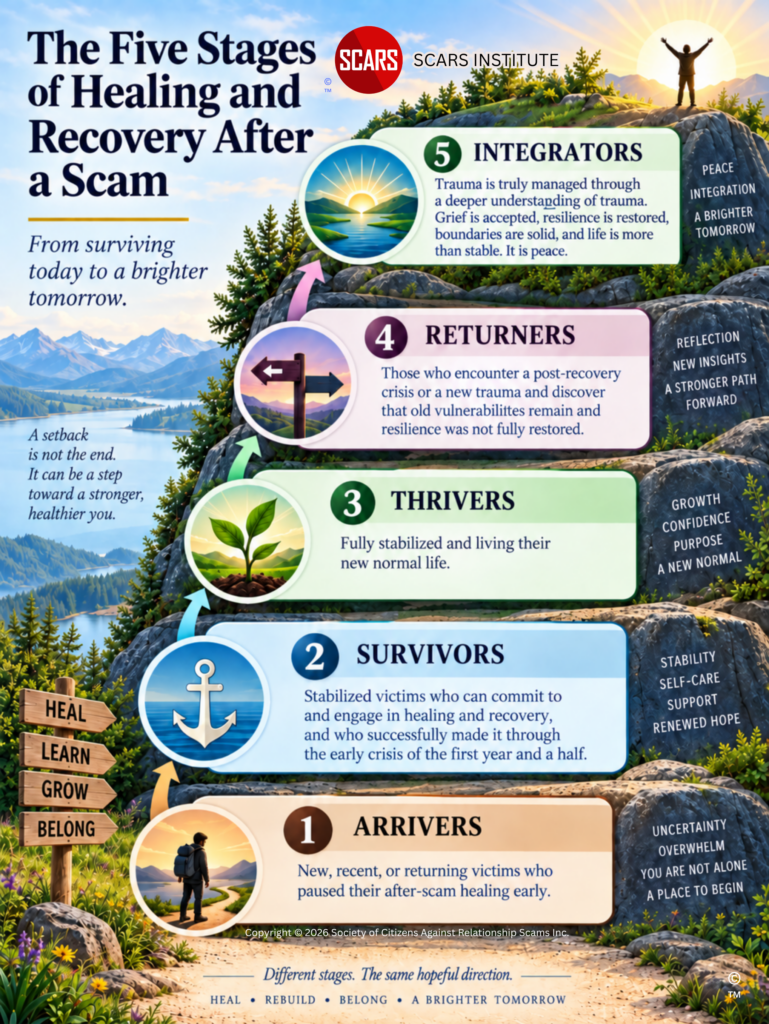
The Five Stages of Scam Victim/Survivor Healing & Recovery
The Five Stages of Healing and Recovery After a Scam
HEAL • REBUILD • BELONG • A BRIGHTER TOMORROW
From surviving today to a brighter tomorrow.
Remember: A setback is not the end. It can be a step toward a stronger, healthier you.
- HEAL
- LEARN
- GROW
- BELONG
STAGE 1 – ARRIVERS
New, recent, or returning victims who paused their after-scam healing early.
- UNCERTAINTY
- OVERWHELM
- YOU ARE NOT ALONE
- A PLACE TO BEGIN
STAGE 2 – SURVIVORS
Stabilized victims who can commit to and engage in healing and recovery, and who successfully made it through the early crisis of the first year and a half.
- STABILITY
- SELF-CARE
- SUPPORT
- RENEWED HOPE
STAGE 3 – THRIVERS
Fully stabilized and living their new normal life.
- GROWTH
- CONFIDENCE
- PURPOSE
- A NEW NORMAL
STAGE 4 – RETURNERS
Those who encounter a post-recovery crisis or a new trauma and discover that old vulnerabilities remain and resilience was not fully restored.
- REFLECTION
- NEW INSIGHTS
- A STRONGER PATH FORWARD
STAGE 5 – INTEGRATORS
Trauma is truly managed through a deeper understanding of trauma. Grief is accepted, resilience is restored, boundaries are solid, and life is more than stable. It is peace.
- PEACE
- INTEGRATION
- A BRIGHTER TOMORROW
Different stages. The same hopeful direction.

Glossary
- Acceptance — Acceptance describes the point at which grief, loss, and changed circumstances have been incorporated into a person’s understanding of life without requiring the past to be restored. It does not mean approval of what happened or absence of sadness. Acceptance allows the survivor to live with reality without remaining in constant conflict with it. — Emotional Process
- Adaptive Capacity — Adaptive capacity is the psychological ability to absorb disruption, reorganize, and continue functioning when familiar conditions change. A scam survivor can regain stability while still having less unused adaptive capacity than before the crime. Later crises can reveal how much capacity remains available when uncertainty and difficult decisions return. — Adaptation and Resilience
- Adaptability — Adaptability is the ability to adjust thoughts, behaviors, plans, and expectations when circumstances change. It becomes especially important when a survivor’s carefully rebuilt new normal is disrupted by illness, financial problems, bereavement, relocation, or another major transition. Strong adaptability allows change to remain difficult without automatically becoming psychologically overwhelming. — Adaptation and Resilience
- Analysis Paralysis — Analysis paralysis occurs when a person continues researching, comparing, questioning, and reconsidering options but remains unable to make a decision. Scam survivors can become trapped in this pattern when uncertainty activates fear of making another catastrophic mistake. The search for perfect certainty then prevents reasonable action even when a decision has become necessary. — Decision-Making
- Arrivers — Arrivers are scam victims who are new to recovery, recently victimized, returning after an interruption, or beginning again after stopping their healing work too early. They are entering the structured process of understanding what happened and rebuilding stability. Their needs frequently include education, support, stabilization, and help understanding the psychological effects of the crime. — Recovery Stage
- Attachment — Attachment refers to the emotional bond that can develop within a relationship and remain psychologically important even after deception is exposed. Scam victimization can injure attachment systems because the survivor must reconcile genuine emotional experience with the discovery that the relationship was manipulated. Unresolved attachment injuries can remain quiet during stability and reappear when later losses or changes occur. — Trauma and Attachment
- Avoidance — Avoidance is the attempt to reduce distress by postponing decisions, withdrawing from difficult situations, or refusing to engage with uncertainty. It can feel protective because it prevents immediate exposure to feared consequences. Over time, avoidance can allow problems to worsen and can strengthen the belief that the survivor is unable to cope with difficult situations. — Trauma Response
- Betrayal — Betrayal occurs when trust is violated by someone whose words, intentions, or relationship were believed to be genuine. Relationship scams create profound betrayal because the victim discovers that trust itself was used as an instrument of manipulation. Later crises can reactivate betrayal-related vulnerabilities even when the new event involves no deception at all. — Trauma Type
- Boundaries — Boundaries are the limits a person establishes to protect emotional, relational, financial, and psychological well-being. Stronger boundaries help survivors distinguish between appropriate responsibility and pressure to surrender control or judgment. In later recovery, solid boundaries become part of the deeper resilience associated with the Integrator stage. — Protective Factor
- Caregiving Responsibilities — Caregiving responsibilities involve providing regular assistance, supervision, emotional support, or practical care to another person. These responsibilities can create substantial stress when they appear after a survivor has already built a stable new normal. The added demands can expose unresolved vulnerabilities involving control, uncertainty, fatigue, and difficult decision-making. — Life Stressor
- Catastrophic Regret — Catastrophic regret is the intense fear that one wrong decision will produce consequences as devastating as those associated with the original scam. It can develop when earlier choices become linked in memory with major financial, relational, or emotional losses. This fear can make ordinary uncertainty feel intolerable and can contribute directly to paralysis. — Cognitive Response
- Confidence in Judgment — Confidence in judgment is the belief that a person can evaluate information, make reasonable decisions, and respond appropriately even without perfect certainty. Scam victimization can severely damage this confidence because the victim later learns that important decisions were made using manipulated information. Restoring confidence under changing conditions is a central part of deeper resilience. — Recovery Capacity
- Crisis Behaviors — Crisis behaviors are actions or patterns that emerge when distress becomes difficult to regulate, including avoidance, panic, withdrawal, indecision, or other disruptions in functioning. Therapy frequently focuses first on reducing these behaviors so the survivor can regain stability. Their reduction is important, but it does not necessarily mean that deeper trauma work has been completed. — Trauma Response
- Decision-Making — Decision-making is the process of evaluating information, considering risks, comparing options, and choosing a course of action. Scam survivors can become especially sensitive to difficult decisions because previous choices became associated with manipulated information and serious consequences. Recovery requires learning that reasonable decisions can be made without absolute certainty. — Cognitive Function
- Disruption — Disruption is a significant interruption to the routines, relationships, finances, health, housing, or other conditions that previously supported stability. A major disruption can test capacities that remained unused during years of predictable living. The resulting distress can reveal the difference between being stable and being resilient. — Life Stressor
- Emotional Regulation — Emotional regulation is the ability to recognize, tolerate, manage, and respond to emotional states without allowing them to control behavior completely. Early therapy frequently helps survivors regain enough regulation to function effectively. Later recovery requires maintaining that capacity when new stress, uncertainty, grief, or trauma places greater demands on it. — Recovery Capacity
- Fear of Making Mistakes — Fear of making mistakes develops when decisions become associated with severe consequences, shame, or loss. A scam survivor may begin to believe that another wrong choice could cause another catastrophe. This fear can make ordinary risk seem unacceptable and can prevent action even when doing nothing carries its own consequences. — Cognitive Response
- Financial Security — Financial security is the degree to which a person has enough stability, resources, and predictability to meet current and future financial needs. Scam victimization can damage this security through direct losses, debt, disrupted retirement plans, or changed living circumstances. Later financial problems can reactivate fears that had remained quiet during years of improved stability. — Life Stability
- Grief — Grief is the emotional process of responding to loss, including the loss of relationships, imagined futures, financial security, identity, trust, and previous assumptions about life. Grief does not necessarily end simply because daily distress decreases. Later life events can give earlier losses new meaning and reactivate unfinished parts of the grieving process. — Emotional Process
- Healing and Recovery — Healing and recovery describe the continuing process through which a scam survivor understands the crime, manages trauma, rebuilds stability, restores self-trust, and adapts to life after victimization. The process can continue well beyond the disappearance of acute distress. Later crises can reveal additional work that was not visible during earlier stages. — Recovery Process
- Hyperactivation — Hyperactivation describes a state of heightened physiological and emotional arousal in which the nervous system remains unusually responsive to possible danger. A survivor may experience reduced hyperactivation as stability returns, leading both the survivor and therapist to view recovery as successful. Its absence does not guarantee that deeper vulnerabilities involving uncertainty, trust, and adaptability have been fully resolved. — Trauma Response
- Hypervigilance — Hypervigilance is persistent monitoring for possible danger, deception, loss, or threat. It can develop after scam victimization because the survivor has learned that serious danger can exist beneath apparently safe circumstances. Hypervigilance can decrease during stable periods but return when a later crisis again makes the future feel unpredictable. — Trauma Response
- Incomplete Shell — Incomplete shell describes a life that appears stable and functional externally while unresolved vulnerabilities remain beneath that stability. Predictable routines can protect those vulnerabilities from being tested for many years. A later crisis can expose the incomplete shell by requiring adaptability, resilience, and tolerance for uncertainty that were never fully rebuilt. — Recovery Condition
- Integrators — Integrators are survivors who have moved beyond basic stability and developed a more complete ability to manage trauma, accept grief, maintain strong boundaries, and adapt to change. Their sense of safety no longer depends entirely upon life remaining predictable. Integration reflects a deeper peace built upon resilience, understanding, and confidence in the ability to respond to future disruption. — Recovery Stage
- Life Change — Life change is any significant alteration in circumstances that requires a person to adjust expectations, routines, responsibilities, relationships, or plans. Changes such as retirement, illness, relocation, bereavement, financial disruption, or family conflict can challenge a survivor years after the scam. The psychological impact depends partly on how fully adaptability and resilience were restored. — Life Stressor
- Loss of Control — Loss of control occurs when a person can no longer reliably influence circumstances, outcomes, timing, or important decisions. Scam victimization creates powerful experiences of lost control because the victim discovers that information and choices were manipulated by another person. Later situations involving uncertainty can reactivate the same fear even when no criminal behavior is present. — Trauma Response
- Major Transition — A major transition is a substantial change in life circumstances that requires psychological, practical, or relational adjustment. Examples include retirement, relocation, caregiving, serious illness, job loss, or selling a home. Such transitions can reveal unresolved vulnerabilities when the survivor’s stability depended heavily upon familiar routines and predictable conditions. — Life Stressor
- Manageable Uncertainty — Manageable uncertainty is uncertainty that remains uncomfortable but does not prevent reasonable thought, decision-making, or action. Recovery involves learning that complete certainty is rarely available and is not required for every important decision. Repeated experiences of functioning successfully under manageable uncertainty help rebuild adaptability and resilience. — Recovery Capacity
- Moral Injury — Moral injury refers to psychological distress associated with events that violate deeply held beliefs about right, wrong, trust, responsibility, or human behavior. Scam victims can experience moral injury when deliberate deception conflicts sharply with their assumptions about relationships and basic human decency. Later events involving betrayal, responsibility, or difficult choices can reactivate these unresolved injuries. — Trauma Type
- New Normal — A new normal is the rebuilt pattern of life that develops after the immediate crisis of scam victimization has passed. It can include new routines, financial arrangements, relationships, boundaries, expectations, and ways of understanding the world. The new normal provides important stability, but reliance upon its predictability can hide weaknesses in adaptability. — Recovery Process
- New Trauma — New trauma is a later psychologically overwhelming event that occurs after the survivor has already achieved substantial stability following the scam. It does not need to resemble the original crime to activate old vulnerabilities. A new trauma can become the event that moves a Thriver into Stage 4 as a Returner. — Trauma and Recovery
- Paralysis — Paralysis describes the inability to move confidently toward action despite recognizing that a decision or response is necessary. It can arise when every available option appears capable of producing severe consequences. For scam survivors, paralysis frequently reflects an attempt to prevent another irreversible mistake rather than lack of intelligence or motivation. — Decision-Making
- Personal Judgment — Personal judgment is the ability to interpret information, weigh risks, form conclusions, and choose actions based upon available evidence. Scam victimization can damage trust in this ability because earlier decisions were made within a reality deliberately constructed by criminals. Later recovery requires rebuilding confidence that reasonable judgment remains possible even when certainty is incomplete. — Recovery Capacity
- Predictability — Predictability is the degree to which routines, relationships, responsibilities, and future conditions remain familiar and expected. Predictability helps traumatized survivors feel safe because it reduces uncertainty and the need for constant adaptation. However, long periods of predictability can conceal unresolved vulnerabilities until a significant disruption requires new responses. — Life Stability
- Recovery Fatigue — Recovery fatigue is the exhaustion that can develop after prolonged effort spent understanding trauma, attending therapy, rebuilding finances, managing emotions, and reconstructing daily life. It can contribute to a survivor’s decision to reduce or stop therapy once stability has been achieved. Fatigue does not necessarily mean that every underlying issue has been fully processed. — Recovery Challenge
- Recovery Maintenance — Recovery maintenance is the continuing attention required to preserve gains, recognize renewed vulnerabilities, and seek additional support when circumstances change. The article compares this ongoing responsibility with other forms of long-term recovery that can require renewed intervention during crisis. Maintenance allows the survivor to respond early when old patterns begin influencing present decisions. — Recovery Process
- Returners — Returners are survivors who previously reached a stable or thriving stage but encounter a new crisis that exposes unresolved vulnerabilities or insufficiently restored resilience. They have not returned to the beginning of recovery. Their return to support or therapy represents recognition that another layer of healing has become visible. — Recovery Stage
- Resilience — Resilience is the ability to remain psychologically functional when familiar conditions change, plans fail, uncertainty increases, and difficult decisions become necessary. It differs from stability because resilience is demonstrated under disruption rather than predictability. Restored resilience allows a survivor to adapt without requiring complete certainty or complete control. — Adaptation and Resilience
- Risk — Risk is the possibility that a decision, action, or changing circumstance will produce an unwanted outcome. Scam survivors can become unusually sensitive to risk because previous decisions were followed by serious consequences. Healthy recovery requires learning that risk cannot be eliminated entirely and that reasonable choices remain possible without guarantees. — Decision-Making
- Self-Blame — Self-blame occurs when a survivor attributes the crime, its consequences, or later difficulties primarily to personal failure. It can intensify fear of future decisions because every mistake becomes evidence that personal judgment cannot be trusted. Deeper recovery requires understanding the role of manipulated information, criminal intent, and normal human limitations in decision-making. — Cognitive Response
- Self-Trust — Self-trust is confidence in one’s ability to think, evaluate information, establish boundaries, make decisions, and respond to changing circumstances. Scam victimization can severely damage this confidence because the survivor’s trust and judgment were deliberately manipulated. Stronger self-trust allows uncertainty to be tolerated without immediately becoming paralysis. — Recovery Capacity
- Shifted Baselines — Shifted baselines are the new standards of normality that develop after a survivor has adapted to life following the scam. The survivor gradually becomes accustomed to different finances, routines, relationships, expectations, and emotional conditions. These baselines can support stability while also hiding how the person will respond if those conditions change again. — Recovery Process
- Stability — Stability is the condition in which daily life functions reliably within familiar and manageable circumstances. It includes predictable routines, manageable finances, functioning relationships, improved emotional regulation, and reduced crisis symptoms. Stability is an important achievement, but it does not prove that resilience, adaptability, grief processing, or trauma integration are complete. — Recovery Condition
- Stage 4 Recovery — Stage 4 Recovery describes the period when a previously stable Thriver encounters a new crisis and discovers that old vulnerabilities, fears, or trauma responses remain active. The person becomes a Returner rather than returning to the beginning. This stage signals a need for renewed support, education, therapeutic work, and deliberate rebuilding of resilience. — Recovery Stage
- Support and Recovery Providers — Support and recovery providers are individuals or organizations that help survivors understand victimization, maintain recovery work, recognize renewed vulnerabilities, and respond to later crises. Their role can become important again years after apparent stability. Returning to an established support provider can prevent fear, avoidance, or paralysis from becoming dominant. — Recovery Support
- Survivors — Survivors are scam victims who have moved beyond the earliest crisis and become stable enough to engage actively in healing and recovery. They have successfully endured the initial period of disruption and begun rebuilding daily functioning. Their progress creates the foundation from which later thriving, resilience, and deeper integration can develop. — Recovery Stage
- Therapy — Therapy is professional psychological treatment used to reduce distress, improve functioning, build emotional regulation, examine trauma, and address unresolved psychological injuries. Therapy may appropriately slow or stop once substantial stability has been achieved, but later life events can make renewed treatment necessary. Returning to therapy years later does not invalidate previous therapeutic success. — Clinical Support
- Thrivers — Thrivers are survivors who have achieved substantial stability and are living within a functional new normal that includes routine, purpose, connection, and renewed enjoyment of life. Their progress is genuine, but stability can remain largely untested by major disruption. A later crisis can move a Thriver into the Returner stage when unresolved vulnerabilities become visible. — Recovery Stage
- Trauma Management — Trauma management is the continuing process of understanding trauma responses, regulating distress, recognizing triggers, adapting to change, and addressing vulnerabilities as life evolves. It does not always reach a single permanent endpoint. Effective trauma management allows a survivor to recognize renewed difficulties and seek appropriate support before those difficulties control major decisions. — Trauma Recovery
- Uncertainty — Uncertainty is the condition of not knowing exactly what will happen, which option will prove best, or whether a decision will produce the desired result. Scam victimization can make uncertainty feel threatening because previous confidence was followed by devastating discovery. Later resilience depends partly upon learning that uncertainty can be uncomfortable without automatically meaning danger. — Cognitive and Emotional Challenge
- Unresolved Vulnerabilities — Unresolved vulnerabilities are psychological sensitivities that remain after substantial stability has been achieved but have not been fully tested or integrated. They can involve grief, damaged trust, fear of mistakes, attachment injuries, uncertainty, moral injury, or weakened confidence in judgment. Major later crises can expose these vulnerabilities after years in which they remained largely invisible. — Recovery Challenge
Author Biographies
Author Biography
Prof. (Emeritus) Tim McGuinness, Ph.D. DFin is a co-founder, Managing Director, and Chairman of the SCARS Institute (Society of Citizens Against Relationship Scams Inc.), where he serves as an unsalaried volunteer officer dedicated to supporting scam victims and survivors around the world. With over 34 years of experience in scam education and awareness, he is perhaps the longest-serving advocate in the field.
Dr. McGuinness has an extensive background as a business pioneer, having co-founded several technology-driven enterprises, including the former e-commerce giant TigerDirect.com. Beyond his corporate achievements, he is actively engaged with multiple global think tanks where he helps develop forward-looking policy strategies that address the intersection of technology, ethics, and societal well-being. He is also a computer industry pioneer (he was an Assistant Director of Corporate Research Engineering at Atari Inc. in the early 1980s) and invented core technologies still in use today.
His professional identity spans a wide range of disciplines. He is a scientist, strategic analyst, solution architect, advisor, public speaker, published author, roboticist, Navy veteran, and recognized polymath. He holds numerous certifications, including those in cybersecurity from the United States Department of Defense under DITSCAP & DIACAP, continuous process improvement and engineering and quality assurance, trauma-informed care, grief counseling, crisis intervention, and related disciplines that support his work with crime victims.
Dr. McGuinness was instrumental in developing U.S. regulatory standards for medical data privacy called HIPAA and financial industry cybersecurity called GLBA. His professional contributions include authoring more than 1,000 papers and publications in fields ranging from scam victim psychology and neuroscience to cybercrime prevention and behavioral science.
“I have dedicated my career to advancing and communicating the impact of emerging technologies, with a strong focus on both their transformative potential and the risks they create for individuals, businesses, and society. My background combines global experience in business process innovation, strategic technology development, and operational efficiency across diverse industries.”
“Throughout my work, I have engaged with enterprise leaders, governments, and think tanks to address the intersection of technology, business, and global risk. I have served as an advisor and board member for numerous organizations shaping strategy in digital transformation and responsible innovation at scale.”
“In addition to my corporate and advisory roles, I remain deeply committed to addressing the rising human cost of cybercrime. As a global advocate for victim support and scam awareness, I have helped educate millions of individuals, protect vulnerable populations, and guide international collaborations aimed at reducing online fraud and digital exploitation.”
“With a unique combination of technical insight, business acumen, and humanitarian drive, I continue to focus on solutions that not only fuel innovation but also safeguard the people and communities impacted by today’s evolving digital landscape.”
Dr. McGuinness brings a rare depth of knowledge, compassion, and leadership to scam victim advocacy. His ongoing mission is to help victims not only survive their experiences but transform through recovery, education, and empowerment.
-/ 30 /-
What do you think about this?
Please share your thoughts in a comment below!
GLOSSARY SEARCH
TOPIC SEARCH
TABLE OF CONTENTS








CATEGORIES
Stability Is Not Resilience After Scam Survivor Recovery – 2026
Please Leave a Comment
Please Tell Us What You Learned From This?
Commenting Is An Essential Part Of Healing
Read • Think • Write
2 Comments
Leave A Comment Cancel reply
More ScamsNOW.com Articles









I am a beginner that came back after stopping recovery because of resistance and a bit stability made it seem like I was recovered enough. When I took the survivors school I commited myself to learn as much as I could to take better care of myself. I started identifying cognitive biases and fallacies common in my past and presents thoughts. I started being more self aware of my thoughts, my assumptions, and started practicing not believing everything I thought. But recovery still felt like a burden. I no longer wanted to be vulnerable and only was looking forward the end of recovery, while still skipping inportant actions that seemed unnecessary because I reached stable points. While I practiced feeling more confortable with uncertainty, I was not actually comfortable with uncertainty. I still doubted myself. But life started to feel ordinary and manageable. Then, similar pressure to that experienced at the moment of the scam made me collapse. I could not handle it, I could not speak for myself, and also found myself secretly wanting for someone to see that I was struggling. And I realized I had to be that person, I had to stand for myself. I had to stop avoiding asking for help and had to practice saying no. Therapy back then helped me stabilize and slowly lower my resistances, but it was not trauma informed, and there were no specific goals. So it helped but not that much. Then I found myself feeling lik I could not breathe nor keep a steady breathing while swimming and stopping suddenly because I did not want to keep swimming while panicking. Before and after the scam I had pretended to be okay while not being okay and facking again felt worse than before. I also could not trust myself in advanced lessons, even after seeing myself that I could actually swim. And, in every day life, I was still doubting my capacity. I could not ask for help nor advice. I only looked forward finished anything I had started without actually asking myself what I wanted to do. I only wanted to survive and be invisible while still deeply, unconsciously wanting for someone to see that I was still struggling. Now I am back in the yellow brick road. I am working or changing my behavior and thought patterns that make vulnerable and prevent me from growing. I am learning to set boundaries and support others without carrying their pain and burdens. I am learning to identify and regulate my emotions. I no longer want them to control me. I am not looking forward to a finish point. I want to feel whole, to regulate my emotions, to be able to take rational decisions with the available information instead of just the information I want to see out of fear. I want to believe in myself, to believe that I am worthy and continue learning to become a better version of myself.
Thank you for sharing this so honestly. What you have described shows why stability and recovery are not the same thing. Stability made daily life feel ordinary and manageable, which was real progress, but it also created the impression that the deeper work was no longer necessary. When familiar pressure returned, it exposed the areas that stabilization had protected but had not yet strengthened. That collapse did not erase what you had learned. It showed you where your recovery still needed attention.
One of the most important realizations in your reflection is that you were secretly waiting for someone to recognize how much you were struggling. Wanting to be seen, understood, and supported is deeply human. You also recognized that you had to become one of the people willing to see you. Standing up for yourself, asking for help, saying no, and admitting when you are not okay are not signs that you have failed to cope. They are essential recovery skills.
Your experience with swimming also reflects something much larger. You had evidence that you could swim, yet panic still interrupted your ability to trust what you knew. The same conflict appeared in daily life. You possessed ability, knowledge, and experience, but fear continued to make you doubt your capacity. Recovery now gives you the opportunity to bring those two realities together until your confidence grows from repeated action rather than reassurance alone.
Returning to the Yellow Brick Road does not make you a beginner in the sense of having learned nothing. You are returning with greater self-awareness, clearer goals, and a more honest understanding of your avoidance and resistance. You are no longer searching only for the end of recovery. You are learning how to live differently within it.
You are also making an important distinction between supporting others and carrying their pain. Boundaries will allow you to remain compassionate without abandoning yourself. Emotional regulation will allow you to experience feelings without surrendering control to them. Asking for help will allow other people to support you without requiring them to guess that you are struggling.
You have already taken a significant step by choosing visibility over invisibility and growth over mere survival. Continue walking. You do not need to complete the entire road today. You need to keep taking the next honest step, especially when resistance tells you that the step is unnecessary. That is how you build trust in yourself, reclaim your voice, and become the person who sees you, protects you, and believes you are worthy.