




Feelings of Unworthiness – Moral Injury – Impostor Beliefs – A Significant Complication in After Scam Healing – 2026

The SCARS Institute Magazine about Scam Victims-Survivors, Scams, Fraud & Cybercrime
- Published: 8/21/26
- Modified: 8/21/26
- Comments: 2
- Read Status:

Feelings of Unworthiness – Moral Injury – Impostor Beliefs – A Significant Complication in After Scam Healing
When You Feel You Do Not Deserve to Recover – Understanding Unworthiness, Moral Injury, and Impostor Beliefs After a Scam
Primary Category: Psychology / Recovery-Healing / Recoverology
Authors:
• Tim McGuinness, Ph.D., DFin, MCPO, MAnth – Anthropologist, Scientist, Polymath, Managing Director of the Society of Citizens Against Relationship Scams Inc.
Author Biographies Below
About This Article
Scam victims can struggle to accept After-Scam Healing when shame, generalized unworthiness, moral injury, or impostor-like beliefs distort how they interpret progress. Generalized unworthiness can create the belief that care or happiness is undeserved, while moral injury can turn perceived wrongdoing into a demand for continued suffering. Impostor-like beliefs can cause genuine progress to feel fraudulent or improperly credited. These experiences can overlap but require different understanding. Accurate accountability considers what the victim knew, what the criminal concealed, the emotional and psychological pressures involved, and the victim’s actions after discovering the crime. Healing does not require denial of responsibility. It allows victims to acknowledge harm, make repairs where possible, accept support, recognize their own work, and rebuild their lives without treating permanent self-punishment as proof of accountability.
Note: This article is intended for informational purposes and does not replace professional medical advice. If you are experiencing distress, please consult a qualified mental health professional.
Keywords
After-Scam Healing, Moral Injury, Generalized Unworthiness, Shame, Guilt, Impostor Beliefs, Self-Blame, Accountability, Self-Forgiveness, Personal Agency

When You Feel You Do Not Deserve to Heal and Recover
Understanding Unworthiness, Moral Injury, and Impostor Beliefs After a Scam
Author’s Note
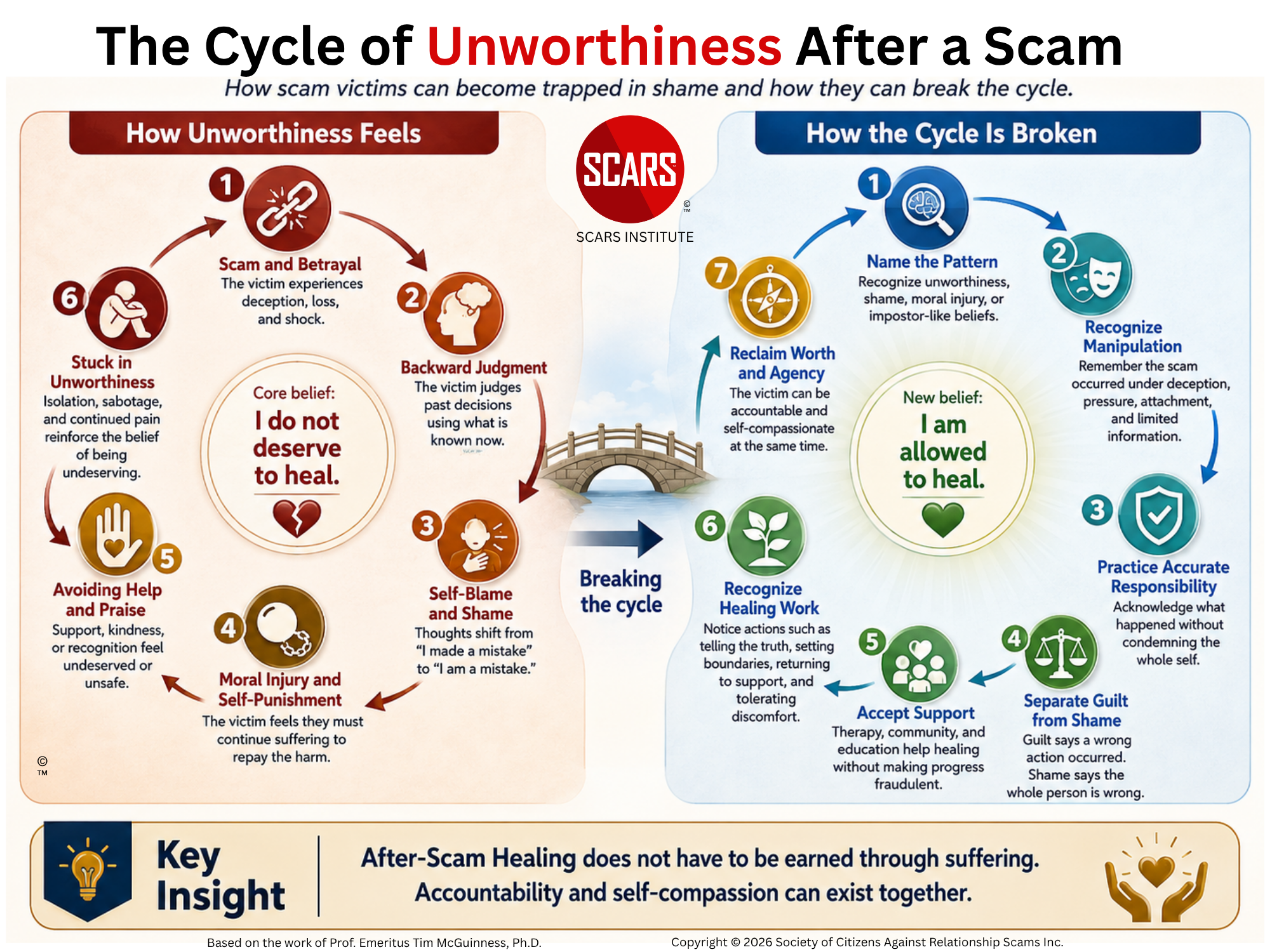
The distinction between unworthiness, moral injury, shame, and impostor-like beliefs is important because each can produce the same outward statement: “I do not deserve to heal.” The psychological meaning underneath that statement can be very different. A victim can believe that happiness is undeserved, that suffering is necessary to repay perceived wrongdoing, or that visible progress is somehow fraudulent. Understanding which belief is operating allows victims, therapists, and support providers to address the actual conflict rather than applying one explanation to every expression of shame. The central concern is helping victims develop accurate accountability without allowing responsibility to become permanent self-condemnation.
Prof. Emeritus Tim McGuinness, Ph.D.
August, 2026
Introduction
Recovery can become complicated when part of you believes that healing is something you have not earned. You can want the pain to stop while also feeling uncomfortable when life begins to improve. You can work hard in therapy, participate in a support community, learn how the scam affected you, and begin making better decisions, yet still feel guilty when someone recognizes your progress. Instead of feeling proud, you can feel exposed, selfish, dishonest, or undeserving. You can even begin to wonder whether you are only pretending to recover.
These reactions do not mean that you are failing. They can arise when trauma, shame, moral conflict, and earlier experiences have changed what recovery means to you. Feeling better might not feel like a simple return to health. It might feel like receiving something that you have no right to possess.
Several different psychological processes can create this response. Generalized unworthiness can tell you that you do not deserve care or happiness. Moral injury can tell you that you must continue suffering because of something you believe you did wrong. Impostor-like beliefs can tell you that your recovery is not genuine and that other people have been deceived by the appearance of progress. These experiences can overlap, but they are not identical. Understanding the difference can help you identify what is actually keeping you from accepting your recovery.
Recovery Can Feel Like Something You Have Not Earned
After a scam, you can easily judge yourself according to what you know now rather than according to what you knew while the crime was happening. You can look back at the warnings, payments, conversations, lies, secrecy, arguments, or decisions and believe that you should have understood everything sooner. You can forget that the criminal was deliberately controlling the information available to you. You can also overlook the effects of grooming, emotional attachment, fear, urgency, isolation, repetition, and hope.
This backward judgment can produce more than regret. It can create the belief that you no longer deserve peace. You might tell yourself that your family is still living with the consequences, so you should not be happy. You might believe that forgiving yourself would minimize the harm. You might think that continued suffering proves that you understand the seriousness of what happened. Pain can begin to function like a sentence that you believe you are required to serve.
Trauma commonly produces self-blame, guilt, and shame as you try to make sense of an event that overwhelmed your ability to understand or control it. You can blame yourself because self-blame creates the illusion that you could have prevented everything if you had only been smarter, stronger, less trusting, or more careful. That belief can feel less frightening than accepting that another person deliberately manipulated you and that human judgment has limits.
When Generalized Unworthiness Enters Healing and Recovery
Sometimes the belief that you do not deserve recovery began long before the scam. You might have grown up learning that your needs were inconvenient, your accomplishments were selfish, your feelings were excessive, or your desire for recognition was shameful. You might have been punished for speaking proudly about something you did well. You might have learned that setting a boundary hurt other people, asking for support created trouble, or accepting praise meant that you thought too highly of yourself.
Over time, these lessons can become a generalized belief about your worth. Instead of thinking, “I made a mistake,” you begin thinking, “I am a mistake.” Instead of thinking, “Someone treated me badly,” you begin thinking, “I must have caused it.” Instead of thinking, “I need help,” you begin thinking, “Needing help makes me selfish.”
Research has found associations between childhood maltreatment, shame, lower self-esteem, and negative beliefs about the self. These early experiences do not determine your future, but they can shape the emotional meaning of attention, praise, mistakes, boundaries, and care.
When you carry generalized unworthiness into scam recovery, progress can activate old danger signals. Someone tells you that you have shown courage, and you feel ashamed. Someone says that you handled a difficult situation well, and you immediately minimize what you did. Someone recognizes your survival, and you feel that you are taking attention away from people who suffered more. The problem is not necessarily that you doubt the facts. You can know exactly what you accomplished while still believing that you are not permitted to value it.
This is not always an impostor belief. It can be a learned prohibition against seeing yourself positively. You are not necessarily afraid that people will discover that you lack ability. You can be afraid that accepting praise will expose you to accusations of selfishness, arrogance, manipulation, or attention-seeking.
Understanding Moral Injury
Moral injury can develop when you believe that you participated in, failed to prevent, witnessed, or were betrayed in connection with something that violated your deeply held moral values. It is not a formal psychiatric diagnosis. It describes the lasting psychological, social, behavioral, and sometimes spiritual distress that can follow a perceived moral violation. Guilt, shame, anger, disgust, loss of trust, withdrawal, self-condemnation, and difficulty forgiving yourself can become central parts of the experience.
Most moral injury research has involved military personnel, veterans, health care workers, and first responders. Applying the concept to scam victims requires care because the circumstances are different and research focused specifically on scam victimization remains limited. However, the underlying process can be relevant when you believe that actions taken during the scam violated your own moral identity.
You might believe that you lied to people who cared about you. You might have concealed payments, borrowed money, transferred funds, ignored warnings, defended the criminal, or said hurtful things to people who challenged the relationship. You might believe that your decisions damaged your family, endangered your financial security, or helped the criminal continue the crime. Even when deception and coercive manipulation substantially limited your understanding and freedom of choice, you can still judge yourself as though you acted with complete knowledge and unrestricted control.
Moral injury does not require that you were legally or ethically responsible for everything that happened. It requires that you believe a meaningful moral boundary was crossed. Your emotional judgment can remain severe even when other people recognize that you were manipulated.
More about Moral Injury:
The Difference Between Guilt and Shame
Guilt generally focuses on conduct. It tells you, “I did something wrong.” Shame generalizes the judgment to your entire identity. It tells you, “I am wrong.” Moral injury can involve both, but shame often creates the most serious barrier to recovery because it changes accountability into permanent condemnation. The National Center for PTSD distinguishes guilt about an action from shame that defines the whole person as bad or defective.
Healthy guilt can help you identify harm, make amends where possible, and make different decisions in the future. Shame can tell you that no repair will ever be enough because the problem is not what you did. The problem, according to shame, is who you are.
When shame controls your recovery, you can believe that attending therapy is an attempt to escape responsibility. You can avoid support because you think other people will judge you. You can refuse kindness because kindness feels undeserved. You can sabotage relationships, financial progress, or emotional stability because suffering has become evidence that you are still taking the harm seriously.
Moral injury can therefore produce the belief that you do not deserve to recover. The National Center for PTSD notes that people struggling with moral injury can feel unworthy of love, avoid treatment because they do not believe they deserve to feel better, or engage in self-sabotaging behavior because they believe they do not deserve success.
Why This Is Not Automatically an Impostor Belief
The impostor phenomenon, commonly called impostor syndrome, has a more specific meaning. It usually involves difficulty internalizing demonstrated competence or achievement. You succeed, but you believe that the success came from luck, excessive effort, favorable circumstances, help from other people, or someone else’s mistaken judgment. You fear that people will eventually discover that you are less capable than they believe. The impostor phenomenon is not itself a formal mental health diagnosis.
A belief that you do not deserve recovery does not automatically meet that description. You can believe that recovery is morally undeserved without believing that your progress is fake. You can acknowledge that you are improving while feeling that improvement should not be allowed. That response is usually more closely connected to shame, self-punishment, or moral injury.
The difference concerns the question you are asking yourself.
- Generalized unworthiness asks, “Why should someone like me receive care, peace, or happiness?”
- Moral injury asks, “After what I did or failed to prevent, what right do I have to stop suffering?”
- Impostor beliefs ask, “What if the recovery people see is not real, and they eventually discover that I have fooled them?”
You can experience one of these processes without experiencing the others. You can also experience all three at the same time.
When Recovery Becomes an Achievement
Recovery can gradually become something that other people recognize as an accomplishment. Your therapist might tell you that you have made meaningful progress. Members of your support community might describe you as strong, courageous, insightful, or resilient. People might notice that you are establishing boundaries, managing triggers, resisting contact, sharing your story, or helping others.
These observations can be accurate and still make you uncomfortable. You might feel that other people are seeing only the version of you that appears during meetings. You might believe that they would not praise you if they knew how frightened, angry, confused, or exhausted you still feel. You might dismiss your work by saying that your therapist did everything, the group carried you, time passed, or you simply had no other choice.
At that point, impostor-like beliefs can become part of recovery. The issue is no longer only that you feel morally undeserving. You also begin treating your progress as false, accidental, exaggerated, or improperly credited to you.
You might think, “Everyone believes I am doing well, but I know that I am falling apart.” You might believe, “I only know how to sound recovered.” You might tell yourself, “I am not strong. I have simply hidden how damaged I really am.” You might fear, “Eventually, I will relapse or make another mistake, and everyone will realize that I never recovered.”
These thoughts resemble the impostor phenomenon because they involve perceived fraudulence, failure to internalize success, misattribution of progress, and fear of exposure. They do not prove that you are deliberately deceiving anyone. They show that your internal understanding of yourself has not caught up with the evidence that other people can see.
How Moral Injury Can Produce Impostor-Like Recovery Beliefs
Moral injury and impostor-like beliefs can develop in sequence. You can begin by believing that you violated your values. That belief can turn into shame and a generalized conclusion that you are no longer a good or worthy person. When recovery begins, other people can recognize progress that conflicts with this damaged identity. Because you believe that a bad person should not succeed, you can conclude that the progress must be false.
You might then attribute recovery entirely to your therapist, your support group, medication, luck, or the passage of time. You might dismiss the choices you made, the work you completed, the boundaries you established, and the pain you tolerated. You might become afraid that people would withdraw their respect if they knew everything that happened during the scam.
In this way, the original injury remains moral, but your interpretation of recovery becomes impostor-like. You feel undeserving because of the moral injury, and you feel fraudulent because other people recognize success that does not fit your condemned view of yourself.
The distinction still matters. Moral injury concerns your goodness, responsibility, values, and right to restoration. Impostor beliefs concern whether your progress is genuine and whether the recognition you receive accurately belongs to you. Treatment and support can address both, but they should not be treated as though they are the same problem.
Recovery Does Not Require You to Deny Responsibility
Accepting recovery does not require you to claim that none of your decisions mattered. It does not require you to pretend that no one was hurt or that every consequence came entirely from the criminal. It asks you to evaluate responsibility accurately rather than using shame as the only measure of accountability.
Accurate responsibility considers what you knew at the time, what the criminal concealed, what pressures were applied, what emotional attachment existed, what threats or urgent claims influenced you, and what options you realistically understood. It also considers what you have done since discovering the crime.
You can acknowledge that a decision caused harm without declaring yourself permanently harmful. You can apologize without surrendering your entire identity to guilt. You can make restitution where possible without using endless suffering as a substitute for repair. You can learn from your actions without agreeing that you deserve lifelong punishment.
Recovery is not an acquittal from accountability. Recovery allows you to become capable of accountability. When you are consumed by shame, your attention remains fixed on proving that you are bad. When you begin healing, you can look more honestly at what happened, repair what can be repaired, accept what cannot be changed, and live according to your values now.
Learning to Recognize Your Own Healing/Recovery Work
You did not create every condition that made possible possible, but that does not mean that your contribution was imaginary. Other people can help you, and the progress can still belong to you. A therapist can guide you, but you must continue attending, speaking honestly, practicing skills, and tolerating discomfort. A support community can encourage you, but you must decide whether to return, participate, listen, and apply what you learn.
Recovery is rarely an individual accomplishment in the sense that no one else contributed. Human beings recover through relationships, education, structure, treatment, community, and repeated experiences of safety. Receiving help does not make your progress fraudulent. It means that recovery occurred through human connection rather than isolation.
You can begin recognizing your work without describing yourself as extraordinary. You can say, “I kept attending even when I wanted to withdraw.” You can say, “I ended contact even though it caused grief.” You can say, “I told the truth after months or years of secrecy.” You can say, “I am learning to pause before reacting.” These statements do not claim perfection. They simply return your actions to the recovery story.
Questions That Can Help You Understand What You Are Feeling
When recovery success makes you uncomfortable, ask yourself what the discomfort is trying to say.
- Does it say that you are fundamentally unworthy of good things?
- Does it say that you must continue suffering to repay the harm?
- Does it say that your progress is not genuine and that other people have overestimated you?
- Does it say that accepting praise will make you selfish or expose you to attack?
Your answer can reveal the central process.
When the thought is, “I am not worth helping,” you are likely confronting generalized shame and unworthiness. When the thought is, “I caused harm, so I should not be allowed to feel better,” you can be confronting moral injury and self-punishment. When the thought is, “Everyone thinks I am recovering, but I have fooled them,” you can be confronting impostor-like beliefs about recovery. When the thought is, “Accepting recognition will make me selfish,” you can be confronting earlier conditioning that made visibility and praise feel dangerous.
You do not need to diagnose yourself. These questions give you language that you can bring to a therapist. They also help prevent one label from being applied to every form of shame.
What Support Should Feel Like
A trauma-informed support environment should not force you to accept praise, adopt an identity, or agree with a psychological interpretation before you are ready. It should help you explore why recognition feels unsafe. It should allow you to say that a comment hurt you without treating your reaction as defiance or oversensitivity. It should also allow misunderstandings to be repaired without assigning malicious intent to either person.
You deserve to be asked what a comment meant to you. You deserve support that distinguishes between your intentions and another person’s interpretation. You also deserve the opportunity to reconsider an interpretation after your nervous system has settled.
At the same time, trauma-sensitive care does not mean that no one can ever challenge a belief or introduce a new idea. It means that challenges should be offered as possibilities rather than declarations. A helper can say, “I wonder whether part of you has difficulty claiming your progress,” instead of saying, “You have impostor syndrome.” The first statement creates room for exploration. The second can feel like an external definition imposed on an experience that has not yet been understood.
Allowing Yourself to Heal and Recover
You do not have to earn recovery by suffering enough. Suffering cannot restore lost money, erase the crime, or repair every damaged relationship. It cannot return time or make the offender understand the harm. Continued self-punishment can feel morally serious, but it often prevents you from carrying your values forward.
Recovery success does not mean that the crime no longer matters. It means that the criminal no longer controls every part of your future. Self-forgiveness does not mean that all consequences disappear. It means that you stop requiring permanent self-hatred as proof that you care.
You can be accountable and compassionate toward yourself at the same time. You can recognize your mistakes and recognize the manipulation that surrounded them. You can accept help without pretending that you healed alone. You can receive praise without promising that you will never struggle again. You can call your progress real even when your recovery remains incomplete.
You are not an impostor because you still have difficult days. Recovery does not require you to perform strength at all times. You are not morally dishonest because you experience moments of peace. You are not selfish because you want to rebuild your life.
Your recovery is not a reward reserved for people who made no mistakes. It is the process through which you regain enough stability, truth, compassion, and agency to live according to your values again. You do not recover because the past was acceptable. You recover because your life still has value, your future still matters, and continued suffering is not the only way to demonstrate that you understand what was lost.
Conclusion
After-Scam Healing can become especially difficult when shame, moral injury, generalized unworthiness, or impostor-like beliefs convince a scam victim that feeling better is somehow undeserved. A victim can intellectually understand the manipulation involved in the crime while continuing to judge past decisions as though they were made with complete knowledge, unrestricted choice, and freedom from emotional pressure. That backward judgment can turn regret into self-condemnation and transform suffering into a form of punishment that the victim believes must continue.
Accountability does not require permanent suffering. A victim can recognize decisions that caused harm, apologize where appropriate, make restitution when possible, and learn from what happened without defining the whole self by those decisions. Shame turns behavior into identity, while healthier accountability separates what a person did from who that person is. Moral injury becomes especially damaging when the victim begins to believe that peace, love, success, or healing must be withheld as evidence that the consequences are still being taken seriously.
Progress can create another conflict when other people recognize strength, courage, insight, or improvement that the victim has difficulty accepting. The victim can acknowledge real improvement while attributing it entirely to therapy, a support community, medication, luck, or the passage of time. Receiving help does not make progress fraudulent. Healing commonly develops through relationships, treatment, education, community, structure, and repeated experiences of safety, while the victim still performs the difficult work of participating, learning, practicing, deciding, and continuing.
After-Scam Healing does not have to be earned through enough suffering. A victim can remain accountable while also becoming compassionate toward the self. Difficult days do not make progress false, moments of peace do not make the victim morally dishonest, and rebuilding a meaningful life does not erase what happened. Healing allows the victim to regain enough stability, truth, compassion, and agency to live according to personal values again.

Glossary
- Accepting Help — Accepting help is the willingness to receive guidance, treatment, encouragement, education, or community support without interpreting that assistance as evidence of weakness or fraudulence. Scam victims can struggle with accepting help when they believe their needs are burdensome or that progress only counts when achieved alone. Recognizing that human healing commonly occurs through relationships allows victims to value both their own effort and the legitimate contribution of others. — Support Systems
- Accepting Praise — Accepting praise is the ability to receive positive recognition without immediately minimizing, rejecting, or interpreting it as dangerous. Scam victims who associate recognition with selfishness, arrogance, or exposure can experience discomfort even when praise accurately reflects their progress. Learning to tolerate appropriate recognition helps victims develop a more balanced understanding of their own effort and accomplishments. — Self-Perception
- Accurate Responsibility — Accurate responsibility is the evaluation of a person’s actions according to what was known, understood, concealed, manipulated, and realistically possible at the time. Scam victims can judge themselves as though they possessed information that only became available after the crime was discovered. Accurate responsibility allows accountability without ignoring deception, emotional attachment, coercive pressure, restricted information, or the limits of human judgment. — Accountability Practice
- Accountability — Accountability is the process of honestly recognizing decisions, consequences, responsibilities, and opportunities for repair without converting specific actions into permanent condemnation of the whole person. Scam victims can acknowledge harm that occurred during victimization while also recognizing the manipulation surrounding those decisions. Healthy accountability encourages learning, repair, changed behavior, and values-based living instead of endless punishment. — Accountability Practice
- Achievement Recognition — Achievement recognition occurs when progress in After-Scam Healing is identified as meaningful effort rather than dismissed as luck, time, outside assistance, or accident. Victims can resist such recognition when their internal view of themselves remains more negative than the evidence visible to others. Recognizing achievement does not require exaggerating success or denying continuing struggles. — Self-Perception
- Backward Judgment — Backward judgment occurs when scam victims evaluate past decisions using information and understanding obtained only after the crime became clear. This perspective can create the false impression that warnings, lies, manipulation, and criminal intent should have been obvious at the time. Correcting backward judgment requires consideration of what the victim actually knew while the scam was occurring. — Decision-Making Pattern
- Childhood Conditioning — Childhood conditioning refers to early lessons that shape how a person later interprets needs, praise, mistakes, boundaries, attention, and requests for support. A person who learned that personal needs were inconvenient or accomplishments were selfish can carry those beliefs into adult victimization. After a scam, these earlier lessons can intensify shame and make healing, recognition, or receiving care feel undeserved. — Psychological Vulnerability
- Childhood Maltreatment — Childhood maltreatment refers to harmful early experiences that can contribute to shame, reduced self-esteem, and negative beliefs about personal worth. These experiences do not determine a person’s future, but they can influence how care, boundaries, mistakes, recognition, and vulnerability are understood later in life. Scam victimization can reactivate these established beliefs and complicate After-Scam Healing. — Psychological Vulnerability
- Coercive Manipulation — Coercive manipulation involves deliberate psychological pressure that restricts a victim’s understanding, perceived choices, or freedom of decision without necessarily involving physical force. Scammers can combine deception, urgency, emotional attachment, fear, isolation, repetition, and hope to shape behavior. Recognizing coercive manipulation helps victims evaluate their responsibility according to the conditions under which decisions were actually made. — Emotional Manipulation
- Condemned Self-View — A condemned self-view develops when a scam victim interprets mistakes or harmful consequences as proof of being permanently bad, defective, or unworthy. This belief moves beyond evaluating conduct and turns the entire identity into the object of judgment. After-Scam Healing requires separating specific actions from a permanent negative definition of the whole person. — Identity Distortion
- Difficulty Internalizing Competence — Difficulty internalizing competence occurs when a person demonstrates ability or progress but cannot emotionally accept that those achievements genuinely reflect personal capacity. Scam victims can attribute improvement entirely to therapists, support groups, luck, circumstances, or the passage of time. This pattern can contribute to impostor-like beliefs even when the victim’s actions provide clear evidence of meaningful participation and growth. — Belief Distortion
- Emotional Attachment — Emotional attachment is the bond that can influence judgment, loyalty, hope, fear of loss, and willingness to defend a relationship during a scam. Victims can later judge decisions without considering how strongly attachment shaped what appeared believable or emotionally necessary at the time. Accurate understanding of attachment helps place past decisions within the psychological conditions created by the offender. — Emotional Manipulation
- Emotional Judgment — Emotional judgment occurs when a person’s feelings about responsibility become more severe than the available evidence supports. Scam victims can continue feeling morally guilty even when others recognize that deception and manipulation substantially restricted informed choice. After-Scam Healing requires examining emotional conclusions alongside facts rather than assuming that intense guilt automatically proves equivalent responsibility. — Moral Emotion
- Fear of Exposure — Fear of exposure is the expectation that other people will eventually discover that a victim’s apparent progress, competence, or strength is not genuine. Victims experiencing impostor-like beliefs can worry that future mistakes or difficult days will reveal that they were never truly healing. This fear reflects a conflict between internal self-perception and the progress recognized by others. — Belief Distortion
- Generalized Unworthiness — Generalized unworthiness is the broad belief that a person does not deserve care, happiness, recognition, support, peace, or other positive experiences. It differs from regret about a specific action because the negative judgment is applied to the person’s overall worth. Scam victimization can intensify this belief when preexisting shame combines with self-blame and traumatic consequences. — Psychological Vulnerability
- Guilt — Guilt is a moral emotion focused primarily on conduct and the belief that a specific action, decision, or failure caused harm or violated personal values. Healthy guilt can motivate apology, restitution, changed behavior, and responsible decision-making. Guilt becomes more damaging when it expands into permanent self-condemnation or is used to justify endless suffering. — Moral Emotion
- Healing as Achievement — Healing as achievement occurs when progress becomes visible enough that therapists, support communities, family members, or peers begin recognizing the victim’s effort and development. Recognition can include stronger boundaries, improved trigger management, continued participation, reduced contact with offenders, or increased insight. Some victims struggle to accept these achievements because their internal identity has not yet adjusted to the progress others can observe. — After-Scam Healing Process
- Healing as Unearned — Healing as unearned is the belief that relief, stability, peace, or improvement must be deserved before a victim is permitted to experience it. Victims can interpret continued suffering as repayment for decisions made during the scam or as proof that they understand the seriousness of the consequences. This belief can obstruct After-Scam Healing by turning pain into a moral requirement. — Belief Distortion
- Impostor Beliefs — Impostor beliefs involve doubts that recognized progress, competence, or achievement genuinely belongs to the person receiving credit for it. Scam victims can believe that others are overestimating their progress or seeing only a carefully presented version of them. These beliefs can cause real healing work to be interpreted as accidental, exaggerated, or fraudulent. — Belief Distortion
- Impostor-Like Healing Beliefs — Impostor-like healing beliefs arise when scam victims begin treating visible improvement as false because it conflicts with a deeply negative internal identity. A victim can believe that other people see strength or progress only because they do not know how much fear, anger, exhaustion, or confusion remains. The resulting conflict can make legitimate progress feel dishonest even when no deception has occurred. — Belief Distortion
- Impostor Phenomenon — The impostor phenomenon involves difficulty internalizing demonstrated competence or achievement and a persistent belief that success resulted from luck, excessive effort, favorable circumstances, or other people’s mistaken judgment. A person can fear being exposed as less capable than others believe. The phenomenon is not itself a formal psychiatric diagnosis and should not be automatically applied to every form of unworthiness or shame. — Psychological Pattern
- Internalizing Success — Internalizing success is the process of accepting that personal effort, choices, perseverance, and learned skills contributed meaningfully to positive change. Scam victims can struggle with this process when they attribute all improvement to therapists, support groups, medication, time, or luck. Internalizing success allows external evidence of progress to become part of a more accurate internal understanding of the self. — Self-Perception
- Learned Prohibition Against Positive Self-Recognition — A learned prohibition against positive self-recognition develops when earlier experiences teach a person that acknowledging personal strengths or accomplishments is selfish, arrogant, manipulative, or unsafe. Scam victims carrying this belief can minimize genuine progress even when they know the facts support it. The central difficulty involves permission to value the self rather than uncertainty about whether progress actually occurred. — Psychological Vulnerability
- Moral Boundary — A moral boundary is a personal limit based on deeply held beliefs about right, wrong, responsibility, loyalty, honesty, care, or acceptable conduct. Moral injury can develop when a person believes that such a boundary was crossed through personal action, failure to act, witnessing, or betrayal. Scam victims can experience intense distress when manipulated behavior appears inconsistent with their established moral values. — Moral Injury
- Moral Conflict — Moral conflict occurs when a person’s actions, perceived responsibilities, or experiences appear inconsistent with deeply held values. Scam victims can experience this conflict after recognizing that they concealed payments, ignored warnings, defended an offender, borrowed money, or hurt people who tried to intervene. The resulting distress can involve guilt, shame, anger, withdrawal, and difficulty accepting healing. — Moral Injury
- Moral Identity — Moral identity is the part of a person’s self-concept connected to beliefs about being honest, responsible, caring, trustworthy, loyal, or otherwise morally acceptable. Scam victims can experience severe distress when actions taken under manipulation appear incompatible with this identity. Restoring moral identity requires accurate responsibility, repair where possible, and renewed living according to current values. — Identity Restoration
- Moral Injury — Moral injury describes lasting psychological, social, behavioral, and sometimes spiritual distress connected to a perceived violation of deeply held moral values. It can involve guilt, shame, anger, disgust, distrust, withdrawal, self-condemnation, and difficulty with self-forgiveness. Scam victims can experience moral injury when they believe actions taken during manipulation violated their own understanding of who they should have been. — Moral Injury
- Negative Beliefs About the Self — Negative beliefs about the self are persistent conclusions that a person is defective, selfish, foolish, undeserving, incapable, or fundamentally responsible for mistreatment. Earlier experiences and later trauma can strengthen these beliefs until they influence how praise, support, mistakes, and healing are interpreted. After a scam, these beliefs can make specific manipulated decisions appear to confirm an already negative identity. — Belief Distortion
- Perceived Fraudulence — Perceived fraudulence is the feeling that other people’s positive impressions are based on an inaccurate or incomplete understanding of the person. Scam victims can believe that visible progress is merely a performance because private fear, grief, anger, or confusion remains. The presence of continuing distress does not prove that the victim’s progress is false or intentionally deceptive. — Belief Distortion
- Permanent Condemnation — Permanent condemnation occurs when shame transforms a specific mistake or harmful consequence into a lifelong judgment against the person’s entire identity. This belief can make apology, restitution, learning, or changed behavior feel insufficient because no amount of repair seems capable of restoring worth. After-Scam Healing requires accountability that allows moral growth rather than endless sentencing of the self. — Shame Response
- Praise Discomfort — Praise discomfort is the uneasiness, shame, suspicion, or fear that can arise when other people acknowledge a scam victim’s courage, progress, insight, or resilience. The victim can know that the praise is factually justified while still feeling that accepting it is unsafe or morally inappropriate. Understanding the source of the discomfort helps distinguish unworthiness, moral injury, and impostor-like beliefs. — Self-Perception
- Progress Misattribution — Progress misattribution occurs when scam victims explain improvement almost entirely through outside causes while discounting their own effort and choices. They can credit therapy, medication, support groups, luck, or time while overlooking attendance, participation, boundary setting, truth-telling, learning, and persistence. Correcting misattribution allows victims to recognize contribution without denying the genuine value of outside support. — Belief Distortion
- Progress Recognition — Progress recognition is the ability to identify concrete evidence that After-Scam Healing is occurring even when distress has not completely disappeared. Examples can include maintaining boundaries, managing triggers, ending contact, speaking honestly, participating in support, or pausing before reacting. Recognition helps victims develop an accurate understanding of improvement without requiring perfection or constant emotional strength. — After-Scam Healing Process
- Repair — Repair is the process of addressing harm through honest acknowledgment, changed behavior, apology, restored boundaries, or other constructive actions that circumstances permit. Scam victims can use repair to respond to consequences without treating suffering itself as the only acceptable form of accountability. Repair focuses attention on what can still be changed instead of repeatedly punishing the self for what cannot be undone. — Social Repair
- Restitution — Restitution is an effort to restore, repay, replace, or otherwise address losses when practical circumstances allow meaningful correction. Scam victims can consider restitution without assuming that every consequence can be fully reversed. Restitution differs from self-punishment because its purpose is constructive repair rather than continued suffering as proof of remorse. — Accountability Practice
- Self-Blame — Self-blame is the tendency to assign excessive personal responsibility for victimization, manipulation, or consequences that occurred under deceptive conditions. It can create an illusion of control by suggesting that greater intelligence, caution, strength, or skepticism would have prevented everything. This belief can feel easier to tolerate than accepting that another person deliberately manipulated normal human judgment. — Trauma Response
- Self-Condemnation — Self-condemnation is the persistent judgment that a person is morally bad, defective, or undeserving because of actions, consequences, or perceived failures. Moral injury and shame can intensify this response after scam victimization. Self-condemnation interferes with repair because attention becomes focused on proving personal badness instead of understanding responsibility and making constructive changes. — Moral Emotion
- Self-Forgiveness — Self-forgiveness is the process of ending permanent self-hatred without denying consequences, responsibility, regret, or the seriousness of harm. Scam victims can mistakenly believe that forgiving themselves would minimize what happened or excuse decisions made during manipulation. Healthy self-forgiveness allows responsibility and compassion to coexist while supporting changed behavior and renewed values-based living. — Emotional Healing
- Self-Punishment — Self-punishment occurs when a scam victim uses continued suffering, deprivation, sabotage, isolation, or refusal of care as a form of repayment for perceived wrongdoing. The behavior can feel morally serious because pain becomes associated with accountability. In practice, self-punishment can obstruct repair, treatment, relationships, financial improvement, and the ability to live according to personal values. — Moral Injury
- Shame — Shame is a painful moral and self-evaluative emotion that changes the judgment from a specific harmful action into a negative conclusion about the whole person. Instead of believing that a mistake occurred, the person begins believing that the self is fundamentally wrong or defective. Shame can become a major obstacle to After-Scam Healing because it makes care, support, kindness, and restoration feel undeserved. — Moral Emotion
- Support Avoidance — Support avoidance occurs when a scam victim withdraws from therapy, community, relationships, or other assistance because receiving help feels undeserved, exposing, or morally inappropriate. Shame can convince victims that other people will judge them or that seeking relief represents an attempt to escape accountability. Avoidance can strengthen isolation and prevent corrective experiences that support more accurate self-understanding. — Withdrawal Pattern
- Support Community Participation — Support community participation involves returning, listening, contributing, sharing experiences, learning from others, and applying information gained through structured peer interaction. A community can provide encouragement and perspective, but the victim still makes the decision to participate and use what is learned. Recognizing this personal contribution helps prevent outside support from being used to dismiss the victim’s own healing work. — Support Systems
- Therapeutic Guidance — Therapeutic guidance is professional assistance that helps a victim examine experiences, develop skills, challenge harmful beliefs, and tolerate difficult emotions without taking ownership of the victim’s accomplishments. A therapist can provide structure and expertise, while the victim remains responsible for attending, speaking honestly, practicing, and making choices. Receiving therapeutic help does not make progress fraudulent or erase personal effort. — Support Relationship
- Trauma-Informed Support Environment — A trauma-informed support environment recognizes that safety, interpretation, choice, emotional reactions, and readiness influence how victims receive guidance and recognition. It does not force a victim to accept praise, adopt a label, or agree with an interpretation before the experience has been explored. Effective support also allows misunderstandings to be discussed and repaired without automatically assigning malicious intent. — Trauma-Informed Care
- Trauma-Sensitive Challenge — Trauma-sensitive challenge introduces alternative perspectives without defining the victim’s experience in absolute terms or dismissing emotional reactions. A helper can invite exploration of whether a victim has difficulty recognizing progress rather than announcing a diagnosis or fixed explanation. This approach preserves curiosity, dignity, and agency while still allowing distorted beliefs to be examined. — Trauma-Informed Care
- Unrestricted Control Assumption — The unrestricted control assumption is the belief that a scam victim made every decision with complete knowledge, full freedom, and unlimited ability to choose differently. This assumption ignores concealed information, emotional attachment, deception, urgency, fear, and manipulation that influenced what appeared possible at the time. Correcting it allows responsibility to be evaluated realistically rather than through hindsight and shame. — Decision-Making Pattern
- Unworthiness of Love — Unworthiness of love is the belief that perceived wrongdoing, failure, or personal defect makes a person undeserving of affection, compassion, acceptance, or close relationships. Moral injury can strengthen this belief when a victim concludes that personal suffering should continue because a moral boundary was crossed. The belief can encourage isolation and rejection of healthy support even when others continue to recognize the victim’s worth. — Psychological Vulnerability
- Values-Based Living — Values-based living is the practice of making present decisions according to important personal principles rather than allowing past mistakes or shame to permanently define behavior. Scam victims can use After-Scam Healing to identify what matters now and act consistently with honesty, responsibility, care, boundaries, and self-respect. This approach allows accountability to become constructive rather than remaining focused only on punishment for the past. — Future Orientation
- Withdrawal — Withdrawal is the movement away from relationships, treatment, community, recognition, or emotionally difficult situations following shame, moral injury, or fear of judgment. Scam victims can withdraw because they expect condemnation or believe support and kindness are undeserved. Persistent withdrawal can reinforce negative beliefs by reducing opportunities for connection, repair, perspective, and corrective experiences. — Withdrawal Pattern
- Work of Healing — The work of healing includes the repeated actions through which scam victims participate in their own improvement, such as attending therapy, speaking honestly, practicing skills, setting boundaries, ending contact, and tolerating difficult emotions. Outside support can make this work possible without replacing the victim’s contribution. Recognizing the work helps counter beliefs that progress happened accidentally or belongs entirely to someone else. — After-Scam Healing Process
- Worthiness of Care — Worthiness of care is the recognition that receiving support, treatment, compassion, safety, and opportunities for healing does not require a person to have made perfect decisions. Shame and generalized unworthiness can convince scam victims that care must be earned through innocence or sufficient suffering. After-Scam Healing becomes more possible when care is understood as compatible with accountability, imperfection, and continued personal growth. — Recovery Insight
Author Biographies
Author Biography
Prof. (Emeritus) Tim McGuinness, Ph.D. DFin is a co-founder, Managing Director, and Chairman of the SCARS Institute (Society of Citizens Against Relationship Scams Inc.), where he serves as an unsalaried volunteer officer dedicated to supporting scam victims and survivors around the world. With over 34 years of experience in scam education and awareness, he is perhaps the longest-serving advocate in the field.
Dr. McGuinness has an extensive background as a business pioneer, having co-founded several technology-driven enterprises, including the former e-commerce giant TigerDirect.com. Beyond his corporate achievements, he is actively engaged with multiple global think tanks where he helps develop forward-looking policy strategies that address the intersection of technology, ethics, and societal well-being. He is also a computer industry pioneer (he was an Assistant Director of Corporate Research Engineering at Atari Inc. in the early 1980s) and invented core technologies still in use today.
His professional identity spans a wide range of disciplines. He is a scientist, strategic analyst, solution architect, advisor, public speaker, published author, roboticist, Navy veteran, and recognized polymath. He holds numerous certifications, including those in cybersecurity from the United States Department of Defense under DITSCAP & DIACAP, continuous process improvement and engineering and quality assurance, trauma-informed care, grief counseling, crisis intervention, and related disciplines that support his work with crime victims.
Dr. McGuinness was instrumental in developing U.S. regulatory standards for medical data privacy called HIPAA and financial industry cybersecurity called GLBA. His professional contributions include authoring more than 1,000 papers and publications in fields ranging from scam victim psychology and neuroscience to cybercrime prevention and behavioral science.
“I have dedicated my career to advancing and communicating the impact of emerging technologies, with a strong focus on both their transformative potential and the risks they create for individuals, businesses, and society. My background combines global experience in business process innovation, strategic technology development, and operational efficiency across diverse industries.”
“Throughout my work, I have engaged with enterprise leaders, governments, and think tanks to address the intersection of technology, business, and global risk. I have served as an advisor and board member for numerous organizations shaping strategy in digital transformation and responsible innovation at scale.”
“In addition to my corporate and advisory roles, I remain deeply committed to addressing the rising human cost of cybercrime. As a global advocate for victim support and scam awareness, I have helped educate millions of individuals, protect vulnerable populations, and guide international collaborations aimed at reducing online fraud and digital exploitation.”
“With a unique combination of technical insight, business acumen, and humanitarian drive, I continue to focus on solutions that not only fuel innovation but also safeguard the people and communities impacted by today’s evolving digital landscape.”
Dr. McGuinness brings a rare depth of knowledge, compassion, and leadership to scam victim advocacy. His ongoing mission is to help victims not only survive their experiences but transform through recovery, education, and empowerment.
-/ 30 /-
What do you think about this?
Please share your thoughts in a comment below!
GLOSSARY SEARCH
TOPIC SEARCH
TABLE OF CONTENTS








CATEGORIES
Feelings of Unworthiness – Moral Injury – Impostor Beliefs – A Significant Complication in After Scam Healing – 2026
Please Leave a Comment
Please Tell Us What You Learned From This?
Commenting Is An Essential Part Of Healing
Read • Think • Write
2 Comments
Leave A Comment Cancel reply
More ScamsNOW.com Articles









I think I have an overall feeling of unworthiness brought about by my childhood. Also every time I start to feel like I’m improving there’s always someone in my family that keeps wanting me to take accountability for what I’ve done which just makes me feel more shame n more guilt. I think it’s time to set a boundary n tell them I can’t talk to them if they can’t get past this.
It is good that you are aware that you need to set boundaries with them, their are not helping at all.
I also feel unworthy since my childhood. I am still trying to figure out in therapy from where does that feeling come from and to start feeling worthy.
It is already hard, but must be tougher if your family is not helping. I hope you can set those boundaries. And I hope we can feel worthy, eventually.