



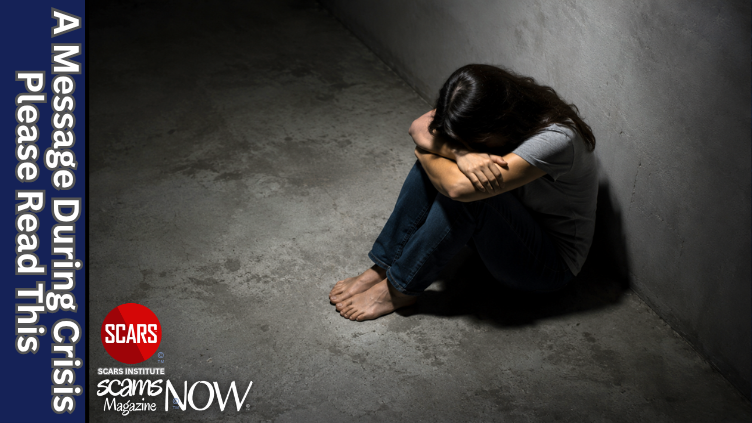
A Message During Crisis – Please Read This – 2026

The SCARS Institute Magazine about Scam Victims-Survivors, Scams, Fraud & Cybercrime
- Published: 6/13/26
- Modified: 6/13/26
- Comments: 0
- Read Status:

A Message During Crisis – Please Read This
If You Are Thinking About Ending Your Life Right Now
Primary Category: Psychology / Recoverology
Authors:
• Tim McGuinness, Ph.D., DFin, MCPO, MAnth – Anthropologist, Scientist, Polymath, Managing Director of the Society of Citizens Against Relationship Scams Inc.
Author Biographies Below
About This Article
Relationship scam victims experiencing suicidal thoughts often suffer from severe betrayal trauma that damages trust, identity, self-worth, and emotional stability. The psychological injury created by manipulation and deception can produce overwhelming feelings of shame, despair, isolation, and hopelessness that make suicide appear to be an escape from unbearable pain. These thoughts are presented as symptoms of trauma rather than reflections of reality or personal value. The discussion emphasizes that victims are not responsible for the crimes committed against them and that recovery remains possible despite the severity of the injury. Professional crisis resources, family support, friends, survivor communities, and structured recovery programs are identified as important sources of assistance. The central message focuses on preserving life, seeking immediate help during moments of crisis, and recognizing that healing can occur even when hope feels distant.
Note: This article is intended for informational purposes and does not replace professional medical advice. If you are experiencing distress, please consult a qualified mental health professional.
Keywords
Betrayal Trauma, Suicide Prevention, Crisis Intervention, Relationship Scams, Scam Victims, Emotional Healing, Psychological Injury, Survivor Support, Trauma Recovery, Crisis Resources
If You Are In Crisis Right Now, Please Read This
If You Are Thinking About Ending Your Life Right Now
We See You. We Hear You. Please Stay.
First, if you are thinking about suicide, ending your life, or if the world would be better off without you, this is actually normal after a severe psychological trauma. It is especially true after the betrayal trauma caused by being the victim of a relationship scam.
What you are experiencing is a profound and desperate response to a wound that goes deeper than finances or practical problems; it is an injury to your very sense of self and your ability to trust. The scam didn’t just take your money; it violated your capacity for connection, your judgment, and your faith in your own perceptions. This level of betrayal creates a psychic shock that can shatter your foundation, leaving you feeling untethered, unworthy, and utterly alone.
In the face of such overwhelming pain and shame, the mind, searching for an escape, can present ending it – death as the only way to stop the pain. The mind can present the end of your life as the only way you can stop the pain and regain control after you have been betrayed, manipulated, and controlled. Taking your life is the ultimate act of agency. But it is a lie.
Please understand that these thoughts, however difficult they may be, are not a reflection of your true worthiness or a sign of your weakness. You are more worthy than you know, stronger than you know; it is just your psychological experience that is telling you otherwise. They are a symptom of the trauma itself, a desperate cry from a part of you that is in agony and cannot see another way out.
It is important to recognize that these suicidal thoughts are not the truth; they are the trauma speaking through you. They are the distorted echo of the scammer’s deception, now turned inward as a weapon against yourself. The belief that the world would be better off without you is the ultimate lie of betrayal trauma, a conclusion drawn from a state of immense pain and despair, not from a place of clarity. Your worth is not, and has never been, defined by what happened to you. You are a person who has been wounded, not a person who is broken beyond repair.
The human spirit, while deeply affected by trauma, has an incredible capacity for healing. Just as a physical wound, no matter how grievous, can begin to close with care and time, so too can this emotional wound heal. The path forward is not apparent to you right now because you are standing in the middle of a storm and darkness, but the storm does not last forever. These feelings are not permanent, and they are not the entirety of who you are.
We Are Glad You Found Us
If you have found this page, something brought you here.
Maybe it was the shame. Maybe it was the unbearable weight of what happened, the love you gave, the money you lost, the person you trusted who turned out not to exist. Maybe you are sitting somewhere right now feeling like you cannot carry unbearable weight for another minute; like the person you were before this happened is gone, and you do not know how to be whoever is left.
We know that feeling. We have heard it from hundreds of thousands of people who have been exactly where you are right now.
We need you to know something first, before anything else:
What happened to you was not your fault.
Not partly. Not mostly. Entirely not your fault. You may not believe this right now, but this is truth. You were targeted by professional criminals, people who study human psychology the way engineers study load-bearing structures, who knew exactly where to apply pressure, exactly what to say, exactly how to make someone feel seen and loved and real. They did this to you with skill and intention. Your love and emotions were real. Your beliefs were real. The cruelty was in using something real against you.
That is not your failure. That is their crime.
The Shame Is Lying to You
Shame is the loudest voice right now. We know that. It is telling you that everyone knew, could see the red flags, maybe even warned you, and you did not listen. It is telling you that you were stupid, that you should have seen it, that people are laughing, that you are beyond help, that the only way to make the humiliation stop is to stop your life. But this is a lie.
Shame lies. It lies specifically, it lies relentlessly, and it lies most loudly at the exact moment when you are most exhausted and most alone.
The truth is this: intelligent people, doctors, lawyers, teachers, therapists, engineers, people who have spent their whole lives being careful and thoughtful, are targeted by these scams every single day. The scam did not find a weak person. It found a person capable of love, caring, and emotion. That capacity is not a flaw. It is the best thing about you. They stole it and used it, and that is the most despicable thing imaginable, but it does not mean you are broken beyond repair. It means you were wronged. It means you are injured. It means you can heal and recover.
What You Are Feeling Has a Name
The pain you are carrying right now is real, it is enormous and heavy, and it has a name: betrayal trauma.
It is one of the most severe forms of psychological injury a person can experience, because it does not just take money or time; it reaches into the part of you that trusts, that loves, that believes in other people, and then damages it. That damage is real. It deserves real care. It deserves the same seriousness we would give to any serious injury to your body. Because this is an injury to your body, not just your mind.
You are not dramatic. You are not weak. You are not naive. You are not stupid. You are not foolish. You are injured. And injured people need help, not judgment. Not even judgment of themself.
The wound you are carrying right now, the one that feels unsurvivable, is survivable. We know this because we have watched and helped thousands of people survive it. People who were exactly where you are, who could not imagine a morning that did not feel like this, who are now living lives they did not believe were still available to them.
Recovery does not mean forgetting. It does not mean it didn’t happen. It means the wound becomes something you carry rather than something that carries you. That transformation is possible. It takes time and effort, and it takes support, and it does not happen alone, but it happens.
There is a process that works. We know, because we invented it. It has helped literally millions of other scam victims just like you. Of course, you do not want to hear that; you want your pain to end. Now! But this knowledge can help you light a candle in the dark. It can help you believe that the pain is not too powerful to overcome. You can heal. You can recover.
Please Do Not Be Alone Right Now
If you are thinking about ending your life, we are asking you, directly, personally, urgently, to reach out before you do anything.
Call 988 in the United States or Canada. Find crisis hotlines for other countries here: https://blog.opencounseling.com/suicide-hotlines/
Your pain is real. You are worthy. Call them to talk to someone when you feel alone. Not because they have easy answers. They don’t. Because you matter.
Call the people in your life, and just tell them that you are a victim of a crime, and you cannot talk about it right now. You are feeling lost and alone, and help someone right now to help you make it through this. You do not need to say more, and if they ask, just say it is too painful right now to talk about.
Do not worry that the people in your life would be shattered. You know people who will understand and support you. You know this, but you are afraid to ask for help.
But the part of you that brought you to this page is still looking for a reason to stay, and we and your friends and family want to be that reason, right now, today, tonight, in this moment.
Message us. Right now. We will respond
Reach out right now. To your friends and family. If you cannot or will not call them, call 988. Now!
You do not have to have the right words. You do not have to explain everything. You can simply say: I am not okay. That is enough. They will take it from there.
Some may judge, though we are not here to judge you. We are not here to tell you what you should have done differently. You are here because you are a human being who was hurt by other human beings, and you deserve someone in your corner.
We can help you, but it will take you a day or two to get our help. If you are in crisis right now, do as we suggest. Call family or friends, or 988 right now.
To get started with the SCARS Institute Scam Survivors’ Support and Recovery Program, visit www.SCARScommunity.org and register (sign up) – it is free, safe, and confidential. Once approved (we screen for bad guys) y0u will be able to get started immediately with our program, connect with other survivors, and begin the long road home.
If You Are in Immediate Crisis Right Now
If you are in immediate danger, please contact a crisis line right now. You can call or text , you do not have to speak out loud if that feels too hard.
- USA: Call or text 988 (Suicide and Crisis Lifeline) , available 24 hours, free, confidential
- USA: Text HOME to 741741 (Crisis Text Line)
- UK: Call 116 123 (Samaritans) , free, 24 hours
- Canada: Call or text 988
- Australia: Call 13 11 14 (Lifeline)
- International: Visit https://blog.opencounseling.com/suicide-hotlines/ or https://findahelpline.com/ to find your country’s crisis lines
One Thing
If you cannot do anything else right now, do this one thing:
Put some distance between yourself and whatever you were thinking of using. Go to a different room. Give it to someone. Leave the building. Just distance. Just that one thing. Suicide is pften about opportunity and being alone.
You do not have to decide anything about tomorrow right now. You do not have to figure out how to recover, how to face the world, or how to pay back the money, or how to explain it to anyone. You just have to get to tomorrow morning. That is the only task. One night, one morning.
We will still be here in the morning. So will the people who love you, even if it doesn’t feel that way right now.
To the Person Who Is Still Reading
You came here because part of you is still looking. Part of you is still reaching toward something. That part of you is right. There is something to reach toward.
You loved someone with your whole heart, and that love was real even if the person wasn’t. That capacity, the one they exploited, is still yours. It did not go with them. It is still in you, waiting.
The people who did this to you took enough. They took your money. They took your time. They took your heart. They took your trust.
Do not let them take the rest.
Please reach out. We are listening. We will respond.
We wish you all the best,
The SCARS Institute Support Team
www.SCARScommunity.org
If you are a counselor, advocate, or support person sharing this with someone in crisis, please stay with them while they read it. Your physical presence, or your continued presence on the other end of a phone or message, is the most important thing you can offer right now. This document is a bridge, not a destination.

Glossary
- 988 Lifeline—The 988 Lifeline is a crisis support resource for people in the United States and Canada who are thinking about suicide or experiencing emotional danger. It provides immediate access to trained crisis responders who can help a person stay alive through the most dangerous moments. It is presented as an urgent support option when a scam victim cannot safely remain alone. — Crisis Resource
- Agency Distortion—Agency distortion occurs when trauma makes death appear to be a way to regain control after manipulation and betrayal. A person may believe that suicide represents freedom, choice, or personal power. In reality, this perception is often created by overwhelming psychological pain rather than clear judgment. — Trauma Response
- Being Heard—Being heard means that a victim’s pain, fear, shame, and confusion are received with understanding and seriousness rather than judgment. Emotional validation can reduce feelings of isolation and helplessness during periods of crisis. Feeling heard often creates the first opening toward safety, support, and recovery. — Support Principle
- Betrayal Trauma—Betrayal trauma is a severe psychological injury that occurs when trust, affection, and emotional vulnerability are exploited by another person. It can damage self-trust, emotional security, identity, and confidence in personal judgment. Recovery often requires addressing both the emotional injury and its effects on daily life. — Psychological Injury
- Capacity for Connection—Capacity for connection refers to a person’s ability to trust, care, love, and form meaningful emotional bonds with others. Criminal exploitation can misuse this strength without destroying it. Preserving and rebuilding healthy connections is an important part of long-term recovery. — Human Strength
- Desperate Escape Thought—A desperate escape thought is the belief that ending life is the only way to stop unbearable emotional pain. These thoughts commonly emerge during periods of severe trauma, despair, or psychological exhaustion. They reflect suffering and hopelessness rather than the objective truth about a person’s future. — Suicidal Thinking
- Distancing From Means—Distancing from means involves creating physical separation from anything that could be used for self-harm during a crisis. This action reduces immediate risk by increasing time, space, and opportunities for intervention. Even a small increase in distance can improve safety during intense emotional distress. — Safety Action
- Emotional Injury—Emotional injury refers to the psychological damage caused by betrayal, deception, manipulation, loss, and trauma. Such injuries can affect thoughts, emotions, relationships, and self-perception. Healing often requires the same seriousness and care that would be given to a significant physical injury. — Psychological Injury
- Emotional Storm—An emotional storm is a period of overwhelming psychological distress marked by intense feelings of fear, shame, grief, confusion, or despair. During such periods, solutions may seem impossible to see and hope may feel distant. Emotional storms are powerful but temporary experiences that can pass with support and time. — Crisis Experience
- Ending Life Ideation—Ending life ideation refers to thoughts about suicide, death, or beliefs that others would be better off if the person were gone. These thoughts can occur after severe emotional trauma and psychological injury. Their presence signals a need for support, protection, and professional intervention. — Suicidal Thinking
- Exploited Love—Exploited love occurs when genuine affection, trust, and emotional investment are deliberately used by another person for deception and manipulation. The emotions experienced by the victim remain real even when the relationship itself was fraudulent. Understanding this distinction helps reduce self-blame and shame. — Scam Impact
- Faith in Perception—Faith in perception is confidence in one’s ability to interpret reality, evaluate situations, and make sound judgments. Relationship scams often damage this confidence by creating false realities that appear genuine. Recovery involves gradually rebuilding trust in personal observation and decision-making. — Identity Impact
- False Burden Belief—False burden belief is the conviction that family, friends, or society would be better off without the victim. This belief commonly develops during periods of severe shame, depression, and trauma. It is a distortion created by emotional suffering rather than an accurate assessment of a person’s value. — Trauma Distortion
- Finding a Reason to Stay—Finding a reason to stay means identifying any source of hope, responsibility, connection, or purpose that supports survival through a crisis. The reason does not need to solve every problem or remove all pain. Even a small reason can help sustain life until additional support arrives. — Survival Support
- Fraud-Based Humiliation—Fraud-based humiliation is the intense embarrassment and shame that can develop after becoming the victim of deception. Victims often believe others will judge, ridicule, or reject them because of what happened. Understanding this response as a common consequence of trauma can help reduce its influence. — Emotional Impact
- Immediate Crisis—An immediate crisis is a condition in which emotional distress becomes so severe that a person’s safety is at risk. It often includes suicidal thoughts, overwhelming despair, or an inability to remain safe without assistance. An immediate crisis requires urgent support and protective intervention. — Crisis Condition
- Injury to Self—Injury to self refers to damage affecting identity, self-worth, confidence, and internal stability following a traumatic experience. Such injuries often extend beyond practical losses and affect how a person views themselves and the world. Recovery focuses on restoring a healthier and more stable sense of self. — Identity Impact
- Judgment-Free Support—Judgment-free support is assistance provided without criticism, blame, ridicule, or condemnation. This approach creates emotional safety for people who are already carrying significant shame and distress. Compassionate support encourages openness, trust, and healing. — Support Principle
- Living Through the Night—Living through the night is a crisis survival strategy that focuses attention on remaining safe until the next day rather than solving every problem immediately. Breaking time into smaller, manageable periods can reduce emotional overwhelm. This approach helps people survive moments when the future feels impossible to face. — Crisis Survival
- Manipulated Control—Manipulated control is the experience of having thoughts, emotions, decisions, or behaviors influenced through deception and psychological exploitation. Victims often feel powerless after recognizing how extensively they were manipulated. Understanding this process helps restore perspective and self-compassion. — Scam Impact
- Not Your Fault—Not your fault is the recognition that responsibility for the crime belongs entirely to the individuals who intentionally planned and carried out the deception. Victims often assume blame for events created through manipulation and psychological exploitation. Accepting the true source of responsibility helps reduce shame and supports recovery. — Recovery Principle
- Pain as Signal—Pain as signal is the understanding that intense emotional suffering indicates injury rather than personal failure. Psychological pain serves as evidence that something harmful has occurred and requires attention. Viewing pain in this way encourages support, care, and healing rather than self-condemnation. — Trauma Understanding
- Professional Criminal Targeting—Professional criminal targeting is the deliberate selection and manipulation of victims by offenders who possess knowledge of human behavior, persuasion, and emotional vulnerability. These criminals often employ systematic techniques to build trust and gain compliance. Recognizing this targeting helps victims understand the intentional nature of the crime. — Offender Tactic
- Psychic Shock—Psychic shock is the profound emotional disruption that follows a traumatic betrayal or devastating loss. It can leave a person feeling disoriented, detached, confused, and emotionally overwhelmed. This reaction reflects the severity of the psychological injury rather than personal weakness. — Psychological Injury
- Recovery Process—The recovery process is the gradual journey through which emotional wounds, distorted beliefs, and trauma-related symptoms begin to heal. Recovery often involves support, education, reflection, and emotional work over time. Progress occurs through consistent effort rather than immediate transformation. — Recovery Framework
- Relationship Scam Crisis—Relationship scam crisis is the acute psychological distress that can occur after discovering that an emotionally significant relationship was fraudulent. It frequently includes grief, shame, betrayal, confusion, and suicidal thoughts. Immediate support and stabilization are often necessary during this period. — Crisis Condition
- Self-Worth Separation—Self-worth separation is the practice of distinguishing personal value from the losses, mistakes, or consequences associated with victimization. A person’s worth remains independent of what criminals did to them. Maintaining this separation supports emotional healing and resilience. — Recovery Principle
- Severe Psychological Trauma—Severe psychological trauma is an intense emotional injury that overwhelms a person’s normal ability to cope and adapt. It can affect emotions, thoughts, behavior, relationships, and physical well-being. Professional support and recovery resources often play an important role in healing. — Psychological Injury
- Shame Voice—Shame voice is the internal message that tells victims they are foolish, weak, exposed, or beyond help. It often becomes strongest during periods of isolation, exhaustion, and emotional pain. Recognizing this voice helps separate trauma-driven beliefs from objective reality. — Emotional Distortion
- Shattered Foundation—Shattered foundation refers to the collapse of trust, safety, stability, and confidence that can occur after severe betrayal. Victims may feel disconnected from their previous identity and uncertain about the future. Recovery involves gradually rebuilding these foundational elements. — Identity Impact
- Suicide Opportunity—Suicide opportunity refers to the combination of emotional crisis, isolation, and access to means that increases immediate danger. Reducing opportunity through distance, supervision, and support can significantly improve safety. Prevention often focuses on interrupting this combination of factors. — Safety Risk
- The Long Road Home—The long road home represents the gradual process of moving from crisis and trauma toward stability, healing, and renewed purpose. Recovery rarely occurs in a straight line and often requires patience and persistence. Progress develops through many small steps over time. — Recovery Journey
- Trauma-Speaking Thought—A trauma-speaking thought is a belief, conclusion, or impulse generated primarily by emotional injury rather than balanced judgment. These thoughts often appear convincing because they are fueled by intense pain. Learning to recognize them helps reduce their influence and supports recovery. — Trauma Distortion
- Trust Violation—Trust violation is the injury that occurs when openness, affection, confidence, and vulnerability are deliberately exploited by another person. This violation often affects both trust in others and trust in oneself. Rebuilding trust is frequently one of the central challenges of recovery. — Scam Impact
- Untethered Feeling—Untethered feeling is the sensation of being disconnected from stability, security, identity, or belonging following a traumatic experience. People experiencing this feeling often struggle to find emotional footing. Recognizing it as a trauma response can reduce fear and confusion. — Crisis Experience
- Unworthy Feeling—Unworthy feeling is the painful belief that personal value has been diminished because of victimization, mistakes, or loss. This feeling commonly develops after betrayal and emotional trauma. It reflects emotional injury rather than a person’s actual worth. — Emotional Distortion
- Wounded Person Identity—Wounded person identity recognizes that a victim has been injured by a traumatic experience rather than permanently damaged or defective. This perspective encourages compassion, healing, and appropriate support. It shifts attention from blame toward recovery and care. — Recovery Reframe
- Worthiness Reminder—A worthiness reminder is a statement or belief that reinforces the enduring value of a person’s life despite trauma, loss, shame, or despair. Such reminders help counter distorted beliefs created by emotional suffering. Repeated reinforcement of worth can support resilience and recovery. — Crisis Support
Author Biographies
Author Biography
Prof. (Emeritus) Tim McGuinness, Ph.D. DFin is a co-founder, Managing Director, and Chairman of the SCARS Institute (Society of Citizens Against Relationship Scams Inc.), where he serves as an unsalaried volunteer officer dedicated to supporting scam victims and survivors around the world. With over 34 years of experience in scam education and awareness, he is perhaps the longest-serving advocate in the field.
Dr. McGuinness has an extensive background as a business pioneer, having co-founded several technology-driven enterprises, including the former e-commerce giant TigerDirect.com. Beyond his corporate achievements, he is actively engaged with multiple global think tanks where he helps develop forward-looking policy strategies that address the intersection of technology, ethics, and societal well-being. He is also a computer industry pioneer (he was an Assistant Director of Corporate Research Engineering at Atari Inc. in the early 1980s) and invented core technologies still in use today.
His professional identity spans a wide range of disciplines. He is a scientist, strategic analyst, solution architect, advisor, public speaker, published author, roboticist, Navy veteran, and recognized polymath. He holds numerous certifications, including those in cybersecurity from the United States Department of Defense under DITSCAP & DIACAP, continuous process improvement and engineering and quality assurance, trauma-informed care, grief counseling, crisis intervention, and related disciplines that support his work with crime victims.
Dr. McGuinness was instrumental in developing U.S. regulatory standards for medical data privacy called HIPAA and financial industry cybersecurity called GLBA. His professional contributions include authoring more than 1,000 papers and publications in fields ranging from scam victim psychology and neuroscience to cybercrime prevention and behavioral science.
“I have dedicated my career to advancing and communicating the impact of emerging technologies, with a strong focus on both their transformative potential and the risks they create for individuals, businesses, and society. My background combines global experience in business process innovation, strategic technology development, and operational efficiency across diverse industries.”
“Throughout my work, I have engaged with enterprise leaders, governments, and think tanks to address the intersection of technology, business, and global risk. I have served as an advisor and board member for numerous organizations shaping strategy in digital transformation and responsible innovation at scale.”
“In addition to my corporate and advisory roles, I remain deeply committed to addressing the rising human cost of cybercrime. As a global advocate for victim support and scam awareness, I have helped educate millions of individuals, protect vulnerable populations, and guide international collaborations aimed at reducing online fraud and digital exploitation.”
“With a unique combination of technical insight, business acumen, and humanitarian drive, I continue to focus on solutions that not only fuel innovation but also safeguard the people and communities impacted by today’s evolving digital landscape.”
Dr. McGuinness brings a rare depth of knowledge, compassion, and leadership to scam victim advocacy. His ongoing mission is to help victims not only survive their experiences but transform through recovery, education, and empowerment.
Vianey Gonzalez is a licensed psychologist in Mexico and a survivor of a romance scam that ended eight years ago. Through her recovery and the support she received, she was able to refocus on her future, eventually attending a prestigious university in Mexico City to become a licensed psychologist with a specialization in crime victims and their unique trauma. She was a Board Member and now serves as an Advisor to the SCARS Institute (Society of Citizens Against Relationship Scams Inc.) and holds the position of Chief Psychology Officer. She also manages our Mexican office, providing support to Spanish-speaking victims around the world. Vianey has been instrumental in helping thousands of victims and remains an active contributor to the work we publish on this and other SCARS Institute websites.
La Lic. Vianey Gonzalez es profesional licenciada en psicología en México y sobreviviente de una estafa romántica que terminó hace ocho años. Gracias a su recuperación y al apoyo recibido, pudo reenfocarse en su futuro y, finalmente, cursó sus estudios en una prestigiosa universidad en la Ciudad de México para obtener su licencia como psicóloga con especialización en víctimas de crimen y sus traumas particulares. Actualmente, es miembro de la junta directiva del Instituto SCARS (Sociedad de Ciudadanos Contra las Estafas en las Relaciones) y ocupa el cargo de Directora de Psicología. También dirige nuestra oficina en México, brindando apoyo a víctimas en español en todo el mundo. Vianey ha sido fundamental para ayudar a miles de víctimas y continúa contribuyendo activamente las obras que publicamos en este y otros sitios web del Instituto SCARS.
Debby Montgomery Johnson is a resilient advocate, author, and speaker dedicated to empowering others through her experiences of triumph over adversity. With a diverse background spanning military service, finance, and community leadership, Debby served as a U.S. Air Force Intelligence Officer, earning accolades like the USAF Meritorious Service Medal and Joint Service Commendation Medal. Transitioning to banking, she excelled as Senior Branch Manager at World Savings Bank, was named Manager of the Year in Florida in 2005, and achieved top customer service honors in 2006.
Her personal journey took a dramatic turn after becoming a victim of a million-dollar online romance scam, inspiring her bestselling book, “The Woman Behind the Smile: Triumph Over the Ultimate Online Dating Betrayal.” This memoir, along with “Snapshots from Positive Tribe Stories” and contributions to “A Gift Called Fearless,” shares her path to healing and resilience. As the former Chair of the Board of Directors, she now serves as an Advisor to the Society of Citizens Against Relationship Scams Inc. (SCARS Institute), Debby educates and supports scam victims/survivors worldwide.
As a businesswoman, she is the CEO of BenfoComplete.com, an exceptional vitamin supplement products company developing innovative products for those who suffer from neuropathy.
A passionate volunteer with her church since 2013, she aids over 500 women in temporal and spiritual growth. Involved in organizations like: Women’s Prosperity Network, Holistic Chamber of Commerce, and The Rosie Network, Debby promotes holistic health and military family businesses. Honored as the 2017 California Women’s Conference SPEAK OFF winner, she continues inspiring audiences to embrace their true selves and live fearlessly.
Janina Morcinek is a dedicated and accomplished educator, holding certifications and credentials that underscore her commitment to teaching. With a robust academic background, she graduated from both the Krakow University of Technology and the Catholic University of Lublin, equipping her with a diverse skill set and a deep understanding of various educational methodologies. Currently, she serves as a teacher in a secondary school, where she inspires and guides young minds, and also at a University of the Third Age (UTW), where she fosters lifelong learning and intellectual growth among her mature students.
Despite her professional success, Janina’s life took an unexpected turn six years ago when she fell victim to romance fraud. This traumatic experience left her feeling vulnerable and betrayed, but it also sparked a journey of resilience and recovery. Thanks to the support and guidance provided by SCARS, a nonprofit organization dedicated to educating and assisting victims of romance scams, Janina was able to navigate the complex emotions and challenges that followed. Through their comprehensive resources and compassionate approach, she found the strength to heal and reclaim her life.
Today, Janina is a beacon of hope and a source of inspiration for others who have experienced similar traumas. As a former Director, and now volunteer Advisor to the SCARS Institute, she has taken on the role of supporting and helping fellow scam victims/survivors, both within her country and internationally. Her story serves as a powerful testament to the transformative power of support and community. By sharing her experiences and the valuable knowledge she continues to acquire, Janina not only aids others in their recovery but also contributes to the broader mission of raising awareness about the perils of romance scams and fraud. Her dedication to this cause is a reflection of her unwavering commitment to making a positive impact and ensuring that no one has to suffer alone.
-/ 30 /-
What do you think about this?
Please share your thoughts in a comment below!
GLOSSARY SEARCH
TOPIC SEARCH
TABLE OF CONTENTS








CATEGORIES
More ScamsNOW.com Articles